
Wave Motion Visit for more Learning Resources 18
- Slides: 61
Wave Motion Visit for more Learning Resources
18 -1 Mechanical waves In this chapter, we consider only mechanical waves, such as sound waves, water waves, and the waves transmitting in a guitar’s strings. • Elastic mediums are needed for the travel of mechanical waves. • Mechanical waves can appear when an initial disturbance is made to the mediums. On a microscopic level, the forces between atoms in the mediums are responsible for the propagation of the waves.
• The particles of the medium do not experience any net displacement in the direction of the wave-as the wave passes, the particles simply move back and forth through small distance about their equilibrium position. What is a wave? It is the process of propagating oscillation in space. What are transmitted by a wave? Energy, momentum, phase…, but the particles are not.
18 -2 Types of waves Waves can be classified according to their properties as following. 1. According to direction of particle motion (a)“Transverse waves(横波)”: If the motion of the particle is perpendicular to the direction of propagation of the waves itself. (b)“Longitudinal wave(纵波)”: If the motion of the particle is parallel to the direction of propagation of the waves. See动画库波动与光学夹2 -01波的产生 2 3
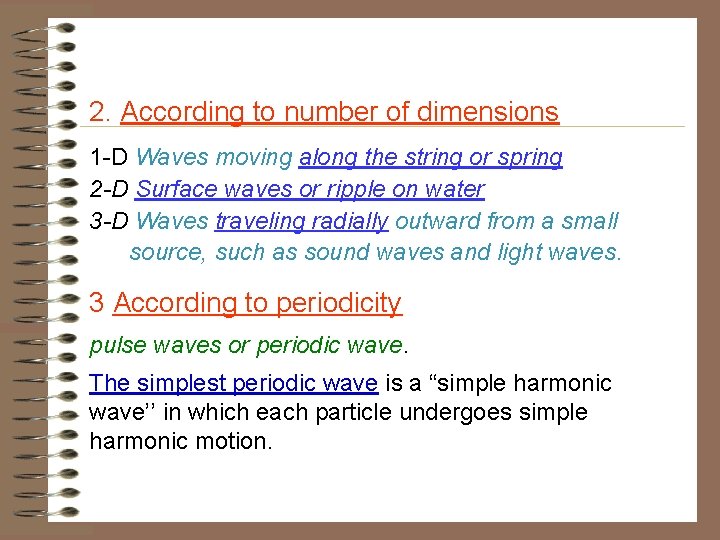
2. According to number of dimensions 1 -D Waves moving along the string or spring 2 -D Surface waves or ripple on water 3 -D Waves traveling radially outward from a small source, such as sound waves and light waves. 3 According to periodicity pulse waves or periodic wave. The simplest periodic wave is a “simple harmonic wave’’ in which each particle undergoes simple harmonic motion.
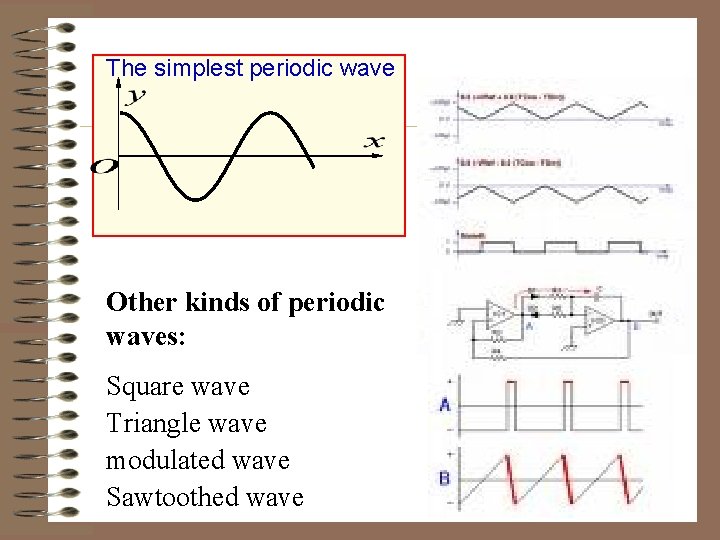
The simplest periodic wave Other kinds of periodic waves: Square wave Triangle wave modulated wave Sawtoothed wave
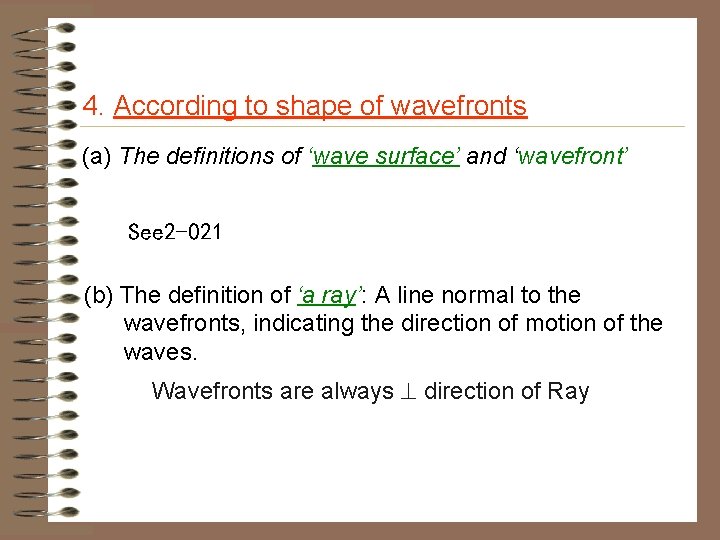
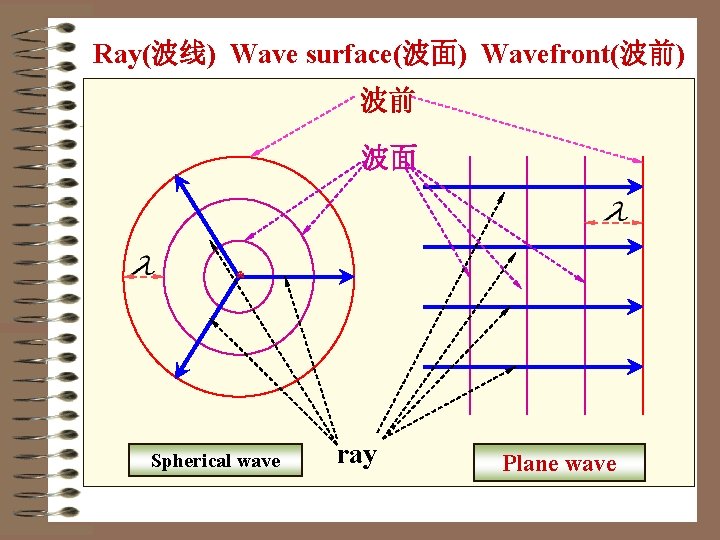
4. According to shape of wavefronts (a) The definitions of ‘wave surface’ and ‘wavefront’ See 2 -021 (b) The definition of ‘a ray’: A line normal to the wavefronts, indicating the direction of motion of the waves. Wavefronts are always direction of Ray
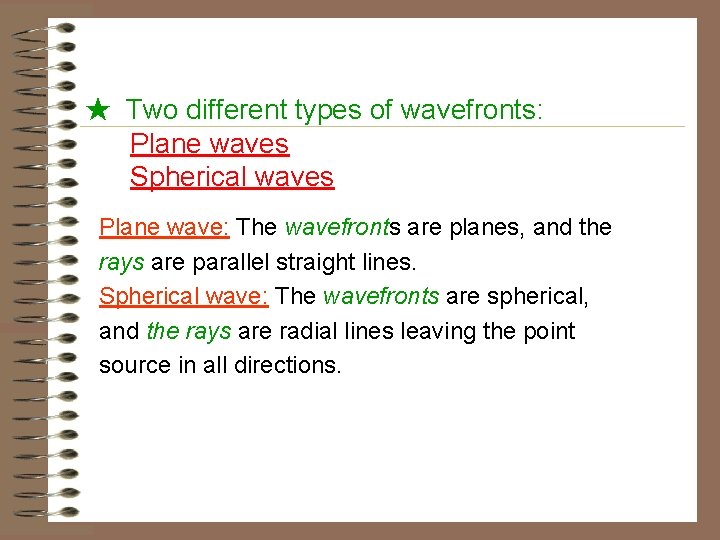
★ Two different types of wavefronts: Plane waves Spherical waves Plane wave: The wavefronts are planes, and the rays are parallel straight lines. Spherical wave: The wavefronts are spherical, and the rays are radial lines leaving the point source in all directions.
Ray(波线) Wave surface(波面) Wavefront(波前) 波前 波面 * Spherical wave ray Plane wave
5. Waves in different fields in physics sound waves water waves earthquake waves light waves electromagnetic waves gravitational waves matter waves lattice waves
18 -3 Traveling waves(行波) • All the waves would travel or propagate, why here say ‘traveling waves’? (with respect to ‘standing wave’(驻波)) • Definition of traveling waves: The waves formed and traveling in an open medium system. • Description of traveling waves We use a 1 -D simple harmonic, transverse, plane wave as an example • Mathematics expressions The vibration displacement y as a function of t and x.
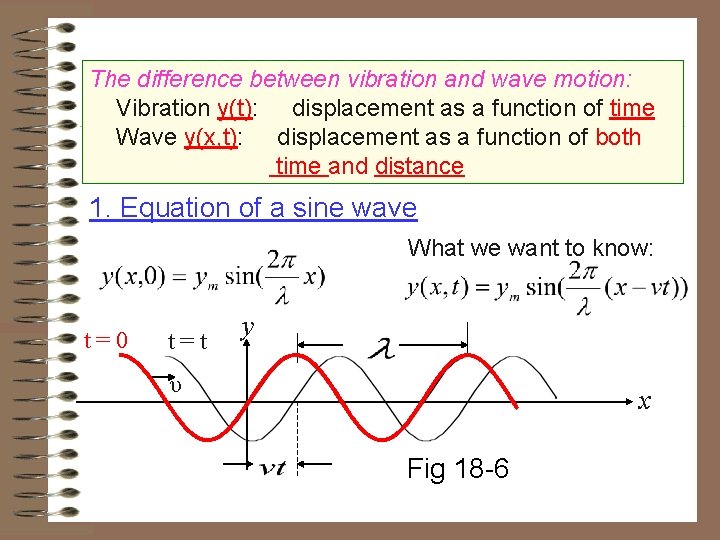
The difference between vibration and wave motion: Vibration y(t): displacement as a function of time Wave y(x, t): displacement as a function of both time and distance 1. Equation of a sine wave What we want to know: t=0 t=t y υ x Fig 18 -6
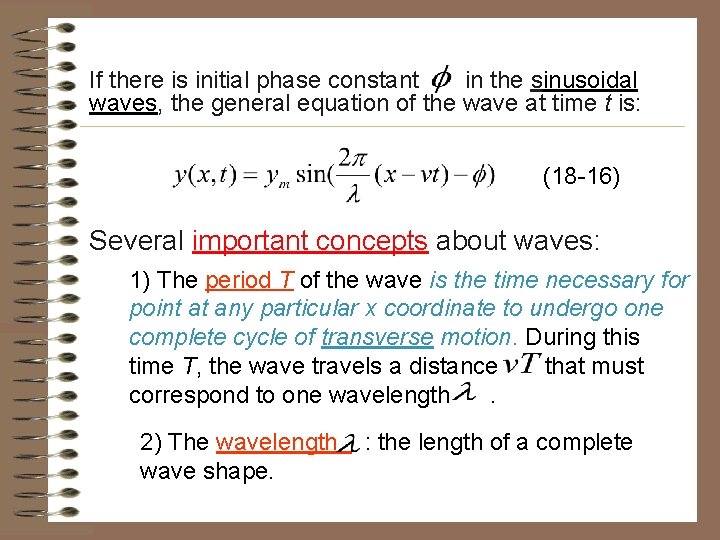
If there is initial phase constant in the sinusoidal waves, the general equation of the wave at time t is: (18 -16) Several important concepts about waves: 1) The period T of the wave is the time necessary for point at any particular x coordinate to undergo one complete cycle of transverse motion. During this time T, the wave travels a distance that must correspond to one wavelength. 2) The wavelength wave shape. : the length of a complete
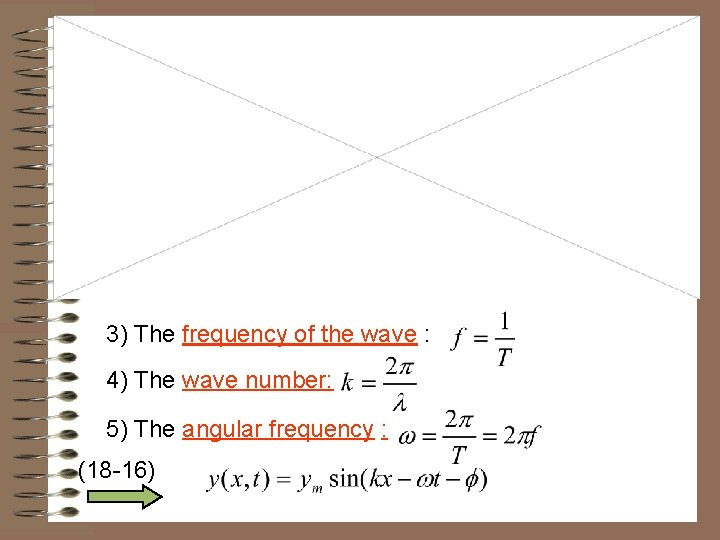
3) The frequency of the wave : 4) The wave number: 5) The angular frequency : (18 -16)
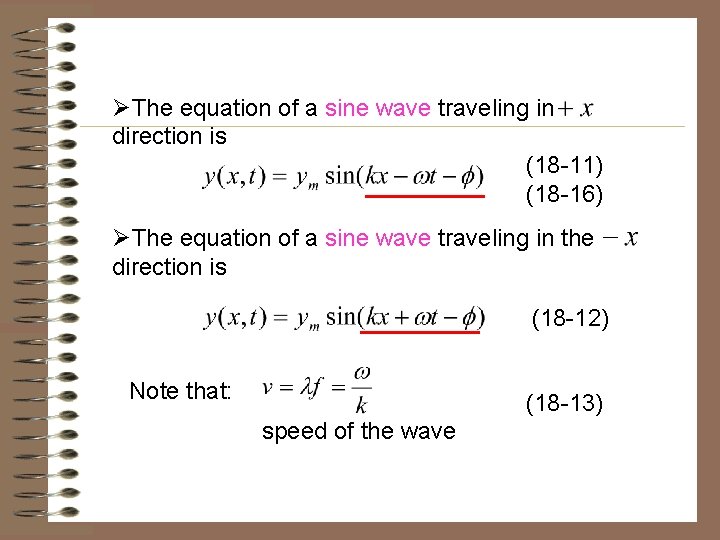
ØThe equation of a sine wave traveling in direction is (18 -11) (18 -16) ØThe equation of a sine wave traveling in the direction is (18 -12) Note that: (18 -13) speed of the wave
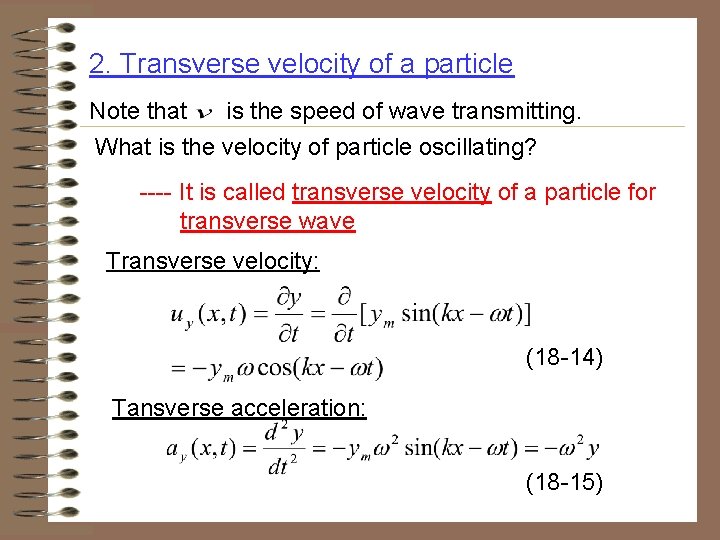
2. Transverse velocity of a particle Note that is the speed of wave transmitting. What is the velocity of particle oscillating? ---- It is called transverse velocity of a particle for transverse wave Transverse velocity: (18 -14) Tansverse acceleration: (18 -15)
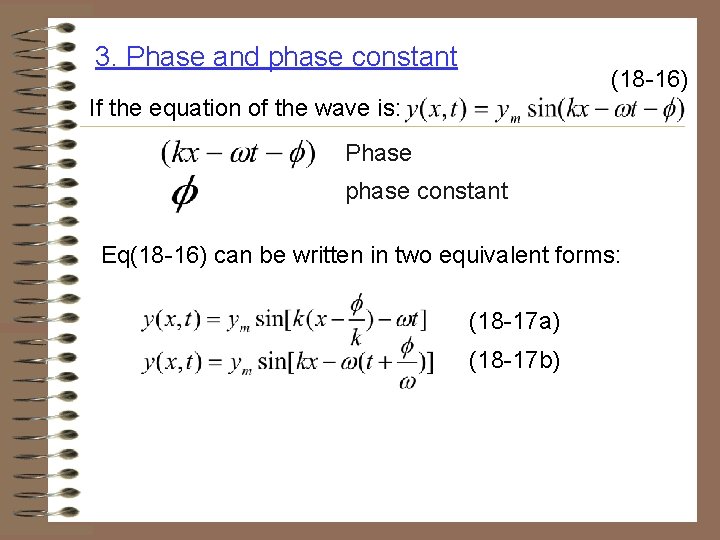
3. Phase and phase constant (18 -16) If the equation of the wave is: Phase phase constant Eq(18 -16) can be written in two equivalent forms: (18 -17 a) (18 -17 b)
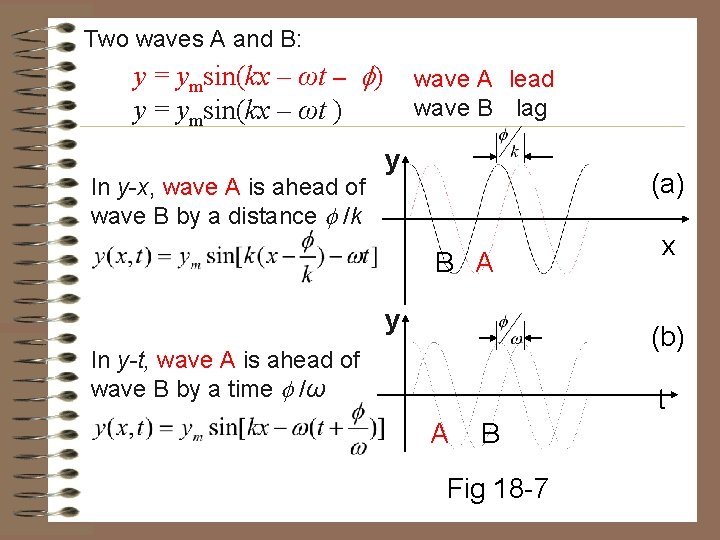
Two waves A and B: y = ymsin(kx – ωt – ) y = ymsin(kx – ωt ) In y-x, wave A is ahead of wave B by a distance /k wave A lead wave B lag y (a) B A y x (b) In y-t, wave A is ahead of wave B by a time /ω t A B Fig 18 -7
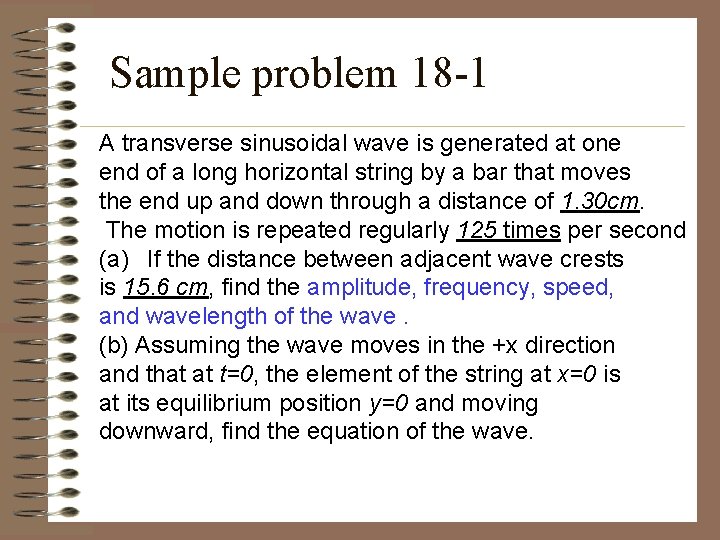
Sample problem 18 -1 A transverse sinusoidal wave is generated at one end of a long horizontal string by a bar that moves the end up and down through a distance of 1. 30 cm. The motion is repeated regularly 125 times per second (a) If the distance between adjacent wave crests is 15. 6 cm, find the amplitude, frequency, speed, and wavelength of the wave. (b) Assuming the wave moves in the +x direction and that at t=0, the element of the string at x=0 is at its equilibrium position y=0 and moving downward, find the equation of the wave.
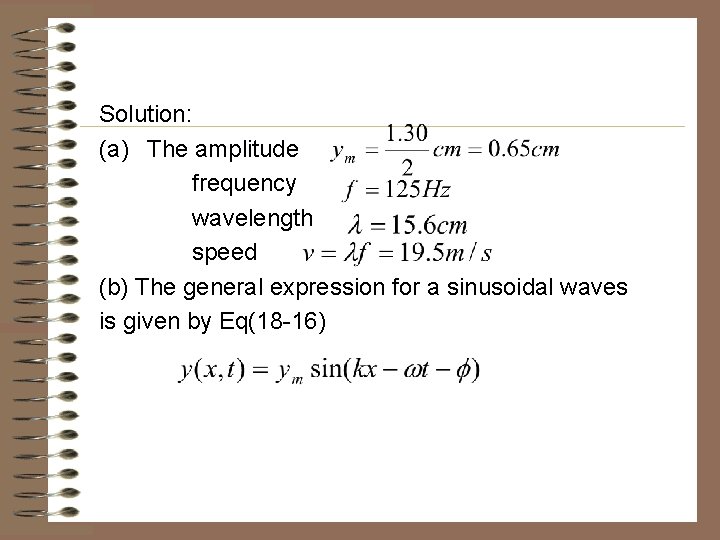
Solution: (a) The amplitude frequency wavelength speed (b) The general expression for a sinusoidal waves is given by Eq(18 -16)
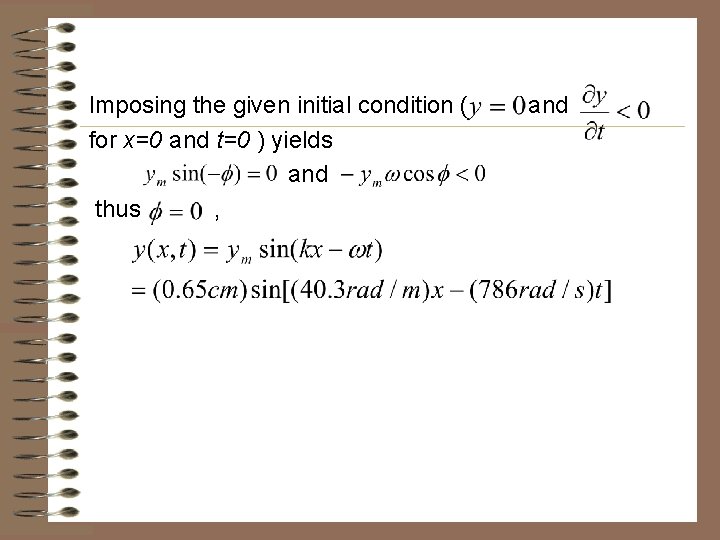
Imposing the given initial condition ( for x=0 and t=0 ) yields and thus , and
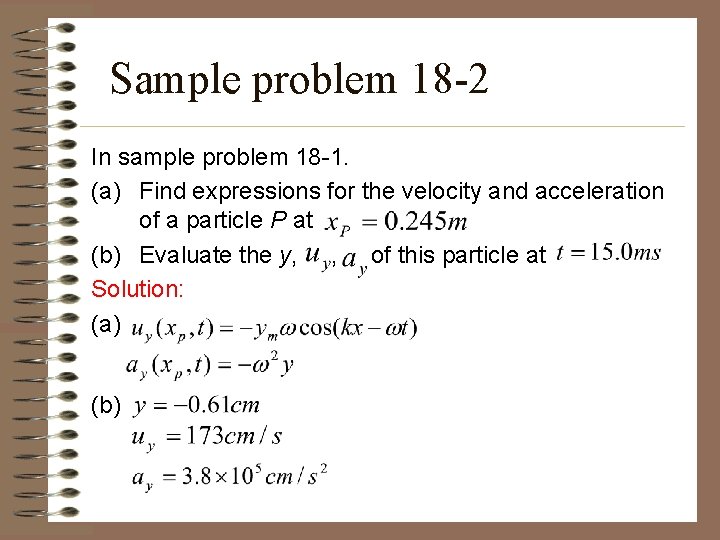
Sample problem 18 -2 In sample problem 18 -1. (a) Find expressions for the velocity and acceleration of a particle P at (b) Evaluate the y, , of this particle at Solution: (a) (b)
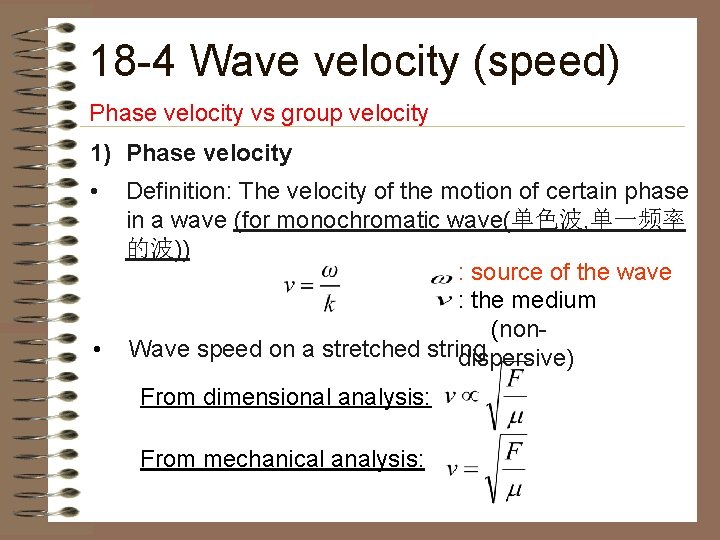
18 -4 Wave velocity (speed) Phase velocity vs group velocity 1) Phase velocity • Definition: The velocity of the motion of certain phase in a wave (for monochromatic wave(单色波, 单一频率 的波)) : source of the wave : the medium (non • Wave speed on a stretched string dispersive) From dimensional analysis: From mechanical analysis:
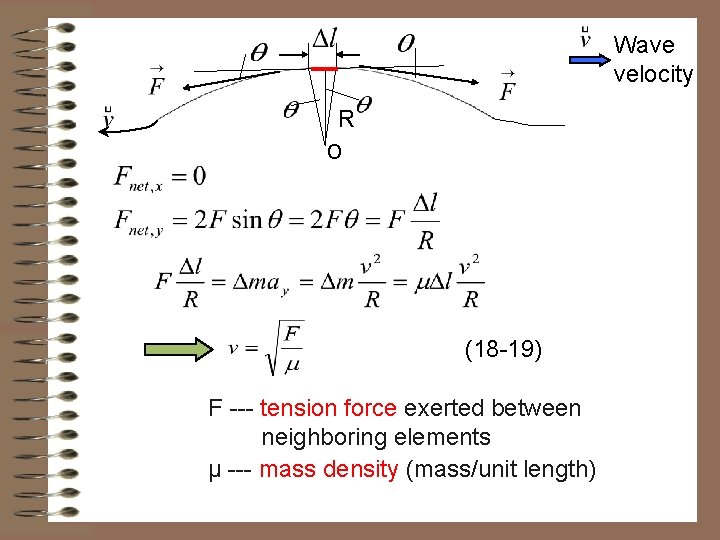
Wave velocity R o (18 -19) F --- tension force exerted between neighboring elements μ --- mass density (mass/unit length)
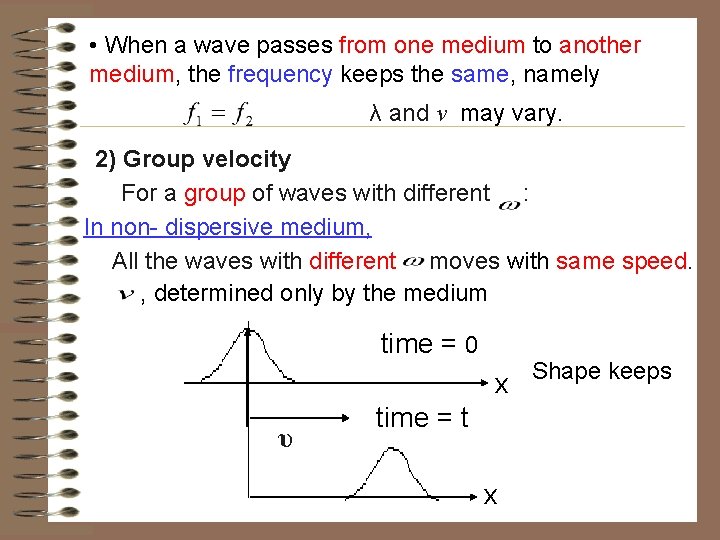
• When a wave passes from one medium to another medium, the frequency keeps the same, namely λ and v may vary. 2) Group velocity For a group of waves with different : In non- dispersive medium, All the waves with different moves with same speed. , determined only by the medium time = 0 x υ time = t x Shape keeps
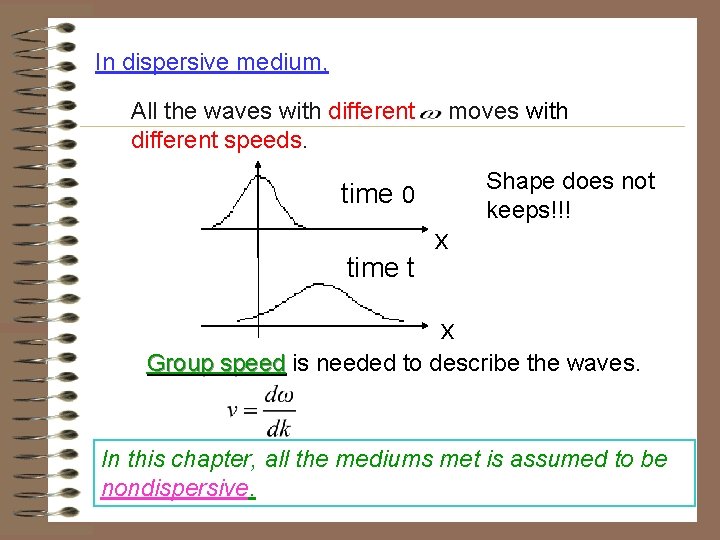
In dispersive medium, All the waves with different speeds. moves with Shape does not keeps!!! time 0 time t x x Group speed is needed to describe the waves. In this chapter, all the mediums met is assumed to be nondispersive.
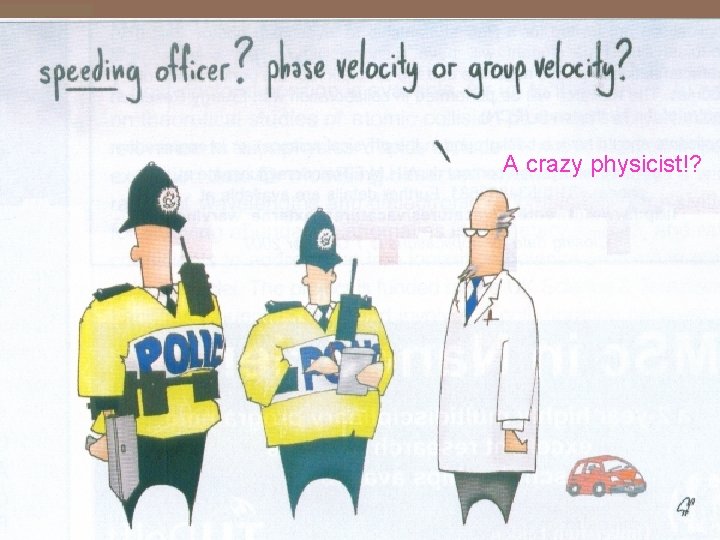
A crazy physicist!?
18 -5* The wave equation
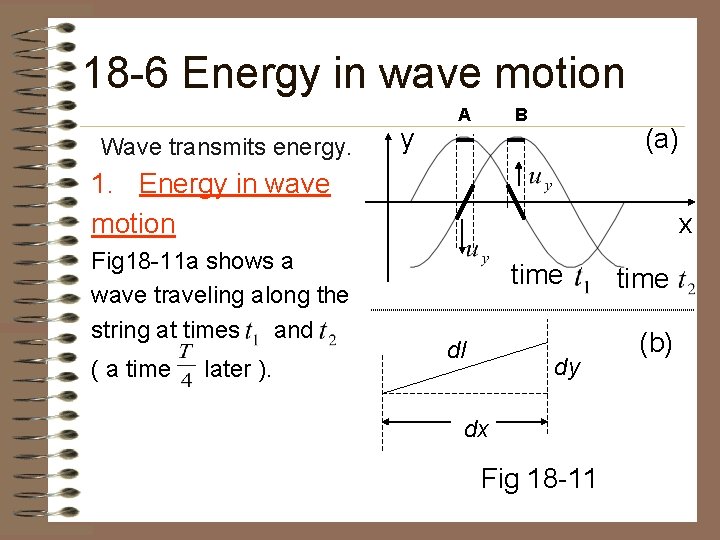
18 -6 Energy in wave motion Wave transmits energy. y A B (a) 1. Energy in wave motion Fig 18 -11 a shows a wave traveling along the string at times and ( a time later ). x time dl dy dx Fig 18 -11 time (b)
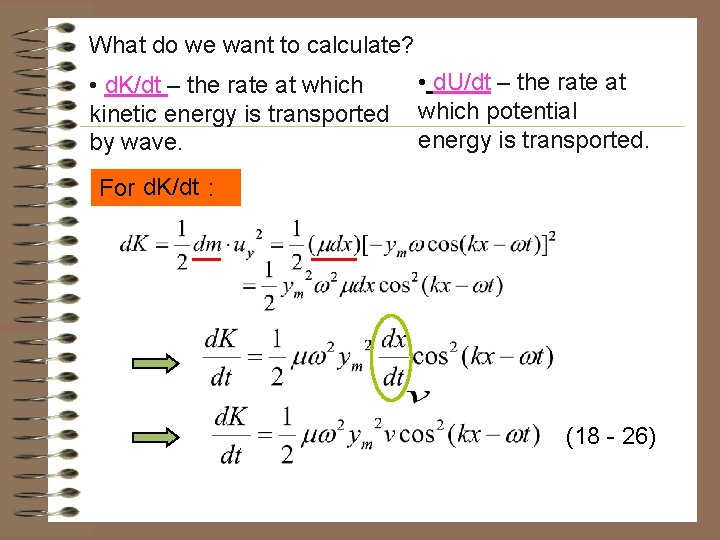
What do we want to calculate? • d. K/dt – the rate at which kinetic energy is transported by wave. • d. U/dt – the rate at which potential energy is transported. For d. K/dt : (18 - 26)
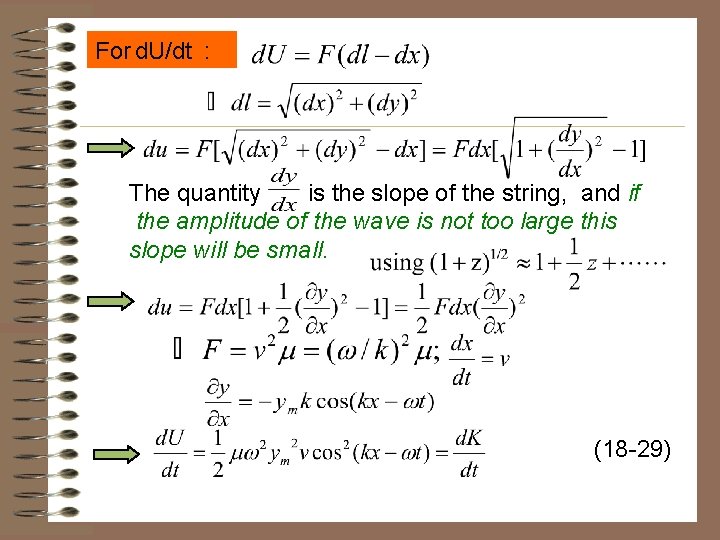
For d. U/dt : The quantity is the slope of the string, and if the amplitude of the wave is not too large this slope will be small. (18 -29)
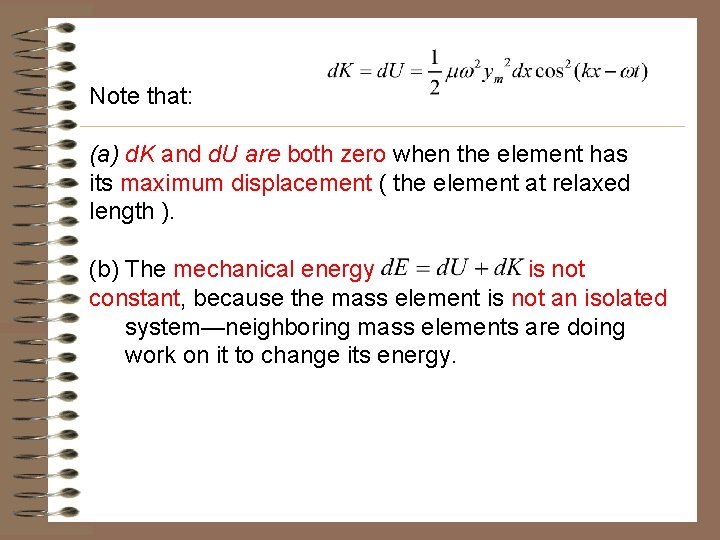
Note that: (a) d. K and d. U are both zero when the element has its maximum displacement ( the element at relaxed length ). (b) The mechanical energy is not constant, because the mass element is not an isolated system—neighboring mass elements are doing work on it to change its energy.
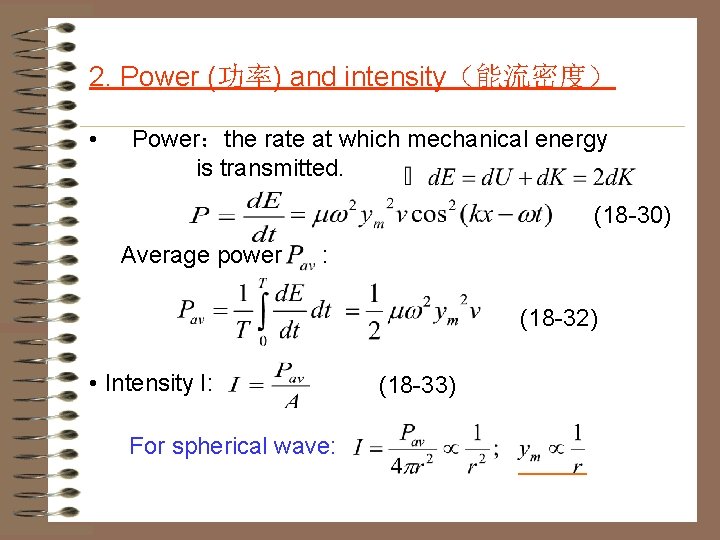
2. Power (功率) and intensity(能流密度) • Power:the rate at which mechanical energy is transmitted. (18 -30) Average power : (18 -32) • Intensity I: For spherical wave: (18 -33)
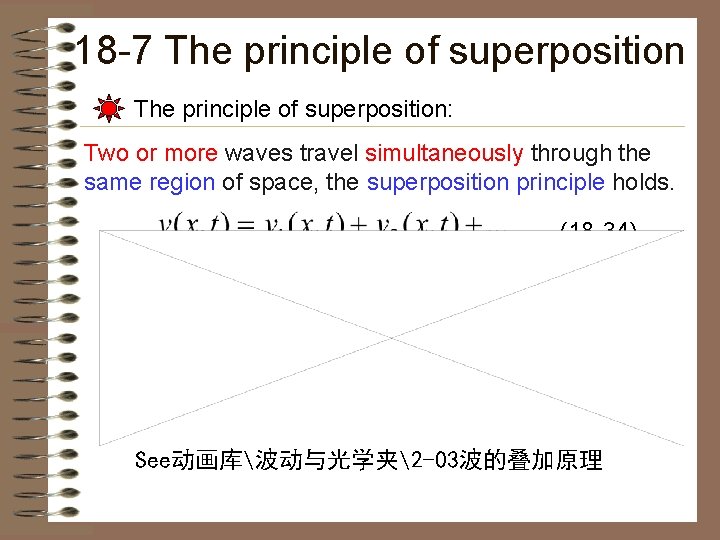
18 -7 The principle of superposition: Two or more waves travel simultaneously through the same region of space, the superposition principle holds. (18 -34) See动画库波动与光学夹2 -03波的叠加原理
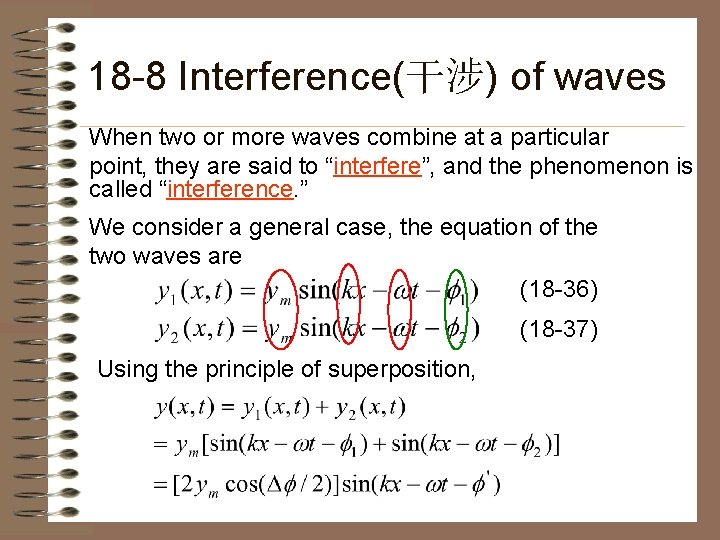
18 -8 Interference(干涉) of waves When two or more waves combine at a particular point, they are said to “interfere”, and the phenomenon is called “interference. ” We consider a general case, the equation of the two waves are (18 -36) (18 -37) Using the principle of superposition,
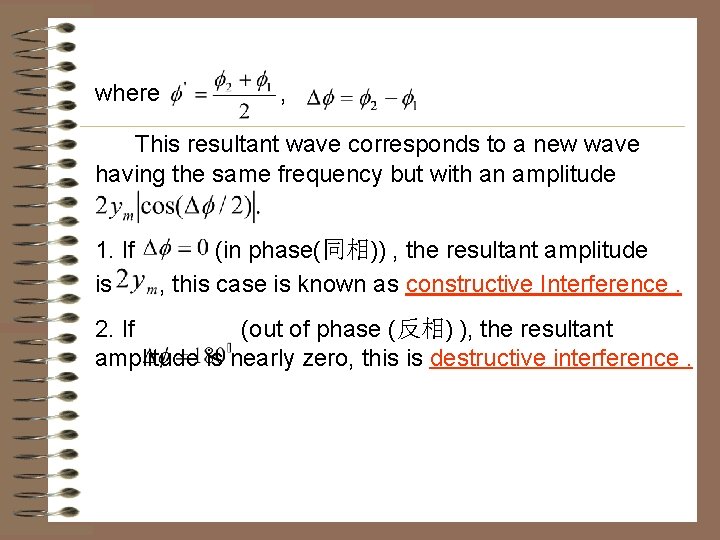
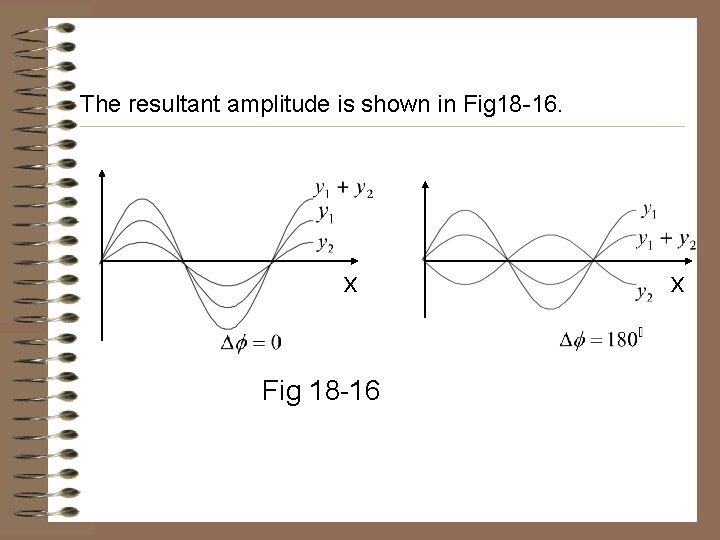
where , This resultant wave corresponds to a new wave having the same frequency but with an amplitude 1. If (in phase(同相)) , the resultant amplitude is , this case is known as constructive Interference. 2. If (out of phase (反相) ), the resultant amplitude is nearly zero, this is destructive interference.
The resultant amplitude is shown in Fig 18 -16. x Fig 18 -16 x
Young’s double slit light-interference experiment Ranked as 5 in top 10 beautiful experiments in Physics See动画库波动与光学夹2 -04波的干涉
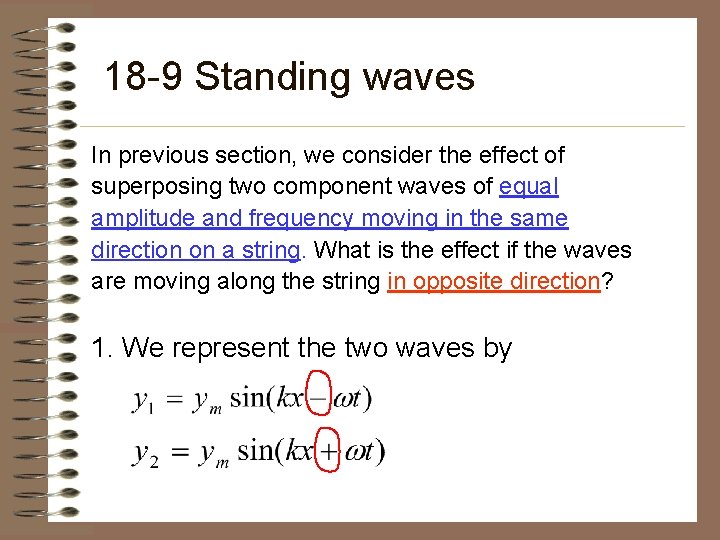
18 -9 Standing waves In previous section, we consider the effect of superposing two component waves of equal amplitude and frequency moving in the same direction on a string. What is the effect if the waves are moving along the string in opposite direction? 1. We represent the two waves by
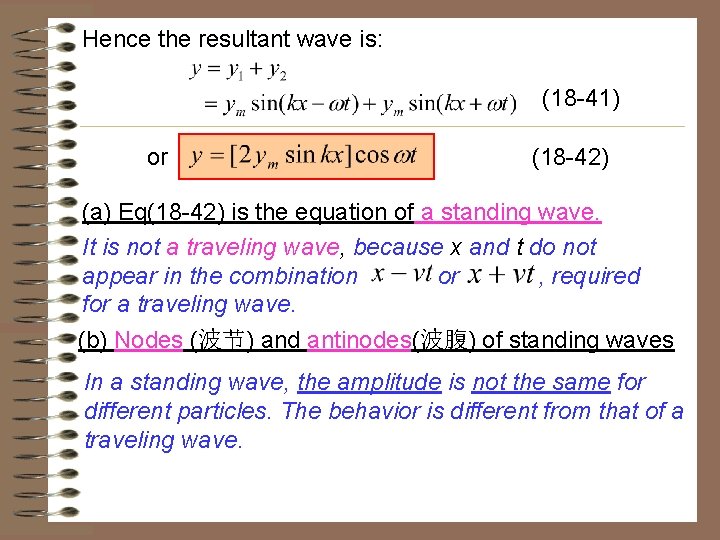
Hence the resultant wave is: (18 -41) or (18 -42) (a) Eq(18 -42) is the equation of a standing wave. It is not a traveling wave, because x and t do not appear in the combination or , required for a traveling wave. (b) Nodes (波节) and antinodes(波腹) of standing waves In a standing wave, the amplitude is not the same for different particles. The behavior is different from that of a traveling wave.
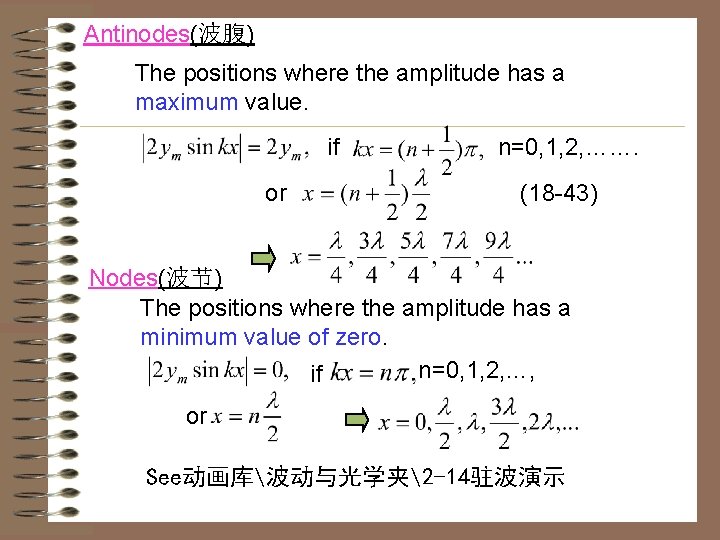
Antinodes(波腹) The positions where the amplitude has a maximum value. if or n=0, 1, 2, ……. (18 -43) Nodes(波节) The positions where the amplitude has a minimum value of zero. n=0, 1, 2, …, if or See动画库波动与光学夹2 -14驻波演示
To form a standing wave a n n —— Forward wave —— Backward wave —— Resultant wave
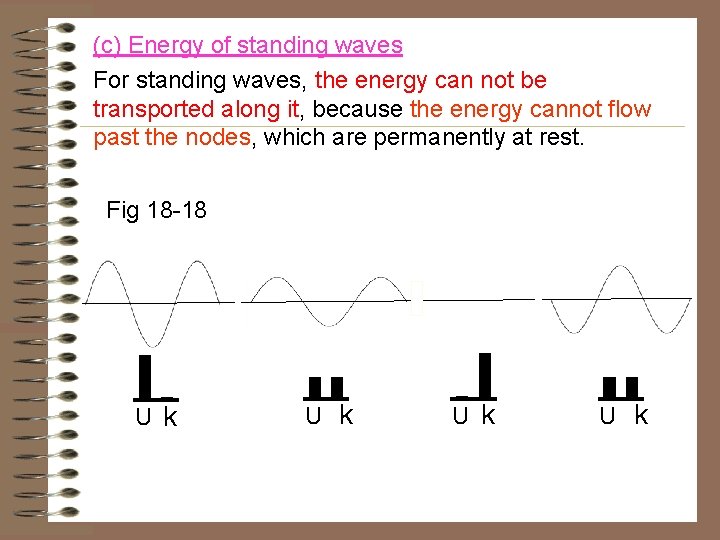
(c) Energy of standing waves For standing waves, the energy can not be transported along it, because the energy cannot flow past the nodes, which are permanently at rest. Fig 18 -18 U k U k
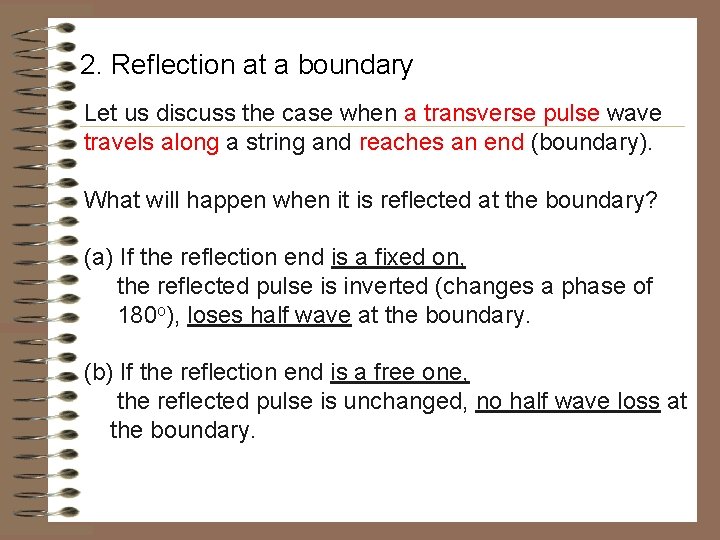
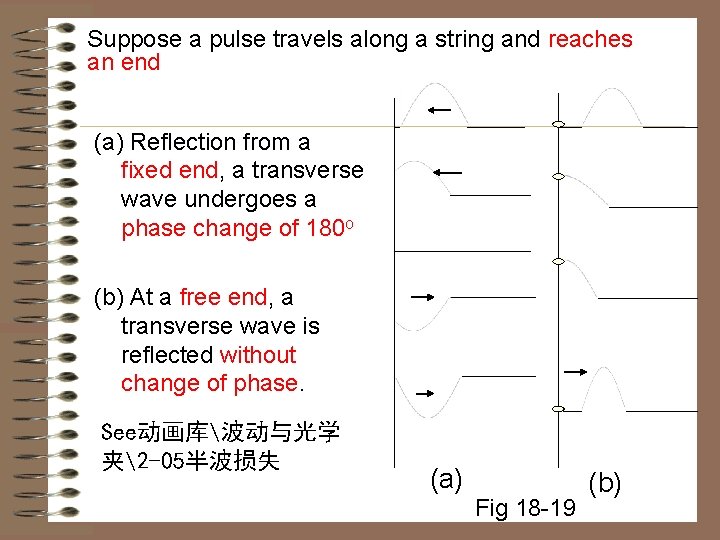
2. Reflection at a boundary Let us discuss the case when a transverse pulse wave travels along a string and reaches an end (boundary). What will happen when it is reflected at the boundary? (a) If the reflection end is a fixed on, the reflected pulse is inverted (changes a phase of 180 o), loses half wave at the boundary. (b) If the reflection end is a free one, the reflected pulse is unchanged, no half wave loss at the boundary.
Suppose a pulse travels along a string and reaches an end (a) Reflection from a fixed end, a transverse wave undergoes a phase change of 180 o (b) At a free end, a transverse wave is reflected without change of phase. See动画库波动与光学 夹2 -05半波损失 (a) Fig 18 -19 (b)
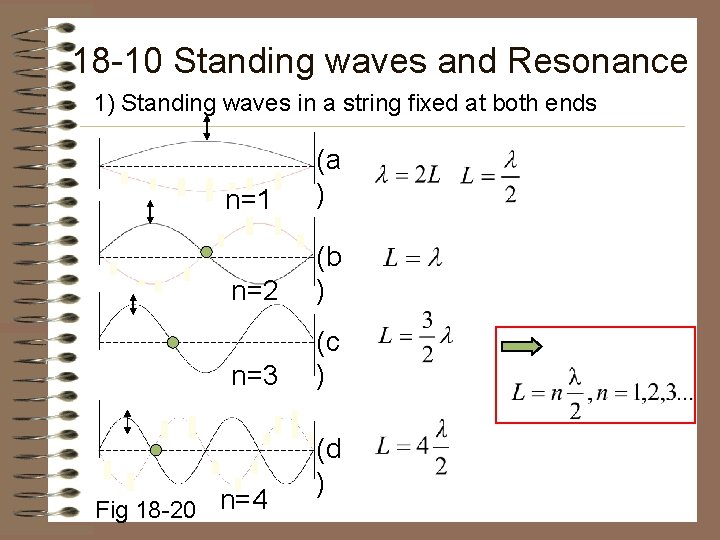
18 -10 Standing waves and Resonance 1) Standing waves in a string fixed at both ends n=1 (a ) n=2 (b ) n=3 (c ) Fig 18 -20 n=4 (d )
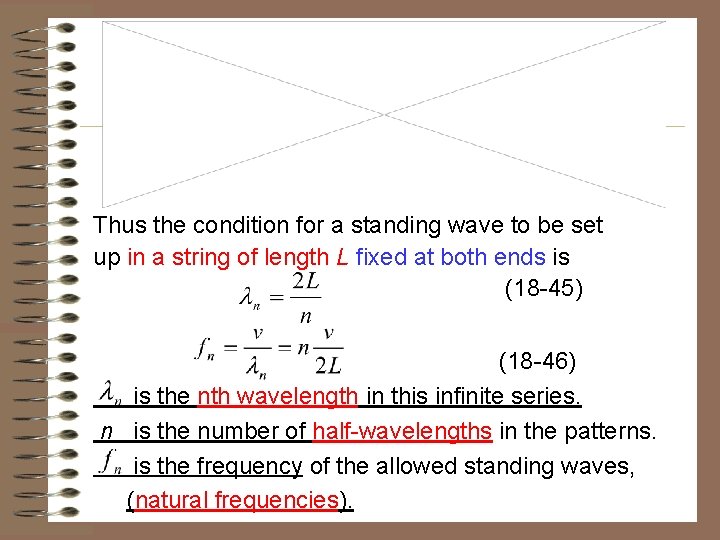
Thus the condition for a standing wave to be set up in a string of length L fixed at both ends is (18 -45) (18 -46) is the nth wavelength in this infinite series. n is the number of half-wavelengths in the patterns. is the frequency of the allowed standing waves, (natural frequencies).
2) Resonance in the stretched string (a) In Fig 18 -20, a student begins to shake the string. If the frequency of the driving force matches one of the natural frequencies, we get a resonance in the string. (b) If the student shakes the string at a frequency that differs from one of the natural frequencies, the reflected wave returns to the student’s hand out of phase with the motion of the hand. No fixed standing wave pattern is produced.
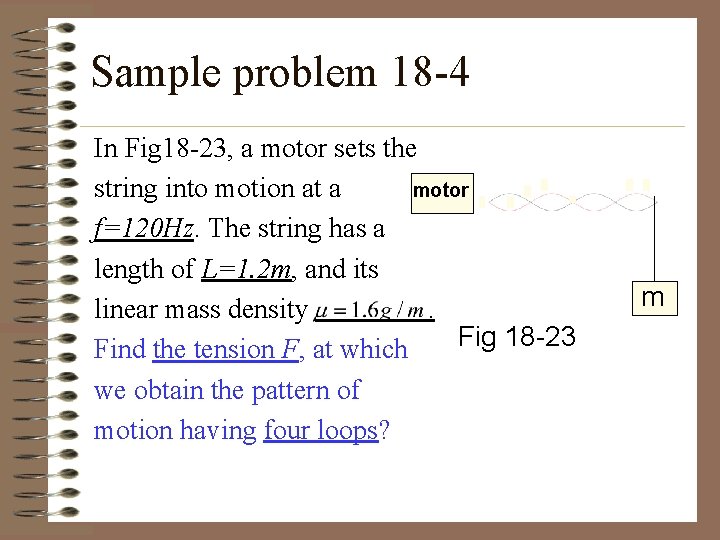
Sample problem 18 -4 In Fig 18 -23, a motor sets the motor string into motion at a f=120 Hz. The string has a length of L=1. 2 m, and its linear mass density. Fig 18 -23 Find the tension F, at which we obtain the pattern of motion having four loops? m
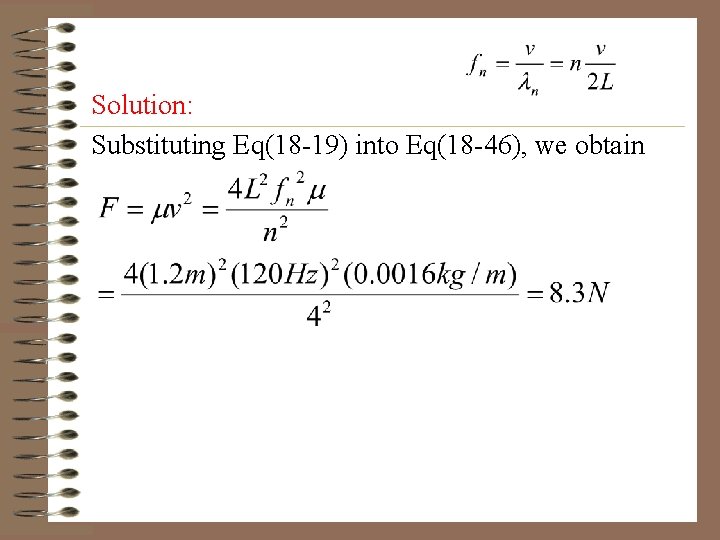
Solution: Substituting Eq(18 -19) into Eq(18 -46), we obtain
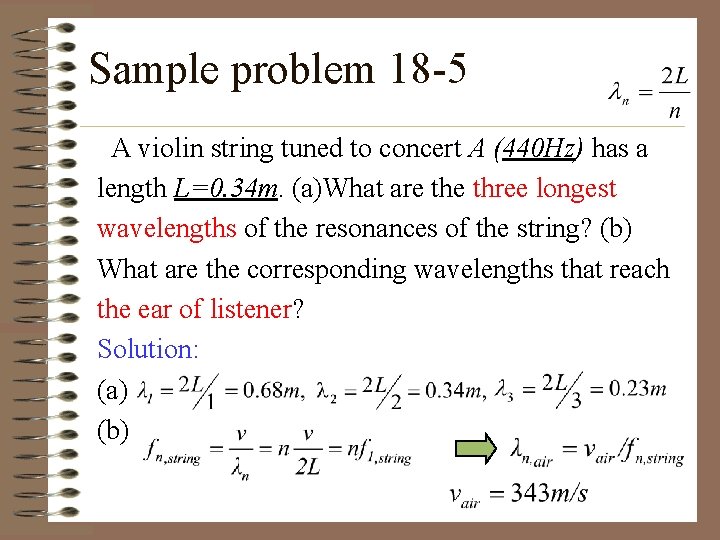
Sample problem 18 -5 A violin string tuned to concert A (440 Hz) has a length L=0. 34 m. (a)What are three longest wavelengths of the resonances of the string? (b) What are the corresponding wavelengths that reach the ear of listener? Solution: (a) (b)
Cover page of our text book
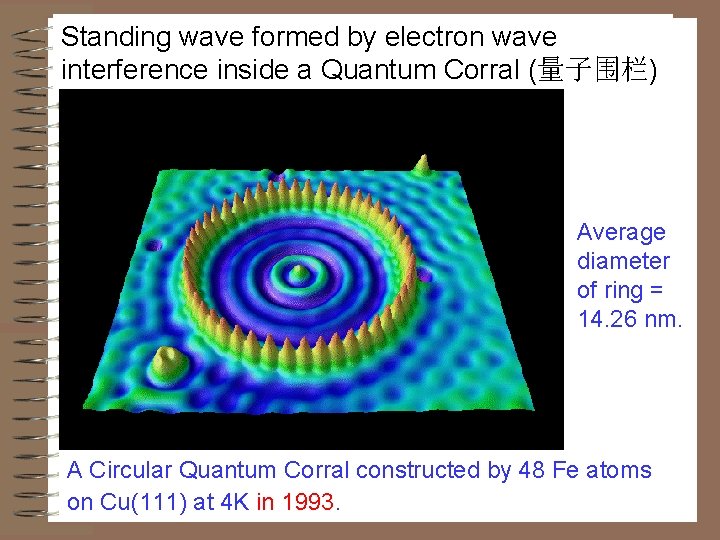
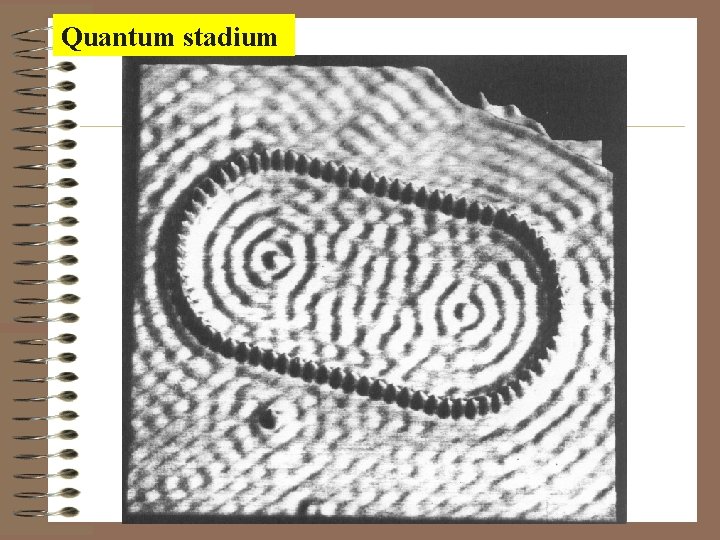
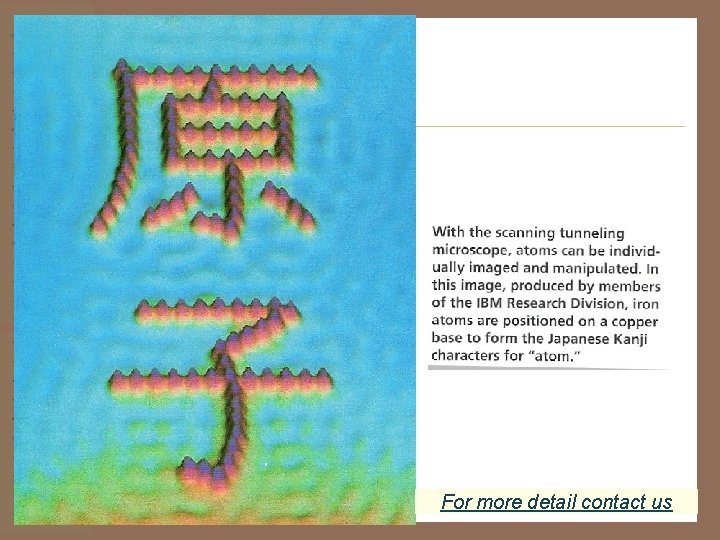
Standing wave formed by electron wave interference inside a Quantum Corral (量子围栏) Average diameter of ring = 14. 26 nm. A Circular Quantum Corral constructed by 48 Fe atoms on Cu(111) at 4 K in 1993.
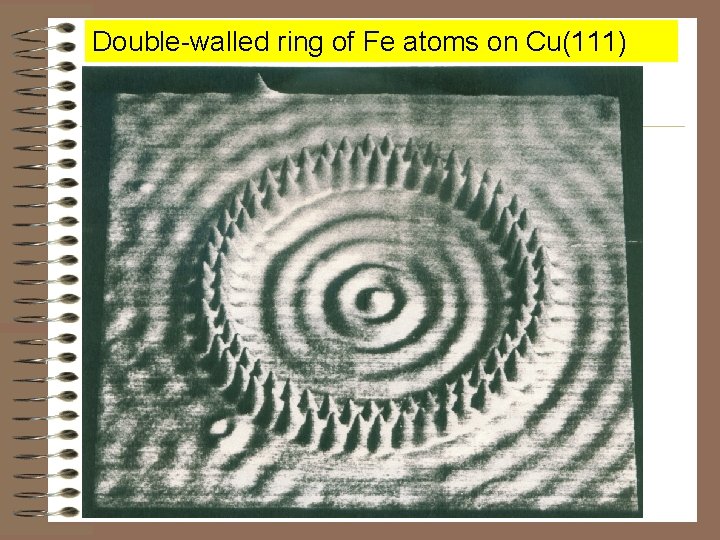
Double-walled ring of Fe atoms on Cu(111)
Quantum stadium
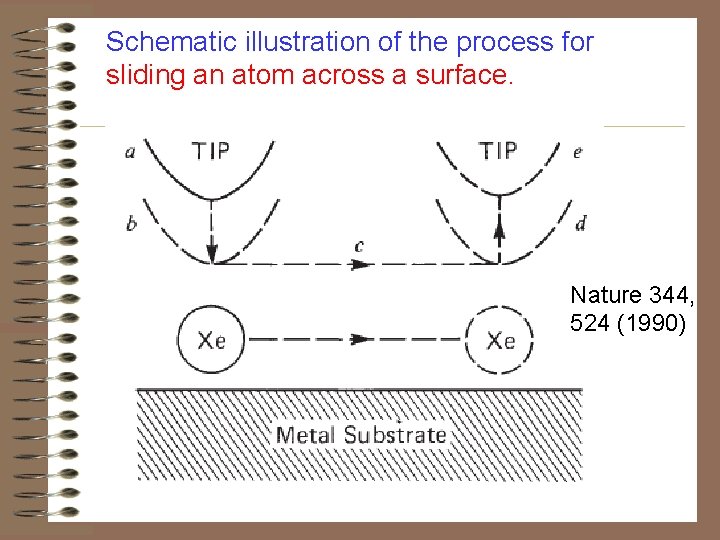
Schematic illustration of the process for sliding an atom across a surface. Nature 344, 524 (1990)
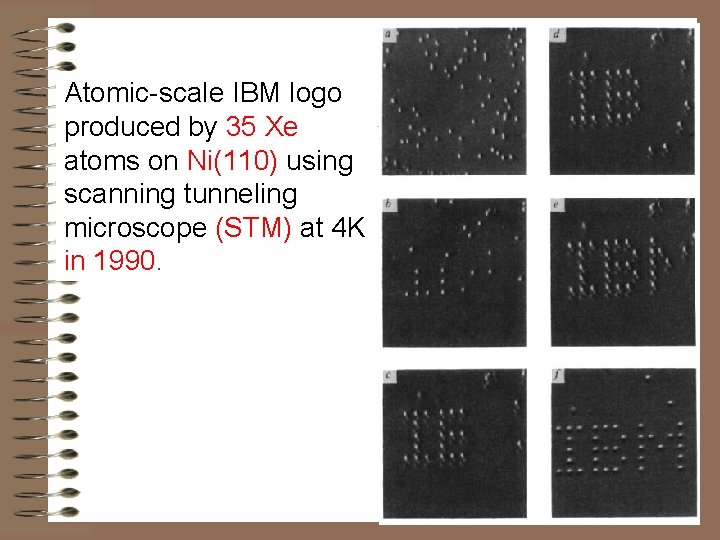
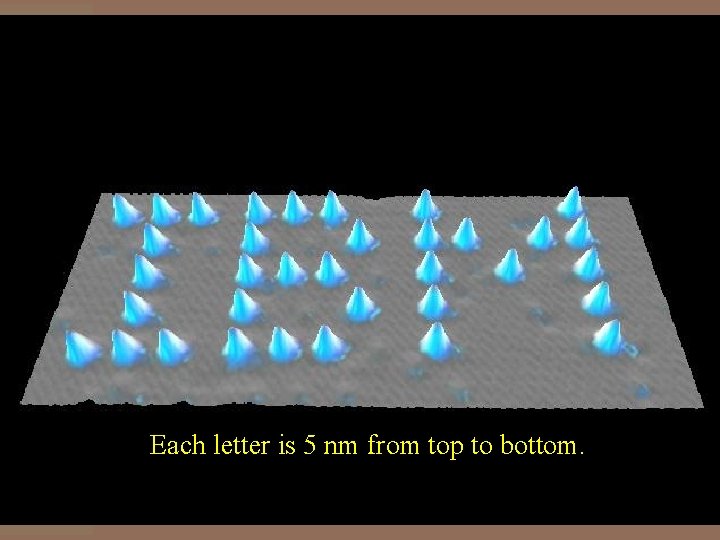
Atomic-scale IBM logo produced by 35 Xe atoms on Ni(110) using scanning tunneling microscope (STM) at 4 K in 1990.
Each letter is 5 nm from top to bottom.
For more detail contact us