CCI Entrepreneurship Curriculum Module 10 Growing and Internationalising
- Slides: 53
CCI Entrepreneurship Curriculum Module 10 - Growing and Internationalising your Business
Growing and Internationalising your Business v 10. 1. Strategies for growing your business – Introduction to scalability v 10. 2. Costing your product/service v 10. 3. Managing Intermediaries v 10. 4. Internationalising your business v 10. 5. Attending Tradeshows
Introduction to Scalability v Business growth strategy (def. ): a strategy aimed at winning larger market share, even at the expense of short-term earnings 1. v Growth strategy usually answers the questions 2: v What is the target market of the business? v Which product will you deliver to your segment of the market? v What development channels will be adopted in order to find, acquire and grow the customers? v Video: The Four Colours Of Business Growth, https: //www. youtube. com/watch? v=w 2 j. Gu. EPB 56 w
Introduction to Scalability Why you need business growth strategies? v You need a growth strategy to increase the value of your business. v Examining generic growth strategies is a good start because they apply to all types of businesses, focusing on one aspect of your operations and specifying the actions you must take to achieve your goals. v Once you understand the generic growth strategies, you can customize the right plan for your company and your objectives.
Introduction to Scalability Types of business growth strategies: v There are certain methods companies must use for implementing a growth strategy. v The method a company uses to expand its business is largely contingent upon its financial situation, the competition and even government regulation. v Some common growth strategies in business include: 1. Market Penetration 2. Market Expansion/Development 3. Product Expansion/Development 4. Diversification 5. Acquisition
Introduction to Scalability “Market Penetration” business growth strategy v One growth strategy in business is Market Penetration. v A small company uses a Market Penetration strategy when it decides to market existing products within the same market it has been using. v The only way to grow using existing products and markets is to increase market share. v Market share is the percent of unit and euro sales a company holds within a certain market vs. all other competitors. v One way to increase market share is by lowering prices. For example, in markets where there is little differentiation among products, a lower price may help a company increase its share of the market. 1. Growth Strategies, http: //www. gaebler. com/Growth-Strategies. htm 2. Examples of Penetration Strategies, http: //smallbusiness. chron. com/examples-penetration-strategies-11699. html
Introduction to Scalability “Market Expansion” business growth strategy v A Market Expansion growth strategy, often called Market Development, entails selling current products in a new market. v There are several reasons why a company may consider a market expansion strategy: Ø the competition may be such that there is no room for growth within the current market. If a business does not find new markets for its products, it cannot increase sales or profits. Ø a small company may also use a market expansion strategy if it finds new uses for its product. For example, a small soap distributor that sells to retail stores may discover that factory workers also use its product. Market Development vs. Market Penetration, http: //yourbusiness. azcentral. com/market-development-vs-marketpenetration-21322. html
Introduction to Scalability “Product Expansion” business growth strategy v A small company may also expand its product line or add new features to increase its sales and profits. v When small companies employ a Product Expansion strategy, also known as Product Development, they continue selling within the existing market. v A Product Expansion growth strategy often works well when technology starts to change. A small company may also be forced to add new products as older ones become outmoded.
Introduction to Scalability “Diversification” business growth strategy v. Growth strategies in business also include Diversification, where a small company will sell new products to new markets. v. This type of strategy can be very risky - A small company will need to plan carefully when using a diversification growth strategy. v. Marketing research is essential because a company will need to determine if consumers in the new market will potentially like the new products. Diversification (New Products/New Market), http: //www. gaebler. com/Growth-Strategies. htm
Introduction to Scalability “Acquisition” business growth strategy v Growth strategies in business can also includes an Acquisition. v In acquisition, a company purchases another company to expand its operations. v A small company may use this type of strategy to expand its product line and enter new markets. v An acquisition growth strategy can be risky, but not as risky as a diversification strategy - One reason is that the products and market are already established. v A company must know exactly what it wants to achieve when using an acquisition strategy, mainly because of the significant investment required to implement it.
Introduction to Scalability Practical examples of business growth strategies v According to Anjan V. Thakors 4, growth strategies fall into four categories (or “Growth Comes in Four Colors”): control in red, collaboration in yellow, creates in green, and competes in blue. v This framework is much more than a way to transform seemingly endless complexity into a parsimonious set of categories. v It also helps leaders achieve organisational alignment for a chosen growth strategy. The Four Colours of Business Growth, http: //www. sciencedirect. com/science/book/9780123852397
Introduction to Scalability Practical examples of business growth strategies v Firms that gain a competitive advantage in growth through a focus on their own people and organizational culture like Mc. Kinsey fall into the collaborate category. v Firms with a growth agenda that is fueled by more effective interactions with external stakeholders and dominating the markets that exist today, like Coca-Cola fall in the compete category. v Firms that predicate their growth strategies on innovation and disruptive change, like Google fall in the create category. v Finally, firms that drive growth through enhanced internal processes and efficiency, such as Wal-Mart fall in the control quadrant.
Introduction to Scalability v Is all growth good? No. Growth can be either good or bad. v Good growth is growth that involves rates of return exceeding the cost of capital. This leads to value creation. v Bad growth involves rates of return that fall below the cast of capital. This leads to value destruction. v The stock market rewards good growth and punishes bad growth.
Introduction to Scalability Good Long-Term Strategy to Grow the Business 5 v Although a small-business owner must maintain a sharp focus on short-term profitability, s/he must also incorporate long-term strategic thinking into her/his business plan. v The formulation of good long-term strategy starts with the business owner developing a vision for what kind of company s/he wants to build: the size and scope of the company’s operations, the target markets it serves and the image s/he wants the company to have in the industry. v Her/his long-term vision could be extremely ambitious, such as building the company to € 50 million in revenues, or more modest.
Introduction to Scalability Good Long-Term Strategy to Grow the Business 5 v A Long-Term Strategy should include: ü Focus on Efficiency ü Acquire Smaller Competitors ü Broaden Marketing Scope ü Increase Potential Market Size
Introduction to Scalability How to Develop a Business Growth Strategy 6 v A growth strategy involves more than simply envisioning longterm success. You need a tangible plan! v You need to adapt your plan to smooth out your business’s inefficiencies, refine its strengths and better suit your customers - who could be completely different than those from a vague, one-size-fits-all strategy. v The key with any growth strategy is to be deliberate. Figure out the rate-limiting step in your growth and take the following steps…
Introduction to Scalability How to Develop a Business Growth Strategy 6 v Your company’s data should lend itself to all your strategic decisions. Specifically, you can use the data from your key indicators and revenue streams to create a personalized growth plan. That way, you’ll better understand your business and your customers’ nuances, which will naturally lead to growth. v A one-size-fits-all strategy implies vague indicators. But a specific plan is a successful plan!
Introduction to Scalability Step 1: Establish a value proposition v. For your business to sustain long-term growth, you must understand what sets it apart from the competition. v. Identify why customers come to you for a product or service. v. What makes you relevant, differentiated and credible? v. Use your answer to explain to other consumers why they should do business with you.
Introduction to Scalability Step 2: Identify your ideal customer v. You got into business to solve a problem for a certain audience. v. Who is that audience? v. Is that audience your ideal customer? v. If not, who are you serving? v. Nail down your ideal customer, and revert back to this audience as you adjust business to stimulate growth.
Introduction to Scalability Step 3: Define your key indicators v. Changes must be measurable. v. If you’re unable to measure a change, you have no way of knowing whether it’s effective. v. Identify which key indicators affect the growth of your business, then dedicate time and money to those areas. v. Making changes over time and comparing historical and current results isn’t valid.
Introduction to Scalability Step 4: Verify your revenue streams v. What are your current revenue streams? v. What revenue streams could you add to make your business more profitable? v. Once you identify the potential for new revenue streams, ask yourself if they’re sustainable in the long run. v Some great ideas or cool products don’t necessarily have revenue streams attached. v. Be careful to isolate and understand the difference.
Introduction to Scalability Step 5: Look to your competition v. No matter your industry, your competition is likely excelling at something that your company is struggling with. v. Look toward similar businesses that are growing in new, unique ways to inform your growth strategy. v. Don’t be afraid to ask for advice. v. Ask yourself why your competitors have made alternate choices. Are they wrong? v. Or are your businesses positioned differently? The assumption that you’re smarter is rarely correct.
Introduction to Scalability Step 6: Focus on your strengths v. Sometimes, focusing on your strengths - rather than trying to improve your weaknesses - can help you establish growth strategies. v. Reorient the playing field to suit your strengths, and build upon them to grow your business.
Introduction to Scalability Step 7: Invest in talent v. Your employees have direct contact with your customers, so you need to hire people who are motivated and inspired by your company’s value proposition. v. Be cheap with office furniture, marketing budgets and holiday parties. v. Hire few employees, but pay them a ton. v. The best ones will usually stick around if you need to cut back their compensation during a slow period.
Introduction to Scalability What is scalability? v Scalability 7 is “the ability of a system, network, or process to handle a growing amount of work in a capable manner or its ability to be enlarged to accommodate that growth. ” v For a business, scalability means that you are prepared to handle an increasing number of customers, clients, and/or users.
Introduction to Scalability Why is scalability important 8? v Companies with a successful business model are scalable. v Scalability is not a black-and-white concept. v No enterprises will be 100% scalable or non-scalable. v The drivers for scalability influence the company to a greater or lesser degree. v The sum of these influences will put the enterprise somewhere in between non-scalable and fully scalable. v Scalability increases along an axis as shown in the figure below. Almost all enterprises can be made more scalable.
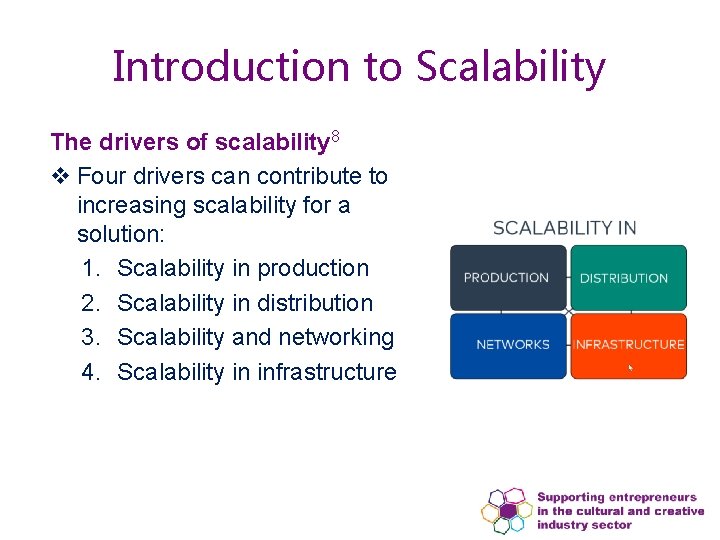
Introduction to Scalability The drivers of scalability 8 v Four drivers can contribute to increasing scalability for a solution: 1. Scalability in production 2. Scalability in distribution 3. Scalability and networking 4. Scalability in infrastructure
Introduction to Scalability 1. Scalability in production: this relates to the percentage of production cost that is directly dependent on the number of manufactured units. 2. Scalability in distribution: you can also create scalability by minimizing distribution costs for each manufactured unit. 3. Scalability and networking: scalability created by interaction between people. When the value of using a product (and thereby the willingness to pay for it) is related to how many others who also use the product, economists call it positive externalities (Stiglitz 1988). 4. Scalability in infrastructure: growth in the number of customers makes it possible to increase the payback from investments already made in infrastructure.
Unit 2 - Costing your Product or Service
Costing your Product or Service v Before you costing your products/services, you have to understand the different types of costs involved in setting up and running your business. v Once that you’ve identified what it costs to start and run your business, you can work out the cost of producing your product or providing your service. v Pricing is a complex area. Set your prices too high and you may lose the sale. Set them too low, and you leave money on the table.
Costing your Product or Service v When you start a small business, you will have two types of expenses: a) fixed costs and b) variable costs 9. v Fixed costs do not change with sales volume, but variable costs do.
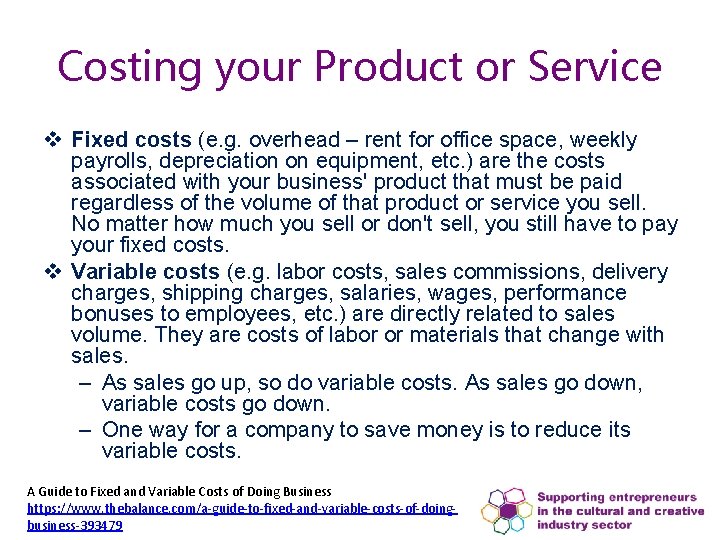
Costing your Product or Service v Fixed costs (e. g. overhead – rent for office space, weekly payrolls, depreciation on equipment, etc. ) are the costs associated with your business' product that must be paid regardless of the volume of that product or service you sell. No matter how much you sell or don't sell, you still have to pay your fixed costs. v Variable costs (e. g. labor costs, sales commissions, delivery charges, shipping charges, salaries, wages, performance bonuses to employees, etc. ) are directly related to sales volume. They are costs of labor or materials that change with sales. – As sales go up, so do variable costs. As sales go down, variable costs go down. – One way for a company to save money is to reduce its variable costs. A Guide to Fixed and Variable Costs of Doing Business https: //www. thebalance. com/a-guide-to-fixed-and-variable-costs-of-doingbusiness-393479
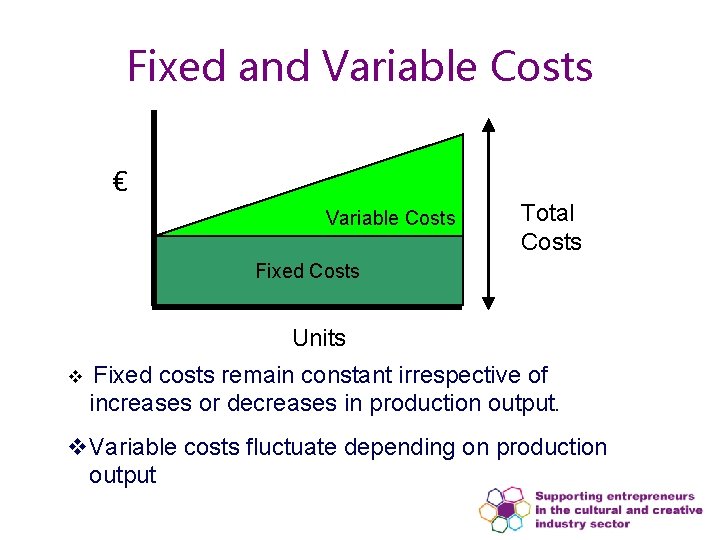
Fixed and Variable Costs € Variable Costs Total Costs Fixed Costs Units v Fixed costs remain constant irrespective of increases or decreases in production output. v. Variable costs fluctuate depending on production output
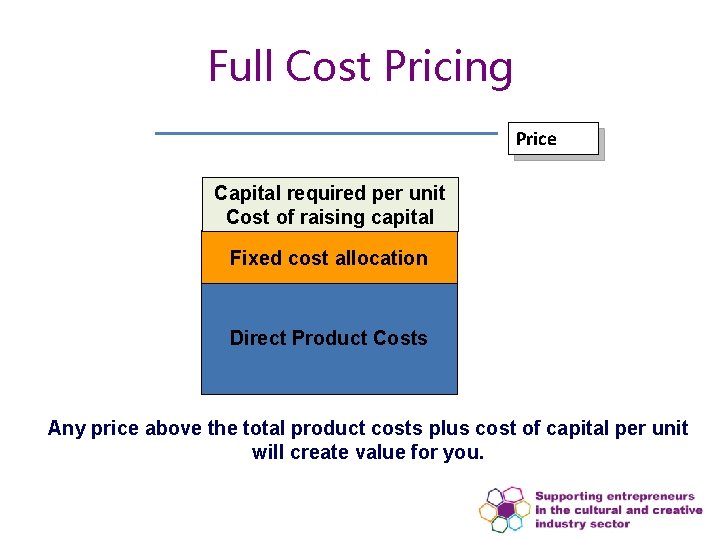
Full Cost Pricing Price Capital required per unit Cost of raising capital Fixed cost allocation Direct Product Costs Any price above the total product costs plus cost of capital per unit will create value for you.
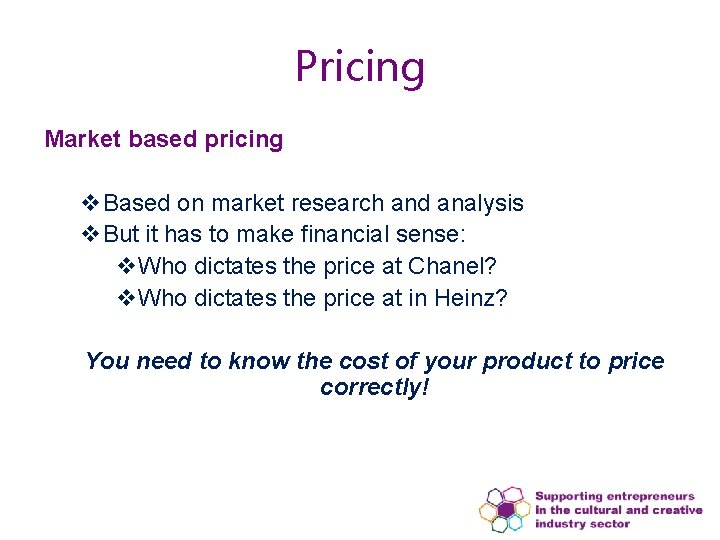
Pricing Market based pricing v. Based on market research and analysis v. But it has to make financial sense: v. Who dictates the price at Chanel? v. Who dictates the price at in Heinz? You need to know the cost of your product to price correctly!
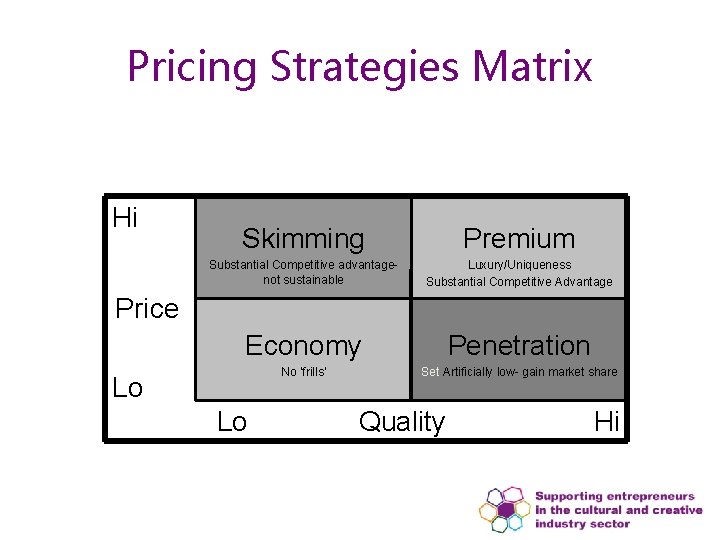
Pricing Strategies Matrix Hi Skimming Premium Substantial Competitive advantage- not sustainable Luxury/Uniqueness Substantial Competitive Advantage Economy Penetration No ‘frills’ Set Artificially low- gain market share Price Lo Lo Quality Hi
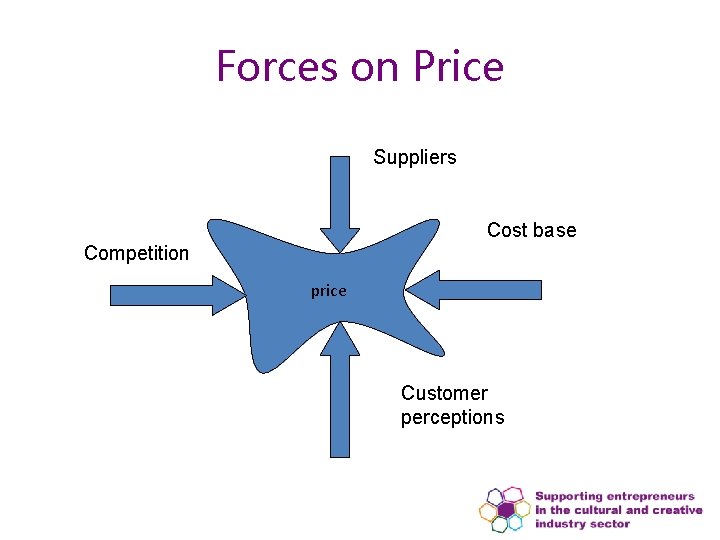
Forces on Price Suppliers Cost base Competition price Customer perceptions
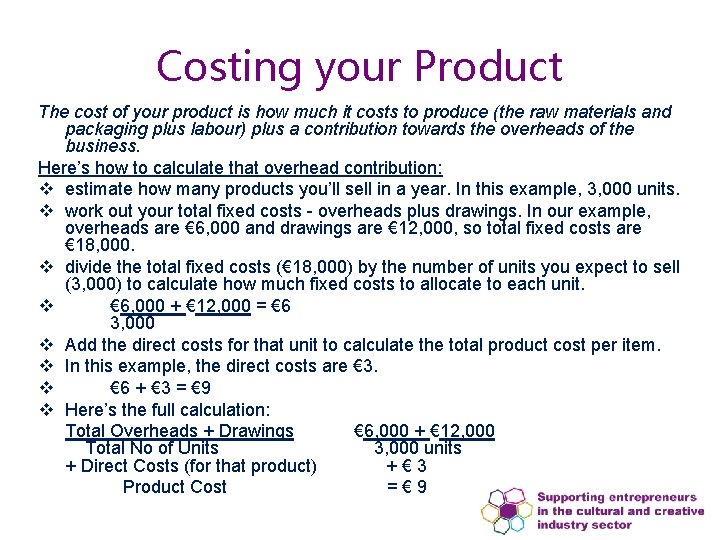
Costing your Product The cost of your product is how much it costs to produce (the raw materials and packaging plus labour) plus a contribution towards the overheads of the business. Here’s how to calculate that overhead contribution: v estimate how many products you’ll sell in a year. In this example, 3, 000 units. v work out your total fixed costs - overheads plus drawings. In our example, overheads are € 6, 000 and drawings are € 12, 000, so total fixed costs are € 18, 000. v divide the total fixed costs (€ 18, 000) by the number of units you expect to sell (3, 000) to calculate how much fixed costs to allocate to each unit. v € 6, 000 + € 12, 000 = € 6 3, 000 v Add the direct costs for that unit to calculate the total product cost per item. v In this example, the direct costs are € 3. v € 6 + € 3 = € 9 v Here’s the full calculation: Total Overheads + Drawings € 6, 000 + € 12, 000 Total No of Units 3, 000 units + Direct Costs (for that product) + € 3 Product Cost = € 9
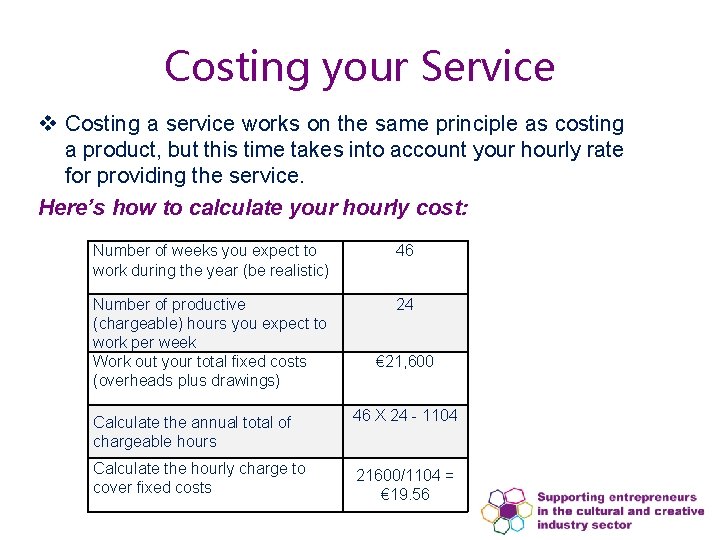
Costing your Service v Costing a service works on the same principle as costing a product, but this time takes into account your hourly rate for providing the service. Here’s how to calculate your hourly cost: Number of weeks you expect to work during the year (be realistic) 46 Number of productive (chargeable) hours you expect to work per week Work out your total fixed costs (overheads plus drawings) 24 € 21, 600 Calculate the annual total of chargeable hours 46 X 24 - 1104 Calculate the hourly charge to cover fixed costs 21600/1104 = € 19. 56
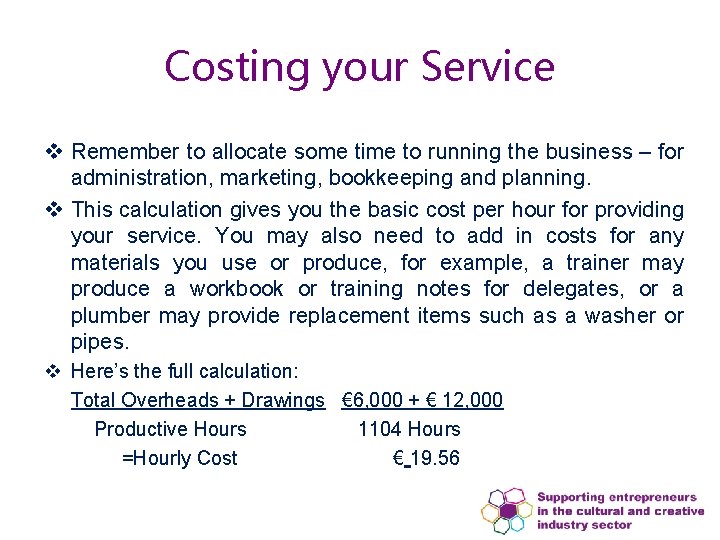
Costing your Service v Remember to allocate some time to running the business – for administration, marketing, bookkeeping and planning. v This calculation gives you the basic cost per hour for providing your service. You may also need to add in costs for any materials you use or produce, for example, a trainer may produce a workbook or training notes for delegates, or a plumber may provide replacement items such as a washer or pipes. v Here’s the full calculation: Total Overheads + Drawings € 6, 000 + € 12, 000 Productive Hours 1104 Hours =Hourly Cost € 19. 56
Unit 3 - Internationalising your Business
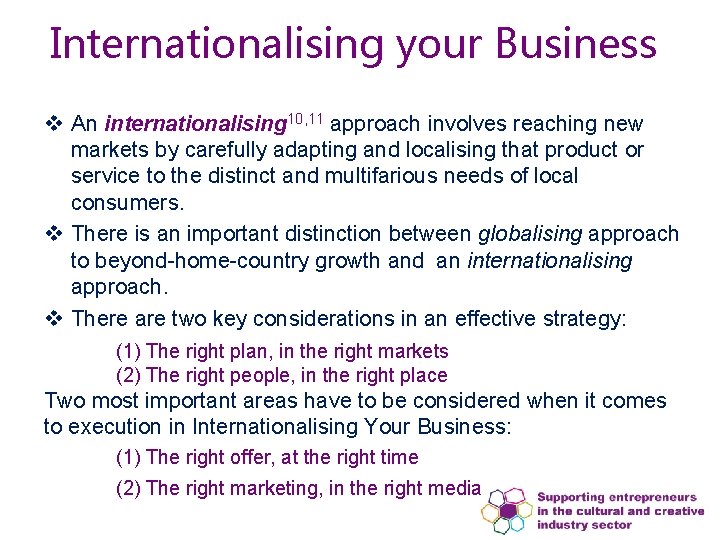
Internationalising your Business v An internationalising 10, 11 approach involves reaching new markets by carefully adapting and localising that product or service to the distinct and multifarious needs of local consumers. v There is an important distinction between globalising approach to beyond-home-country growth and an internationalising approach. v There are two key considerations in an effective strategy: (1) The right plan, in the right markets (2) The right people, in the right place Two most important areas have to be considered when it comes to execution in Internationalising Your Business: (1) The right offer, at the right time (2) The right marketing, in the right media
Internationalising your Business v Deciding to expand internationally is an exciting time for any business, but it also comes with the need to make many tough decisions. v At a basic level, there a raft of logistical and administrative decisions that need to be made, from which market and country presents the best opportunities to the legal, financial and tax implications. v While these issues may seem daunting, there are lots of data and information sources, established systems, and experts who can help guide the process. v The real challenges lay in making internal operating decisions because the “right” decisions vary from company to company and the implications of making the “wrong” decisions can have major financial implications.
Internationalising your Business v Every company will need to answer important questions whenever an international expansion is being considered, but regardless of the type of company or the nature of your business, there are three critical questions 12 that should always be clearly answered before taking any actions: v Do we need international operations? v How should we design our operating model? v What mix of local versus expat talent should we have? 3 questions you must answer when internationalising your business, http: //www. onyxconsulting. co. uk/tl-blog/3 -questions-you-must-answerwhen-internationalising-your-business/
Internationalising your Business Why would I want to internationalise your business 13? v Internationalisation allows a company to become more competitive by expanding its activity. v Some companies go international to reduce their production costs, by relocating part or all of their services abroad. v The goal is to benefit from competitive economic advantages, such as: low cost labour, flexibility regarding labour law or fiscal issues, economic vitality, or low transportation costs.
Internationalising your Business What strategy to adopt when internationalising your business 13? v There are two possible strategies: exporting and relocating 1. Exporting v Direct exporting v Indirect exporting 2. Relocation v Cooperative relocation v Non-cooperative relocation
Internationalising your Business v Internationalising a business is a large undertaking, but when you approach it methodically and thoughtfully, it can be extremely rewarding and profitable. v There are 8 Steps towards Internationalising 14 Your Business: 1. Choose What Country 2. Conduct a Market Analysis 3. Plan Your Market Entry 4. Evaluate Your Market Position 5. Consider Your Targets 6. Fine-Tune Your Products and Services 7. Evaluate Your Core Competencies 8. Analyse The Supply Chain and Value Chain Options Video: Porter’s Five Forces, https: //www. mindtools. com/pages/article/new. TMC_08. htm
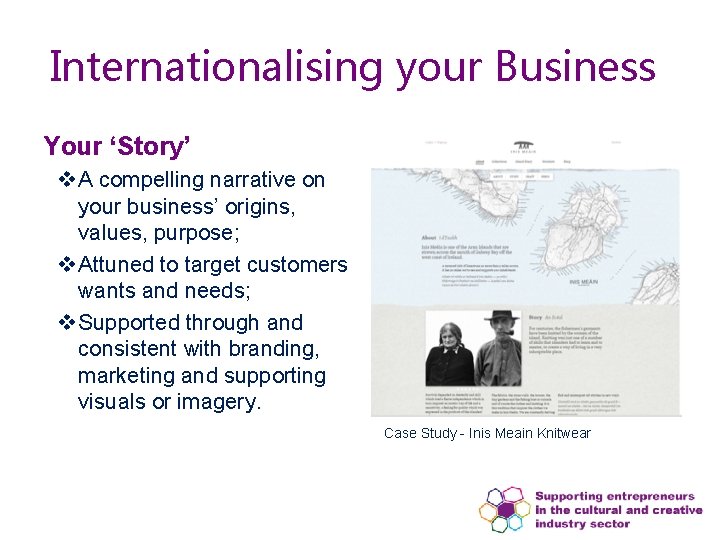
Internationalising your Business Your ‘Story’ v A compelling narrative on your business’ origins, values, purpose; v Attuned to target customers wants and needs; v Supported through and consistent with branding, marketing and supporting visuals or imagery. Case Study - Inis Meain Knitwear
Internationalising your Business Individual Exercise Write your story – Creative Statement v Your name v The business you are in v How long you are in business v Your background – relevant education, training, worked with v Your work – design, inspirations, interests v Your values, core purpose: what’s in your creative DNA v Innovation and design v Longer-term aspirations
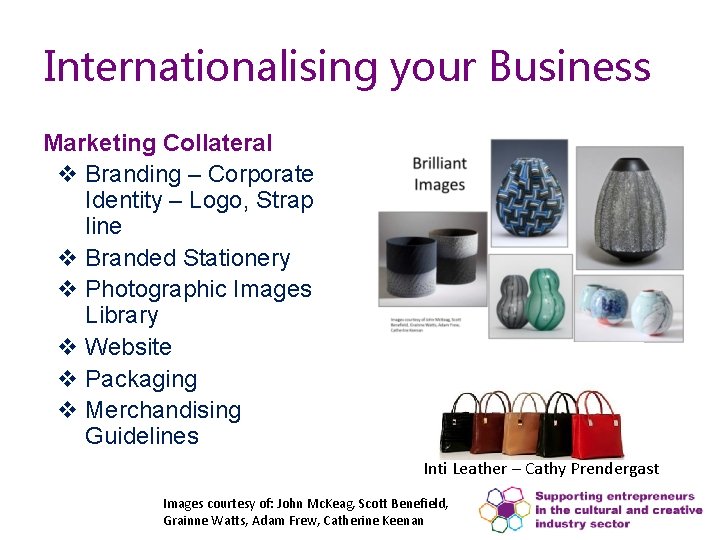
Internationalising your Business Marketing Collateral v Branding – Corporate Identity – Logo, Strap line v Branded Stationery v Photographic Images Library v Website v Packaging v Merchandising Guidelines Inti Leather – Cathy Prendergast Images courtesy of: John Mc. Keag, Scott Benefield, Grainne Watts, Adam Frew, Catherine Keenan
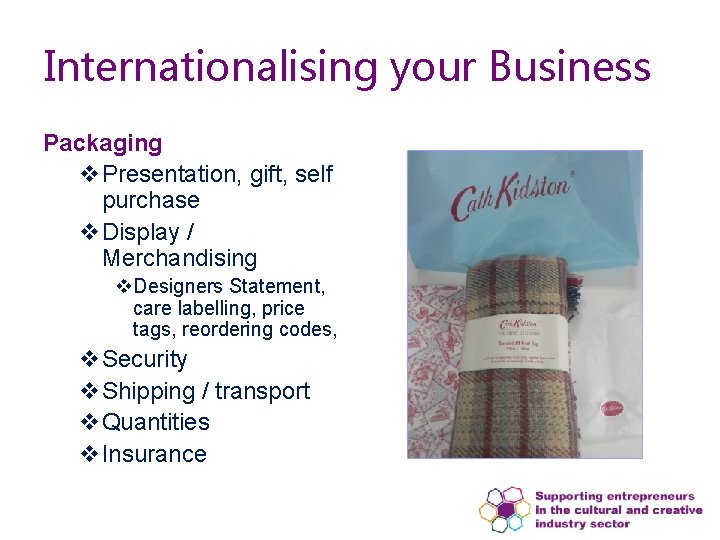
Internationalising your Business Packaging v. Presentation, gift, self purchase v. Display / Merchandising v. Designers Statement, care labelling, price tags, reordering codes, v. Security v. Shipping / transport v. Quantities v. Insurance
References 1. 2. 3. 4. 5. 6. 7. BD Business Dictionary, http: //www. businessdictionary. com/definition/growth-strategy. html Study lecture notes, http: //www. studylecturenotes. com/mbamarketing/business-growth-strategies-definition-types-and-examples Growth Strategies in Business http: //smallbusiness. chron. com/growth-strategies-business 4510. html Anjan V. Thakors, The Four Colors of Business Growth, Anjan V. Thakor, ISBN: 978 -0 -12 -385239 -7 , http: //www. sciencedirect. com/science/book/9780123852397 Good Long-Term Strategy to Grow the Business http: //yourbusiness. azcentral. com/good-longterm-strategy-growbusiness-17124. html 7 Key Steps to a Growth Strategy That Works Immediately, https: //www. entrepreneur. com/article/240853 Why is Scalability Important for My Business? , http: //www. contegix. com/why-is-scalability-important-for-mybusiness/
References 8. What is scalability, and why is it important for your Startup? , http: //info. leanbusinessplatform. com/what-is-scalability-and-why-is-itimportant-for-your-startup 9. Starting up and Business Planning https: //businesswales. gov. wales/zones/starting-up/finance 10. Internationalizing Your Business: The Strategy, https: //monticellollp. wordpress. com/2015/02/03/internationalisingyour-business-the-execution-2/ 11. Internationalising Your Business: The Execution, https: //www. marketingsociety. com/the-gym/internationalising-yourbusiness-strategy#Eq 5 v 1 Kf. TX 2 t. Mch. Bw. 99 12. 3 questions you must answer when internationalising your business, http: //www. onyxconsulting. co. uk/tl-blog/3 -questions-you-mustanswer-when-internationalising-your-business/ 13. How to internationalise your company, http: //www. tradonline. fr/en/how-to-internationalise-your-company/ 14. 8 Steps to Internationalise Your Business, https: //www. altusfinancial. com. au/latest-news-1/8 -steps-tointernationalise-your-business