
CCI Entrepreneurship Curriculum Module 2 Business Model Generation

CCI Entrepreneurship Curriculum Module 2 - Business Model Generation
Introduction v This module will introduce you to common tools, techniques and models you can use to develop, plan and track your business progress. v It is divided into 3 learning units as follows: v Unit 1 - Turning your business idea into success – methods for starting a business with limited resources; v Unit 2 – Developing a business plan and a business canvas; v Unit 3 - Tracking business progress.
Turning your Business Idea into Success v Financial Times Lexicon defines business acumen: “In practice, people with business acumen are thought of as having business ‘sense’ or business ‘smarts’. They are able to obtain essential information about a situation, focus on the key objectives, recognise the relevant options available for a solution, select an appropriate course of action and set in motion an implementation plan to get the job done. ”
Methods for Starting a Business with Limited Resources v There are some fundamental steps 2 that every new entrepreneur can take to get their idea in motion. Take these 8 steps to turn your idea into a functioning business: 1. Figure out what problem is being solved! 2. Find your market! 3. Find your support! 4. Create a financial model and plan the first phase! 5. Figure out your source of capital! 6. Build the MVP (Minimal Viable Product)! 7. Find the pivot! 8. Stay positive!
Methods for Starting a Business with Limited Resources v Only 12% of first-time entrepreneurs succeed 1, and so, the key question here is: “What raises the chance for my startup to do well in the market? ” v Some rely purely on luck and others on expertise, here a few things that you can learn from the branding industry, for moving forward with confidence with your business idea:
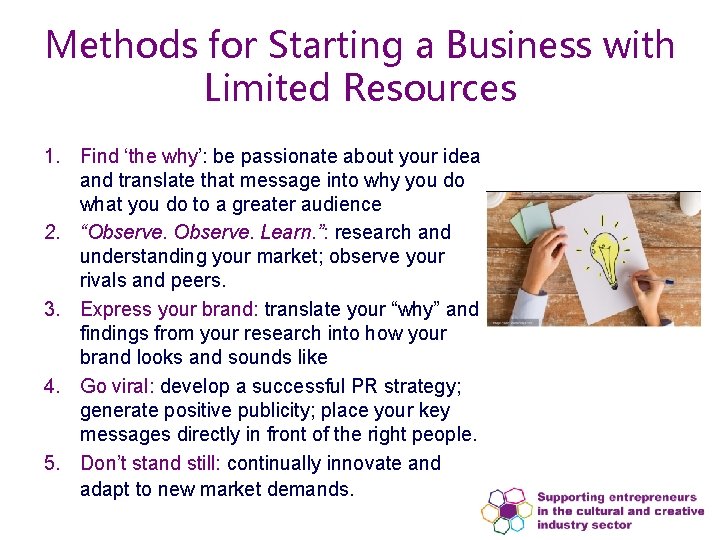
Methods for Starting a Business with Limited Resources 1. Find ‘the why’: be passionate about your idea and translate that message into why you do what you do to a greater audience 2. “Observe. Learn. ”: research and understanding your market; observe your rivals and peers. 3. Express your brand: translate your “why” and findings from your research into how your brand looks and sounds like 4. Go viral: develop a successful PR strategy; generate positive publicity; place your key messages directly in front of the right people. 5. Don’t stand still: continually innovate and adapt to new market demands.
Methods for Starting a Business with Limited Resources v Here they are some practical tips 3 for starting a business even with limited financial resources: Legalese & Logos: Skip It! Forget about spending valuable time and money trying to decide whether you should form your business as an LLC, C Corporation, S Corporation, LLC Envelope, Partnership, etc. and just start working on your business immediately. In the absence of any kind of formal business entity, your business will just be labeled a sole proprietorship for tax purposes. Ignore all of the periphery (hiring accountants, renting office space, designing business cards, taking out an ad in the yellow pages) and concentrate on only doing the primary focus of your business model so that you can get money in the door and test out the soundness of your business idea for as little start up cash as possible.
Methods for Starting a Business with Limited Resources Choose Your Niche Carefully! There are certain constraints that a lack of money will place on the types of businesses that you will be able to start, BUT all that means is that you will have to really focus on the kinds of niches that will make sense for your limited budget. Any type of business that is heavily capital intensive is probably a no-go.
Methods for Starting a Business with Limited Resources v Start businesses that are online based. v Within minutes of setting up your own website or blog you can be interacting with potential customers and selling your products or services online to people all over the world. Which brings us to the next very important point: it’s going take a lot of hard work.
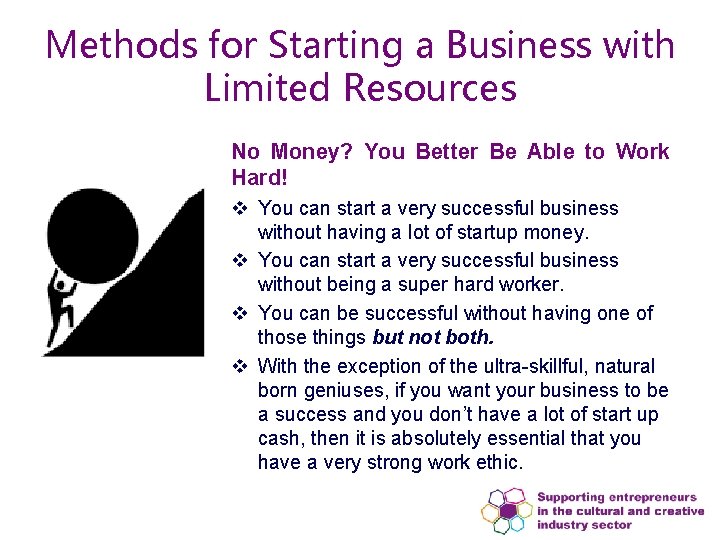
Methods for Starting a Business with Limited Resources No Money? You Better Be Able to Work Hard! v You can start a very successful business without having a lot of startup money. v You can start a very successful business without being a super hard worker. v You can be successful without having one of those things but not both. v With the exception of the ultra-skillful, natural born geniuses, if you want your business to be a success and you don’t have a lot of start up cash, then it is absolutely essential that you have a very strong work ethic.
Methods for Starting a Business with Limited Resources Practical Options for Getting Off the Ground 3: v If have a limited budget, are already convinced that you are in the right business niche, and you know that you are committed to working long hard hours on your business, then here are some practical options that you should consider exploring as you move forward with your startup idea: 1. “Double Up” v This is a sound risk management strategy and is efficient as a very economical business startup option as well. v “Doubling Up” simply means that if you’re already working at a “J-O-B” then continue to work in your job but tack on the extra career of starting your business on the side.
Methods for Starting a Business with Limited Resources 2. “Partner Up” v If you have a good business idea and no money, then a great business partner for you could potentially be someone with a lot of money and an interest in starting (or just financing) a new business.
Methods for Starting a Business with Limited Resources 3. “Charge Up” v If you ask very successful entrepreneurs how they financed the beginnings of their businesses, the majority will tell you that they used personal credit cards and not a more traditional source of “big business” funds like a bank loan, angel investment, or venture capital cash infusion. v Low interest rate credit card could be an option to consider. If you prepare to start, read also “Top 10 Money Saving Business Startup Action Items” from http: //www. artofmanliness. com/2010/02/18/how-to-start-abusiness-with-limited-funds/. . .
Methods for Starting a Business with Limited Resources You have two main paths of starting a business with less money: (a) lowering your costs or (b) increasing your available capital from outside sources. You have three options here 4: 1. Reduce your needs 2. Bootstrap 3. Outsource
Methods for Starting a Business with Limited Resources Funding Options To Raise Startup Capital For Your Business 5: v According to a recent study, over 94% of new businesses fail during first year of operation. v Lack of funding turns to be one of the common reasons. v Money is the bloodline of any business. v The long painstaking yet exciting journey from the idea to revenue generating business needs a fuel named capital. v That’s why, at almost every stage of the business, entrepreneurs find themselves asking – How do I finance my startup? v We will share with you 10 funding options for startups, that will help you raise capital for your business
Methods for Starting a Business with Limited Resources 10 ways to raise money for your business 5: 1. 2. 3. 4. 5. Bootstrapping your startup business Crowd-funding As A Funding Option Get Angel Investment In Your Startup Get Venture Capital For Your Business Get Funding From Business Incubators & Accelerators
Methods for Starting a Business with Limited Resources 6. Raise Funds By Winning Contests 7. Raise Money Through Bank Loans 8. Get Business Loans From Microfinance Providers or Non Banking Financial Corporations (NBFCs) 9. Government Programs That Offer Startup Capital 10. Quick Ways To Raise Money For Your Business: Product Presale; Selling Assets; Business Credit Cards.
Methods for Starting a Business with Limited Resources Before finishing, a brief summarizing movie 4: https: //www. entrepreneur. com/article/271446 BELIEVE in your business idea!
Developing a Business Plan v A Business Plan is a document which allows entrepreneurs and business owners to showcase their potential business venture. v Business Plans offers an indepth, comprehensive look at a business idea. v In a Business Plan, the entrepreneur makes assumptions about the future and then thinks critically about each and every one of the steps needed in order to implement the business idea.
Developing a Business Plan What’s the advantage of a Business Plan? v For a CCI entrepreneur, the business plan provides an excellent and detailed structure for laying out who you are as a business, what your plans and visions are, and how you can get there.
What goes into a Business Plan? v A Business Plan is made up of the following elements: 1. 2. 3. 4. 5. 6. 7. 8. 9. 10. A cover page Table of contents Executive summary that outlines the entire plan Description of the business Operation and Management Plan A SWOT analysis (Strengths, Weaknesses, Opportunities, Threats) Financial statements (balance sheets, income statements, etc. ) Market analysis Competitor analysis Marketing plan
What goes into a Business Plan? Executive Summary v This should tell the reader what you want. v Often, what the business owner desires is buried somewhere deep inside the plan – use this summary to clearly state what you're asking for in the summary. Business Description v The business description usually begins with a short description of the industry or market sector an presents an overview of the current situation and its future outlook. v This section also provides information on any new products or developments that will benefit or adversely affect your business.
What goes into a Business Plan? Operations & Management Plan v This section describes how the business will function on a continuing basis. v The operations plan highlights the logistics of the business and the capital and expense requirements related to the operations of the business. Financial Factors v Financial data is always at the back of the business plan. v In this section, entrepreneurs present their financial projections typically for the first 5 years of their business.
What goes into a Business Plan? Market Strategies and Marketing Plan v This section can only be written after the entrepreneur has conducted meticulous market analysis. v A market analysis forces the entrepreneur to become familiar with all aspects of the market so that the target market can be defined and the company can be positioned in order to secure sales. Competitive Analysis v The purpose of the competitive analysis is to determine the strengths and weaknesses of your competitors. v It helps entrepreneurs to develop strategies that will provide a distinct advantage and to identify barriers that can be developed in order to prevent competition from entering your market.
Overview of a Business Canvas v The Business Model Canvas was developed by Alex Osterwalder. v The aim of the Canvas is to give businesses greater flexibility in planning, testing and validating their business model. v The Business Model Canvas illustrates how a company creates, delivers and captures value by presenting the interactions between the different parts of the company.
Overview of a Business Canvas “Unless you have tested the assumptions in your business model first, outside the building, your business plan is just creative writing. ” - Steve Blank v The Business Model Canvas provides an easy-to-use and flexible template to allow entrepreneurs to test these assumptions.
Overview of a Business Canvas v The Business Canvas has nine elements 1. Customer Segments: v Who are the customers? v What do they think? See? Feel? Do? 2. Value Propositions: v What’s compelling about the proposition? v Why do customers buy, use? 3. Channels: v How are these propositions promoted, sold and delivered? v Why? Is it working?
Overview of a Business Canvas 4. Customer Relationships: v How do you interact with the customer through their ‘journey’? 5. Revenue Streams: v How does the business earn revenue from the value propositions? 6. Key Activities: v What uniquely strategic things does the business do to deliver its proposition?
Overview of a Business Canvas 7. Key Resources: v What unique strategic assets must the business have to compete? 8. Key Partnerships: v What can the company not do so it can focus on its Key Activities? 9. Cost Structure: v What are the business’ major cost drivers? v How are they linked to revenue?
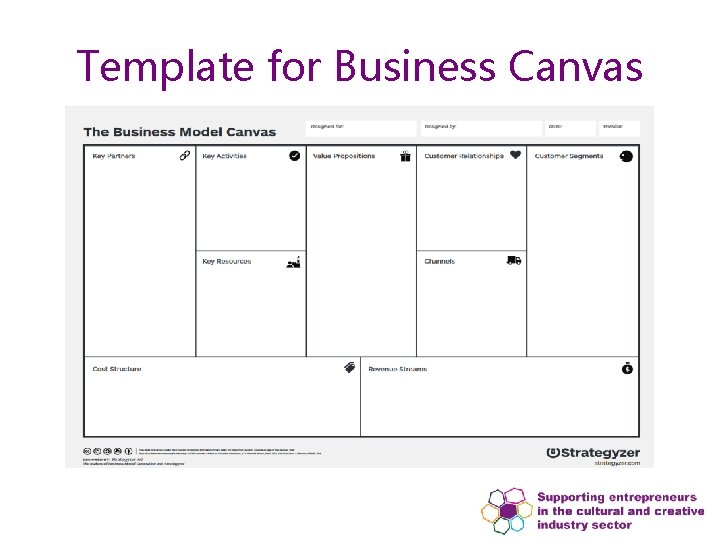
Template for Business Canvas
Over to You! Take 30 minutes for this activity: For each of the 9 elements of the Business Model Canvas, work as part of your group to brainstorm what you could fill out under each heading to complete the Canvas for your business.
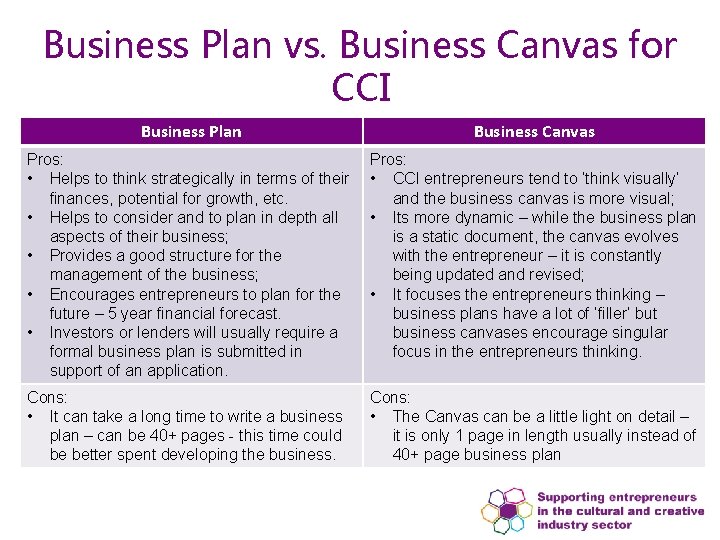
Business Plan vs. Business Canvas for CCI Business Plan Business Canvas Pros: • Helps to think strategically in terms of their finances, potential for growth, etc. • Helps to consider and to plan in depth all aspects of their business; • Provides a good structure for the management of the business; • Encourages entrepreneurs to plan for the future – 5 year financial forecast. • Investors or lenders will usually require a formal business plan is submitted in support of an application. Pros: • CCI entrepreneurs tend to ‘think visually’ and the business canvas is more visual; • Its more dynamic – while the business plan is a static document, the canvas evolves with the entrepreneur – it is constantly being updated and revised; • It focuses the entrepreneurs thinking – business plans have a lot of ‘filler’ but business canvases encourage singular focus in the entrepreneurs thinking. Cons: • It can take a long time to write a business plan – can be 40+ pages - this time could be better spent developing the business. Cons: • The Canvas can be a little light on detail – it is only 1 page in length usually instead of 40+ page business plan
Tracking Business Progress Why do you need to track your progress? v Having a business plan is important – it forces you to think about all aspects of your business. v But without controlling your progress the plan is just a piece of paper and an ambiguous vision in your head. What really matters is Plan VS. Reality v Tracking your business shows you that you are moving in the right direction, that your business is developing the way you programmed it to. v If you don’t meet your plans – you will find out early enough to modify your actions. v And if you meet your assumptions – it will give you a motivating feeling of satisfaction.
Tracking Business Progress Before you start You need very specific indicators that will allow you to measure your progress. These might be: money, milestone achievements, projects, work progress, time, interest or an online presence. Goals in your plan should be SMART [1] (Specific, Measurable, Attainable, Relevant and Time-bound) to make it easier to track. The examples SMART of goals are: v „The income in 2018 will be at least 30% higher than in 2017” v „The prototype of my product will be ready before the Inov. Conference in June 2019” v „I will sell at least 12000 copies of my book and find 300 participants of my online course by the end of 2018”
Tracking Business Progress Before you start v Out of your business plan extract and clarify main goals for every aspect concerning your business: income, number of sales, milestones and achievements, marketing, advancement, market shares, business growth, employment or public opinion. v Out of these goals pick 3 that are your absolute priorities! v If you have your goals – check the progress regularly. v Preferably plan it like any other regular activity and put it into your calendar - like once a month or once a quarter.
Tracking Business Progress Keep your business plan alive! v Updating your business plan on the regular basis, especially when your idea or circumstances have changed, is crucial for tracking the progress. v Even if the basis of your company has changed it is recommended to have your plan written and updated in measurable details to have something valuable to refer to in the future. How to track your business progress? v You’ve probably heard that most of the new companies fail during their first two years of existence. v Now when you realize how tracking your business is inevitable to survive on the market we will present you methods and indicators to help you be up to date.
Tracking Business Progress Plan Vs. Actual v You can start with simple math – see what did you predict and what did you manage to achieve. v It’s not only about the money, it might be number of copies of your sold products, number of employees, number of the visitors on your website or a number of x-marks on your to-do list. v Use Excel to create charts, graphs and calculations to help you see where are you exactly comparing to your plan.
Tracking Business Progress Track the money Tracking the money is not only about the difference between a predicted and real income. There is much more that you can read from your budget: v Relevant and unnecessary spending v Potential savings v The amount of debts v Most and least significant source of income v Tendencies in sales and purchases
Tracking Business Progress Track the work progress If you planned to release an app, find the premises for your store or finish your design for the competition – how is your progress? Ask yourself: v What have you already achieved? v How much work is left to do? v What is my biggest problem? v How can I overcome these obstacles? v Do I need to pay someone to help me? v Should I give up some of my ideas or modify my plan. This also a time to consider tools and software for time and project management (like Nozbe)
Tracking Business Progress Track the time Do you fit in your schedule? If not, don’t worry – you are not the only one. But this doesn’t mean you shouldn’t work on it. Especially as an entrepreneur. Ask yourself: v Am I far behind the schedule? v What do I spend the most of my time and effort on? v Do I use my time for unnecessary activities? v In which areas am I good at meeting deadlines? v Should I focus on learning new skills? v Should I delegate the work? And take actions!
Tracking Business Progress Track the interest If your activity is not 100% online - you should directly pay attention to your customers. This affects your financial well-being and credibility. Notice: v How many people visit your shop/workshop/studio? v What do they think about your idea and quality? v How many visitors pay you for your product or service? v How many of them returns to your premises? Or are they new customers every time? v How many people came to you because of somebody’s recommendations? Each of the answers may indicate on a problem or potential.
Tracking Business Progress Track the interest online In the times of social media there are many ways to attract somebody’s attention. On the other hand – if your service is poor quality, the word will also spread. What can you do? v Pay attention to the numbers – likes, shares, visits, comments. Do they meet your plans expectations? v Focus on creating good relationships with your customers. Social media support so-called „The thank you economy” [1]. Nowadays quality of customers can be more important that quantity. v Ask for comments and feedback v Think about tools for Internet and social media monitoring (like Brand 24)
Tracking Business Progress More than numbers Good entrepreneur knows that tracking progress is not only about the money and numbers (although they are very helpful). There are other factors that should be judged while thinking of your progress: v Your own spirit, beliefs, feelings and intuition v The value of stress, time and other things you devoted to your business v Missed opportunities v Employee morale v Customer satisfaction v Intangible costs and gains
Tracking Business Progress What’s next? The point of tracking your progress is not only the knowledge and awareness. Real entrepreneurs use the information they gained to make improvements. The typical plan consists of: 1. Comparing reality with business plan 2. Identifying successes and failures 3. Finding explanations for failures (incorrect plan, change of circumstances, logistic problems, human factor) 4. Reviewing the initial goals 5. Initiating modifications to improve the situation and prevent from further problems 6. Evaluating the effectiveness of these changes and making improvements if necessary
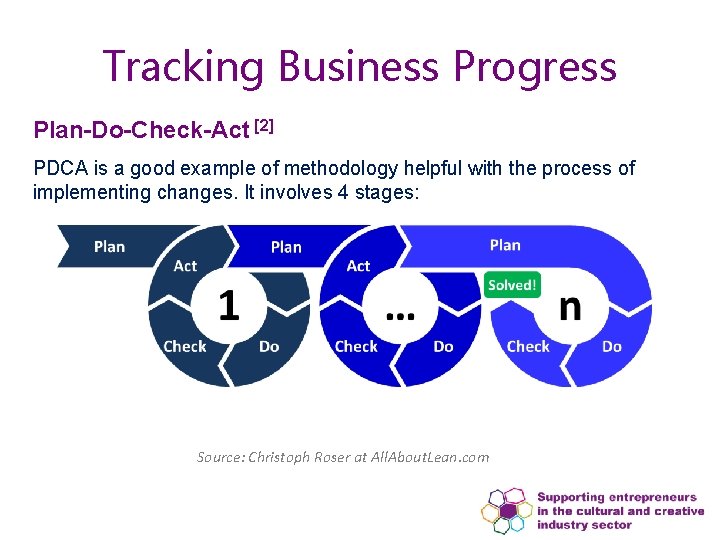
Tracking Business Progress Plan-Do-Check-Act [2] PDCA is a good example of methodology helpful with the process of implementing changes. It involves 4 stages: Source: Christoph Roser at All. About. Lean. com
Tracking Business Progress Plan-Do-Check-Act 1. Plan: identifying areas that need improvements, gathering ideas and creating plan to improve these areas. 2. Do: making changes as stated in the plan, preferably a pilot test, not large-scale changes 3. Check: verifying if the changes were successful (after reasonable period of time). If not - why? What did you learn from this attempt? 4. Act – make changes in proposed improvements or test another idea Repeat the cycle until the final solution is implemented. Remember: this methodology is perfect for conscious and continuous changes, not for emergency situations.
References 1. SMART goals: https: //www. mindtools. com/pages/article/smart-goals. htm 2. PDCA methodology: https: //en. wikipedia. org/wiki/PDCA http: //news. ewmfg. com/blog/how-to-implement-the-pdca-cycle-plando-check-act-in-any-department https: //www. ahrq. gov/professionals/quality-patient-safety/qualityresources/tools/literacy-toolkit/healthlittoolkit 2 -tool 2 b. html
- Slides: 47