Award Administration Part Three Audits and Audit Issues
- Slides: 79
Award Administration Part Three: Audits and Audit Issues Presented by: Heather Lopez Chief Audit Executive, Internal Audit Updated March 2017
Recording date of this workshop is March 10, 2017 Some of the rules and procedures discussed in this workshop are subject to change. Please check University resources before relying exclusively on this recorded presentation.
Agenda • Internal • Audits • Audit • How Controls and Auditors Process Overview to Prepare for a POSITIVE Audit 3
WHAT ARE INTERNAL CONTROLS? 4
What is Internal Control? Internal control is a process, effected by people at all levels of an organization, designed to provide reasonable assurance that the organization will achieve its objectives by: Safeguarding its assets and resources Providing accurate accounting data Promoting efficient operations Ensuring adherence to policies and regulations 5
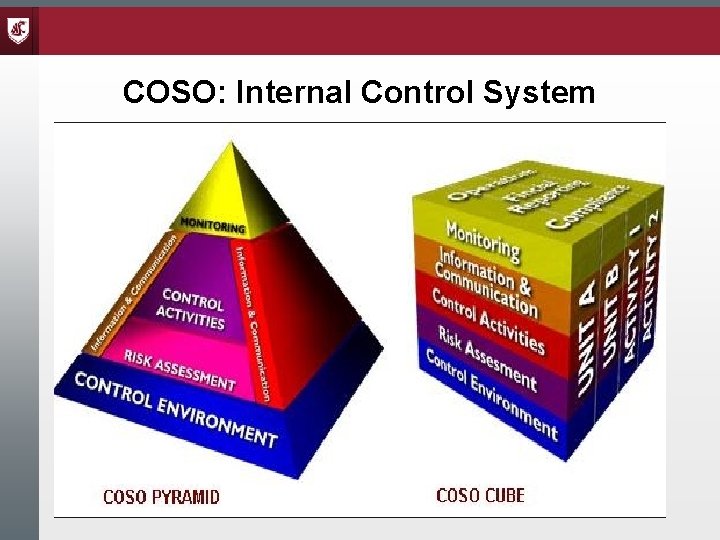
COSO: Internal Control System
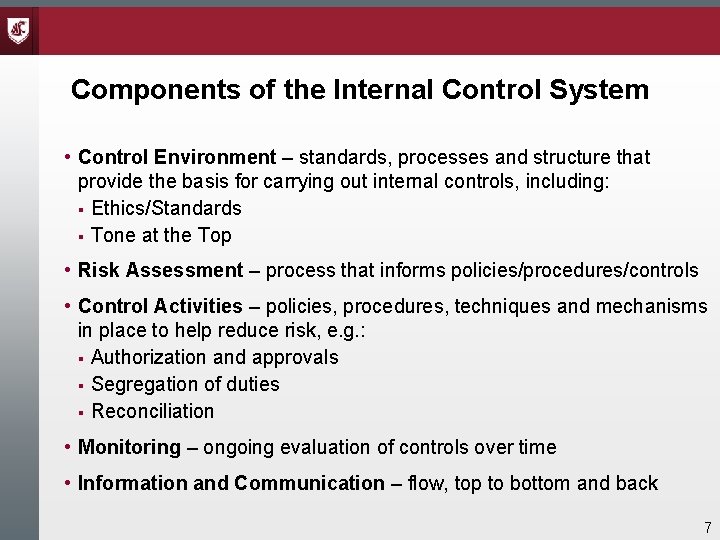
Components of the Internal Control System • Control Environment – standards, processes and structure that provide the basis for carrying out internal controls, including: § Ethics/Standards § Tone at the Top • Risk Assessment – process that informs policies/procedures/controls • Control Activities – policies, procedures, techniques and mechanisms in place to help reduce risk, e. g. : § Authorization and approvals § Segregation of duties § Reconciliation • Monitoring – ongoing evaluation of controls over time • Information and Communication – flow, top to bottom and back 7
Under COSO, an organization’s internal control system is deemed effective only if all five components (along with relevant principles) are both present and functioning. It is not enough to design and implement a system of control. There must be processes to ensure continued existence and evaluation and address as needed.
Who is Responsible for Internal Controls? Internal Controls are Everyone’s Business! • Though leadership is ultimately responsible, everyone in an entity has some responsibility for the organization’s internal controls. • All personnel should be responsible to effect internal controls, communicate problems in operations, deviations from established standards and violations of policy or law. 9
Management’s Role • Management has responsibility to: Assess risks to the organization of not meeting its objectives Identify and develop appropriate control system to mitigate/manage identified risks Implement controls and monitor them to ensure they are working as designed and are adequate 10
Auditor’s Role • Auditors test to ensure the controls and processes management has established and implemented are adequate to: Ensure compliance with applicable rules Safeguard Properly Provide resources present and report activity (reliable reporting) for effectiveness and efficiency in operations 11
AUDITS AND AUDITORS 12
Audits Began as Far Back as 3, 500 B. C. • Records of Mesopotamian civilization show tiny marks beside numbers involved in financial transactions. The dots, checks and tick marks portray a system of verification. One scribe prepared summaries of transactions, another verified those assertions. Internal controls, systems of verification and the concept of division of duties probably originated at that time. (Sawyer’s Internal Auditing, 5 th Edition) 13
In General… – An audit is an evaluation of a person, organization, system, process, enterprise, project or product. – Audits are performed to ascertain validity and reliability of information. 14
Types of Auditors • External auditors State Federal Private audit firms – e. g. KPMG, PWC, Clifton. Larson. Allen • Internal auditors 15
Types of Audits • Program/compliance audits • Program reviews and/or studies • State accountability/compliance audit • Financial statement • Investigations 16
What Triggers an Audit? • Statutory requirement By accepting federal funds, agree to meet requirements State agencies required to be audited by State Auditor • Contract contingency • Complaint Internal/external Whistleblower 17
Program Audits/Reviews (State and Federal) • Can be state, federal, or other sponsor • Focus on programmatic attributes • Test of transactions relating to program reviewed • Program reviews or studies • Identify best practices, programs or processes to omit 18
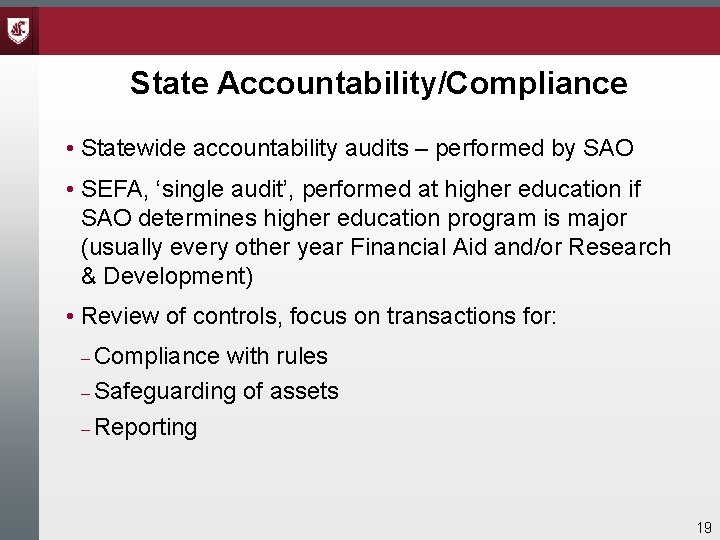
State Accountability/Compliance • Statewide accountability audits – performed by SAO • SEFA, ‘single audit’, performed at higher education if SAO determines higher education program is major (usually every other year Financial Aid and/or Research & Development) • Review of controls, focus on transactions for: Compliance with rules Safeguarding of assets Reporting 19
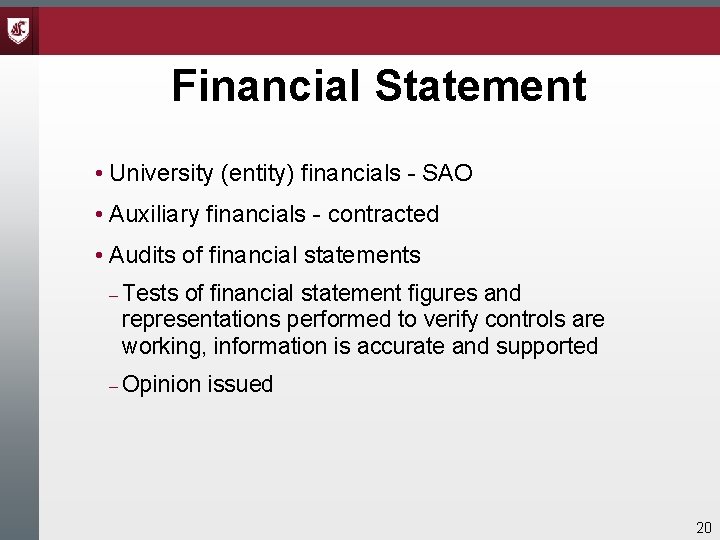
Financial Statement • University (entity) financials - SAO • Auxiliary financials - contracted • Audits of financial statements Tests of financial statement figures and representations performed to verify controls are working, information is accurate and supported Opinion issued 20
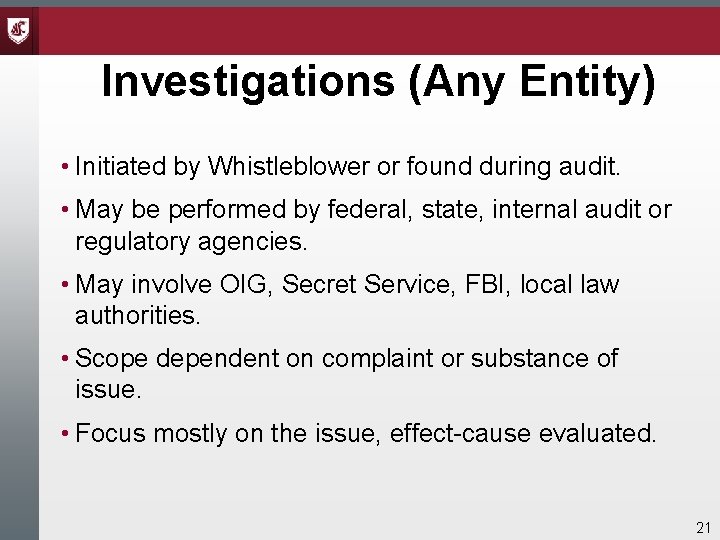
Investigations (Any Entity) • Initiated by Whistleblower or found during audit. • May be performed by federal, state, internal audit or regulatory agencies. • May involve OIG, Secret Service, FBI, local law authorities. • Scope dependent on complaint or substance of issue. • Focus mostly on the issue, effect-cause evaluated. 21
AUDIT PROCESS OVERVIEW 22
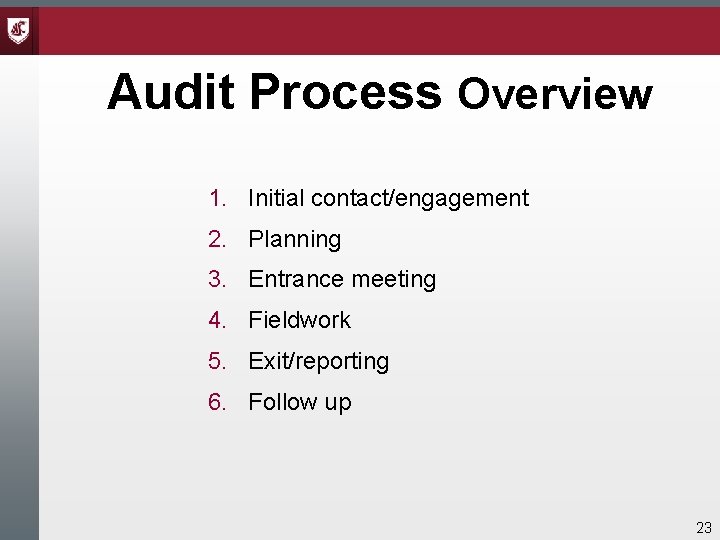
Audit Process Overview 1. Initial contact/engagement 2. Planning 3. Entrance meeting 4. Fieldwork 5. Exit/reporting 6. Follow up 23
1. Initial Contact/Engagement WSU Policy on External Audits (BPPM 30. 14): WSU ‘cooperates with and assists external auditors or investigators whose responsibilities involve examination and confirmation of University transactions. ’ • External audits may be initiated by invitation, mandate or by request of funding agency. • Internal Audit serves as liaison between central offices, departments and external auditors. § SPS, Controller – liaison on specific audits 24
WSU Protocol for External Audit Engagement • Initial contact usually by mail, telephone call or email. • If contacted, get identification and contact supervisor and Internal Audit. • It is important for external auditors to understand University policy on external audit protocol. This is to ensure appropriate administration is involved in the audit process. 25
Establish Primary Contact • Units subject to audit should establish: Who in their unit will be the primary contact during all phases of the audit. Identify the responsible administrator. This is usually the Chair, Director or Dean who takes responsibility for the report, and needed corrective action. 26
2. Auditor Planning • Preliminary procedures by auditor generally include: Review all requirements (circulars, CFR codes) Obtain and review proposals, contract, correspondence between Grantor and WSU Perform financial analysis Identify high risk areas Create an audit plan 27
Auditor Planning (Continued) • During auditor planning stage, the work may be performed on site or remotely. There may be initial requests for reports, downloads of data or other information to be sent via mail or email. • Prior to sending any information to auditors, their identification should be verified. * • Full and timely cooperation with auditors is essential to a successful audit. 28
Confidential Information • If auditors request information that is confidential, including any student data, identifications or financial information that may include banking or private data: Determine Work if the info is necessary for request with AAG for nondisclosure agreement DO NOT send any confidential data without it first being encrypted 29
3. Entrance • Generally, external auditors conduct an entrance meeting with central administrators to communicate the purpose, scope and timing of the audit. • Attendees at entrance meeting should include the appropriate central administrator, unit supervisor and Internal Audit. 30
4. Auditor Fieldwork • Auditor gains understanding of unit (and University) method for processing functions within scope – tests to transactions. For audit of a grant, the auditor will want to know general administrative and functional processes, who does what and how, in order to identify controls in place. These controls may be tested by pulling transactions and verifying through review of initials, stamps, signatures, files or other means that the process described is working. 31
Auditor Fieldwork (Continued) • Auditors usually know what transactions they want to test prior to working onsite. Tests of those transactions include reviewing records, support and conducting interviews. • Auditors then analyze the results of tests. Work is documented to support any reporting. • It is important to ensure auditors have right understanding and information at this stage to ensure accurate reporting of issues. 32
5. Exit/Reporting • Not all audits culminate in a written report, though there will usually be some form of summary (even verbal) to communicate results. • Single audits and state audits result in a written report. If any findings are communicated, it is a state and federal requirement to timely provide a corrective action plan. • Program audits and reviews do not always generate a report. It is helpful to attempt feedback from the auditor prior to completion of audit. 33
6. Follow Up • Some audits and reviews will require the external auditor to return after a designated time to determine if the University has resolved prior issues. Single audit: follow up within one year regardless of whether another single audit is determined necessary the second year State audit: follow up required if findings were issued Program reviews/audits: dependent on the agency 34
HOW TO PREPARE FOR A POSITIVE AUDIT 35
Effects of a Negative Audit • Loss of future awards • Bad publicity • Potential undermining of public trust and confidence in agency and government • Personal losses 36
Key Considerations for Controls and Compliance 1. 2. 3. 4. 5. Be prepared Have adequate segregation of duties Authorizations, approvals and verifications should be in place Allocation of costs/allowability considerations Control over assets, data and resources 37
1. Be Prepared for Audit at Any Time • Be familiar with WSU Policy – BPPM 30. 14. Obtain identification, contact supervisor, notify IA/SPS • Understand grant/project, terms of agreements and applicable circulars. • Ensure thorough, fact-based proposal. • Understand be able to explain procedures and how they coincide with BPPM and grants. • Provide all information requested timely and orderly. • Be organized! • Document, document! 38
2. Separation of Duties • Strong internal controls require adequate separation of duties: Record keeping Authorization Asset custody Reconciliation 39
Problems Caused by Inadequate Separation of Duties • Administrative errors may not be detected without an independent review of transactions. • Inappropriate or unauthorized transactions are permitted to occur since one individual controls a major portion of the revenue, expenditure or payroll function. 40
What if There is Inadequate Staff to Properly Separate Duties? • Smaller units may not be able to obtain the ideal system to adequately separate certain functions. In these cases, compensating controls can be used to decrease risk (e. g. , increased monitoring from supervisor, chair, etc. ). • Contact the Controller or Internal Audit if you need assistance in determining your individual policies. 41
3. Authorizations, Approvals and Verifications • Establish and know authorization limits. • Rubber stamping is not allowed. • Secure access to electronic signatures or other signatory devices. • Never, never sign a blank form. • Develop written procedures outlining delegation guidelines. 42
4. Allowability of Expenses • OMB A-81 – Uniform Guidance – Allowable, allocable and reasonable still apply • How does the expense benefit the specific grant? • Is there supporting documentation? • Authorized by PI or person with specific knowledge of grant? • Some direct charges permitted that weren’t before. 43
Salaries and Personnel § Administrative and clerical salaries Direct charge may be appropriate only if ALL: o Integral to a project o Individuals can be specifically identified with the project o The costs explicitly in budget or have prior written approval o And not also recovered as indirect § Level of effort – if paid on the grant, work on the grant § Effort certification 44
Unallowable Costs - $35 million • University of Washington - False Claims Act Charged for operations retroactively billed to Medicare Charged for bedside procedures by doctors who were not at bedsides Charged for surgical procedures done in absence of surgeons (2008) 45
Allocation of Costs • Allocation of expenses Rent Lab supplies • What is the allocation plan? • Is it documented, reasonable, periodically reviewed? • Has cost sharing promise been met? 46
Allocation of Costs (Continued) • How a PI might assign costs to a project: Based on who is ordering the supplies, the cost should be charged to that project By splitting costs among grants involving similar research By a pre-determined consistently applied method • Have a spending plan in place When requested, be prepared to demonstrate knowledge of cost allocation plan, support for allocations 47
Unallocable Costs - $2. 3 million • Harvard - $5. 5 M direct/indirect costs related to grant awards on four NIH grants. • Subcontractor improper claims: Salary of people not working on grant Salary in excess of budget amount Expenses for projects not related to grants On behalf of scientists not eligible to work on grant, or did not work on grant (Settled 2004, Activity 1993 -1998) 48
Unallocable Costs - $7. 6 million • Yale University – False Claims Act • Grants made by ~30 federal agencies and organizations (94% of $3 B by DHHS, NSF, Energy, Do. D, NASA) Cost transfers – charges to grants not allocable (motivated to spend down funds near term) Effort – charged 100% for summer effort though researchers spent significant time and effort on unrelated work (motivation by academic researchers: summer salary paid as result of effort charged to grants) (12/08) 49
• Columbia University agreed to pay $9. 5 million to resolve allegations that it improperly charged NIH for F&A costs on more than 400 federal grants. • Universities are allowed to charge a higher rate for research conducted on campus to offset M&O, however, amounts charged were inflated from 20032015. University claims rates were openly and consistently disclosed but government disagreed with university’s approach. (7/16)
• University of Florida agreed to pay nearly $20 million to resolve allegations it improperly charged DHHS for salary and administrative costs on hundreds of grants. Suit claims university overcharged for salaries of its employees without documenting their contributions (effort) and inflated the cost of services performed by a contractor, also, claimed school sought reimbursement for equipment and supplies not covered by the grant. (11/16)
• 8/15 National Science Foundation ordered Northeastern University to pay back $2. 7 million. Salaries paid without proper support, advances disbursed without required verification of need and sufficient oversight. • 8/15 NASA and NSF settle for $2. 3 million from Wheeling Jesuit University – costs improperly mischaracterized, impermissible costs and misused federal funds and property acquired with federal funds.
5. Asset Control Activities • Periodic asset counts • Periodic comparisons • Investigation of discrepancies • Physical safeguards against theft and fire 53
OTHER CONTROL CONSIDERATIONS
Payroll • Time records: Should never be pre-approved or pre-signed Should be signed/certified by employee and supervisor Should reflect actual hours worked • After certification, approved time records should not return to employee. • Should have adequate separation of duties – scheduling, post of hours, payroll processing. 55
Auditing Payroll • When requested, have available, or allow access to, personnel files (PAF, appointments, Time/Leave Reports, pay-affecting documents). • Ensure all support is accounted for. • If unusual activity, document the conditions. • Evidence reviews. • Be able to identify employee responsibilities. 56
Payroll Issues Example • Payroll Fraud ~$25, 000 - payroll administrator created temp position for herself, used rubber stamp for supervisor ‘authorization, ’ no monitoring. • Payroll Audit Finding – supervisor allowed employees to take 2 - 4 days off work without booking leave. • Payroll Audit Finding – supervisor signing time reports and handing back to employee prior to posting payroll hours. 57
Purchasing Cards • Be sure to understand comply with University policy. • Safeguard purchasing cards when not in use. • Only authorized persons should use card. • Log all transactions and make sure timely reconciled on -line and with bank statements. 58
Purchasing Cards (Continued) • Ensure adequate separation of duties – custodian, authorizing official, reconciler. • Retain original receipts. • Review purchase activity to ensure for allowable purchases. • Ensure expenditure authority on all budgets charged. 59
Auditing Purchasing Cards • When asked for purchasing card records, have available: Purchasing Issuing All card logs bank statement supporting receipts/documents* Check-out logs *Gift card/gas card/other distribution support Receipt of initial purchase Log of disposition 60
Purchasing Card Issues Example • Purchasing card fraud: ~$350, 000 use of p-card for personal (UW) • State audit of purchasing cards (2013) • Purchasing card audit issues/findings at WSU: Inadequate Approving separation of duties authority does not have expenditure authority Inadequate support or incomplete logs Reconciliations Split not performed or not timely purchases 61
Purchasing Equipment • Review the order; determine if it is allowable per grant. • Compare with budget provided in grant proposal. • If not listed as part of planned equipment purchase, read the award to determine if allowed via budget revision. 62
Control Over Equipment • WSU inventories equipment every two years. • Be sure department inventory is updated with location of equipment. • Equipment purchased with federal funds has restrictions on disposal or transfer. • If you have equipment that is ‘borrowed’ develop a checkout and return system. 63
Control Over Equipment (Continued) • Essential to control equipment from purchase to disposal. • If equipment holds data, data is an asset, track accordingly. If equipment lost or stolen, it must be reported immediately to determine if data breach protocol must be initiated. 64
Auditing Equipment • When asked for audit, have available: Purchase records Equipment Known inventory listings – verified location of equipment Knowledge of what equipment is used for 65
State Audit Finding: Equipment • Asotin County – ($106, 000, Homeland Security Grant) Failed to maintain proper records for equipment purchased with federal money. Failed to conduct physical inventory every two years as required. Items purchased not on inventory listing, could not be located. 66
Control Environment – Investment in Employee Development • All objectives are at risk when employees are not adequately trained due to layoff, turnover, lack of time, etc. • Employees should be trained and cross-trained in essential duties. • Development does not have to be expensive – can provide opportunity for on-line learning, WSU learning, satellite or webinar, etc. ; be aware of trainings that will provide most value overall. 67
Receipting • Cash and checks should be deposited on a timely basis. • Deposits should be made intact and in proper composition. • Funds should be properly safeguarded (before deposit and in transit). • Numerical receipts should be used in order. 68
Receipting Issues Example • Receipt Fraud: Money not deposited timely ($18, 340 - Klickitat County Fire Protection District No. 7). • Receipt Audit Issues: Use of redi-form receipts, uncontrolled, lack of accountability. Using Not receipts out of order. retaining receipts intact. Untimely deposits, longer period of time funds at risk of misappropriation. 69
Reconciliation • Reconciliation is a detective control. • Departmental budgets should be reviewed monthly, timely and discrepancies investigated. • Check budget statements to ensure transactions: Are posted to the correct account Are listed at the correct amount Are appropriate for the account • Follow up on errors that need correction. 70
Reconciliation (Continued) • The reconciliation process should include verifying the transactions are valid, properly authorized and properly recorded on a timely basis. • Who should perform? Someone independent from function • For expenditures, someone with authority to sign for that account should review (required for some methods of procurement). 71
Do Not Skimp on Review as Key Control • Do not cut oversight! Most important control, not only to detect errors, but also as deterrent. • Consider sharing oversight, reconciliation responsibilities. • Review frequency of oversight activities and assess those that may be performed periodically without compromising integrity of process. 72
Security • Limit access to keys. • Safeguard cash and checks in secure area. • Lock doors and desks after hours. • Restrict access to forms (petty cash, reimbursements and payment). • Periodically review accessibility to programs; limit to those needed. • Periodically change passwords; do not give out. 73
Control over Data • As University employees, we have an obligation to handle confidential data in a manner that seeks to protect the privacy of the individual who has directly or indirectly entrusted us with their data. Basic guidelines: – Make sure you need it before you collect it – If you collect it, protect it – Be open and honest about how you collect, use and share personal information – Create a culture of privacy – Conduct due diligence and maintain oversight of partners and vendors
Data Breaches • University of Mississippi Medical Center $2. 75 million settlement, alleged HIPAA violation stemming from unsecured electronic health information on 10, 000 people breached when a laptop computer found to be missing. (7/16) • Oregon Health and Science University $2. 7 million for 2 data breaches in 2013 involving 7, 000 patients.
In Summary • Always verify auditor’s credentials before giving information and notify Internal Audit. • Be prepared. • Be organized. • Do it right the first time. 76
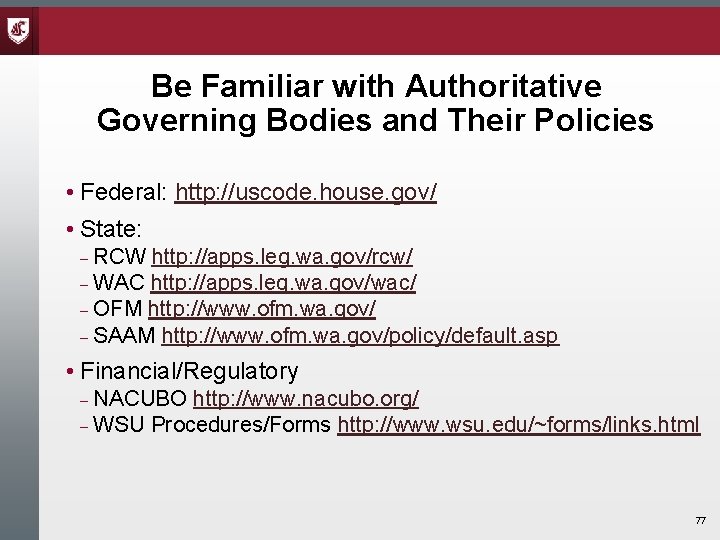
Be Familiar with Authoritative Governing Bodies and Their Policies • Federal: http: //uscode. house. gov/ • State: RCW http: //apps. leg. wa. gov/rcw/ WAC http: //apps. leg. wa. gov/wac/ OFM http: //www. ofm. wa. gov/ SAAM http: //www. ofm. wa. gov/policy/default. asp • Financial/Regulatory NACUBO http: //www. nacubo. org/ WSU Procedures/Forms http: //www. wsu. edu/~forms/links. html 77
Resources • Internal Audit – 5 -5336, ia. central@wsu. edu • ORSO – 5 -9661, orso@wsu. edu • Sponsored Programs – 5 -2058, sps@wsu. edu • General Accounting – 5 -2013, genacct@wsu. edu • SAO – http: //www. sao. wa. gov 78
This has been a WSU Training Videoconference If you attended this live training session and wish to have your attendance documented in your training history, please notify Human Resource Services within 24 hours of today's date: hrstraining@wsu. edu