A ECL 365 SI EXAM 1 REVIEW CLICK






- Slides: 66
A ECL 365 SI EXAM 1 REVIEW CLICK TO START
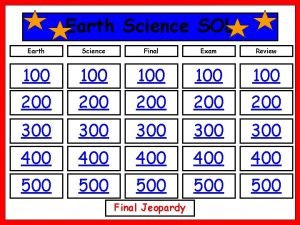
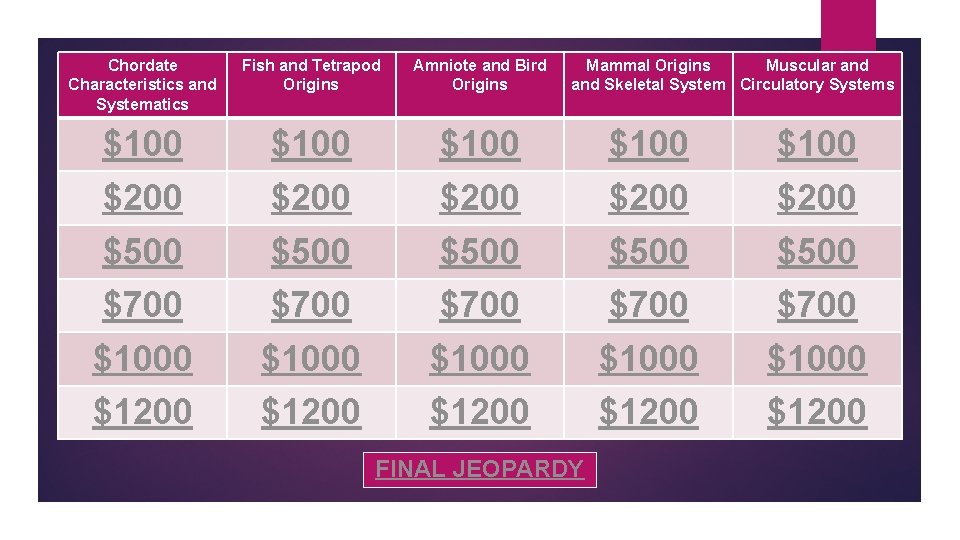
Chordate Characteristics and Systematics Fish and Tetrapod Origins Amniote and Bird Origins $100 $200 $500 $700 $1000 $1200 Mammal Origins Muscular and Skeletal System Circulatory Systems FINAL JEOPARDY $100 $200 $500 $700 $1000 $1200
_______ must be testable, falsifiable, and make predictions.
Hypothesis CONTINUE
What is the two-part name given to each species?
Binomial Nomenclature CONTINUE
Which class of vertebrates contains the largest number of species. Which contains the fewest?
Osteichthyes contains the highest, Mammalia contains the fewest CONTINUE
What is the difference between sympatric and allopatric speciation?
Allopatric speciation occurs when a new species arises due to geographic isolation. Sympatric speciation occurs when a new species arises without geographic isolation. CONTINUE
What 4 characteristics do all chordates share at some point in development?
1. Notochord 2. Pharyngeal Slits 3. Post-Anal Tail 4. Dorsal Hollow Nerve Cord CONTINUE
What 4 conditions need to be met in order for natural selection to occur?
1. More individuals must be born than can reach adulthood. 2. There must be variation within the population. 3. This variation must be inheritable. 4. This variation must result in differences in fitness. CONTINUE
Why are amphibians obligately tied to water?
Their skin and eggs are both at risk of desiccation. CONTINUE
What are the 3 orders in Lissamphibia?
1. Anura – Frogs and Toads 2. Gymnophiona – Caecilians 3. Caudata/Urodela Salamanders CONTINUE
What are the two subgroups of the Osteichthyes?
1. Actinopterygii – Ray-finned Fishes 2. Sarcopterygii – Lobefinned Fishes CONTINUE
What two evolutionary breakthroughs are associated with Gnathostomata and why are they important?
Paired fins and jaws. These allow vertebrates to occupy new predatory niches to rapidly diversify CONTINUE
What are the 3 hypotheses for why tetrapod ancestors moved to land?
1. Lots of food on land 2. Less predators on land 3. Less competition on land CONTINUE
Give a couple examples of challenges tetrapod ancestors would face by moving on to land.
1. Gravity requires a skeleton that must support weight and a circulatory system that can pump blood. 2. Gills don’t function in air 3. Eggs and body covering desiccate quickly. CONTINUE
Why is the amniotic egg important for the evolution of vertebrates?
It broke the tie to water, allowing vertebrates to lay their eggs on land. CONTINUE
What do the terms endotherm and homeotherm mean?
1. Homeotherms are animals that maintain a nearly constant body temperature 2. Endotherms are animals that supply their own body heat using metabolic processes CONTINUE
There are two lineages within the diapsid reptiles. What are they and what do they contain?
1. Lepidosaurs - tuataras, lizards, and snakes 2. Archelosaurs - turtles, crocodiles, and birds CONTINUE
In the amniotic egg, what is the yolk, allantois, and amnion used for?
1. Yolk provides nutrition to the embryo 2. Allantois contains waste made by the embryo 3. Amnion keeps the embryo in an aqueous environment CONTINUE
What are three adaptations birds have to allow flight?
hollow/fused bones, and a single ovary to reduce weight 2. 4 -chambered heart, flow-through respiratory system, and endothermic homeothermy to keep up with their metabolism 3. Keeled sternum and furcula to serve as anchor points and attachment for flight muscles CONTINUE
What are the 4 hypotheses for the evolution of powered flight in bird ancestors?
would glide in between branches. 2. Cursorial I: ancestors were cursorial predators and used their wings to increase lift. 3. Cursorial II: ancestors were cursorial predators and used their wings to subdue prey. 4. Cursorial III: ancestors were cursorial predators and used their wings to increase lift while running on water. CONTINUE
How are the jaws of mammals distinct from other vertebrates?
They have squamosaldentary jaw articulation, meaning the entire lower jaw is made up of a single bone CONTINUE
What happened to the other jaw bones mammals don’t have?
They migrated to the middle ear, allowing for more acute hearing. *note: the stapes was ALREADY present and is found in other vertebrate lineages CONTINUE
Mammals and their direct ancestors have a body posture different from other tetrapods. How is it different and why would it be beneficial?
Mammals have a “limb under the body” posture while other tetrapods generally have a sprawling posture. It allows for locomotion to be paired with respiration, making them more efficient. CONTINUE
Vertebrates have two types of bone. What are they and what is the difference between them?
1. Endochondral – bones that develop from a cartilage precursor. 2. Dermal – bones that don’t develop from a cartilage precursor. CONTINUE
Arthropods have an exoskeleton while vertebrates have an endoskeleton. What do these terms mean and what are pros and cons for each?
1. Exoskeleton – an external skeleton made of chitin. Great for protection but must be molted to allow for growth. 2. Endoskeleton – an internal skeleton made of bone or cartilage. Not as strong but can grow with the animal without need for molting. CONTINUE
As we move up the vertebrate phylogeny, what are some general trends we see in elaboration of the skeletal system?
Fewer bones in the skull, specialization of vertebrae, and interlocking of vertebrae CONTINUE
Many vertebrate lineages have two pathways in their circulatory systems. What are they and where do they take blood?
1. Systemic circuit – takes oxygenated blood to the body and back to the heart. 2. Pulmonary circuit –takes deoxygenated blood to the lungs and back to the heart. CONTINUE
What is the difference between an artery and a vein?
Arteries take blood away from the heart and have thick walls while veins take blood to the heart and have thin walls CONTINUE
What does the Sliding Filament Model state?
When a sarcomere is signaled to contract, the myosin filaments bind to and pull the actin filaments towards the middle, shortening the sarcomere. CONTINUE
The contraction of a sarcomere is a binary (allor-none) response. If that is the case, why are we able to flex muscles halfway?
Muscle tension is controlled by the number of motor neurons signaling the muscle to contract. CONTINUE
As we move up the phylogeny, what is a general pattern we see in elaboration of the muscular system?
Less of a reliance on segmental bands and a greater reliance on muscles in and around the limbs. CONTINUE
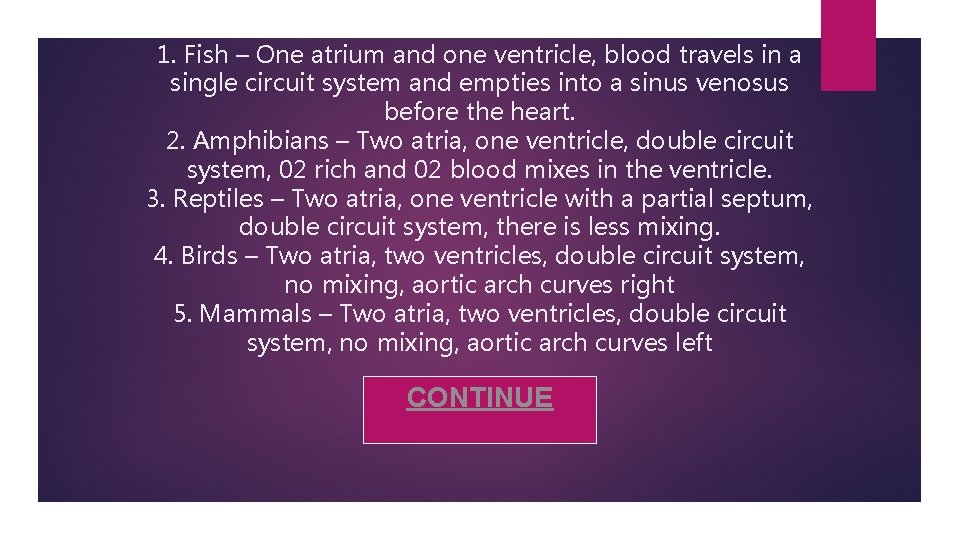
Briefly describe the circulatory systems of fish, amphibians, reptiles, birds, and mammals.
1. Fish – One atrium and one ventricle, blood travels in a single circuit system and empties into a sinus venosus before the heart. 2. Amphibians – Two atria, one ventricle, double circuit system, 02 rich and 02 blood mixes in the ventricle. 3. Reptiles – Two atria, one ventricle with a partial septum, double circuit system, there is less mixing. 4. Birds – Two atria, two ventricles, double circuit system, no mixing, aortic arch curves right 5. Mammals – Two atria, two ventricles, double circuit system, no mixing, aortic arch curves left CONTINUE
FINAL JEOPARDY
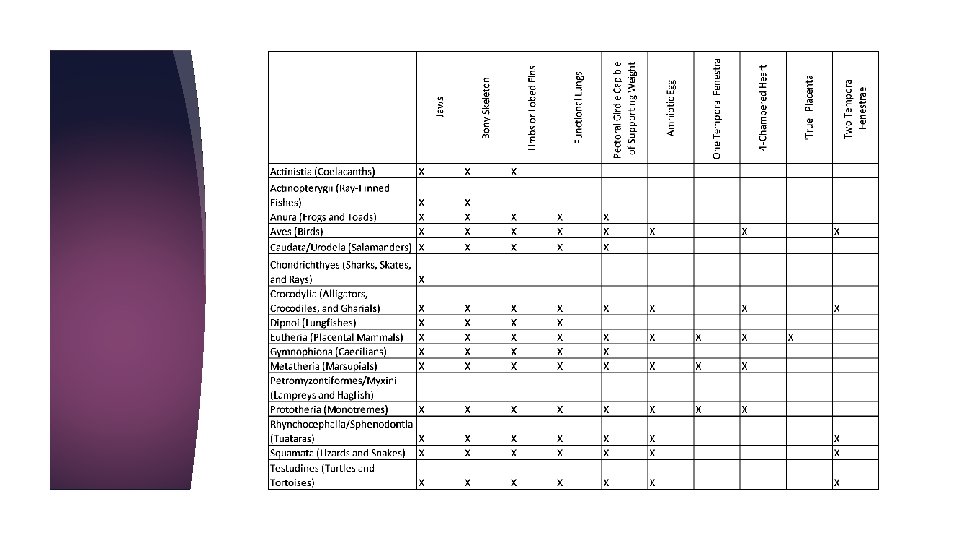
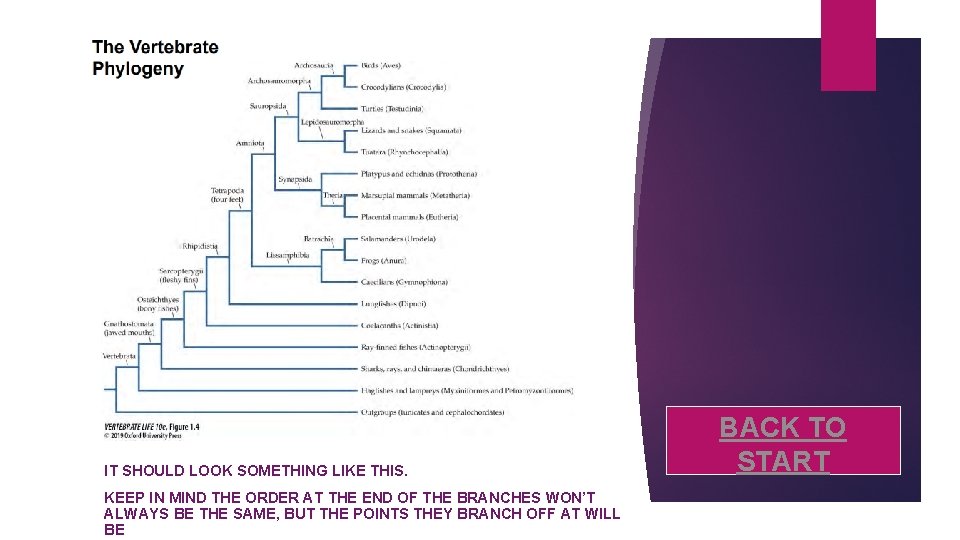
On the next slide, there will be a character matrix for all the extant vertebrate groups. Use it to fill out the vertebrate phylogeny. Good luck!
IT SHOULD LOOK SOMETHING LIKE THIS. KEEP IN MIND THE ORDER AT THE END OF THE BRANCHES WON’T ALWAYS BE THE SAME, BUT THE POINTS THEY BRANCH OFF AT WILL BE BACK TO START