15 853 Algorithms in the Real World Error





- Slides: 29
15 -853: Algorithms in the Real World Error Correcting Codes I – Overview – Hamming Codes – Linear Codes 15 -853 1
Mathematicians are like Frenchmen: whatever you say to them they translate into their own language and forthwith it is something entirely different. - Goethe 15 -853 2
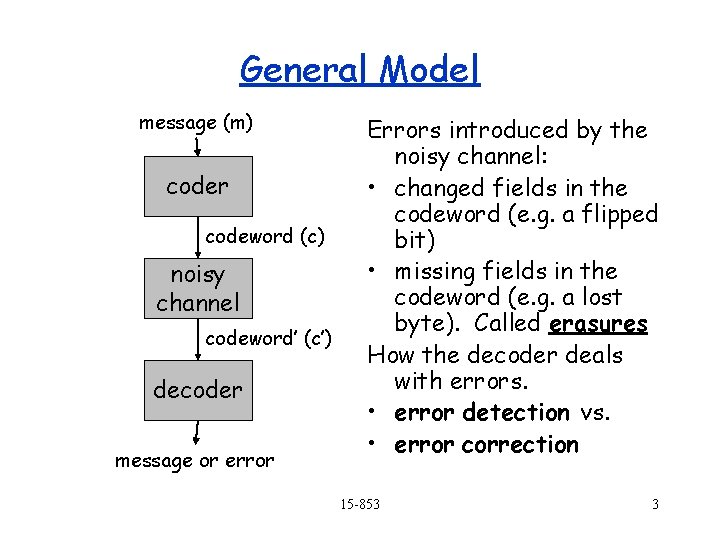
General Model message (m) coder codeword (c) noisy channel codeword’ (c’) decoder message or error Errors introduced by the noisy channel: • changed fields in the codeword (e. g. a flipped bit) • missing fields in the codeword (e. g. a lost byte). Called erasures How the decoder deals with errors. • error detection vs. • error correction 15 -853 3
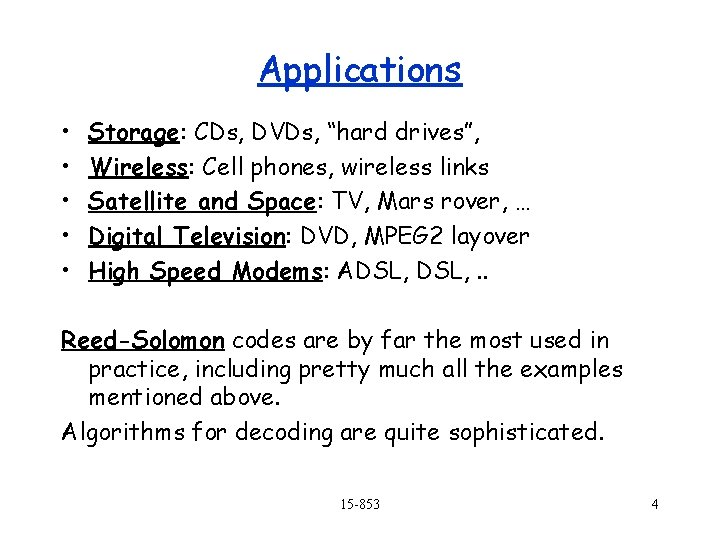
Applications • • • Storage: CDs, DVDs, “hard drives”, Wireless: Cell phones, wireless links Satellite and Space: TV, Mars rover, … Digital Television: DVD, MPEG 2 layover High Speed Modems: ADSL, . . Reed-Solomon codes are by far the most used in practice, including pretty much all the examples mentioned above. Algorithms for decoding are quite sophisticated. 15 -853 4
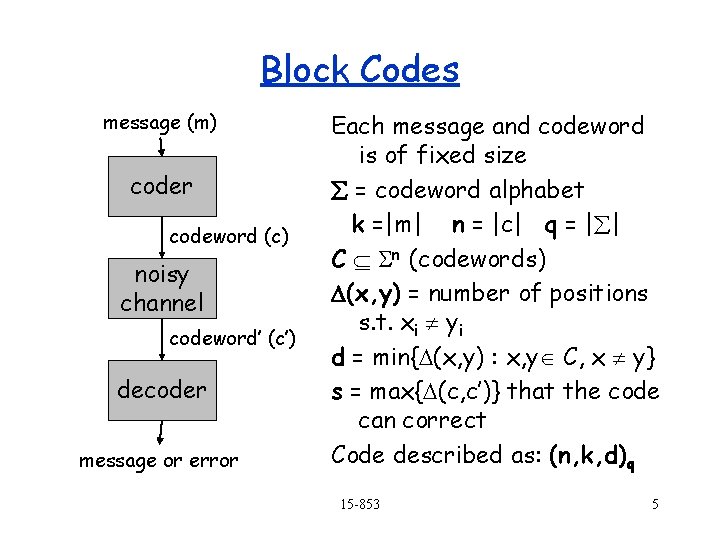
Block Codes message (m) coder codeword (c) noisy channel codeword’ (c’) decoder message or error Each message and codeword is of fixed size å = codeword alphabet k =|m| n = |c| q = | | C Sn (codewords) D(x, y) = number of positions s. t. xi ¹ yi d = min{D(x, y) : x, y C, x ¹ y} s = max{D(c, c’)} that the code can correct Code described as: (n, k, d)q 15 -853 5
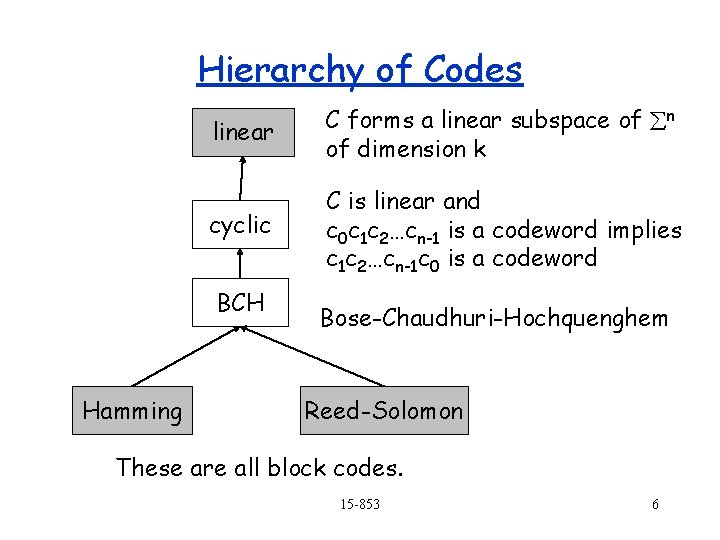
Hierarchy of Codes linear C forms a linear subspace of n of dimension k cyclic C is linear and c 0 c 1 c 2…cn-1 is a codeword implies c 1 c 2…cn-1 c 0 is a codeword BCH Hamming Bose-Chaudhuri-Hochquenghem Reed-Solomon These are all block codes. 15 -853 6
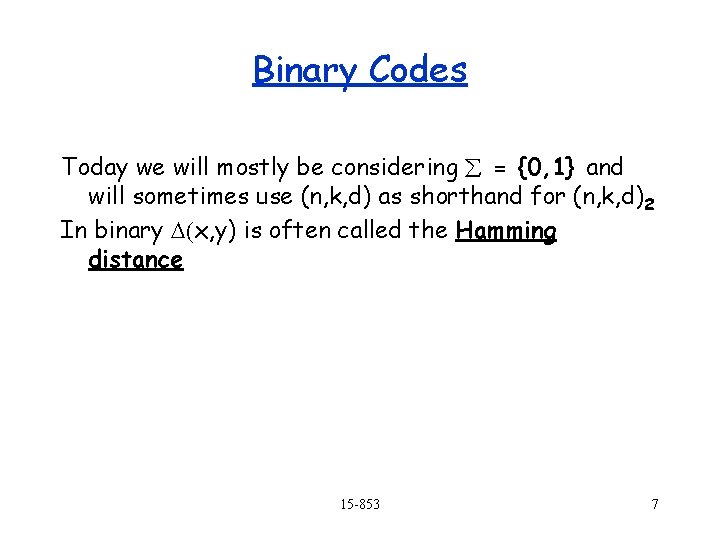
Binary Codes Today we will mostly be considering = {0, 1} and will sometimes use (n, k, d) as shorthand for (n, k, d) 2 In binary D(x, y) is often called the Hamming distance 15 -853 7
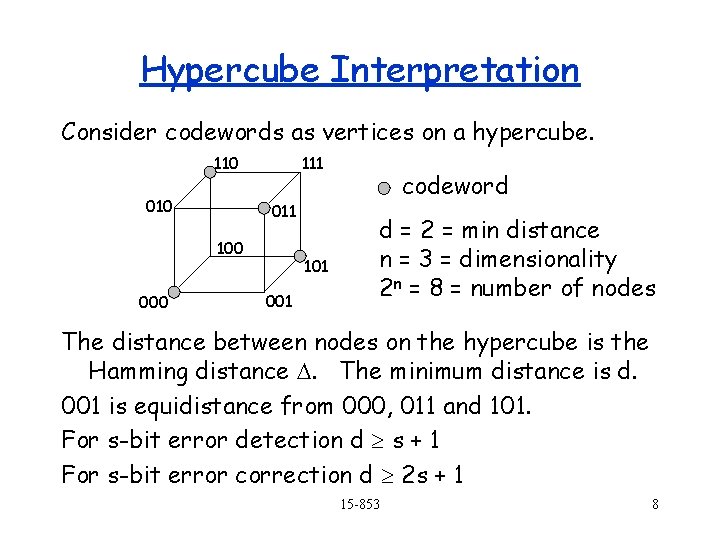
Hypercube Interpretation Consider codewords as vertices on a hypercube. 110 010 111 011 100 000 101 001 codeword d = 2 = min distance n = 3 = dimensionality 2 n = 8 = number of nodes The distance between nodes on the hypercube is the Hamming distance D. The minimum distance is d. 001 is equidistance from 000, 011 and 101. For s-bit error detection d s + 1 For s-bit error correction d 2 s + 1 15 -853 8
Error Detection with Parity Bit A (k+1, k, 2)2 systematic code Encoding: m 1 m 2…mkpk+1 where pk+1 = m 1 m 2 … mk d = 2 since the parity is always even (it takes two bit changes to go from one codeword to another). Detects one-bit error since this gives odd parity Cannot be used to correct 1 -bit error since any odd-parity word is equal distance D to k+1 valid codewords. 15 -853 9
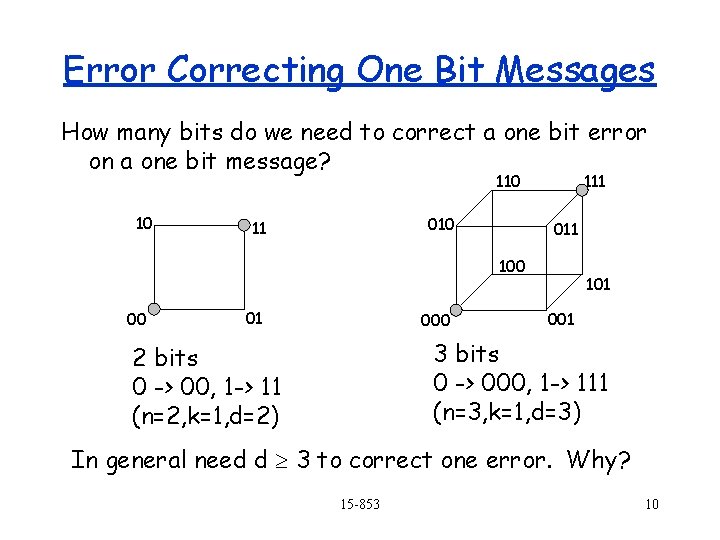
Error Correcting One Bit Messages How many bits do we need to correct a one bit error on a one bit message? 110 10 010 11 111 011 100 00 01 000 101 001 3 bits 0 -> 000, 1 -> 111 (n=3, k=1, d=3) 2 bits 0 -> 00, 1 -> 11 (n=2, k=1, d=2) In general need d 3 to correct one error. Why? 15 -853 10
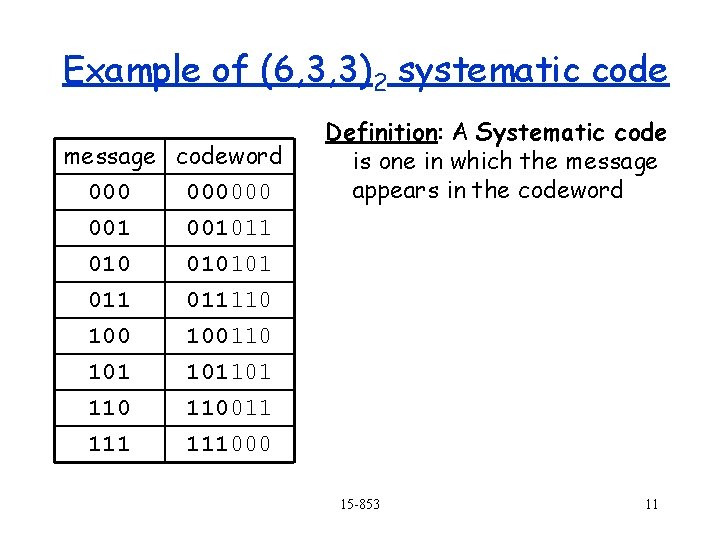
Example of (6, 3, 3)2 systematic code message codeword 000000 001011 010101 011 100 101 110 111 Definition: A Systematic code is one in which the message appears in the codeword 011110 100110 101101 110011 111000 15 -853 11
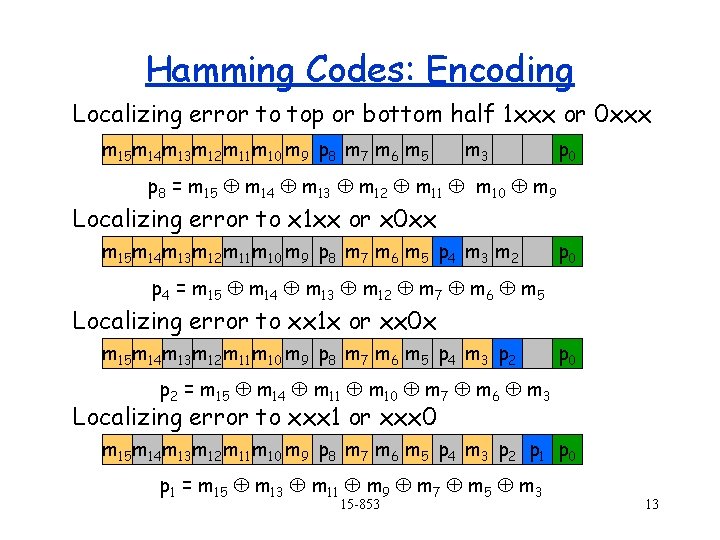
Error Correcting Multibit Messages We will first discuss Hamming Codes Detect and correct 1 -bit errors. Codes are of form: (2 r-1, 2 r-1 – r, 3) for any r > 1 e. g. (3, 1, 3), (7, 4, 3), (15, 11, 3), (31, 26, 3), … which correspond to 2, 3, 4, 5, … “parity bits” (i. e. n-k) The high-level idea is to “localize” the error. Any specific ideas? 15 -853 12
Hamming Codes: Encoding Localizing error to top or bottom half 1 xxx or 0 xxx m 15 m 14 m 13 m 12 m 11 m 10 m 9 p 8 m 7 m 6 m 5 m 3 p 0 p 8 = m 15 m 14 m 13 m 12 m 11 m 10 m 9 Localizing error to x 1 xx or x 0 xx m 15 m 14 m 13 m 12 m 11 m 10 m 9 p 8 m 7 m 6 m 5 p 4 m 3 m 2 p 0 p 4 = m 15 m 14 m 13 m 12 m 7 m 6 m 5 Localizing error to xx 1 x or xx 0 x m 15 m 14 m 13 m 12 m 11 m 10 m 9 p 8 m 7 m 6 m 5 p 4 m 3 p 2 p 0 p 2 = m 15 m 14 m 11 m 10 m 7 m 6 m 3 Localizing error to xxx 1 or xxx 0 m 15 m 14 m 13 m 12 m 11 m 10 m 9 p 8 m 7 m 6 m 5 p 4 m 3 p 2 p 1 p 0 p 1 = m 15 m 13 m 11 m 9 m 7 m 5 m 3 15 -853 13
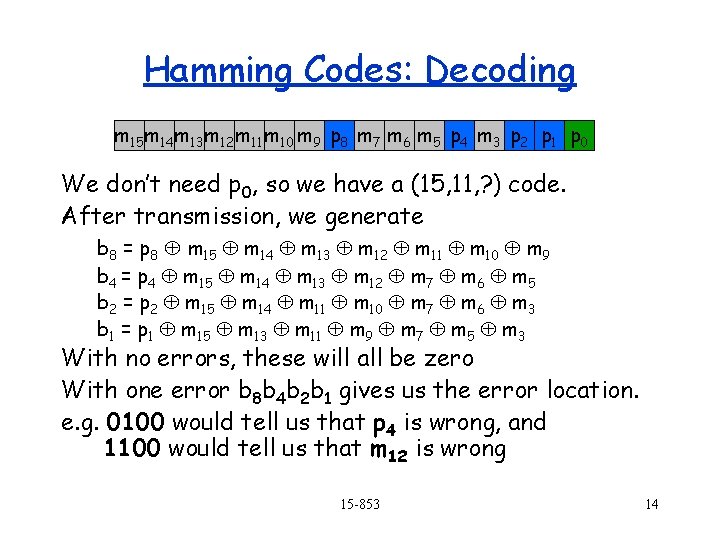
Hamming Codes: Decoding m 15 m 14 m 13 m 12 m 11 m 10 m 9 p 8 m 7 m 6 m 5 p 4 m 3 p 2 p 1 p 0 We don’t need p 0, so we have a (15, 11, ? ) code. After transmission, we generate b 8 = p 8 m 15 m 14 m 13 m 12 m 11 m 10 m 9 b 4 = p 4 m 15 m 14 m 13 m 12 m 7 m 6 m 5 b 2 = p 2 m 15 m 14 m 11 m 10 m 7 m 6 m 3 b 1 = p 1 m 15 m 13 m 11 m 9 m 7 m 5 m 3 With no errors, these will all be zero With one error b 8 b 4 b 2 b 1 gives us the error location. e. g. 0100 would tell us that p 4 is wrong, and 1100 would tell us that m 12 is wrong 15 -853 14
Hamming Codes Can be generalized to any power of 2 – n = 2 r – 1 (15 in the example) – (n-k) = r (4 in the example) – d = 3 (discuss later) – Can correct one error, but can’t tell difference between one and two! – Gives (2 r-1, 2 r-1 -r, 3) code Extended Hamming code – Add back the parity bit at the end – Gives (2 r, 2 r-1 -r, 4) code – Can correct one error and detect 2 – (not so obvious) 15 -853 15
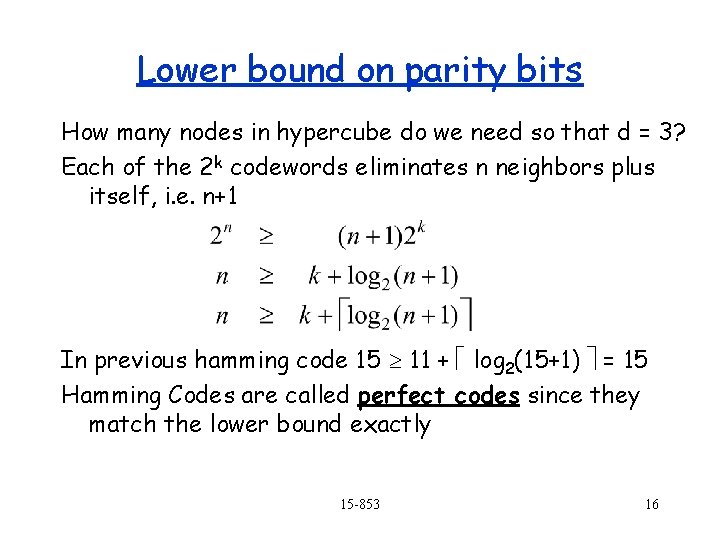
Lower bound on parity bits How many nodes in hypercube do we need so that d = 3? Each of the 2 k codewords eliminates n neighbors plus itself, i. e. n+1 In previous hamming code 15 11 + log 2(15+1) = 15 Hamming Codes are called perfect codes since they match the lower bound exactly 15 -853 16
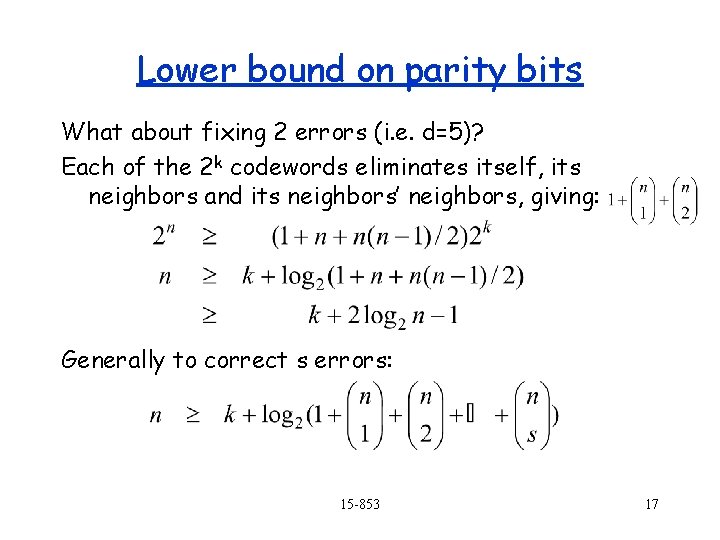
Lower bound on parity bits What about fixing 2 errors (i. e. d=5)? Each of the 2 k codewords eliminates itself, its neighbors and its neighbors’ neighbors, giving: Generally to correct s errors: 15 -853 17
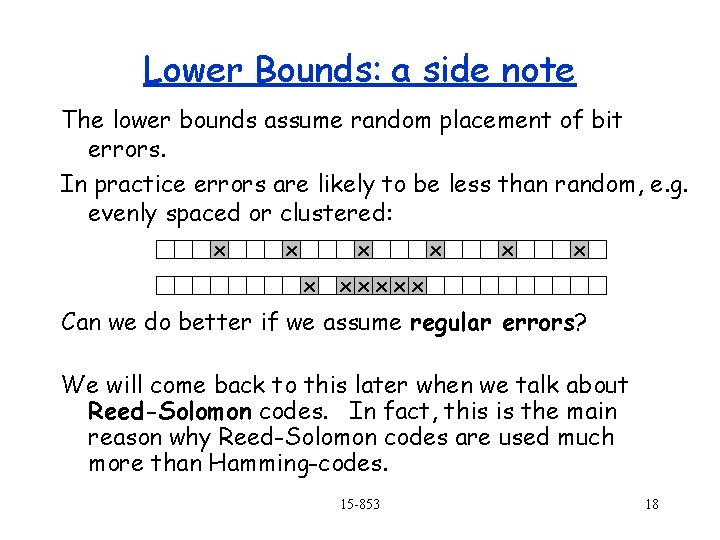
Lower Bounds: a side note The lower bounds assume random placement of bit errors. In practice errors are likely to be less than random, e. g. evenly spaced or clustered: x x x xxxxx Can we do better if we assume regular errors? We will come back to this later when we talk about Reed-Solomon codes. In fact, this is the main reason why Reed-Solomon codes are used much more than Hamming-codes. 15 -853 18
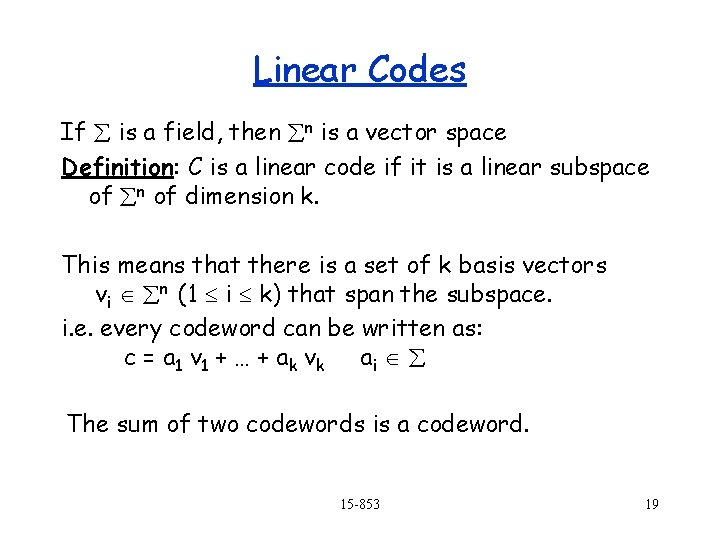
Linear Codes If is a field, then n is a vector space Definition: C is a linear code if it is a linear subspace of n of dimension k. This means that there is a set of k basis vectors vi n (1 i k) that span the subspace. i. e. every codeword can be written as: c = a 1 v 1 + … + a k vk a i The sum of two codewords is a codeword. 15 -853 19
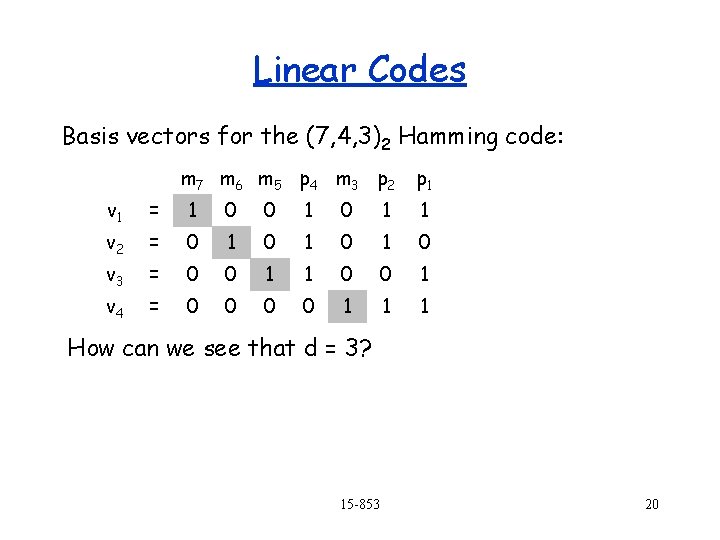
Linear Codes Basis vectors for the (7, 4, 3)2 Hamming code: m 7 m 6 m 5 p 4 m 3 p 2 p 1 v 1 = 1 0 0 1 1 v 2 = 0 1 0 1 0 v 3 = 0 0 1 1 0 0 1 v 4 = 0 0 1 1 1 How can we see that d = 3? 15 -853 20
Generator and Parity Check Matrices Generator Matrix: A k x n matrix G such that: C = {x. G | x k} Made from stacking the basis vectors Parity Check Matrix: An (n – k) x n matrix H such that: C = {y n | Hy. T = 0} Codewords are the nullspace of H These always exist for linear codes 15 -853 21
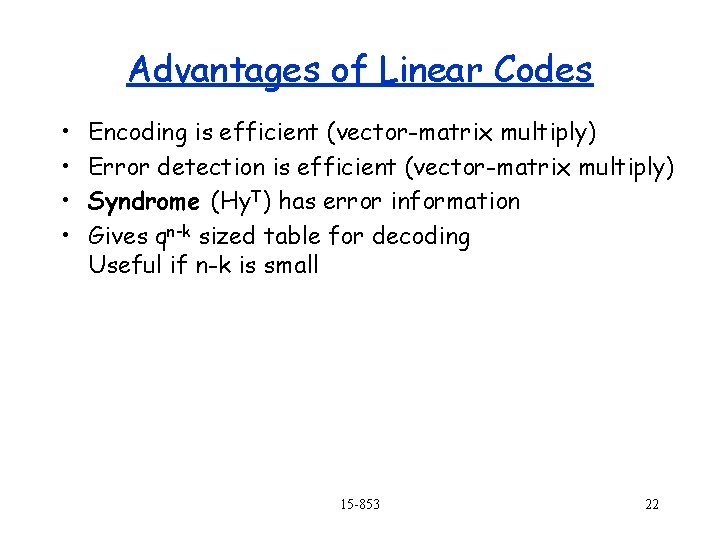
Advantages of Linear Codes • • Encoding is efficient (vector-matrix multiply) Error detection is efficient (vector-matrix multiply) Syndrome (Hy. T) has error information Gives qn-k sized table for decoding Useful if n-k is small 15 -853 22
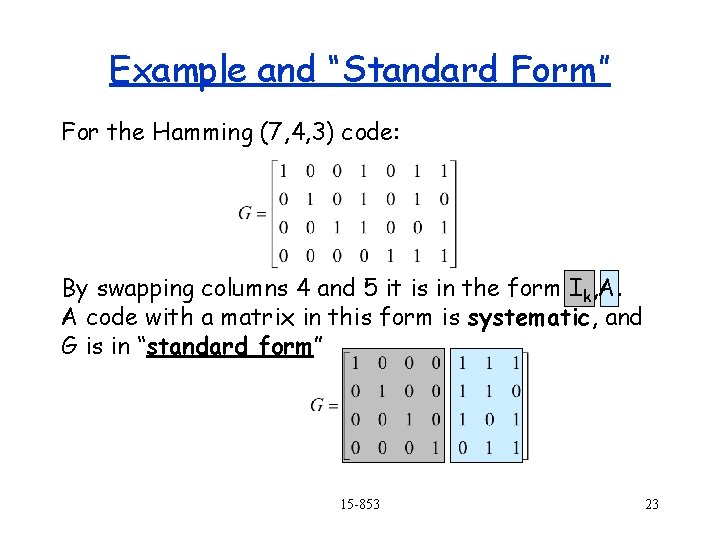
Example and “Standard Form” For the Hamming (7, 4, 3) code: By swapping columns 4 and 5 it is in the form Ik, A. A code with a matrix in this form is systematic, and G is in “standard form” 15 -853 23
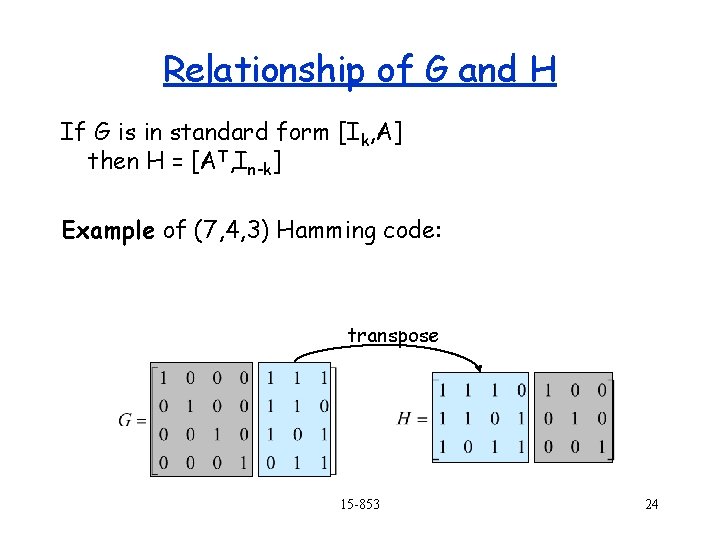
Relationship of G and H If G is in standard form [Ik, A] then H = [AT, In-k] Example of (7, 4, 3) Hamming code: transpose 15 -853 24
Proof that H is a Parity Check Matrix Suppose that x is a message. Then H(x. G)T = H(GTx. T) = (HGT)x. T = (ATIk+In-k. AT)x. T = (A T + AT)x. T = 0 Now suppose that Hy. T = 0. Then ATi, * y. T[1. . k] + y. Tk+i = 0 (where ATi, * is row i of AT and y. T[1. . k] are the first k elements of y. T]) for 1 i n-k. Thus, y[1. . k] A*, i = yk+i where A*, i is now column i of A, and y[1. . k] are the first k elements of y, so y[k+1…n] = y[1. . k]A. Consider x = y[1. . k]. Then x. G = [y [1. . k] | y[1. . k]A] = y. Hence if Hy. T = 0, y is the codeword for x = y[1. . k]. 15 -853 25
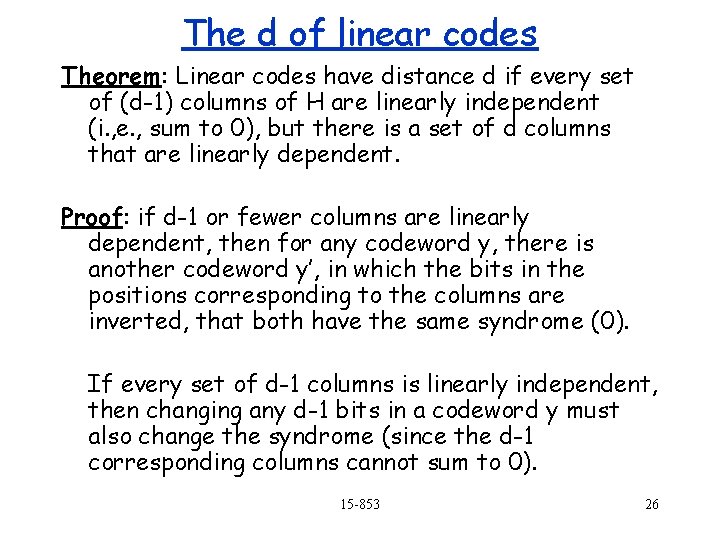
The d of linear codes Theorem: Linear codes have distance d if every set of (d-1) columns of H are linearly independent (i. , e. , sum to 0), but there is a set of d columns that are linearly dependent. Proof: if d-1 or fewer columns are linearly dependent, then for any codeword y, there is another codeword y’, in which the bits in the positions corresponding to the columns are inverted, that both have the same syndrome (0). If every set of d-1 columns is linearly independent, then changing any d-1 bits in a codeword y must also change the syndrome (since the d-1 corresponding columns cannot sum to 0). 15 -853 26
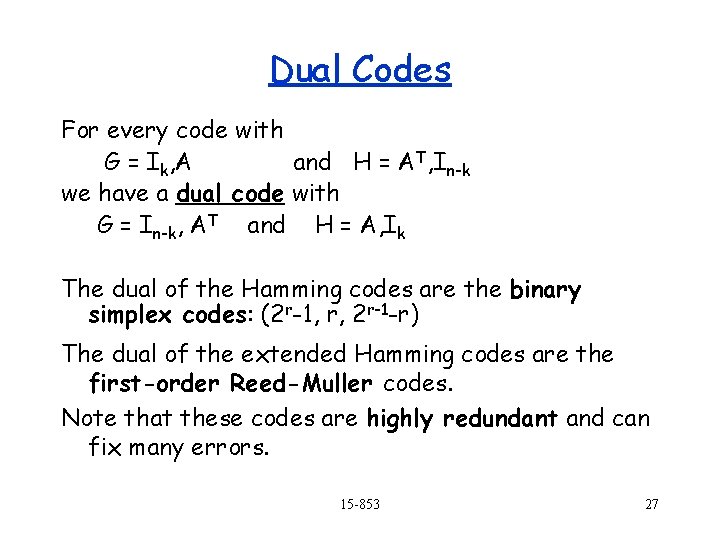
Dual Codes For every code with G = Ik, A and H = AT, In-k we have a dual code with G = In-k, AT and H = A, Ik The dual of the Hamming codes are the binary simplex codes: (2 r-1, r, 2 r-1 -r) The dual of the extended Hamming codes are the first-order Reed-Muller codes. Note that these codes are highly redundant and can fix many errors. 15 -853 27
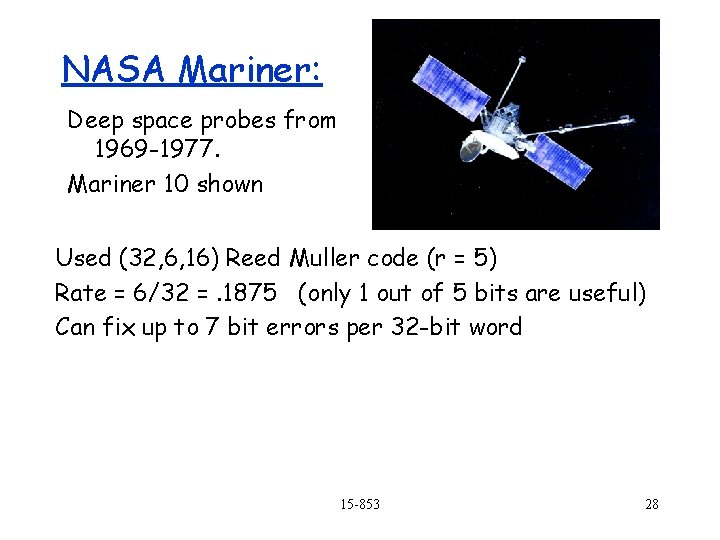
NASA Mariner: Deep space probes from 1969 -1977. Mariner 10 shown Used (32, 6, 16) Reed Muller code (r = 5) Rate = 6/32 =. 1875 (only 1 out of 5 bits are useful) Can fix up to 7 bit errors per 32 -bit word 15 -853 28
How to find the error locations Hy. T is called the syndrome (no error if 0). In general we can find the error location by creating a table that maps each syndrome to a set of error locations. Theorem: assuming s 2 d-1 every syndrome value corresponds to a unique set of error locations. Proof: Exercise. Table has qn-k entries, each of size at most n (i. e. keep a bit vector of locations). 15 -853 29