15 853 Algorithms in the Real World Computational

- Slides: 12
15 -853: Algorithms in the Real World Computational Biology IV – Multiple Sequence Alignment 15 -853 1
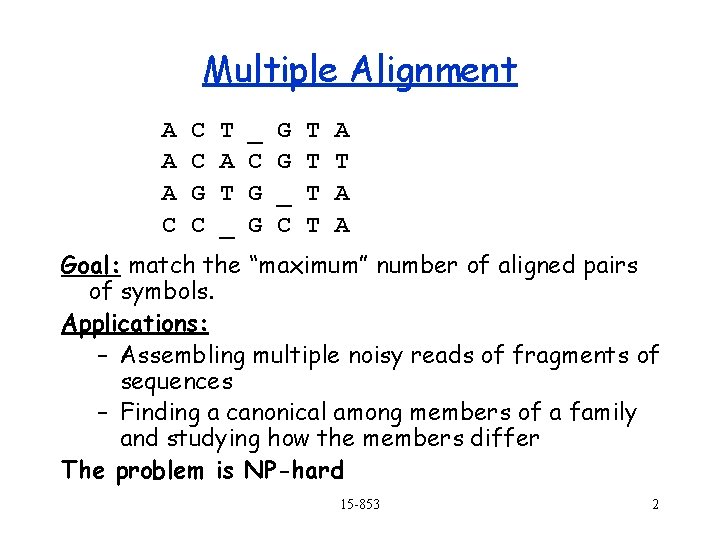
Multiple Alignment A A A C C C G C T A T _ _ C G G _ C T T A T A A Goal: match the “maximum” number of aligned pairs of symbols. Applications: – Assembling multiple noisy reads of fragments of sequences – Finding a canonical among members of a family and studying how the members differ The problem is NP-hard 15 -853 2
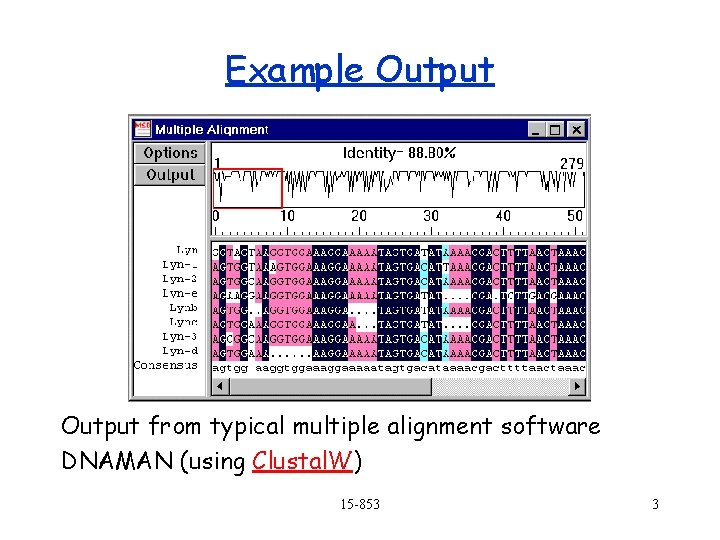
Example Output from typical multiple alignment software DNAMAN (using Clustal. W) 15 -853 3
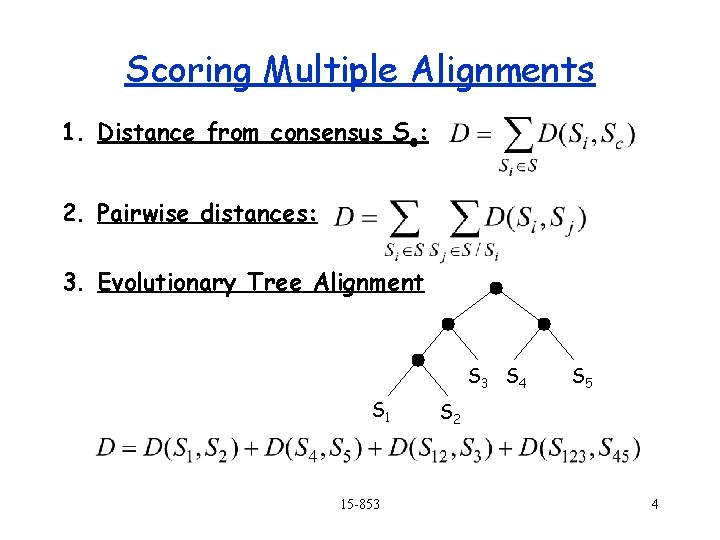
Scoring Multiple Alignments 1. Distance from consensus Sc: 2. Pairwise distances: 3. Evolutionary Tree Alignment S 3 S 4 S 1 15 -853 S 5 S 2 4
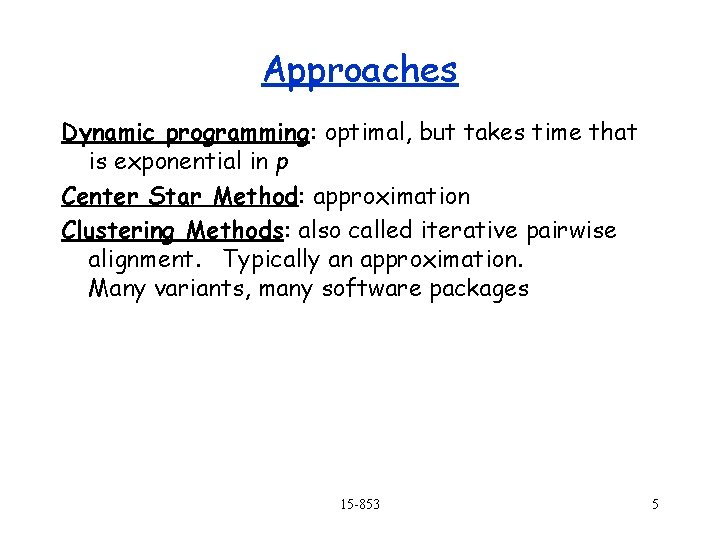
Approaches Dynamic programming: optimal, but takes time that is exponential in p Center Star Method: approximation Clustering Methods: also called iterative pairwise alignment. Typically an approximation. Many variants, many software packages 15 -853 5
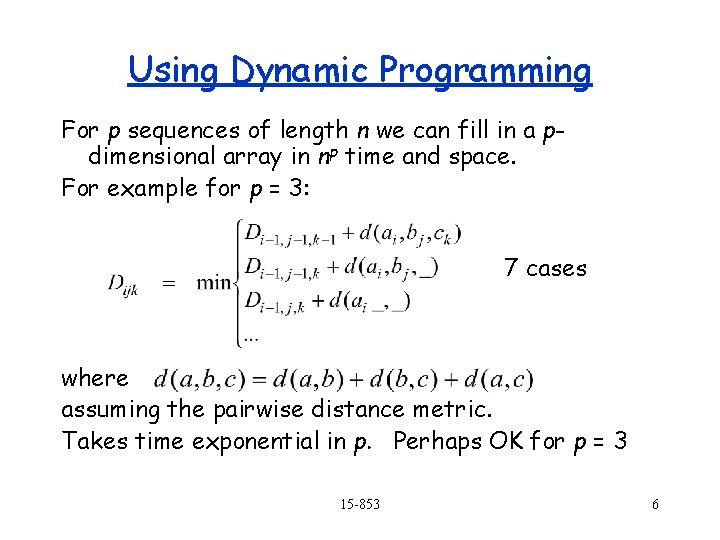
Using Dynamic Programming For p sequences of length n we can fill in a pdimensional array in np time and space. For example for p = 3: 7 cases where assuming the pairwise distance metric. Takes time exponential in p. Perhaps OK for p = 3 15 -853 6
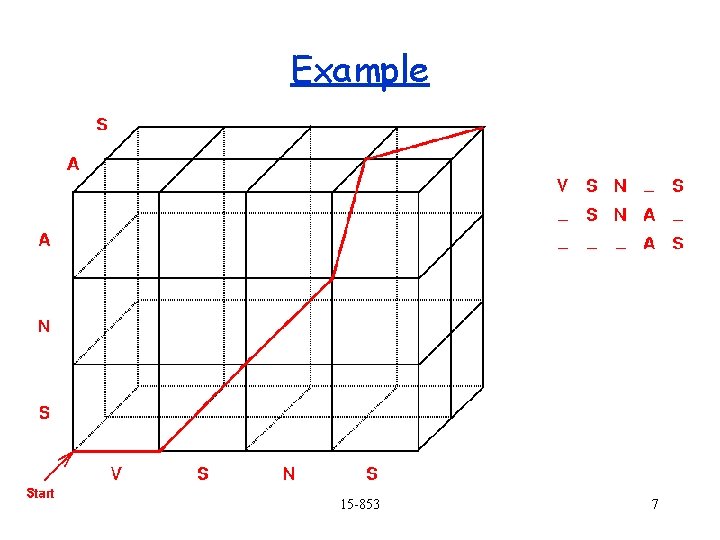
Example 15 -853 7
Optimization As in the case of pairwise alignment we can view the array as a graph and find shortest paths. Used in a program called MSA. Can align 6 strings consisting of 200 bp each in a “practical” amount of time. 15 -853 8
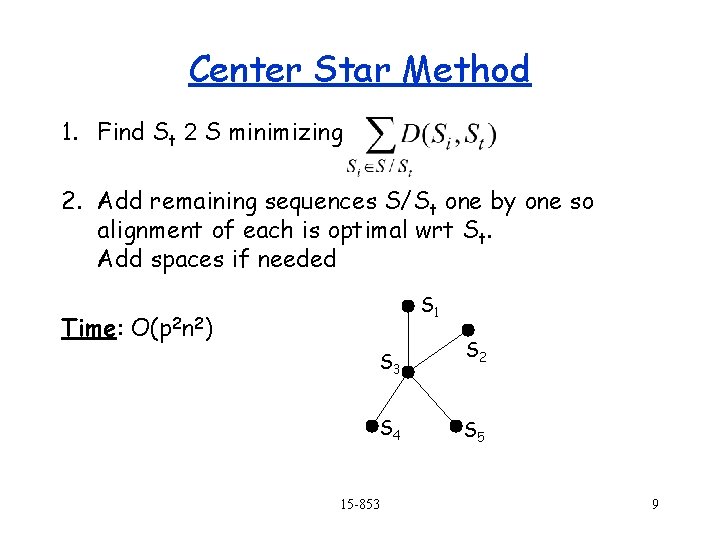
Center Star Method 1. Find St 2 S minimizing 2. Add remaining sequences S/St one by one so alignment of each is optimal wrt St. Add spaces if needed S 1 Time: O(p 2 n 2) S 3 S 4 15 -853 S 2 S 5 9
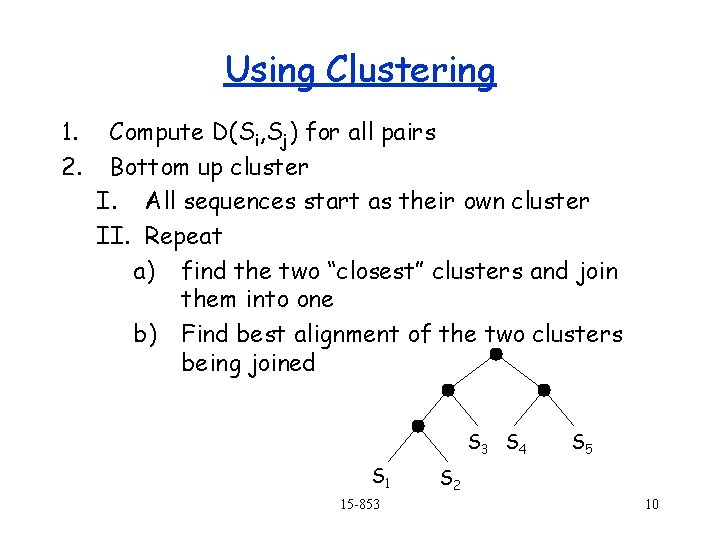
Using Clustering 1. 2. Compute D(Si, Sj) for all pairs Bottom up cluster I. All sequences start as their own cluster II. Repeat a) find the two “closest” clusters and join them into one b) Find best alignment of the two clusters being joined S 3 S 4 S 1 15 -853 S 5 S 2 10
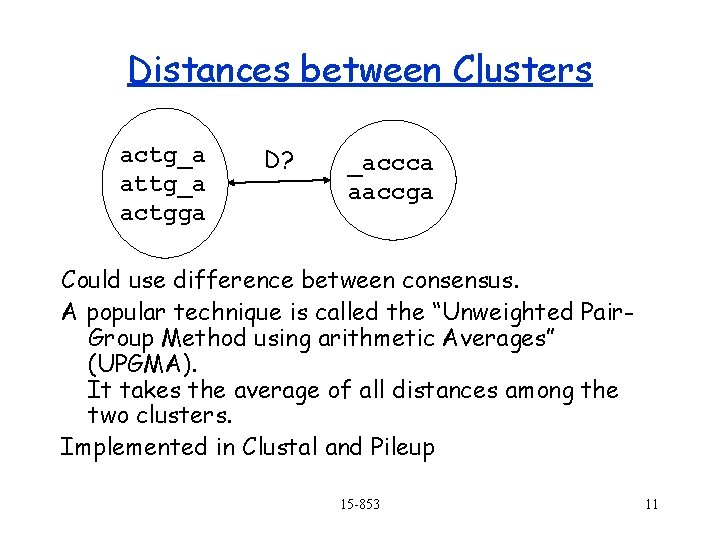
Distances between Clusters actg_a attg_a actgga D? _accca aaccga Could use difference between consensus. A popular technique is called the “Unweighted Pair. Group Method using arithmetic Averages” (UPGMA). It takes the average of all distances among the two clusters. Implemented in Clustal and Pileup 15 -853 11
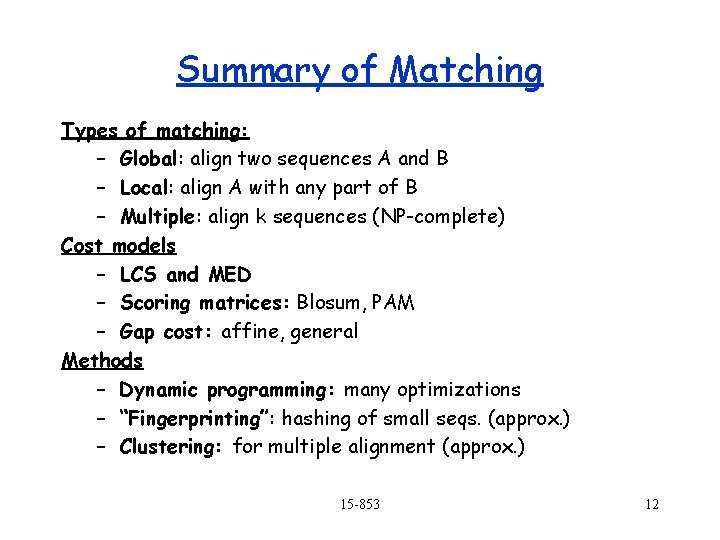
Summary of Matching Types of matching: – Global: align two sequences A and B – Local: align A with any part of B – Multiple: align k sequences (NP-complete) Cost models – LCS and MED – Scoring matrices: Blosum, PAM – Gap cost: affine, general Methods – Dynamic programming: many optimizations – “Fingerprinting”: hashing of small seqs. (approx. ) – Clustering: for multiple alignment (approx. ) 15 -853 12