1 DEPARTMENT OF PSYCHOLOGY EDUCATION UNIVERSITY OF EDUCATION






- Slides: 78
1 DEPARTMENT OF PSYCHOLOGY & EDUCATION UNIVERSITY OF EDUCATION, WINNEBA COURSE OUTLINE FOR EDC 242 TRENDS IN EDUCATION & SCHOOL MANAGEMENT IN GHANA FIRST SEMESTER DAMPSON DANDY GEORGE
COURSE OUTLINE 2 COURSE TITLE: Trends in Education & School Management in Ghana COURSE CODE: EDC 242 CREDIT HOURS: 3 VENUE: North Assembly Hall TIME: 1: 30 – 3: 30 GROUPS: French Education, HPERS, & Science Education DAMPSON DANDY GEORGE
COURSE DESCRIPTION 3 This course is designed to expose: students to theoretical and practical bases of educational administration and management with special reference to Ghana. It examines the meanings and purposes of educational administration and the role of the school administrator in school DAMPSON DANDY GEORGE management.
Cont; 4 This course will equip students with the basic and relevant management techniques to run schools more effectively. Students will also be exposed to the nature of Ghana’s education system and contemporary issues in education, including school-community relationship. DAMPSON DANDY GEORGE
COURSE OBJECTIVES 5 This course will: Enable students to understand the nature and purpose of educational administration, leadership and management. Equip students with the relevant knowledge and skills in educational leadership. DAMPSON DANDY GEORGE
Cont; 6 Expose students to some contemporary issues relating to the management of schools. Enable students to manage human resource effectively. DAMPSON DANDY GEORGE
COURSE CONTENT 7 The nature and purpose of educational administration and management The meaning of administration, leadership and management Functions of the administrator /manager (POSDCORD) DAMPSON DANDY GEORGE
Cont; 8 Nature of Organization Leadership theories and styles Characteristics of an effective leader Administrative tasks/duties of school head DAMPSON DANDY GEORGE
MANAGEMENT SKILLS 9 Motivation theories Time management Decision-making in educational organizations Communication in educational organizations DAMPSON DANDY GEORGE
OTHER MANAGEMENTRELATED ISSUSES 10 Organizational climate School-community relationship DAMPSON DANDY GEORGE
11 LEARNING AND TEACHING STRATEGIES There will be a mixture of lectures (including Radio lectures), presentations and tutorial support. DAMPSON DANDY GEORGE
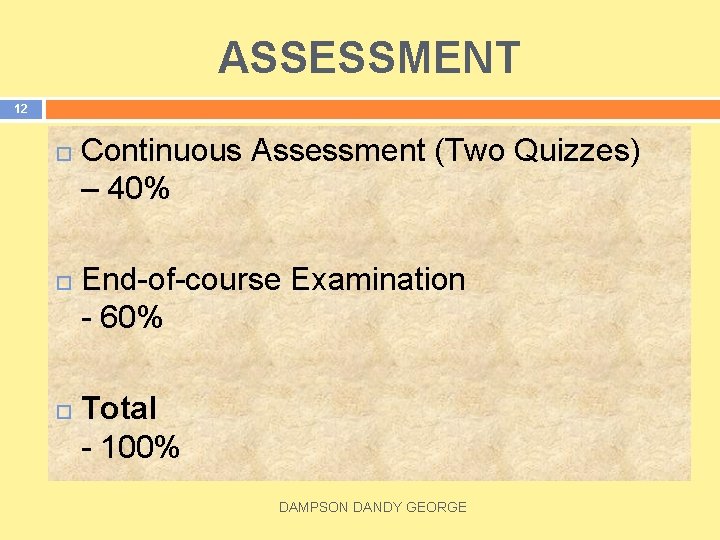
ASSESSMENT 12 Continuous Assessment (Two Quizzes) – 40% End-of-course Examination - 60% Total - 100% DAMPSON DANDY GEORGE
13 1. MEANING & BASES FOR LEADERSHIP 2. MEANING OF ADMINISTRATION 3. MEANING OF MANAGEMENT DAMPSON DANDY GEORGE LEADERSHIP, ADMINISTRATION AND MANAGEMENT
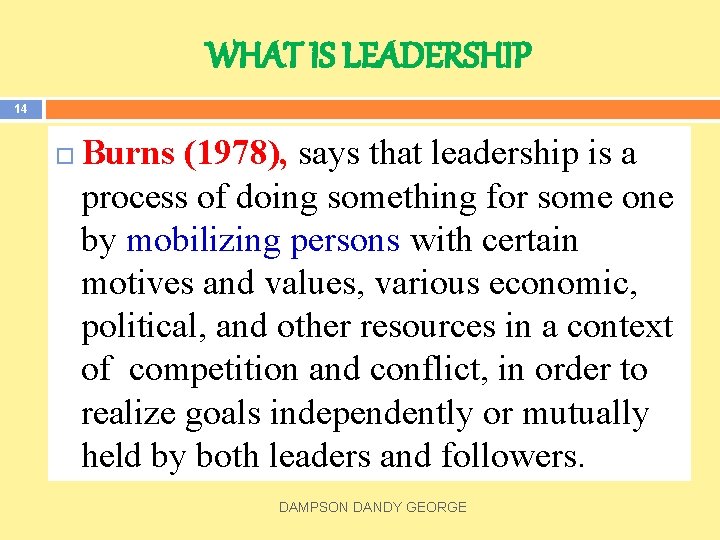
WHAT IS LEADERSHIP 14 Burns (1978), says that leadership is a process of doing something for some one by mobilizing persons with certain motives and values, various economic, political, and other resources in a context of competition and conflict, in order to realize goals independently or mutually held by both leaders and followers. DAMPSON DANDY GEORGE
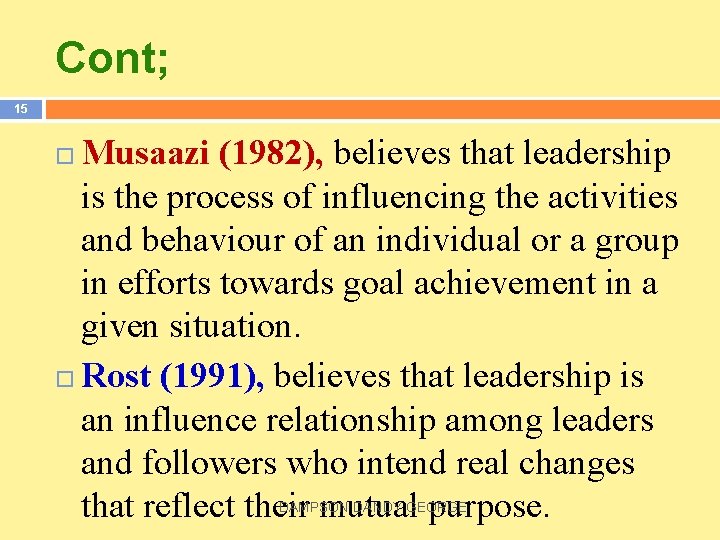
Cont; 15 Musaazi (1982), believes that leadership is the process of influencing the activities and behaviour of an individual or a group in efforts towards goal achievement in a given situation. Rost (1991), believes that leadership is an influence relationship among leaders and followers who intend real changes that reflect their mutual purpose. DAMPSON DANDY GEORGE
Cont; 16 Gardener (1995), states that leaders are individuals who affect the thoughts, feelings and behaviours of a significant number of individual. He stressed that the leader must be an educator, bridging the gap between the vision and the familiar and must be ready to walk alone to enable the society to follow the path he has selected. DAMPSON DANDY GEORGE
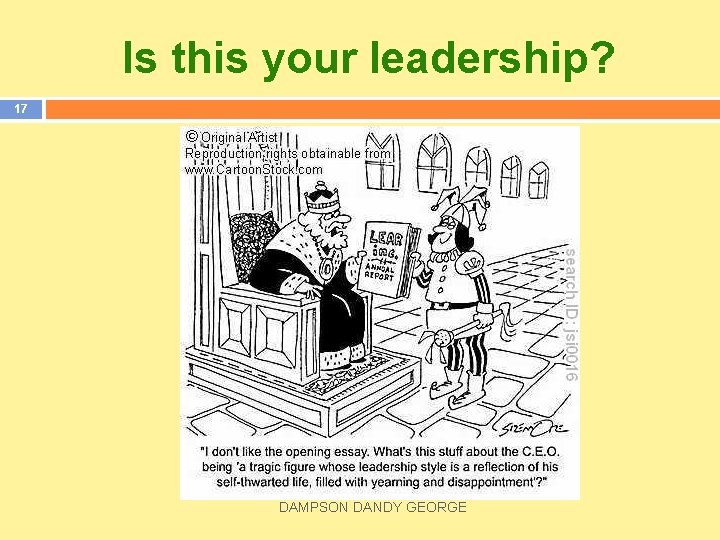
Is this your leadership? 17 DAMPSON DANDY GEORGE
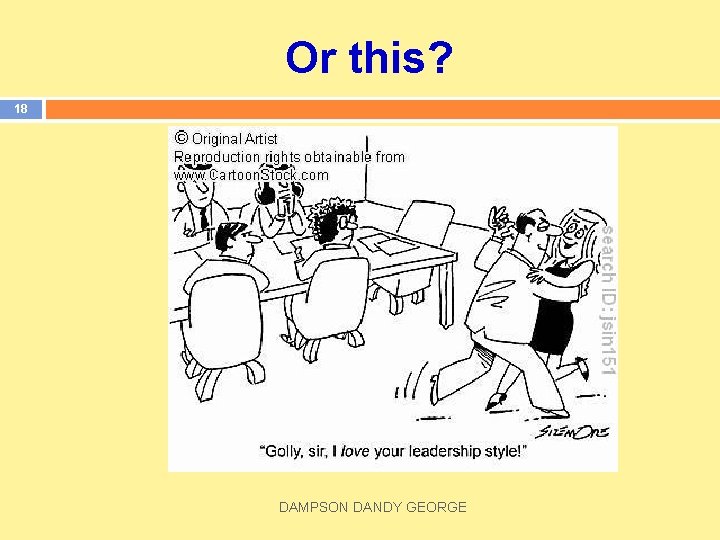
Or this? 18 DAMPSON DANDY GEORGE
Cont; 19 So, leadership has the following: Affect individual Affect feelings, emotions, thought and behaviours Mobilize people Common goal achievement Mutual purpose Real change DAMPSON DANDY GEORGE
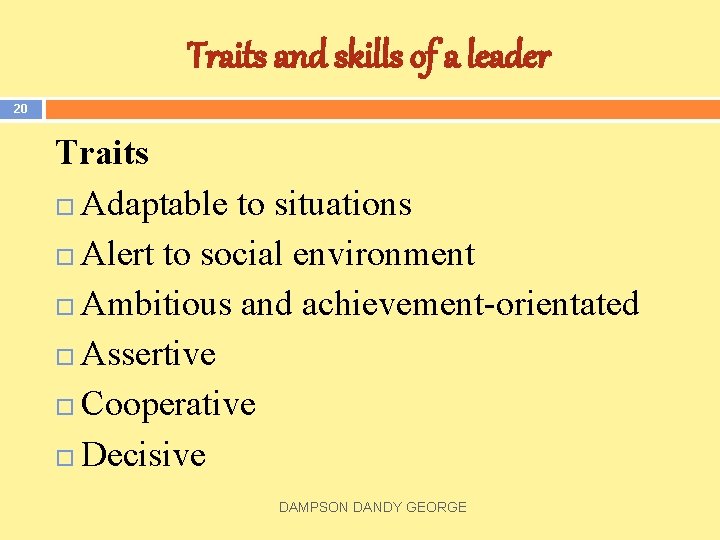
Traits and skills of a leader 20 Traits Adaptable to situations Alert to social environment Ambitious and achievement-orientated Assertive Cooperative Decisive DAMPSON DANDY GEORGE
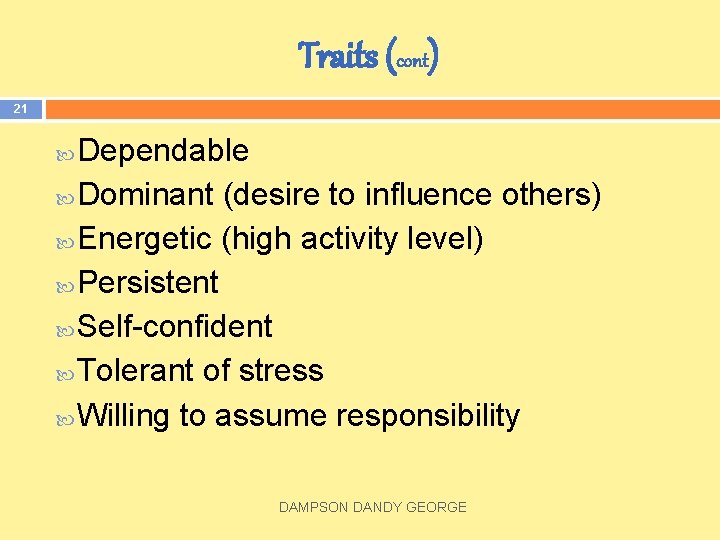
Traits (cont) 21 Dependable Dominant (desire to influence others) Energetic (high activity level) Persistent Self-confident Tolerant of stress Willing to assume responsibility DAMPSON DANDY GEORGE
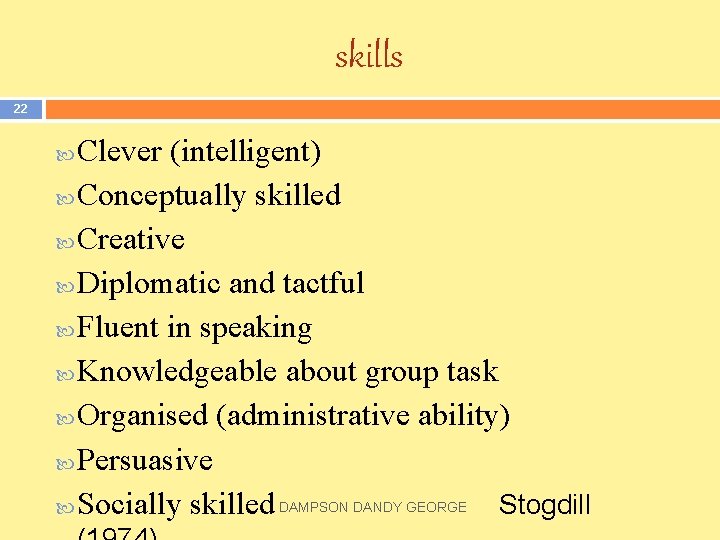
skills 22 Clever (intelligent) Conceptually skilled Creative Diplomatic and tactful Fluent in speaking Knowledgeable about group task Organised (administrative ability) Persuasive Socially skilled DAMPSON DANDY GEORGE Stogdill
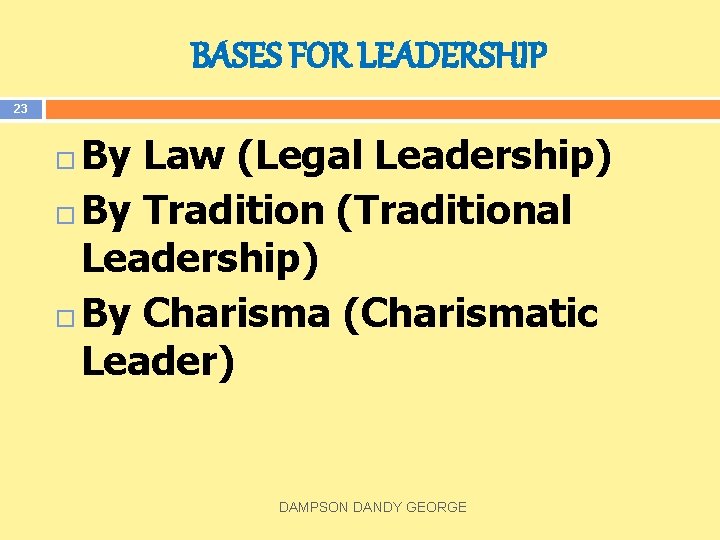
BASES FOR LEADERSHIP 23 By Law (Legal Leadership) By Tradition (Traditional Leadership) By Charisma (Charismatic Leader) DAMPSON DANDY GEORGE
LEGAL LEADERSHIP 24 This is also known as rational leadership and the one who holds this position is backed fundamentally and primarily by law. In a typical secondary school, and the basic school situation in Ghana, we can see this kind of leadership. This is because the school being a formal organization is guided and controlled by a set of principles, laws and rules. DAMPSON DANDY GEORGE
TRADITIONAL LEADERSHIP 25 This is the leadership that has its fundamental basis not primarily in the legal system of the formal organization, nor mainly in the charismatic nature of the candidate, but rather in the traditional status quo. One key characteristics which is unique with this type of leadership is that its inheritance by lineage; in certain tribes or clans through patrilineal links and in others the matrilineal DAMPSON DANDY GEORGE
CHARISTMATIC LEADERSHIP 26 The basis of charismatic leadership is in the charisma of the leader who may initially not have any legal or traditional basis for leadership. This type of leadership has it basis in the people’s devotion to an extraordinary individual who is leader by virtue of personal trust in him and his exemplary qualities. The leader has a special and unique duty to fulfil for the revolutionary change of the social order. DAMPSON DANDY GEORGE
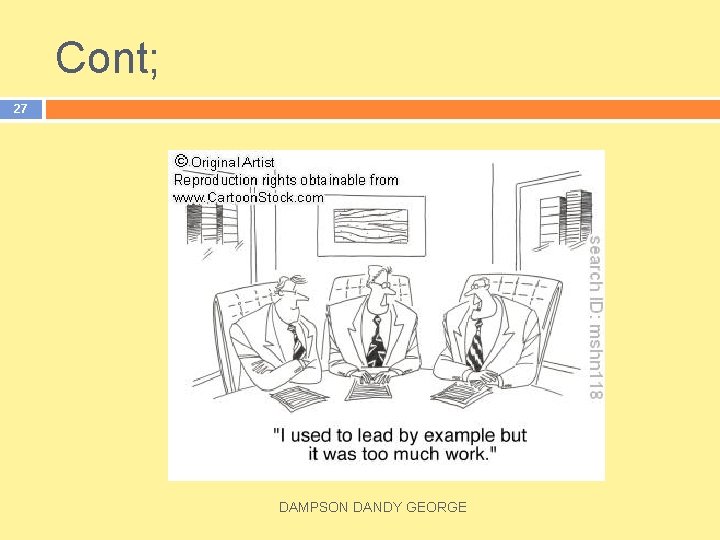
Cont; 27 DAMPSON DANDY GEORGE
POWER 28 Power is the ability to do something, or act upon oneself, another individual or a thing. Power is the inner strength that enables a person to carry out their wishes or beliefs in spite of the possible disapproval of others. It is the ability to affect something or someone with force or character or strength. Power may be sought, and when it is obtained, can be used to accomplish a multitude of things, positive and negative. Power may be manifested in several ways in a given organization. DAMPSON DANDY GEORGE
TYPES OF POWER 29 LEGAL POWER EXPERT POWER REWARD POWER REFERENT POWER COERCIVE POWER DAMPSON DANDY GEORGE
Cont; 30 Legal Power: the basis of this power is not questioned by most people in society. The population has a believe that by virtue of office, the leader has been given certain rights to lead, and should be followed. Agreeing to belong to the organization is tantamount to signing a contract to recognize and summit to the power of the leader. Legal power is at the core of the stability of the formal DAMPSON DANDY GEORGE
Is this your legal power? 31 DAMPSON DANDY GEORGE
Cont; 32 Expert Power: this type of power has its basis in the people’s belief in and recognition of certain unique talents or skills which the leader has to enable him accomplish the goals of the organization in ways not possible by the ordinary staff. In the DAMPSON DANDY GEORGE
Is this your expert power? 33 DAMPSON DANDY GEORGE
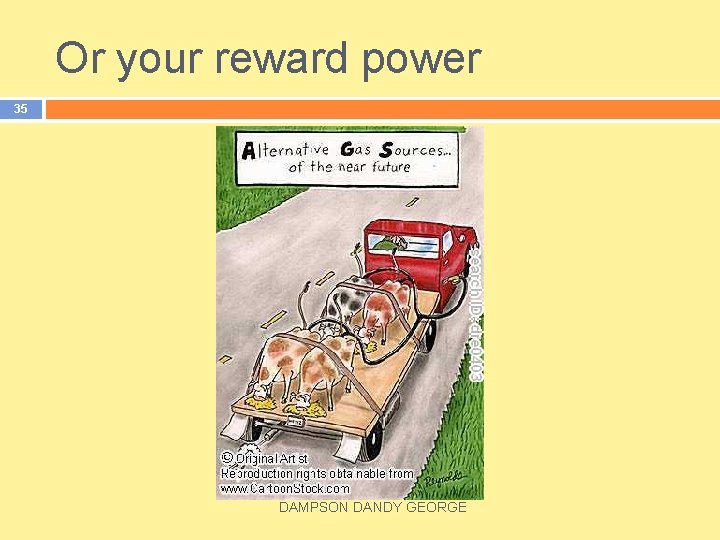
Cont; 34 Reward Power: the basis of this power resides in the belief of the member organization that if they behave in certain way, or do certain things, the system or organization will reward them. In this case, they accept to obey the dictates of the leader, in hopes of DAMPSON DANDY GEORGE
Or your reward power 35 DAMPSON DANDY GEORGE
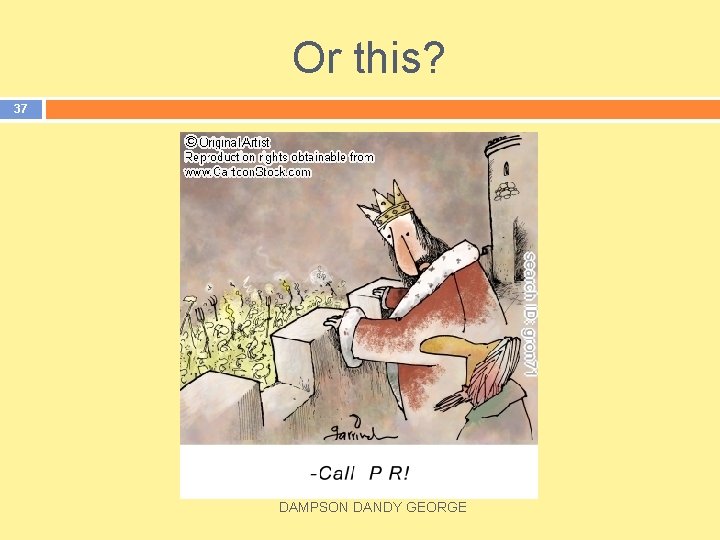
Cont; 36 Referent Power: it has is basis in the common people’s belief that this individual possesses certain outstanding and rare characteristics which are attractive and with which they want to be identify. It may also be referred to as charismatic power. DAMPSON DANDY GEORGE
Or this? 37 DAMPSON DANDY GEORGE
Cont; 38 Coercive Power (force): members of the organization or a group of them will develop the strong belief that they must obey and do exactly what the leader wants lest they suffer severe punishment. Coercive power is that which intimidates and reduces the human person within the organization to the state of a slave, an object who sees his primary task as that of pleasing the leader. DAMPSON DANDY GEORGE
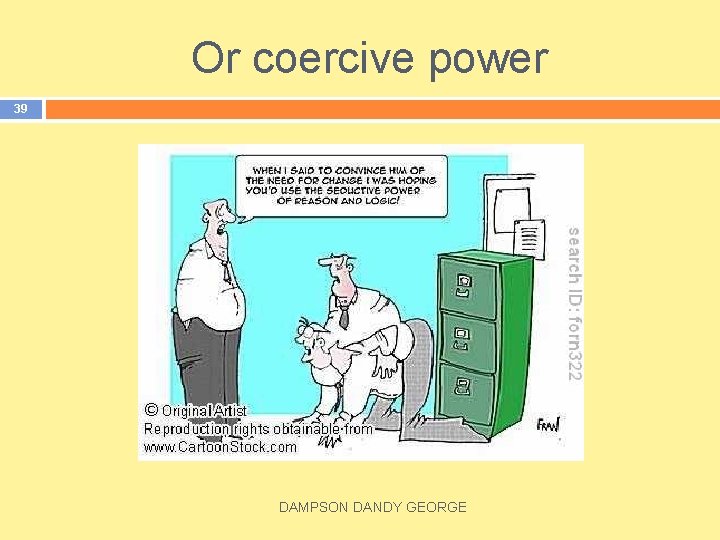
Or coercive power 39 DAMPSON DANDY GEORGE
WHAT IS ADMINISTRATION 40 The word “administration” is from the Latin word “minister” meaning servant or slave. Therefore, administration has to do with the identification, maintaining, motivating, controlling, and the unification of human and material resources within an organization to achieve a common goal. DAMPSON DANDY GEORGE
Cont; 41 Administration can also be considered as the careful and systematic arrangements and use of resources (human & material), situations and opportunities for the achievement of the specific objectives of a given organization. (Nwankwo, 1987) To Gulick & Urwick, administration is a process of getting things done through the effort of others in goal achievement. DAMPSON DANDY GEORGE
Cont; 42 According to Walton (1996), administration is an activity that concerns it self with the survival and maintenance of an organization. In simple term, administration is where the seven functions of a chief executive is executed. DAMPSON DANDY GEORGE
What then is Educational Administration 43 Nwankwo (1987), defined educational administration as the systematic arrangement of human and material resources and programmes that are available for education and carefully using them systematically within defined guidelines or policies to achieve educational goals. DAMPSON DANDY GEORGE
Cont; 44 Educational administration is the process of providing instructional leadership, management of the day-to-day activities, setting educational standards and goals, establishing policies and procedures required to achieve them in schools, preschools, day care centres, colleges and universities. DAMPSON DANDY GEORGE
Some basic functions 45 Educational Administrators typically performs the following basic functions: develop academic programs, monitor students’ educational progress, train and motivate teachers and other staff, manage career counselling and other student services, administer recordkeeping, prepare budgets. DAMPSON DANDY
Cont; 46 They also handle relations with parents, prospective and current students, employers, and the community. They set the academic tone and work actively with teachers to develop and maintain high curriculum standards, formulate mission statements, and establish performance goals and objectives. DAMPSON DANDY GEORGE
WHAT IS MANAGEMENT 47 Management is the process by which managers create, direct, maintain and operate purposive organizations through systematic, co-ordinated and cooperative human effort. (Forland, 1998) Management refers to a set of functions which unite group efforts in a meaningful manner. DAMPSON DANDY GEORGE
Cont; 48 Management is the art of getting things done through people. (Follett, 1996). Management is the organization and coordination of the activities of an enterprise in accordance with certain policies and in achievement of defined objectives. (Drucker, 2005) DAMPSON DANDY GEORGE
What is educational management 49 Educational management is concerned with the planning and formulation of educational policies or programmes with a view to achieving educational goals. The process of deciding on the aims and goal setting of the institution/school. In some settings, aims are decided by the principal, often working in association with senior colleagues and perhaps a small group of lay DAMPSON DANDY GEORGE stakeholders. (Bush 2003)
CONCLUSION 50 The ways in which managers influence their employees and encourage them to be productive depend on many variables, including the personality of the leader, the skills of the group/employees, the task or assignment at hand, or the group dynamics and personalities of group members. DAMPSON DANDY GEORGE
Cont; 51 As with leadership, each base of power has its place in management and can prove effective in the right setting and right circumstances. There are four major factors of leadership that we need to take with us as student if we want to become effective leaders. We need to: DAMPSON DANDY GEORGE
Cont; 52 a. b. Be a leader: You must have an honest understanding of who you are, what you know, and what you can do. Know your followers: Different people require different styles of leadership. You must know your people! The fundamental starting point is having a good understanding of human nature, DAMPSON DANDY GEORGE
Cont; 53 … such as needs, emotions, and motivation. You must come to know your employees' be, know, and do attributes. c. Communication: You lead through two -way communication. Much of it is nonverbal and verbal. What and how you communicate either builds or harms the relationship between you and your employees. DAMPSON DANDY GEORGE
Cont; 54 d. Situations: All situations are different. What you do in one situation will not always work in another. You must use your judgment to decide the best course of action and the leadership style needed for each situation. DAMPSON DANDY GEORGE
QUIZ ONE 55 State five (5) differences between an administrator and a manager. Five minutes DAMPSON DANDY GEORGE
NATURE OF ORGANIZATION 56 Definition of organization Characteristics of organization Types of organization The school as an organization DAMPSON DANDY GEORGE
WHAT IS AN ORGANIZATION 57 A social unit of people, systematically structured and managed to meet a need or to pursue collective goals on a continuing basis. A group of persons with a common objective" "A structured process in which individuals interact for objectives. DAMPSON DANDY GEORGE
Some Scholar’s definition 58 Russell (1938) describes an organization as a set of people who are combined by virtue of activities directed to common end. Simon (1955) teaches that organization is a tool that permits groups of human beings to aim at and … achieve goals that would be far beyond the reach of their powers as individual. DAMPSON DANDY GEORGE
Cont; 59 To Musaazi (1982) organizations are born when certain people have identified a common purpose, have been able to communicate with each other, and have shown willingness to contribute action. DAMPSON DANDY GEORGE
Cont; 60 "Every organized human activity -- from the making of pots to the placing of a man on the moon -- gives rise to two fundamental and opposing requirements: The division of labour into various tasks to be performed, and the coordination of these tasks to accomplish the activity" (Mintzberg, 1983) DAMPSON DANDY GEORGE
CHARACTERISTICS OF AN ORGANIZATION 61 Organizations are fundamentally about people: It seeks to address the needs of the common member/community. It is however common to observe organizations growing so large and becoming so complex powerful that they shift their focus or end up engaging on goal displacement. They abandon their original objectives to seek more power and place greater emphasis on seeking for money. DAMPSON DANDY GEORGE
Cont; 62 Organization by nature is structural. That is to say they deal with structures as its sole existence rely on it. In organizations, members must have respect for, and make use of the structures that are put in place. Organizations across the globe possess structures which define their very nature, and which support them in their continuous efforts to survive, grow and progress. DAMPSON DANDY GEORGE
Cont; 63 All organizations, even informal ones, must have purpose. for it is a sense of purpose that brought the people together in the first place. These objectives/purposes/goals are termed as Mission Statements. Organization is all about team work: with different players functioning at different level within the group. DAMPSON DANDY GEORGE
Cont; 64 Organization must be provided with conditions: aimed at enhancing the effectiveness of the attainment of their goals, ie, Principle of natural justices. Eg, conditions of educational goal; there must be physical facilities, well-trained, experienced and qualified teachers, learners, visionary and loving administrators. DAMPSON DANDY GEORGE
Cont; 65 Proper planning and management: must be in place so that internal conflict will be reduced. Personal interest must not be confused with larger, communal organizational goals. There must be a system of leadership: There must be a system of leadership, management and administration in order to function properly, and to allow the organization to provide the services for which it was set up. DAMPSON DANDY GEORGE
TYPES OF ORGANIZATION 66 Formal organizations are setup with the clear purpose of arriving at specific goals and objectives, their existence is intentionally planned, their procedures and practices carefully arranged and they stand to be constantly evaluated, scrutinized based on whether or not and to what extent they are able to live up to their expectations. (Musaazi, 1984). DAMPSON DANDY GEORGE
Characteristics of formal organization 67 Deliberately planned and created Concerned with the co-ordination of activities Hierarchically structured with stated objectives Based on certain principles such as the specification of tasks DAMPSON DANDY GEORGE
Cont; 68 Organization structure is laid down by the top management to achieve organizational goals. Organization structure is based on division of labour and specialization to achieve efficiency in the operations. The organization does not take into consideration the sentiments of organizational members. DAMPSON DANDY GEORGE
Cont; 69 The authority and responsibility relationships created by the organization structure are to be honoured by everyone. Developed through delegation of authority Organization structure concentrates on the jobs to be performed and not the individuals who are to perform jobs. DAMPSON DANDY GEORGE
INFORMAL ORGANIZATION 70 Williams (1980) simply refers to an informal organization as “the actual groupings of human beings in an organization including all the interpersonal relationship, friendships and cliques that prevail in an organization. Gorton (1980) used the term to refer to a network of interpersonal associations which grow out of the social contacts and interactions of those members of formal organization. DAMPSON DANDY GEORGE
Cont; 71 Informal organizations they do not have clear-cut in their operations as formal organization. The origin of informal organization are sometimes very obscure (not well known), sometimes even spontaneous (not planned, out of a blue). Membership is gained unconsciously, although they could be consciously gained as well. Their goals are not specified but evolve (develop gradually) with time. DAMPSON DANDY GEORGE
Types of informal organization 72 There are basically three types of informal organization namely, Horizontal Clique Vertical Clique Mixed Clique DAMPSON DANDY GEORGE
Cont; 73 Horizontal Clique consist of workers who are of similar rank in the organization and who work in a common area. Vertical Clique often consist of higher-level employees-managers and supervisors who work in the same department. Mixed Clique is composed of employees of different ranks, departments and even different locations. DAMPSON DANDY GEORGE
Characteristics of informal organization 74 The informal organization is flexible and loosely structured Relationships may be left undefined Informal relationships, groupings & interactions Membership is spontaneous and with varying degrees of involvement DAMPSON DANDY GEORGE
Cont, 75 Involves two or more people Informal association precedes formal organization, as it requires preliminary (informal) contact and interaction before establishment Repeated contacts but without any conscious joint purpose DAMPSON DANDY GEORGE
Cont; 76 Involves the human need to socialize Includes both friendly and hostile relationships and interactions DAMPSON DANDY GEORGE
THE SCHOOL AS AN ORGANIZATION 77 What is a School? Can a school be considered as an organization? Or is an organization? Why? DAMPSON DANDY GEORGE
QUIZ 2 78 Is a school an organization? State five (5) reasons to support your answer. DAMPSON DANDY GEORGE