Writing Competitive Research Proposals UPRM Timothy M Pinkston

- Slides: 72
Writing Competitive Research Proposals UPRM Timothy M. Pinkston Professor, Sr. Assoc. Dean USC Viterbi School of Engineering
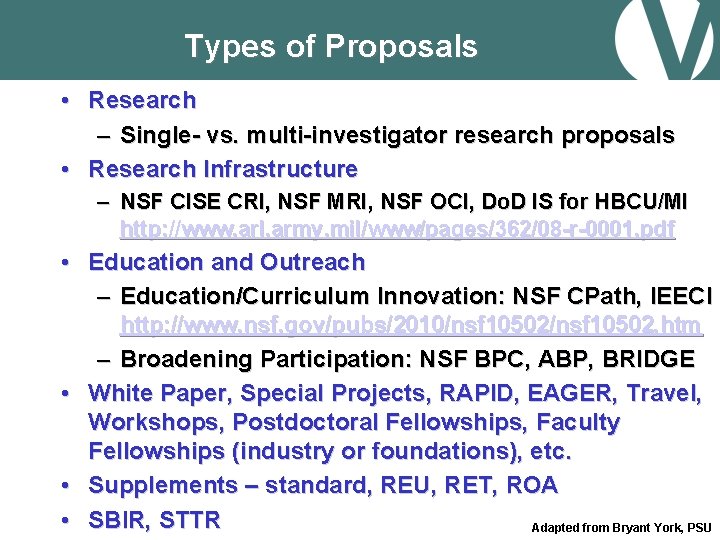
Types of Proposals • Research – Single- vs. multi-investigator research proposals • Research Infrastructure – NSF CISE CRI, NSF MRI, NSF OCI, Do. D IS for HBCU/MI http: //www. arl. army. mil/www/pages/362/08 -r-0001. pdf • Education and Outreach – Education/Curriculum Innovation: NSF CPath, IEECI http: //www. nsf. gov/pubs/2010/nsf 10502. htm – Broadening Participation: NSF BPC, ABP, BRIDGE • White Paper, Special Projects, RAPID, EAGER, Travel, Workshops, Postdoctoral Fellowships, Faculty Fellowships (industry or foundations), etc. • Supplements – standard, REU, RET, ROA • SBIR, STTR Adapted from Bryant York, PSU
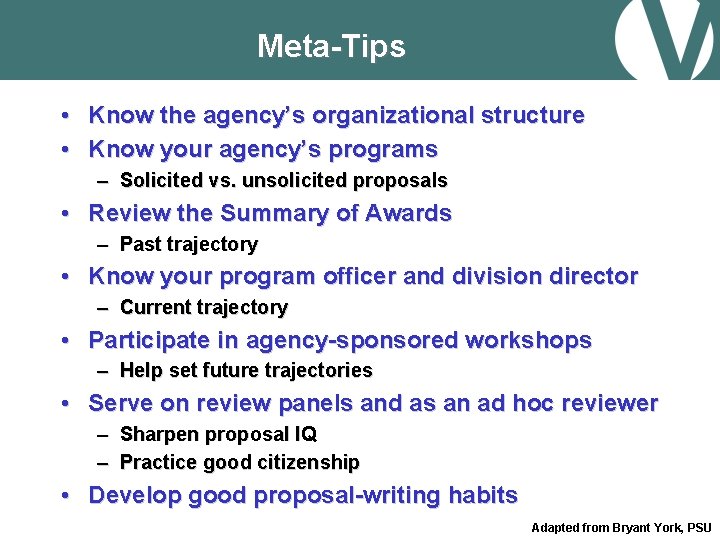
Meta-Tips • Know the agency’s organizational structure • Know your agency’s programs – Solicited vs. unsolicited proposals • Review the Summary of Awards – Past trajectory • Know your program officer and division director – Current trajectory • Participate in agency-sponsored workshops – Help set future trajectories • Serve on review panels and as an ad hoc reviewer – Sharpen proposal IQ – Practice good citizenship • Develop good proposal-writing habits Adapted from Bryant York, PSU
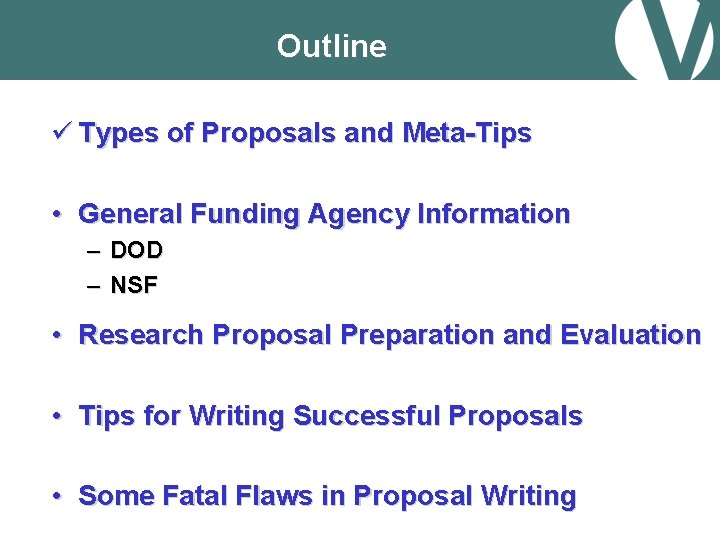
Outline ü Types of Proposals and Meta-Tips • General Funding Agency Information – DOD – NSF • Research Proposal Preparation and Evaluation • Tips for Writing Successful Proposals • Some Fatal Flaws in Proposal Writing
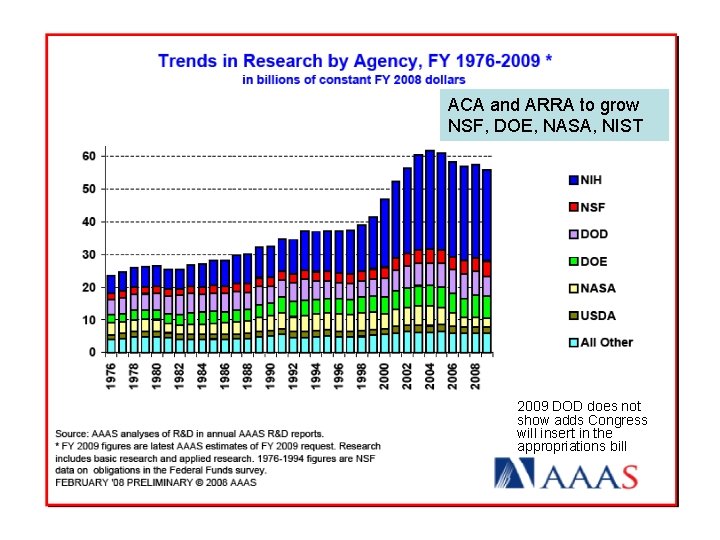
ACA and ARRA to grow NSF, DOE, NASA, NIST 2009 DOD does not show adds Congress will insert in the appropriations bill 5
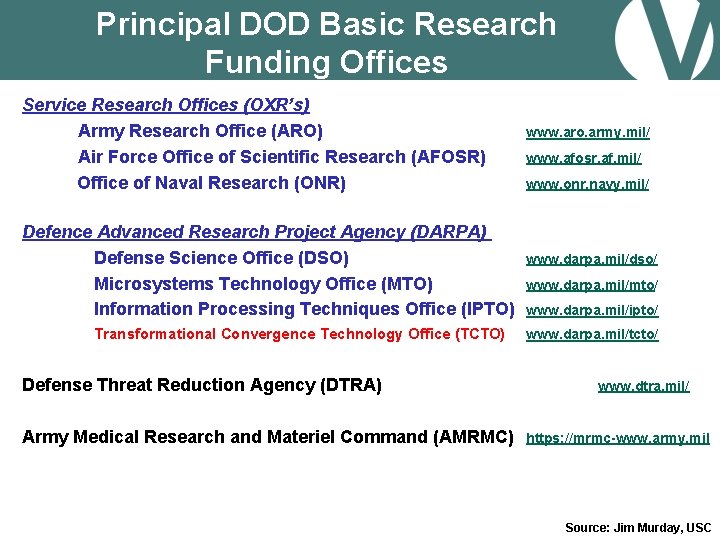
Principal DOD Basic Research Funding Offices Service Research Offices (OXR’s) Army Research Office (ARO) Air Force Office of Scientific Research (AFOSR) Office of Naval Research (ONR) Defence Advanced Research Project Agency (DARPA) Defense Science Office (DSO) Microsystems Technology Office (MTO) Information Processing Techniques Office (IPTO) Transformational Convergence Technology Office (TCTO) Defense Threat Reduction Agency (DTRA) Army Medical Research and Materiel Command (AMRMC) www. aro. army. mil/ www. afosr. af. mil/ www. onr. navy. mil/ www. darpa. mil/dso/ www. darpa. mil/mto/ www. darpa. mil/ipto/ www. darpa. mil/tcto/ www. dtra. mil/ https: //mrmc-www. army. mil Source: Jim Murday, USC
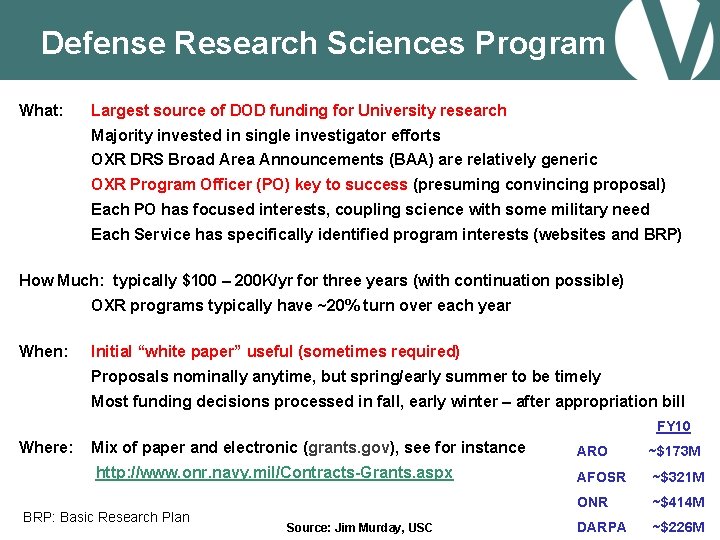
Defense Research Sciences Program What: Largest source of DOD funding for University research Majority invested in single investigator efforts OXR DRS Broad Area Announcements (BAA) are relatively generic OXR Program Officer (PO) key to success (presuming convincing proposal) Each PO has focused interests, coupling science with some military need Each Service has specifically identified program interests (websites and BRP) How Much: typically $100 – 200 K/yr for three years (with continuation possible) OXR programs typically have ~20% turn over each year When: Initial “white paper” useful (sometimes required) Proposals nominally anytime, but spring/early summer to be timely Most funding decisions processed in fall, early winter – after appropriation bill FY 10 Where: Mix of paper and electronic (grants. gov), see for instance http: //www. onr. navy. mil/Contracts-Grants. aspx BRP: Basic Research Plan Source: Jim Murday, USC ARO ~$173 M AFOSR ~$321 M ONR ~$414 M 7 DARPA ~$226 M
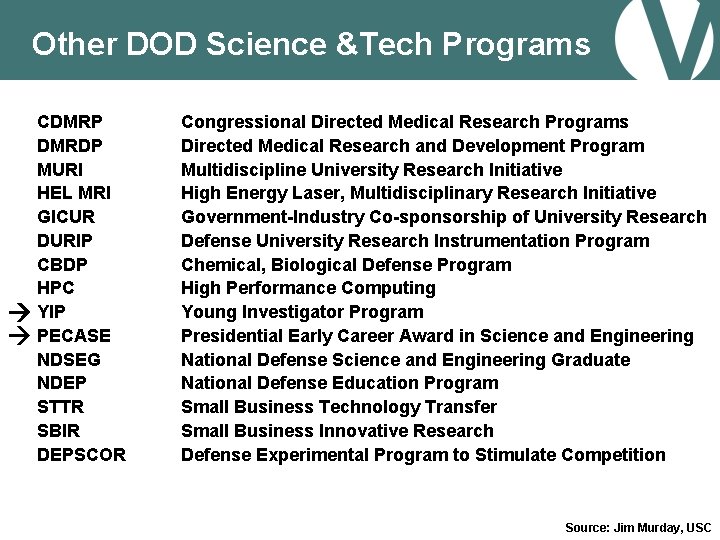
Other DOD Science &Tech Programs CDMRP DMRDP MURI HEL MRI GICUR DURIP CBDP HPC YIP PECASE NDSEG NDEP STTR SBIR DEPSCOR Congressional Directed Medical Research Programs Directed Medical Research and Development Program Multidiscipline University Research Initiative High Energy Laser, Multidisciplinary Research Initiative Government-Industry Co-sponsorship of University Research Defense University Research Instrumentation Program Chemical, Biological Defense Program High Performance Computing Young Investigator Program Presidential Early Career Award in Science and Engineering National Defense Science and Engineering Graduate National Defense Education Program Small Business Technology Transfer Small Business Innovative Research Defense Experimental Program to Stimulate Competition Source: Jim Murday, USC
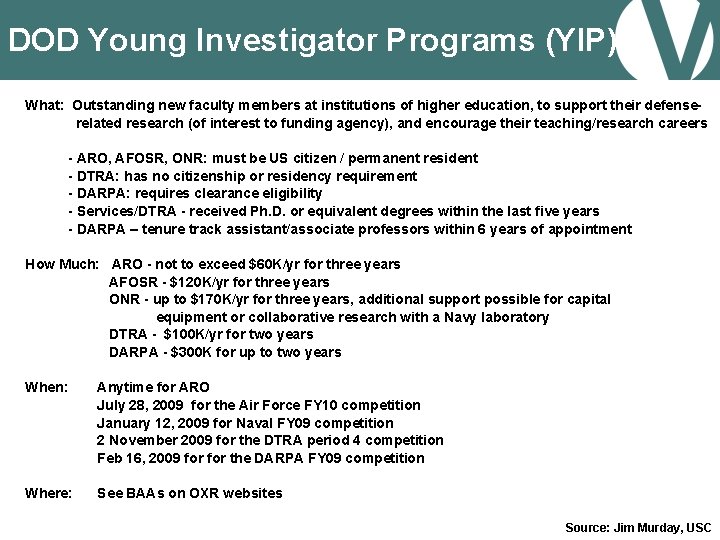
DOD Young Investigator Programs (YIP) What: Outstanding new faculty members at institutions of higher education, to support their defenserelated research (of interest to funding agency), and encourage their teaching/research careers - ARO, AFOSR, ONR: must be US citizen / permanent resident - DTRA: has no citizenship or residency requirement - DARPA: requires clearance eligibility - Services/DTRA - received Ph. D. or equivalent degrees within the last five years - DARPA – tenure track assistant/associate professors within 6 years of appointment How Much: ARO - not to exceed $60 K/yr for three years AFOSR - $120 K/yr for three years ONR - up to $170 K/yr for three years, additional support possible for capital equipment or collaborative research with a Navy laboratory DTRA - $100 K/yr for two years DARPA - $300 K for up to two years When: Anytime for ARO July 28, 2009 for the Air Force FY 10 competition January 12, 2009 for Naval FY 09 competition 2 November 2009 for the DTRA period 4 competition Feb 16, 2009 for the DARPA FY 09 competition Where: See BAAs on OXR websites Source: Jim Murday, USC
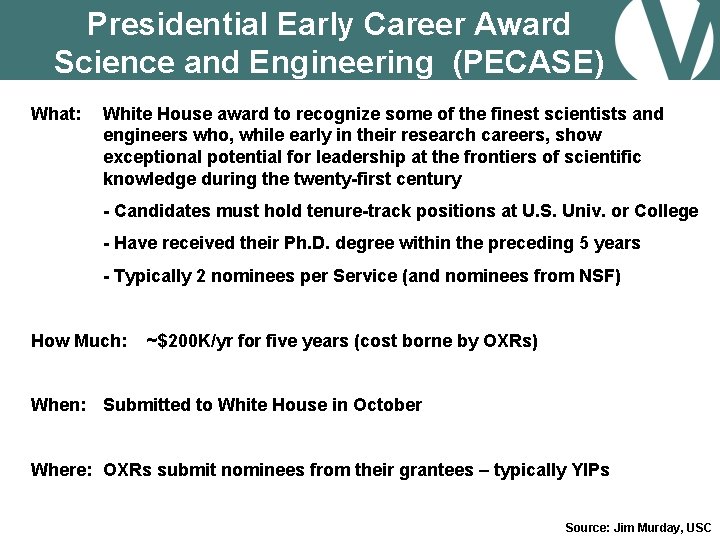
Presidential Early Career Award Science and Engineering (PECASE) What: White House award to recognize some of the finest scientists and engineers who, while early in their research careers, show exceptional potential for leadership at the frontiers of scientific knowledge during the twenty-first century - Candidates must hold tenure-track positions at U. S. Univ. or College - Have received their Ph. D. degree within the preceding 5 years - Typically 2 nominees per Service (and nominees from NSF) How Much: ~$200 K/yr for five years (cost borne by OXRs) When: Submitted to White House in October Where: OXRs submit nominees from their grantees – typically YIPs Source: Jim Murday, USC
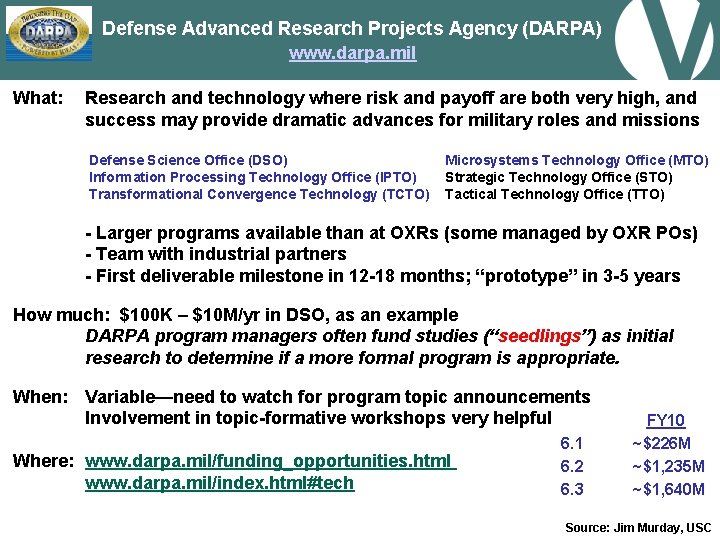
Defense Advanced Research Projects Agency (DARPA) www. darpa. mil What: Research and technology where risk and payoff are both very high, and success may provide dramatic advances for military roles and missions Defense Science Office (DSO) Information Processing Technology Office (IPTO) Transformational Convergence Technology (TCTO) Microsystems Technology Office (MTO) Strategic Technology Office (STO) Tactical Technology Office (TTO) - Larger programs available than at OXRs (some managed by OXR POs) - Team with industrial partners - First deliverable milestone in 12 -18 months; “prototype” in 3 -5 years How much: $100 K – $10 M/yr in DSO, as an example DARPA program managers often fund studies (“seedlings”) as initial research to determine if a more formal program is appropriate. When: Variable—need to watch for program topic announcements Involvement in topic-formative workshops very helpful Where: www. darpa. mil/funding_opportunities. html www. darpa. mil/index. html#tech 6. 1 6. 2 6. 3 FY 10 ~$226 M ~$1, 235 M ~$1, 640 M Source: Jim Murday, USC
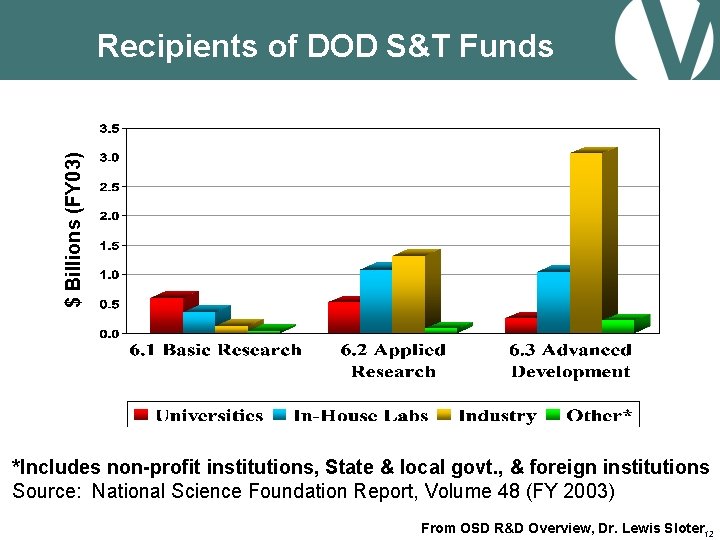
$ Billions (FY 03) Recipients of DOD S&T Funds *Includes non-profit institutions, State & local govt. , & foreign institutions Source: National Science Foundation Report, Volume 48 (FY 2003) From OSD R&D Overview, Dr. Lewis Sloter 12
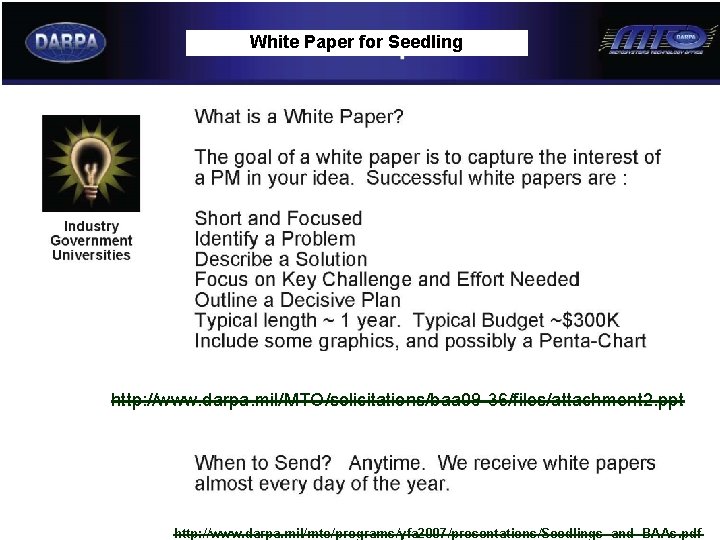
White Paper for Seedling http: //www. darpa. mil/MTO/solicitations/baa 09 -36/files/attachment 2. ppt 13 http: //www. darpa. mil/mto/programs/yfa 2007/presentations/Seedlings_and_BAAs. pdf
Outline ü Types of Proposals and Meta-Tips • General Funding Agency Information – DOD – NSF • Research Proposal Preparation and Evaluation • Tips for Writing Successful Proposals • Some Fatal Flaws in Proposal Writing
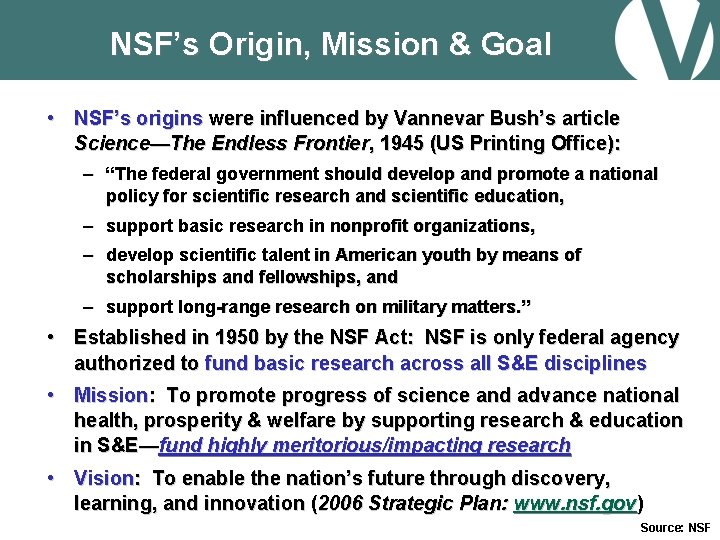
NSF’s Origin, Mission & Goal • NSF’s origins were influenced by Vannevar Bush’s article Science—The Endless Frontier, 1945 (US Printing Office): – “The federal government should develop and promote a national policy for scientific research and scientific education, – support basic research in nonprofit organizations, – develop scientific talent in American youth by means of scholarships and fellowships, and – support long-range research on military matters. ” • Established in 1950 by the NSF Act: NSF is only federal agency authorized to fund basic research across all S&E disciplines • Mission: To promote progress of science and advance national health, prosperity & welfare by supporting research & education in S&E—fund highly meritorious/impacting research • Vision: To enable the nation’s future through discovery, learning, and innovation (2006 Strategic Plan: www. nsf. gov) Source: NSF
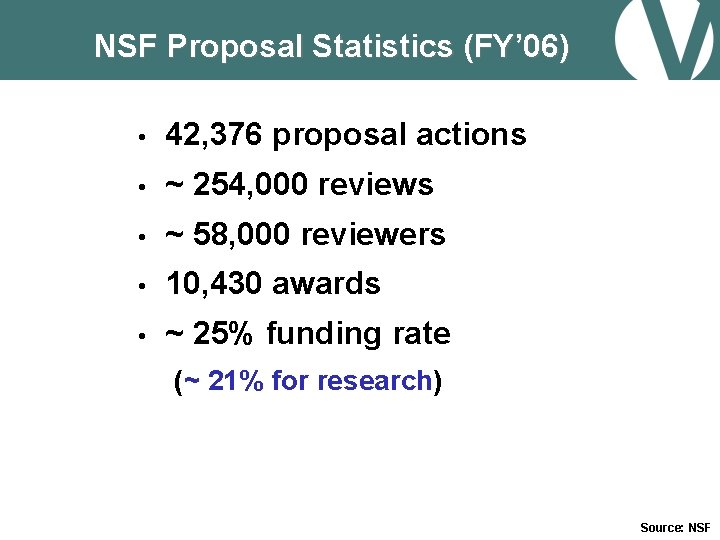
NSF Proposal Statistics (FY’ 06) • 42, 376 proposal actions • ~ 254, 000 reviews • ~ 58, 000 reviewers • 10, 430 awards • ~ 25% funding rate (~ 21% for research) NSF-9 Source: NSF
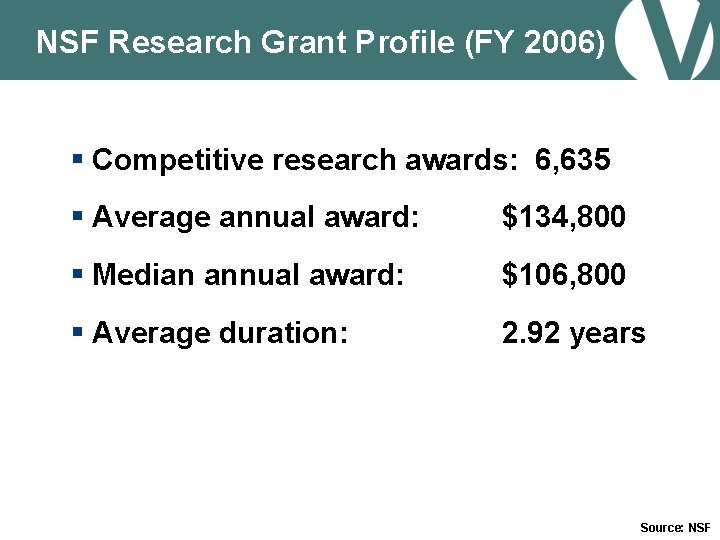
NSF Research Grant Profile (FY 2006) § Competitive research awards: 6, 635 § Average annual award: $134, 800 § Median annual award: $106, 800 § Average duration: 2. 92 years NSF-10 Source: NSF
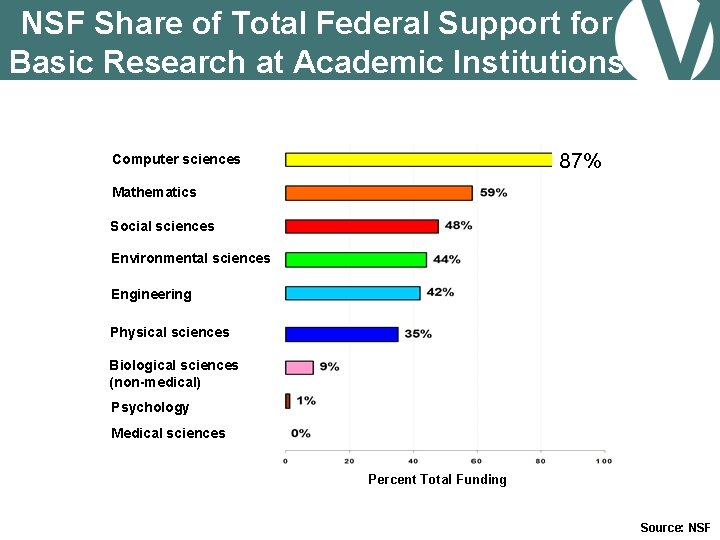
NSF Share of Total Federal Support for Basic Research at Academic Institutions 87% Computer sciences Mathematics Social sciences Environmental sciences Engineering Physical sciences Biological sciences (non-medical) Psychology Medical sciences Percent Total Funding Source: NSF
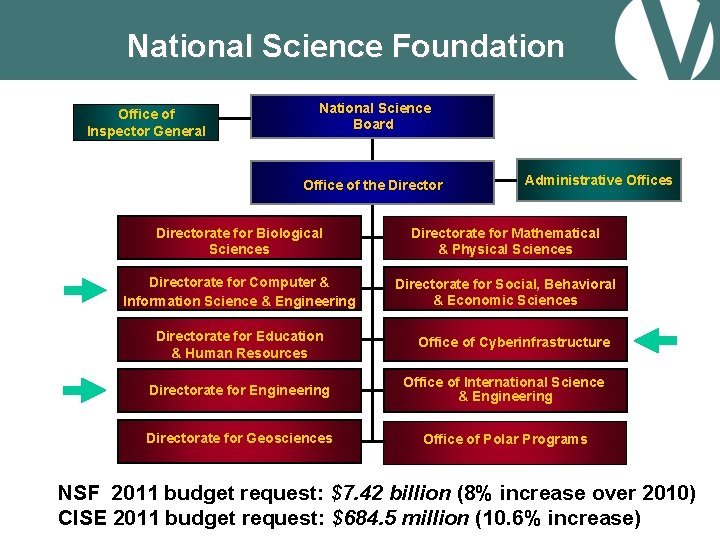
National Science Foundation Office of Inspector General National Science Board Office of the Director Administrative Offices Directorate for Biological Sciences Directorate for Mathematical & Physical Sciences Directorate for Computer & Information Science & Engineering Directorate for Social, Behavioral & Economic Sciences Directorate for Education & Human Resources Office of Cyberinfrastructure Directorate for Engineering Office of International Science & Engineering Directorate for Geosciences Office of Polar Programs NSF 2011 budget request: $7. 42 billion (8% increase over 2010) CISE 2011 budget request: $684. 5 million (10. 6% increase)
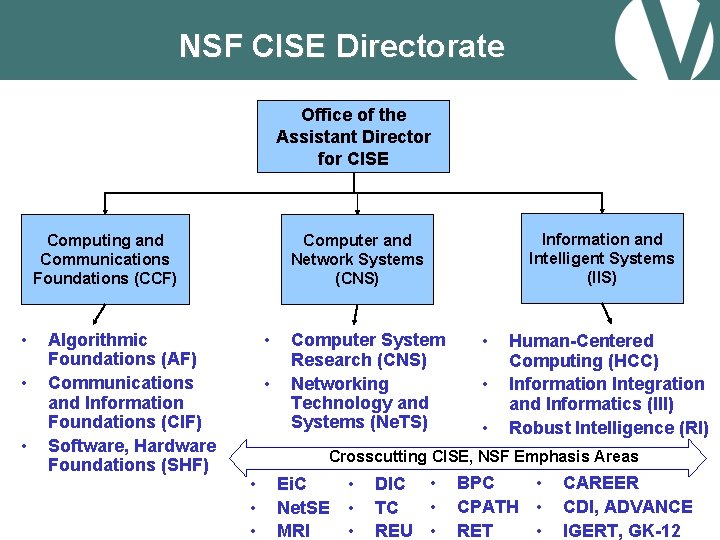
NSF CISE Directorate Office of the Assistant Director for CISE Computing and Communications Foundations (CCF) • • • Algorithmic Foundations (AF) Communications and Information Foundations (CIF) Software, Hardware Foundations (SHF) Information and Intelligent Systems (IIS) Computer and Network Systems (CNS) • • Computer System Research (CNS) Networking Technology and Systems (Ne. TS) • • • Human-Centered Computing (HCC) Information Integration and Informatics (III) Robust Intelligence (RI) Crosscutting CISE, NSF Emphasis Areas • • • Ei. C • Net. SE • MRI • DIC • • TC REU • BPC • CPATH • RET • CAREER CDI, ADVANCE IGERT, GK-12
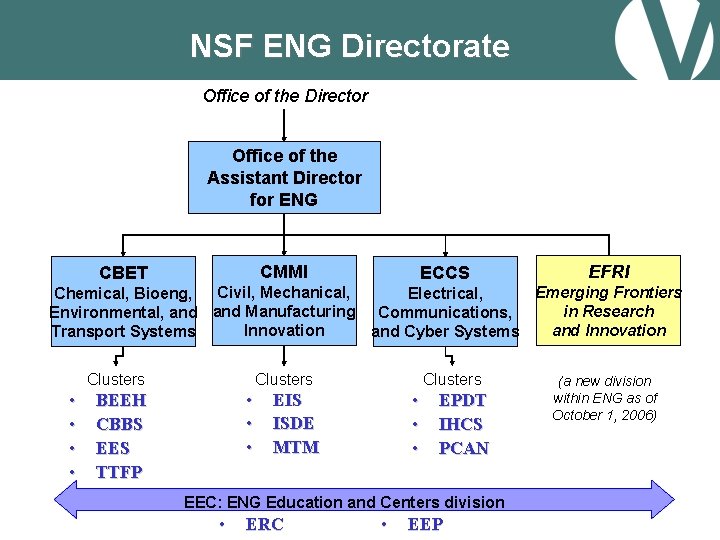
NSF ENG Directorate Office of the Director Office of the Assistant Director for ENG CMMI CBET ECCS EFRI Civil, Mechanical, Emerging Frontiers Chemical, Bioeng, Electrical, in Research Environmental, and Manufacturing Communications, Innovation and Innovation Transport Systems and Cyber Systems Clusters • • • BEEH CBBS EES TTFP Clusters EIS ISDE MTM • • • EPDT IHCS PCAN EEC: ENG Education and Centers division • ERC • EEP (a new division within ENG as of October 1, 2006)
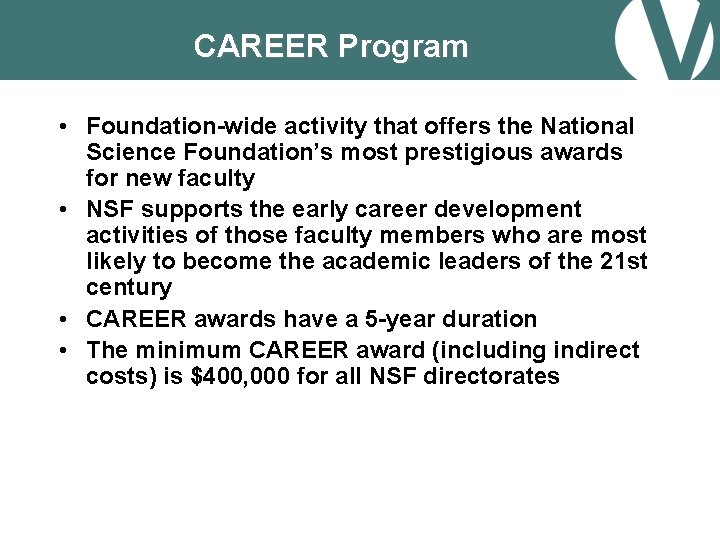
CAREER Program • Foundation-wide activity that offers the National Science Foundation’s most prestigious awards for new faculty • NSF supports the early career development activities of those faculty members who are most likely to become the academic leaders of the 21 st century • CAREER awards have a 5 -year duration • The minimum CAREER award (including indirect costs) is $400, 000 for all NSF directorates
Outline ü Types of Proposals and Meta-Tips ü General Funding Agency Information – DOD – NSF • Research Proposal Preparation and Evaluation (some slides adapted from Don Ethlon, NSF) • Tips for Writing Successful Proposals • Some Fatal Flaws in Proposal Writing
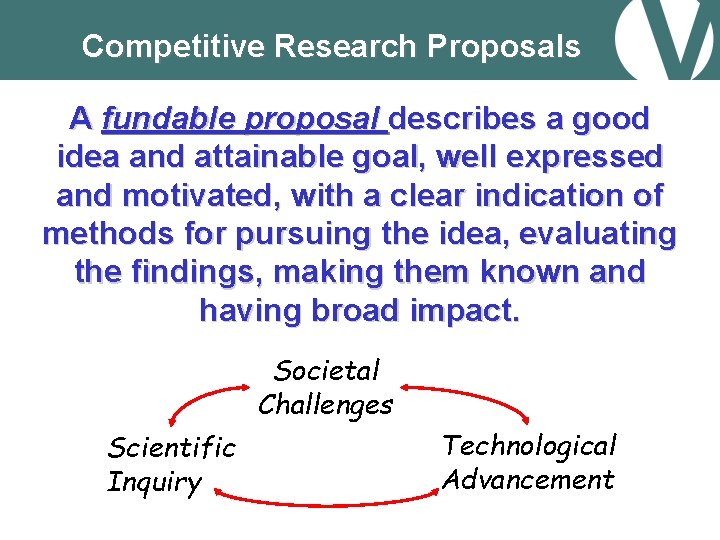
Competitive Research Proposals A fundable proposal describes a good idea and attainable goal, well expressed and motivated, with a clear indication of methods for pursuing the idea, evaluating the findings, making them known and having broad impact. Societal Challenges Scientific Inquiry Technological Advancement
Transformative Research “Transformative Research is research driven by ideas that stand a reasonable chance of radically changing our understanding of an important existing scientific concept or leading to the creation of a new paradigm or field of science. Such research also is characterized by its challenge to current understanding or its pathway to new frontiers. ” • See official definition given on page 10 of Enhancing Support of Transformative Research at the National Science Foundation, by the National Science Board found at http: //nsf. gov/pubs/2007/nsb 0732. pdf
Properties of a Research Goal • • • Simple to state Not obvious how to do it Clear benefit Progress and solution are testable Can be broken into smaller steps – So that you can see intermediate progress By Jim Gray, Turing Award Winner http: //research. Microsoft. com/~Gray/talks/Turing 2. ppt
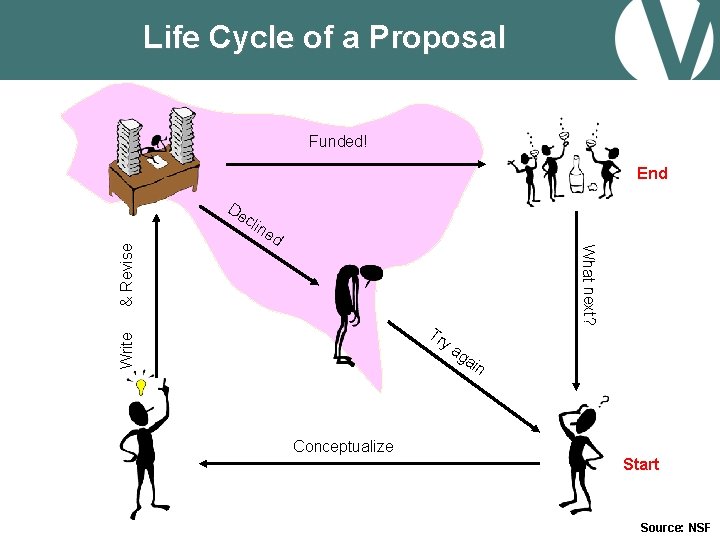
Life Cycle of a Proposal Funded! End De ne d Tr What next? ya Write & Revise cli ga in Conceptualize Start Source: NSF
Step 1: Carefully Read the Program Announcements and Solicitations • Find the right program early! – It’s better to do this well before you write than after you get your reviews back • Talk with your Program Officer to make sure that your ideas fit in the program – If the Program Officer tells you that your ideas are too narrow or don’t fit the program, look for other sources • Make sure that your project is worthwhile, realistic, well-planned, and innovative Source: NSF
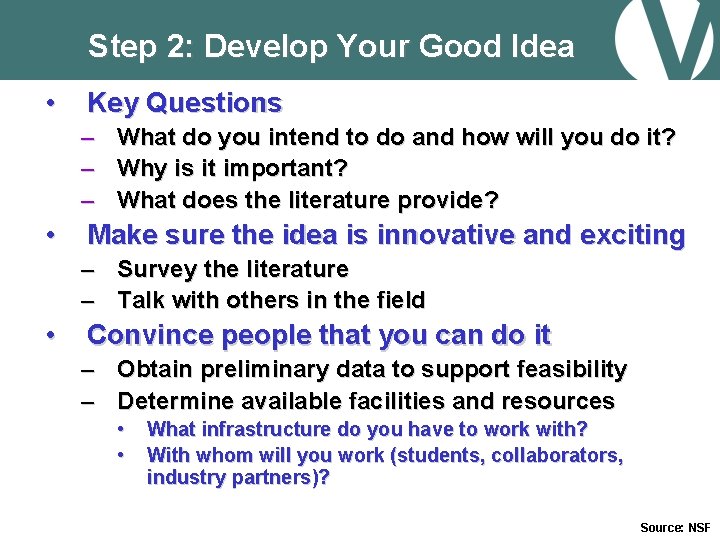
Step 2: Develop Your Good Idea • Key Questions – – – • What do you intend to do and how will you do it? Why is it important? What does the literature provide? Make sure the idea is innovative and exciting – Survey the literature – Talk with others in the field • Convince people that you can do it – Obtain preliminary data to support feasibility – Determine available facilities and resources • • What infrastructure do you have to work with? With whom will you work (students, collaborators, industry partners)? Source: NSF
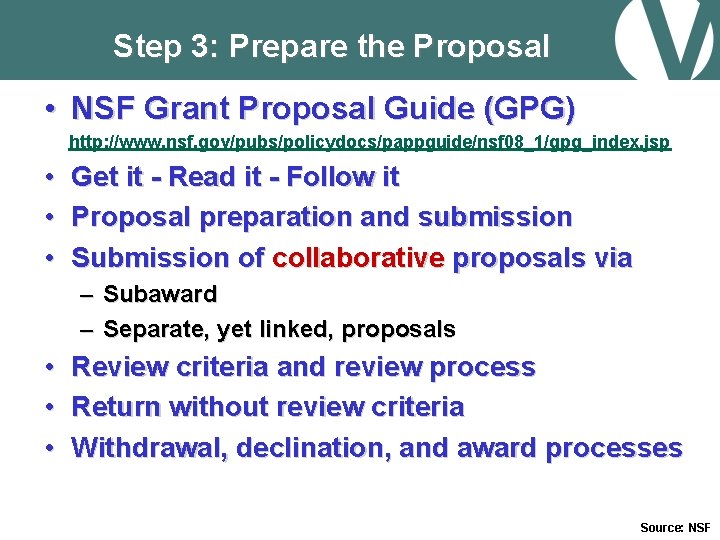
Step 3: Prepare the Proposal • NSF Grant Proposal Guide (GPG) http: //www. nsf. gov/pubs/policydocs/pappguide/nsf 08_1/gpg_index. jsp • Get it - Read it - Follow it • Proposal preparation and submission • Submission of collaborative proposals via – Subaward – Separate, yet linked, proposals • • • Review criteria and review process Return without review criteria Withdrawal, declination, and award processes Source: NSF
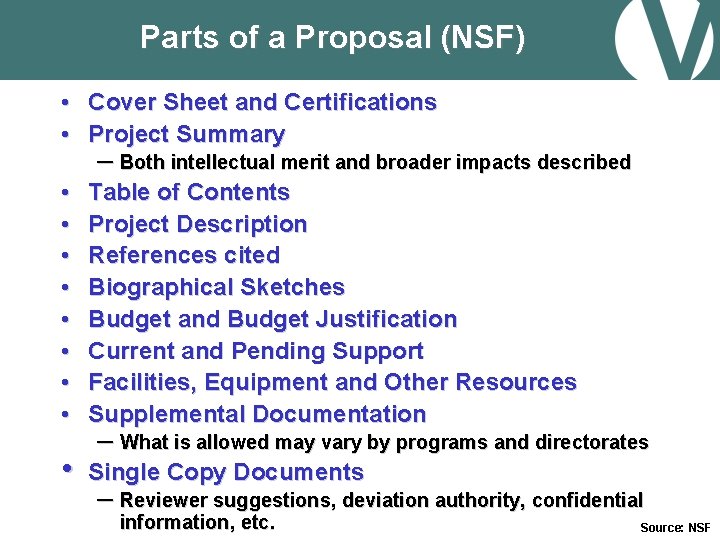
Parts of a Proposal (NSF) • Cover Sheet and Certifications • Project Summary – Both intellectual merit and broader impacts described • • Table of Contents Project Description References cited Biographical Sketches Budget and Budget Justification Current and Pending Support Facilities, Equipment and Other Resources Supplemental Documentation • Single Copy Documents – What is allowed may vary by programs and directorates – Reviewer suggestions, deviation authority, confidential information, etc. Source: NSF
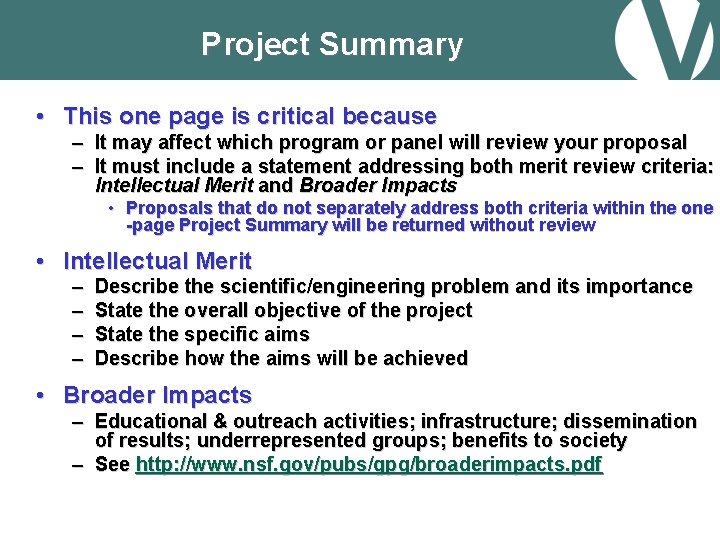
Project Summary • This one page is critical because – It may affect which program or panel will review your proposal – It must include a statement addressing both merit review criteria: Intellectual Merit and Broader Impacts • Proposals that do not separately address both criteria within the one -page Project Summary will be returned without review • Intellectual Merit – – Describe the scientific/engineering problem and its importance State the overall objective of the project State the specific aims Describe how the aims will be achieved • Broader Impacts – Educational & outreach activities; infrastructure; dissemination of results; underrepresented groups; benefits to society – See http: //www. nsf. gov/pubs/gpg/broaderimpacts. pdf
Project Description • • • This is the key to a strong proposal Overall concept and rationale Hypothesis-driven or data-driven or innovation-driven • Execution – – – Careful Thorough Appropriate • Warning: Most NSF formal proposals are limited to 15 pages. Some preliminary proposals and other special cases may be limited to fewer pages. Check the program solicitation! Source: NSF
Project Description • • • In 15 pages, you need to cover Objectives and expected significance Relation to present state of knowledge Experimental methods and procedures Results from prior agency-sponsored support (required if applicable) Relation to your (the PI’s) longer term goals Optional sections: – preface, background, preliminary studies, specific objectives, significance, experimental plan
Project Description • Know your audience – the reviewers, PO! – Write accurately, concisely, and clearly – Make it easy for reviewers to like your proposal – You never get a second chance to make a first impression – First page tells it all – Figures and tables get your points across clearly – Some reviewers (particularly on interdisciplinary proposals) may not be experts in your specific field
Biographical Sketch • • Usually limited to only two pages Professional preparation Appointments Publications – 5 closely related – 5 other significant publications • Synergistic activities • Collaborators & other affiliations – Collaborators (last 4 yrs) & co-editors (last 2 yrs) – Graduate and Postdoctoral Advisors – Thesis Advisor and Postgraduate-Scholar Sponsor
Budget • Budget should be – reasonable, but request what you need – for personnel, equipment, travel, participant support and other direct costs (subaward, consultant, computer services, publication costs) – for cost of educational activities associated with research, where appropriate • Must be accompanied by “Budget Justification” for direct cost line items
Current and Pending Support • List everything, including the proposal being submitted – current, pending and anticipated • Be careful of overlap – Perception of overlap could be detrimental in the review • Multiple submissions – when they are allowed to same program
Evaluation: Ad Hoc and Panel Reviews • A minimum of 3 reviews/proposal (typically 4 or more) • A score of E, V, G, F, P is given by each reviewer • Comments on intellectual merit and broader impacts • Typically, a recommendation to fund (or not) is given • Panel Review: • Proposals are discussed and evaluated collectively • Proposal summary is written—couple of sentences • Intellectual merits are described: strengths and weaknesses • Broader impacts are described: strengths, weaknesses • Improvements may be suggested (optional) • Panel recommendation: Competitive or Not Competitive • Comments are intended to help unsuccessful PIs improve their proposals for the next competition
NSF Proposal Merit Review Criteria The Intellectual Merit of the proposed activity – Creativity, originality, and potentially transformative – Potential to advancing knowledge and understanding within and across fields – Conceptualization and organization – Qualifications of investigators – Access to resources • The Broader Impacts of the proposed activity – – Discovery while promoting teaching, training and learning Participation of underrepresented groups Enhancement of infrastructure for research and education Dissemination of results to enhance scientific and technological understanding – Benefits to society • Program-specific merit review criteria – Some programs have additional review criteria in solicitation • There are NSF general statements regarding intellectual merit and broader impact, but also some programs list examples of these criteria specific to the program – See http: //www. nsf. gov/pubs/gpg/broaderimpacts. pdf
Basis for Decisions: Reviewer Input • Reviews – Content/justification of the reviews by reviewers oftentimes is more important than just the rating • Panel Ranking – Proposals (competitive ones) often ranked by panel • Program Director uses reviews and panel summary/recommendation in award decisions – – – Fairness How substantive the reviews are Technical problems raised in the reviews • major vs. minor issues – Reasons for the reviewer concerns or enthusiasm
Basis for Decisions: Balanced Portfolio • Program Director uses other information in addition to reviewer input in making decisions – Innovation and creativity • High risk, high reward projects – – – – Breadth of research areas Priority areas and systems Demographics and diversity Broadening participation Institutional impact: EPSCOR, MSI, PUI, etc. Integration of research & education International collaborations
Why Do Some Proposals Fail? • Absence of innovative ideas or hypothesis – Will provide only an incremental advance – Not exciting or cutting edge • Errors – – – Unclear or incomplete expression of aims Faulty logic or experimental design Less than rigorous presentation • Unrealistic, sloppy or incomplete • Resources and facilities not in place – PI qualifications/expertise not evident – Necessary collaborations not documented
If You Have to Resubmit… • Stay calm! – Take ten… breaths, hours, days – Examine the criticisms carefully • Get in touch: – Call, email, or visit your Program Officer • Think carefully about too rapid of a resubmission: – Take time to self-evaluate the proposal/project
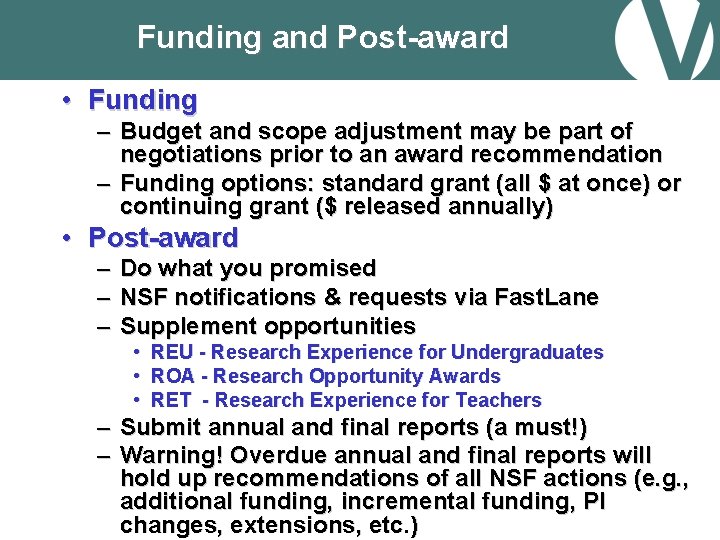
Funding and Post-award • Funding – Budget and scope adjustment may be part of negotiations prior to an award recommendation – Funding options: standard grant (all $ at once) or continuing grant ($ released annually) • Post-award – Do what you promised – NSF notifications & requests via Fast. Lane – Supplement opportunities • REU - Research Experience for Undergraduates • ROA - Research Opportunity Awards • RET - Research Experience for Teachers – Submit annual and final reports (a must!) – Warning! Overdue annual and final reports will hold up recommendations of all NSF actions (e. g. , additional funding, incremental funding, PI changes, extensions, etc. )
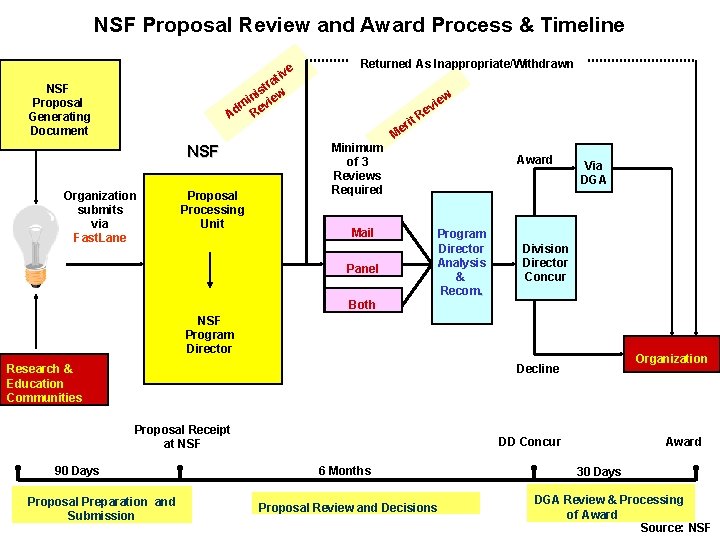
NSF Proposal Review and Award Process & Timeline tiv ra t is in view dm Re NSF Proposal Generating Document e Returned As Inappropriate/Withdrawn A NSF Organization submits via Fast. Lane Proposal Processing Unit w ie it er Minimum of 3 Reviews Required Mail Panel v Re M Award Program Director Analysis & Recom. . Via DGA Division Director Concur Both NSF Program Director Research & Education Communities Organization Decline Proposal Receipt at NSF 90 Days Proposal Preparation and Submission DD Concur 6 Months Proposal Review and Decisions Award 30 Days DGA Review & Processing of Award Source: NSF
Outline ü Types of Proposals and Meta-Tips ü General Funding Agency Information – DOD – NSF ü Research Proposal Preparation and Evaluation (some slides adapted from Don Ethlon, NSF) • Tips for Writing Successful Proposals (some slides adapted from Don Ethlon, NSF) • Some Fatal Flaws in Proposal Writing
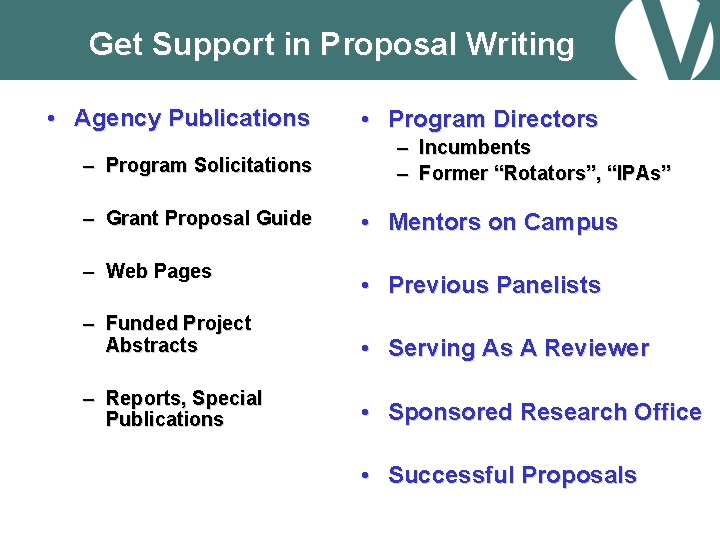
Get Support in Proposal Writing • Agency Publications – Program Solicitations – Grant Proposal Guide – Web Pages • Program Directors – Incumbents – Former “Rotators”, “IPAs” • Mentors on Campus • Previous Panelists – Funded Project Abstracts • Serving As A Reviewer – Reports, Special Publications • Sponsored Research Office • Successful Proposals
Useful NSF On-line Documents • FY 2011 NSF Budget Request – http: //www. nsf. gov/about/budget/fy 2011 • FY 2010 NSF Budget – http: //www. nsf. gov/about/budget/fy 2010 • Grant Proposal Guide (NSF 04 -23) – http: //www. nsf. gov/publications/pub_summ. jsp ? ods_key=GPG • Science and Engineering Statistics – http: // www. nsf. gov/statistics/ • General Information – http: //www. nsf. gov/
Start Early and Get Feedback • Write: – Rewrite and rewrite again… • Get critiques from: – Mentors and colleagues – Previous members of review panels
Be Reasonable • Be aware of the scope: – “Too ambitious” vs. “Too narrow” • Be honest and up-front: – Address issues instead of trying to hide them – Acknowledge possible experimental problems and have alternatives
Make It Easy for Reviewers • Know your audience: – All reviewers may not be experts in your specific field • Simplify and streamline: – Make sure you get your overall idea across • Pay attention to details: – – – Run the spell checker and proof-read Prepare clear photos, graphs, etc. Make the font size as big as you can
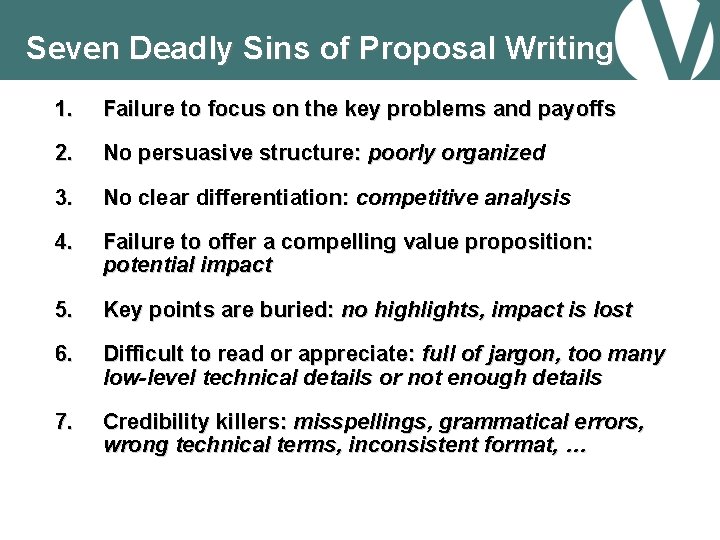
Seven Deadly Sins of Proposal Writing 1. Failure to focus on the key problems and payoffs 2. No persuasive structure: poorly organized 3. No clear differentiation: competitive analysis 4. Failure to offer a compelling value proposition: potential impact 5. Key points are buried: no highlights, impact is lost 6. Difficult to read or appreciate: full of jargon, too many low-level technical details or not enough details 7. Credibility killers: misspellings, grammatical errors, wrong technical terms, inconsistent format, …
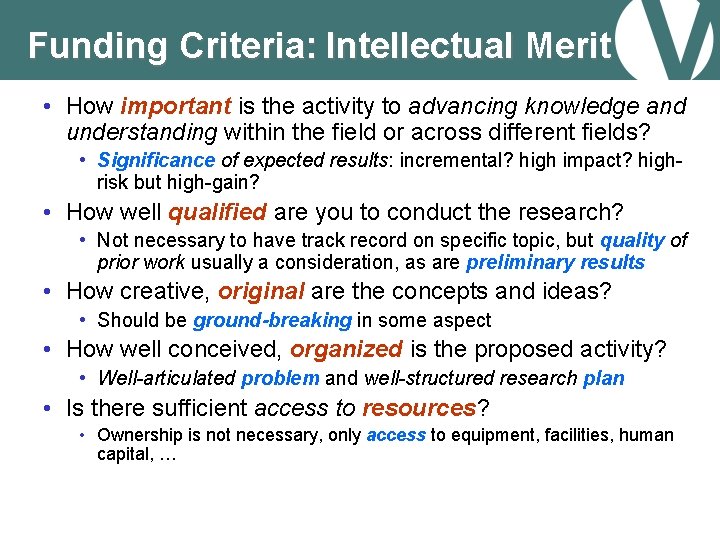
Funding Criteria: Intellectual Merit • How important is the activity to advancing knowledge and understanding within the field or across different fields? • Significance of expected results: incremental? high impact? highrisk but high-gain? • How well qualified are you to conduct the research? • Not necessary to have track record on specific topic, but quality of prior work usually a consideration, as are preliminary results • How creative, original are the concepts and ideas? • Should be ground-breaking in some aspect • How well conceived, organized is the proposed activity? • Well-articulated problem and well-structured research plan • Is there sufficient access to resources? • Ownership is not necessary, only access to equipment, facilities, human capital, …
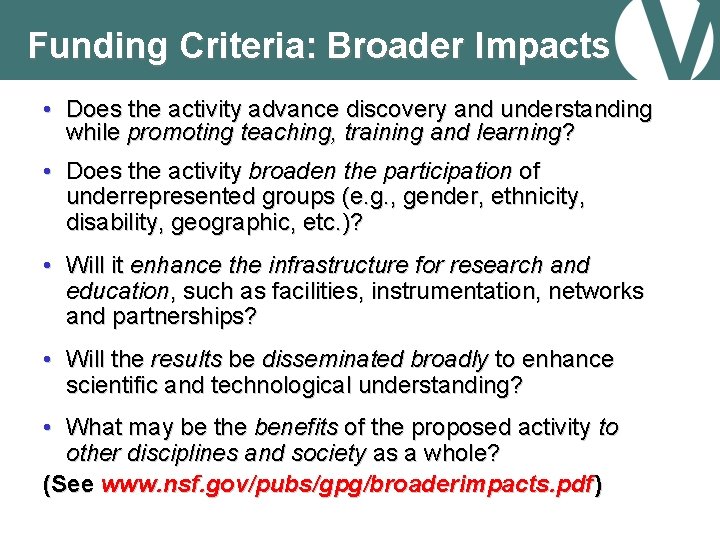
Funding Criteria: Broader Impacts • Does the activity advance discovery and understanding while promoting teaching, training and learning? • Does the activity broaden the participation of underrepresented groups (e. g. , gender, ethnicity, disability, geographic, etc. )? • Will it enhance the infrastructure for research and education, such as facilities, instrumentation, networks and partnerships? • Will the results be disseminated broadly to enhance scientific and technological understanding? • What may be the benefits of the proposed activity to other disciplines and society as a whole? (See www. nsf. gov/pubs/gpg/broaderimpacts. pdf)
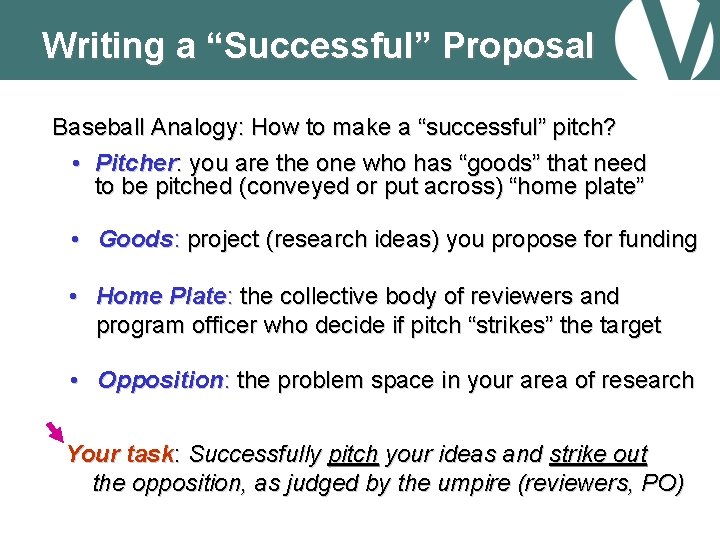
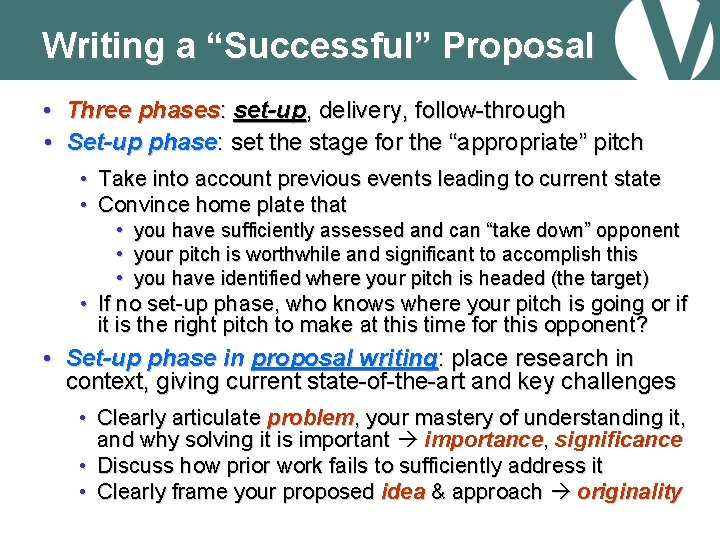
Writing a “Successful” Proposal Baseball Analogy: How to make a “successful” pitch? • Pitcher: you are the one who has “goods” that need to be pitched (conveyed or put across) “home plate” • Goods: project (research ideas) you propose for funding • Home Plate: the collective body of reviewers and program officer who decide if pitch “strikes” the target • Opposition: the problem space in your area of research Your task: Successfully pitch your ideas and strike out the opposition, as judged by the umpire (reviewers, PO)
Writing a “Successful” Proposal • Three phases: set-up, delivery, follow-through • Set-up phase: set the stage for the “appropriate” pitch • Take into account previous events leading to current state • Convince home plate that • you have sufficiently assessed and can “take down” opponent • your pitch is worthwhile and significant to accomplish this • you have identified where your pitch is headed (the target) • If no set-up phase, who knows where your pitch is going or if it is the right pitch to make at this time for this opponent? • Set-up phase in proposal writing: place research in context, giving current state-of-the-art and key challenges • Clearly articulate problem, your mastery of understanding it, and why solving it is important importance, significance • Discuss how prior work fails to sufficiently address it • Clearly frame your proposed idea & approach originality
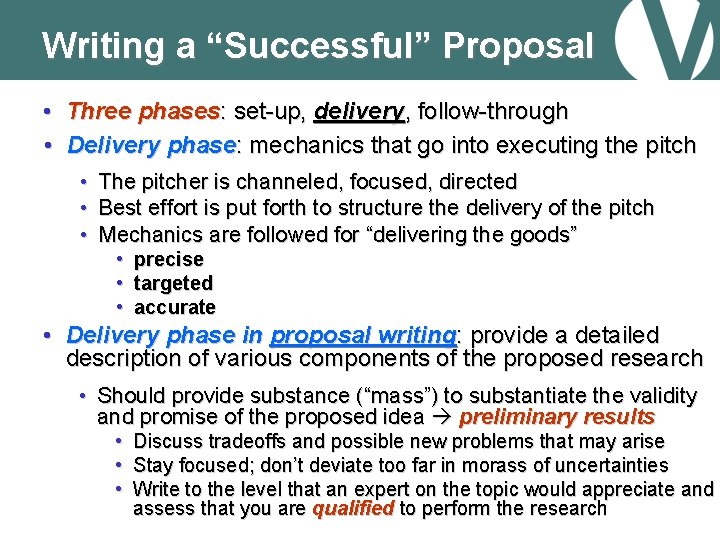
Writing a “Successful” Proposal • Three phases: set-up, delivery, follow-through • Delivery phase: mechanics that go into executing the pitch • • • The pitcher is channeled, focused, directed Best effort is put forth to structure the delivery of the pitch Mechanics are followed for “delivering the goods” • precise • targeted • accurate • Delivery phase in proposal writing: provide a detailed description of various components of the proposed research • Should provide substance (“mass”) to substantiate the validity and promise of the proposed idea preliminary results • Discuss tradeoffs and possible new problems that may arise • Stay focused; don’t deviate too far in morass of uncertainties • Write to the level that an expert on the topic would appreciate and assess that you are qualified to perform the research
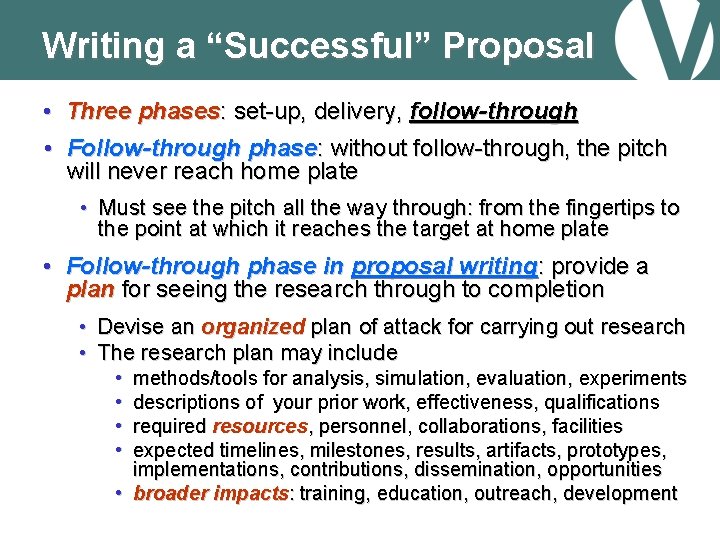
Writing a “Successful” Proposal • • Three phases: set-up, delivery, follow-through Follow-through phase: without follow-through, the pitch will never reach home plate • Must see the pitch all the way through: from the fingertips to the point at which it reaches the target at home plate • Follow-through phase in proposal writing: provide a plan for seeing the research through to completion • Devise an organized plan of attack for carrying out research • The research plan may include • • methods/tools for analysis, simulation, evaluation, experiments descriptions of your prior work, effectiveness, qualifications required resources, personnel, collaborations, facilities expected timelines, milestones, results, artifacts, prototypes, implementations, contributions, dissemination, opportunities • broader impacts: training, education, outreach, development
Outline ü Types of Proposals and Meta-Tips ü General Funding Agency Information – DOD – NSF ü Research Proposal Preparation and Evaluation (some slides adapted from Don Ethlon, NSF) ü Tips for Writing Successful Proposals (some slides adapted from Don Ethlon, NSF) • Some Fatal Flaws in Proposal Writing
Top Ten Ways To Write a Good Proposal… That Won’t Get Funded! Source: NSF
Flaw #10 Inflate the budget to allow for negotiations Instead… § Make the budget reflect the work plan directly § Provide a budget explanation that ties your budget request to project personnel and activities § Make it clear who is responsible for what § Provide biographical sketches for all key personnel Source: NSF
Flaw #9 Provide a template letter of commitment for your (genuine) supporters to use. (They will!) Instead… • Ask for original letters of support that detail what your collaborators will do and why involvement in your project will help them • Letters from administrators are stronger if they demonstrate real commitment, e. g. release time, faculty development funds, new course approvals, etc. • Make sure the program to which you are submitting allows letters of support or commitment and if they do, what type are allowed. Read the program solicitation! Source: NSF
Flaw #8 Assume your past accomplishments are well known – after all, the agency probably funded them Instead… § Provide results from prior funding – this includes quantitative data and information on impact § Describe how new efforts build on this previous work, and how it has contributed to the broader knowledge base about educational improvement § Recognize that the review panelists are diverse and not all familiar with your institutional context Source: NSF
Flaw #7 Assume a project website is sufficient for dissemination Instead… § A website may be necessary, but who will maintain it and how in the long run? § Engage others; “early adopters” can serve as natural dissemination channels § Plan workshops and mini-courses; identify similar projects and propose sessions at regional and national meetings § Visit high schools, other colleges and universities § Present in other public forums Source: NSF
Flaw #6 Assert: “Evaluation will be ongoing and consist of a variety of methods” Instead… § Plan formative and comprehensive evaluation § Include an evaluation plan with specific timelines and projected benchmarks § Engage an objective evaluator § Use an Advisory Committee or team or a small Visiting Committee Source: NSF
Flaw #5 Assume the program guidelines have not changed; or better yet, ignore them! Instead… § Read the solicitation completely and carefully § Address each area outlined in the solicitation that is relevant to your project § Check the program solicitation carefully for any additional criteria, e. g. the Integration of Research and Education, potentially transformative, or integrating diversity into NSF Programs, Projects, and Activities Source: NSF
Flaw #4 Don’t check your speeling, nor you’re grammer Instead… § Check and double check; first impressions are important to reviewers § State your good ideas clearly; ignore the bad ones § Have a trusted colleague who is not involved in the project read your drafts and final proposal § Watch word usage. For example, don’t use “complimentary” when you mean “complementary” or “principle investigator” when you mean “principal investigator, ” etc. Source: NSF
Flaw #3 Substitute flowery rhetoric for good examples Instead… § § § § Minimize negatives; describe what you will do and why Ground your project in the context of related efforts Provide detailed examples of impact of prior work Specify who you will work with and why State how you plan to assess progress Detail the tasks and timeline for completing activities Specifically address intellectual merit and broader impacts and use the phrases explicitly in the project summary Source: NSF
Flaw #2 Assume page limits and font size restrictions are not enforced Instead… • Consult the program solicitation and the GPG (Grant Proposal Guide) carefully • Make sure your proposal does not exceed page and/or font size limits so that it is not returned without review Source: NSF
Flaw #1 Assume deadlines are not enforced Instead… • Work early with your Sponsored Research Office (SRO) • Test drive Grants. gov or Fast. Lane. nsf. gov to make sure your SRO knows how to drive the tool. • Set your own final deadline several days ahead of the formal deadline to allow time to resolve unforeseen problems Source: NSF
Closing Remarks • There may be no “best” (or only) way to write a successful proposal, but many successful ones share similar characteristics – clearly written, well motivated, organized, original, targeted, important, accomplishable, impactful, significant • Funding depends on many things, some of which are beyond your control – availability of funds, portfolio of existing funded research projects, set of reviewers, timing, … • Be persistent and give your best effort; success will come!