
Newgistics Case Study 04192006 Lei Deng Timothy Gumm

- Slides: 20
Newgistics Case Study 04/19/2006 Lei Deng, Timothy Gumm, Jacqueline Jones, Adam Levin, Leihong Li, Yang Song 1
Agenda l l l Problem Overview Current vs. Proposed Situation Pre-Modeling Issues The Model Results Analysis 2
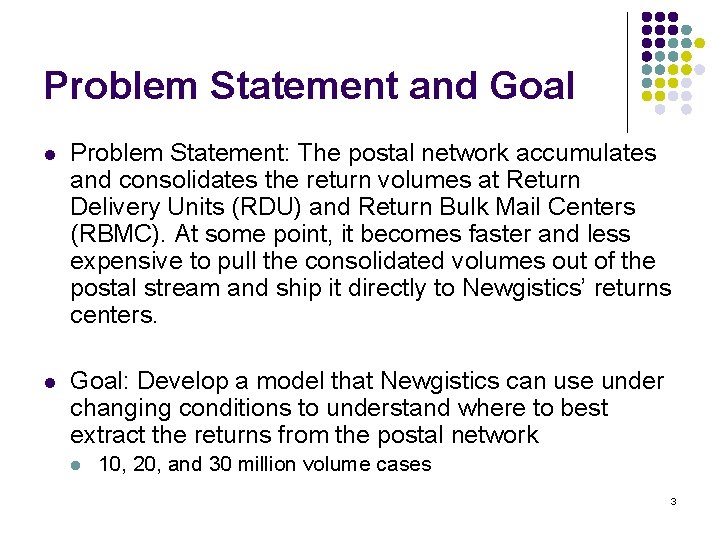
Problem Statement and Goal l Problem Statement: The postal network accumulates and consolidates the return volumes at Return Delivery Units (RDU) and Return Bulk Mail Centers (RBMC). At some point, it becomes faster and less expensive to pull the consolidated volumes out of the postal stream and ship it directly to Newgistics’ returns centers. l Goal: Develop a model that Newgistics can use under changing conditions to understand where to best extract the returns from the postal network l 10, 20, and 30 million volume cases 3
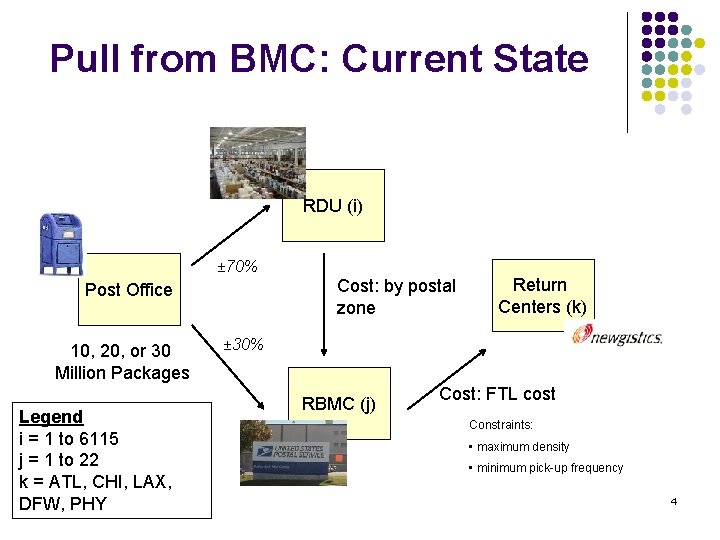
Pull from BMC: Current State RDU (i) ± 70% Cost: by postal zone Post Office 10, 20, or 30 Million Packages Legend i = 1 to 6115 j = 1 to 22 k = ATL, CHI, LAX, DFW, PHY Return Centers (k) ± 30% RBMC (j) Cost: FTL cost Constraints: • maximum density • minimum pick-up frequency 4
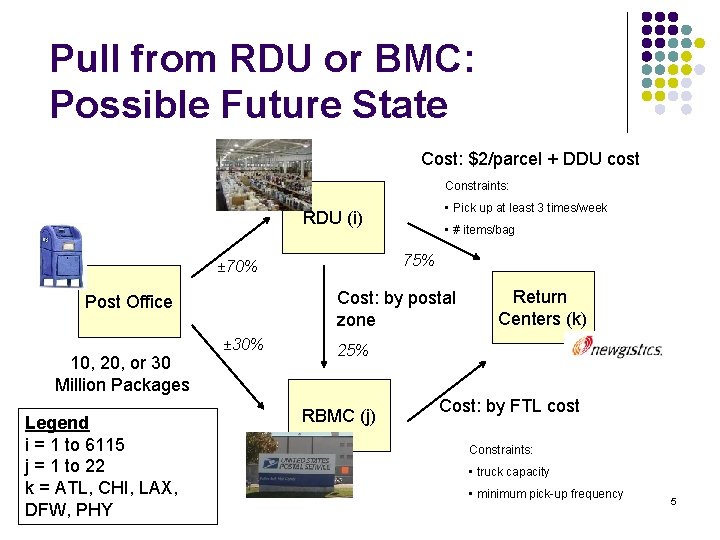
Pull from RDU or BMC: Possible Future State Cost: $2/parcel + DDU cost Constraints: • Pick up at least 3 times/week RDU (i) 75% ± 70% Cost: by postal zone Post Office 10, 20, or 30 Million Packages Legend i = 1 to 6115 j = 1 to 22 k = ATL, CHI, LAX, DFW, PHY • # items/bag ± 30% Return Centers (k) 25% RBMC (j) Cost: by FTL cost Constraints: • truck capacity • minimum pick-up frequency 5
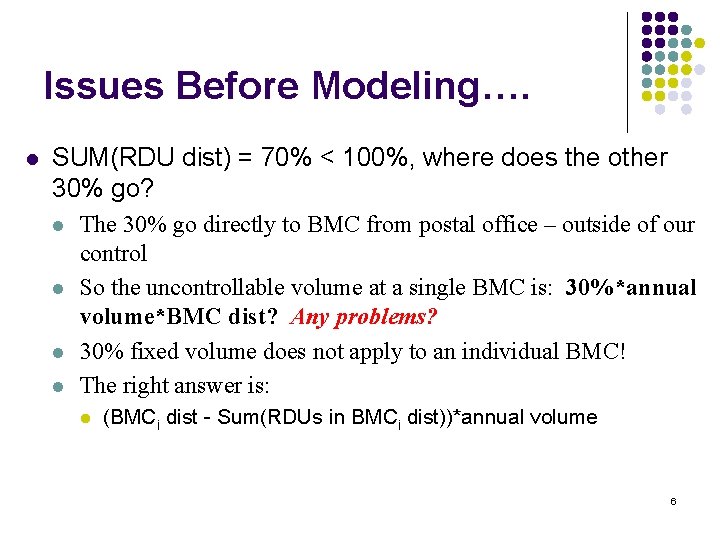
Issues Before Modeling…. l SUM(RDU dist) = 70% < 100%, where does the other 30% go? l l The 30% go directly to BMC from postal office – outside of our control So the uncontrollable volume at a single BMC is: 30%*annual volume*BMC dist? Any problems? 30% fixed volume does not apply to an individual BMC! The right answer is: l (BMCi dist - Sum(RDUs in BMCi dist))*annual volume 6
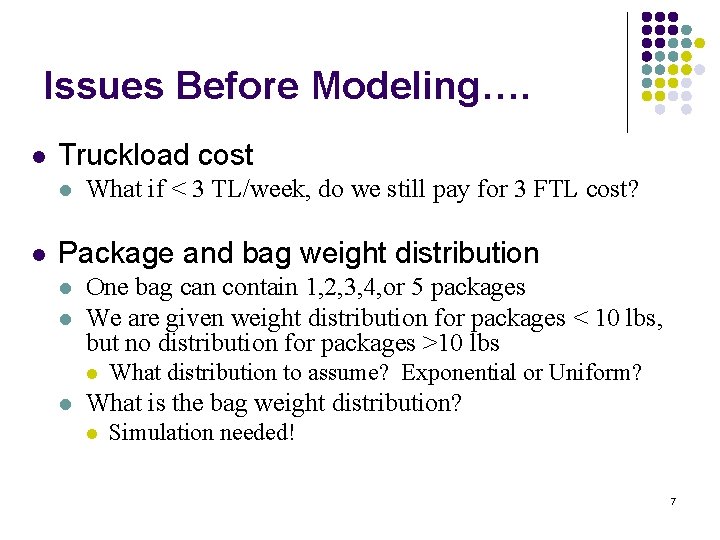
Issues Before Modeling…. l Truckload cost l l What if < 3 TL/week, do we still pay for 3 FTL cost? Package and bag weight distribution l l One bag can contain 1, 2, 3, 4, or 5 packages We are given weight distribution for packages < 10 lbs, but no distribution for packages >10 lbs l l What distribution to assume? Exponential or Uniform? What is the bag weight distribution? l Simulation needed! 7
DDU Bag Weight Simulation Not realistic! Exponential is better estimate. 8
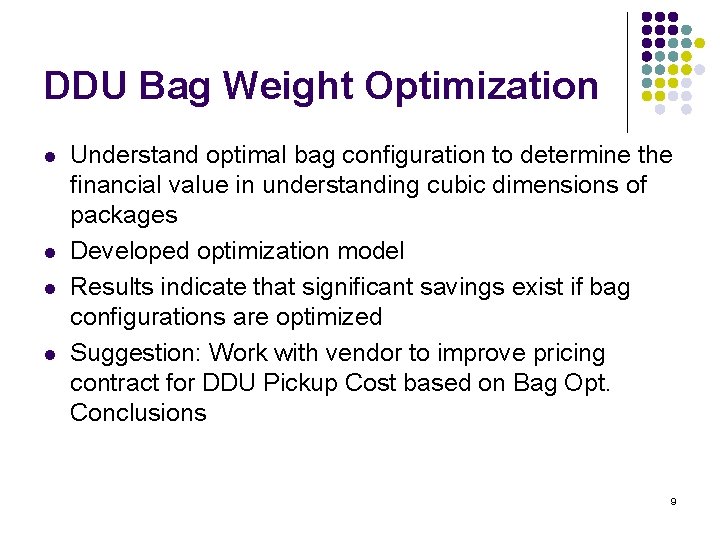
DDU Bag Weight Optimization l l Understand optimal bag configuration to determine the financial value in understanding cubic dimensions of packages Developed optimization model Results indicate that significant savings exist if bag configurations are optimized Suggestion: Work with vendor to improve pricing contract for DDU Pickup Cost based on Bag Opt. Conclusions 9
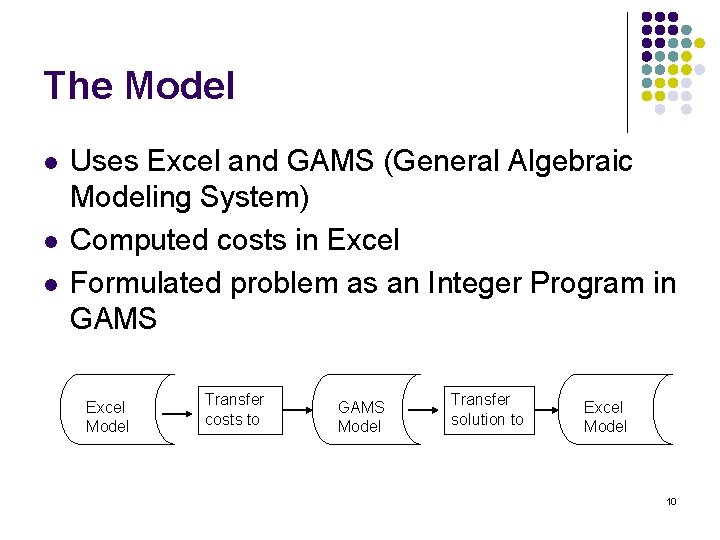
The Model l Uses Excel and GAMS (General Algebraic Modeling System) Computed costs in Excel Formulated problem as an Integer Program in GAMS Excel Model Transfer costs to GAMS Model Transfer solution to Excel Model 10
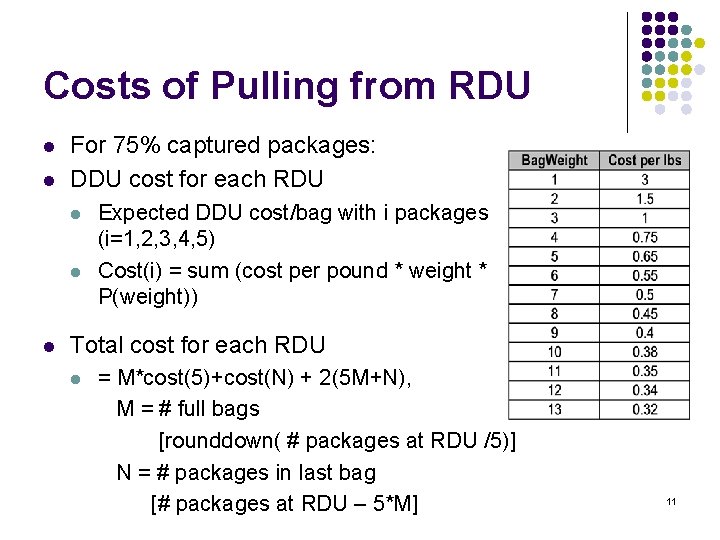
Costs of Pulling from RDU l l For 75% captured packages: DDU cost for each RDU l l l Expected DDU cost/bag with i packages (i=1, 2, 3, 4, 5) Cost(i) = sum (cost per pound * weight * P(weight)) Total cost for each RDU l = M*cost(5)+cost(N) + 2(5 M+N), M = # full bags [rounddown( # packages at RDU /5)] N = # packages in last bag [# packages at RDU – 5*M] 11
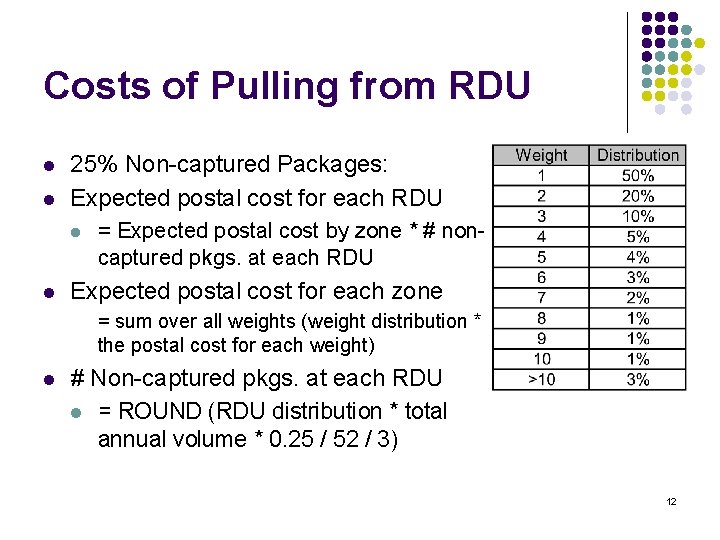
Costs of Pulling from RDU l l 25% Non-captured Packages: Expected postal cost for each RDU l l = Expected postal cost by zone * # noncaptured pkgs. at each RDU Expected postal cost for each zone = sum over all weights (weight distribution * the postal cost for each weight) l # Non-captured pkgs. at each RDU l = ROUND (RDU distribution * total annual volume * 0. 25 / 52 / 3) 12
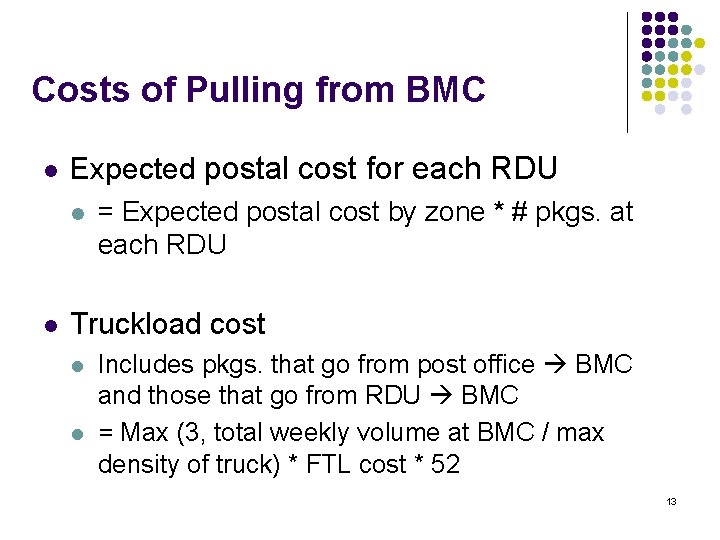
Costs of Pulling from BMC l Expected postal cost for each RDU l l = Expected postal cost by zone * # pkgs. at each RDU Truckload cost l l Includes pkgs. that go from post office BMC and those that go from RDU BMC = Max (3, total weekly volume at BMC / max density of truck) * FTL cost * 52 13
Model Formulation 14
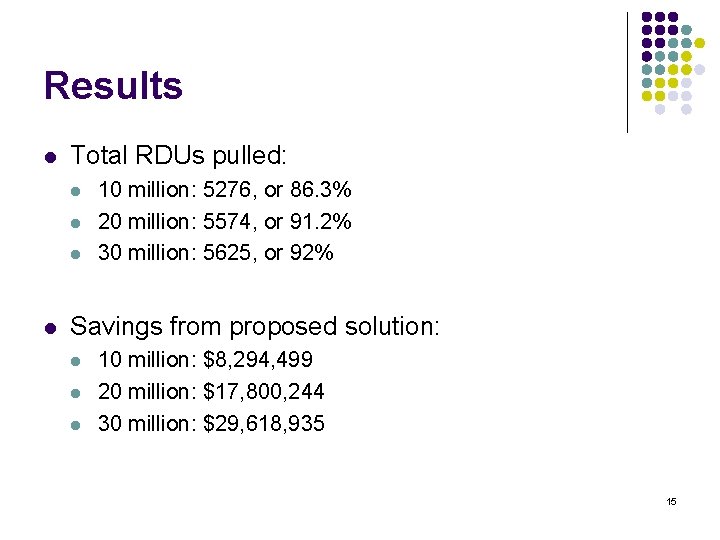
Results l Total RDUs pulled: l l 10 million: 5276, or 86. 3% 20 million: 5574, or 91. 2% 30 million: 5625, or 92% Savings from proposed solution: l l l 10 million: $8, 294, 499 20 million: $17, 800, 244 30 million: $29, 618, 935 15
DDU Cost Sensitivity Analysis: Detroit and Springfield 16
Postal Cost Sensitivity Analysis: Detroit 17
Overall Results l Pull from RDU except when volumes are very low l l Very low volumes increase DDU cost cheaper to go through BMC As annual volume increases, pull from more RDUs Solution is not very sensitive to small changes in DDU cost Solution can change when postal costs decrease by at least 20% 18
Recommendations l l l Start pulling packages from specified RDUs Understand better cubic dimensions of packages reduce DDU cost Explore possibility of paying LTL instead of FTL: may change optimal solution 19
Questions? 20