
Tim Burrows Ph D Director of Assessment and
Tim Burrows, Ph. D. Director of Assessment and Accreditation Writing & Measuring Effective Learning Outcomes Presentation includes information from workshops originally presented by De. Paul University, Loyola University, & Virginia Tech
Workshop Agenda 1. Definition and Purposes of direct and indirect measures 2. What to write when you’re creating Learning Outcomes 3. How to assess your learning outcomes 4. Questions
Workshop objectives • Distinguish between cognitive and affective types of learning outcomes • Identify relevant considerations when writing learning outcomes • Write effective learning outcomes • Determine the most effective assessment for your learning outcomes

Part I WRITING EFFECTIVE LEARNING OUTCOMES
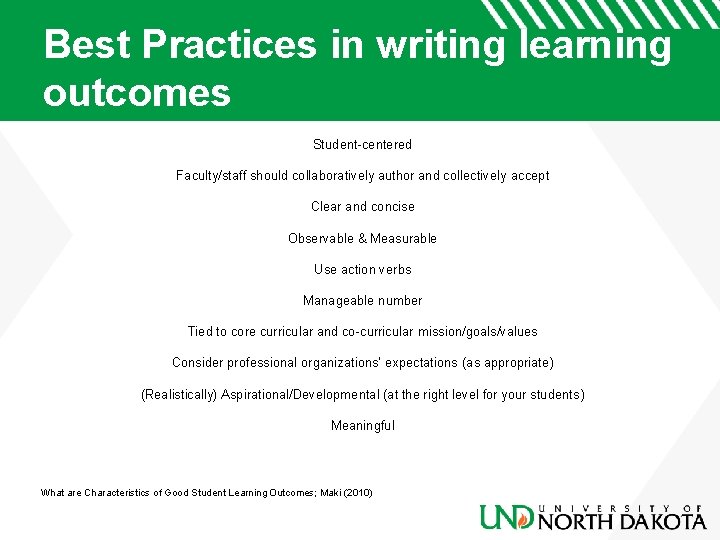
Best Practices in writing learning outcomes Student-centered Faculty/staff should collaboratively author and collectively accept Clear and concise Observable & Measurable Use action verbs Manageable number Tied to core curricular and co-curricular mission/goals/values Consider professional organizations’ expectations (as appropriate) (Realistically) Aspirational/Developmental (at the right level for your students) Meaningful What are Characteristics of Good Student Learning Outcomes; Maki (2010)
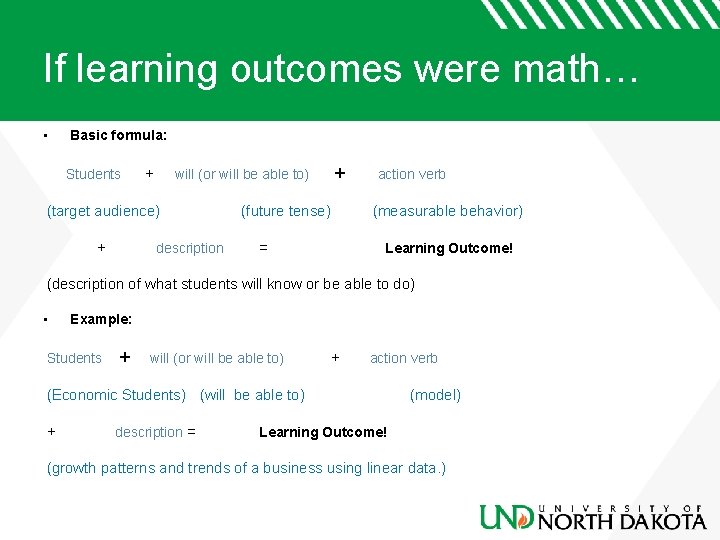
If learning outcomes were math… • Basic formula: Students + will (or will be able to) + action verb (target audience) (future tense) (measurable behavior) + description = Learning Outcome! (description of what students will know or be able to do) • Example: Students + will (or will be able to) + action verb (Economic Students) (will be able to) (model) + description = Learning Outcome! (growth patterns and trends of a business using linear data. )
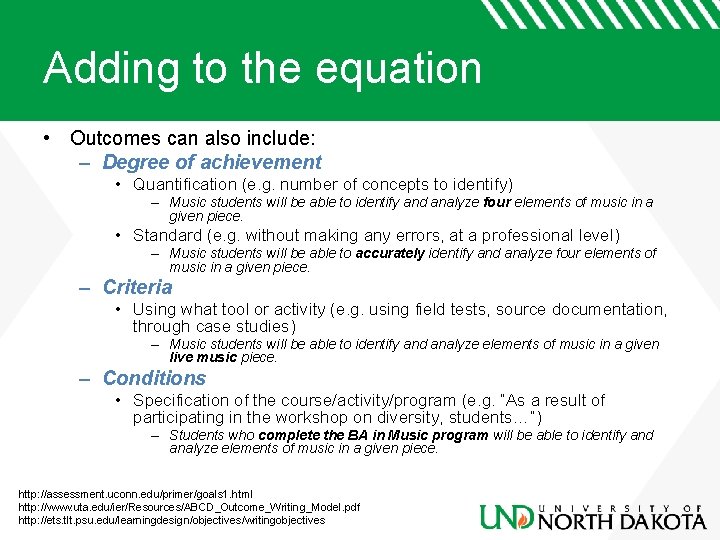
Adding to the equation • Outcomes can also include: – Degree of achievement • Quantification (e. g. number of concepts to identify) – Music students will be able to identify and analyze four elements of music in a given piece. • Standard (e. g. without making any errors, at a professional level) – Music students will be able to accurately identify and analyze four elements of music in a given piece. – Criteria • Using what tool or activity (e. g. using field tests, source documentation, through case studies) – Music students will be able to identify and analyze elements of music in a given live music piece. – Conditions • Specification of the course/activity/program (e. g. “As a result of participating in the workshop on diversity, students…”) – Students who complete the BA in Music program will be able to identify and analyze elements of music in a given piece. http: //assessment. uconn. edu/primer/goals 1. html http: //www. uta. edu/ier/Resources/ABCD_Outcome_Writing_Model. pdf http: //ets. tlt. psu. edu/learningdesign/objectives/writingobjectives
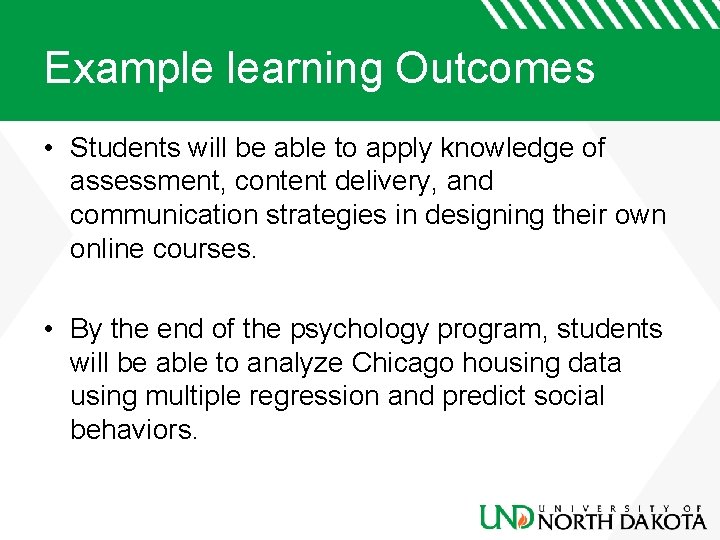
Example learning Outcomes • Students will be able to apply knowledge of assessment, content delivery, and communication strategies in designing their own online courses. • By the end of the psychology program, students will be able to analyze Chicago housing data using multiple regression and predict social behaviors.
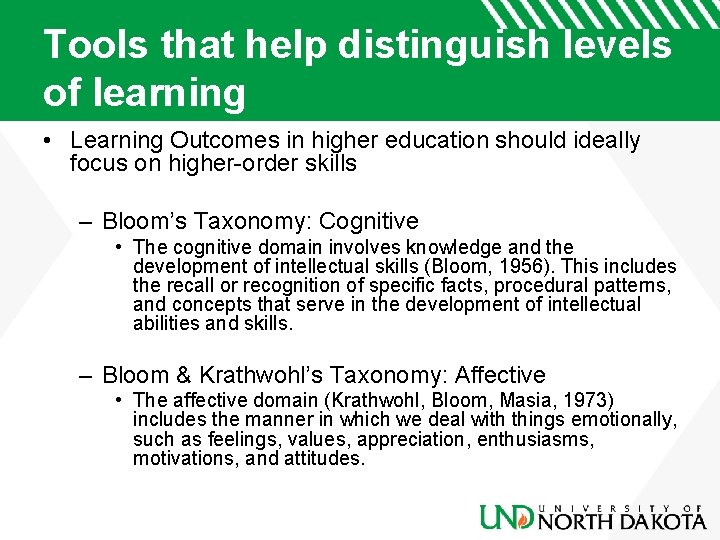
Tools that help distinguish levels of learning • Learning Outcomes in higher education should ideally focus on higher-order skills – Bloom’s Taxonomy: Cognitive • The cognitive domain involves knowledge and the development of intellectual skills (Bloom, 1956). This includes the recall or recognition of specific facts, procedural patterns, and concepts that serve in the development of intellectual abilities and skills. – Bloom & Krathwohl’s Taxonomy: Affective • The affective domain (Krathwohl, Bloom, Masia, 1973) includes the manner in which we deal with things emotionally, such as feelings, values, appreciation, enthusiasms, motivations, and attitudes.
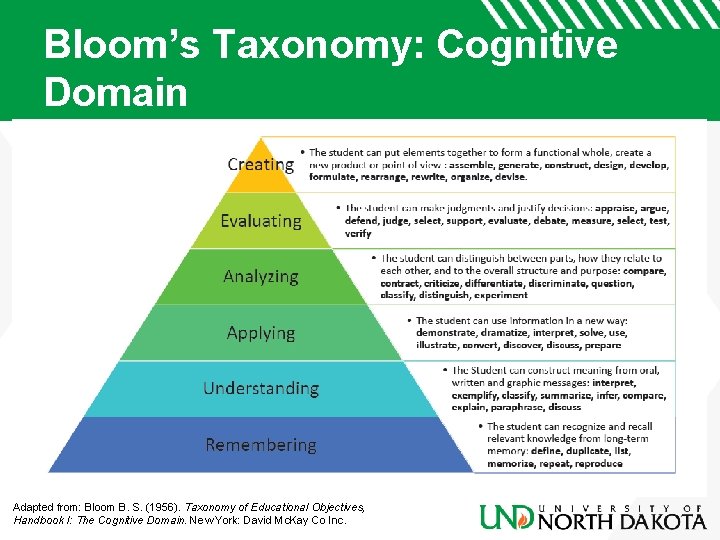
Bloom’s Taxonomy: Cognitive Domain Adapted from: Bloom B. S. (1956). Taxonomy of Educational Objectives, Handbook I: The Cognitive Domain. New York: David Mc. Kay Co Inc.
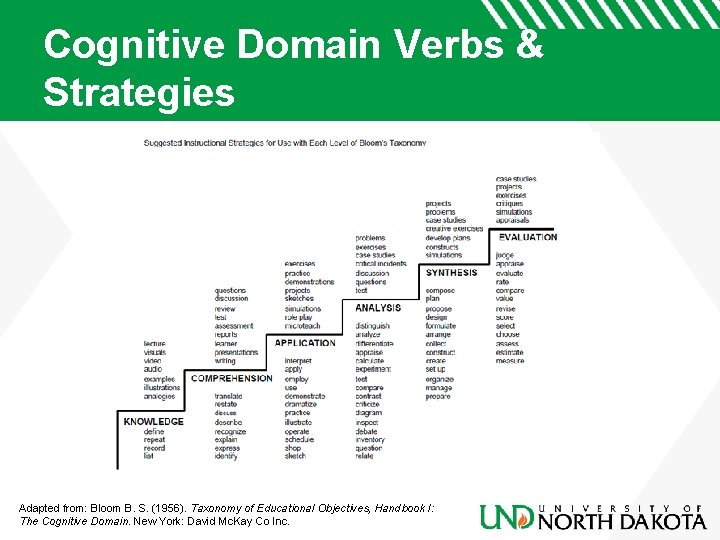
Cognitive Domain Verbs & Strategies Adapted from: Bloom B. S. (1956). Taxonomy of Educational Objectives, Handbook I: The Cognitive Domain. New York: David Mc. Kay Co Inc.
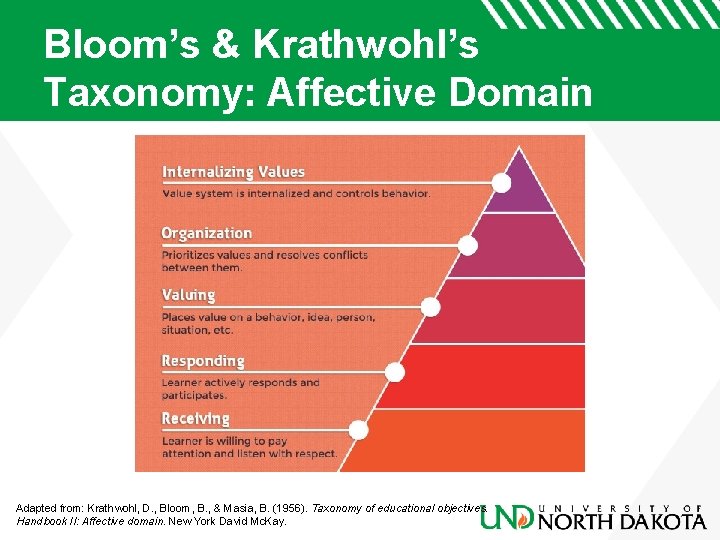
Bloom’s & Krathwohl’s Taxonomy: Affective Domain Adapted from: Krathwohl, D. , Bloom, B. , & Masia, B. (1956). Taxonomy of educational objectives. Handbook II: Affective domain. New York David Mc. Kay.

Affective Domain Verbs
Common slip-ups • Using “understand, ” “have knowledge of, ” “be aware of, ” “appreciate”… • Focusing on yourself rather than the student • Not enough/too many outcomes • Outcomes that are too complex (difficult for stakeholders to understand)

Part II MEASURING EFFECTIVE LEARNING OUTCOMES
What should you consider when choosing an assessment measure? • Assessment measure is compatible with the outcome • The measure selected should provide reasonably accurate, useful information • The measure would yield results specific enough to know where improvements can be made • Assessment measure matches the cognitive level of the outcome (for student learning outcomes)
What should you consider when choosing an assessment measure? • Consider what is already being done: – Survey faculty on what activities are being done in their courses – Find out what is being done locally or Institute‐wide that might map to your outcomes – Utilize one activity for several outcomes where possible – Use capstone points in the curriculum
When selecting your measure what should your program ask? • Is the measure a reasonable indicator for the cognitive level specified in the student learning outcome? • Would this assessment method assist the program in other ways (meeting accreditation standards, provide feedback to students, etc. )? • Will the results of the assessment produce data that are trustworthy and understandable? • Is the development/preparation time involved in using this measure reasonable?
Direct Measures • Direct measures are tangible, visible, and observable – Allow someone to directly observe the student learning, usually via student work embedded in a course – Show a demonstration of a students’ knowledge or skill – Indicate a service or activity implemented by the program • For each student learning outcome the program should have at least one direct indicator of student learning.
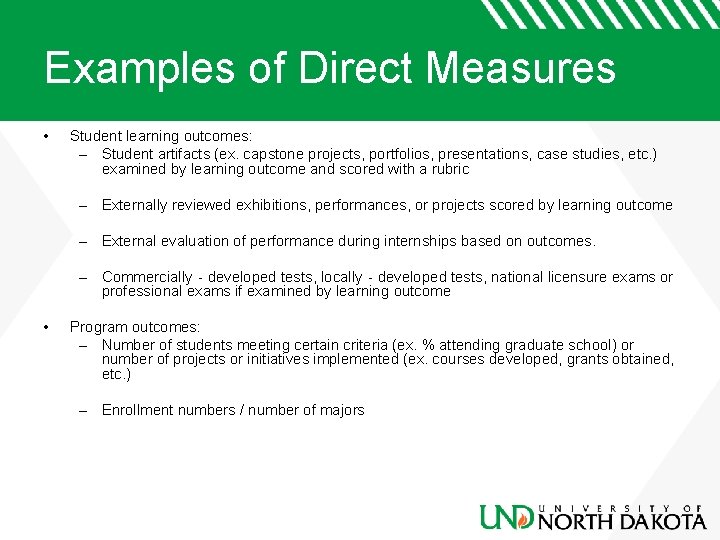
Examples of Direct Measures • Student learning outcomes: – Student artifacts (ex. capstone projects, portfolios, presentations, case studies, etc. ) examined by learning outcome and scored with a rubric – Externally reviewed exhibitions, performances, or projects scored by learning outcome – External evaluation of performance during internships based on outcomes. – Commercially‐developed tests, locally‐developed tests, national licensure exams or professional exams if examined by learning outcome • Program outcomes: – Number of students meeting certain criteria (ex. % attending graduate school) or number of projects or initiatives implemented (ex. courses developed, grants obtained, etc. ) – Enrollment numbers / number of majors
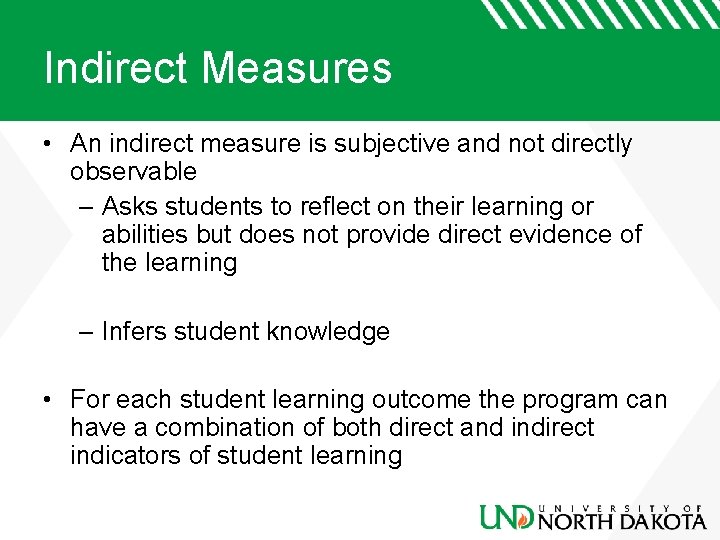
Indirect Measures • An indirect measure is subjective and not directly observable – Asks students to reflect on their learning or abilities but does not provide direct evidence of the learning – Infers student knowledge • For each student learning outcome the program can have a combination of both direct and indirect indicators of student learning
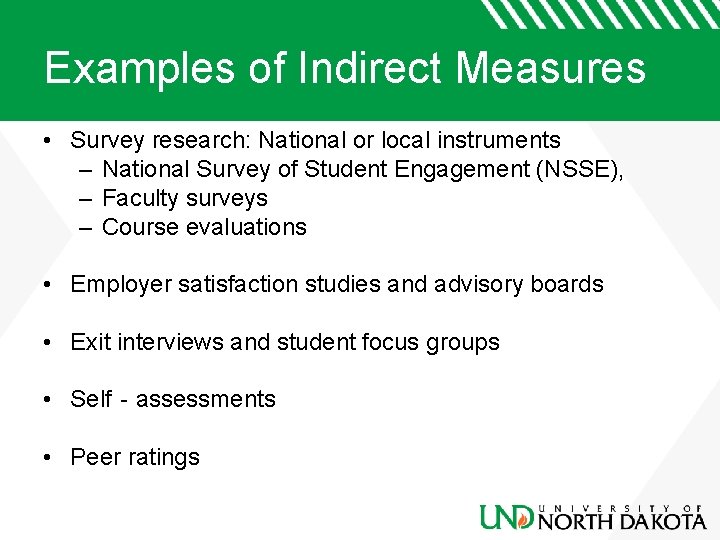
Examples of Indirect Measures • Survey research: National or local instruments – National Survey of Student Engagement (NSSE), – Faculty surveys – Course evaluations • Employer satisfaction studies and advisory boards • Exit interviews and student focus groups • Self‐assessments • Peer ratings
Resources for writing learning outcomes – Director of Assessment and Accreditation • Dr. Tim Burrows – Email: timothy. burrows@und. edu • Assessment website: https: //www 1. und. edu/research/institutionalresearch/assessment/
- Slides: 23