My life Our Lessons Timothy Cordes Ph D







- Slides: 41
My life: Our Lessons Timothy Cordes, Ph. D, MD
Disclaimer � This presentation is my own. � It does not reflect the views or opinions of the government of the United States or its Veterans Administration. � I have also received funds from Vanda Pharmaceuticals for unrelated work.
Outline � Conceptualizing disability � Challenges and strategies ◦ Technical challenges ◦ Conceptual challenges � Examples of successful accommodation � Parting ideas
Considering Strengths � “To make strength productive is the unique purpose of organization” � “It cannot, of course, overcome the weaknesses with which each of us is abundantly endowed. But it can make them irrelevant. ”
Considering Strengths � “Strong people always have strong weaknesses too. Where there are peaks, there are valleys. And no one is strong in many areas. Measured against the universe of human knowledge, experience, and abilities, even the greatest genius would have to be rated a total failure. There is no such thing as a ‘good man’. ‘Good for what? ’ is the question. ” � From Peter Drucker
How do we think about disability
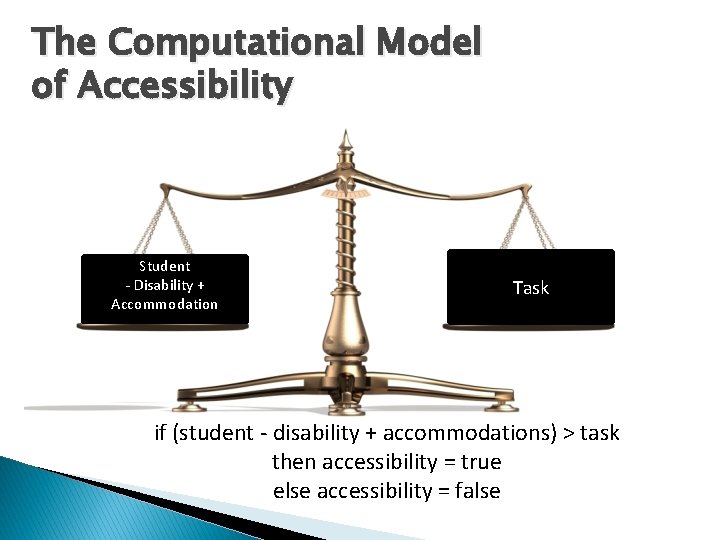
The Computational Model of Accessibility Student - Disability + Accommodation Task if (student - disability + accommodations) > task then accessibility = true else accessibility = false
Benefits of the Computational Model � Simple � Defines a clear relationship � Intuitively fits our way of viewing disability
Limitations � Assumes quantities are static ◦ Can students abilities improve? ◦ Is the task truly fixed? � Assumes the disability is negative � Assumes all measurements are accurate � Provides no direct role for the educator
Ideal Model �As simple as possible �Acknowledges active role of educator and student �Incorporates strengths of each �Implies ultimate goal is accommodation �Emphasizes the dynamic nature of the process
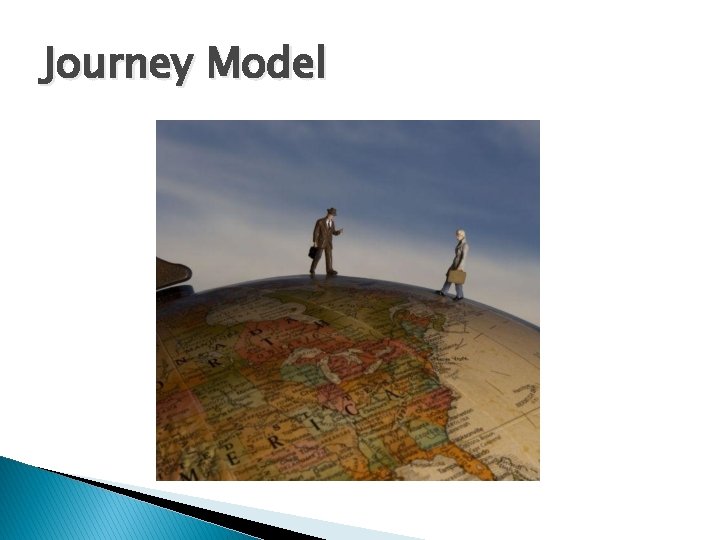
Journey Model
From Ex-anatomy. org
Challenges on the Journey Challenges are a reality for the disabled in higher education 2 main categories of challenges Technical Addressed through the appropriate use of tools and technology Conceptual Created by inaccuracies in how people think about disability and accommodation Can be more difficult to recognize and address Success depends on the combination of technical and conceptual challenges
Tools for Addressing Challenges �Technology ◦ Simple ◦ Complex �Techniques �Attitudes ◦ Acceptance
Finding Tools ◦ Define the problem � Assess strengths and skills ◦ Have open discussions ◦ Investigate options ◦ Be creative
Think Broadly about Tools � Core skills of disability ◦ Lip reading, Braille, etc. � Technical skills ◦ ◦ Computers Performance arts Athleticism Hobbies ◦ ◦ Motivation Persistence Willingness Adaptability � Personal attributes
Tools Are Ubiquitous
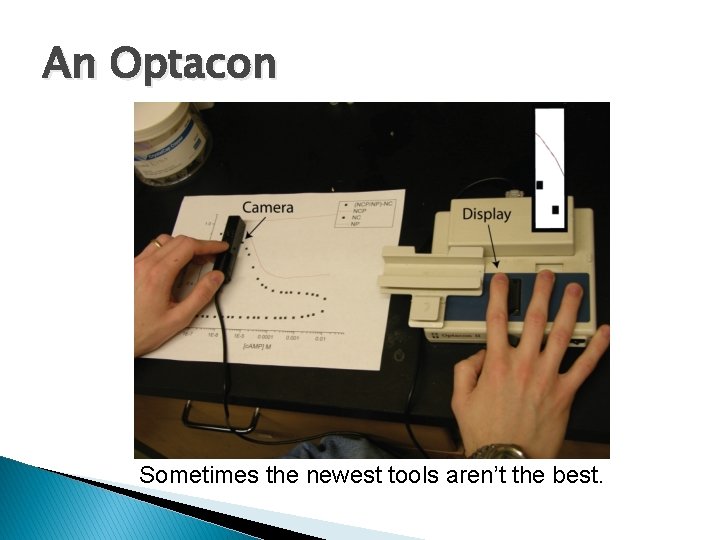
An Optacon Sometimes the newest tools aren’t the best.
Examples � Skeletons, heart and brain models � Clay models describing blood cell shape and appearance � Organic chemistry models � Simple plastic raised-line drawing kits � Veterinary syringes to measure liquids � ILAB project now makes a variety of accessible lab equipment
Conceptual Challenges � Counter-transference ◦ A psychological concept which encompasses how a therapist feels towards a patient ◦ Needs to be brought into conscious awareness ◦ We all ‘see’ things through our own lens. ◦ In order to build bridges , we need to be aware of what we and those around us carry with us.
Common Conceptual Challenge �The “If I can’t do it without that sense or ability, then …” �Perpetuated by well meaning advocates �Neglects ◦ Skills that the individual has acquired to compensate ◦ Actual neuroplasticity
Neuroplasticity � The brain's ability to reorganize itself by forming new neural connections throughout life. � Neuroplasticity allows the neurons in the brain to compensate for injury and disease and to adjust their activities in response to new situations or to changes in their environment.
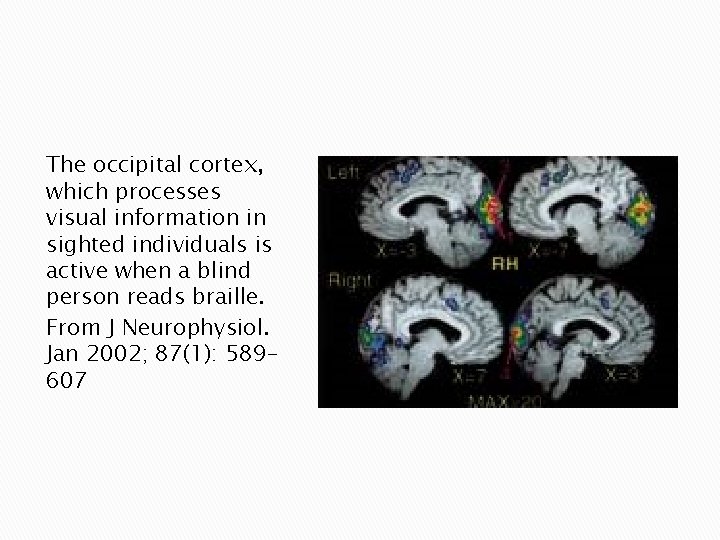
The occipital cortex, which processes visual information in sighted individuals is active when a blind person reads braille. From J Neurophysiol. Jan 2002; 87(1): 589– 607
Examples of Neuroplasticity � Changes in patterns of brain activation occurred after 5 days of blind folding � Occipital cortex became active in sensory and auditory tasks � Visual cortex has been found to be active in braille reading and verbal memory tasks � Auditory cortex has been activated in the deaf while lip reading
An Antidote � How I learned to handle this barrier � Embracing � One first � If the power of dreams cannot “achieve” without “conceiving” we stop at the conceptual phase, we block achievement.
The Model Trap � Happens when we confuse the model with reality � Example: anatomy course ◦ Standard procedure was to identify nerves, muscles, and blood vessels visually ◦ True task is to know the structures ◦ Identifying by feel is equivalent � Protein structure ◦ No one has ever “seen” the 3 -D structure of a protein ◦ All models are approximations
Variant: The Tradition Trap �“That’s just not how we do things. ” �Prevalent �Solution: in medicine and surgery Simultaneous rejection of the premise while embracing a greater goal or idea
Why are you here? �What is your purpose ◦ How does it give meaning to surmounting the barrier
A Challenge �How could a blind person understand the 3 -dimensional structure of a protein ◦ Need a way to appreciate distances ◦ Need a way to understand spatial relationships ◦ Need a way to use a tool in near real-time on multiple structures.
Available Tools � Technology ◦ Computing resources ◦ Publically available routines for computer graphics ◦ Interest of my supervisor � Techniques/Skills ◦ Auditory spatial abilities ◦ Musical experience ◦ Programming experience
TIMMol �Explores the protein by moving a selection sphere or 3 D cursor �Text output describes the contents of the selection sphere �Gives atom name identifiers and x, y, z location for each
TIMMol Audio Output �TIMMol plays tones to indicate atom position and identity �X axis: Left and right ear �Y axis: Pitch �Z axis: Softer and Louder
Sample Graphical Output
Lessons from TIMMol § § We asked 9 adults with some structural biology experience to participate in a trial of TIMMol. With brief training, a majority of participants could identify a beta-sheet, a common structural element of proteins. Participants were also able to correctly identify spatial relationships (like +y or –z) between atoms 88% of the time. People with less experience with traditional molecular visualization packages were more successful with TIMMol.
Medical School �Once you decide something can be done, it just becomes a matter of how. �Anatomy by touch �Raised-line drawings �Work with describers �Screen readers to access the medical record
Clinical Training �Adapted elements of the physical exam to do by touch (avoiding the Model Trap) �Using an optacon to read EKG’s (old technology) �Identifying organs by touch in surgery �Use of clinical simulators �Placing breathing tubes
My Bridge, Tomorrow who knows … � See dozens of patients a week independently � Settings range from a clinic, to a psychiatric ward, to the emergency room � I specialize in helping with those with addictions � I use computers to complete paperwork and documentation � I also teach medical students and resident physicians
Summary �Building bridges is a dynamic process �Utilizing tools, techniques, and attitudes �Undertaken with an awareness of our own strengths and weaknesses �Capitalizing on the student’s strengths
Closing Thoughts �Today’s technical tools are amazing and barriers are falling rapidly. �The remaining barriers are nothing compared to the power of our hearts and minds when fully engaged. � With openness, persistence, creativity, and cooperation, we can build bridges to tomorrow.
Journey Model