
Focused Relevance Feedback Timothy Chappell t chappellconnect qut
Focused Relevance Feedback Timothy Chappell (t. chappell@connect. qut. edu. au) Supervisor: Shlomo Geva

Introduction
Query-based Information Retrieval • Standard search engine paradigm • Based on a model of users searching for documents by predicting patterns of text • Require users to have a fairly good idea of what they are looking for
Relevance Feedback • Starts with a normal search query • User examines the results returned and provides the search engine with feedback • Search engine uses the feedback to learn more about what the user is looking for • Search engine modifies the user’s query to return more relevant results
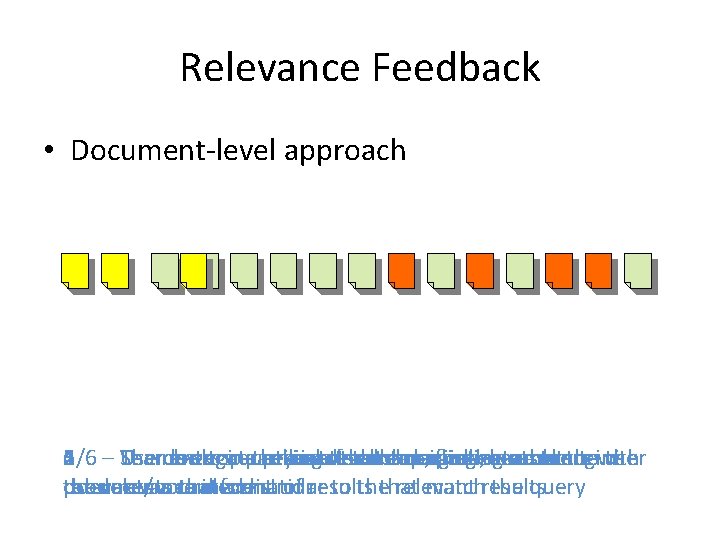
Relevance Feedback • Document-level approach 6/6 – The 1/6 2/6 3/6 4/6 5/6 Usernew Search enters looks engine top-ranking atquery the presents utilises reranks results intoresults feedback, the search the and remaining top-ranking are marks engine, presented finding them documents search results other astoengine the towith user the produces user relevant/not documents the relevance a ranked that relevant information arelist similar of results to thethat relevant matchresults the query
Focused Relevance Feedback • Research aimed at determining whether relevance feedback approaches are effective when applied at a higher resolution • Users provide feedback in terms of relevant passages, not documents
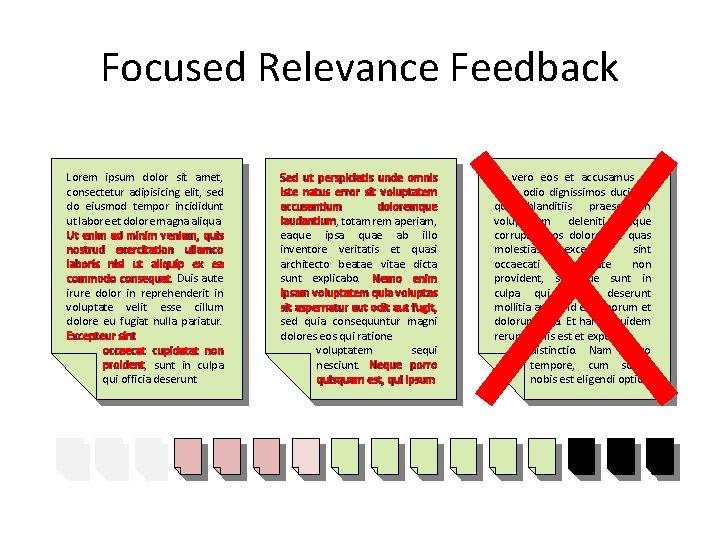
Focused Relevance Feedback Lorem ipsum dolor sit amet, consectetur adipisicing elit, sed do eiusmod tempor incididunt ut labore et dolore magna aliqua. Ut enim ad minim veniam, quis nostrud exercitation ullamco laboris nisi ut aliquip ex ea commodo consequat. Duis aute irure dolor in reprehenderit in voluptate velit esse cillum dolore eu fugiat nulla pariatur. Excepteur sint occaecat cupidatat non proident, sunt in culpa qui officia deserunt Sed ut perspiciatis unde omnis iste natus error sit voluptatem accusantium doloremque laudantium, totam rem aperiam, eaque ipsa quae ab illo inventore veritatis et quasi architecto beatae vitae dicta sunt explicabo. Nemo enim ipsam voluptatem quia voluptas sit aspernatur aut odit aut fugit, sed quia consequuntur magni dolores eos qui ratione voluptatem sequi nesciunt. Neque porro quisquam est, qui ipsum At vero eos et accusamus et iusto odio dignissimos ducimus qui blanditiis praesentium voluptatum deleniti atque corrupti quos dolores et quas molestias excepturi sint occaecati cupiditate non provident, similique sunt in culpa qui officia deserunt mollitia animi, id est laborum et dolorum fuga. Et harum quidem rerum facilis est et expedita distinctio. Nam libero tempore, cum soluta nobis est eligendi optio

Methodology
Evaluation • Standard method for evaluating the effectiveness of ranking systems is average precision over recall. • Recall: the % of relevant documents returned • Precision: the % of documents returned that are relevant Ruthven and Lalmas, 2003 [5]
Test Collection • Test collection that approximates ‘real-world data’ needed • The Wikipedia XML Corpus, a collection of documents from Wikipedia converted to XML was used Denoyer and Gallinari, 2006 [1]
Relevance Assessments • Assessment data from the INEX 2008 Ad Hoc track used to provide relevance information • Data consists of segments of text that users have identified as being relevant in relation to particular topics • Used for both simulating user feedback for the focused relevance feedback algorithms and evaluating their performance Kamps, Geva, Trotman, Woodley and Koolen, 2009 [3]
Evaluation Platform • Need for a consistent platform for evaluating different relevance feedback algorithms • Written in C and Java • Relevance feedback algorithms developed as plugins for the evaluation platform (as dynamic libraries) • Will be used as the basis for a new track in INEX 2010.
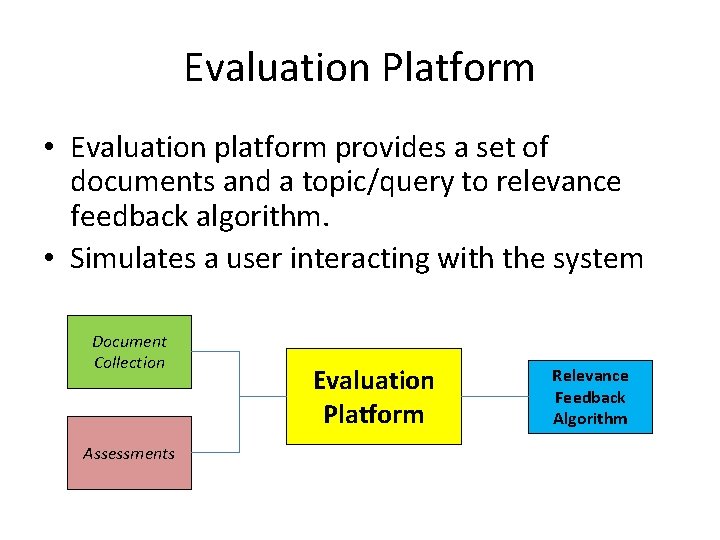
Evaluation Platform • Evaluation platform provides a set of documents and a topic/query to relevance feedback algorithm. • Simulates a user interacting with the system Document Collection Assessments Evaluation Platform Relevance Feedback Algorithm
Evaluation Platform • The plugins are evaluated side by side over a run of 20 different topics • For each result returned by the relevance feedback algorithm, a line of a TREC or INEX run is output • trec_eval, inex_eval or internal metrics can be used to evaluate algorithm performance
Relevance Feedback algorithms • Written in Java using the Apache Lucene search engine as a base • Most effective algorithm tested was based on the Rocchio relevance feedback approach • Tested against the University of Waterloo's Okapi BM 25 run from INEX 2008, BICER, which was the best-performing in-context engine Jakarta, 2004[2] Rocchio, 1971[4]
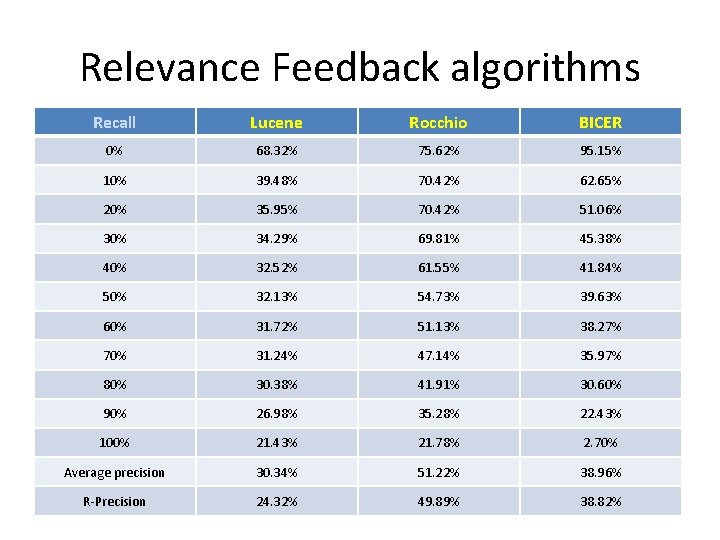
Relevance Feedback algorithms Recall Lucene Rocchio BICER 0% 68. 32% 75. 62% 95. 15% 10% 39. 48% 70. 42% 62. 65% 20% 35. 95% 70. 42% 51. 06% 30% 34. 29% 69. 81% 45. 38% 40% 32. 52% 61. 55% 41. 84% 50% 32. 13% 54. 73% 39. 63% 60% 31. 72% 51. 13% 38. 27% 70% 31. 24% 47. 14% 35. 97% 80% 30. 38% 41. 91% 30. 60% 90% 26. 98% 35. 28% 22. 43% 100% 21. 43% 21. 78% 2. 70% Average precision 30. 34% 51. 22% 38. 96% R-Precision 24. 32% 49. 89% 38. 82%
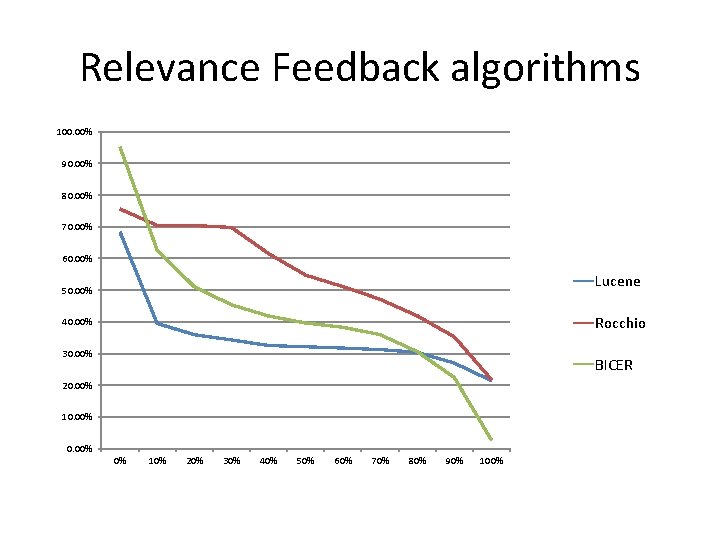
Relevance Feedback algorithms 100. 00% 90. 00% 80. 00% 70. 00% 60. 00% Lucene 50. 00% Rocchio 40. 00% 30. 00% BICER 20. 00% 10. 00% 0% 10% 20% 30% 40% 50% 60% 70% 80% 90% 100%
References [1] L. Denoyer and P. Gallinari. The Wikipedia XML Corpus. In Sig. IR Forum, 2006. [2] A. Jakarta. Apache Lucene-a high-performance, full-featured text search engine library, 2004. [3] J. Kamps, S. Geva, A. Trotman, A. Woodley and M. Koolen. Overview of the INEX 2008 ad hoc track. In Advances in Focused Retrieval, pages 1 -28. Springer, 2009.
References [4] J. J. Rocchio. Relevance feedback in information retrieval. In The SMART retrieval system - experiments in automatic document processing, pages 313 -323. Englewood Cliffs, NJ: Prentice-Hall, 1971. [5] I. Ruthven and M. Lalmas. A survey on the use of relevance feedback for information access systems. Knowl. Eng. Rev. , 18(2): 95 -145, 2003.
- Slides: 19