Worship Groups and Other Alternatives to Traditional Church














- Slides: 99
Worship Groups and Other Alternatives to “Traditional” Church A conversation about the revitalization of the Quaker message for today
Worship Groups and Other Alternatives to “Traditional” Church Session One: Facts and Figures
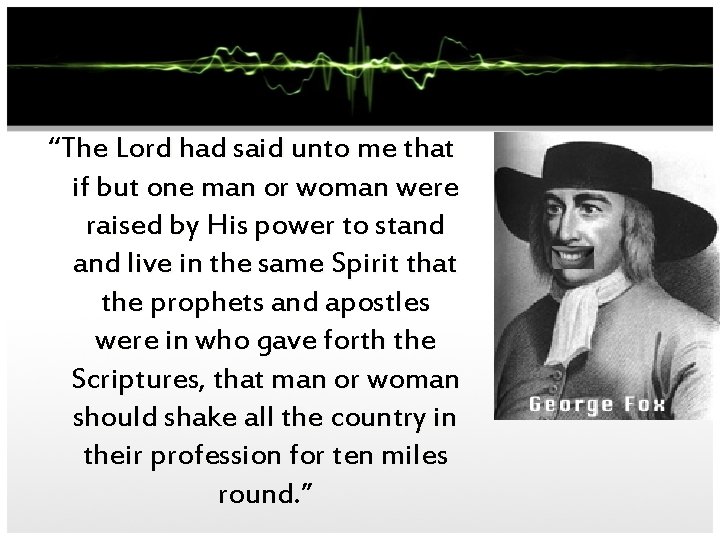
“The Lord had said unto me that if but one man or woman were raised by His power to stand live in the same Spirit that the prophets and apostles were in who gave forth the Scriptures, that man or woman should shake all the country in their profession for ten miles round. ”
Otherwise
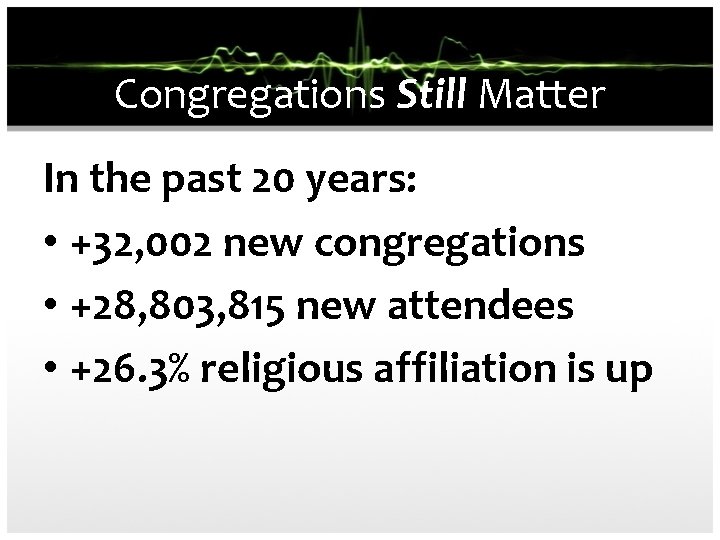
Congregations Still Matter In the past 20 years: • +32, 002 new congregations • +28, 803, 815 new attendees • +26. 3% religious affiliation is up
But… do Quaker Congregations Still Matter? In the past 20 years: we’ve added 311 new congregations have lost 17, 000 members and dropped recognized affiliation by 14% Friends United Meeting has dropped 15, 000 members • Evangelical Friends International has dropped 3, 000 members • Friends General Conference has grown 1, 000 members • •
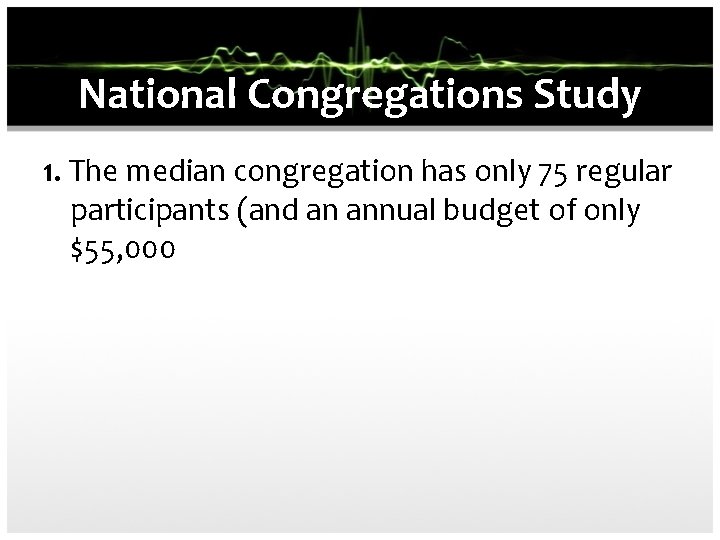
National Congregations Study 1. The median congregation has only 75 regular participants (and an annual budget of only $55, 000
National Congregations Study 2. Worship and religious education are the core activities of religious congregations. – Significant minorities of congregations engage in social services and political activities in serious ways – These do not represent the core activities of most congregations
National Congregations Study 3. The secular arenas with which congregations have most interaction are not politics or social services but rather education and culture/arts. – This is important to keep in mind when considering the sorts of community activities and secular organizations with which seminary students should be encouraged to develop familiarity and expertise.
National Congregations Study • 4. Congregations are not necessarily community or neighborhood organizations. – Most congregations (61 percent) draw at least half their people from within a 10 -minute drive, but only 20 percent draw as many as a third of their people from within a 10 -minute walk, and 20 percent of congregations have at least a quarter of their people living more than a 30 minute drive away.
National Congregations Study • 5. More recently founded congregations are different than older congregations. – recently founded congregations have more informal and enthusiastic worship – more recently founded congregations are less likely to engage in activities that build bridges between congregations and communities outside the congregation.
Some Congregational Myths … And Strengths!
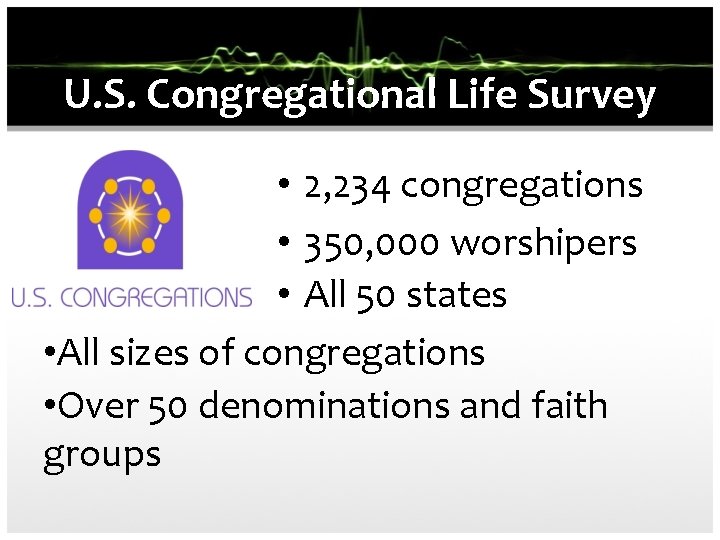
U. S. Congregational Life Survey • 2, 234 congregations • 350, 000 worshipers • All 50 states • All sizes of congregations • Over 50 denominations and faith groups
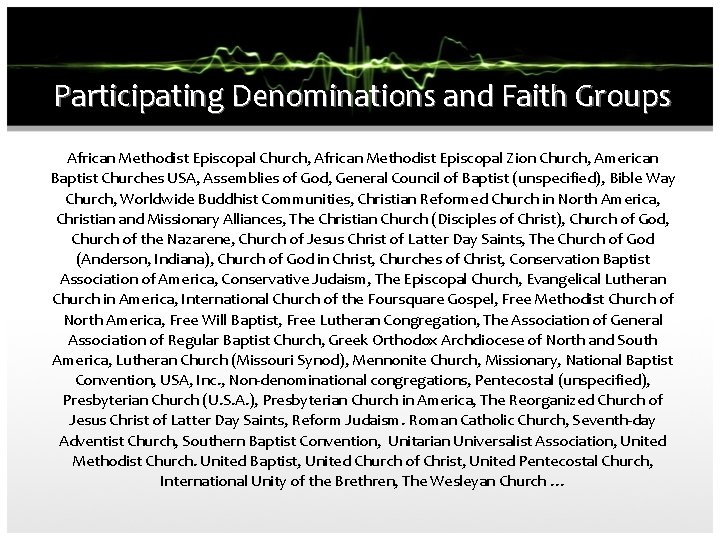
Participating Denominations and Faith Groups African Methodist Episcopal Church, African Methodist Episcopal Zion Church, American Baptist Churches USA, Assemblies of God, General Council of Baptist (unspecified), Bible Way Church, Worldwide Buddhist Communities, Christian Reformed Church in North America, Christian and Missionary Alliances, The Christian Church (Disciples of Christ), Church of God, Church of the Nazarene, Church of Jesus Christ of Latter Day Saints, The Church of God (Anderson, Indiana), Church of God in Christ, Churches of Christ, Conservation Baptist Association of America, Conservative Judaism, The Episcopal Church, Evangelical Lutheran Church in America, International Church of the Foursquare Gospel, Free Methodist Church of North America, Free Will Baptist, Free Lutheran Congregation, The Association of General Association of Regular Baptist Church, Greek Orthodox Archdiocese of North and South America, Lutheran Church (Missouri Synod), Mennonite Church, Missionary, National Baptist Convention, USA, Inc. , Non-denominational congregations, Pentecostal (unspecified), Presbyterian Church (U. S. A. ), Presbyterian Church in America, The Reorganized Church of Jesus Christ of Latter Day Saints, Reform Judaism. Roman Catholic Church, Seventh-day Adventist Church, Southern Baptist Convention, Unitarian Universalist Association, United Methodist Church. United Baptist, United Church of Christ, United Pentecostal Church, International Unity of the Brethren, The Wesleyan Church …
… and Quakers!
Not Your Ordinary Survey • more than just leaders’ perceptions • broad range of denominations and faith groups • congregational health viewed as more than numerical growth • congregations of all sizes are included • all worshipers in participating congregations took part • a huge representative sample of worshipers and congregations
Myth “Nothing ever changes here” is an accurate statement about congregational life
New People
Myth Congregations grow by attracting new people who are not attending religious services anywhere
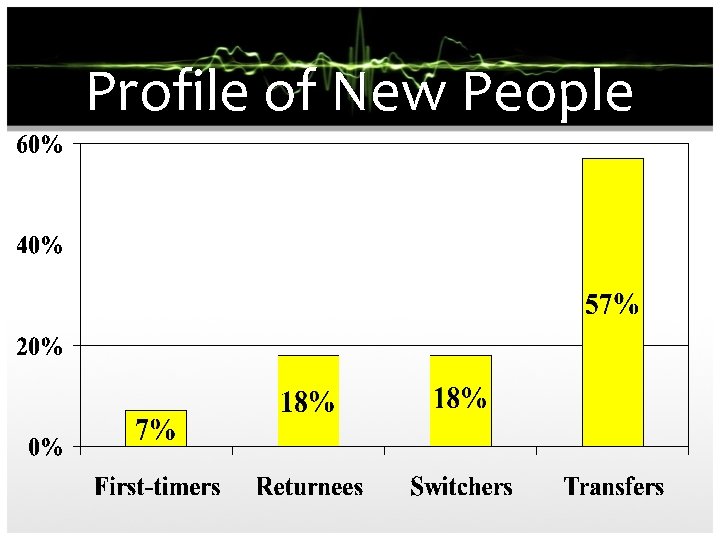
Profile of New People • First-timers –Never regularly attended • Returnees –Participated earlier; returned after lengthy absence
Profile of New People • Switchers –Changed from one faith group to another –Southern Baptist who becomes Quaker
Profile of New People • Transfers –Move within denomination –New Garden Friends, NC to New Garden Friends, IN
Profile of New People
Myth Worshipers who regularly attend are almost always members of the congregation.
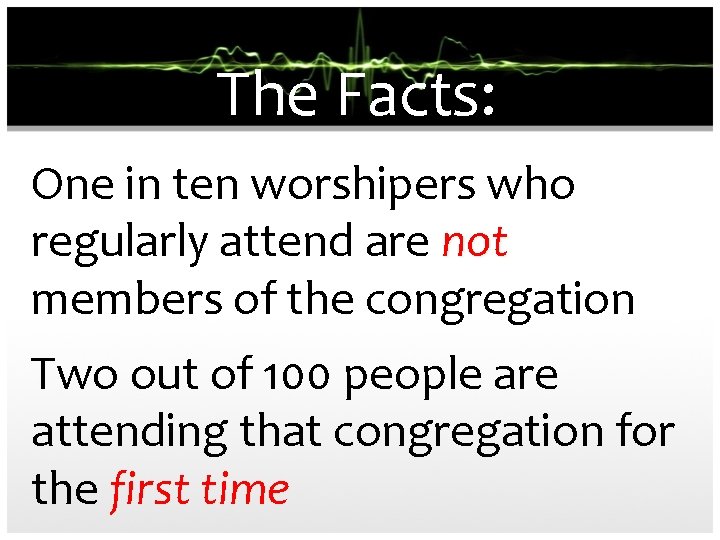
The Facts: One in ten worshipers who regularly attend are not members of the congregation Two out of 100 people are attending that congregation for the first time
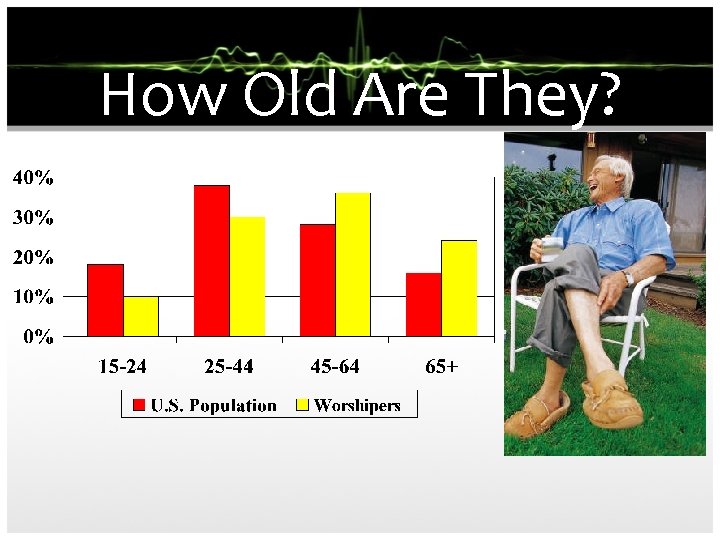
Myth A typical worshiper is over 65 years of age and retired
How Old Are They?
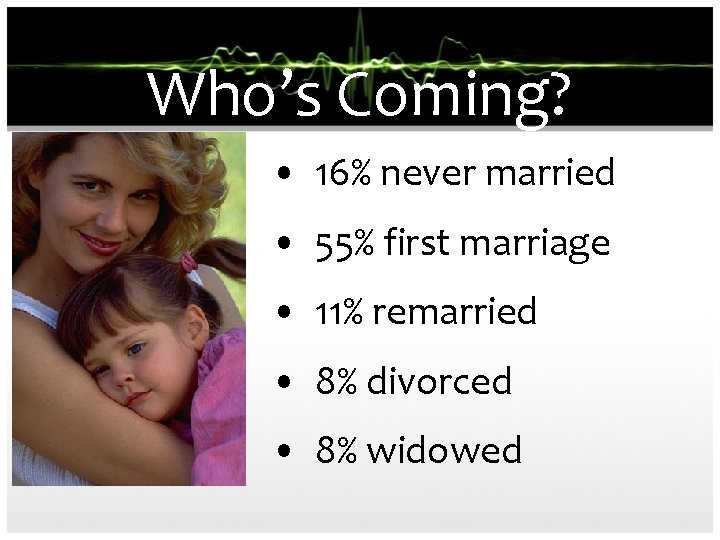
Who’s Coming? • 16% never married • 55% first marriage • 11% remarried • 8% divorced • 8% widowed
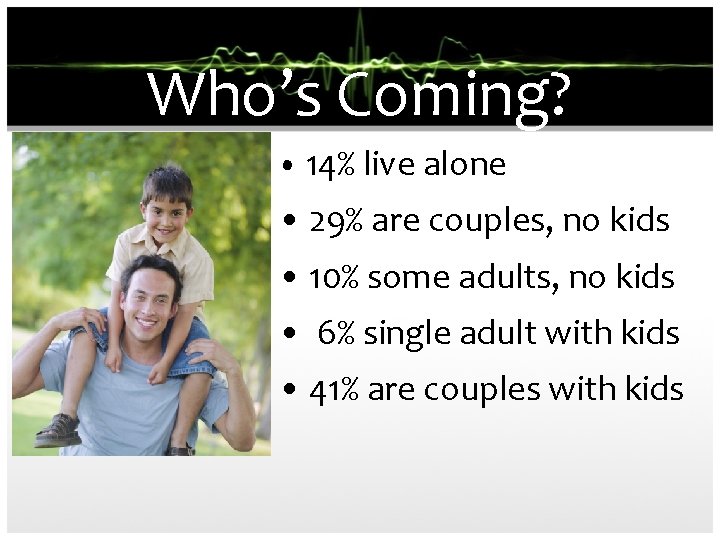
Who’s Coming? • 14% live alone • 29% are couples, no kids • 10% some adults, no kids • 6% single adult with kids • 41% are couples with kids
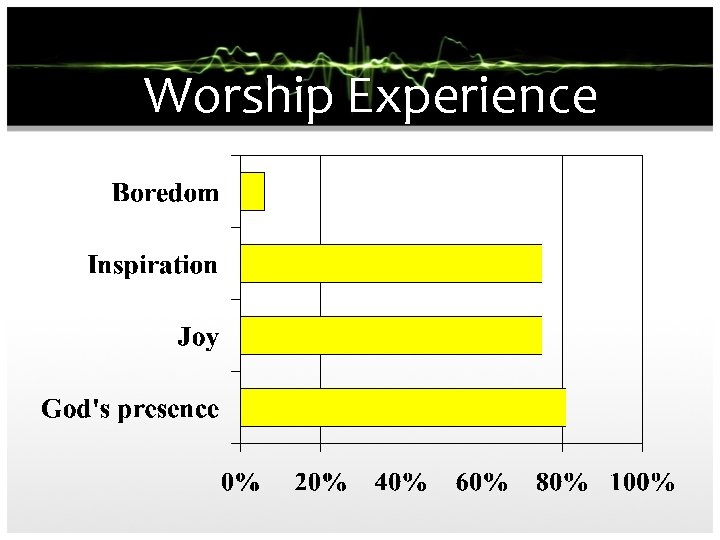
Myth Worship is boring
Worship Experience
Spiritual Needs 83% say their spiritual needs are being met in their congregation
Myth Congregations have difficulty adapting to the changing world because the majority of worshipers are not open to change.
The Facts • Worshipers express ample willingness to try new things (61%) • Many believe their parish or congregation is already considering or implementing new directions (51%)
What are the 10 Strengths? • The U. S. Congregational Life Survey identified 10 key strengths that make congregations successful • Congregations that go Beyond the Ordinary excel in the following areas
1. Growing Spiritually • Beyond the Ordinary congregations help worshipers grow in their faith. – 72% of worshipers spend time in private devotions – 43% of worshipers say they have grown in faith during the past year – Smaller congregations tend to score better than average on the Growing Spiritually Index
2. Meaningful Worship - • Beyond the Ordinary congregations provide worship services that meet the needs of worshipers. – 78% of worshipers experience God’s presence during worship always or regularly – Congregational size has no bearing on this!
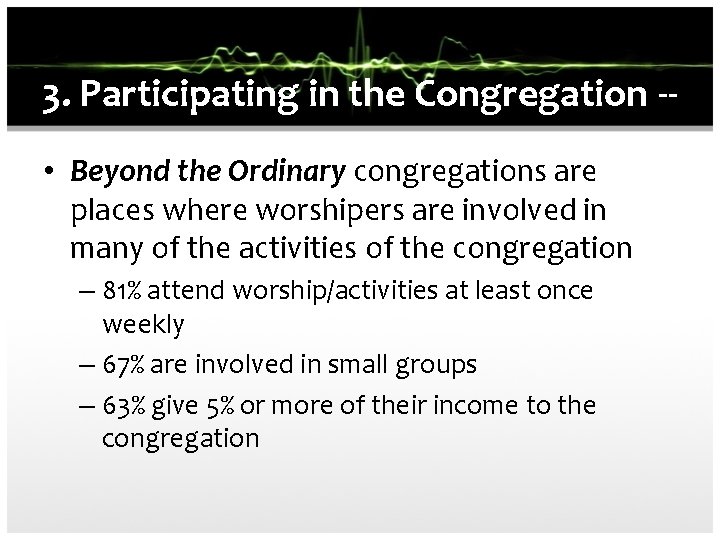
3. Participating in the Congregation - • Beyond the Ordinary congregations are places where worshipers are involved in many of the activities of the congregation – 81% attend worship/activities at least once weekly – 67% are involved in small groups – 63% give 5% or more of their income to the congregation
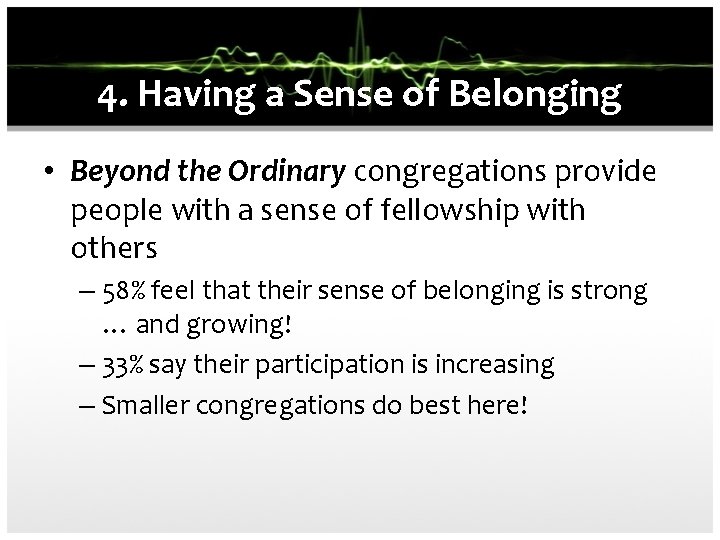
4. Having a Sense of Belonging • Beyond the Ordinary congregations provide people with a sense of fellowship with others – 58% feel that their sense of belonging is strong … and growing! – 33% say their participation is increasing – Smaller congregations do best here!
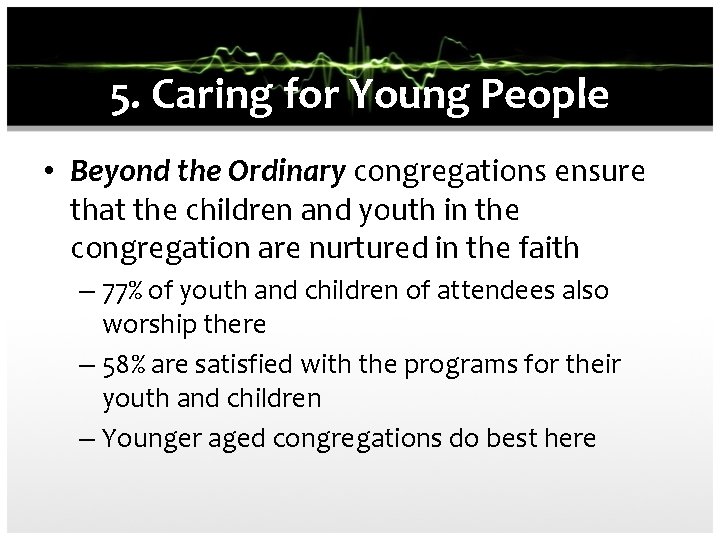
5. Caring for Young People • Beyond the Ordinary congregations ensure that the children and youth in the congregation are nurtured in the faith – 77% of youth and children of attendees also worship there – 58% are satisfied with the programs for their youth and children – Younger aged congregations do best here
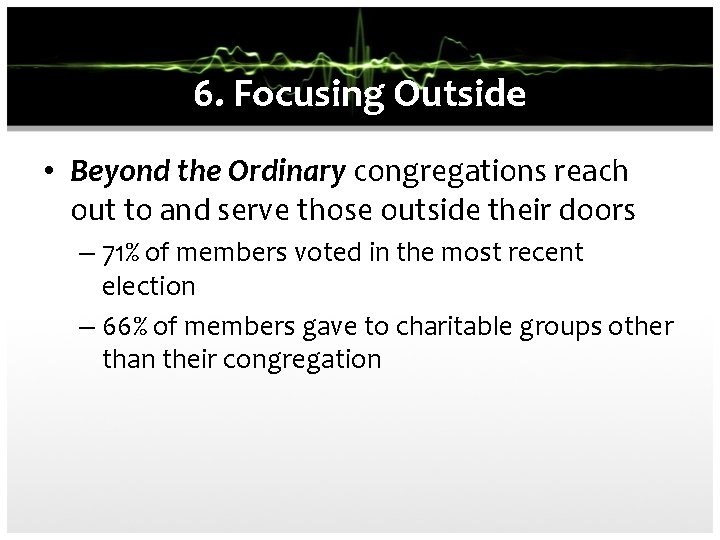
6. Focusing Outside • Beyond the Ordinary congregations reach out to and serve those outside their doors – 71% of members voted in the most recent election – 66% of members gave to charitable groups other than their congregation
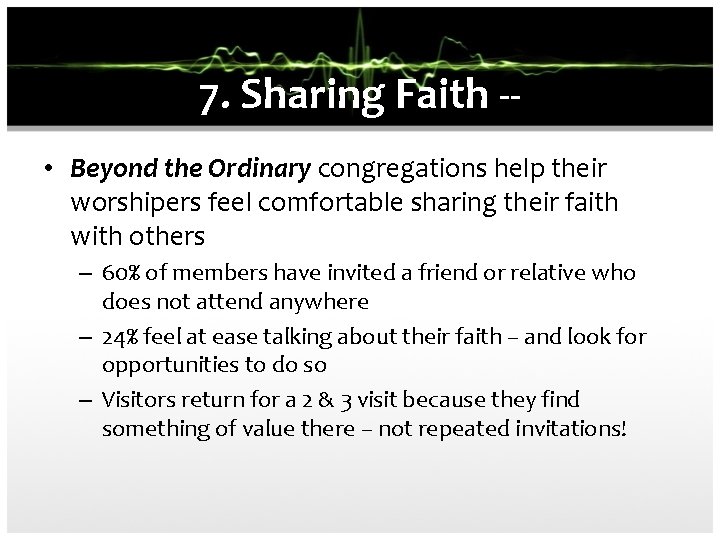
7. Sharing Faith - • Beyond the Ordinary congregations help their worshipers feel comfortable sharing their faith with others – 60% of members have invited a friend or relative who does not attend anywhere – 24% feel at ease talking about their faith – and look for opportunities to do so – Visitors return for a 2 & 3 visit because they find something of value there – not repeated invitations!
8. Welcoming New People • Beyond the Ordinary congregations ensure that new people become part of their faith community – Small congregations do just as well (and sometimes better) than large congregations do – And they attract as many new people!
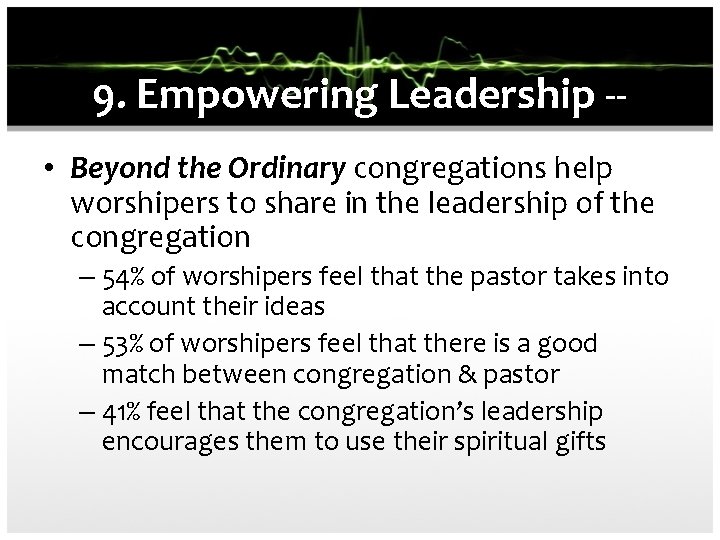
9. Empowering Leadership - • Beyond the Ordinary congregations help worshipers to share in the leadership of the congregation – 54% of worshipers feel that the pastor takes into account their ideas – 53% of worshipers feel that there is a good match between congregation & pastor – 41% feel that the congregation’s leadership encourages them to use their spiritual gifts
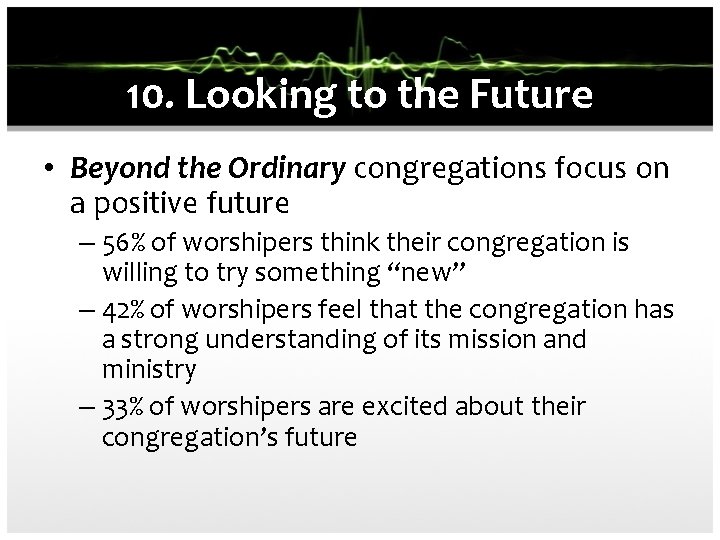
10. Looking to the Future • Beyond the Ordinary congregations focus on a positive future – 56% of worshipers think their congregation is willing to try something “new” – 42% of worshipers feel that the congregation has a strong understanding of its mission and ministry – 33% of worshipers are excited about their congregation’s future
What Growing Congregations Do • Strong congregations welcome new people. – Increase the visibility of the congregation in the community (e. g. , Web site, paid newspaper and telephone book ads, good outdoor signage, participation in community events). – Encourage members to invite others; equip members to invite effectively (e. g. Bring a Friend Sundays, special events). – Identify and make personal and telephone follow-up contact with all visitors, especially first time worship visitors. – Offer a group for new people.
What Growing Congregations Do • Strong congregations encourage participation. – Fast-track new people into meaningful ministry roles. Ask them what they feel passionate about. What do they see as their ministry? – Identify what types of new people the congregation attracts (e. g. , returnees, switchers). Ask new people what made the congregation attractive to them. – Create additional small group experiences, such as prayer or study groups.
What Growing Congregations Do • Strong congregations offer meaningful worship experiences. – Evaluate current worship service(s) for vitality. Are service(s) connecting with all age groups and relevant local cultures (e. g. , ethnic groups, family types)? – Offer more worship service options (e. g. , additional services, more variety in worship and music styles, different types of services).
What Growing Congregations Do • Strong congregations help people grow spiritually. – Focus on the long-term development of disciples (spirituality or faith, financial stewardship, and ministry).
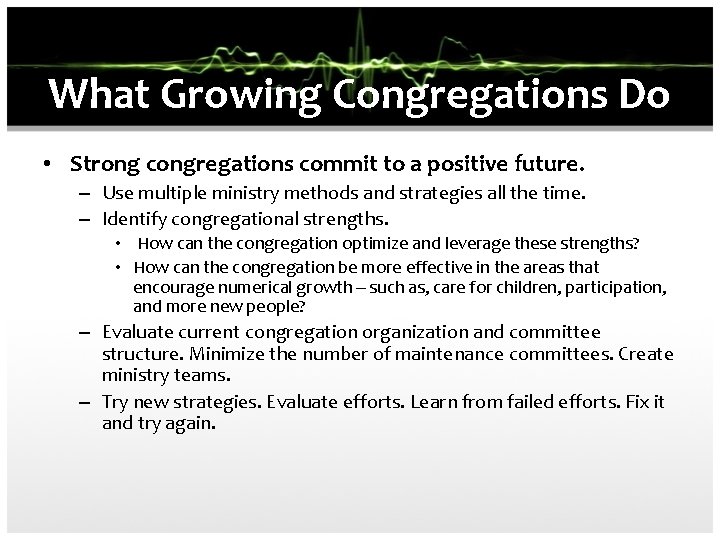
What Growing Congregations Do • Strong congregations commit to a positive future. – Use multiple ministry methods and strategies all the time. – Identify congregational strengths. • How can the congregation optimize and leverage these strengths? • How can the congregation be more effective in the areas that encourage numerical growth -- such as, care for children, participation, and more new people? – Evaluate current congregation organization and committee structure. Minimize the number of maintenance committees. Create ministry teams. – Try new strategies. Evaluate efforts. Learn from failed efforts. Fix it and try again.
Queries • Who are we? • What is God calling us to be and do? • What do we believe? • Do we welcome others? • How do we relate to our community? • How do we adapt to change?
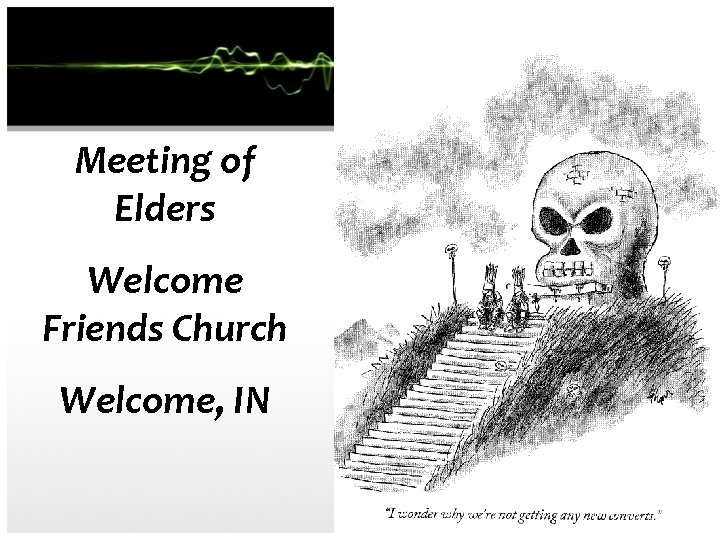
Meeting of Elders Welcome Friends Church Welcome, IN
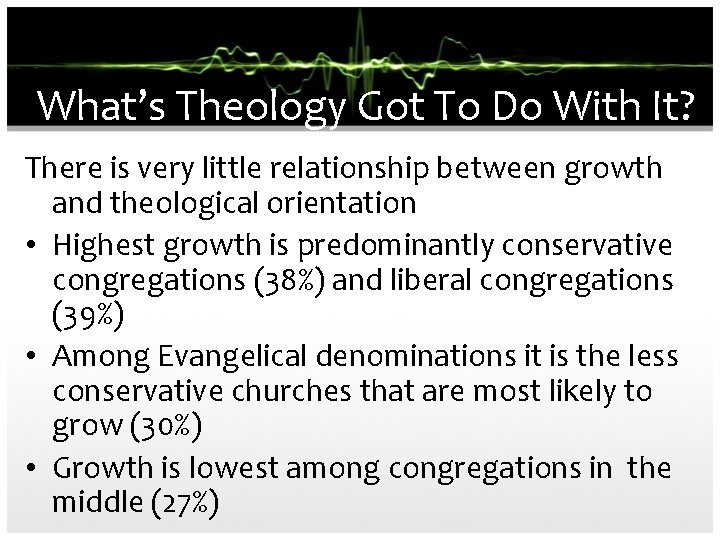
What’s Theology Got To Do With It? There is very little relationship between growth and theological orientation • Highest growth is predominantly conservative congregations (38%) and liberal congregations (39%) • Among Evangelical denominations it is the less conservative churches that are most likely to grow (30%) • Growth is lowest among congregations in the middle (27%)
What’s Essential? • Essential to the mission of any religious congregation is to create a community where people encounter God • Congregations that involved children in worship were more likely to experience significant growth – Congregations that did not were much more likely to experience decline
Clear Mission • More important than theological orientation is the religious character of the congregation and clarity of mission and purpose • Growing congregations are clear about why they exist • They grow because they understand their reason for being and they make sure they do the things that are essential to their life as a religious organization
Growth and Spirituality Strong relationship between growth and the sense that the congregation is “spiritually vital and alive”
Our Congregation Wants YOU! • Growing congregations are more likely to engage in a variety of recruitment-related activities • Members tell others about their congregation and the congregation makes itself more visible through various forms of advertising • Most formal activities, such as radio and television spots, newspaper ads, flyers, etc. help only a little • However, the programmatic activity that is most strongly related to growth is establishing or maintaining a web site for the congregation • Congregations that have started or maintained a web site in the past year are most likely to grow
Luddites Beware
Getting ‘Em in the Door • A specific action that a congregation can do to encourage growth is sponsoring a program or event to attract non-members • 44% of congregations that sponsor such events grew substantially from 2000 to 2005
Who Wants to Meet Here!? of congregations that consider support groups to be a key program or activity, 67% are growing
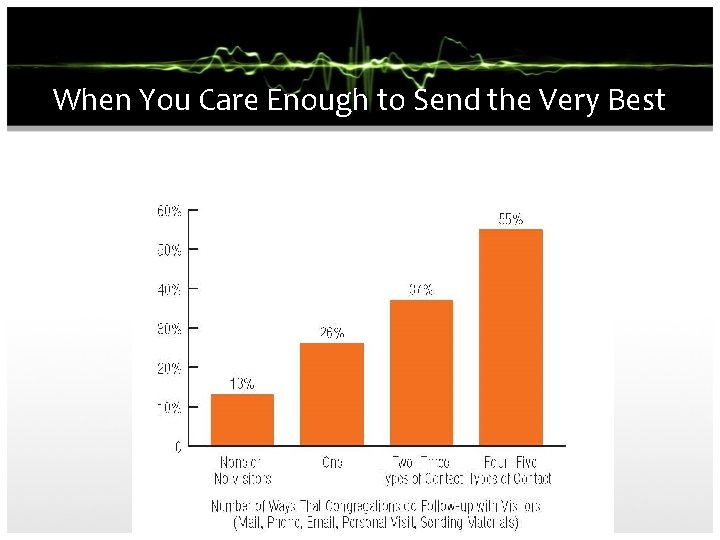
Follow-up Congregations that follow-up on visitors through mail, phone calls, emails, personal visits, mailed materials, etc. are those most likely to grow
When You Care Enough to Send the Very Best
What is a Strong Congregation? • Provides a sense of community • Seeks to educate worshipers about the faith • Shares their faith with others • Serves others • Conveys the sense that life has meaning
So What?
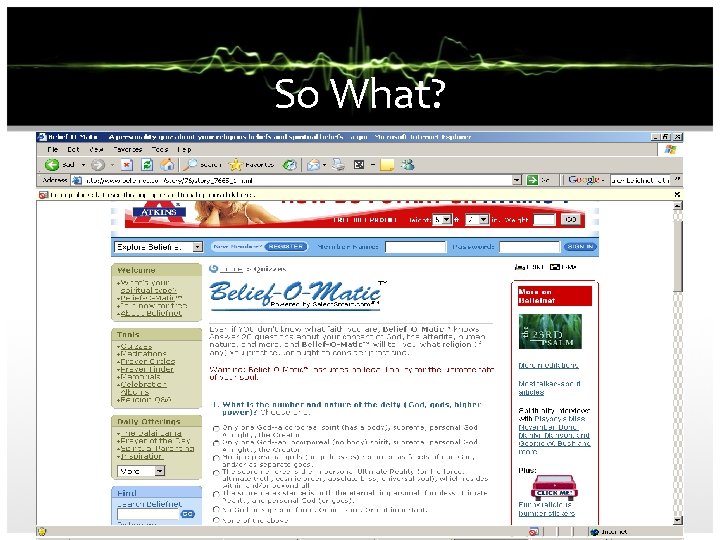
So What? • 30 thousand people a day try Belief-O-Matic • More and more people are religious seekers • Many come out “Quaker” – – An issue of Newsweek magazine reported that a "disproportionate number" of respondents to the quiz identified themselves as "liberal Quakers. " The article notes that the page on the Belief. Net web site devoted to Quakers has become one of their top 50 links!
Web Resources • • The ARDA -- http: //www. thearda. com/ U. S. Congregations -- http: //www. uscongregations. org/ Insights into Religion -- http: //religioninsights. org/ Synagogue 3000 -- http: //www. synagogue 3000. org/ Shapevine -- http: //shapevine. com/ Leadership Network -- http: //www. leadnet. org/ ICC -http: //centerforcongregations. org/blogs/news_thoughts/a rchive/2011/01/20/The. Missional. Church. aspx
Worship Groups and Other Alternatives to “Traditional” Church Session Two: A (not-so) Modest Proposal
A Modest Proposal • Unprogrammed Programmed or Programmed Unprogrammed? • Where to Sit: A Shift in Architecture • The End of the Quaker Pastorate • Seeking the Seekers
Unprogrammed Programmed or Programmed Unprogrammed? • what we have is a winsome invitation – to meet God • participatory listening to/for God sets us apart from other Christians • scrap the bulletin and the worship planning • trust the Spirit to lead worship • more prepared to encounter the Divine. • to be more participatory —we are each responsible
Unprogrammed Programmed or Programmed Unprogrammed? • don’t scrap singing, choir, sermon, etc • use holy silence as the basis for worship • trust God to lead people to sing, share, sermonize at the right time • be a place where people are invited to encounter God and other like-hearted people • involve kids in worship • create a sense of hospitality in the silence and a feeling that “anything, God willing” can happen
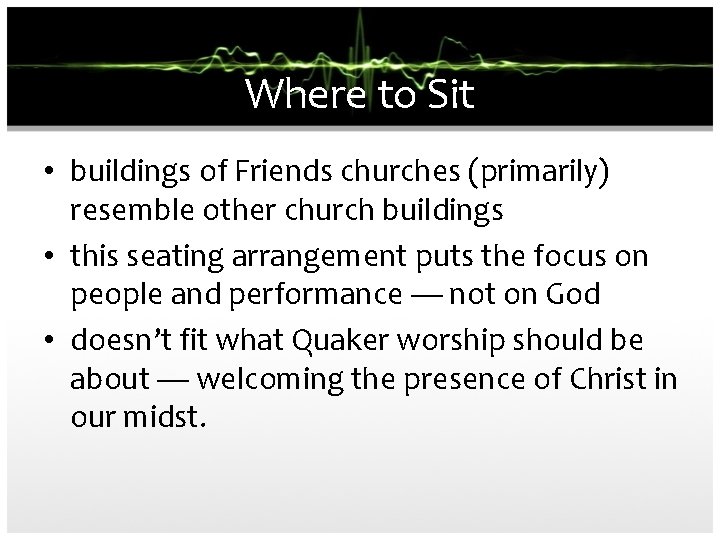
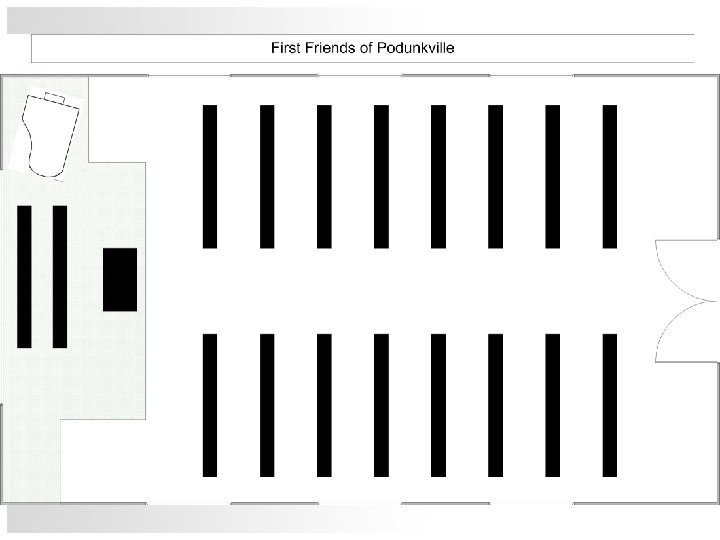
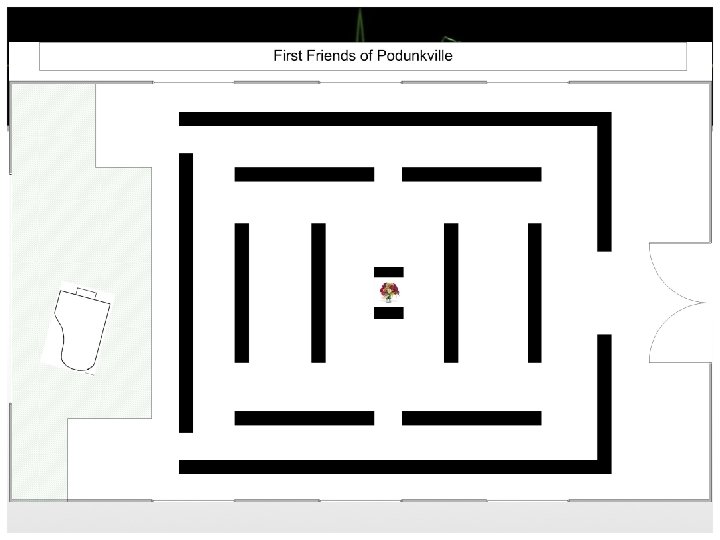
Where to Sit • buildings of Friends churches (primarily) resemble other church buildings • this seating arrangement puts the focus on people and performance — not on God • doesn’t fit what Quaker worship should be about — welcoming the presence of Christ in our midst.
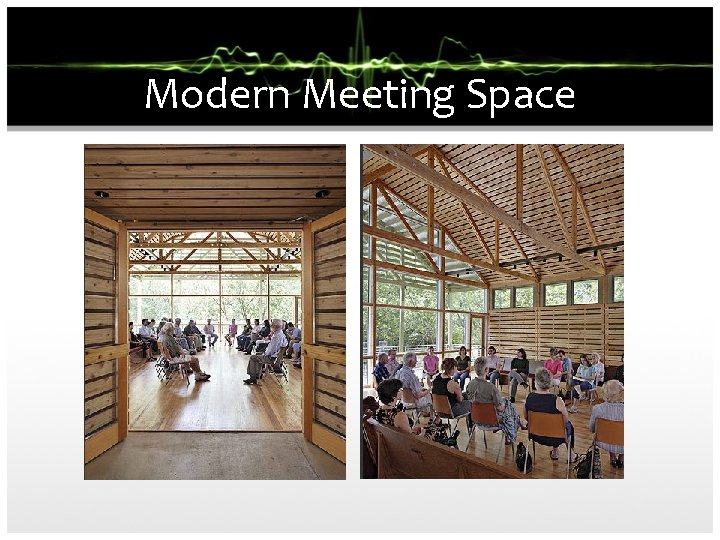
Rearranging Deck Chairs? 3 reasons for this alteration 1. to change from looking at a particular place from which we expect ministry to a view that says ministry comes from anywhere/anyone 2. makes it easier to hear vocal ministry 3. to see the faces of those God has gathered that day -- as we see the gathered community, we pray for, care, and love them
Modern Meeting Space
End the Pastorate • “The first thing we do, let’s kill all the Quaker pastors. ” — Brently VI, part II, Act 4, scene 2 (with apologies to William Shakespeare — and all the Quaker pastors. ) • a concern about Quaker pastoral ministry has always been that it will evolve into “profession. ” • the paradox for Quaker paid ministry today is to find a third way where the paid minister is not the CEO of the local Meeting nor slave.
4 Needs specialized ministry of a trained and called pastor and the universal ministry of a called and equipped congregation 1. The meeting for worship must be free from rigidity which prevents the workings of the Spirit 2. Preaching in our meetings for worship must be under the leadership of the Spirit. 3. We must adhere to Friends’ business methods and never let power and authority be centralized in the pastor. 4. Paid ministers and the other members of the meeting must be trained in the art of silence. (Lorton Huesel)
What’s in a Name? • have thought a long time about this and here’s my ungainly name — “released minister. ” • we are all ministers, are we not? • it also allows us to recover the Friendly idea that there are many types of ministry • Encourage local Friends congregations to recognize those among them who exhibit gifts of ministry – but may not be “professionals”
Seeking the Seekers Videos • http: //www. youtube. com/watch? v=D 7_d. ZTrj w 9 I • http: //www. youtube. com/watch? v=pk. GIBIui. Z c. I • http: //www. youtube. com/watch? v=arxf. LK_sd 68
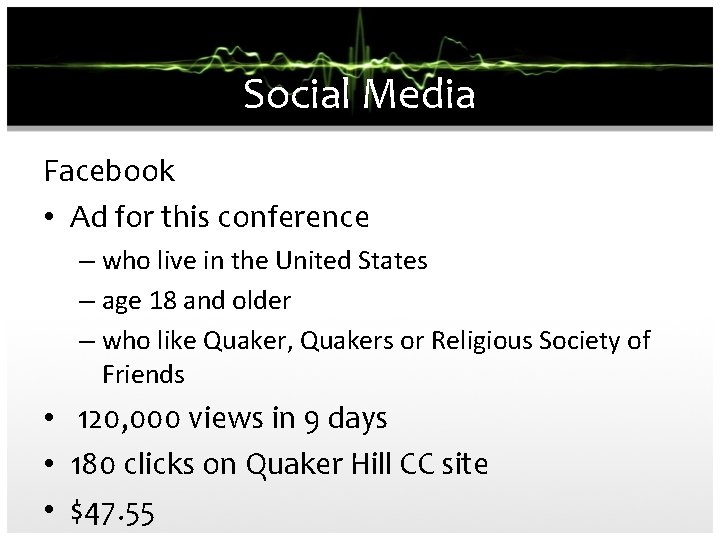
Social Media Facebook • Ad for this conference – who live in the United States – age 18 and older – who like Quaker, Quakers or Religious Society of Friends • 120, 000 views in 9 days • 180 clicks on Quaker Hill CC site • $47. 55
The Inner-net
Some Tools Quaker. Quest • Quaker Quest is both a process and an experience. It is: – A workshop for the whole meeting, co-led by Quaker Quest Travel Team members. – An invitation to the meeting to discern for itself what changes it wants to make in order to integrate newcomers into the life of the meeting and nurture those who are already there. – A deliberate process for the meeting to discern if it is led to undertake the public sessions. – An opportunity to look at the meeting from a newcomer’s perspective. – A chance to consider how to be more welcoming. – A set format for public sessions, where the topics and content are determined by each meeting. – Much more than the public sessions: An experience that the whole meeting shares over many months. – A lot of work and a lot of fun!
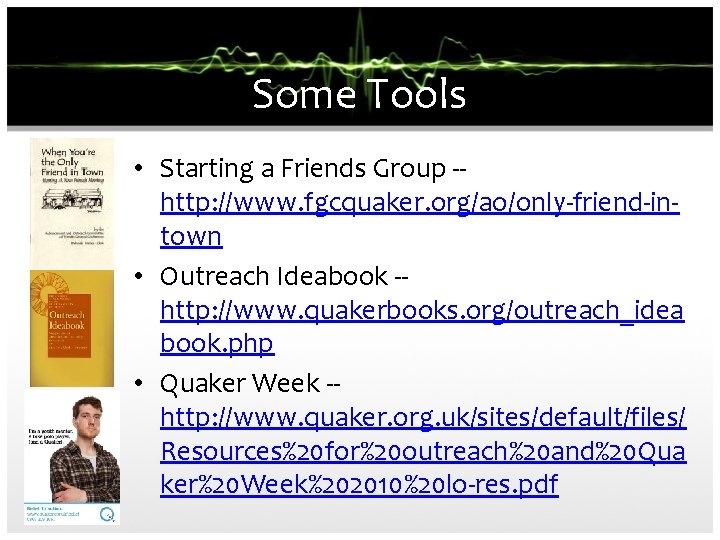
Some Tools • Starting a Friends Group -http: //www. fgcquaker. org/ao/only-friend-intown • Outreach Ideabook -http: //www. quakerbooks. org/outreach_idea book. php • Quaker Week -http: //www. quaker. org. uk/sites/default/files/ Resources%20 for%20 outreach%20 and%20 Qua ker%20 Week%202010%20 lo-res. pdf
Worship Groups and Other Alternatives to “Traditional” Church Session Three: New Worship Forms
New Forms • Monastic Communities • House Churches • Worship Groups
New Monasticism The movement differs from traditional Christian monastic movements in many ways. • A rule of life is associated with the New Monastic movement though traditional monastic vows of celibacy, poverty and obedience are not normally taken • Communities do not always live in a single place but rather geographic proximity • The movement allows married couples and celibate singles • Members of the movement do not wear religious habits
New Monasticism • http: //www. youtube. com/watch? v=OZ 8 t. M 81 S 8 q 4
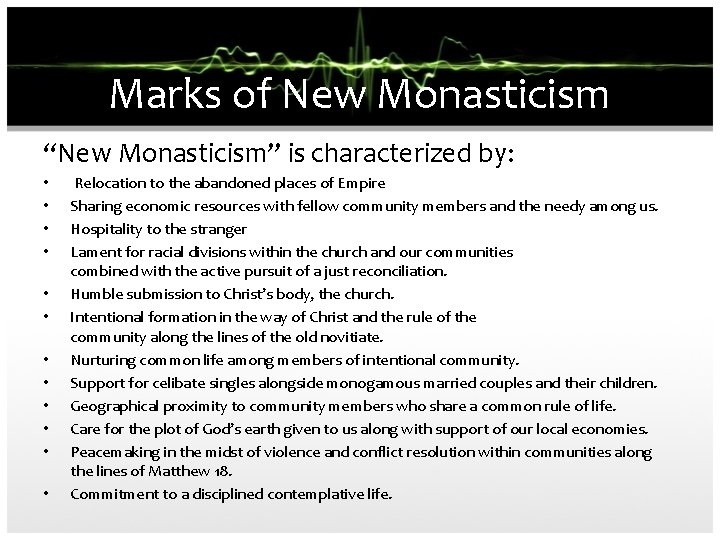
Marks of New Monasticism “New Monasticism” is characterized by: • • • Relocation to the abandoned places of Empire Sharing economic resources with fellow community members and the needy among us. Hospitality to the stranger Lament for racial divisions within the church and our communities combined with the active pursuit of a just reconciliation. Humble submission to Christ’s body, the church. Intentional formation in the way of Christ and the rule of the community along the lines of the old novitiate. Nurturing common life among members of intentional community. Support for celibate singles alongside monogamous married couples and their children. Geographical proximity to community members who share a common rule of life. Care for the plot of God’s earth given to us along with support of our local economies. Peacemaking in the midst of violence and conflict resolution within communities along the lines of Matthew 18. Commitment to a disciplined contemplative life.
People • • • Jonathan Wilson-Hartgrove Shane Claiborne Maria Kenney Sarah Jobe http: //www. communityofcommunities. info/ http: //www. thesimpleway. org/
House Churches • 30 - 50, 000 house churches • as of 2009 about 5 - 12, 000 adults • 10% of the adult population claims to have done so in the past month (Barna) • 5% of the adult population is currently engaged in a house church (Barna) • Aka “simple church” • http: //www. housechurchresource. org/ • http: //www. housechurch. org/
House Churches • http: //www. youtube. com/watch? v=eub. Argo Mo-M • http: //www. youtube. com/watch? v=2 z. Uzs. AEbrc&feature=related
House Churches Hallmarks • that is born out of spiritual life • grass roots experience • face-to-face community • every-member functioning • open-participatory meetings • non-hierarchical leadership • centrality and supremacy of Jesus Christ as the functional Leader and Head of the gathering
Worship Groups • http: //www. ohioyearlymeeting. org/startingw orshipgroup. htm
Worship Groups • Do they replace/supplement congregational life? • What needs are they serving? • Do they contribute to revitalization of larger faith tradition – or just for personal growth?
Worship Groups and Other Alternatives to “Traditional” Church Session Four: Positive Change Tools
Positive Change Tools • Interview • Asset Mapping • Flourishing Café
Interview Purpose – to discover the circumstances, condition, and/or practices that contribute to vitality • What attracted you to Friends • What was a “best moment” for you among Friends? • What three wishes do you have for Friends?
Asset Mapping Purpose – to transform thinking from “deficit based” to “abundance” • Physical Assets • Individual Assets • Associations • Institutions • Economic Assets
World Café • What has the retreat said about Friends at our best? • What three practices, conditions, or circumstances contribute to revitalization? • What have you heard that has real meaning/resonates with you?