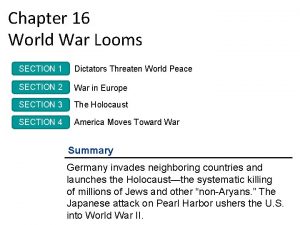
WORLD WAR LOOMS SECTION 1 DICTATORS THREATEN WORLD
- Slides: 54
WORLD WAR LOOMS
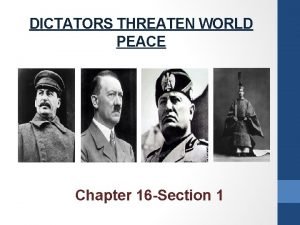
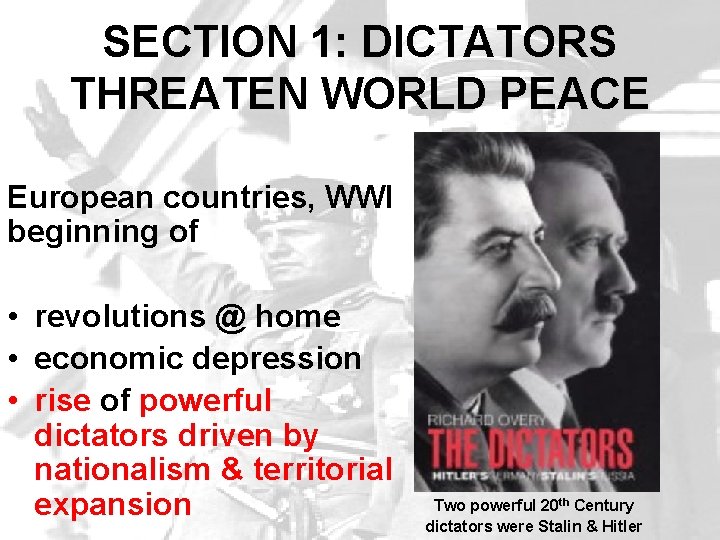
SECTION 1: DICTATORS THREATEN WORLD PEACE European countries, WWI beginning of • revolutions @ home • economic depression • rise of powerful dictators driven by nationalism & territorial expansion Two powerful 20 th Century dictators were Stalin & Hitler
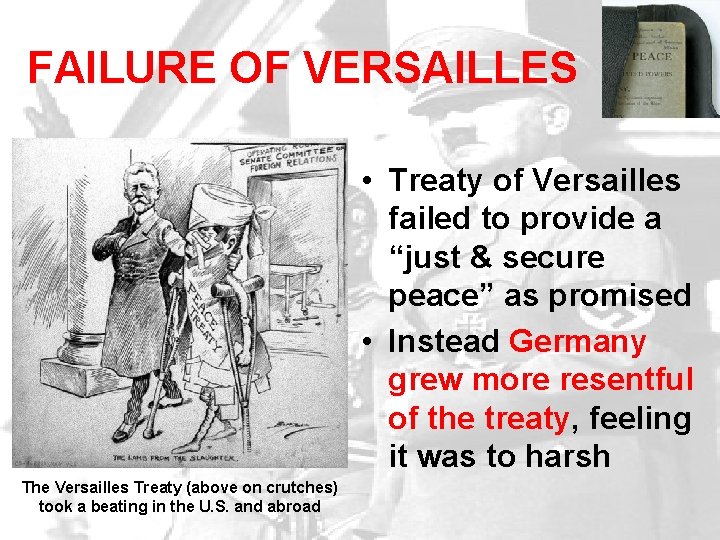
FAILURE OF VERSAILLES • Treaty of Versailles failed to provide a “just & secure peace” as promised • Instead Germany grew more resentful of the treaty, feeling it was to harsh The Versailles Treaty (above on crutches) took a beating in the U. S. and abroad
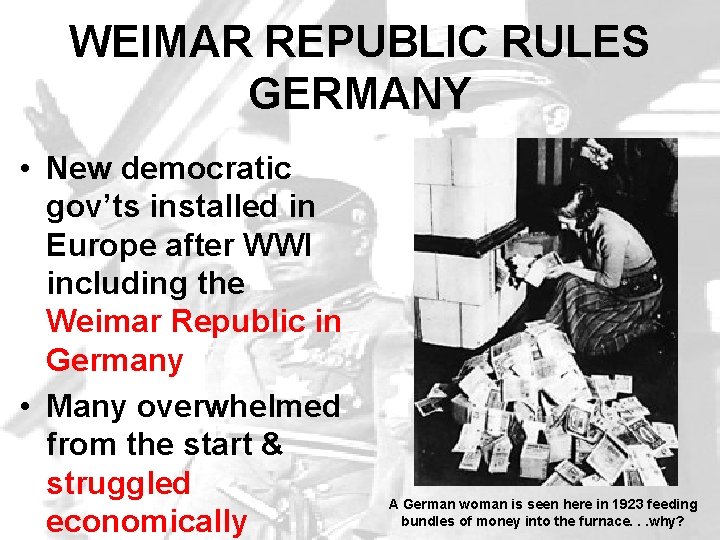
WEIMAR REPUBLIC RULES GERMANY • New democratic gov’ts installed in Europe after WWI including the Weimar Republic in Germany • Many overwhelmed from the start & struggled economically A German woman is seen here in 1923 feeding bundles of money into the furnace. . . why?
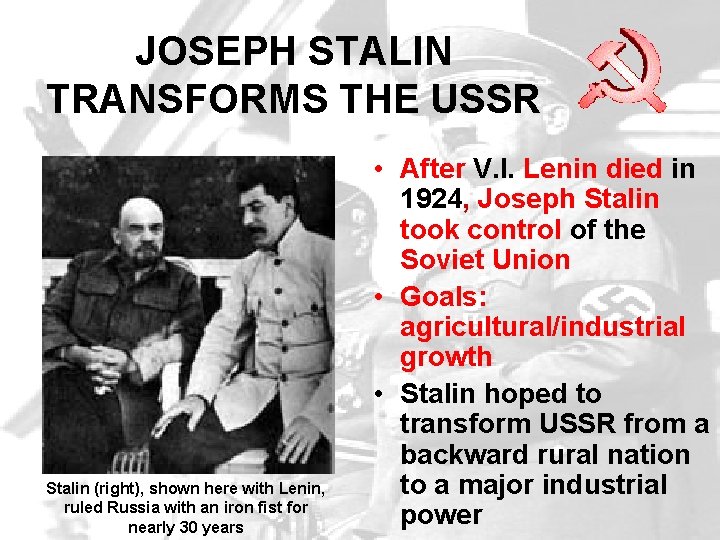
JOSEPH STALIN TRANSFORMS THE USSR Stalin (right), shown here with Lenin, ruled Russia with an iron fist for nearly 30 years • After V. I. Lenin died in 1924, Joseph Stalin took control of the Soviet Union • Goals: agricultural/industrial growth • Stalin hoped to transform USSR from a backward rural nation to a major industrial power
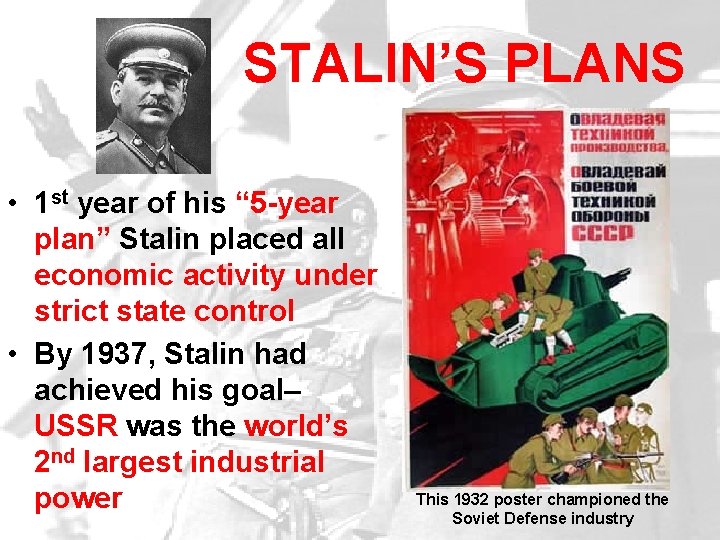
STALIN’S PLANS • 1 st year of his “ 5 -year plan” Stalin placed all economic activity under strict state control • By 1937, Stalin had achieved his goal– USSR was the world’s 2 nd largest industrial power This 1932 poster championed the Soviet Defense industry
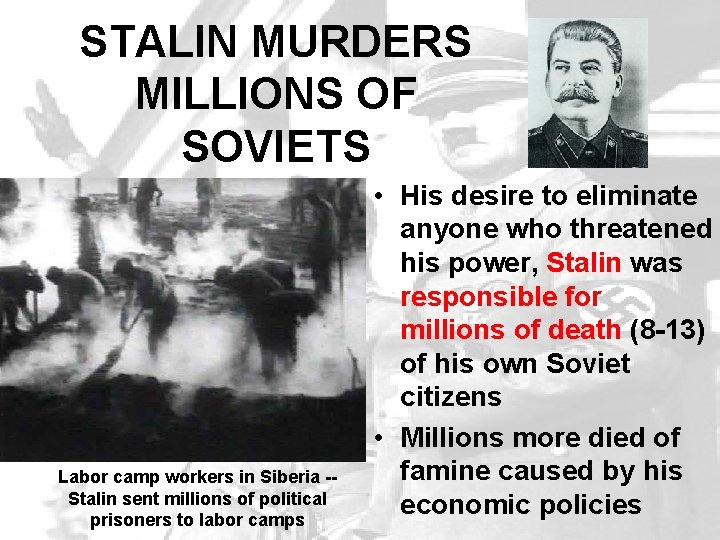
STALIN MURDERS MILLIONS OF SOVIETS Labor camp workers in Siberia -Stalin sent millions of political prisoners to labor camps • His desire to eliminate anyone who threatened his power, Stalin was responsible for millions of death (8 -13) of his own Soviet citizens • Millions more died of famine caused by his economic policies
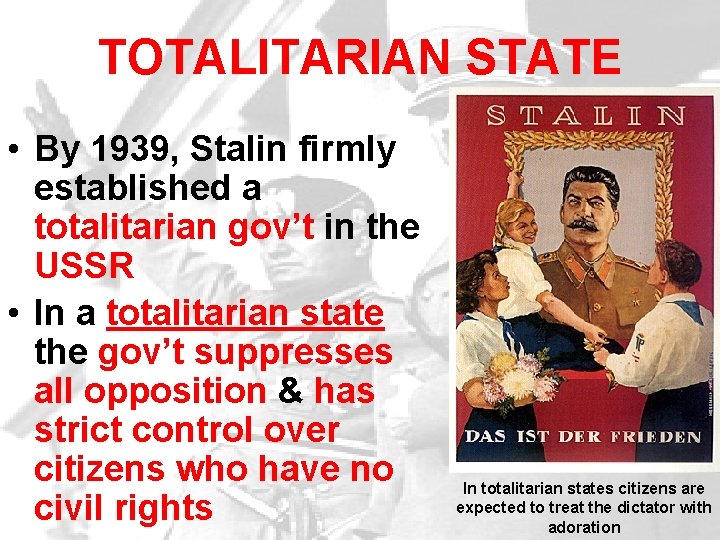
TOTALITARIAN STATE • By 1939, Stalin firmly established a totalitarian gov’t in the USSR • In a totalitarian state the gov’t suppresses all opposition & has strict control over citizens who have no civil rights In totalitarian states citizens are expected to treat the dictator with adoration
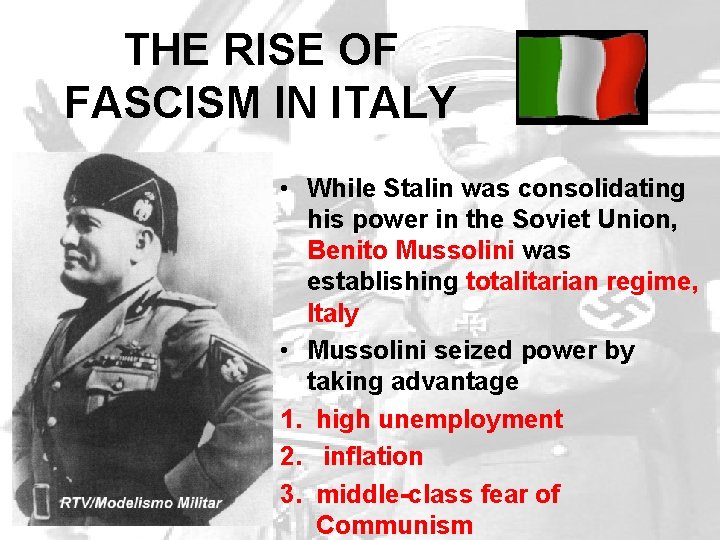
THE RISE OF FASCISM IN ITALY • While Stalin was consolidating his power in the Soviet Union, Benito Mussolini was establishing totalitarian regime, Italy • Mussolini seized power by taking advantage 1. high unemployment 2. inflation 3. middle-class fear of Communism
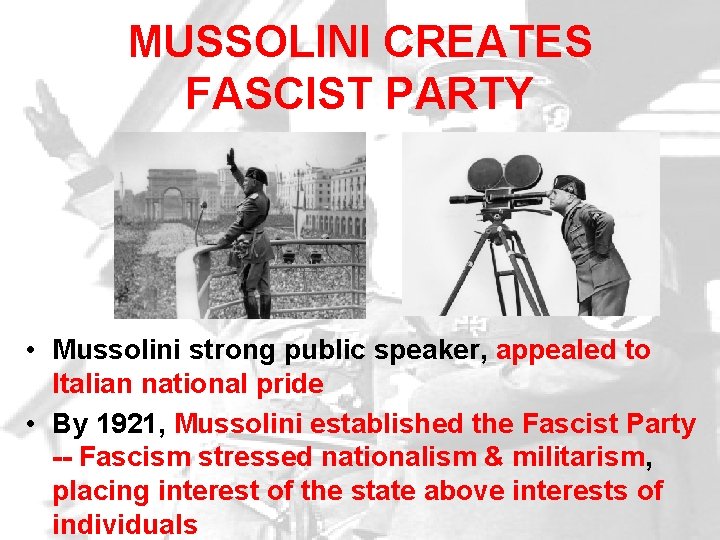
MUSSOLINI CREATES FASCIST PARTY • Mussolini strong public speaker, appealed to Italian national pride • By 1921, Mussolini established the Fascist Party -- Fascism stressed nationalism & militarism, placing interest of the state above interests of individuals
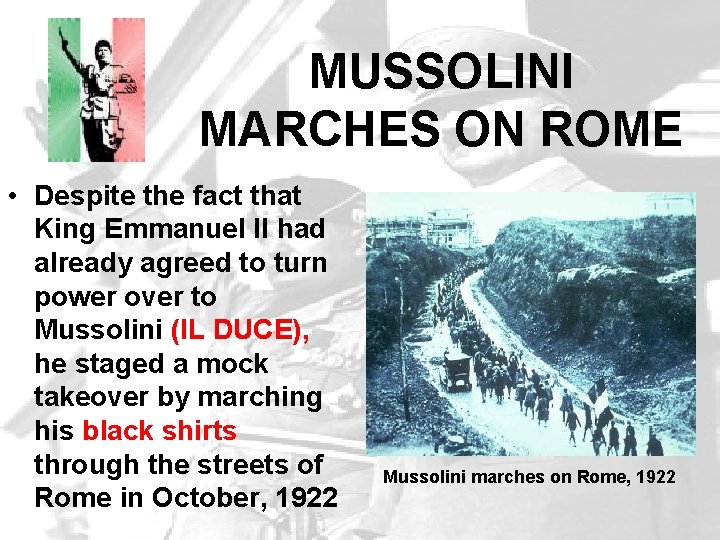
MUSSOLINI MARCHES ON ROME • Despite the fact that King Emmanuel II had already agreed to turn power over to Mussolini (IL DUCE), he staged a mock takeover by marching his black shirts through the streets of Rome in October, 1922 Mussolini marches on Rome, 1922
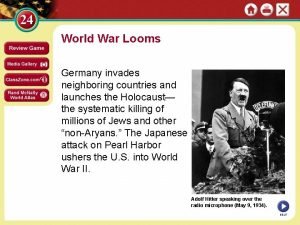
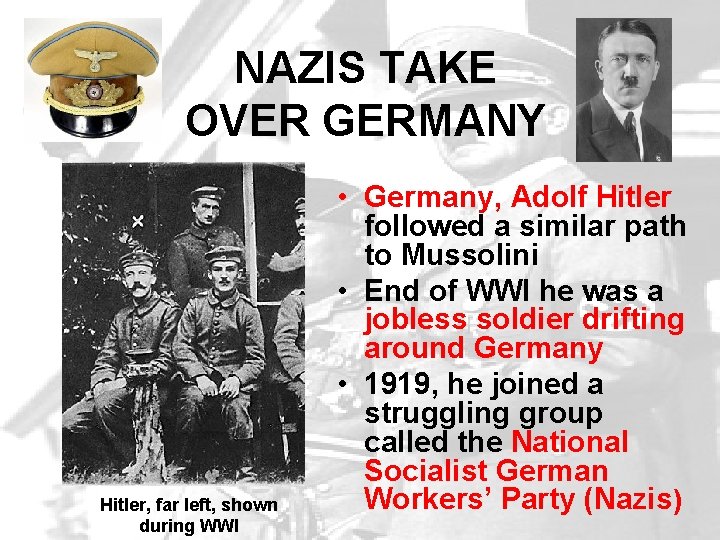
NAZIS TAKE OVER GERMANY Hitler, far left, shown during WWI • Germany, Adolf Hitler followed a similar path to Mussolini • End of WWI he was a jobless soldier drifting around Germany • 1919, he joined a struggling group called the National Socialist German Workers’ Party (Nazis)
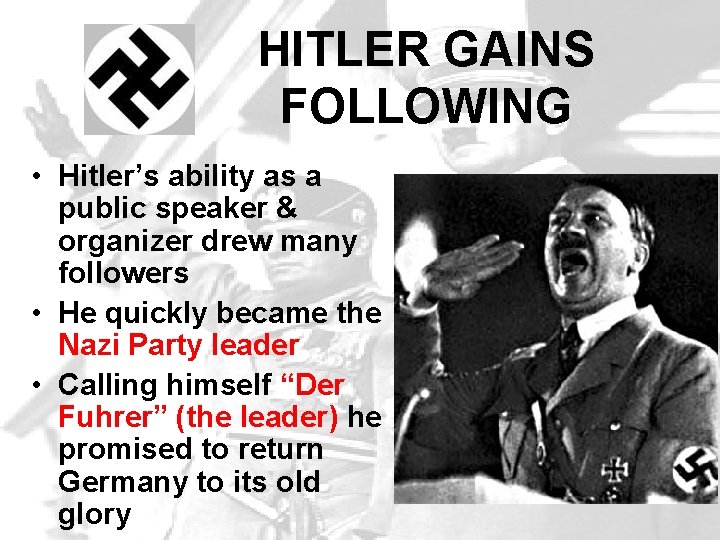
HITLER GAINS FOLLOWING • Hitler’s ability as a public speaker & organizer drew many followers • He quickly became the Nazi Party leader • Calling himself “Der Fuhrer” (the leader) he promised to return Germany to its old glory
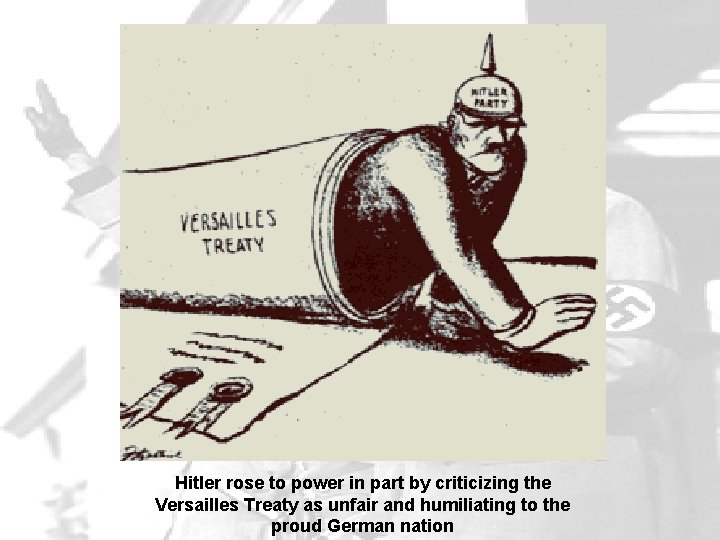
Hitler rose to power in part by criticizing the Versailles Treaty as unfair and humiliating to the proud German nation
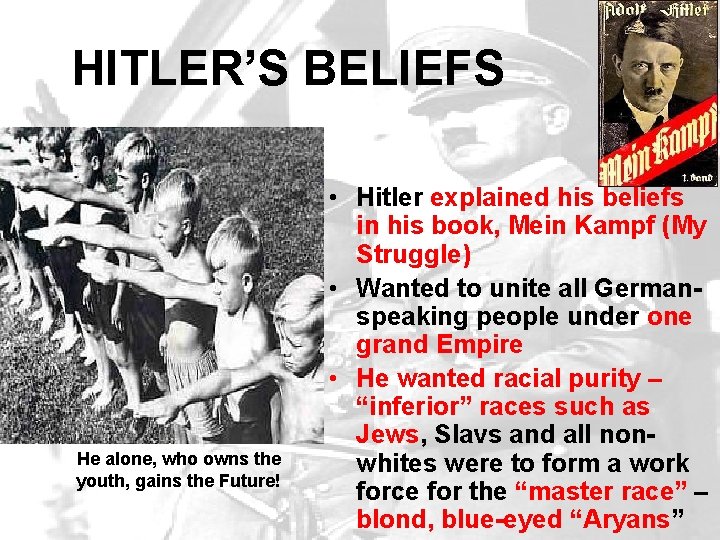
HITLER’S BELIEFS He alone, who owns the youth, gains the Future! • Hitler explained his beliefs in his book, Mein Kampf (My Struggle) • Wanted to unite all Germanspeaking people under one grand Empire • He wanted racial purity – “inferior” races such as Jews, Slavs and all nonwhites were to form a work force for the “master race” – blond, blue-eyed “Aryans”
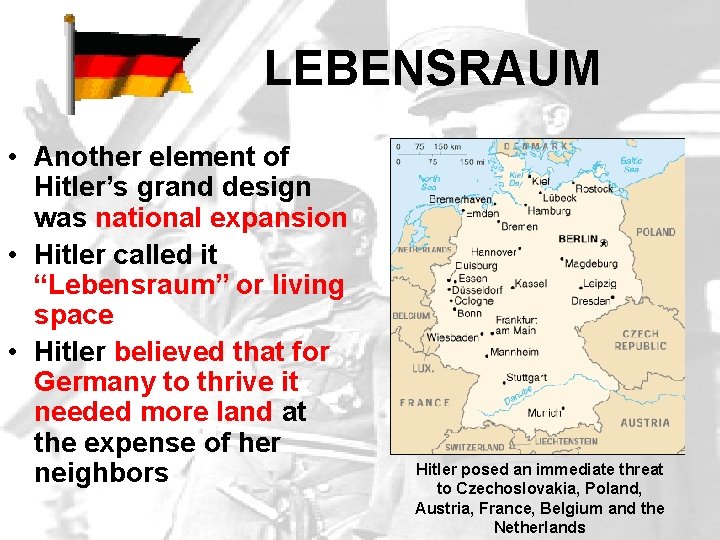
LEBENSRAUM • Another element of Hitler’s grand design was national expansion • Hitler called it “Lebensraum” or living space • Hitler believed that for Germany to thrive it needed more land at the expense of her neighbors Hitler posed an immediate threat to Czechoslovakia, Poland, Austria, France, Belgium and the Netherlands
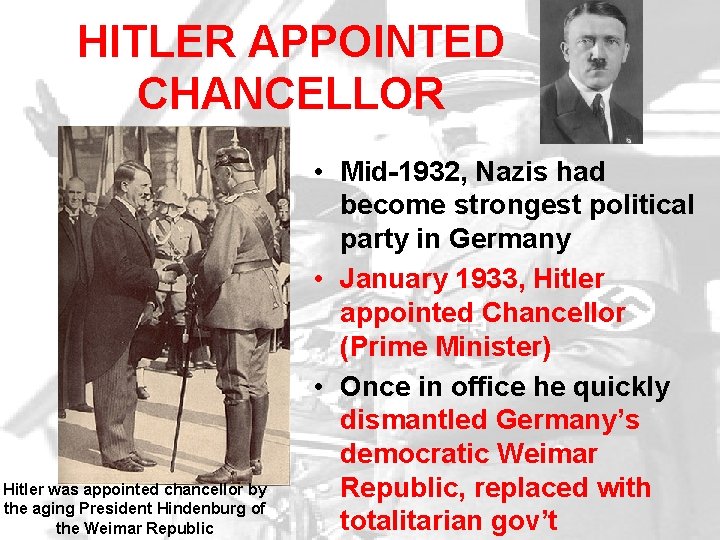
HITLER APPOINTED CHANCELLOR Hitler was appointed chancellor by the aging President Hindenburg of the Weimar Republic • Mid-1932, Nazis had become strongest political party in Germany • January 1933, Hitler appointed Chancellor (Prime Minister) • Once in office he quickly dismantled Germany’s democratic Weimar Republic, replaced with totalitarian gov’t
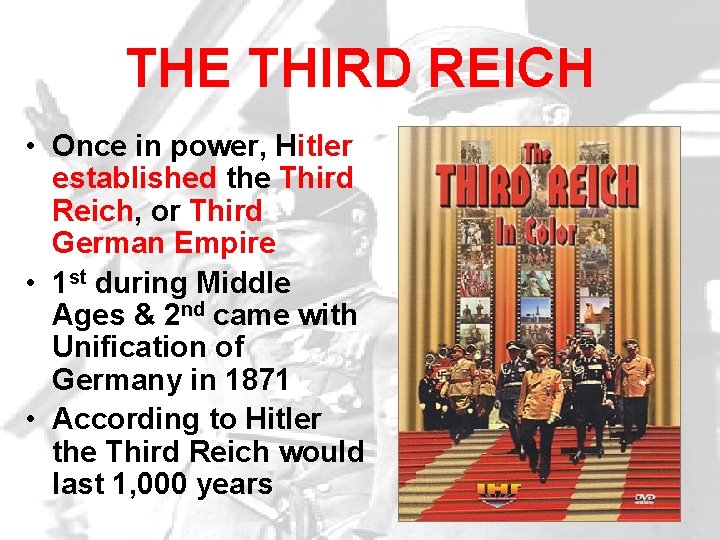
THE THIRD REICH • Once in power, Hitler established the Third Reich, or Third German Empire • 1 st during Middle Ages & 2 nd came with Unification of Germany in 1871 • According to Hitler the Third Reich would last 1, 000 years
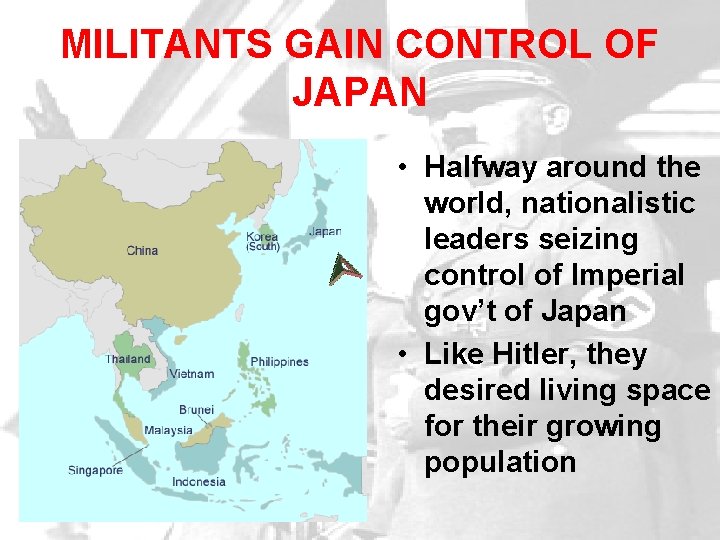
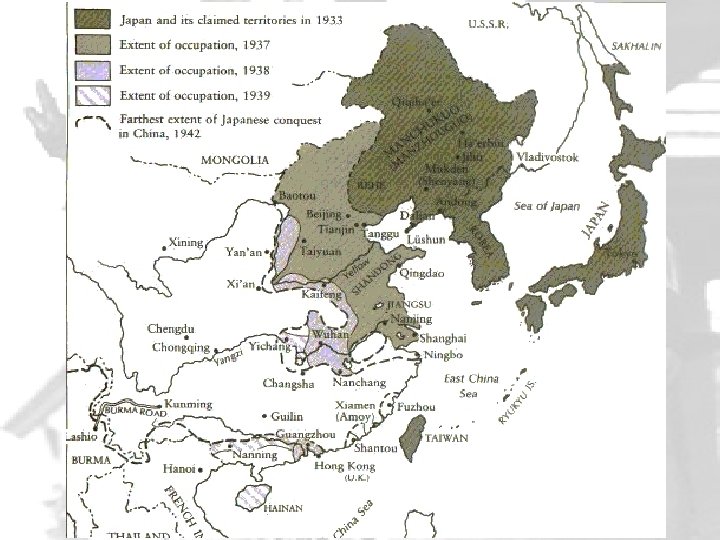
MILITANTS GAIN CONTROL OF JAPAN • Halfway around the world, nationalistic leaders seizing control of Imperial gov’t of Japan • Like Hitler, they desired living space for their growing population
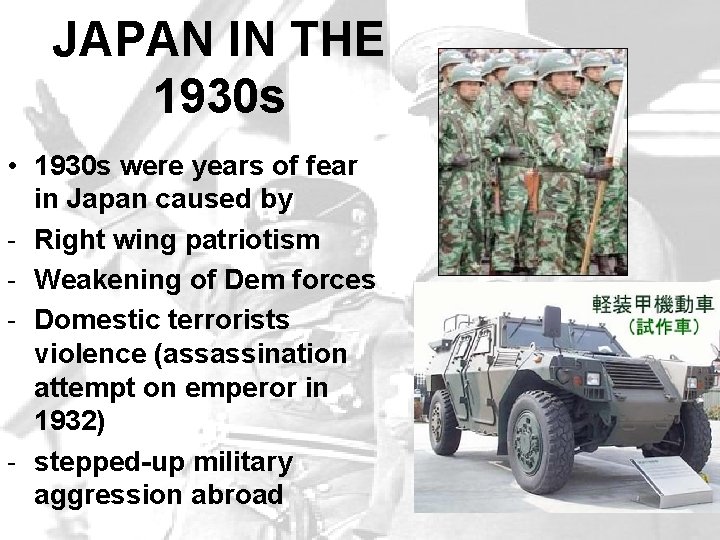
JAPAN IN THE 1930 s • 1930 s were years of fear in Japan caused by - Right wing patriotism - Weakening of Dem forces - Domestic terrorists violence (assassination attempt on emperor in 1932) - stepped-up military aggression abroad
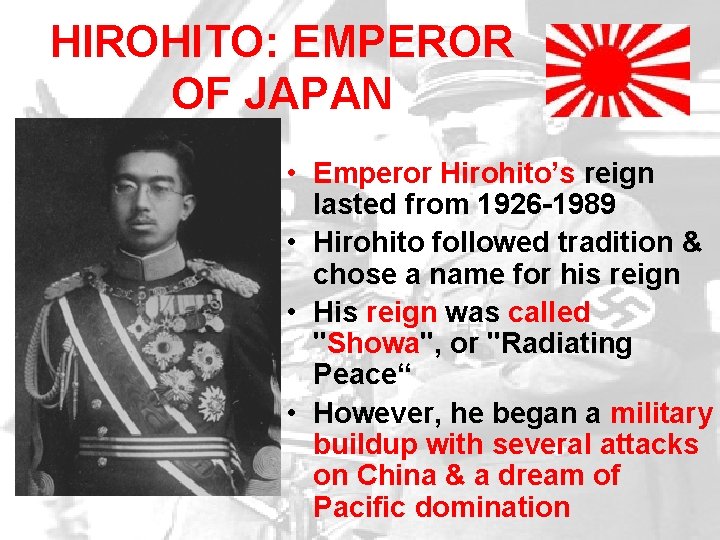
HIROHITO: EMPEROR OF JAPAN • Emperor Hirohito’s reign lasted from 1926 -1989 • Hirohito followed tradition & chose a name for his reign • His reign was called "Showa", or "Radiating Peace“ • However, he began a military buildup with several attacks on China & a dream of Pacific domination
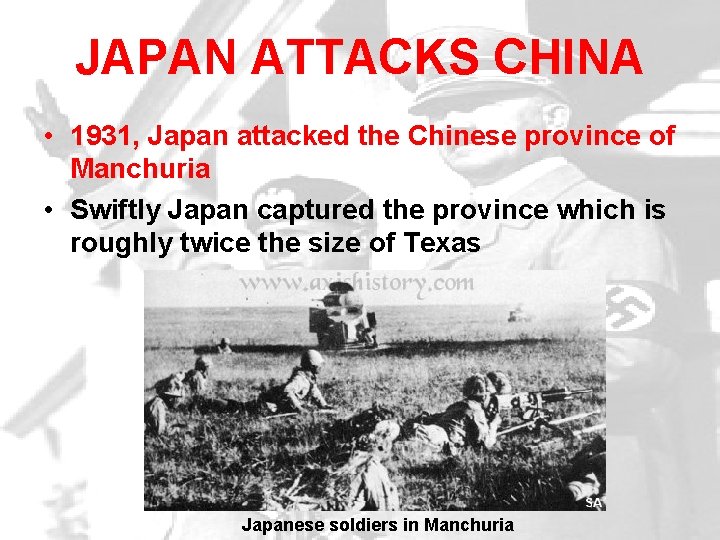
JAPAN ATTACKS CHINA • 1931, Japan attacked the Chinese province of Manchuria • Swiftly Japan captured the province which is roughly twice the size of Texas Japanese soldiers in Manchuria
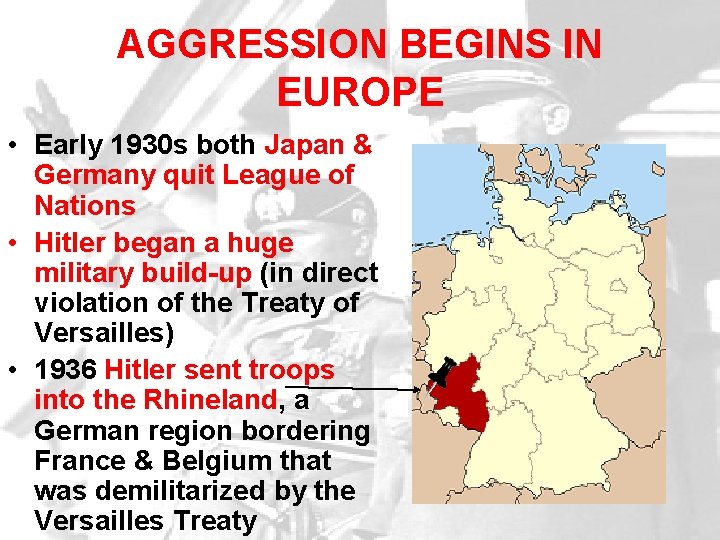
AGGRESSION BEGINS IN EUROPE • Early 1930 s both Japan & Germany quit League of Nations • Hitler began a huge military build-up (in direct violation of the Treaty of Versailles) • 1936 Hitler sent troops into the Rhineland, a German region bordering France & Belgium that was demilitarized by the Versailles Treaty
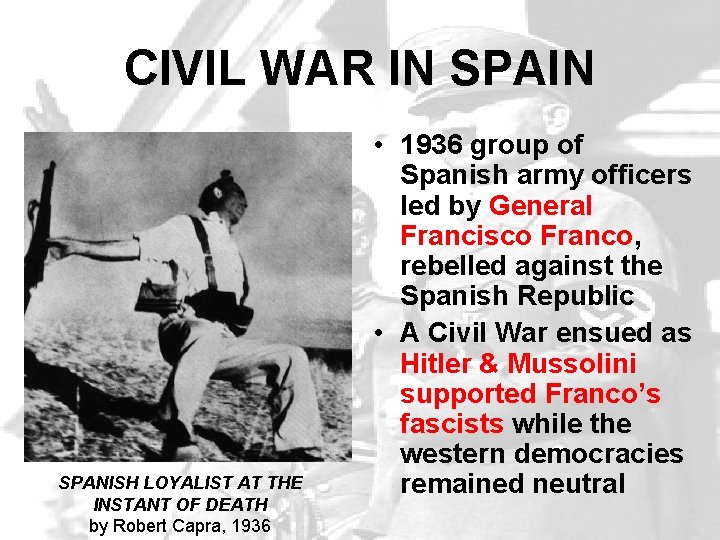
CIVIL WAR IN SPANISH LOYALIST AT THE INSTANT OF DEATH by Robert Capra, 1936 • 1936 group of Spanish army officers led by General Francisco Franco, rebelled against the Spanish Republic • A Civil War ensued as Hitler & Mussolini supported Franco’s fascists while the western democracies remained neutral
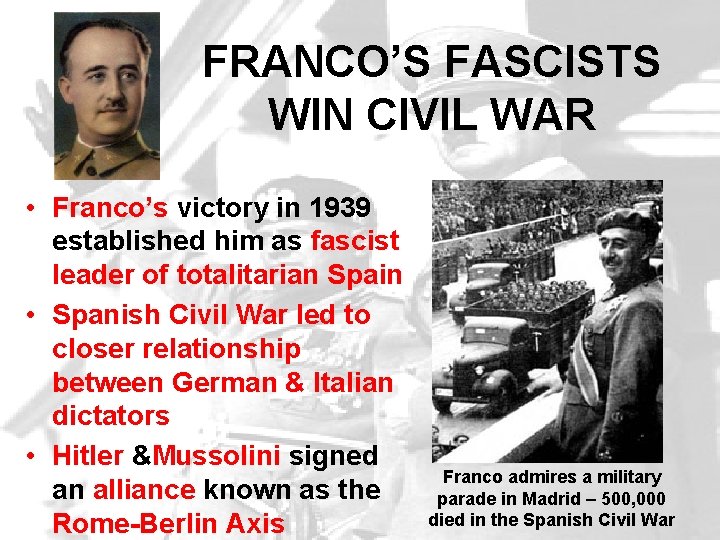
FRANCO’S FASCISTS WIN CIVIL WAR • Franco’s victory in 1939 established him as fascist leader of totalitarian Spain • Spanish Civil War led to closer relationship between German & Italian dictators • Hitler &Mussolini signed an alliance known as the Rome-Berlin Axis Franco admires a military parade in Madrid – 500, 000 died in the Spanish Civil War
U. S. REMAINS NEUTRAL. . . FOR NOW • Memories still fresh from WWI, most Americans believed the U. S. should not get involved in the increasing aggression in Europe • Some critics believed banks & manufacturers were pushing for war solely for their own profit • Critics called them “merchants of death”
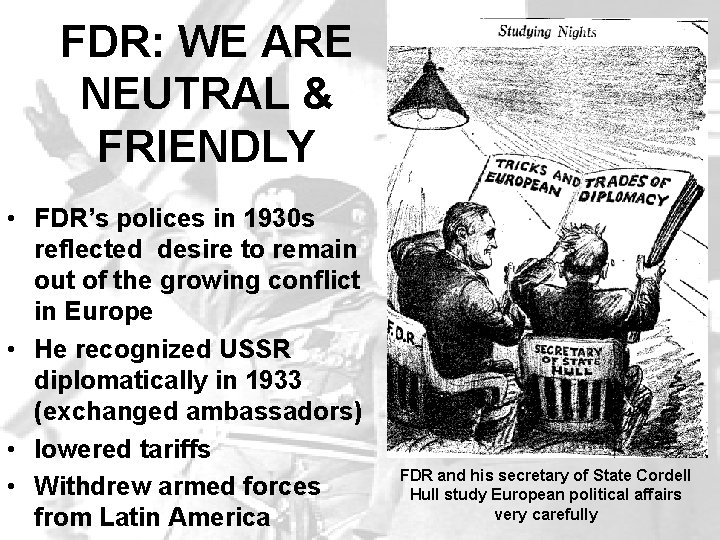
FDR: WE ARE NEUTRAL & FRIENDLY • FDR’s polices in 1930 s reflected desire to remain out of the growing conflict in Europe • He recognized USSR diplomatically in 1933 (exchanged ambassadors) • lowered tariffs • Withdrew armed forces from Latin America FDR and his secretary of State Cordell Hull study European political affairs very carefully
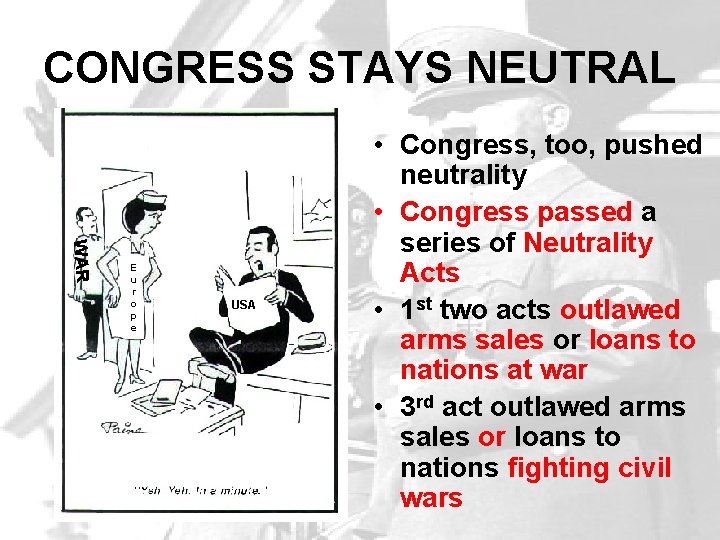
CONGRESS STAYS NEUTRAL WAR E u r o p e USA • Congress, too, pushed neutrality • Congress passed a series of Neutrality Acts • 1 st two acts outlawed arms sales or loans to nations at war • 3 rd act outlawed arms sales or loans to nations fighting civil wars
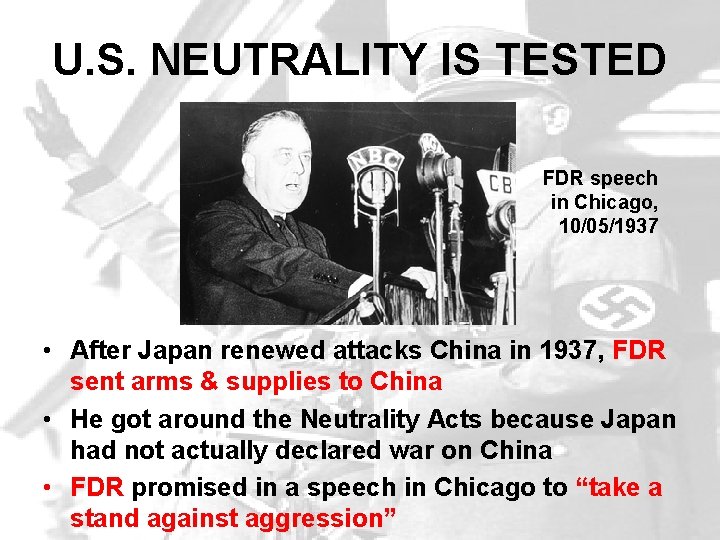
U. S. NEUTRALITY IS TESTED FDR speech in Chicago, 10/05/1937 • After Japan renewed attacks China in 1937, FDR sent arms & supplies to China • He got around the Neutrality Acts because Japan had not actually declared war on China • FDR promised in a speech in Chicago to “take a stand against aggression”
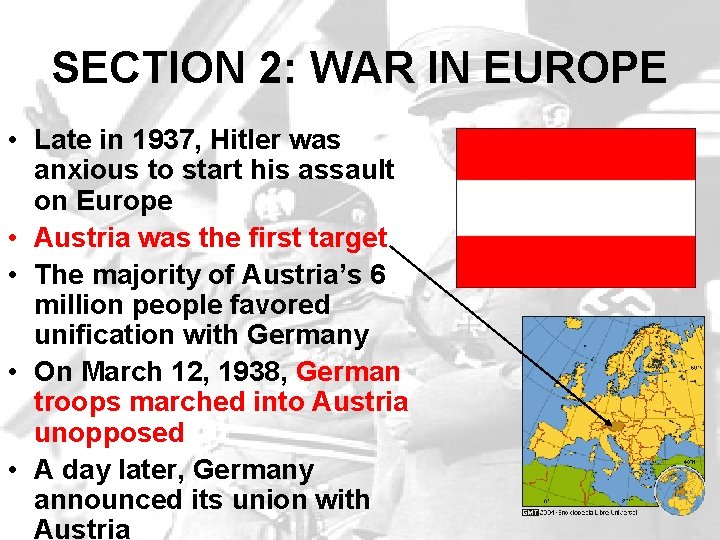
SECTION 2: WAR IN EUROPE • Late in 1937, Hitler was anxious to start his assault on Europe • Austria was the first target • The majority of Austria’s 6 million people favored unification with Germany • On March 12, 1938, German troops marched into Austria unopposed • A day later, Germany announced its union with Austria
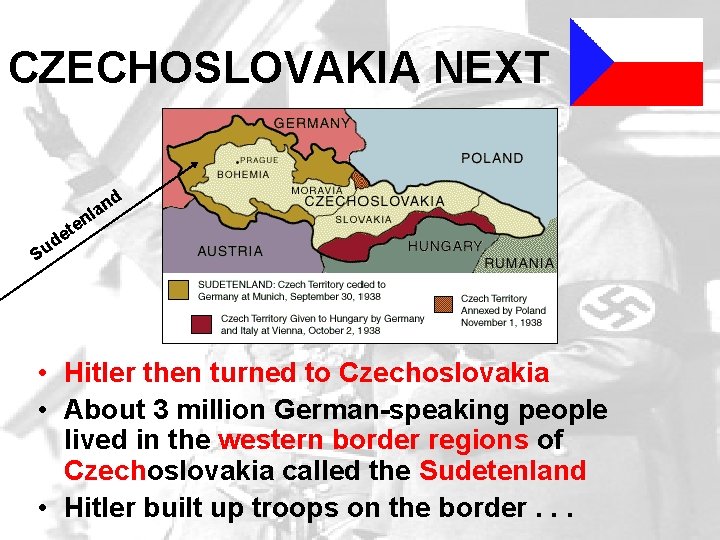
CZECHOSLOVAKIA NEXT an l n d e t e d Su • Hitler then turned to Czechoslovakia • About 3 million German-speaking people lived in the western border regions of Czechoslovakia called the Sudetenland • Hitler built up troops on the border. . .
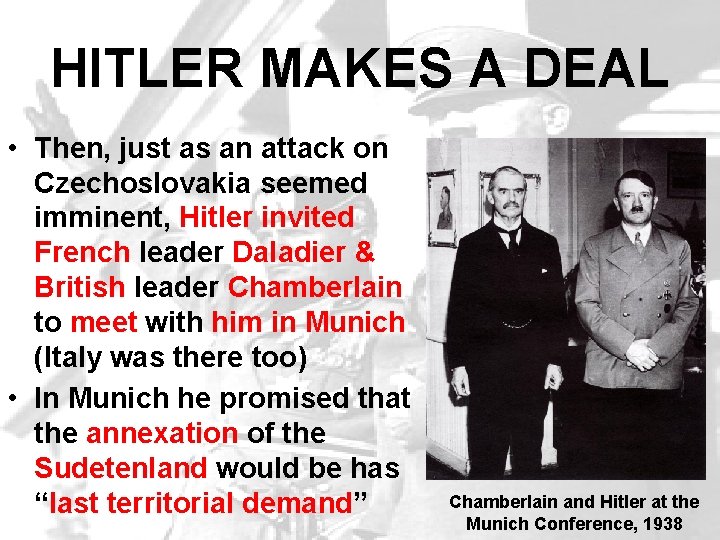
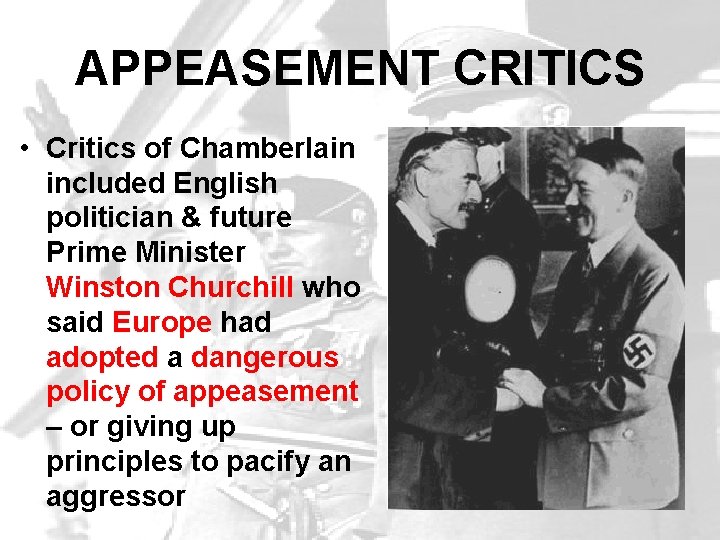
HITLER MAKES A DEAL • Then, just as an attack on Czechoslovakia seemed imminent, Hitler invited French leader Daladier & British leader Chamberlain to meet with him in Munich (Italy was there too) • In Munich he promised that the annexation of the Sudetenland would be has “last territorial demand” Chamberlain and Hitler at the Munich Conference, 1938
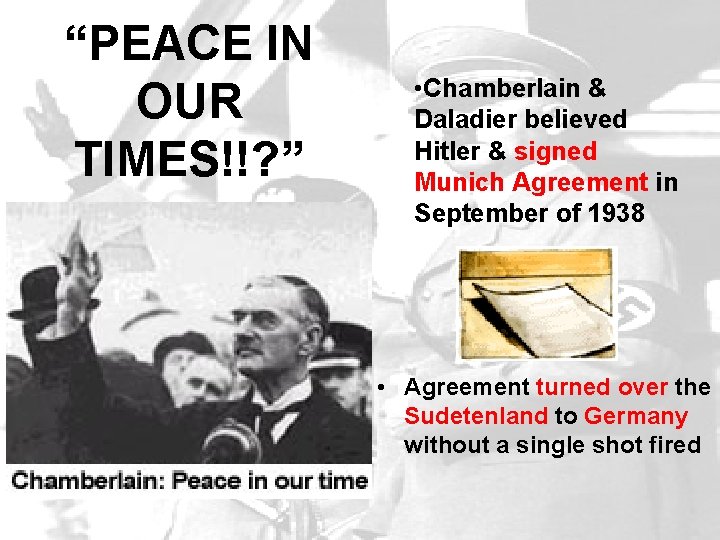
“PEACE IN OUR TIMES!!? ” • Chamberlain & Daladier believed Hitler & signed Munich Agreement in September of 1938 • Agreement turned over the Sudetenland to Germany without a single shot fired
APPEASEMENT CRITICS • Critics of Chamberlain included English politician & future Prime Minister Winston Churchill who said Europe had adopted a dangerous policy of appeasement – or giving up principles to pacify an aggressor
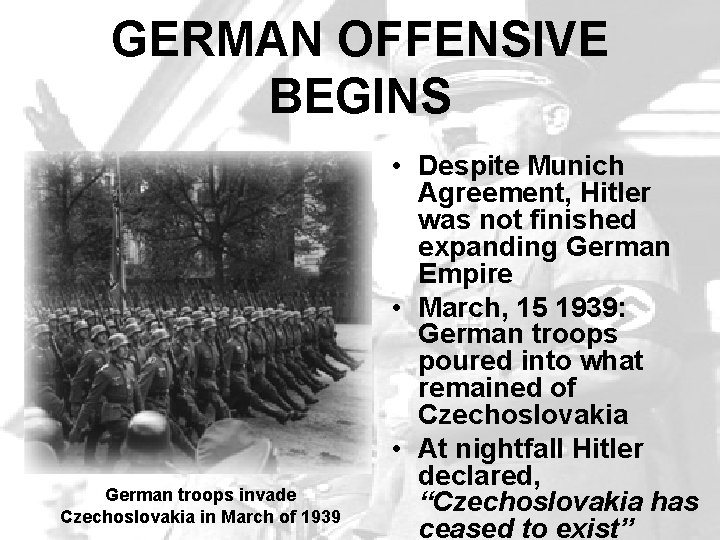
GERMAN OFFENSIVE BEGINS German troops invade Czechoslovakia in March of 1939 • Despite Munich Agreement, Hitler was not finished expanding German Empire • March, 15 1939: German troops poured into what remained of Czechoslovakia • At nightfall Hitler declared, “Czechoslovakia has ceased to exist”
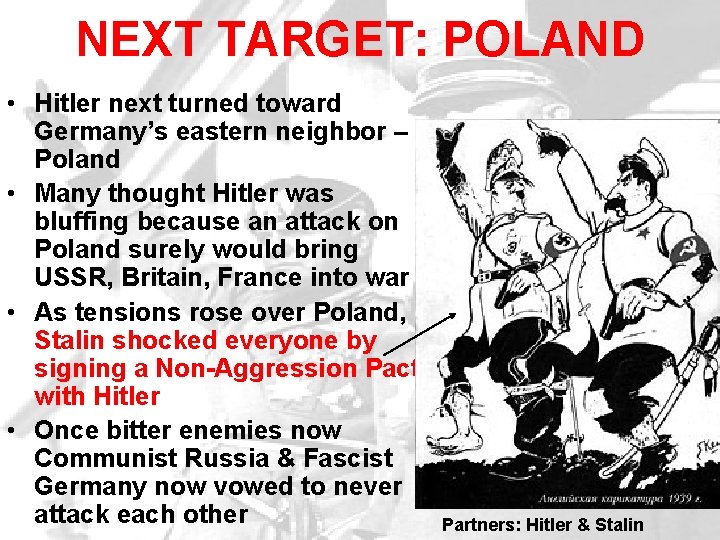
NEXT TARGET: POLAND • Hitler next turned toward Germany’s eastern neighbor – Poland • Many thought Hitler was bluffing because an attack on Poland surely would bring USSR, Britain, France into war • As tensions rose over Poland, Stalin shocked everyone by signing a Non-Aggression Pact with Hitler • Once bitter enemies now Communist Russia & Fascist Germany now vowed to never attack each other Partners: Hitler & Stalin
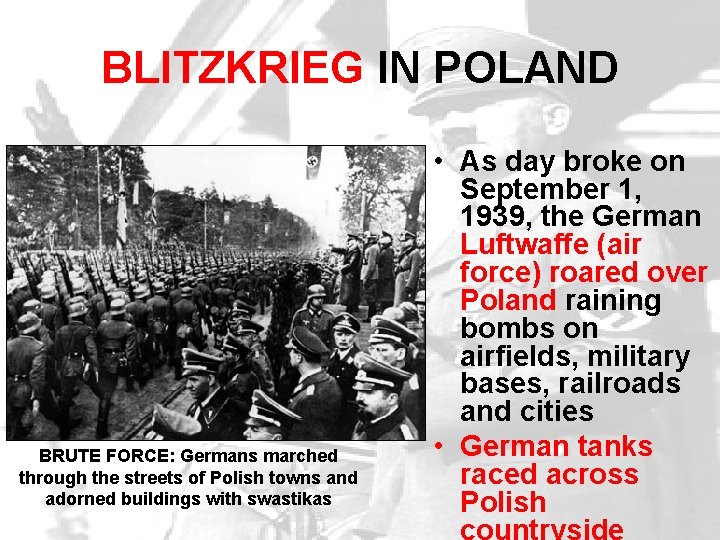
BLITZKRIEG IN POLAND BRUTE FORCE: Germans marched through the streets of Polish towns and adorned buildings with swastikas • As day broke on September 1, 1939, the German Luftwaffe (air force) roared over Poland raining bombs on airfields, military bases, railroads and cities • German tanks raced across Polish countryside
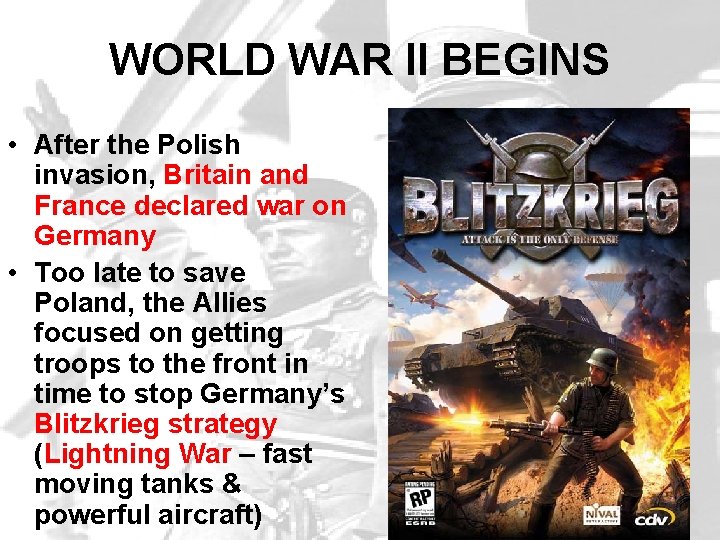
WORLD WAR II BEGINS • After the Polish invasion, Britain and France declared war on Germany • Too late to save Poland, the Allies focused on getting troops to the front in time to stop Germany’s Blitzkrieg strategy (Lightning War – fast moving tanks & powerful aircraft)
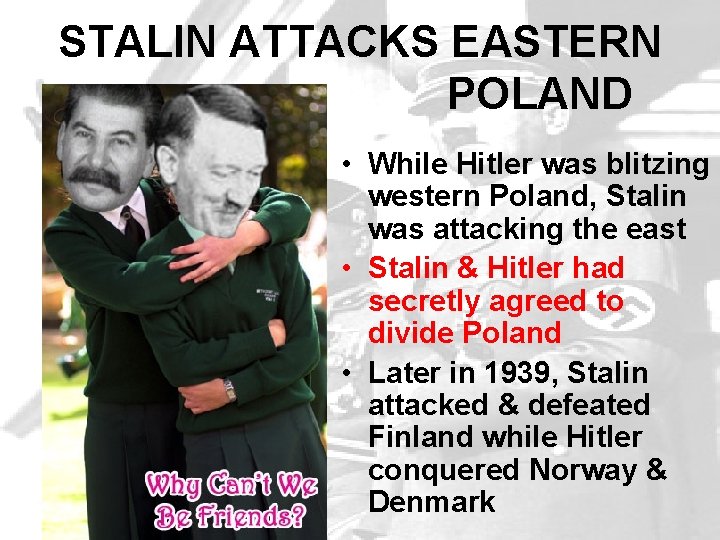
STALIN ATTACKS EASTERN POLAND • While Hitler was blitzing western Poland, Stalin was attacking the east • Stalin & Hitler had secretly agreed to divide Poland • Later in 1939, Stalin attacked & defeated Finland while Hitler conquered Norway & Denmark
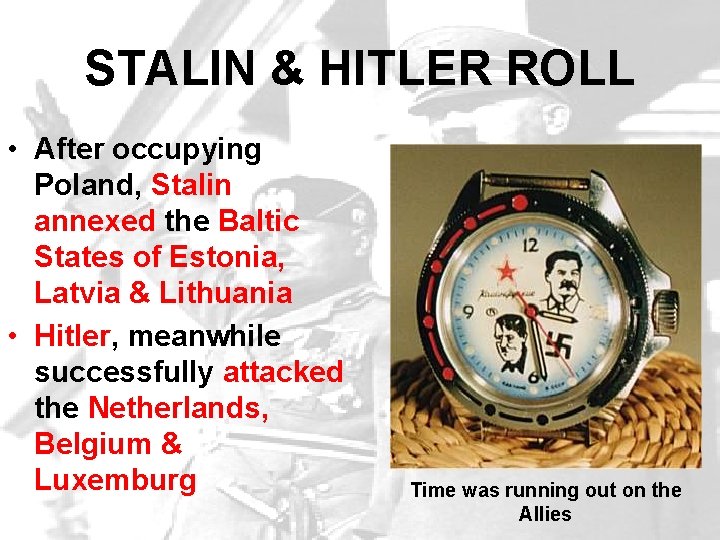
STALIN & HITLER ROLL • After occupying Poland, Stalin annexed the Baltic States of Estonia, Latvia & Lithuania • Hitler, meanwhile successfully attacked the Netherlands, Belgium & Luxemburg Time was running out on the Allies
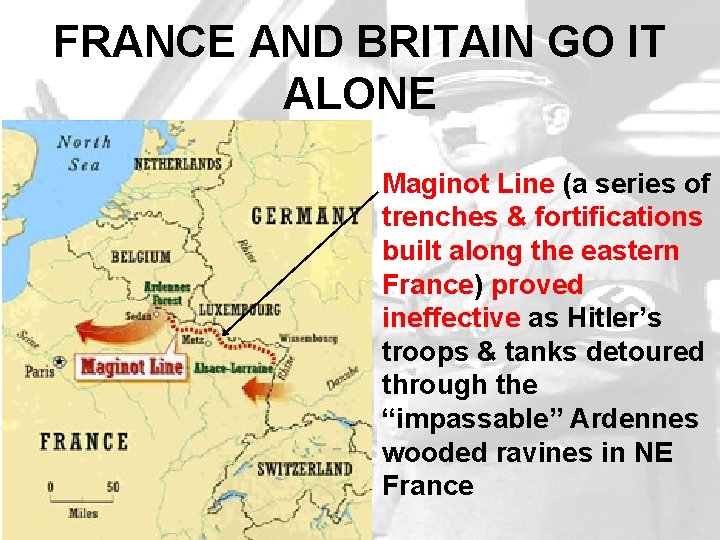
FRANCE AND BRITAIN GO IT ALONE • Maginot Line (a series of trenches & fortifications built along the eastern France) proved ineffective as Hitler’s troops & tanks detoured through the “impassable” Ardennes wooded ravines in NE France
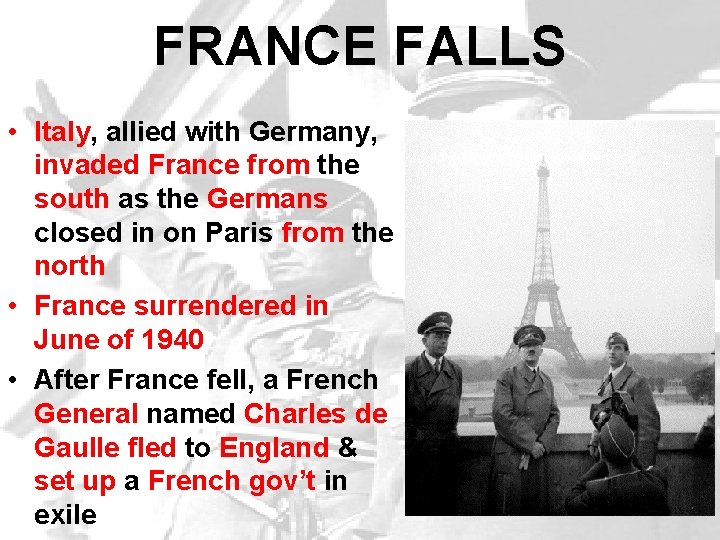
FRANCE FALLS • Italy, allied with Germany, invaded France from the south as the Germans closed in on Paris from the north • France surrendered in June of 1940 • After France fell, a French General named Charles de Gaulle fled to England & set up a French gov’t in exile
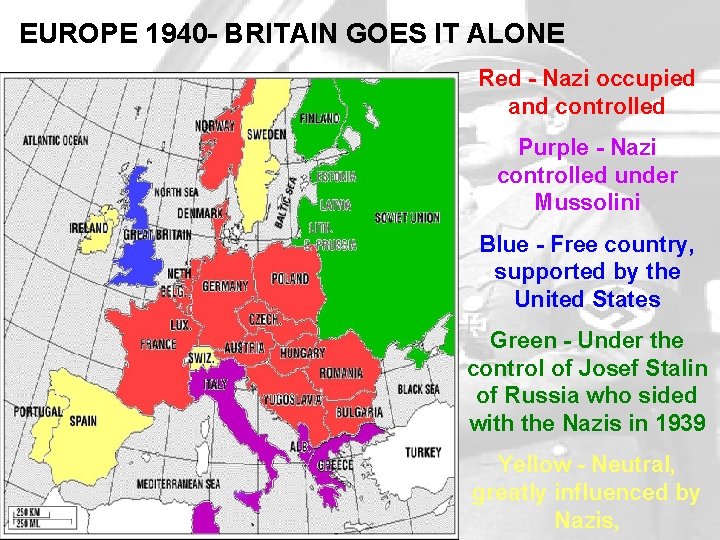
EUROPE 1940 - BRITAIN GOES IT ALONE Red - Nazi occupied and controlled Purple - Nazi controlled under Mussolini Blue - Free country, supported by the United States Green - Under the control of Josef Stalin of Russia who sided with the Nazis in 1939 Yellow - Neutral, greatly influenced by Nazis,
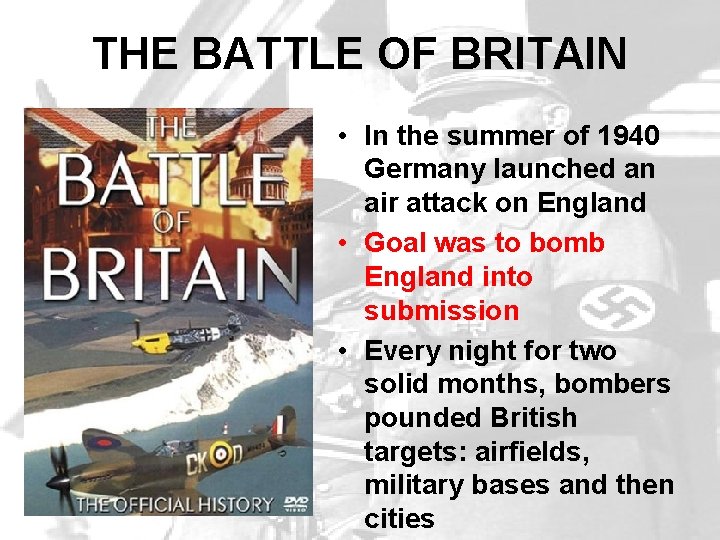
THE BATTLE OF BRITAIN • In the summer of 1940 Germany launched an air attack on England • Goal was to bomb England into submission • Every night for two solid months, bombers pounded British targets: airfields, military bases and then cities
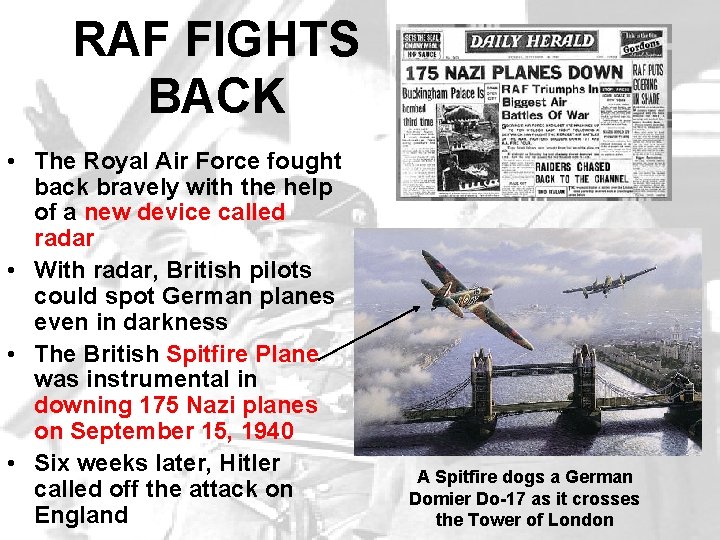
RAF FIGHTS BACK • The Royal Air Force fought back bravely with the help of a new device called radar • With radar, British pilots could spot German planes even in darkness • The British Spitfire Plane was instrumental in downing 175 Nazi planes on September 15, 1940 • Six weeks later, Hitler called off the attack on England A Spitfire dogs a German Domier Do-17 as it crosses the Tower of London
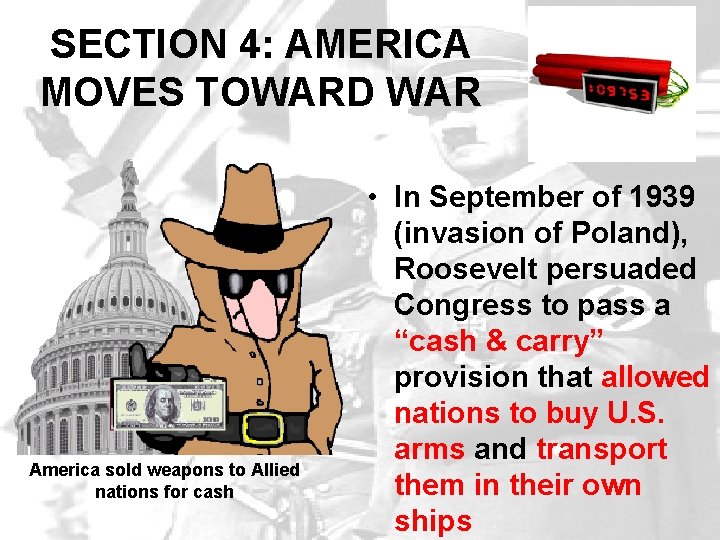
SECTION 4: AMERICA MOVES TOWARD WAR America sold weapons to Allied nations for cash • In September of 1939 (invasion of Poland), Roosevelt persuaded Congress to pass a “cash & carry” provision that allowed nations to buy U. S. arms and transport them in their own ships
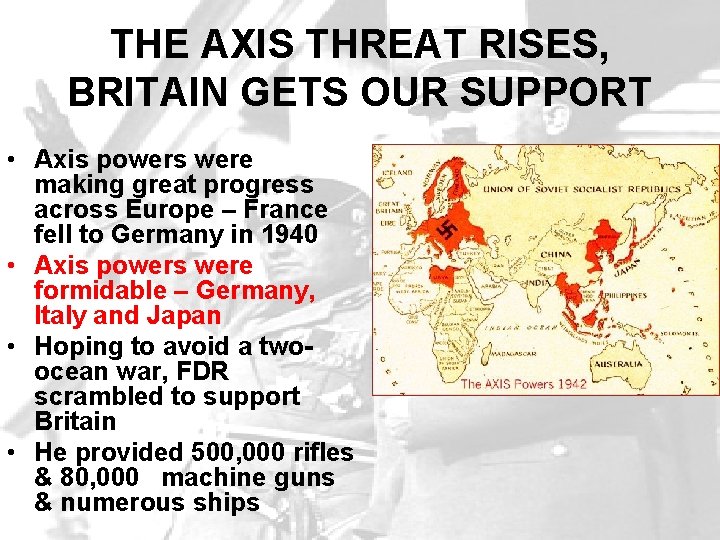
THE AXIS THREAT RISES, BRITAIN GETS OUR SUPPORT • Axis powers were making great progress across Europe – France fell to Germany in 1940 • Axis powers were formidable – Germany, Italy and Japan • Hoping to avoid a twoocean war, FDR scrambled to support Britain • He provided 500, 000 rifles & 80, 000 machine guns & numerous ships
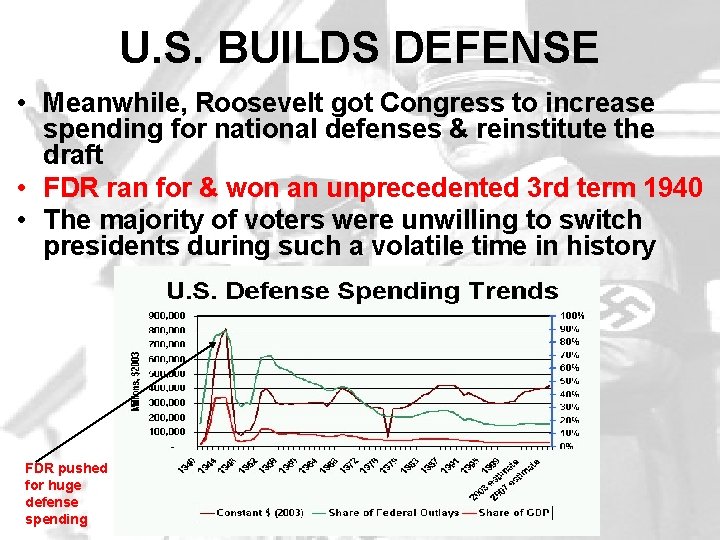
U. S. BUILDS DEFENSE • Meanwhile, Roosevelt got Congress to increase spending for national defenses & reinstitute the draft • FDR ran for & won an unprecedented 3 rd term 1940 • The majority of voters were unwilling to switch presidents during such a volatile time in history FDR pushed for huge defense spending
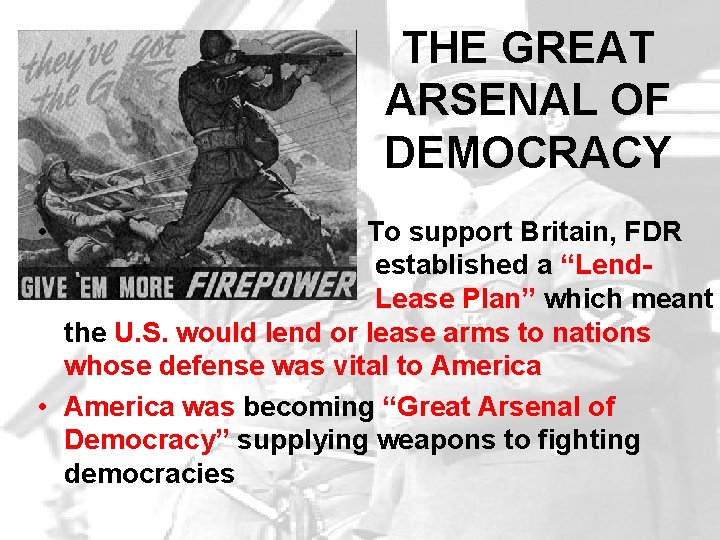
THE GREAT ARSENAL OF DEMOCRACY • To support Britain, FDR established a “Lend. Lease Plan” which meant the U. S. would lend or lease arms to nations whose defense was vital to America • America was becoming “Great Arsenal of Democracy” supplying weapons to fighting democracies
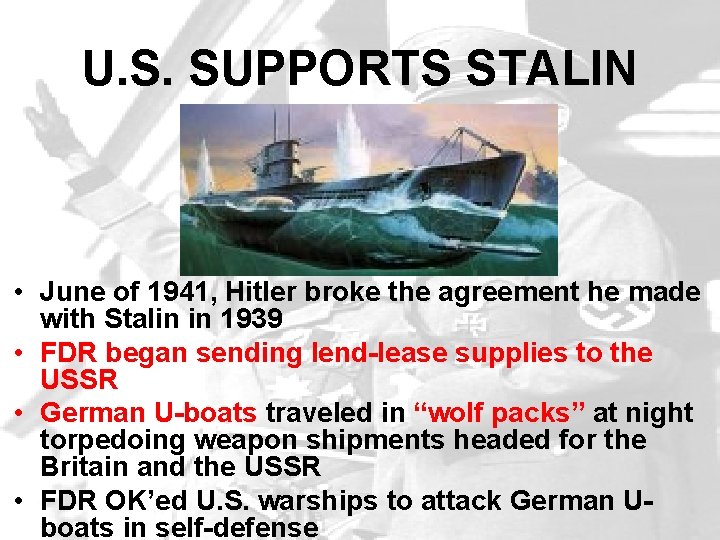
U. S. SUPPORTS STALIN • June of 1941, Hitler broke the agreement he made with Stalin in 1939 • FDR began sending lend-lease supplies to the USSR • German U-boats traveled in “wolf packs” at night torpedoing weapon shipments headed for the Britain and the USSR • FDR OK’ed U. S. warships to attack German Uboats in self-defense
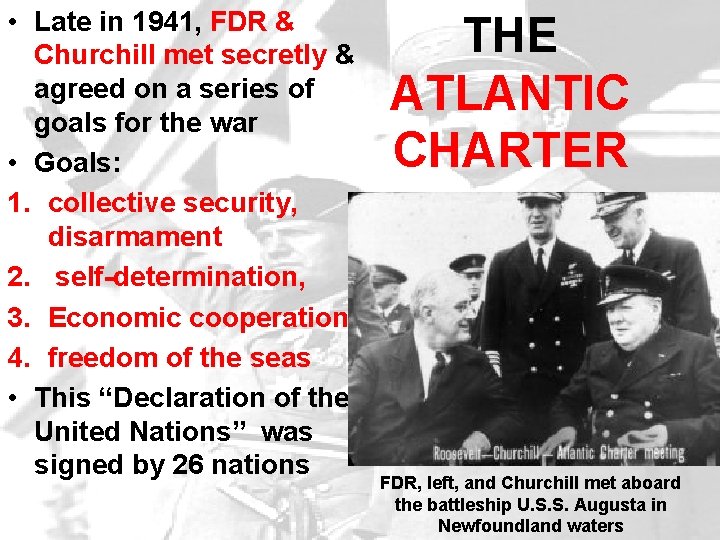
• Late in 1941, FDR & Churchill met secretly & agreed on a series of goals for the war • Goals: 1. collective security, disarmament 2. self-determination, 3. Economic cooperation 4. freedom of the seas • This “Declaration of the United Nations” was signed by 26 nations THE ATLANTIC CHARTER FDR, left, and Churchill met aboard the battleship U. S. S. Augusta in Newfoundland waters
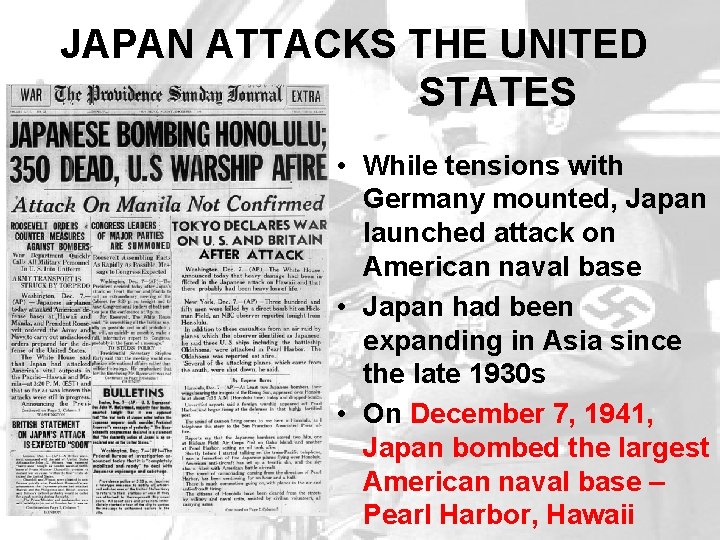
JAPAN ATTACKS THE UNITED STATES • While tensions with Germany mounted, Japan launched attack on American naval base • Japan had been expanding in Asia since the late 1930 s • On December 7, 1941, Japan bombed the largest American naval base – Pearl Harbor, Hawaii
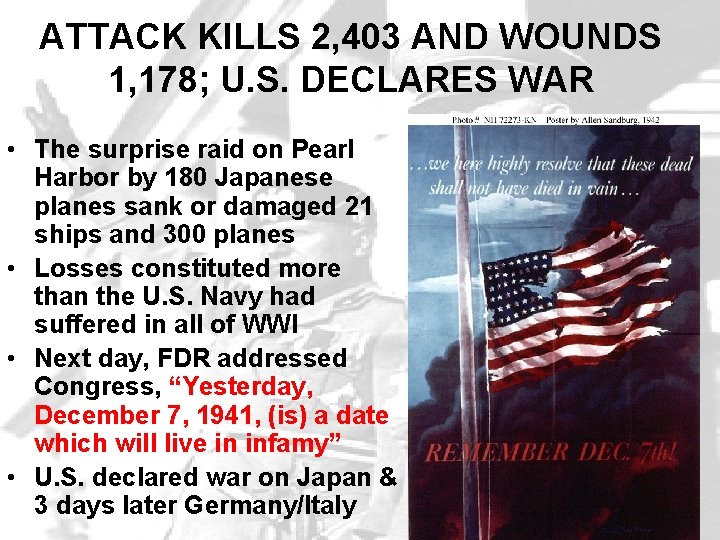
ATTACK KILLS 2, 403 AND WOUNDS 1, 178; U. S. DECLARES WAR • The surprise raid on Pearl Harbor by 180 Japanese planes sank or damaged 21 ships and 300 planes • Losses constituted more than the U. S. Navy had suffered in all of WWI • Next day, FDR addressed Congress, “Yesterday, December 7, 1941, (is) a date which will live in infamy” • U. S. declared war on Japan & 3 days later Germany/Italy