Wide Range Assessment of Memory and Learning Second


- Slides: 72
Wide Range Assessment of Memory and Learning Second Edition David Sheslow, Ph. D Wayne Adams, Ph. D
About the authors: Dr. David Sheslow o o o Ph. D in Clinical Psychology, University of North Carolina at Greensboro 29 years at the Du. Pont Hospital for Children as chief psychologist and co-director of the Division of Behavioral Health, Department of Pediatrics Teaches at the Du. Pont Hospital Pediatric and Psychology Residency Programs Private, Clinical Psychology practice Published over 48 professional articles
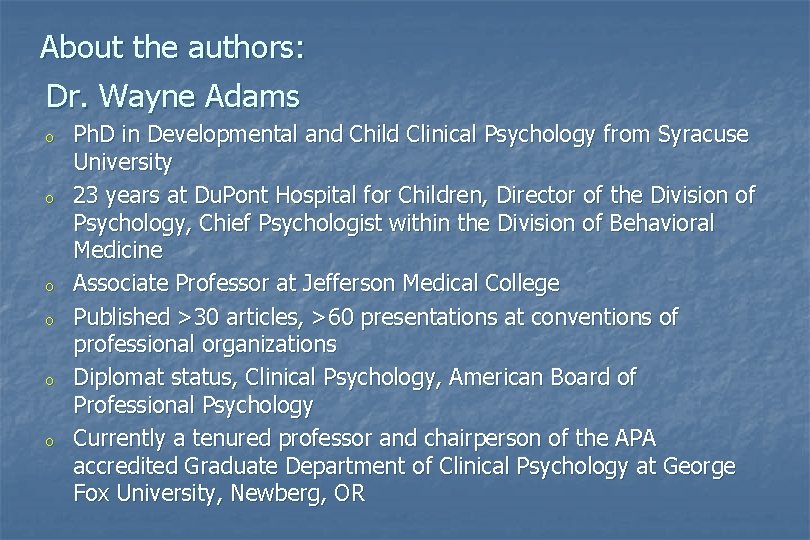
About the authors: Dr. Wayne Adams o o o Ph. D in Developmental and Child Clinical Psychology from Syracuse University 23 years at Du. Pont Hospital for Children, Director of the Division of Psychology, Chief Psychologist within the Division of Behavioral Medicine Associate Professor at Jefferson Medical College Published >30 articles, >60 presentations at conventions of professional organizations Diplomat status, Clinical Psychology, American Board of Professional Psychology Currently a tenured professor and chairperson of the APA accredited Graduate Department of Clinical Psychology at George Fox University, Newberg, OR
About the authors: Drs. Adams and Sheslow have co-authored 5 instruments. They have extensive experience working with children and teens with mild to severe neurological disorders such as Learning Disabilities, ADHD, and Traumatic Brain Injury. It is this clinical involvement that lead to the development of a memory battery when there was none normed on children.
Evaluation of Memory: Our Clinical and Empirical Roots
Historical Roots Hans Ebbinghaus (1850 – 1909) n Immediate memory (digit span) n Chunking n Nonsense syllables n Meaningfulness n Rehearsal n Interference n Disadvantage of age n Memory “illusions”
Historical Roots Alfred Binet (1857 – 1911) n Qualitative analysis n Serial position effect n “Importance” effect n Acoustic vs. semantic recall effects Frederic Barlett (1886 -1969) n Visual and motor memory
Historical Roots Sigmund Freud n Repressed memory effects Theodule Ribot (1839 -1916) n Encoding, storage, retrieval n Procedural and volitional memory n Study of amnesias Developmental aspects of memory n Immediate memory improves during school years n Declining long-term retention with age
Historical Roots Associationism n Function of habit strength n Simple association between external stimulus and observable response Introduction of the Computer n People are active information processors n Memory is a “storage system” with stages
Historical Roots Broadbent (1958) n “serial processing” Atkinson and Shiffrin (1968) n Sensory register, short-term store, long-term store n Control processes Craik and Lockhart (1972) n “levels of processing”
Historical Roots Developmental Aspects: n Immediate recall improves during school years n Improvement on immediate memory tasks is particularly noticeable until 13 years of age n Children’s performance across ages does differ n Long-term retention declines with increasing age n Gender differences are small or non-existent n Memory performance is related to IQ but the correlation is not very high
Historical Roots Neuropsychological Influences n H. M. (hippocampal lesion) n Intact short-term, severely impaired long-term n Support for multi-store model? n Non-localized dimension? n Executive processes
Contemporary Status n n Neuroimaging studies Computational/connectionist models Multi-system nature, active, dynamic Interaction of: n Memory n Executive functions that control and regulate n Knowledge and skills of learner
A sampling of historical memory concepts found on WRAML 2 n n n Primacy/Recency List Learning Trials and Learning Curve Recognition Memory Immediate vs. Delayed Recall n n n Sustained Attention Working Memory Gist vs. Verbatim Verbal vs. Visual Rote vs. Meaningful
Early Memory Measures n n n Rey (list learning of 15 words) 1958 Rey-Osterrieth Complex Figure Task (1944) Wechsler Memory Scale (1945) Wechsler Memory Scale – Revised (1987) Wechsler Memory Scale – III (1997) Wide Range Assessment of Memory and Learning (1990)
Test Revision WRAML (1990) WRAML 2 (2004)
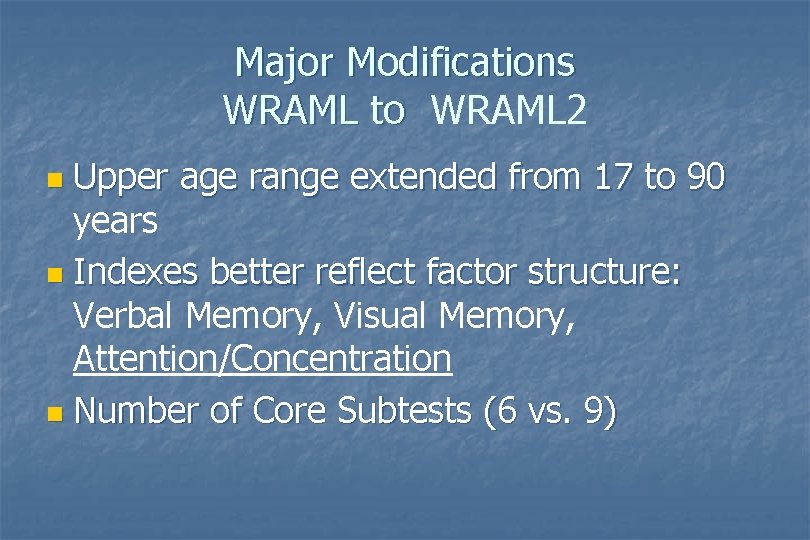
Major Modifications WRAML to WRAML 2 Upper age range extended from 17 to 90 years n Indexes better reflect factor structure: Verbal Memory, Visual Memory, Attention/Concentration n Number of Core Subtests (6 vs. 9) n
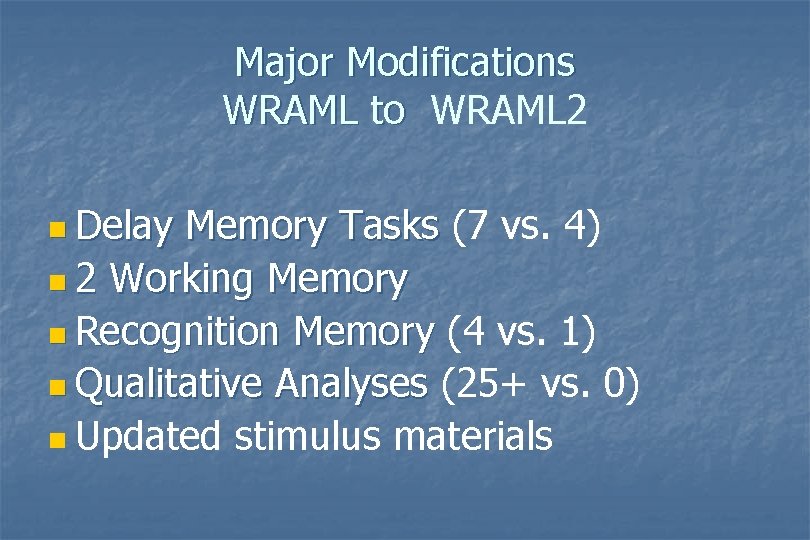
Major Modifications WRAML to WRAML 2 n Delay Memory Tasks (7 vs. 4) n 2 Working Memory n Recognition Memory (4 vs. 1) n Qualitative Analyses (25+ vs. 0) n Updated stimulus materials
WRAML 2 Structure Core Subtests § Optional Subtests § Qualitative Analyses §
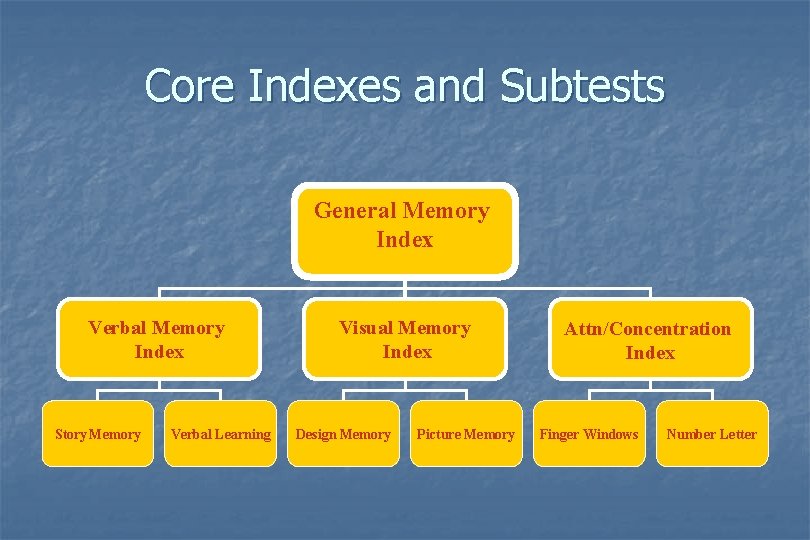
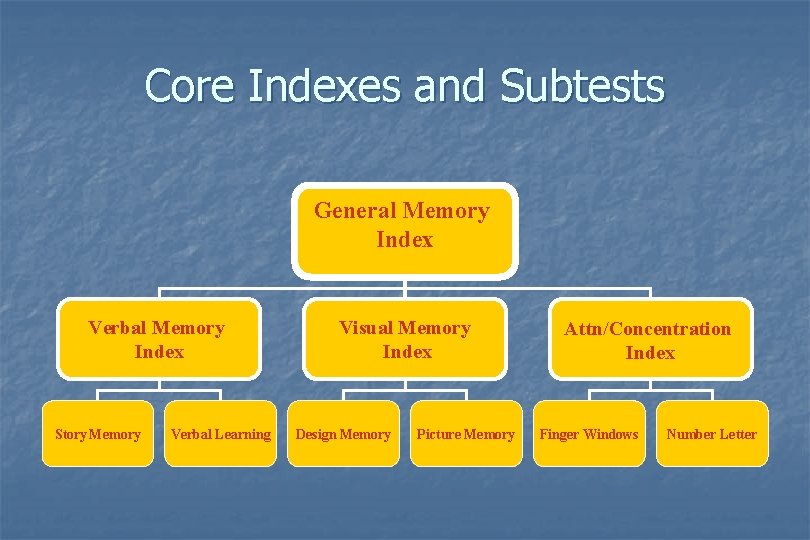
Core Indexes and Subtests General Memory Index Verbal Memory Index Story Memory Verbal Learning Visual Memory Index Design Memory Picture Memory Attn/Concentration Index Finger Windows Number Letter
Psychometric Properties of the WRAML 2
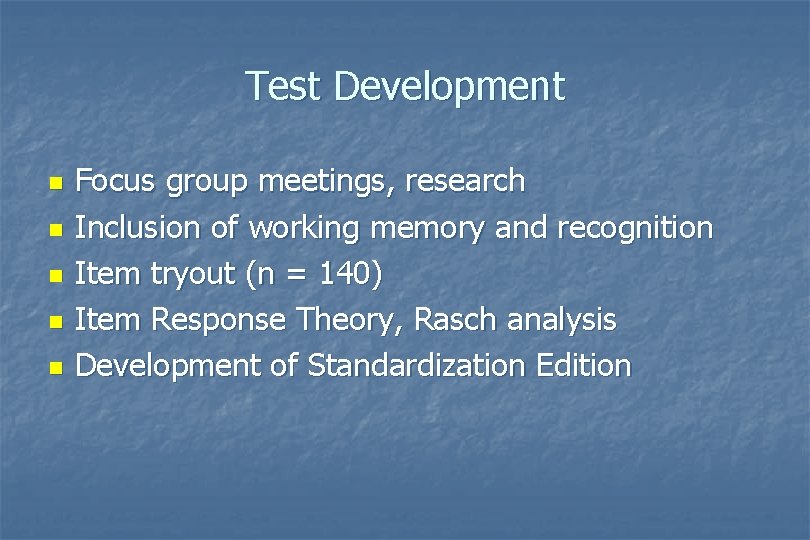
Test Development n n n Focus group meetings, research Inclusion of working memory and recognition Item tryout (n = 140) Item Response Theory, Rasch analysis Development of Standardization Edition
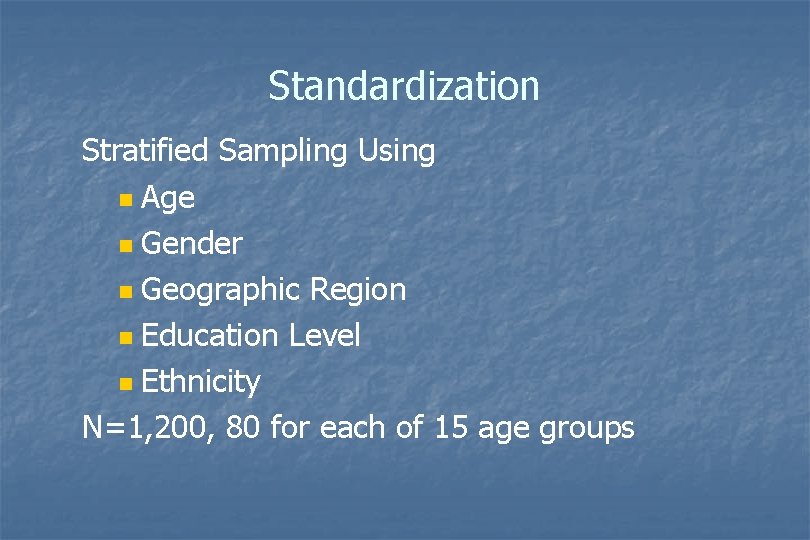
Standardization Stratified Sampling Using n Age n Gender n Geographic Region n Education Level n Ethnicity N=1, 200, 80 for each of 15 age groups
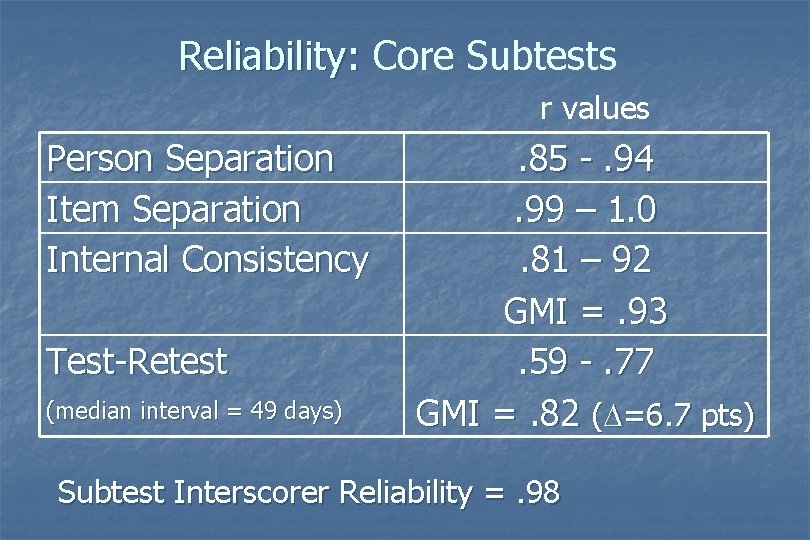
Reliability: Core Subtests r values Person Separation Item Separation Internal Consistency Test-Retest (median interval = 49 days) . 85 -. 94. 99 – 1. 0. 81 – 92 GMI =. 93. 59 -. 77 GMI =. 82 ( =6. 7 pts) Subtest Interscorer Reliability =. 98
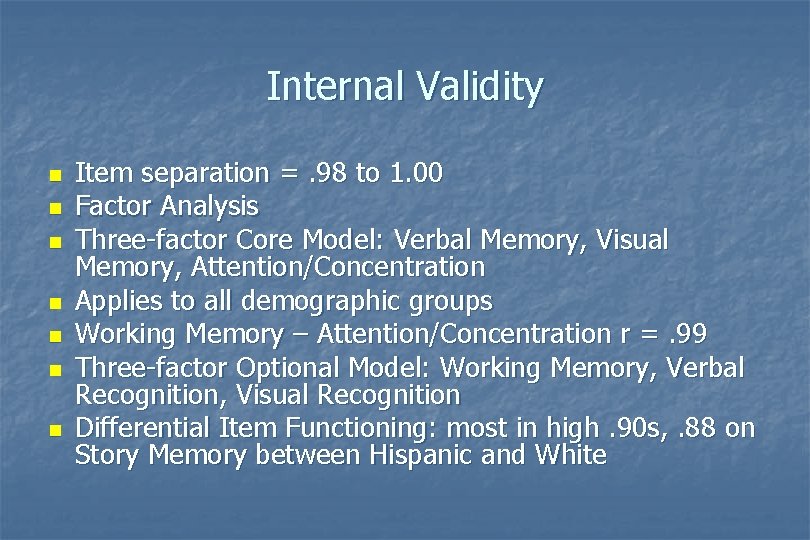
Internal Validity n n n n Item separation =. 98 to 1. 00 Factor Analysis Three-factor Core Model: Verbal Memory, Visual Memory, Attention/Concentration Applies to all demographic groups Working Memory – Attention/Concentration r =. 99 Three-factor Optional Model: Working Memory, Verbal Recognition, Visual Recognition Differential Item Functioning: most in high. 90 s, . 88 on Story Memory between Hispanic and White
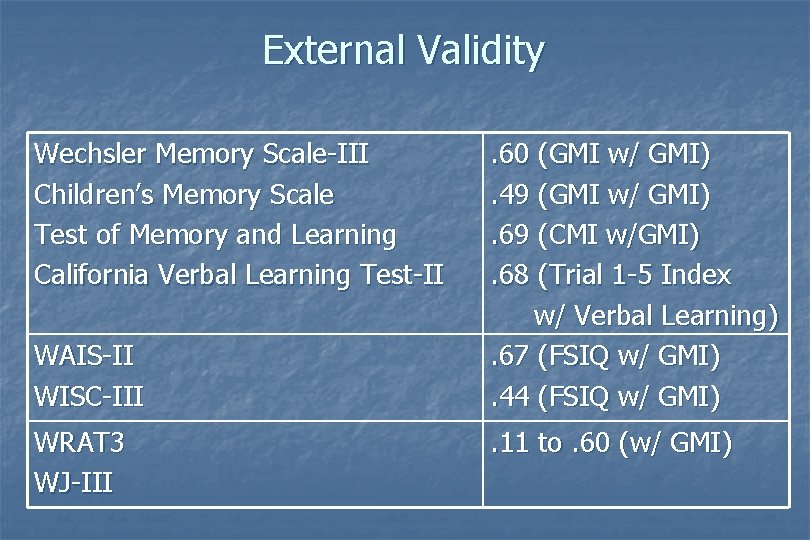
External Validity Wechsler Memory Scale-III Children’s Memory Scale Test of Memory and Learning California Verbal Learning Test-II WAIS-II WISC-III WRAT 3 WJ-III . 60 (GMI w/ GMI). 49 (GMI w/ GMI). 69 (CMI w/GMI). 68 (Trial 1 -5 Index w/ Verbal Learning). 67 (FSIQ w/ GMI). 44 (FSIQ w/ GMI). 11 to. 60 (w/ GMI)
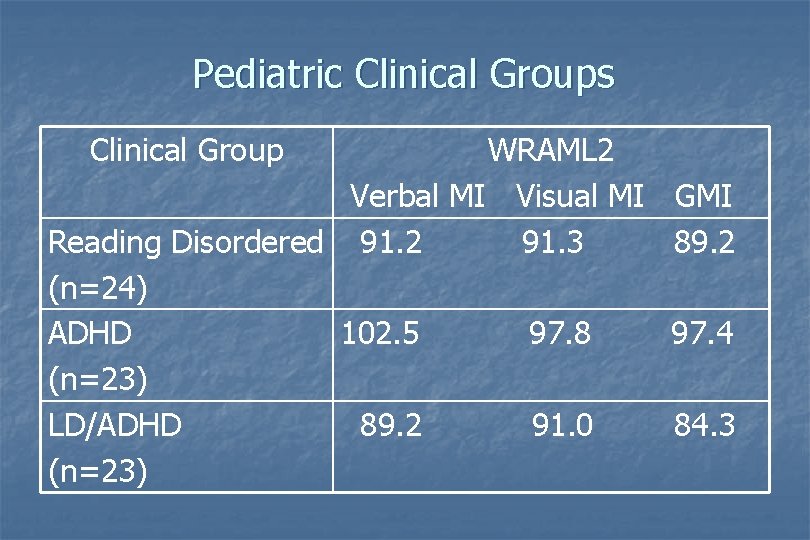
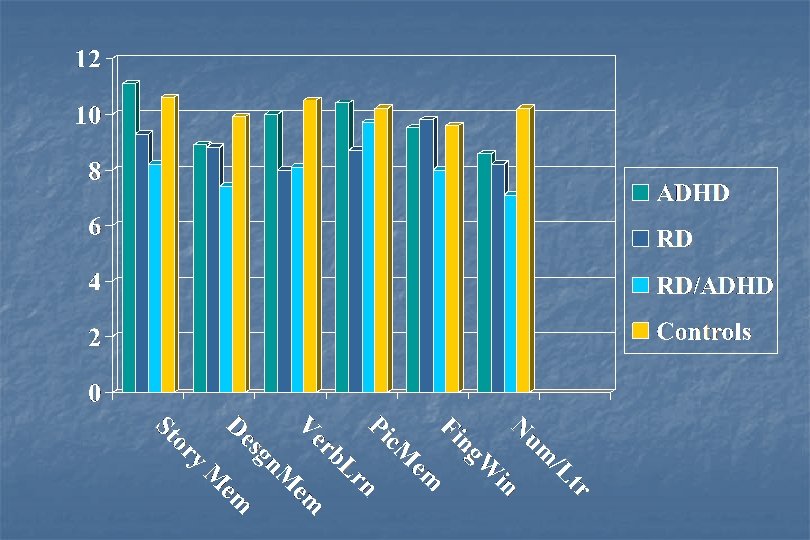
Pediatric Clinical Groups Clinical Group WRAML 2 Verbal MI Visual MI GMI Reading Disordered 91. 2 91. 3 89. 2 (n=24) ADHD 102. 5 97. 8 97. 4 (n=23) LD/ADHD 89. 2 91. 0 84. 3 (n=23)
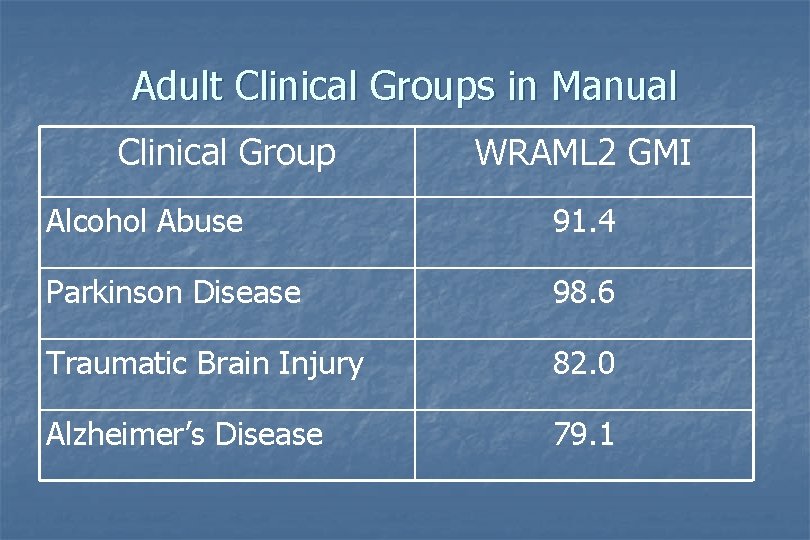
Adult Clinical Groups in Manual Clinical Group WRAML 2 GMI Alcohol Abuse 91. 4 Parkinson Disease 98. 6 Traumatic Brain Injury 82. 0 Alzheimer’s Disease 79. 1
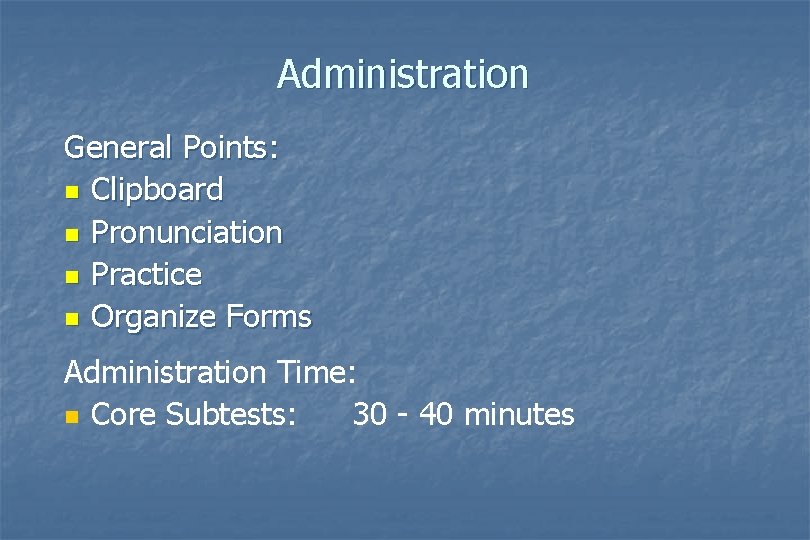
Administration General Points: n Clipboard n Pronunciation n Practice n Organize Forms Administration Time: n Core Subtests: 30 - 40 minutes
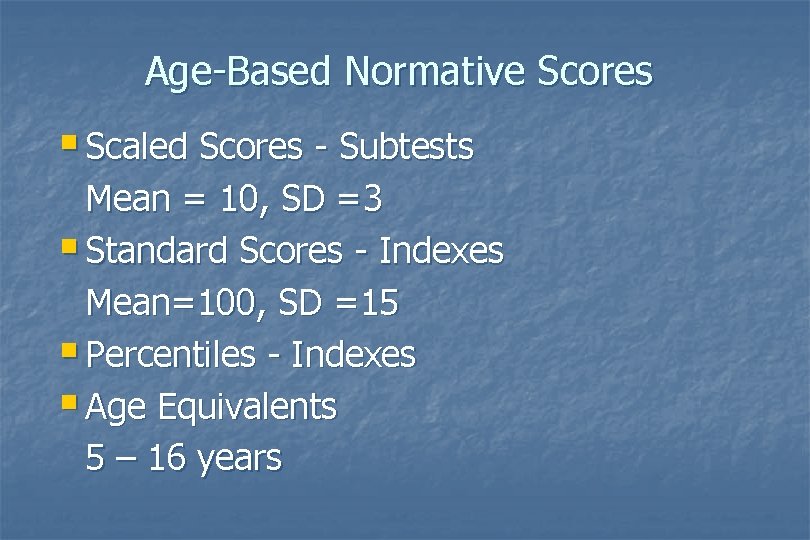
Age-Based Normative Scores § Scaled Scores - Subtests Mean = 10, SD =3 § Standard Scores - Indexes Mean=100, SD =15 § Percentiles - Indexes § Age Equivalents 5 – 16 years
Other Data Available n n n Confidence Intervals Index Discrepancy Data Statistical significance Prevalence data Scaled and/or Cut Scores for qualitative analyses Qualitative Analyses (with quantitative support) Age-based descriptive statistics and clinical base rates (prevalence) are provided Computer scoring program available
Core Indexes and Subtests General Memory Index Verbal Memory Index Story Memory Verbal Learning Visual Memory Index Design Memory Picture Memory Attn/Concentration Index Finger Windows Number Letter
Story Memory Subtest Core Subtest (1), Verbal Memory Index n n Two Stories read to Participant A & B = 5 -8 years B & C = 9 years and older Immediate Recall Trial Upper case scoring criteria = requires an exact response Lower case scoring criteria = acceptable gist responses listed in manual
Story Memory Subtest Core Subtest (1), Verbal Memory Index Tips: n n Practice reading stories out loud Use a pencil to point to each word as it is read Note unusual gist responses so can score later Transfer to Verbatim and Gist columns later
Story Memory Subtest Associated Optional Subtests and Qualitative Measures Story Memory Delay Recall q Story Memory Retention q Individual Story Comparison q Verbatim and Gist Measures q Story Memory Delay Recognition q
Verbal Learning Subtest Core Subtest (3), Verbal Memory Index List-learning task 13 words, 8 years and younger 16 words, > 9 years n Common words n Four learning trials n
Verbal Learning Subtest Core Subtest (3), Verbal Memory Index n n Tips: One second pause between words Number repetition order IF have time Write first letter of word in free space
Verbal Learning Subtest Associated Optional Subtests and Qualitative Measures n n n n Verbal Learning Delay Recall Trials 1 – 4 Verbal Learning Slope Verbal Learning Retention Verbal Learning Intrusion Errors Verbal Learning Recognition Semantic vs. Phonological Error analysis for Recognition
Design Memory Subtest Core Subtest (2), Visual Memory Index § § 5 Design Memory Cards Design Memory Response Form Copying – aid for judging accuracy Young examinees Any age with poor visual-motor skills Drawing task 5 second exposure 10 second pause before drawing
Design Memory Subtest Core Subtest (2), Visual Memory Index Tips: n Take back the pencil each time after drawing is complete n Hold the pencil to deter grabbing n Let clock run and note time vs. resetting n Scoring guidelines in manual Associated Optional Subtest: n Design Memory Recognition
Picture Memory Subtest Core Subtest (4), Visual Memory Index n n n 4 Memory Stimulus Cards Picture Memory Response Form Red China Marker 10 second exposure “Put an X on each part of the picture that has been changed, moved or added. ” Correct Zoo card only
Picture Memory Subtest Core Subtest (4), Visual Memory Index Tips: n Put Memory Stimulus Cards in order n Can use a crayon – liquid markers typically bleed n Familiarize yourself with the Zoo responses, in particular, so can quickly correct if needed Associated Optional Subtest/Qualitative Measure: n Commission Errors n Picture Memory Recognition
Finger Windows Subtest Core Subtest (7), Attention/Concentration Index n n n Finger Windows Card Start places determined by age 5 -8 years = A 9 years & older = 4 1 second in window, 1 second between windows Correct A, B, and C only If 4 is incorrect, go to A
Finger Windows Subtest Core Subtest (7), Attention/Concentration Index n n n Tips: May be easier to write numbers in order while looking at card Can place pencil on table between windows to aid timing
Number Letter Subtest Core Subtest (9), Attention/Concentration Index n n 1 per second Examinee repeats the sequence in the same order
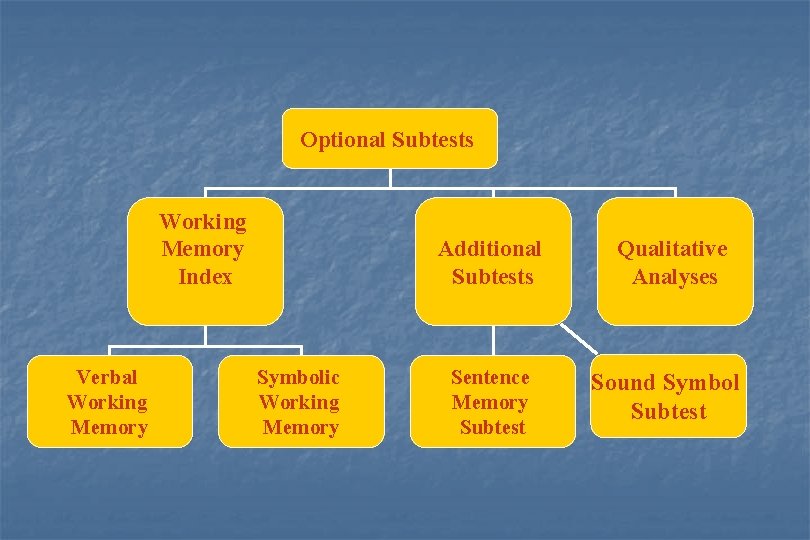
Optional Subtests Working Memory Index Verbal Working Memory Additional Subtests Symbolic Working Memory Sentence Memory Subtest Qualitative Analyses Sound Symbol Subtest
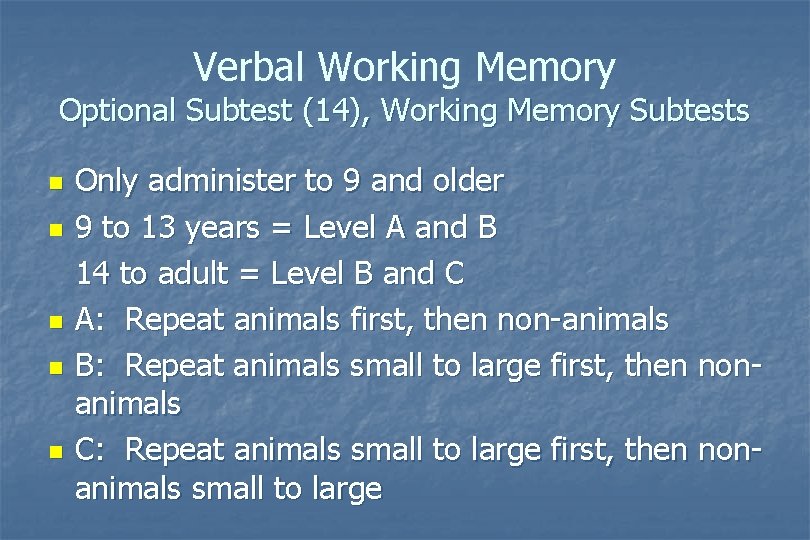
Verbal Working Memory Optional Subtest (14), Working Memory Subtests n n n Only administer to 9 and older 9 to 13 years = Level A and B 14 to adult = Level B and C A: Repeat animals first, then non-animals B: Repeat animals small to large first, then nonanimals C: Repeat animals small to large first, then nonanimals small to large
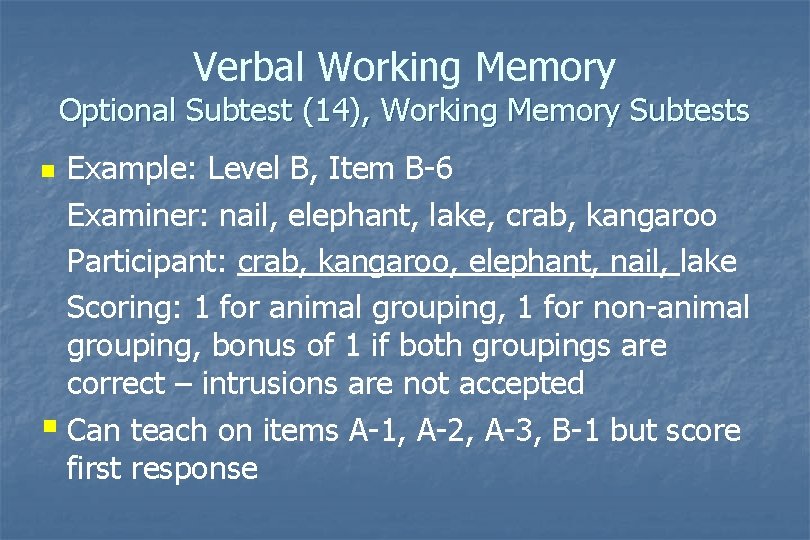
Verbal Working Memory Optional Subtest (14), Working Memory Subtests Example: Level B, Item B-6 Examiner: nail, elephant, lake, crab, kangaroo Participant: crab, kangaroo, elephant, nail, lake Scoring: 1 for animal grouping, 1 for non-animal grouping, bonus of 1 if both groupings are correct – intrusions are not accepted § Can teach on items A-1, A-2, A-3, B-1 but score first response n
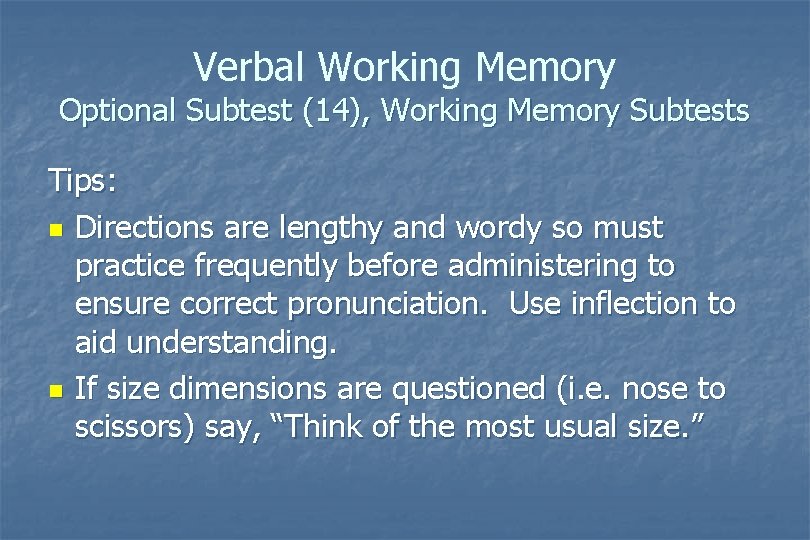
Verbal Working Memory Optional Subtest (14), Working Memory Subtests Tips: n Directions are lengthy and wordy so must practice frequently before administering to ensure correct pronunciation. Use inflection to aid understanding. n If size dimensions are questioned (i. e. nose to scissors) say, “Think of the most usual size. ”
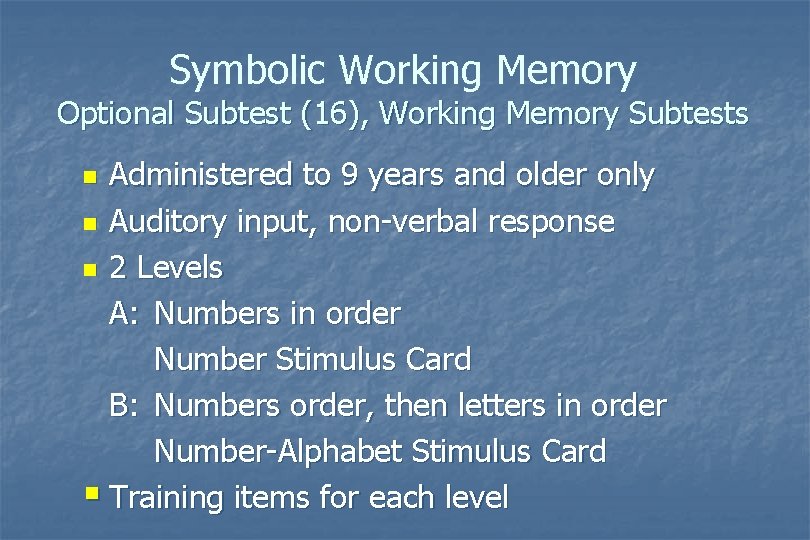
Symbolic Working Memory Optional Subtest (16), Working Memory Subtests Administered to 9 years and older only n Auditory input, non-verbal response n 2 Levels A: Numbers in order Number Stimulus Card B: Numbers order, then letters in order Number-Alphabet Stimulus Card § Training items for each level n
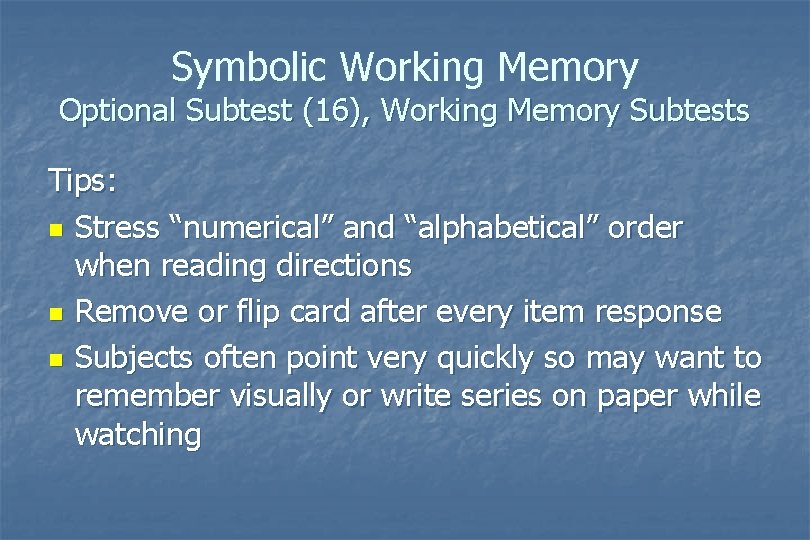
Symbolic Working Memory Optional Subtest (16), Working Memory Subtests Tips: n Stress “numerical” and “alphabetical” order when reading directions n Remove or flip card after every item response n Subjects often point very quickly so may want to remember visually or write series on paper while watching
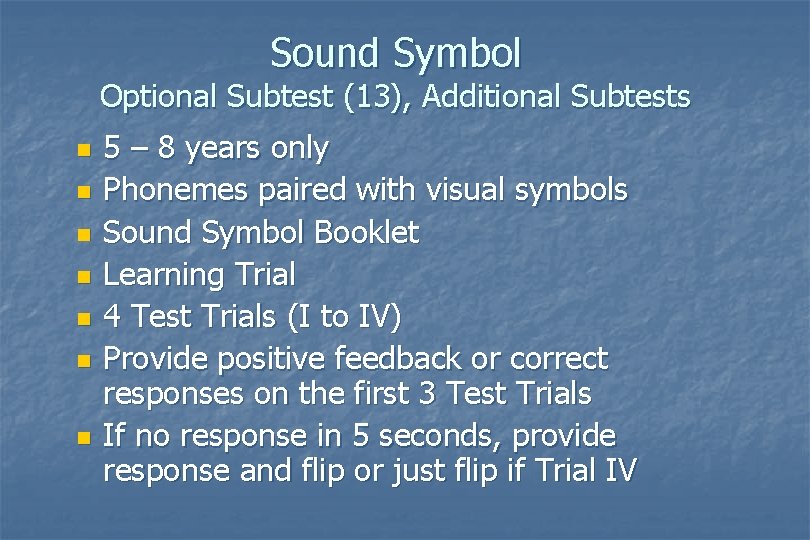
Sound Symbol Optional Subtest (13), Additional Subtests n n n n 5 – 8 years only Phonemes paired with visual symbols Sound Symbol Booklet Learning Trial 4 Test Trials (I to IV) Provide positive feedback or correct responses on the first 3 Test Trials If no response in 5 seconds, provide response and flip or just flip if Trial IV
Sound Symbol Associated Optional Subtest and Qualitative Measures n. Sound Symbol Delay Recall n. Trial 1 – 4 n. Sound Symbol Retention n. Sound Symbol Slope
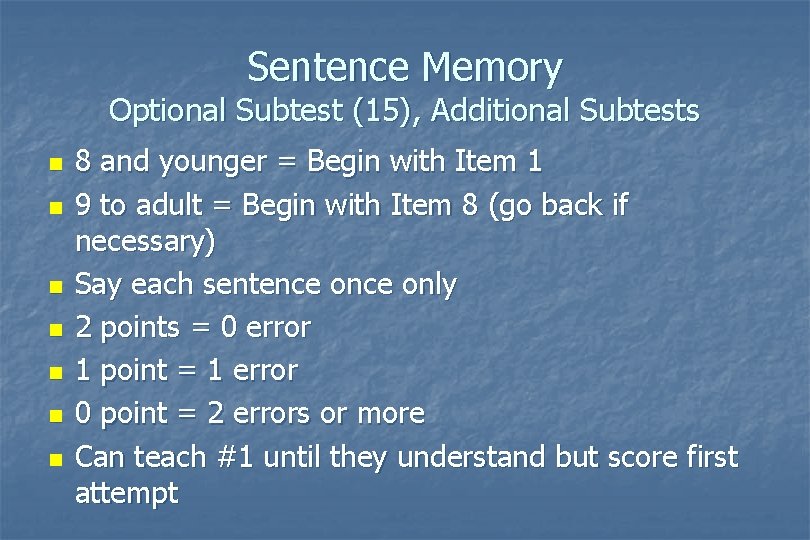
Sentence Memory Optional Subtest (15), Additional Subtests n n n n 8 and younger = Begin with Item 1 9 to adult = Begin with Item 8 (go back if necessary) Say each sentence only 2 points = 0 error 1 point = 1 error 0 point = 2 errors or more Can teach #1 until they understand but score first attempt
Sentence Memory Optional Subtest (15), Additional Subtests Scoring: n Response must be verbatim n Additions, omissions, changing word form, and contracting are one error Tips: n Place pencil on each word to decrease error n Record incorrect response for scoring and analysis
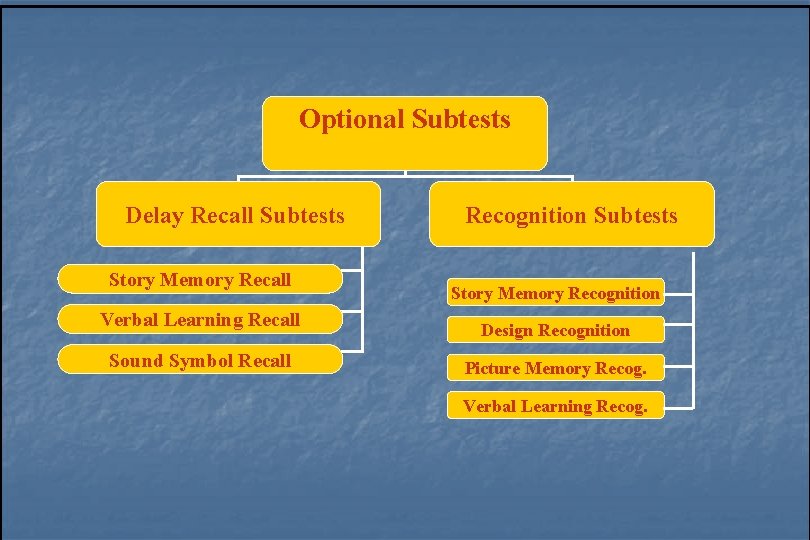
Optional Subtests Delay Recall Subtests Story Memory Recall Verbal Learning Recall Sound Symbol Recall Recognition Subtests Story Memory Recognition Design Recognition Picture Memory Recog. Verbal Learning Recog.
Story Memory Delay Recall Optional Subtest (5), Delay Recall Subtests Return to Story Memory (1) scoring pages n Administer same story set as Story Memory n Do not read story to examinee n Indicate performance in the Delay Recall column n No Verbatim or Gist columns for delay but must comply with same scoring guidelines n
Verbal Learning Delay Recall Optional Subtest (8), Delay Recall Subtests n n Return to Verbal Learning (3) scoring pages Do not read the list to the examinee
Sound Symbol Delay Recall Optional Subtest (17), Delay Recall Subtests n n Return to Sound Symbol (13) scoring pages Sound Symbol Booklet Do not name any symbols Delay Recall Trial is the same set as the Learning Trial
Story Memory Recognition Optional Subtest (6), Recognition Subtests Administer same story set as Story Memory n Give automatic credit for any correct detail given during Story Memory Recall n
Design Memory Recognition Optional Subtest (10), Recognition Subtests n n n Design Memory Recognition Booklet Pencil or Marker Review directions until examinee independently understands Make sure page is correctly oriented Do not let examinee go back once a page is finished
Picture Memory Recognition Optional Subtest (11), Recognition Subtests n n n Picture Memory Recognition Booklet Pencil or Marker Review directions until examinee independently understands Do not let examinee go back once a page is finished Can clarify that picture can appear on either the Picture Stimulus Card (cards with scenes) or Picture Memory Response Form (marked changes)
Verbal Learning Recognition Optional Subtest (12), Recognition Subtests n n Administer if Verbal Learning and Verbal Learning Delay Recall have been administered Ask for recognition of each word on list Optional Qualitative Analysis n Semantic Error Total n Phonological Error Total
WRAML 2 Screening Form 1 st Four Core Subtests n Story Memory n Design Memory n Verbal Learning n Picture Memory Administration Time: 20 - 30 minutes Memory Screening Index and General Memory Index correlation =. 91
Scores n n n Raw – Scaled – Sum of Scaled – Index Graphic Representation Index Score Discrepancy Analyses Core Subtest vs. Recognition Discrepancy Retention: Subtest minus Recall raw score
Qualitative Analyses - Scores n n n Story Memory Individual Story/Verbatim and Gist Scale Score Picture Memory Commission Errors - Descriptive Verbal Learning Trials/Slope/Intrusion Errors – Graph and Descriptive Verbal Learning Recognition Semantic and Phonological Errors - Descriptive Sound Symbol Trials/Slope/Retention – Graph and Descriptive
Qualitative Analyses - Possible Implications Story Memory n Forgetting “chunks” - Limited sustained attention n Delay better than recall - Need for memory consolidation n Reliance on Gist related to Reading Disability n Poor Delay Recall common in dementia or left temporal lobe head injury or stroke n Retention is particularly poor with moderate to severe brain injury, although immediate recall can be intact
Qualitative Analyses - Possible Implications Verbal Learning n Flat curve could suggest adequate auditory memory but difficulty recalling rote information n Slight curve suggests subject may benefit from repetitive review n Variable curve could suggest attention/organization issues n Poor slope suggests limited or decreased learning; adequate slope suggests learning efficiency
Qualitative Analyses - Possible Implications Verbal Learning, continued n Retention score < the 5 th percentile could suggest recent brain injury or progressive dementia n Frequent intrusion errors may suggest limited selfmonitoring, difficulty using feedback to change performance, disorganized processing, or confusion n Poor recognition may be associated with congenital developmental delay or neurologically based illness or injury
Qualitative Analyses - Possible Implications Picture Memory n Low Recognition and adequate Memory (rare) could suggest developmental delay, neurologically-based illness or injury, fatigue, poor motivation/attention, or malingering n Poor Memory and adequate Recognition may suggest early-to-mid-stage Alzheimer’s n High Commission Errors may be associated with poorly modulated work style, disinhibition, and poor impulse control as often seen in AD/HD, TBI, and mania
Qualitative Analyses - Possible Implications Sound Symbol n Retention score < the 5 th percentile may suggest memory loss typical of phonologicallybased reading disability, recent brain injury, or recent seizure disorder n Phonological/visual associates (tabe, wah, haa) are similar to the decoding aspects of reading