
Assessment for Learning More than just traffic lights


- Slides: 24
Assessment for Learning More than just traffic lights, smiley faces and lollipop sticks!
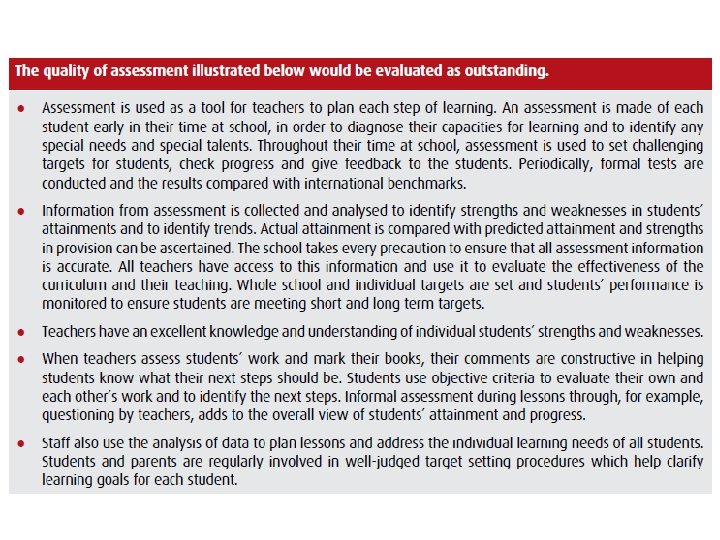
What do you understand Af. L to be? What might it look like in the classroom?
KHDA recommendations for SRS are: • to continue to increase progress and attainment • to improve student attitudes e. g. responsibility, aspirations. SRS school improvement priorities are: • raising attainment and accelerating progress • improving and maintaining quality of T & L • enhance the ethos of the school including effective behaviour for learning. By using a variety of Af. L strategies, we can effectively raise attainment and enable accelerated progress as well as challenging pupils own perceptions of their learning and intelligence by promoting a growth mindset i. e. that intelligence is not fixed. Research has shown that Af. L has seen pupils taking on more ownership of their own learning.
If you are using Assessment for Learning, what is the role of: The teacher? The learner? Peers?
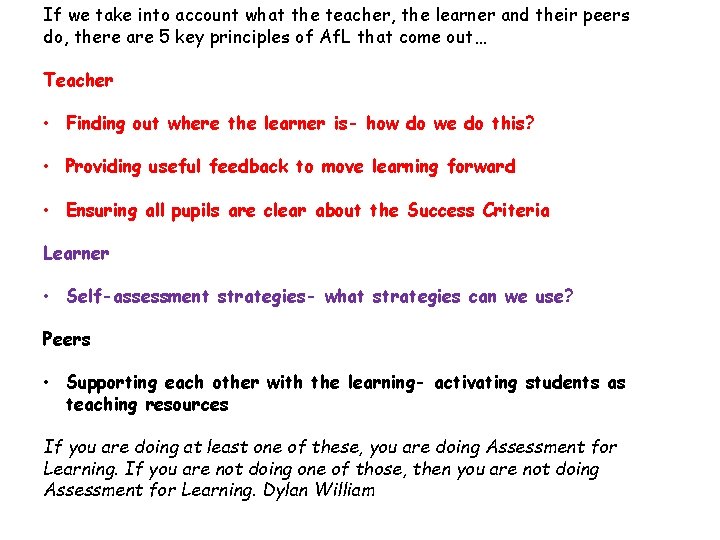
If we take into account what the teacher, the learner and their peers do, there are 5 key principles of Af. L that come out… Teacher • Finding out where the learner is- how do we do this? • Providing useful feedback to move learning forward • Ensuring all pupils are clear about the Success Criteria Learner • Self-assessment strategies- what strategies can we use? Peers • Supporting each other with the learning- activating students as teaching resources If you are doing at least one of these, you are doing Assessment for Learning. If you are not doing one of those, then you are not doing Assessment for Learning. Dylan William
VIDEO- Year 11 Revising polygons Questions to think about during the video: * What Af. L strategies did she use? * How were they useful in helping her to understand the pupils learning and identify next steps? * What higher order thinking skills was she promoting?
How do we provide effective feedback in order to move learning forward?
Next steps marking at SRS • Once a week in: • • English Mathematics Science IPC (open question)
Activity • This is focused on refining our marking feedback skills to give clear and specific comments that children can respond to and that will help them improve/ extend their understanding.
Poor quality feedback • • Limits the response the child can give Isn’t specific Doesn’t require the child to respond immediately Doesn’t allow the child to demonstrate that they have deepened their understanding. • “You have included excellent adjectives. • Next time try to use adverbs. ”
High quality feedback • • Allows the child to respond fully Is very specific to what the individual needs Requires the child to respond immediately Allows the child to demonstrate that they have corrected their misconceptions/challenged their learning • “You have included excellent adjectives. • Look at your second paragraph. There are 3 verbs in there. Can you add in 3 adverbs to describe these verbs? ”
What to do • Look at the sheets on your tables in 3 s. Read the learning intentions (WALTs) and the example of a poor quality feedback comment. • Write a high quality comment that allows the child to give a full and immediate (ish) response. • Now swap with another 3 to share your comments. Can you improve them even more?
Don’t let the tools become the focus… Self and Peer Assessment
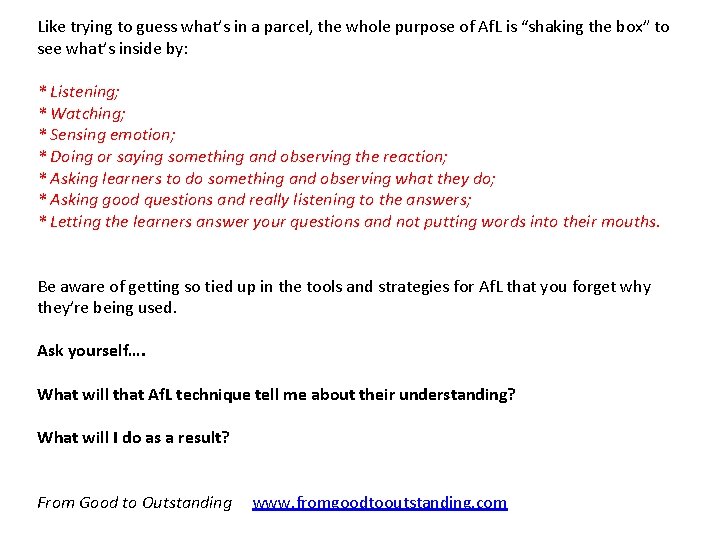
Like trying to guess what’s in a parcel, the whole purpose of Af. L is “shaking the box” to see what’s inside by: * Listening; * Watching; * Sensing emotion; * Doing or saying something and observing the reaction; * Asking learners to do something and observing what they do; * Asking good questions and really listening to the answers; * Letting the learners answer your questions and not putting words into their mouths. Be aware of getting so tied up in the tools and strategies for Af. L that you forget why they’re being used. Ask yourself…. What will that Af. L technique tell me about their understanding? What will I do as a result? From Good to Outstanding www. fromgoodtooutstanding. com
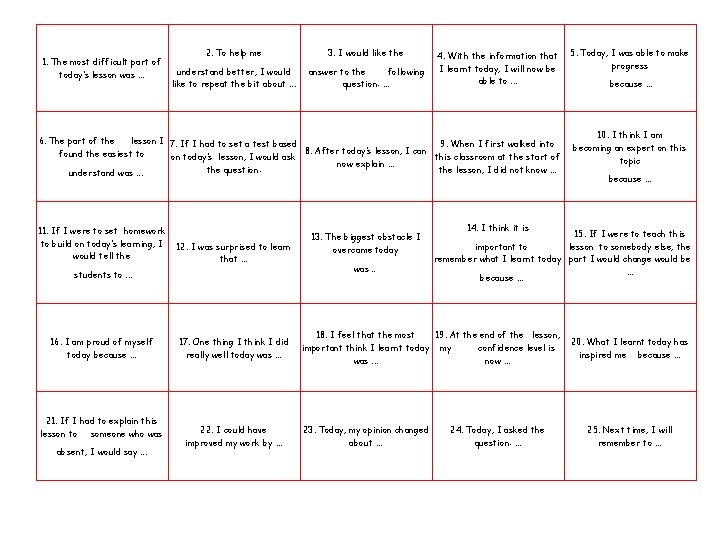
1. The most difficult part of today’s lesson was. . . 2. To help me 3. I would like the understand better, I would like to repeat the bit about. . . answer to the following question: . . . 4. With the information that I learnt today, I will now be able to. . . 6. The part of the lesson I 7. If I had to set a test based 9. When I first walked into 8. After today’s lesson, I can found the easiest to on today’s lesson, I would ask this classroom at the start of now explain. . . the question: the lesson, I did not know. . . understand was. . . 11. If I were to set homework to build on today’s learning, I would tell the 12. I was surprised to learn that. . . students to. . . 16. I am proud of myself today because. . . 21. If I had to explain this lesson to someone who was absent, I would say. . . 17. One thing I think I did really well today was. . . 22. I could have improved my work by. . . 13. The biggest obstacle I overcame today was … because. . . 10. I think I am becoming an expert on this topic because. . . 14. I think it is 15. If I were to teach this important to lesson to somebody else, the remember what I learnt today part I would change would be. . . because. . . 18. I feel that the most 19. At the end of the lesson, important think I learnt today my confidence level is was. . . now. . . 23. Today, my opinion changed about. . . 5. Today, I was able to make progress 24. Today, I asked the question: . . . 20. What I learnt today has inspired me because. . . 25. Next time, I will remember to. . .
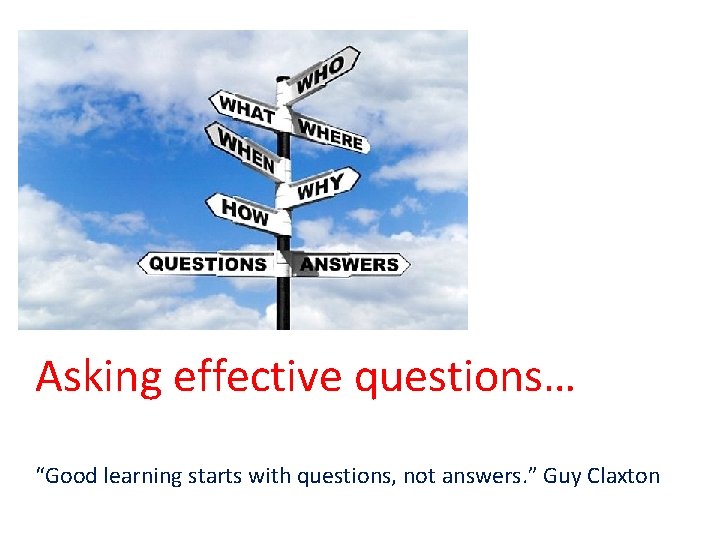
Asking effective questions… “Good learning starts with questions, not answers. ” Guy Claxton
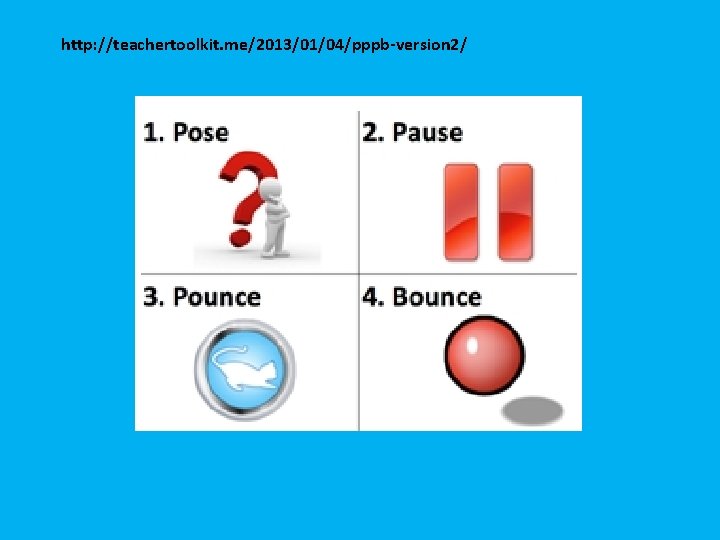
http: //teachertoolkit. me/2013/01/04/pppb-version 2/
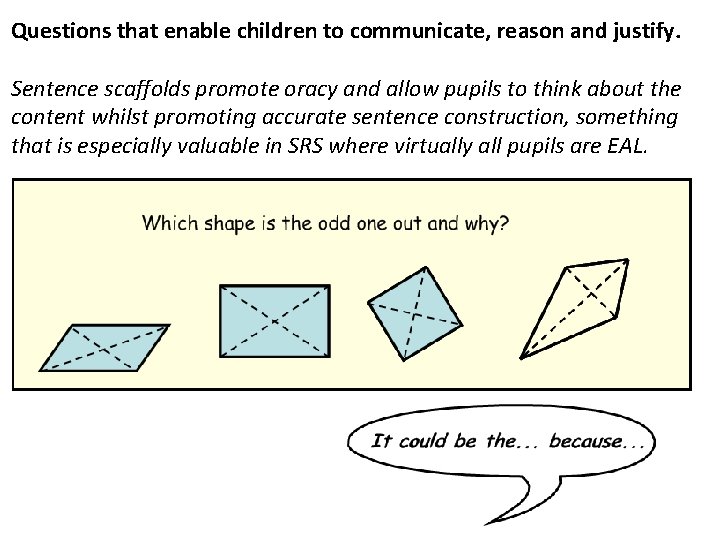
Questions that enable children to communicate, reason and justify. Sentence scaffolds promote oracy and allow pupils to think about the content whilst promoting accurate sentence construction, something that is especially valuable in SRS where virtually all pupils are EAL. Maths question- Odd one Out
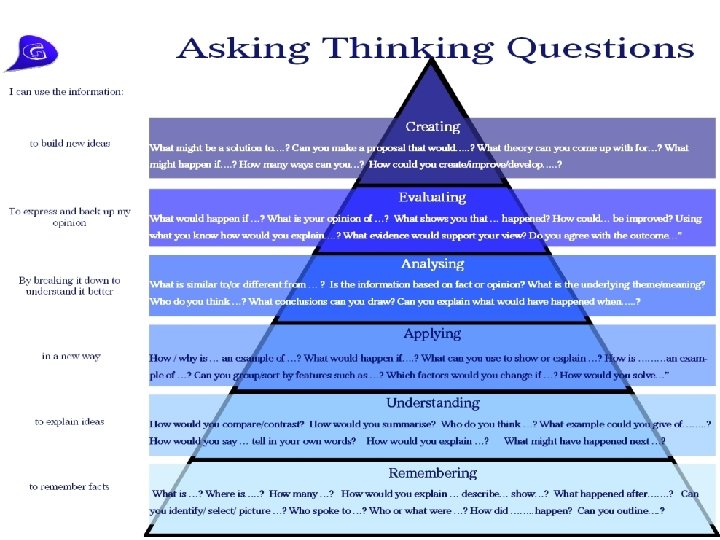
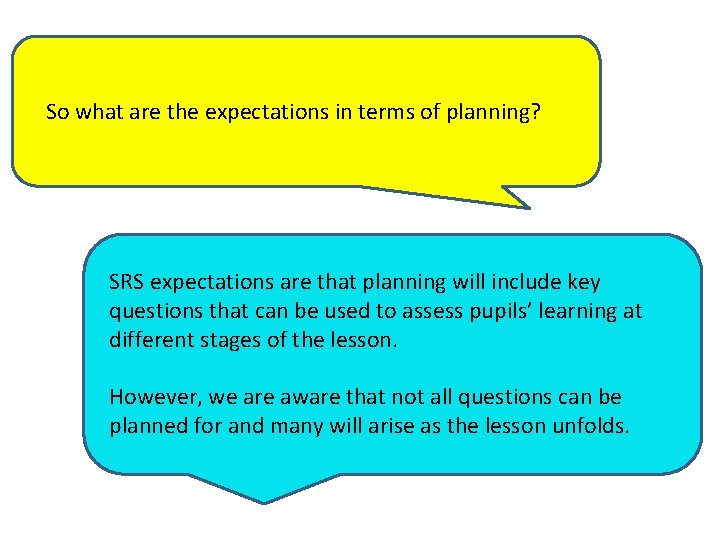
So what are the expectations in terms of planning? SRS expectations are that planning will include key questions that can be used to assess pupils’ learning at different stages of the lesson. However, we are aware that not all questions can be planned for and many will arise as the lesson unfolds.
http: //www. journeytoexcellence. org. uk/videos/expertspeakers/collaborativelearning dylanwiliam. asp http: //www. tes. co. uk/article. aspx? storycode=6261847 What are your next steps in terms of using Assessment for Learning in your classroom?