Welcome to Physics 420 Instructor Jay Sau Modern

- Slides: 29
Welcome to Physics 420 • Instructor: Jay Sau (Modern Physics) • Interests/expectations? • Pre-requisites: mechanics, electrodynamics, waves, differential equation – without the prerequisite level of algebra Phys 420 looks like an overwhelming set of facts • Course page: (ELMS) https: //myelms. umd. edu/courses/1231767
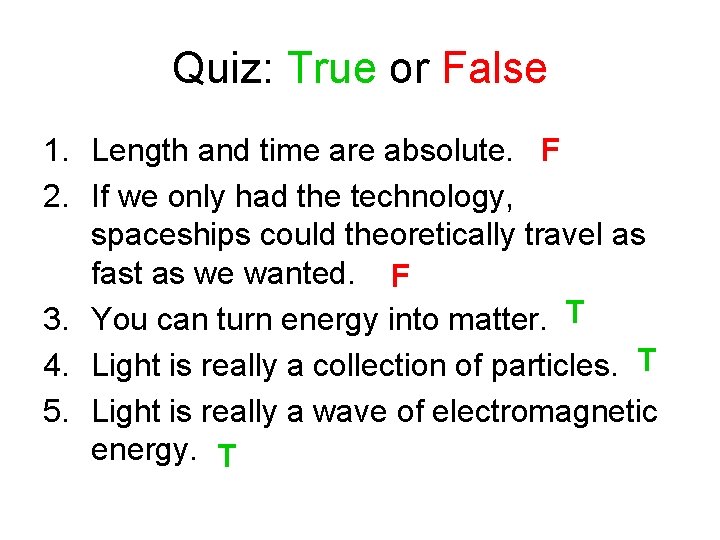
Quiz: True or False 1. Length and time are absolute. F 2. If we only had the technology, spaceships could theoretically travel as fast as we wanted. F 3. You can turn energy into matter. T 4. Light is really a collection of particles. T 5. Light is really a wave of electromagnetic energy. T
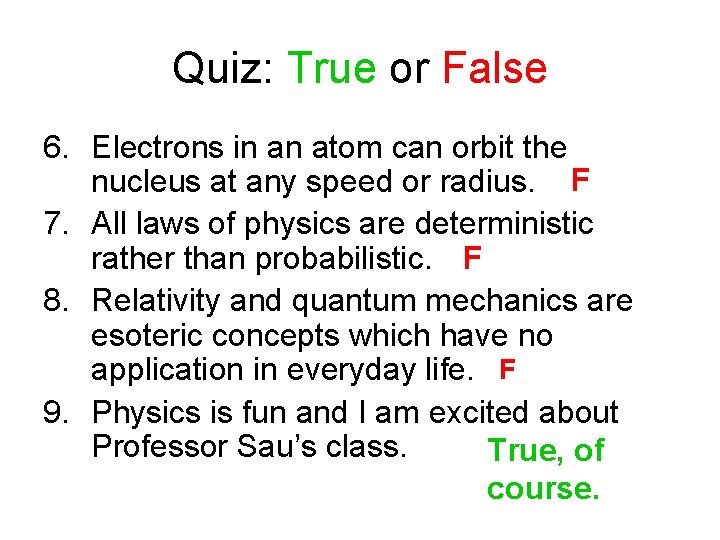
Quiz: True or False 6. Electrons in an atom can orbit the nucleus at any speed or radius. F 7. All laws of physics are deterministic rather than probabilistic. F 8. Relativity and quantum mechanics are esoteric concepts which have no application in everyday life. F 9. Physics is fun and I am excited about Professor Sau’s class. True, of course.
What do we mean when we talk about ? "Common sense is the collection of prejudices acquired by age eighteen. " Albert Einstein (1952)
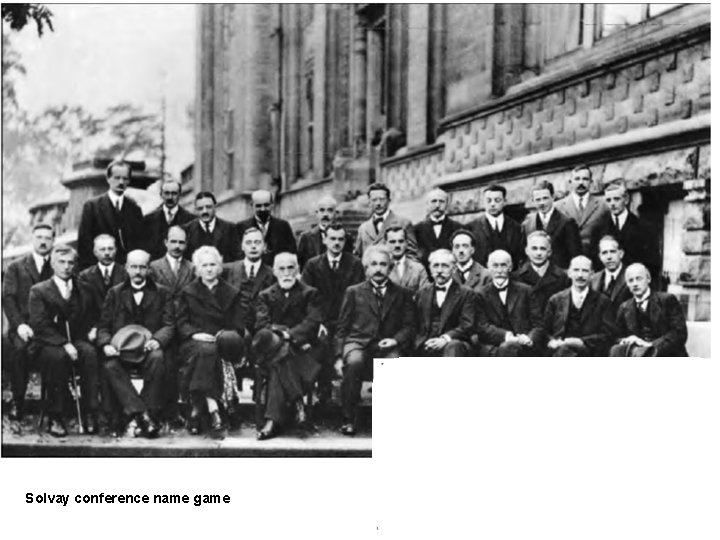
Solvay conference name game
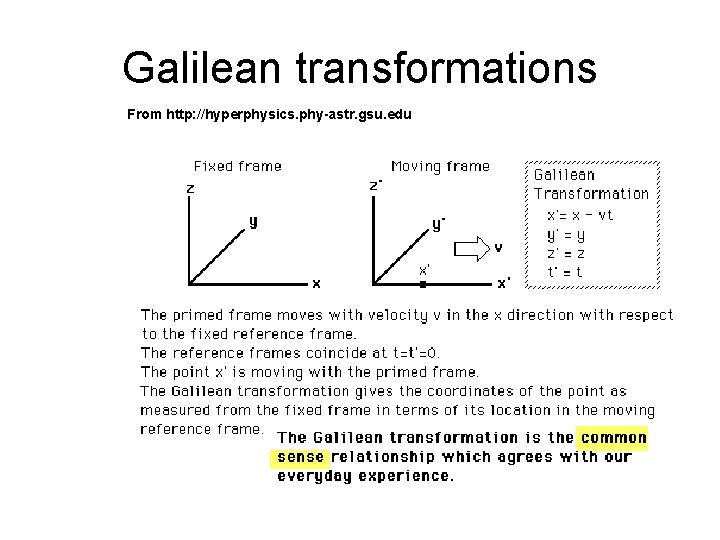
Galilean transformations From http: //hyperphysics. phy-astr. gsu. edu
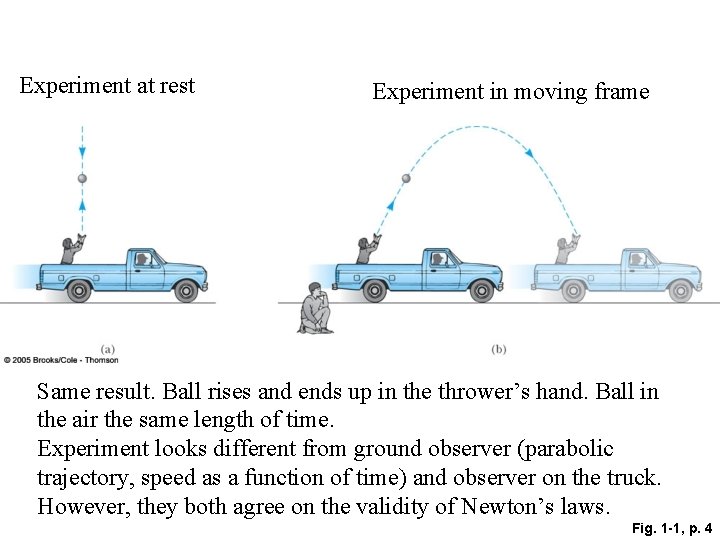
Experiment at rest Experiment in moving frame Same result. Ball rises and ends up in the thrower’s hand. Ball in the air the same length of time. Experiment looks different from ground observer (parabolic trajectory, speed as a function of time) and observer on the truck. However, they both agree on the validity of Newton’s laws. Fig. 1 -1, p. 4
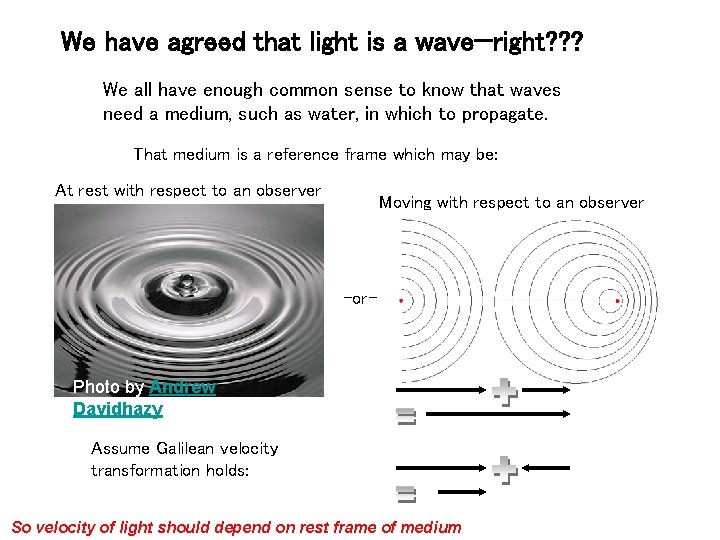
We have agreed that light is a wave—right? ? ? We all have enough common sense to know that waves need a medium, such as water, in which to propagate. That medium is a reference frame which may be: At rest with respect to an observer Moving with respect to an observer -or- Photo by Andrew Davidhazy Assume Galilean velocity transformation holds: So velocity of light should depend on rest frame of medium
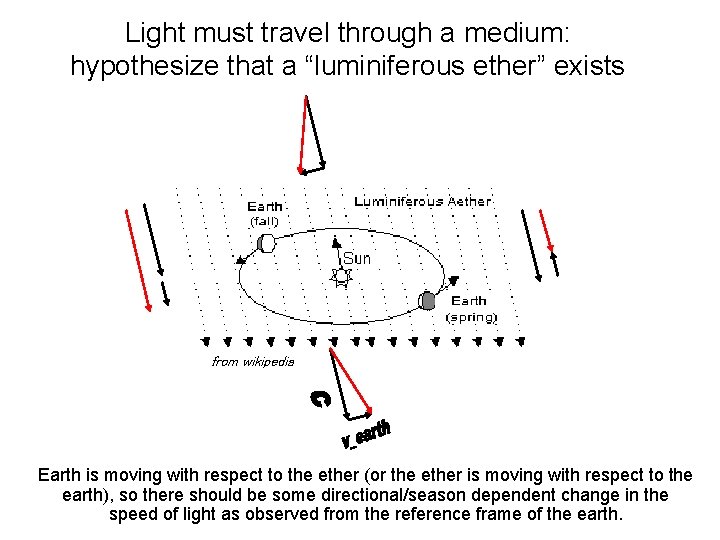
Light must travel through a medium: hypothesize that a “luminiferous ether” exists from wikipedia Earth is moving with respect to the ether (or the ether is moving with respect to the earth), so there should be some directional/season dependent change in the speed of light as observed from the reference frame of the earth.
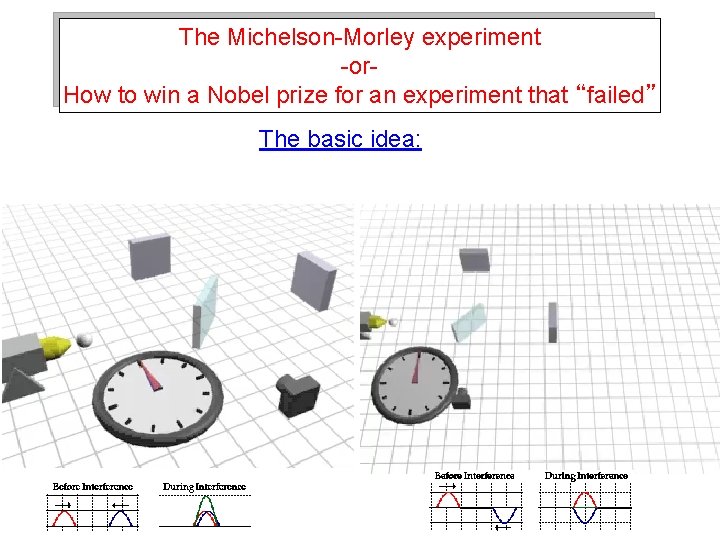
The Michelson-Morley experiment -or. How to win a Nobel prize for an experiment that “failed” The basic idea:
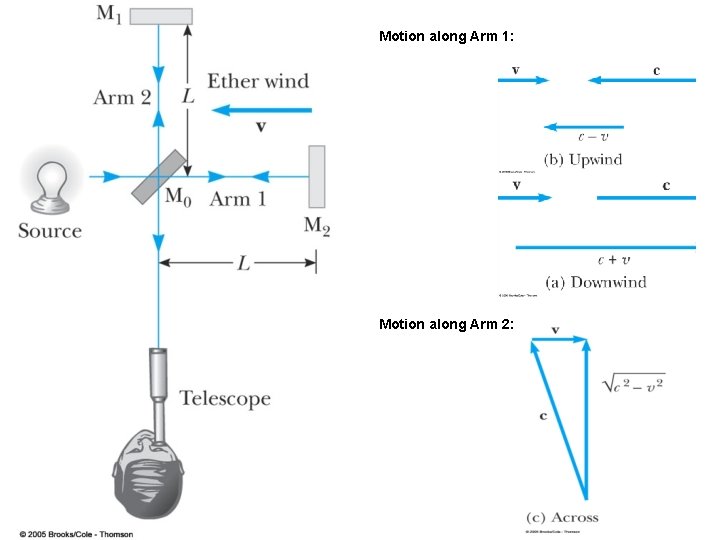
Motion along Arm 1: Motion along Arm 2:
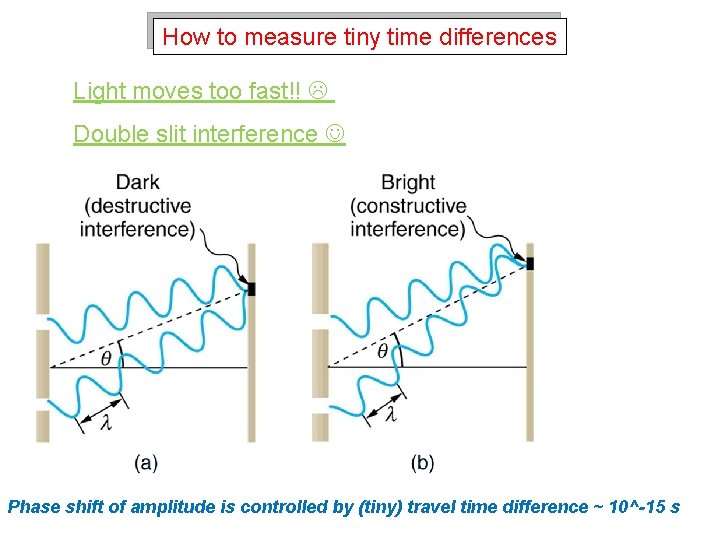
How to measure tiny time differences Light moves too fast!! Double slit interference Phase shift of amplitude is controlled by (tiny) travel time difference ~ 10^-15 s
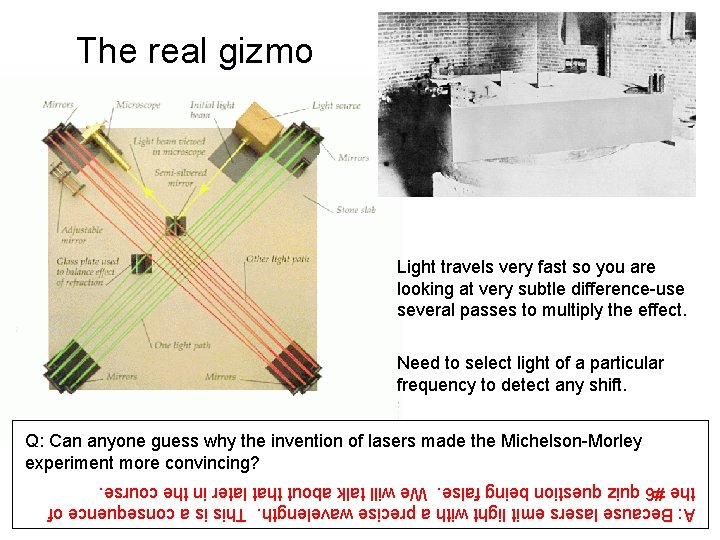
The real gizmo Light travels very fast so you are looking at very subtle difference-use several passes to multiply the effect. Need to select light of a particular frequency to detect any shift. Q: Can anyone guess why the invention of lasers made the Michelson-Morley experiment more convincing? A: Because lasers emit light with a precise wavelength. This is a consequence of the #6 quiz question being false. We will talk about that later in the course.
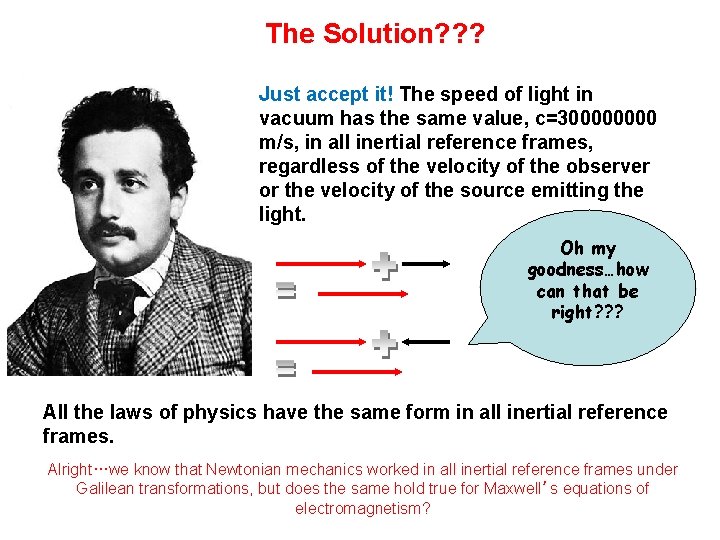
The Solution? ? ? Just accept it! The speed of light in vacuum has the same value, c=30000 m/s, in all inertial reference frames, regardless of the velocity of the observer or the velocity of the source emitting the light. Oh my goodness…how can that be right? ? ? All the laws of physics have the same form in all inertial reference frames. Alright…we know that Newtonian mechanics worked in all inertial reference frames under Galilean transformations, but does the same hold true for Maxwell’s equations of electromagnetism?
The radical consequences So what if speed of light is constant? Absoluteness of simultaneity, length and time will be on the chopping block (hence Relativity) These effects are known as length contraction and time dilation. How come you never noticed this before, and how was it that people got away with Galilean transformations in calculations for 500 years? speed of light = 670 616 629 miles per hour Most of the time the speed of the object whose motion you are calculating is do slow relative to the speed of light that the discrepancy due to relativity is negligible. (Most, but not all of the time)
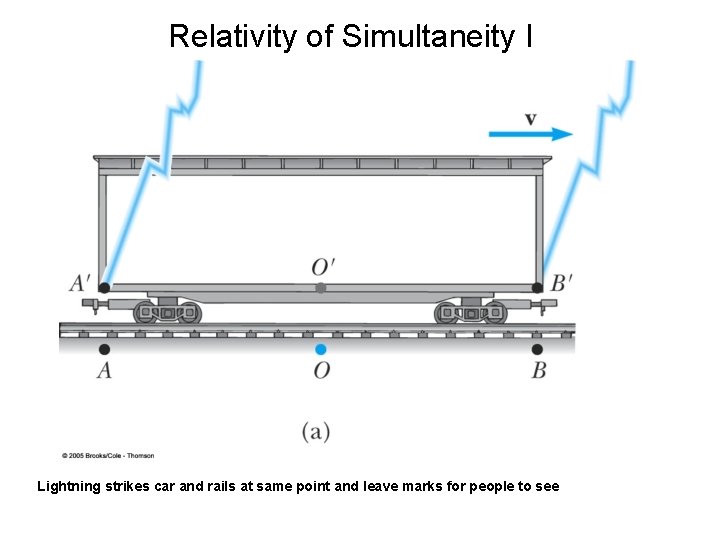
Relativity of Simultaneity I Lightning strikes car and rails at same point and leave marks for people to see
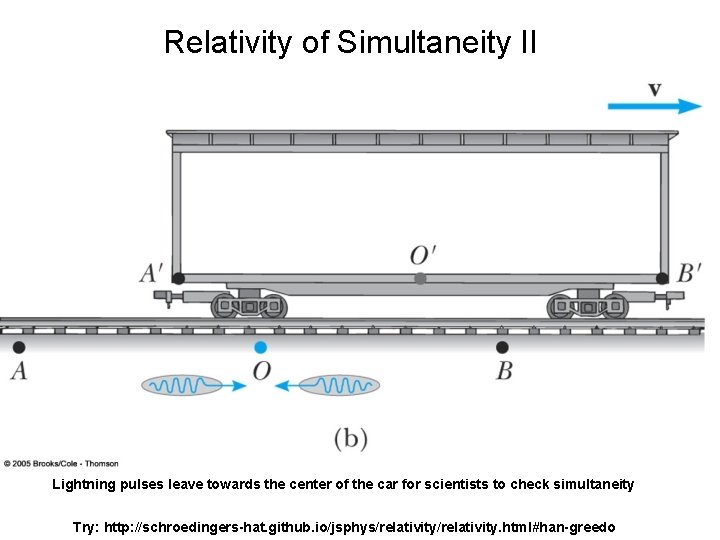
Relativity of Simultaneity II Lightning pulses leave towards the center of the car for scientists to check simultaneity Try: http: //schroedingers-hat. github. io/jsphys/relativity. html#han-greedo
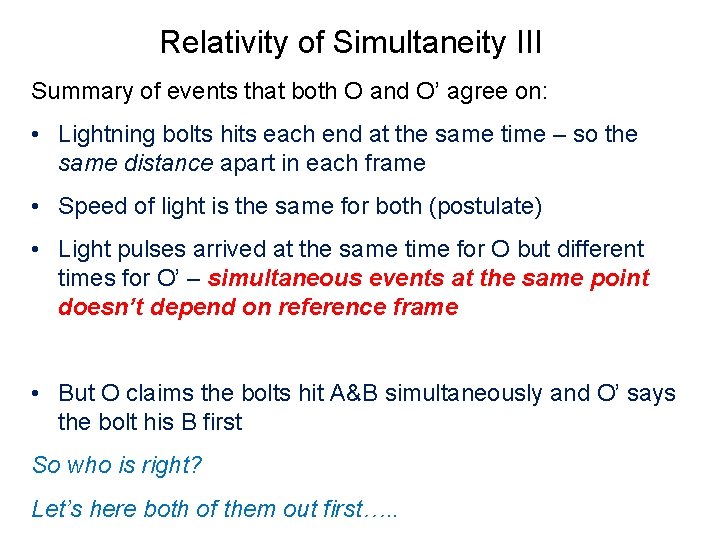
Relativity of Simultaneity III Summary of events that both O and O’ agree on: • Lightning bolts hits each end at the same time – so the same distance apart in each frame • Speed of light is the same for both (postulate) • Light pulses arrived at the same time for O but different times for O’ – simultaneous events at the same point doesn’t depend on reference frame • But O claims the bolts hit A&B simultaneously and O’ says the bolt his B first So who is right? Let’s here both of them out first…. .
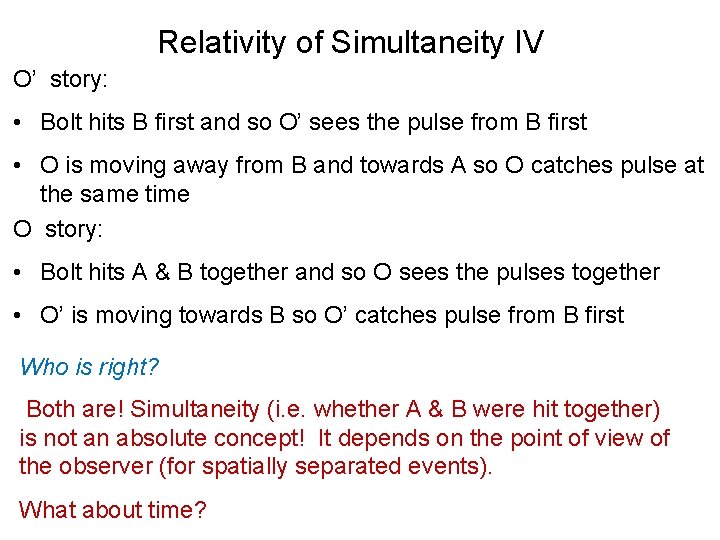
Relativity of Simultaneity IV O’ story: • Bolt hits B first and so O’ sees the pulse from B first • O is moving away from B and towards A so O catches pulse at the same time O story: • Bolt hits A & B together and so O sees the pulses together • O’ is moving towards B so O’ catches pulse from B first Who is right? Both are! Simultaneity (i. e. whether A & B were hit together) is not an absolute concept! It depends on the point of view of the observer (for spatially separated events). What about time?
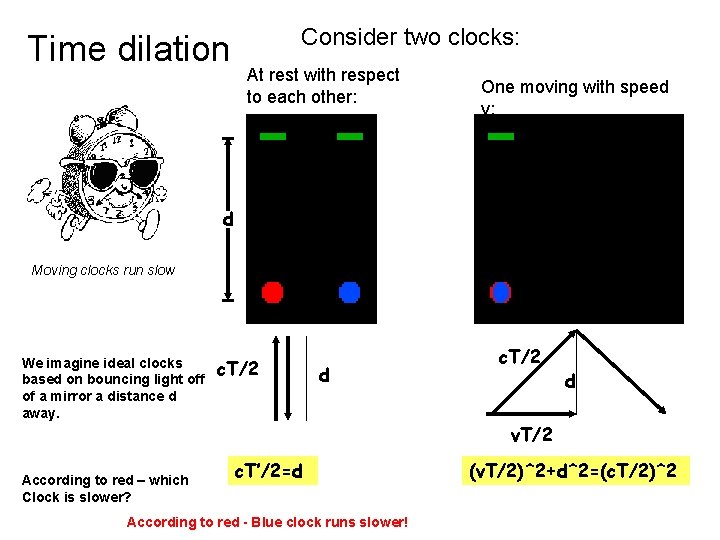
Time dilation Consider two clocks: At rest with respect to each other: One moving with speed v: d Moving clocks run slow We imagine ideal clocks based on bouncing light off of a mirror a distance d away. According to red – which Clock is slower? c. T/2 d v. T/2 c. T’/2=d According to red - Blue clock runs slower! (v. T/2)^2+d^2=(c. T/2)^2
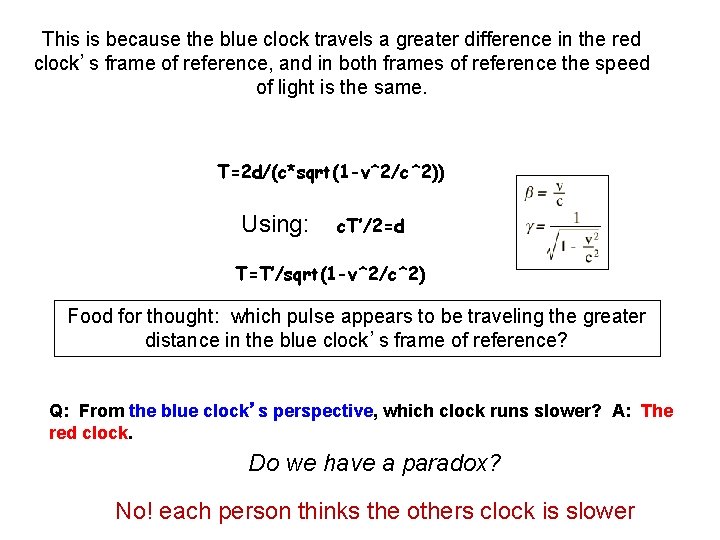
This is because the blue clock travels a greater difference in the red clock’s frame of reference, and in both frames of reference the speed of light is the same. T=2 d/(c*sqrt(1 -v^2/c^2)) Using: c. T’/2=d T=T’/sqrt(1 -v^2/c^2) Food for thought: which pulse appears to be traveling the greater distance in the blue clock’s frame of reference? Q: From the blue clock’s perspective, which clock runs slower? A: The red clock. Do we have a paradox? No! each person thinks the others clock is slower
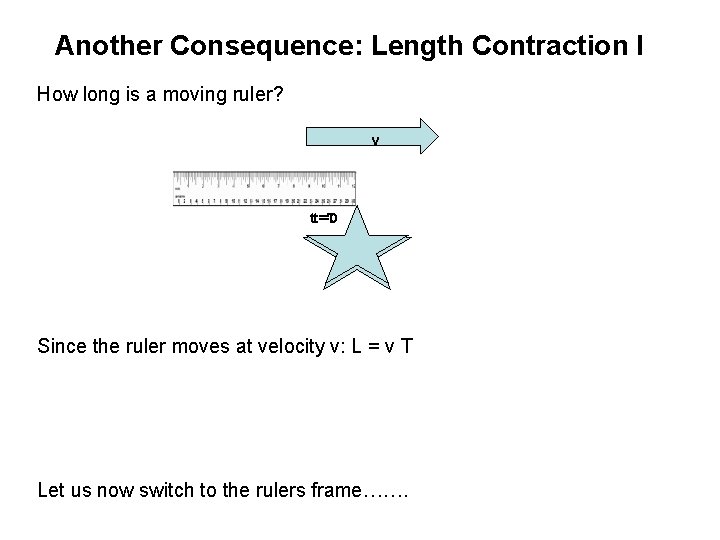
Another Consequence: Length Contraction I How long is a moving ruler? v tt =T =0 Since the ruler moves at velocity v: L = v T Let us now switch to the rulers frame…….
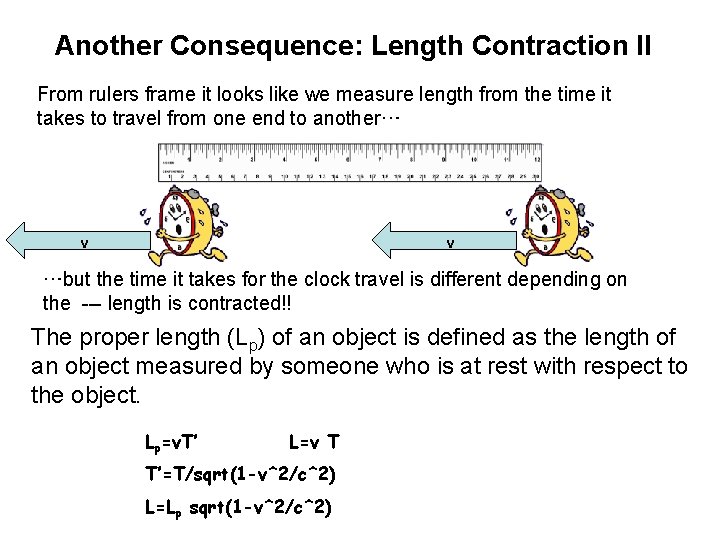
Another Consequence: Length Contraction II From rulers frame it looks like we measure length from the time it takes to travel from one end to another… v v …but the time it takes for the clock travel is different depending on the --- length is contracted!! The proper length (Lp) of an object is defined as the length of an object measured by someone who is at rest with respect to the object. Lp=v. T’ L=v T T’=T/sqrt(1 -v^2/c^2) L=Lp sqrt(1 -v^2/c^2)
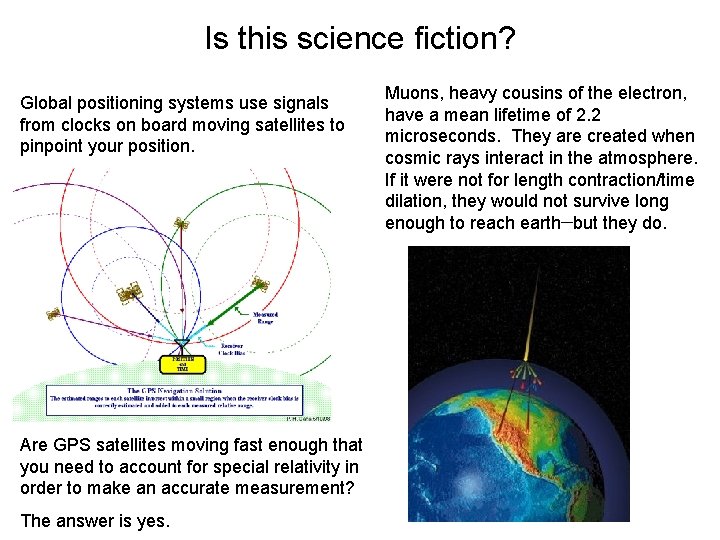
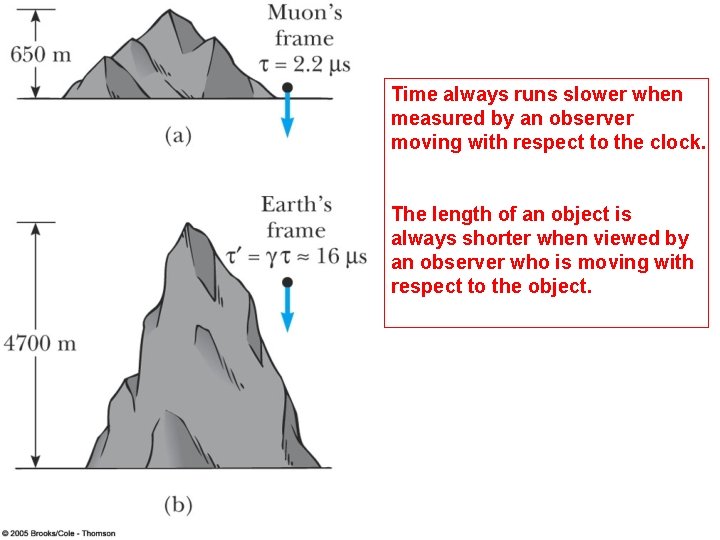
Is this science fiction? Global positioning systems use signals from clocks on board moving satellites to pinpoint your position. Are GPS satellites moving fast enough that you need to account for special relativity in order to make an accurate measurement? The answer is yes. Muons, heavy cousins of the electron, have a mean lifetime of 2. 2 microseconds. They are created when cosmic rays interact in the atmosphere. If it were not for length contraction/time dilation, they would not survive long enough to reach earth—but they do.
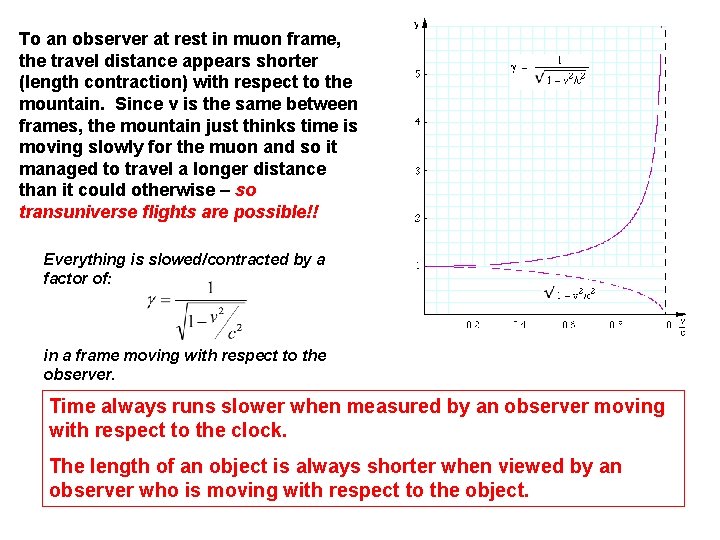
Time always runs slower when measured by an observer moving with respect to the clock. The length of an object is always shorter when viewed by an observer who is moving with respect to the object.
To an observer at rest in muon frame, the travel distance appears shorter (length contraction) with respect to the mountain. Since v is the same between frames, the mountain just thinks time is moving slowly for the muon and so it managed to travel a longer distance than it could otherwise – so transuniverse flights are possible!! Everything is slowed/contracted by a factor of: in a frame moving with respect to the observer. Time always runs slower when measured by an observer moving with respect to the clock. The length of an object is always shorter when viewed by an observer who is moving with respect to the object.
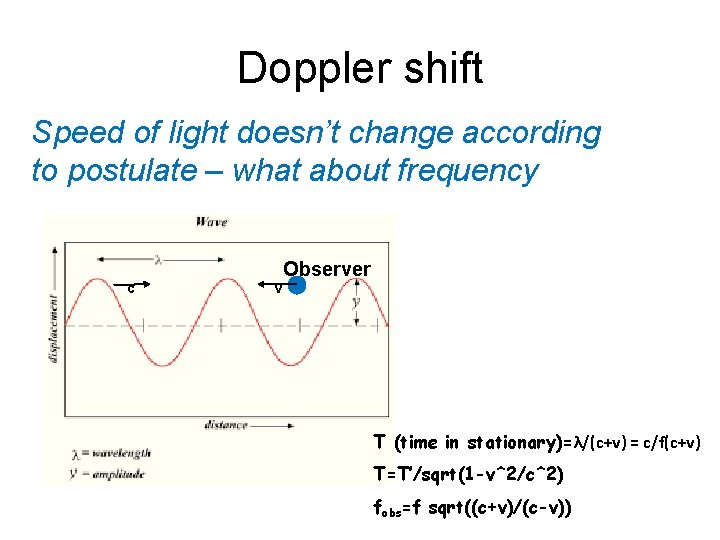
Doppler shift Speed of light doesn’t change according to postulate – what about frequency Observer c v T (time in stationary)=λ/(c+v) = c/f(c+v) T=T’/sqrt(1 -v^2/c^2) fobs=f sqrt((c+v)/(c-v))
Tune in next time when we discuss Life in the fast lane: the kinematics of Star Trek