
TEACHING ELECTIVE MED 420 AB Michael Koller M
TEACHING ELECTIVE MED 420 A&B Michael Koller, M. D. Mary Boyle, M. D. Patricia Mc. Nally, Ed. D.
Today’s Agenda 1. GET YOUR FLU SHOT NOW No ID, No flu shot 2. Boyle A. B. 3. 4. 5. 6. 6. Requirements for teaching elective PCM 2 update Dr. Vance Broach, Resident of the Year Dr. Mc. Nally—Bloom’s Taxonomy Beth Sonntag – Teaching in small groups Teaching articles Fill out evaluation
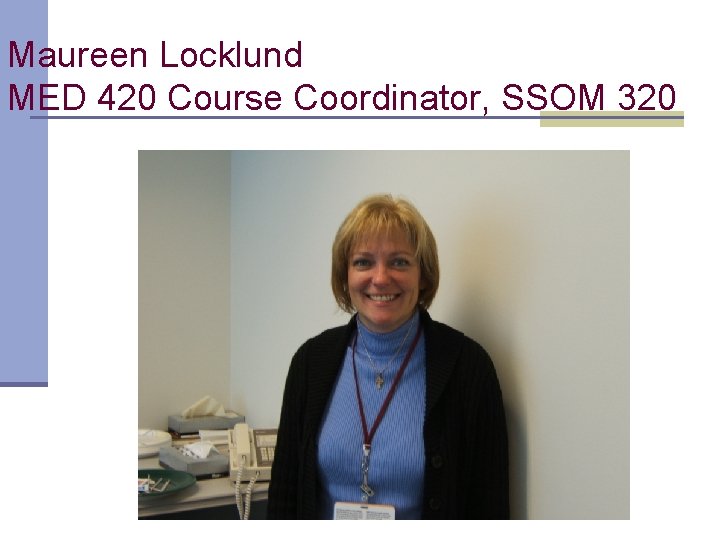
Maureen Locklund MED 420 Course Coordinator, SSOM 320
Teaching Elective Requirements 1. 2. 3. Attend 3 of 4 quarterly evening Didactic Sessions: 4: 45 pm– 6: 30 pm Teach at 5 PCM 2 small group sessions and do teaching reflection within 1 week Two master teacher reflections (you pick the 2 teachers) completed before January 1 st CHECK PCM 2 homepage for reflections received “Requirements fulfilled to date”
Attend 3 of 4 Quarterly Evening Didactic Sessions: 4: 45 pm– 6: 30 pm • Each of the quarterly sessions is offered twice: – Summer 9 A/B (July 23 or July 30) – Fall 10 A/B (October 22 or October 29) – Winter 11 A/B (January 22 (Tues. ) or January 28) – Spring 11 C/12 A (March 11 or March 25) • Match day = Friday March 15 • SSOM 160
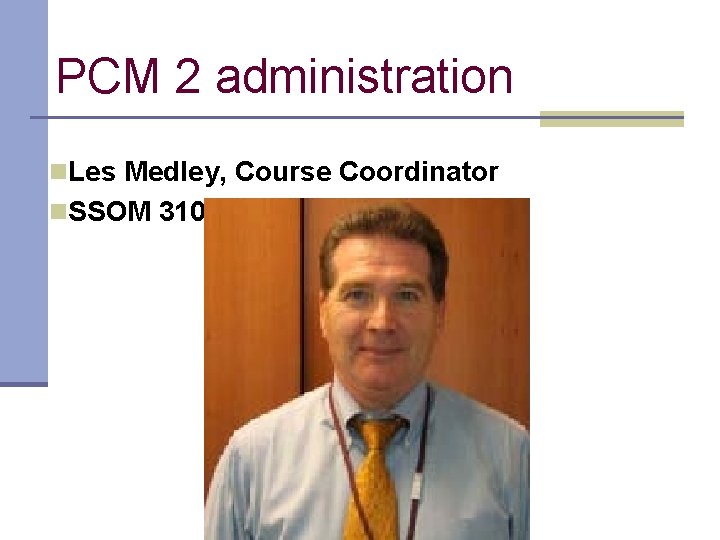
PCM 2 administration n. Les Medley, Course Coordinator n. SSOM 310
PCM 2 n Lectures begin at 1: 15, SSOM Rm 190 n Contact/page your facilitator(s) and co- facilitators before class -discuss what you will do -discuss what you’d like to cover -do NOT give MS 2 s a second lecture -answer any questions MS 2 s may have from the lecture n No assigned questions from readings n EKG answers, CXR answers are in a folder by Les in SSOM 310. New booklets this year please leave in folder for each other to use.
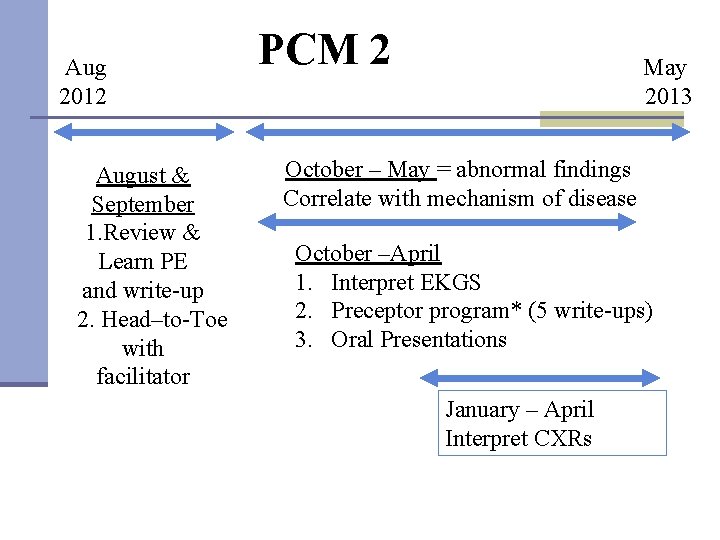
Aug 2012 August & September 1. Review & Learn PE and write-up 2. Head–to-Toe with facilitator PCM 2 May 2013 October – May = abnormal findings Correlate with mechanism of disease October –April 1. Interpret EKGS 2. Preceptor program* (5 write-ups) 3. Oral Presentations January – April Interpret CXRs
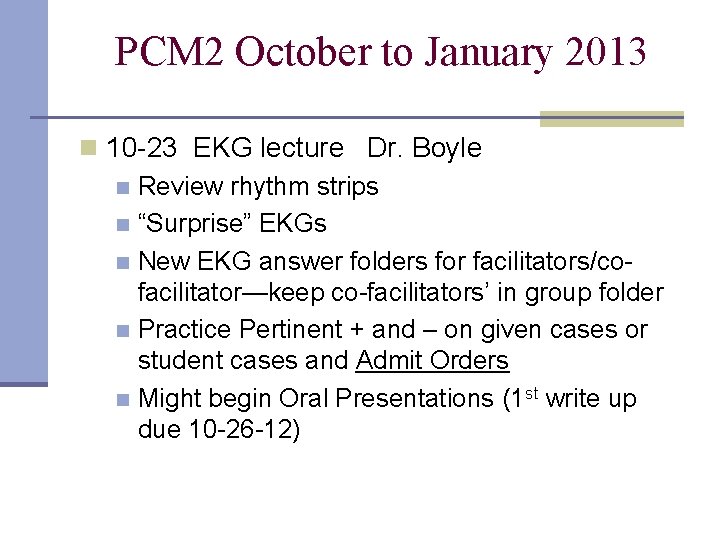
PCM 2 October to January 2013 n 10 -23 EKG lecture Dr. Boyle n Review rhythm strips n “Surprise” EKGs n New EKG answer folders for facilitators/cofacilitator—keep co-facilitators’ in group folder n Practice Pertinent + and – on given cases or student cases and Admit Orders n Might begin Oral Presentations (1 st write up due 10 -26 -12)
PCM 2 October to January 2013 n EKGs began last week on 10 -23 n “Surprise” EKGs n New EKG answer folders for facilitators/cofacilitator—keep co-facilitators’ in group folder n Might begin Oral Presentations (1 st write up was due 10 -26 -12
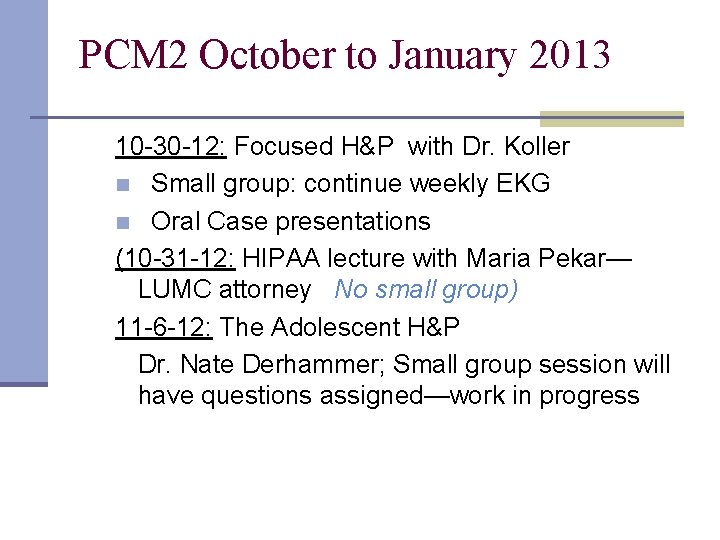
PCM 2 October to January 2013 10 -30 -12: Focused H&P with Dr. Koller n Small group: continue weekly EKG n Oral Case presentations (10 -31 -12: HIPAA lecture with Maria Pekar— LUMC attorney No small group) 11 -6 -12: The Adolescent H&P Dr. Nate Derhammer; Small group session will have questions assigned—work in progress
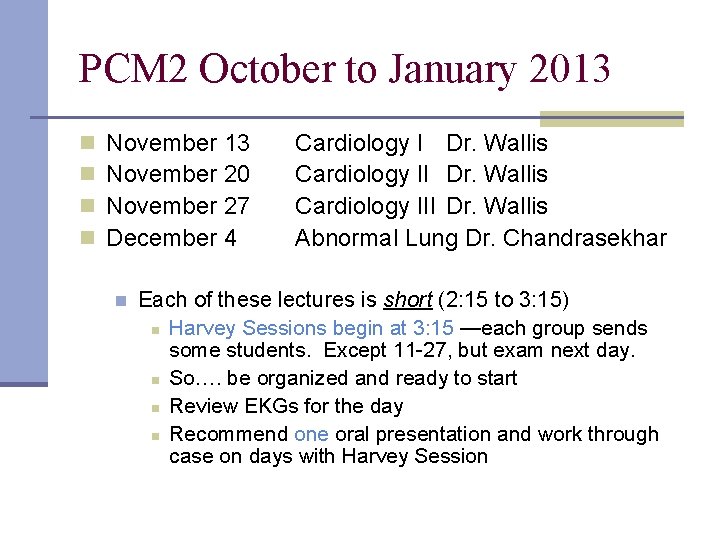
PCM 2 October to January 2013 n n November 13 November 20 November 27 December 4 n Cardiology I Dr. Wallis Cardiology III Dr. Wallis Abnormal Lung Dr. Chandrasekhar Each of these lectures is short (2: 15 to 3: 15) n Harvey Sessions begin at 3: 15 —each group sends some students. Except 11 -27, but exam next day. n So…. be organized and ready to start n Review EKGs for the day n Recommend one oral presentation and work through case on days with Harvey Session
PCM 2 October to January 2013 n (December 6 PCM 2 Written Exam Review) n (December 11 PCM 2 Written Exam) n *****End of Semester Break****** n January 8 Radiology Begins! Dr. Pierce n Begin review of CXR: give lots of individual attention n Review for SP exams the following week on January 14 -16 -17 (M-W-Th)
PCM 2 October to January 2013 n January 15 Standard Precautions Dr. O’Keefe n Please, NO further discussion of SP exam—some students will already have taken it n January 22 Abnormal Abdomen Dr. Klamut and Dr. Reed Ultrasound of Abdomen Small Group for these two sessions —EKG, CXRs, and Oral Case Presentations n January 29 Careers in Medicine n More than 2 MS 4 s ok, encouraged!
n Any questions about the requirements? n Any questions about PCM 2?
What is a learning objective? n An outcome statement that captures specifically the knowledge, skills, and attitudes that learners should be able to exhibit following instruction n NOT what the lecturer will do n Rather, “After this session, the learner will be able to “…. . ”
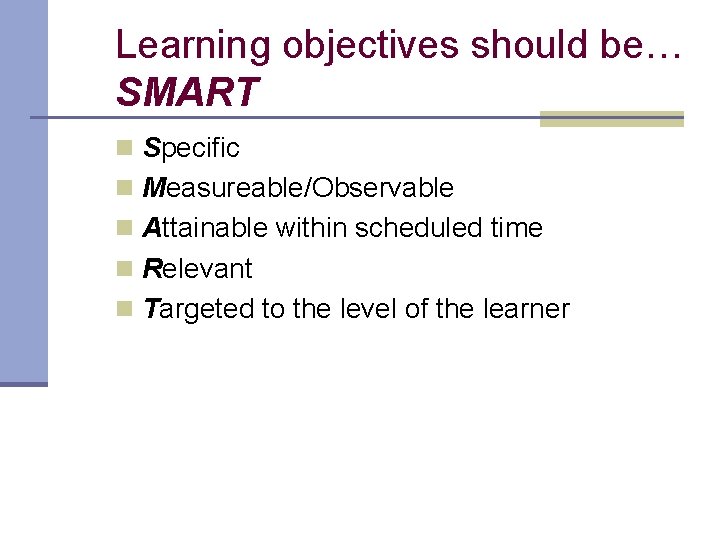
Learning objectives should be… SMART n Specific n Measureable/Observable n Attainable within scheduled time n Relevant n Targeted to the level of the learner
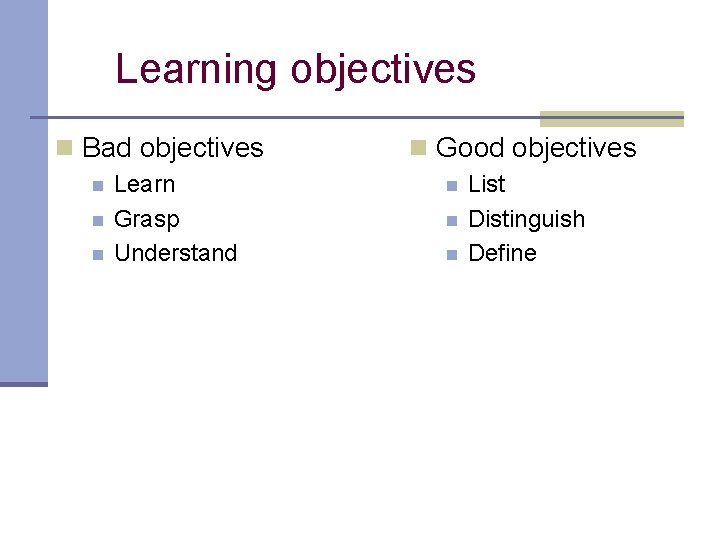
Learning objectives n Bad objectives n n n Learn Grasp Understand n Good objectives n n n List Distinguish Define
Learning objectives n Should guide assessment (test) n Classic example = Bloom’s Taxonomy
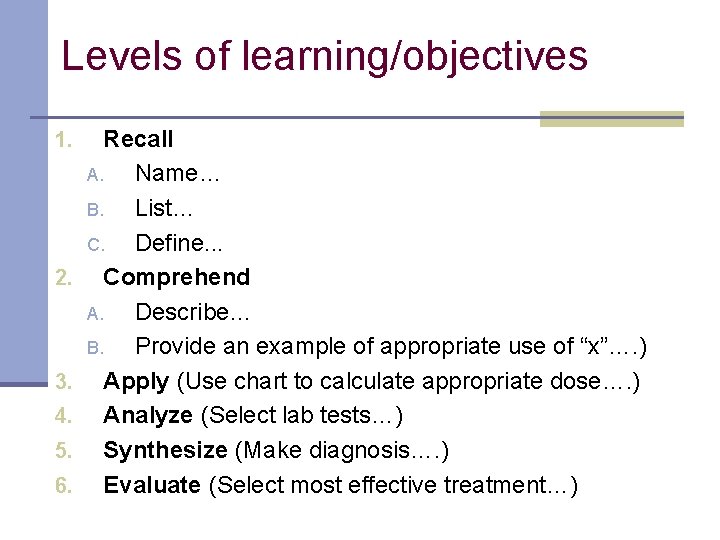
Levels of learning/objectives 1. 2. 3. 4. 5. 6. Recall A. Name… B. List… C. Define. . . Comprehend A. Describe… B. Provide an example of appropriate use of “x”…. ) Apply (Use chart to calculate appropriate dose…. ) Analyze (Select lab tests…) Synthesize (Make diagnosis…. ) Evaluate (Select most effective treatment…)
- Slides: 20