
Unit 1 Measurement and Data Collection Mini Metric



- Slides: 33
Unit 1: Measurement and Data Collection
Mini Metric Olympics • Olympic Symbol: five interlocking rings represent the five major continents of the world. Their colors in order from left to right are blue, yellow, black, green, and red. These colors are special because at least one of them appears in the flag of every nation of the world. These colorful rings are joined together to remind us of the sporting friendship of all mankind.
• History: Ancient Games: Traditionally the accepted date of the first Olympiad is 776 BC but there is reasonable certainty that they were held considerably earlier than that. These festivities were held in Olympia, Greece where a stadium and a temple to Zeus were built. On selected occasions a “day of games” was held to honor a god or a dead hero. Only males were allowed to participate and events originally included a foot race, wrestling, and the pentathlon which was a combination of five events. The ancient games ceased to take place after 392 AD because they were viewed by Christians as a pagan ritual.
• The Olympic Motto: Citius, Altius, Fortius from the Latin meaning swifter, higher, stronger. These words are used to build healthy attitudes and winning spirits in preparation for competition. • The Olympic Flame: The Olympic Flame is lighted by the Olympic torch during the opening ceremonies. The flame is a symbol of peace and is lit first in the temple of Zeus in Olympia. Thousands of relay runners from many countries then carry it to the stadium of the city hosting the games. The flame is passed by hand from one runner to the next.
• Modern Olympic Games: Credit for the revival of the Olympic Games goes to Pierre de Coubertin, a French baron who felt strongly about bringing together representatives from many nations for the purpose of peaceful competition. He posed these words that now make up the Olympic creed: “The most important thing in the Olympic Games is not to win but to take part, just as the most important thing in life is not the triumph but the struggle. The essential thing is not to have conquered but to have fought well. ” With respect and honor to Greece, the land of
the original games, the first modern games were held in Athens in 1896 where nine countries came together. In the Modern Olympics, winners in each event earn gold, silver, and bronze medals for their performances. Each athlete makes this pledge: “We swear that we will take part in these Olympic Games in the true spirit of sportsmanship and that we will respect and abide by the rules which govern them for the glory of the sport and the honor of our country. ”
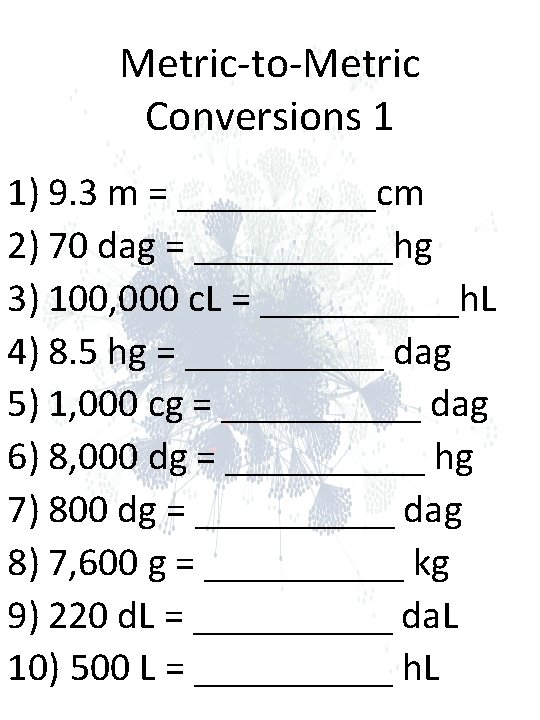
Metric-to-Metric Conversions 1 1) 9. 3 m = _____cm 2) 70 dag = _____hg 3) 100, 000 c. L = _____h. L 4) 8. 5 hg = _____ dag 5) 1, 000 cg = _____ dag 6) 8, 000 dg = _____ hg 7) 800 dg = _____ dag 8) 7, 600 g = _____ kg 9) 220 d. L = _____ da. L 10) 500 L = _____ h. L
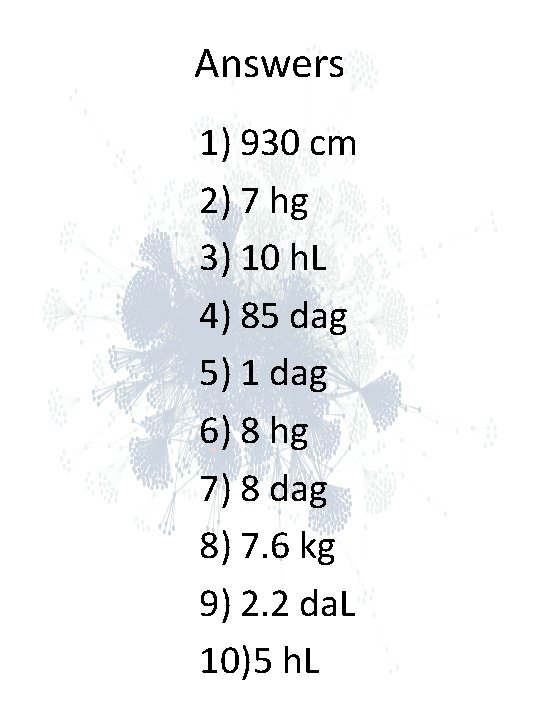
Answers 1) 930 cm 2) 7 hg 3) 10 h. L 4) 85 dag 5) 1 dag 6) 8 hg 7) 8 dag 8) 7. 6 kg 9) 2. 2 da. L 10)5 h. L
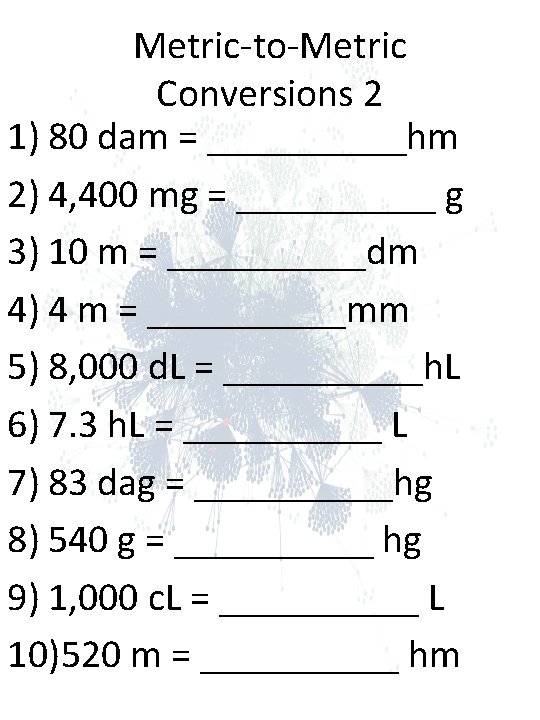
Metric-to-Metric Conversions 2 1) 80 dam = _____hm 2) 4, 400 mg = _____ g 3) 10 m = _____dm 4) 4 m = _____mm 5) 8, 000 d. L = _____h. L 6) 7. 3 h. L = _____ L 7) 83 dag = _____hg 8) 540 g = _____ hg 9) 1, 000 c. L = _____ L 10)520 m = _____ hm
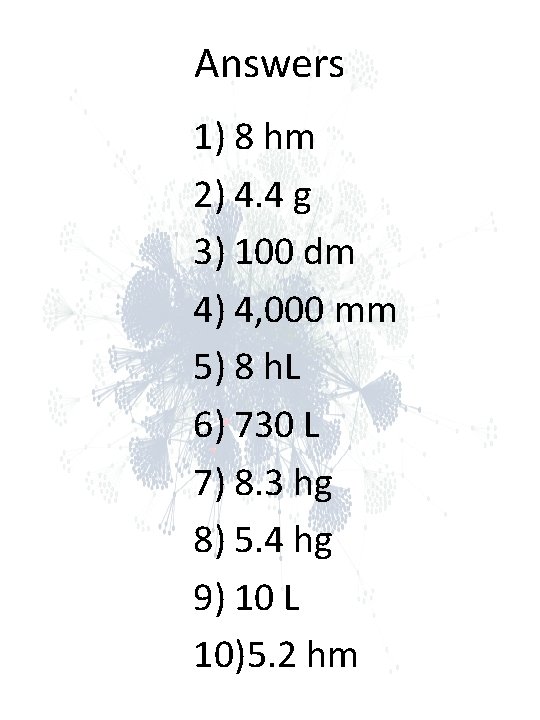
Answers 1) 8 hm 2) 4. 4 g 3) 100 dm 4) 4, 000 mm 5) 8 h. L 6) 730 L 7) 8. 3 hg 8) 5. 4 hg 9) 10 L 10)5. 2 hm
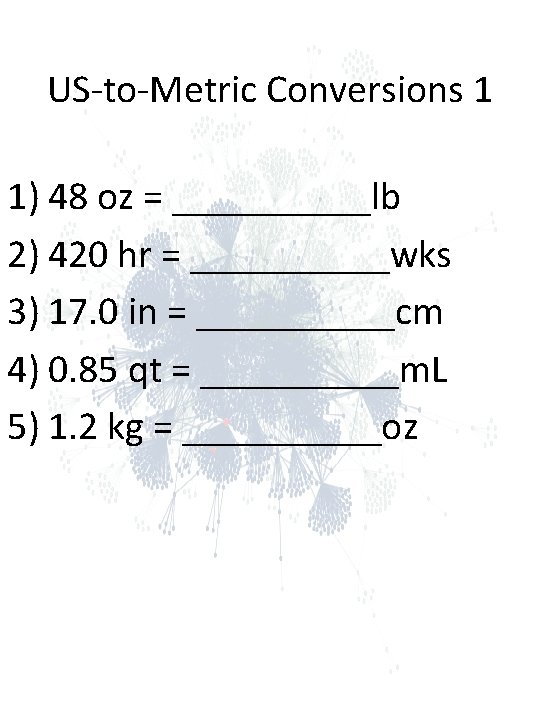
US-to-Metric Conversions 1 1) 48 oz = _____lb 2) 420 hr = _____wks 3) 17. 0 in = _____cm 4) 0. 85 qt = _____m. L 5) 1. 2 kg = _____oz
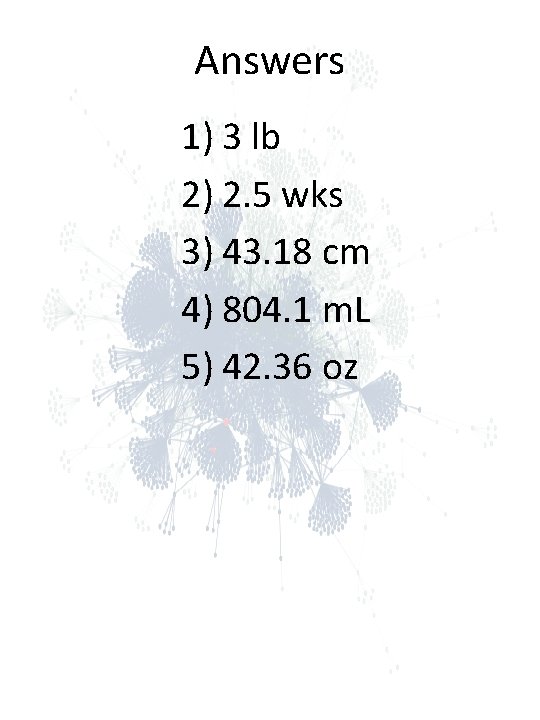
Answers 1) 3 lb 2) 2. 5 wks 3) 43. 18 cm 4) 804. 1 m. L 5) 42. 36 oz
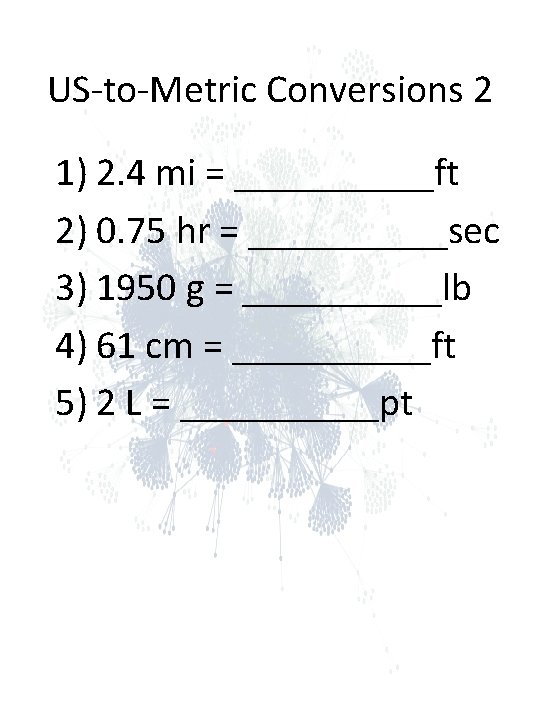
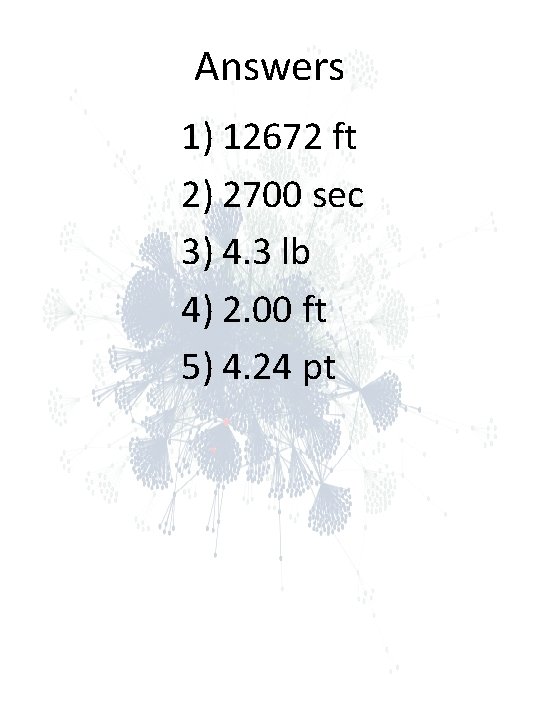
US-to-Metric Conversions 2 1) 2. 4 mi = _____ft 2) 0. 75 hr = _____sec 3) 1950 g = _____lb 4) 61 cm = _____ft 5) 2 L = _____pt
Answers 1) 12672 ft 2) 2700 sec 3) 4. 3 lb 4) 2. 00 ft 5) 4. 24 pt
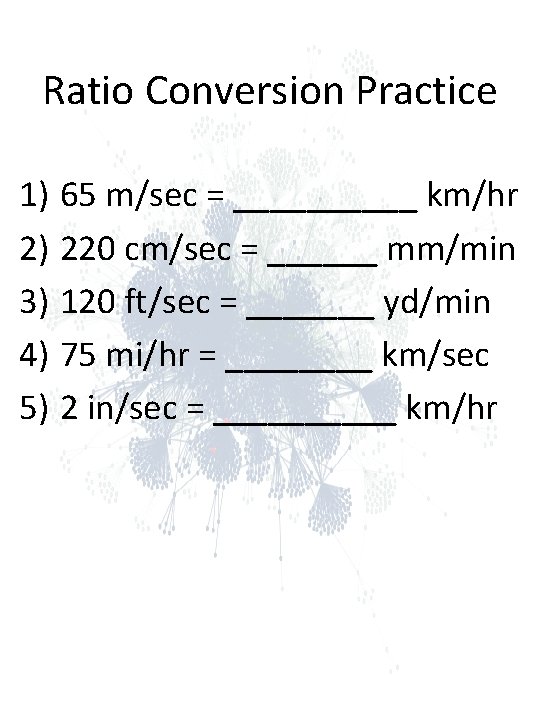
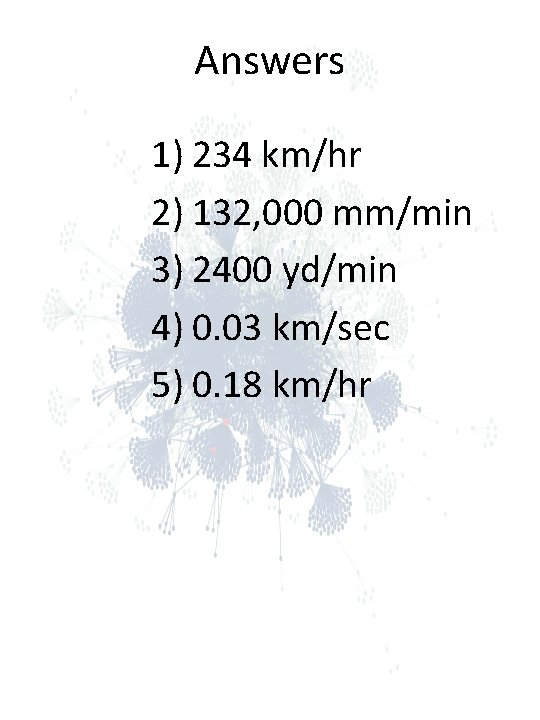
Ratio Conversion Practice 1) 65 m/sec = _____ km/hr 2) 220 cm/sec = ______ mm/min 3) 120 ft/sec = _______ yd/min 4) 75 mi/hr = ____ km/sec 5) 2 in/sec = _____ km/hr
Answers 1) 234 km/hr 2) 132, 000 mm/min 3) 2400 yd/min 4) 0. 03 km/sec 5) 0. 18 km/hr
Assignment List 1) Conversion and Units Practice Worksheet 2) Conversion Word Problems
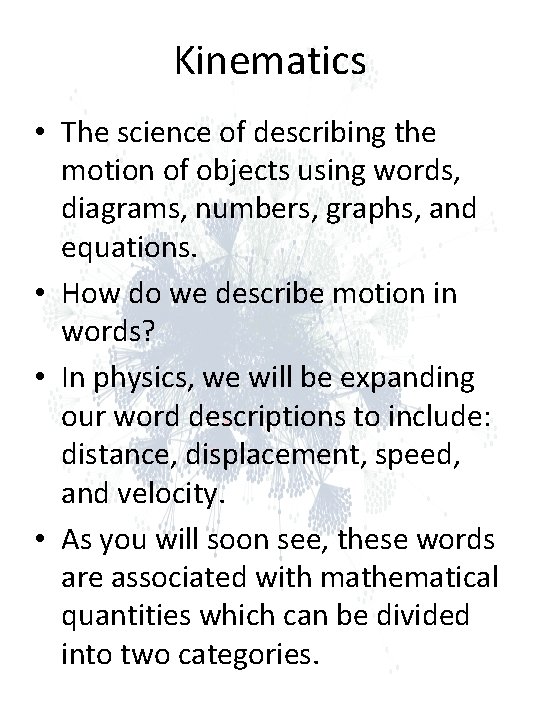
Kinematics • The science of describing the motion of objects using words, diagrams, numbers, graphs, and equations. • How do we describe motion in words? • In physics, we will be expanding our word descriptions to include: distance, displacement, speed, and velocity. • As you will soon see, these words are associated with mathematical quantities which can be divided into two categories.
• Scalar – quantities fully described by a magnitude (numerical value) alone. • Vector – quantities fully described by both a magnitude and a direction. • Distance – a scalar quantity that refers to how much ground an object has covered. • Displacement – a vector quantity that refers to how far out of place an object is; its overall change in position.
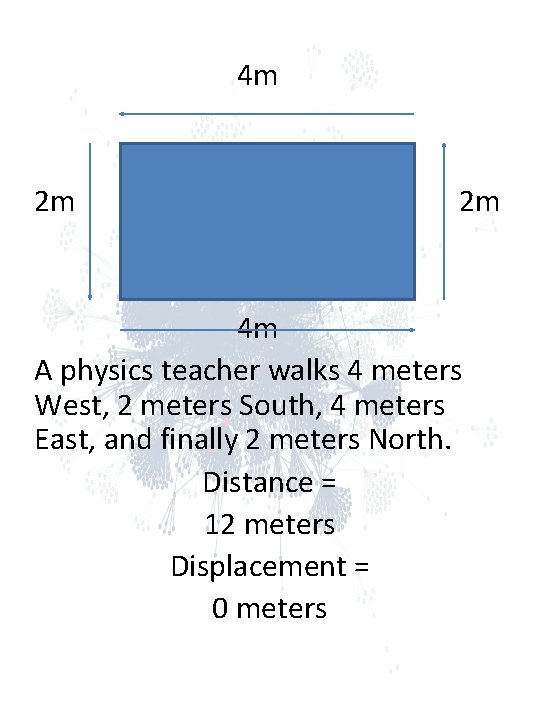
4 m 2 m 4 m A physics teacher walks 4 meters West, 2 meters South, 4 meters East, and finally 2 meters North. Distance = 12 meters Displacement = 0 meters
Practice Find the distance and the displacement. A) Cross-Country Skier: • In the first minute, the skier travels 180 meters East. • In the second minute, the skier travels 140 meters West. • In the third minute, the skier travels 100 meters East. B) Football Coach (pacing the sidelines): • In the first three minutes of the game, the coach paces 35 yards West. • In the next three minutes, the coach paces 20 yards East. • In the next four minutes, the coach paces 40 yards West.
• Speed – a scalar quantity that refers to how fast an object is moving. (miles/hour) – Speed can be thought of as the rate at which an object covers distance. – No movement = zero speed • Velocity – a vector quantity that refers to the rate at which an object changes its position. (miles/hour + direction) – Velocity is the rate at which an object changes position. – If a person returns to their original position, they have zero velocity. Every step must go into moving a person further from their original position.
Slope •
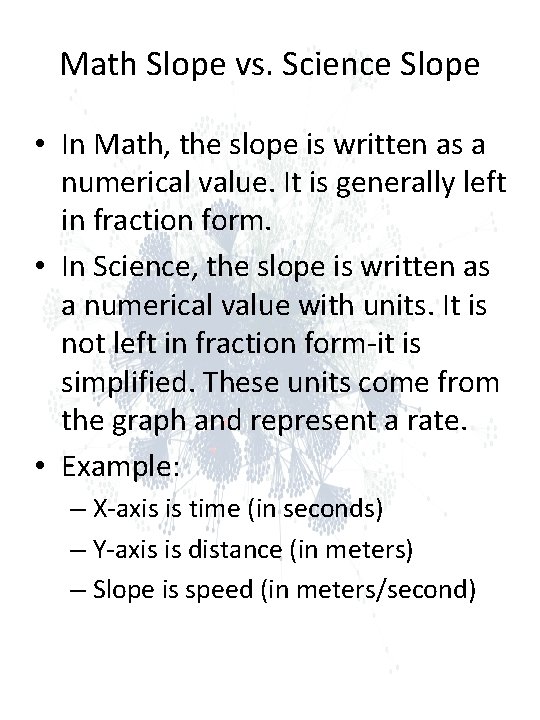
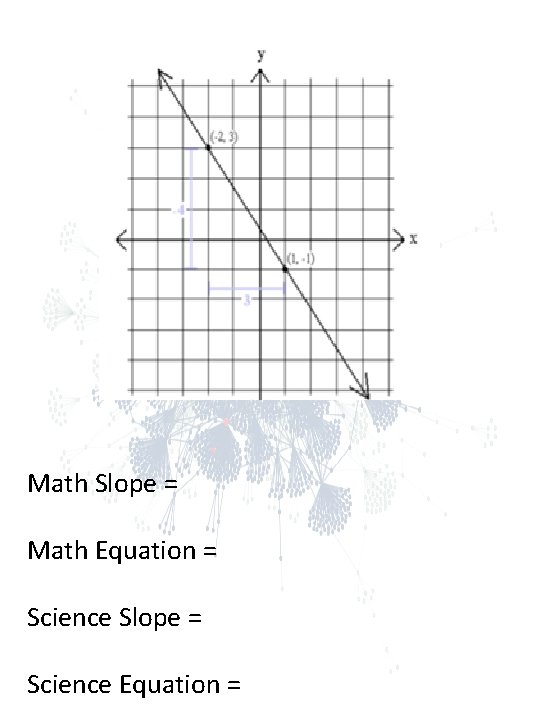
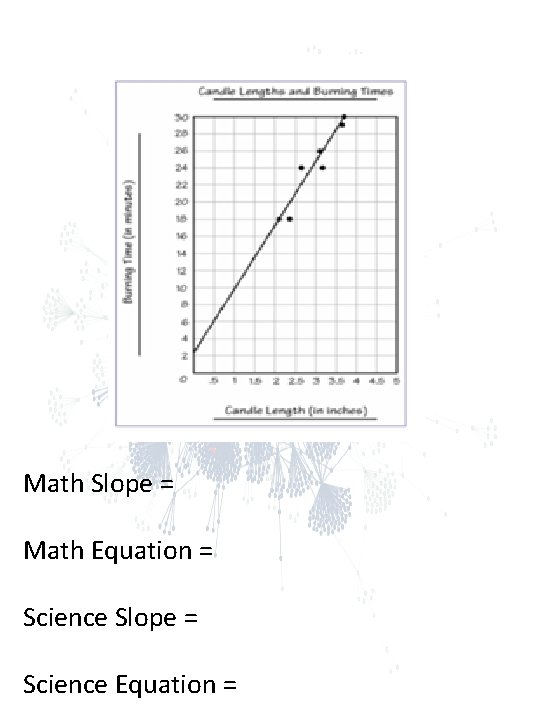
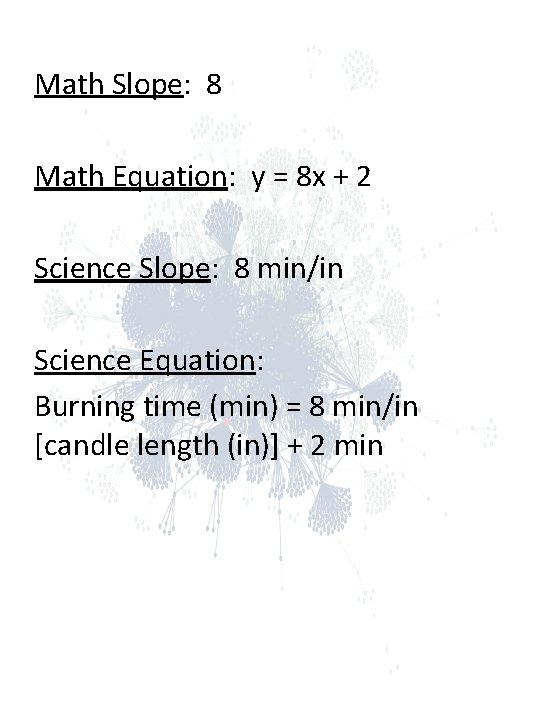
Math Slope vs. Science Slope • In Math, the slope is written as a numerical value. It is generally left in fraction form. • In Science, the slope is written as a numerical value with units. It is not left in fraction form-it is simplified. These units come from the graph and represent a rate. • Example: – X-axis is time (in seconds) – Y-axis is distance (in meters) – Slope is speed (in meters/second)
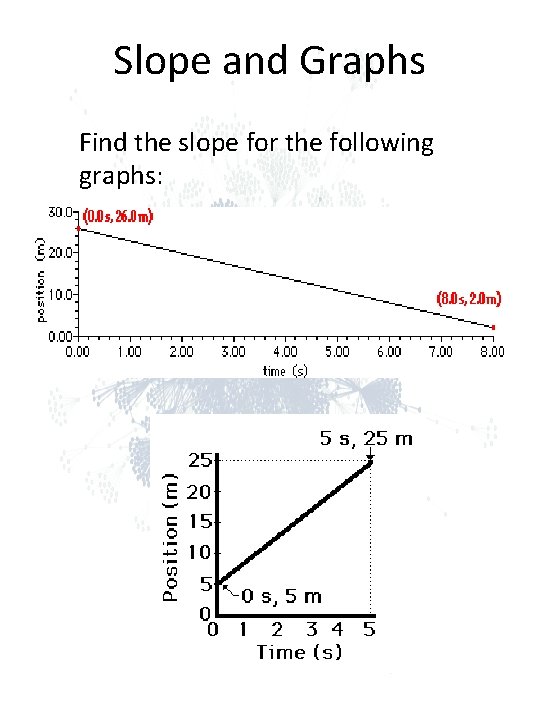
Slope and Graphs Find the slope for the following graphs:
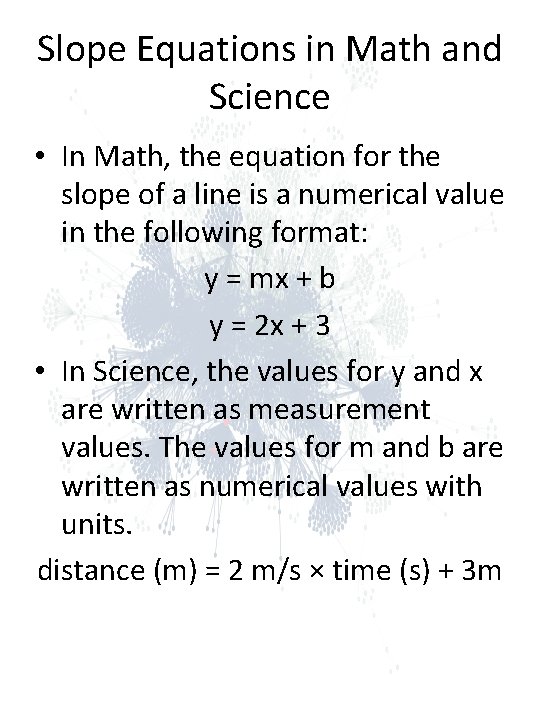
Slope Equations in Math and Science • In Math, the equation for the slope of a line is a numerical value in the following format: y = mx + b y = 2 x + 3 • In Science, the values for y and x are written as measurement values. The values for m and b are written as numerical values with units. distance (m) = 2 m/s × time (s) + 3 m
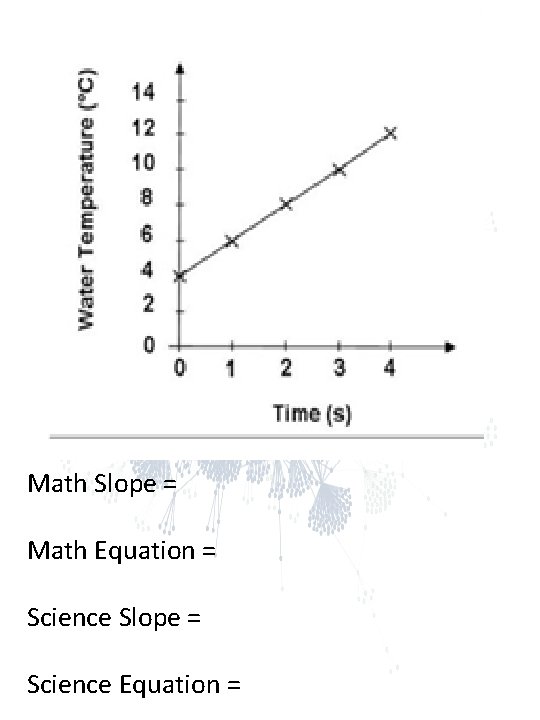
Math Slope = Math Equation = Science Slope = Science Equation =
Math Slope = Math Equation = Science Slope = Science Equation =
Math Slope = Math Equation = Science Slope = Science Equation =
Math Slope: 8 Math Equation: y = 8 x + 2 Science Slope: 8 min/in Science Equation: Burning time (min) = 8 min/in [candle length (in)] + 2 min
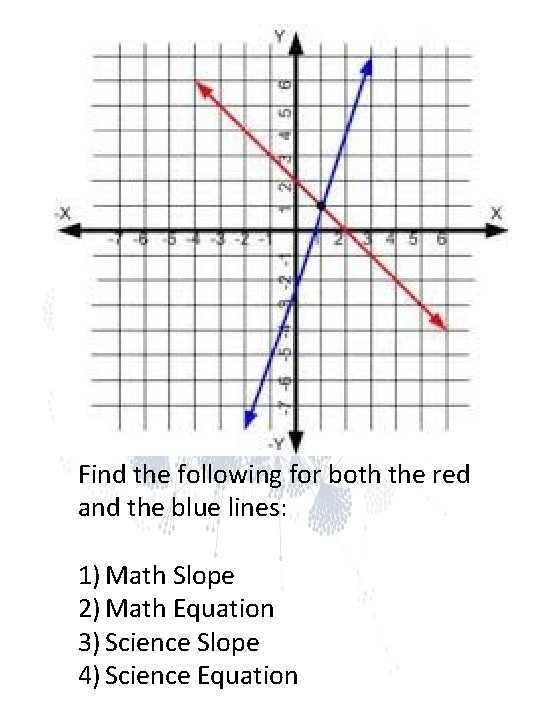
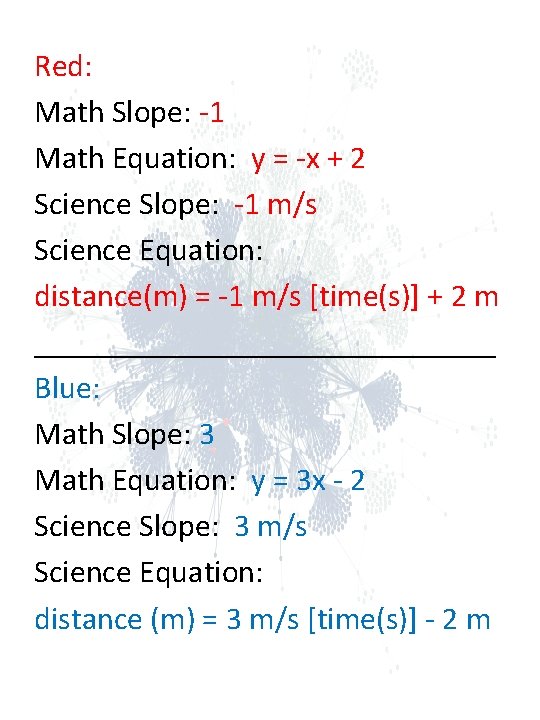
Find the following for both the red and the blue lines: 1) Math Slope 2) Math Equation 3) Science Slope 4) Science Equation
Red: Math Slope: -1 Math Equation: y = -x + 2 Science Slope: -1 m/s Science Equation: distance(m) = -1 m/s [time(s)] + 2 m _______________ Blue: Math Slope: 3 Math Equation: y = 3 x - 2 Science Slope: 3 m/s Science Equation: distance (m) = 3 m/s [time(s)] - 2 m
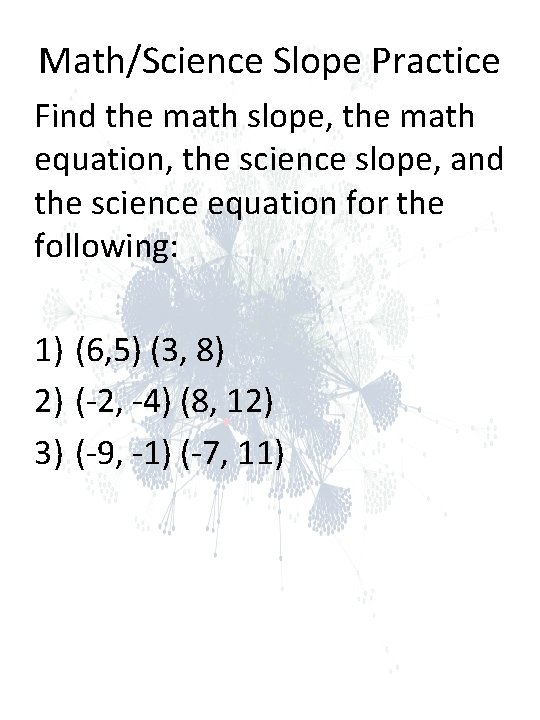
Math/Science Slope Practice Find the math slope, the math equation, the science slope, and the science equation for the following: 1) (6, 5) (3, 8) 2) (-2, -4) (8, 12) 3) (-9, -1) (-7, 11)