
Implementation of DOE O 420 2 C at
- Slides: 22
Implementation of DOE O 420. 2 C at PPPL for NSTX-U Jessica Malo - Safety Analyst, Princeton Plasma Physics Lab ASO Team DOE Accelerator Safety Workshop 2018
Outline • • • Messages What is NSTX-U? ASO Requirements and Applicability Introduction to NSTX-U - Mission, Design, Shielding & Access Control Accelerators vs. NSTX-U Required Program Elements ASO Implementation Plan Scope Status Update Summary Timeline 2
Messages • The ASO was added to our contract since our 2016 run and is required for restart • Elements of the ASO have existed on NSTX-U before but with less rigor • The ASO provides an opportunity to improve NSTX-U and sustain improvement well into its future • The ASO Implementation planning effort has already provided benefits to the project and future operation • We look forward to benefiting from the Accelerator community 3
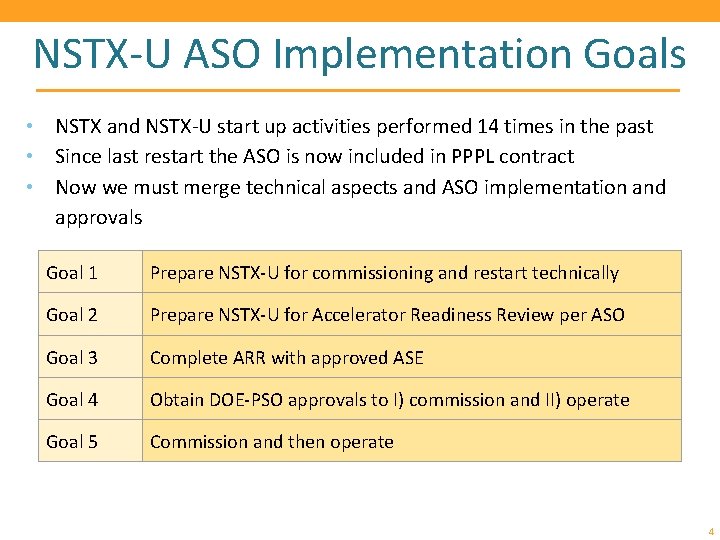
NSTX-U ASO Implementation Goals • NSTX and NSTX-U start up activities performed 14 times in the past • Since last restart the ASO is now included in PPPL contract • Now we must merge technical aspects and ASO implementation and approvals Goal 1 Prepare NSTX-U for commissioning and restart technically Goal 2 Prepare NSTX-U for Accelerator Readiness Review per ASO Goal 3 Complete ARR with approved ASE Goal 4 Obtain DOE-PSO approvals to I) commission and II) operate Goal 5 Commission and then operate 4
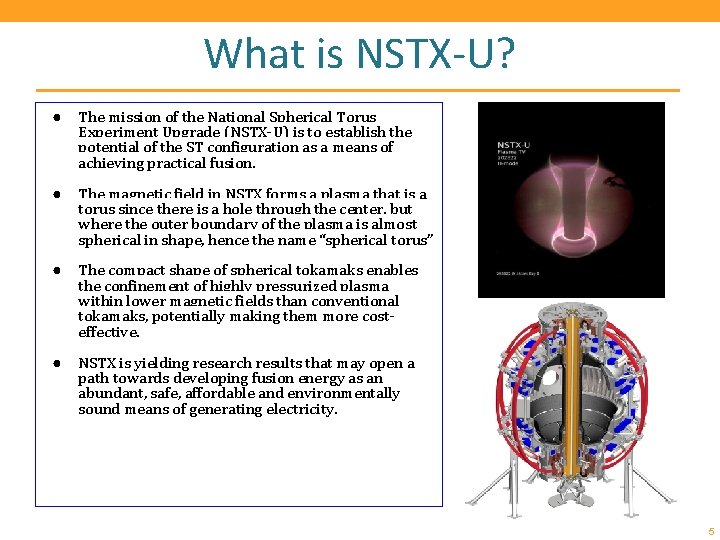
What is NSTX-U? ● The mission of the National Spherical Torus Experiment Upgrade (NSTX-U) is to establish the potential of the ST configuration as a means of achieving practical fusion. ● The magnetic field in NSTX forms a plasma that is a torus since there is a hole through the center, but where the outer boundary of the plasma is almost spherical in shape, hence the name “spherical torus” ● The compact shape of spherical tokamaks enables the confinement of highly pressurized plasma within lower magnetic fields than conventional tokamaks, potentially making them more costeffective. ● NSTX is yielding research results that may open a path towards developing fusion energy as an abundant, safe, affordable and environmentally sound means of generating electricity. 5
Why does 420. 2 C Apply? NSTX-U Fits the Definition of an Accelerator in the Order Accelerator definition: “A device employing electrostatic or electromagnetic fields to impart kinetic energy to molecular, atomic or subatomic particles and capable of creating a radiological area. ” While NSTX-U is not a conventional accelerator, it does accelerate charged particles and has the capability to create a radiological area, and therefore meets the definition of an accelerator in DOE O 420. 2 C. 6
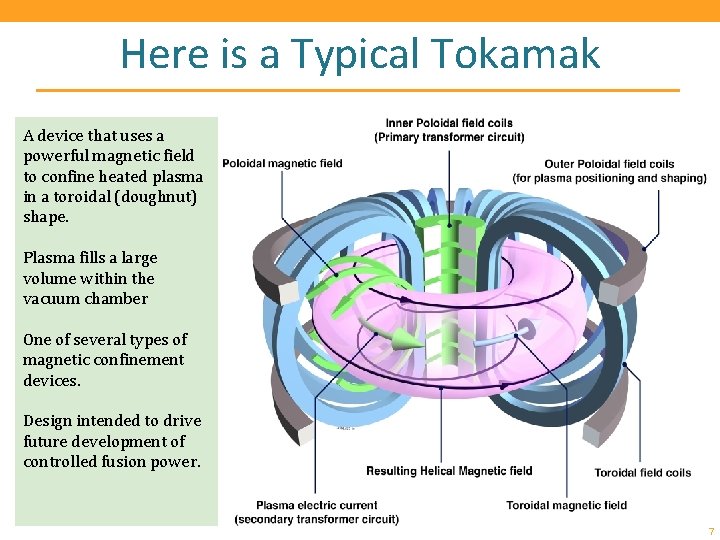
Here is a Typical Tokamak A device that uses a powerful magnetic field to confine heated plasma in a toroidal (doughnut) shape. Plasma fills a large volume within the vacuum chamber One of several types of magnetic confinement devices. Design intended to drive future development of controlled fusion power. 7
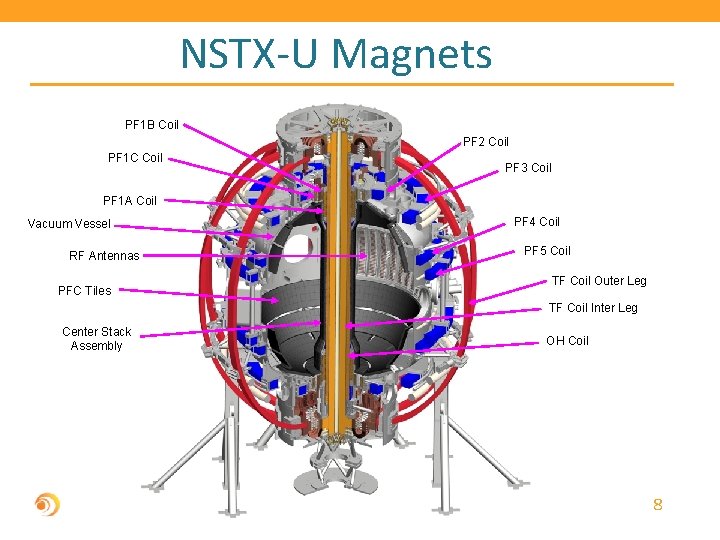
NSTX-U Magnets PF 1 B Coil PF 2 Coil PF 1 C Coil PF 3 Coil PF 1 A Coil Vacuum Vessel RF Antennas PFC Tiles PF 4 Coil PF 5 Coil TF Coil Outer Leg TF Coil Inter Leg Center Stack Assembly OH Coil 8
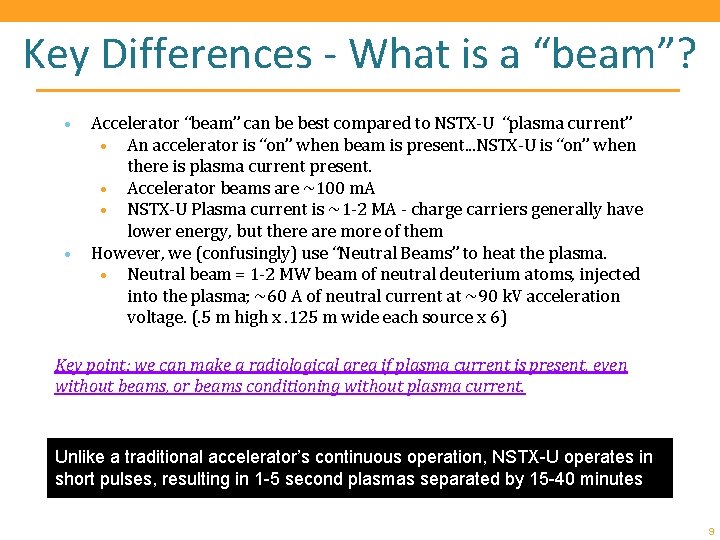
Key Differences - What is a “beam”? • • Accelerator “beam” can be best compared to NSTX-U “plasma current” • An accelerator is “on” when beam is present. . . NSTX-U is “on” when there is plasma current present. • Accelerator beams are ~100 m. A • NSTX-U Plasma current is ~1 -2 MA - charge carriers generally have lower energy, but there are more of them However, we (confusingly) use “Neutral Beams” to heat the plasma. • Neutral beam = 1 -2 MW beam of neutral deuterium atoms, injected into the plasma; ~60 A of neutral current at ~90 k. V acceleration voltage. (. 5 m high x. 125 m wide each source x 6) Key point: we can make a radiological area if plasma current is present, even without beams, or beams conditioning without plasma current. Unlike a traditional accelerator’s continuous operation, NSTX-U operates in short pulses, resulting in 1 -5 second plasmas separated by 15 -40 minutes 9
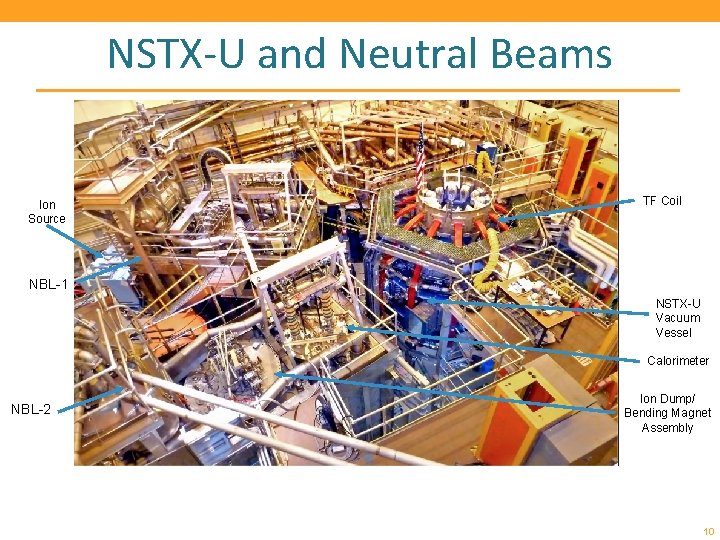
NSTX-U and Neutral Beams Ion Source TF Coil NBL-1 NSTX-U Vacuum Vessel Calorimeter NBL-2 Ion Dump/ Bending Magnet Assembly 10
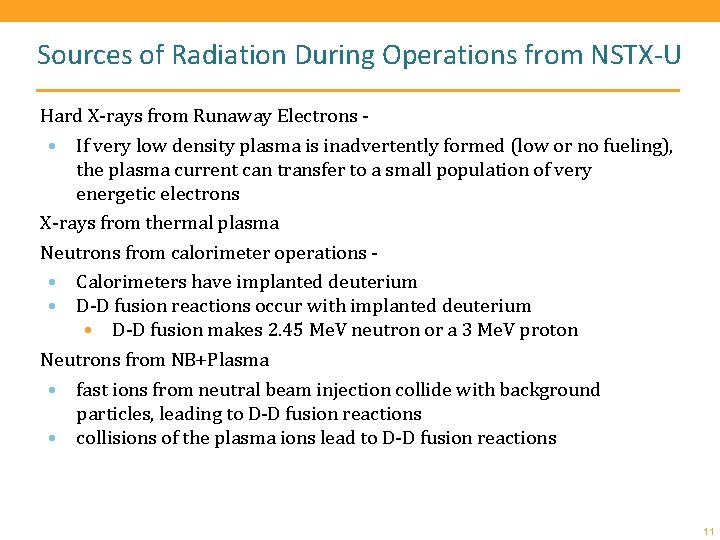
Sources of Radiation During Operations from NSTX-U Hard X-rays from Runaway Electrons • If very low density plasma is inadvertently formed (low or no fueling), the plasma current can transfer to a small population of very energetic electrons X-rays from thermal plasma Neutrons from calorimeter operations • Calorimeters have implanted deuterium • D-D fusion reactions occur with implanted deuterium • D-D fusion makes 2. 45 Me. V neutron or a 3 Me. V proton Neutrons from NB+Plasma • fast ions from neutral beam injection collide with background particles, leading to D-D fusion reactions • collisions of the plasma ions lead to D-D fusion reactions 11
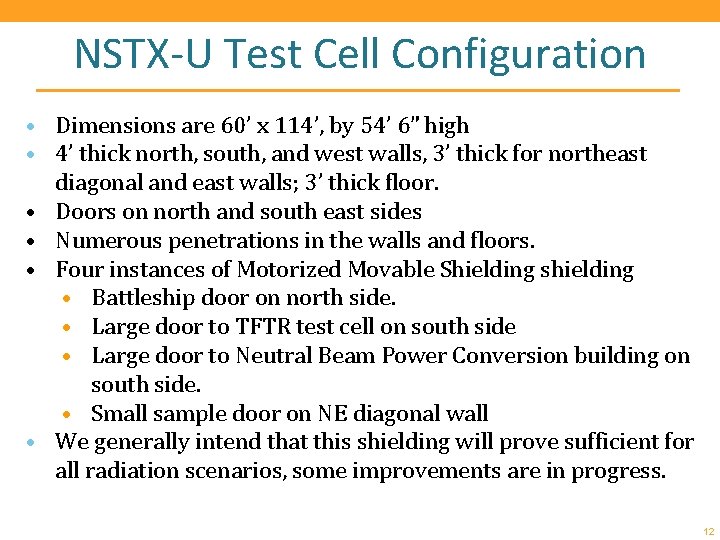
NSTX-U Test Cell Configuration • Dimensions are 60’ x 114’, by 54’ 6” high • 4’ thick north, south, and west walls, 3’ thick for northeast diagonal and east walls; 3’ thick floor. • Doors on north and south east sides • Numerous penetrations in the walls and floors. • Four instances of Motorized Movable Shielding shielding • Battleship door on north side. • Large door to TFTR test cell on south side • Large door to Neutral Beam Power Conversion building on south side. • Small sample door on NE diagonal wall • We generally intend that this shielding will prove sufficient for all radiation scenarios, some improvements are in progress. 12
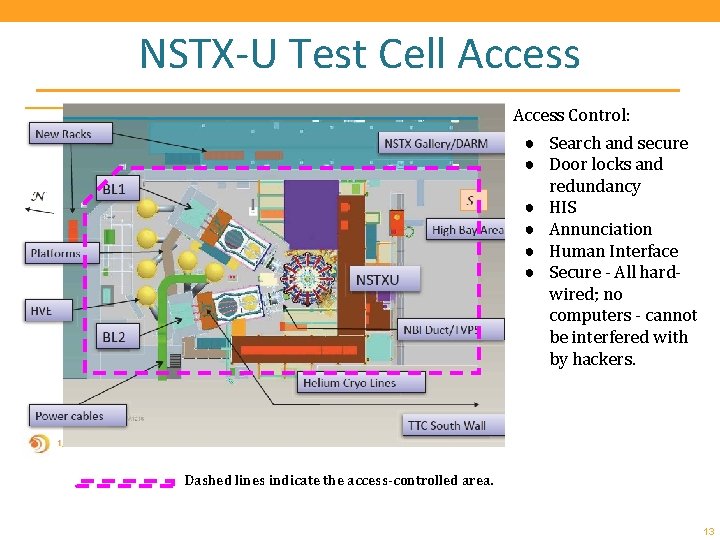
NSTX-U Test Cell Access Control: ● Search and secure ● Door locks and redundancy ● HIS ● Annunciation ● Human Interface ● Secure - All hardwired; no computers - cannot be interfered with by hackers. Dashed lines indicate the access-controlled area. 13
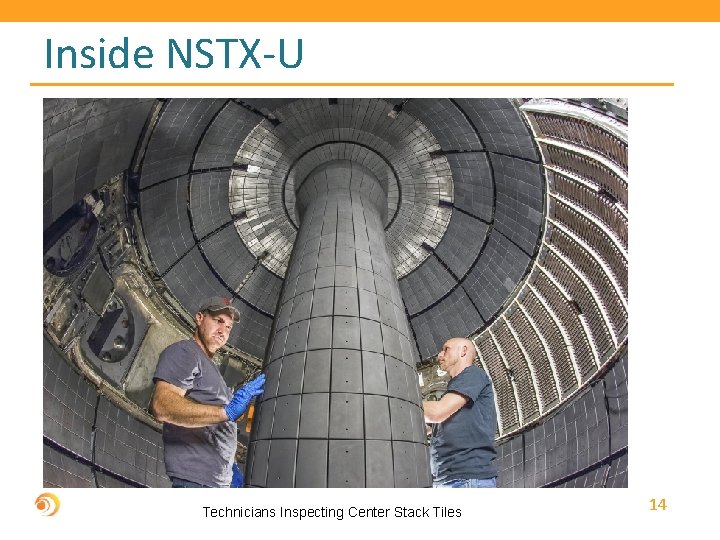
Inside NSTX-U Technicians Inspecting Center Stack Tiles 14
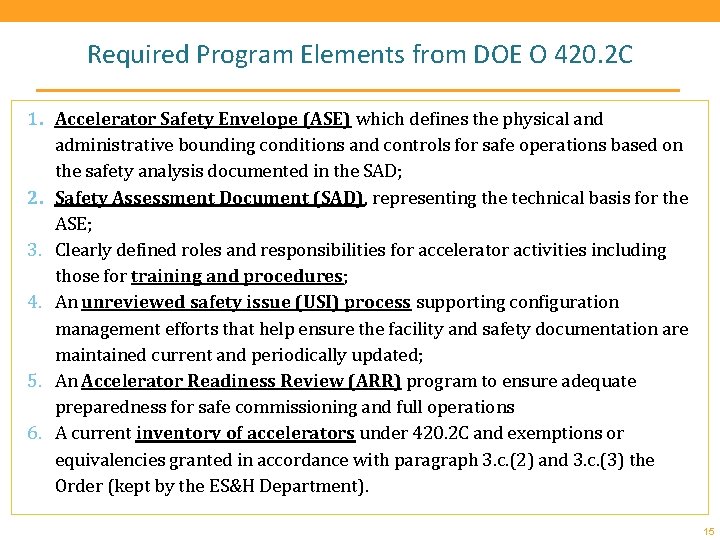
Required Program Elements from DOE O 420. 2 C 1. Accelerator Safety Envelope (ASE) which defines the physical and administrative bounding conditions and controls for safe operations based on the safety analysis documented in the SAD; 2. Safety Assessment Document (SAD), representing the technical basis for the ASE; 3. Clearly defined roles and responsibilities for accelerator activities including those for training and procedures; 4. An unreviewed safety issue (USI) process supporting configuration management efforts that help ensure the facility and safety documentation are maintained current and periodically updated; 5. An Accelerator Readiness Review (ARR) program to ensure adequate preparedness for safe commissioning and full operations 6. A current inventory of accelerators under 420. 2 C and exemptions or equivalencies granted in accordance with paragraph 3. c. (2) and 3. c. (3) the Order (kept by the ES&H Department). 15
ASO Implementation Plan Scope • An Accelerator Safety Order Implementation Plan document (ASOIP) has been developed for stakeholder approval and is in the review and approval process • ASO Team: We have a strong team in place to manage the work • Configuration Management evaluation • Preparing Training Plan and perform training • Preparing Commissioning Plan and procedure update • PPPL Activity Certification Committee Review (internal) • ARR and DOE-PSO Approvals to commission and to operate • Implement procedures to commission • Achieve Recovery KPPs 16
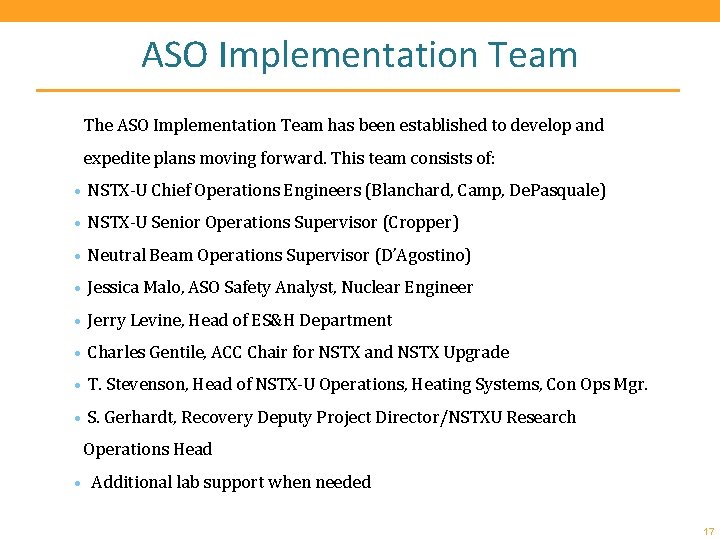
ASO Implementation Team The ASO Implementation Team has been established to develop and expedite plans moving forward. This team consists of: • NSTX-U Chief Operations Engineers (Blanchard, Camp, De. Pasquale) • NSTX-U Senior Operations Supervisor (Cropper) • Neutral Beam Operations Supervisor (D’Agostino) • Jessica Malo, ASO Safety Analyst, Nuclear Engineer • Jerry Levine, Head of ES&H Department • Charles Gentile, ACC Chair for NSTX and NSTX Upgrade • T. Stevenson, Head of NSTX-U Operations, Heating Systems, Con Ops Mgr. • S. Gerhardt, Recovery Deputy Project Director/NSTXU Research Operations Head • Additional lab support when needed 17
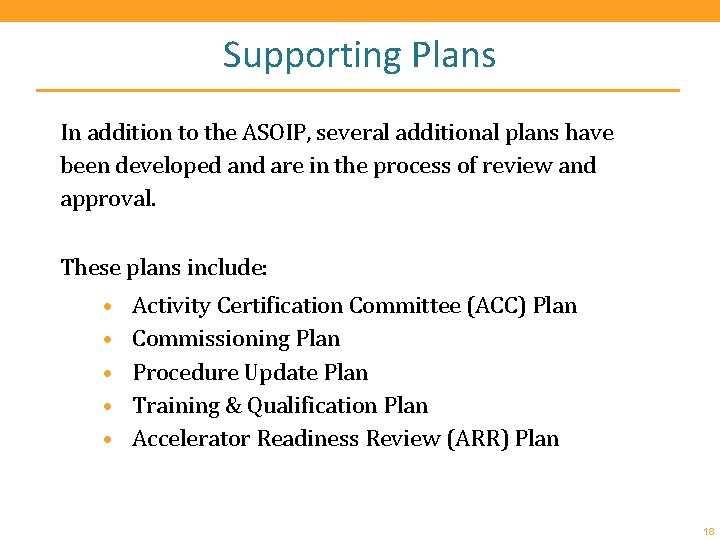
Supporting Plans In addition to the ASOIP, several additional plans have been developed and are in the process of review and approval. These plans include: • • • Activity Certification Committee (ACC) Plan Commissioning Plan Procedure Update Plan Training & Qualification Plan Accelerator Readiness Review (ARR) Plan 18
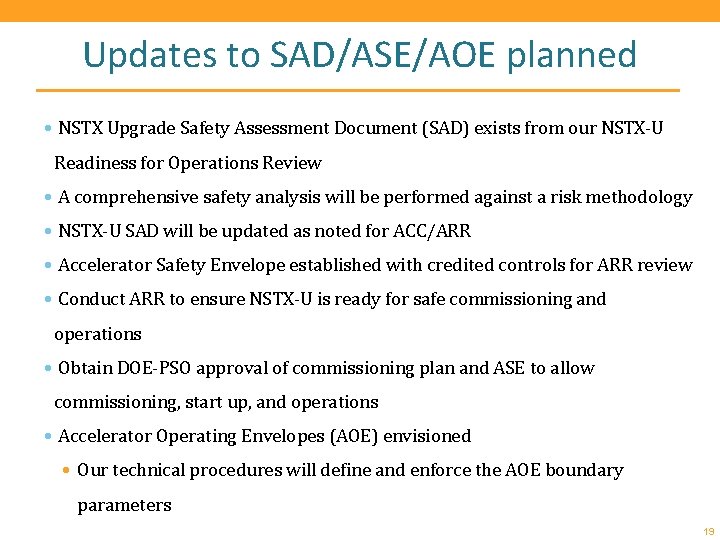
Updates to SAD/ASE/AOE planned • NSTX Upgrade Safety Assessment Document (SAD) exists from our NSTX-U Readiness for Operations Review • A comprehensive safety analysis will be performed against a risk methodology • NSTX-U SAD will be updated as noted for ACC/ARR • Accelerator Safety Envelope established with credited controls for ARR review • Conduct ARR to ensure NSTX-U is ready for safe commissioning and operations • Obtain DOE-PSO approval of commissioning plan and ASE to allow commissioning, start up, and operations • Accelerator Operating Envelopes (AOE) envisioned • Our technical procedures will define and enforce the AOE boundary parameters 19
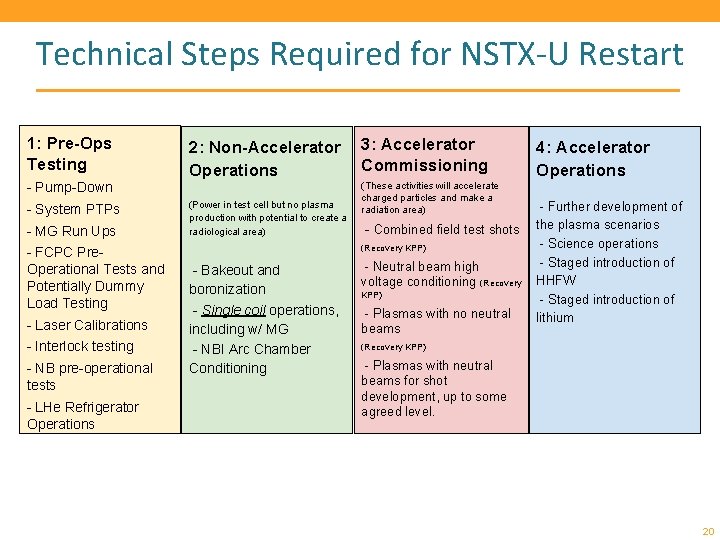
Technical Steps Required for NSTX-U Restart 1: Pre-Ops Testing - Pump-Down - System PTPs - MG Run Ups - FCPC Pre. Operational Tests and Potentially Dummy Load Testing - Laser Calibrations - Interlock testing - NB pre-operational tests - LHe Refrigerator Operations 2: Non-Accelerator Operations (Power in test cell but no plasma production with potential to create a radiological area) 3: Accelerator Commissioning (These activities will accelerate charged particles and make a radiation area) - Combined field test shots (Recovery KPP) - Bakeout and boronization - Single coil operations, including w/ MG - NBI Arc Chamber Conditioning - Neutral beam high voltage conditioning (Recovery KPP) - Plasmas with no neutral beams 4: Accelerator Operations - Further development of the plasma scenarios - Science operations - Staged introduction of HHFW - Staged introduction of lithium (Recovery KPP) - Plasmas with neutral beams for shot development, up to some agreed level. 20
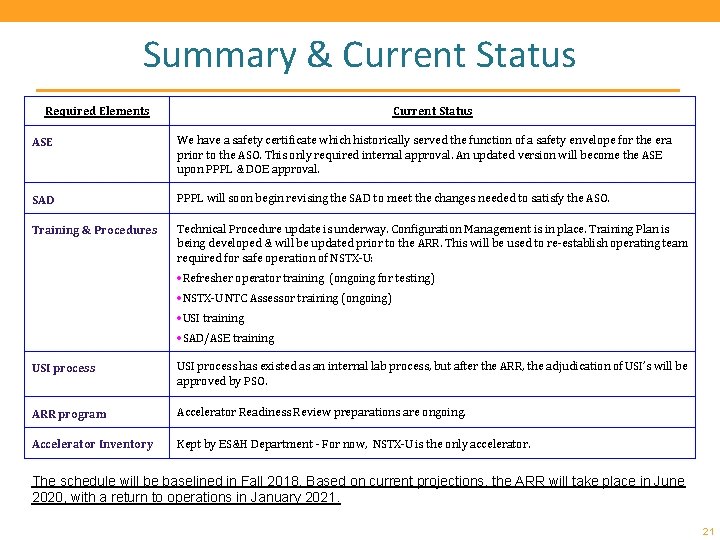
Summary & Current Status Required Elements Current Status ASE We have a safety certificate which historically served the function of a safety envelope for the era prior to the ASO. This only required internal approval. An updated version will become the ASE upon PPPL & DOE approval. SAD PPPL will soon begin revising the SAD to meet the changes needed to satisfy the ASO. Training & Procedures Technical Procedure update is underway. Configuration Management is in place. Training Plan is being developed & will be updated prior to the ARR. This will be used to re-establish operating team required for safe operation of NSTX-U: • Refresher operator training (ongoing for testing) • NSTX-U NTC Assessor training (ongoing) • USI training • SAD/ASE training USI process has existed as an internal lab process, but after the ARR, the adjudication of USI’s will be approved by PSO. ARR program Accelerator Readiness Review preparations are ongoing. Accelerator Inventory Kept by ES&H Department - For now, NSTX-U is the only accelerator. The schedule will be baselined in Fall 2018. Based on current projections, the ARR will take place in June 2020, with a return to operations in January 2021. 21
Questions? 22