Walter Nicholson Amherst College Christopher Snyder Dartmouth College
- Slides: 48
Walter Nicholson Amherst College Christopher Snyder Dartmouth College Power. Point Slide Presentation | Philip Heap, James Madison University © 2015 Cengage Learning. All Rights Reserved. May not be scanned, copied or duplicated, or posted to a publicly accessible website, in whole or in part. 1
CHAPTER 5 Game Theory © 2015 Cengage Learning. All Rights Reserved. May not be scanned, copied or duplicated, or posted to a publicly accessible website, in whole or in part. 2
Chapter Preview • What happens when decisions are interdependent or involve strategic interaction? • Game theory is a way of modeling these types of decisions. • Cooperative game theory • Non-cooperative game theory © 2015 Cengage Learning. All Rights Reserved. May not be scanned, copied or duplicated, or posted to a publicly accessible website, in whole or in part. Ch. 5 • 3
Basic Concepts of Game Theory • Four elements describe a game. 1. Players • The decision makers in the game. • 2, 3, . . . N players. 2. Strategies: a player’s choice in a game. • In simple games, they are the same as actions. • They may be contingent on what another player has done. • They can involve randomization. © 2015 Cengage Learning. All Rights Reserved. May not be scanned, copied or duplicated, or posted to a publicly accessible website, in whole or in part. Ch. 5 • 4
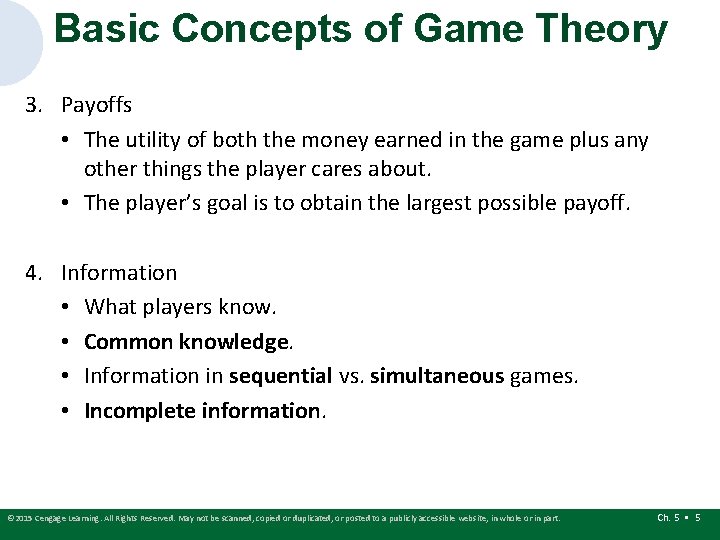
Basic Concepts of Game Theory 3. Payoffs • The utility of both the money earned in the game plus any other things the player cares about. • The player’s goal is to obtain the largest possible payoff. 4. Information • What players know. • Common knowledge. • Information in sequential vs. simultaneous games. • Incomplete information. © 2015 Cengage Learning. All Rights Reserved. May not be scanned, copied or duplicated, or posted to a publicly accessible website, in whole or in part. Ch. 5 • 5
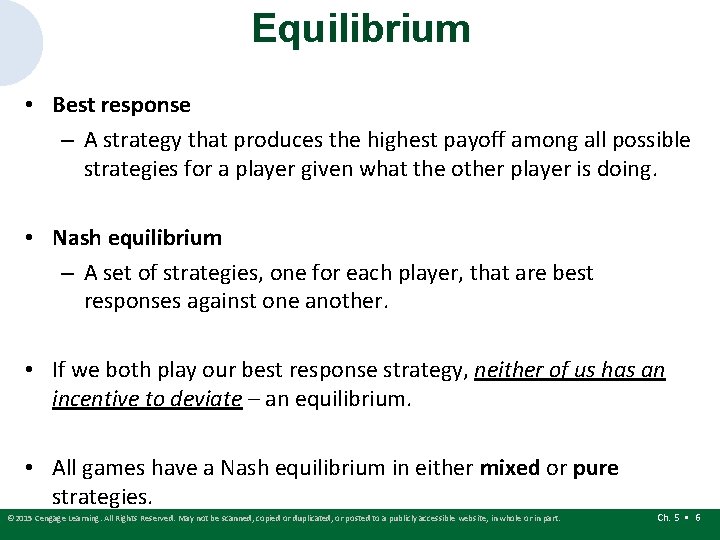
Equilibrium • Best response – A strategy that produces the highest payoff among all possible strategies for a player given what the other player is doing. • Nash equilibrium – A set of strategies, one for each player, that are best responses against one another. • If we both play our best response strategy, neither of us has an incentive to deviate – an equilibrium. • All games have a Nash equilibrium in either mixed or pure strategies. © 2015 Cengage Learning. All Rights Reserved. May not be scanned, copied or duplicated, or posted to a publicly accessible website, in whole or in part. Ch. 5 • 6
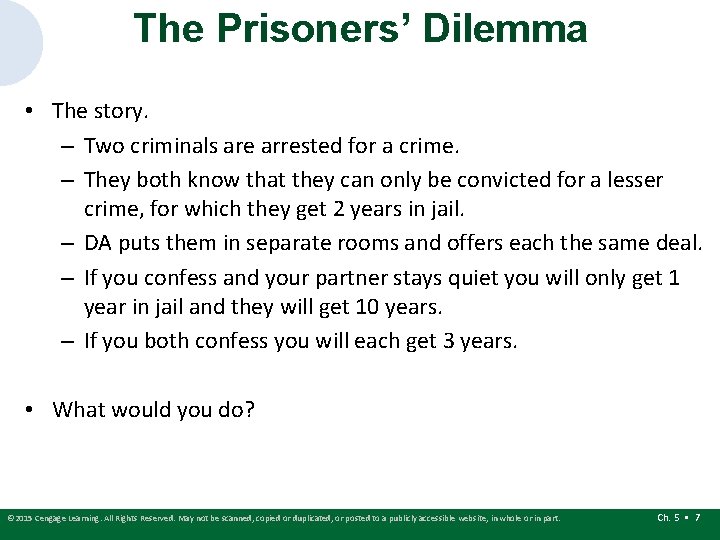
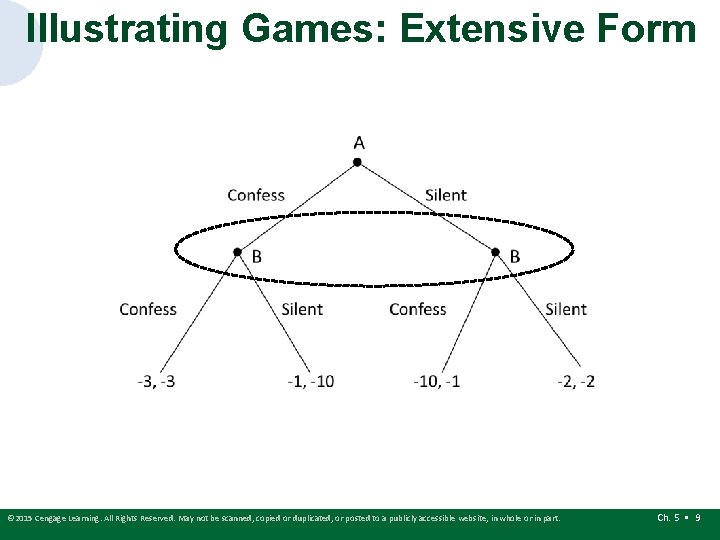
The Prisoners’ Dilemma • The story. – Two criminals are arrested for a crime. – They both know that they can only be convicted for a lesser crime, for which they get 2 years in jail. – DA puts them in separate rooms and offers each the same deal. – If you confess and your partner stays quiet you will only get 1 year in jail and they will get 10 years. – If you both confess you will each get 3 years. • What would you do? © 2015 Cengage Learning. All Rights Reserved. May not be scanned, copied or duplicated, or posted to a publicly accessible website, in whole or in part. Ch. 5 • 7
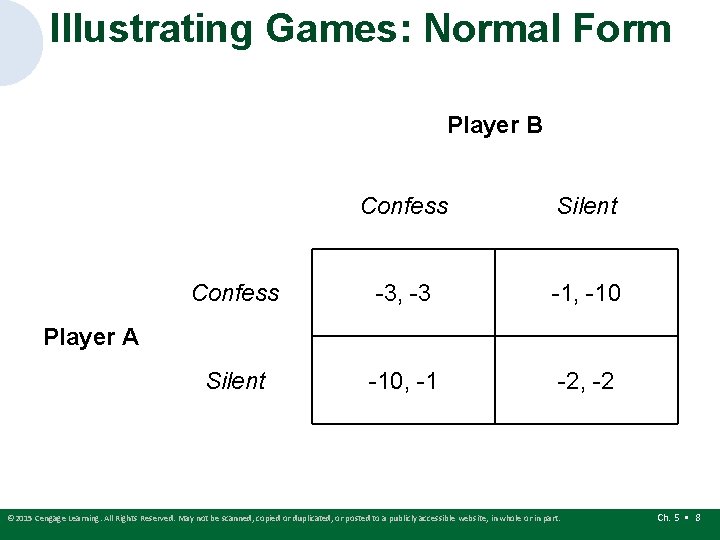
Illustrating Games: Normal Form Player B Confess Silent Confess -3, -3 -1, -10 Silent -10, -1 -2, -2 Player A © 2015 Cengage Learning. All Rights Reserved. May not be scanned, copied or duplicated, or posted to a publicly accessible website, in whole or in part. Ch. 5 • 8
Illustrating Games: Extensive Form © 2015 Cengage Learning. All Rights Reserved. May not be scanned, copied or duplicated, or posted to a publicly accessible website, in whole or in part. Ch. 5 • 9
How to Solve the Game • Two ways to find the Nash equilibrium. – Inspection • Pick an outcome and see if one or both of the players has an incentive to deviate. If not, it’s an equilibrium. – Underline method • For each player underline the payoff value the player would get if he played his best response to each of the other player’s actions. The outcome(s) where there are two underlines is an equilibrium. © 2015 Cengage Learning. All Rights Reserved. May not be scanned, copied or duplicated, or posted to a publicly accessible website, in whole or in part. Ch. 5 • 10
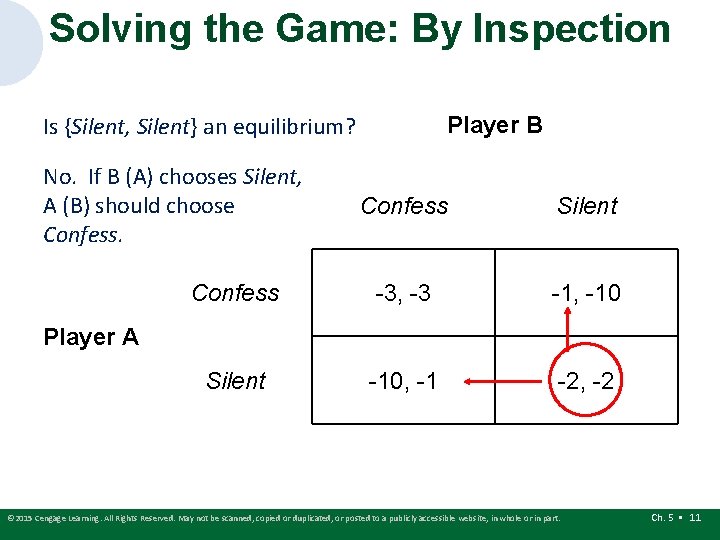
Solving the Game: By Inspection Player B Is {Silent, Silent} an equilibrium? No. If B (A) chooses Silent, A (B) should choose Confess Silent Confess -3, -3 -1, -10 Silent -10, -1 -2, -2 Player A © 2015 Cengage Learning. All Rights Reserved. May not be scanned, copied or duplicated, or posted to a publicly accessible website, in whole or in part. Ch. 5 • 11
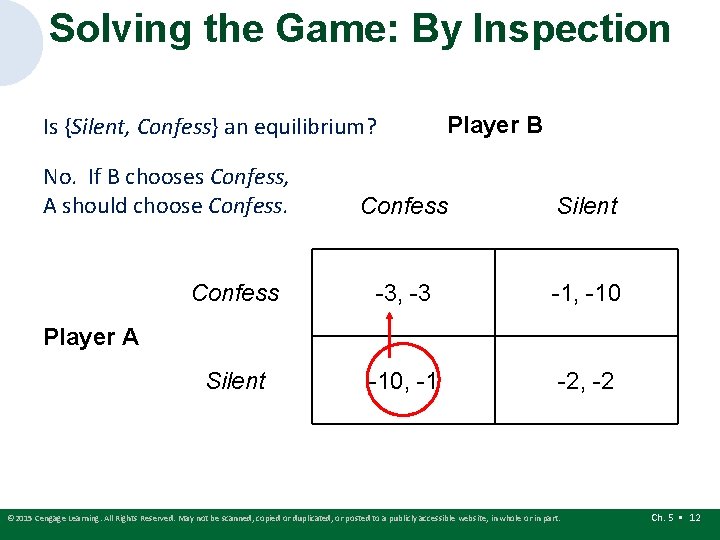
Solving the Game: By Inspection Is {Silent, Confess} an equilibrium? No. If B chooses Confess, A should choose Confess. Player B Confess Silent Confess -3, -3 -1, -10 Silent -10, -1 -2, -2 Player A © 2015 Cengage Learning. All Rights Reserved. May not be scanned, copied or duplicated, or posted to a publicly accessible website, in whole or in part. Ch. 5 • 12
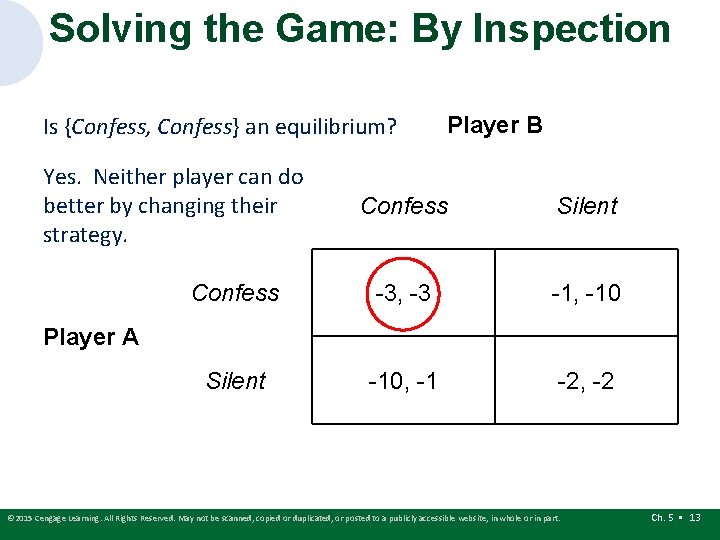
Solving the Game: By Inspection Is {Confess, Confess} an equilibrium? Yes. Neither player can do better by changing their strategy. Player B Confess Silent Confess -3, -3 -1, -10 Silent -10, -1 -2, -2 Player A © 2015 Cengage Learning. All Rights Reserved. May not be scanned, copied or duplicated, or posted to a publicly accessible website, in whole or in part. Ch. 5 • 13
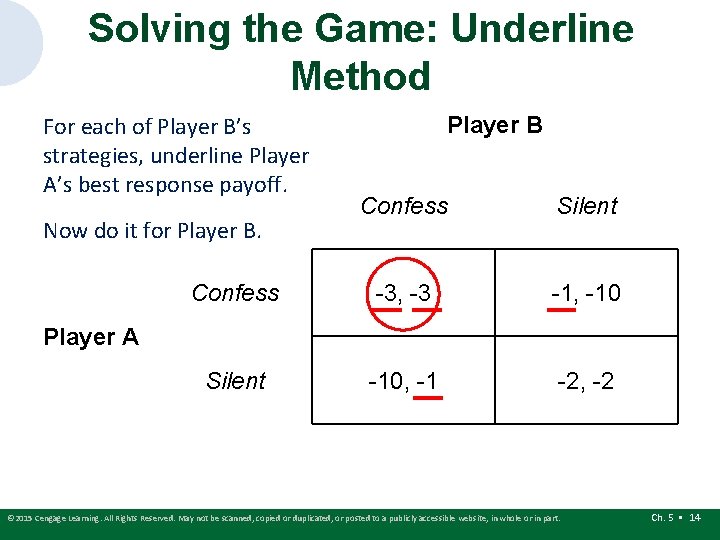
Solving the Game: Underline Method For each of Player B’s strategies, underline Player A’s best response payoff. Player B Confess Silent Confess -3, -3 -1, -10 Silent -10, -1 -2, -2 Now do it for Player B. Player A © 2015 Cengage Learning. All Rights Reserved. May not be scanned, copied or duplicated, or posted to a publicly accessible website, in whole or in part. Ch. 5 • 14
Other Aspects of the Prisoners’ Dilemma Game • Confess is a dominant strategy. • It is the best response to any of the other player’s strategies. • What is the relationship between a dominant strategy equilibrium and a Nash equilibrium? – Every dominant strategy equilibrium is a Nash equilibrium, but not every Nash equilibrium is a dominant strategy equilibrium. © 2015 Cengage Learning. All Rights Reserved. May not be scanned, copied or duplicated, or posted to a publicly accessible website, in whole or in part. Ch. 5 • 15
Other Aspects of the Prisoners’ Dilemma Game • If the players were allowed to communicate what would seem to be the best outcome? • Both staying silent would be better: 2 yrs. vs. 3 yrs. • But this is a non-cooperative game so binding agreements are not allowed. • Other examples of the Prisoners’ Dilemma. © 2015 Cengage Learning. All Rights Reserved. May not be scanned, copied or duplicated, or posted to a publicly accessible website, in whole or in part. Ch. 5 • 16
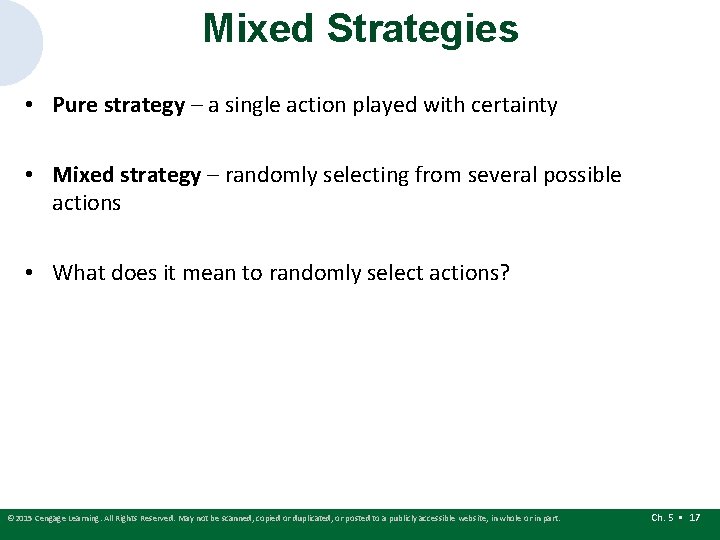
Mixed Strategies • Pure strategy – a single action played with certainty • Mixed strategy – randomly selecting from several possible actions • What does it mean to randomly select actions? © 2015 Cengage Learning. All Rights Reserved. May not be scanned, copied or duplicated, or posted to a publicly accessible website, in whole or in part. Ch. 5 • 17
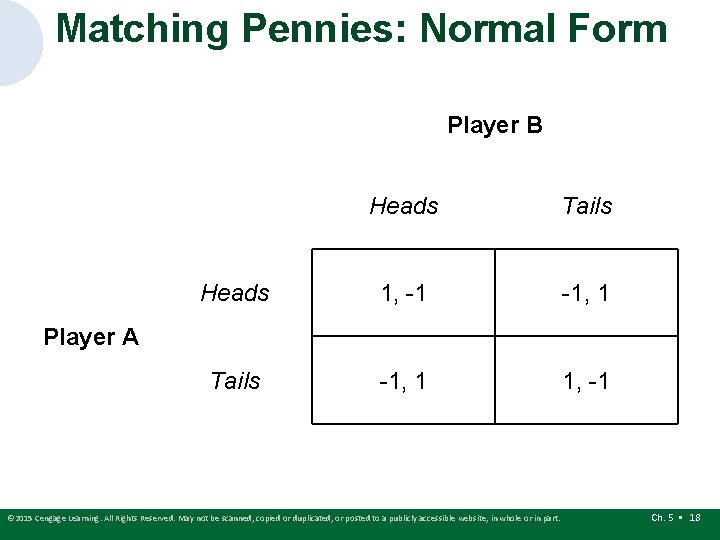
Matching Pennies: Normal Form Player B Heads Tails Heads 1, -1 -1, 1 Tails -1, 1 1, -1 Player A © 2015 Cengage Learning. All Rights Reserved. May not be scanned, copied or duplicated, or posted to a publicly accessible website, in whole or in part. Ch. 5 • 18
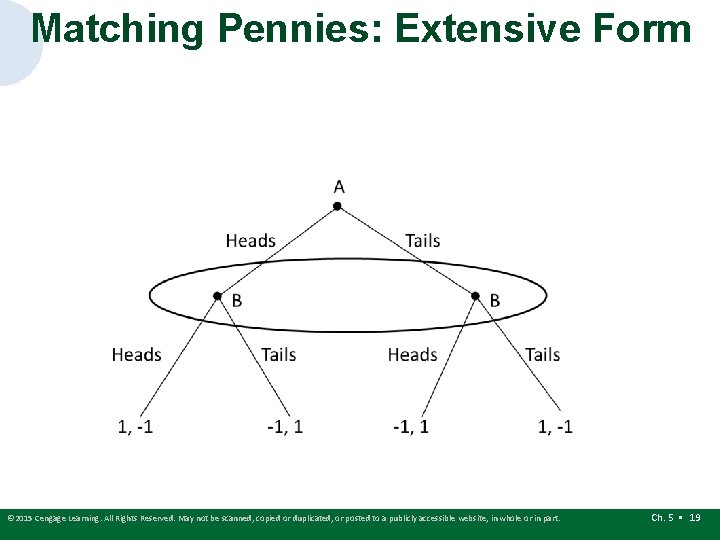
Matching Pennies: Extensive Form © 2015 Cengage Learning. All Rights Reserved. May not be scanned, copied or duplicated, or posted to a publicly accessible website, in whole or in part. Ch. 5 • 19
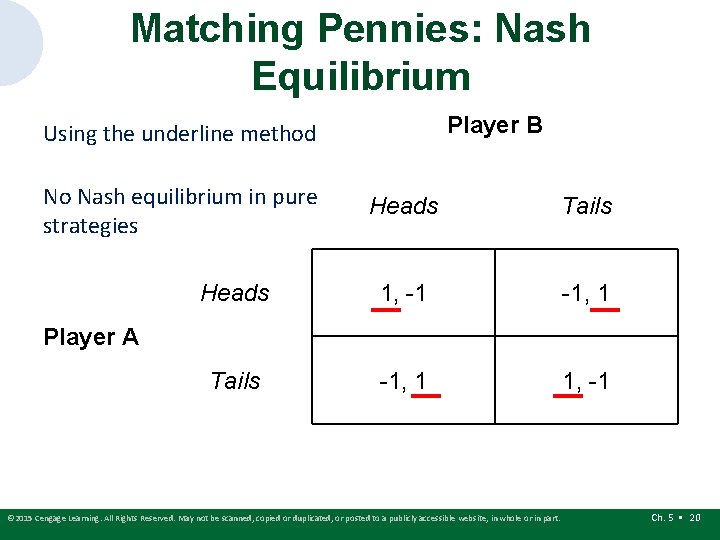
Matching Pennies: Nash Equilibrium Player B Using the underline method No Nash equilibrium in pure strategies Heads Tails Heads 1, -1 -1, 1 Tails -1, 1 1, -1 Player A © 2015 Cengage Learning. All Rights Reserved. May not be scanned, copied or duplicated, or posted to a publicly accessible website, in whole or in part. Ch. 5 • 20
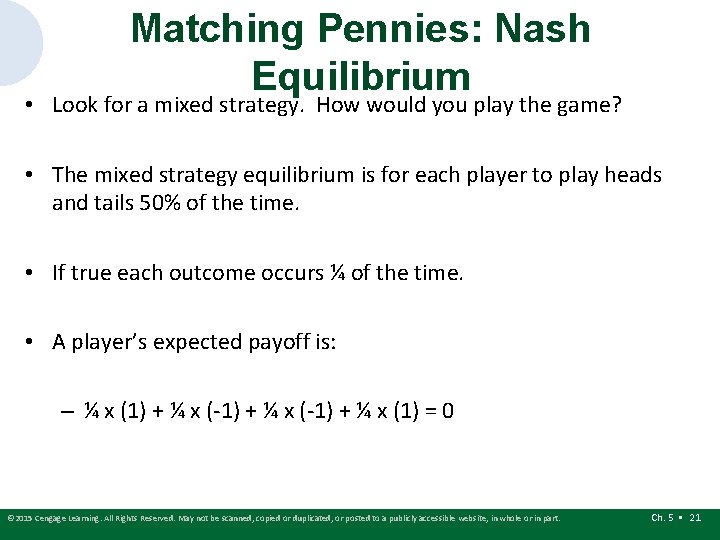
Matching Pennies: Nash Equilibrium • Look for a mixed strategy. How would you play the game? • The mixed strategy equilibrium is for each player to play heads and tails 50% of the time. • If true each outcome occurs ¼ of the time. • A player’s expected payoff is: – ¼ x (1) + ¼ x (-1) + ¼ x (1) = 0 © 2015 Cengage Learning. All Rights Reserved. May not be scanned, copied or duplicated, or posted to a publicly accessible website, in whole or in part. Ch. 5 • 21
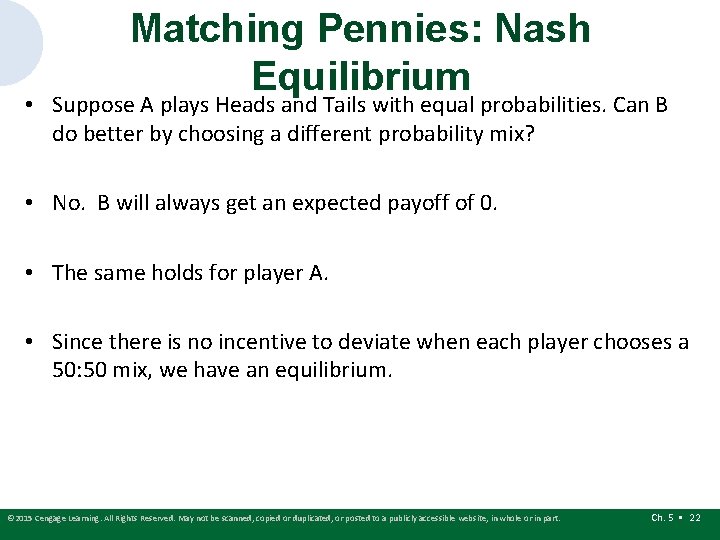
Matching Pennies: Nash Equilibrium • Suppose A plays Heads and Tails with equal probabilities. Can B do better by choosing a different probability mix? • No. B will always get an expected payoff of 0. • The same holds for player A. • Since there is no incentive to deviate when each player chooses a 50: 50 mix, we have an equilibrium. © 2015 Cengage Learning. All Rights Reserved. May not be scanned, copied or duplicated, or posted to a publicly accessible website, in whole or in part. Ch. 5 • 22
Interpretation of Mixed Strategies • In Matching Pennies what is the point of mixing? What are you trying to do? • Mixed strategies in sports: goal kicks in soccer, serves in tennis. Why not always kick, serve, defend to the right? • Randomization prevents the other player from being able to exploit you. © 2015 Cengage Learning. All Rights Reserved. May not be scanned, copied or duplicated, or posted to a publicly accessible website, in whole or in part. Ch. 5 • 23
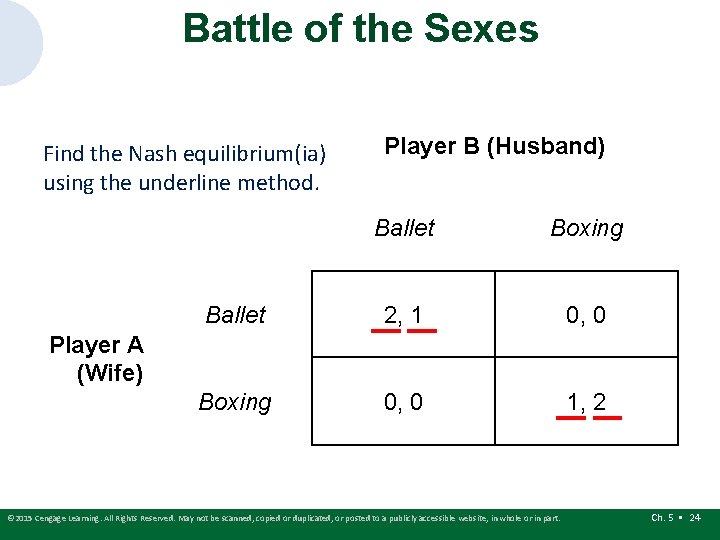
Battle of the Sexes Find the Nash equilibrium(ia) using the underline method. Player B (Husband) Ballet Boxing Ballet 2, 1 0, 0 Boxing 0, 0 1, 2 Player A (Wife) © 2015 Cengage Learning. All Rights Reserved. May not be scanned, copied or duplicated, or posted to a publicly accessible website, in whole or in part. Ch. 5 • 24
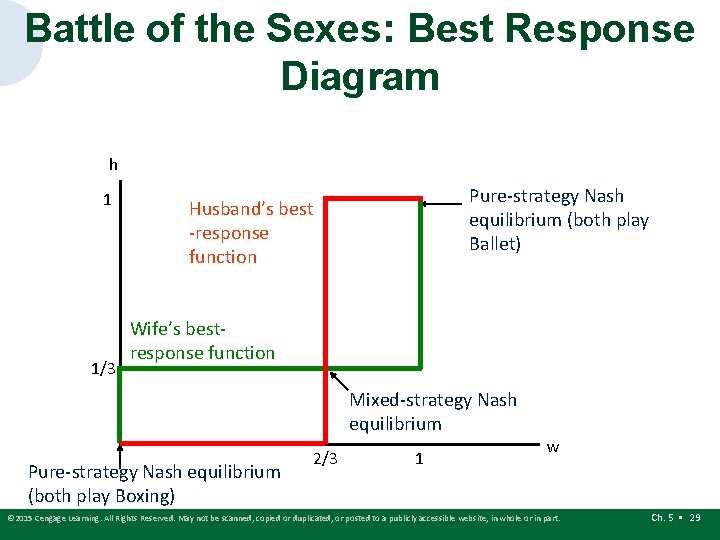
Battle of the Sexes: Mixed Strategy • Want to derive the best response function. A function that shows one player’s profit maximizing choice for anything the other player chooses. • Intuition from the wife’s perspective. – She wants to end up at the same place as her husband but doesn’t know where he is going. – If she believes that he will always go to the ballet (boxing) she should always go to the ballet (boxing). – What other beliefs may she have? © 2015 Cengage Learning. All Rights Reserved. May not be scanned, copied or duplicated, or posted to a publicly accessible website, in whole or in part. Ch. 5 • 25
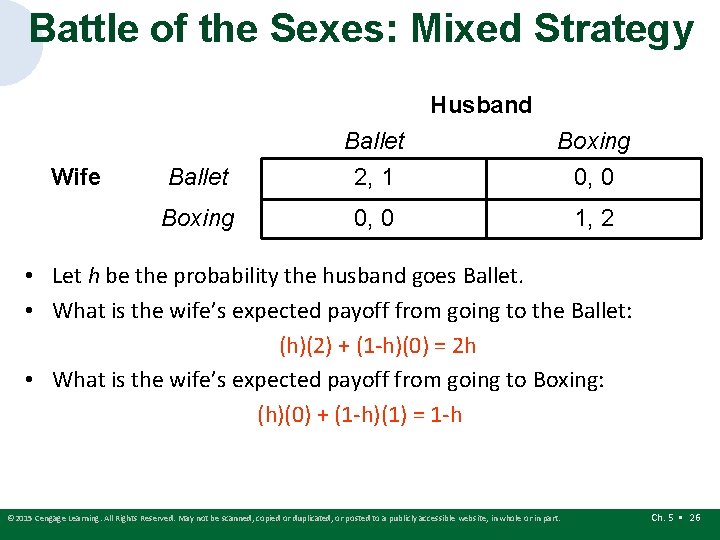
Battle of the Sexes: Mixed Strategy Husband Wife Ballet 2, 1 Boxing 0, 0 1, 2 • Let h be the probability the husband goes Ballet. • What is the wife’s expected payoff from going to the Ballet: (h)(2) + (1 -h)(0) = 2 h • What is the wife’s expected payoff from going to Boxing: (h)(0) + (1 -h)(1) = 1 -h © 2015 Cengage Learning. All Rights Reserved. May not be scanned, copied or duplicated, or posted to a publicly accessible website, in whole or in part. Ch. 5 • 26
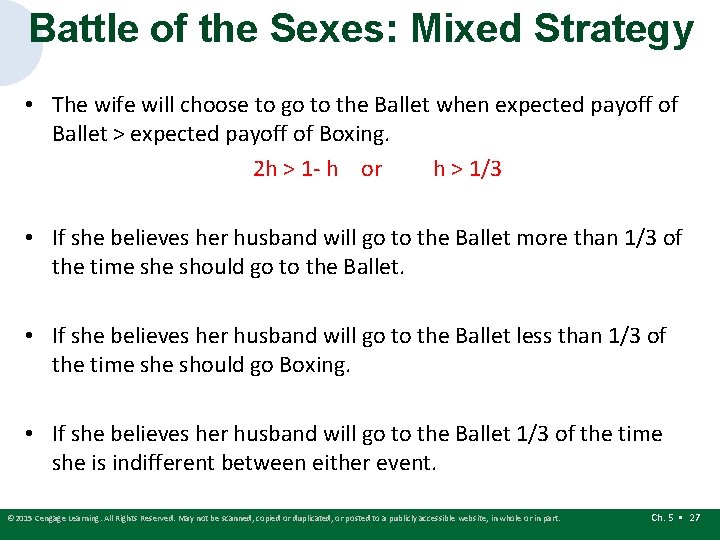
Battle of the Sexes: Mixed Strategy • The wife will choose to go to the Ballet when expected payoff of Ballet > expected payoff of Boxing. 2 h > 1 - h or h > 1/3 • If she believes her husband will go to the Ballet more than 1/3 of the time should go to the Ballet. • If she believes her husband will go to the Ballet less than 1/3 of the time should go Boxing. • If she believes her husband will go to the Ballet 1/3 of the time she is indifferent between either event. © 2015 Cengage Learning. All Rights Reserved. May not be scanned, copied or duplicated, or posted to a publicly accessible website, in whole or in part. Ch. 5 • 27
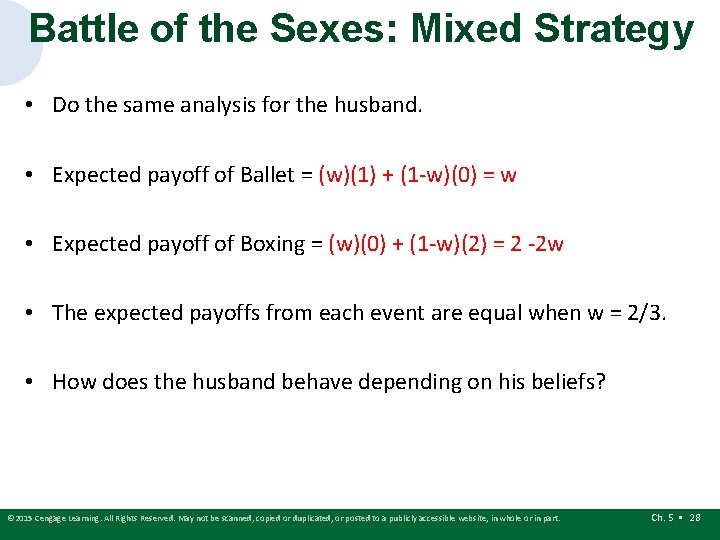
Battle of the Sexes: Mixed Strategy • Do the same analysis for the husband. • Expected payoff of Ballet = (w)(1) + (1 -w)(0) = w • Expected payoff of Boxing = (w)(0) + (1 -w)(2) = 2 -2 w • The expected payoffs from each event are equal when w = 2/3. • How does the husband behave depending on his beliefs? © 2015 Cengage Learning. All Rights Reserved. May not be scanned, copied or duplicated, or posted to a publicly accessible website, in whole or in part. Ch. 5 • 28
Battle of the Sexes: Best Response Diagram h 1 1/3 Pure-strategy Nash equilibrium (both play Ballet) Husband’s best -response function Wife’s bestresponse function Mixed-strategy Nash equilibrium Pure-strategy Nash equilibrium (both play Boxing) 2/3 1 w © 2015 Cengage Learning. All Rights Reserved. May not be scanned, copied or duplicated, or posted to a publicly accessible website, in whole or in part. Ch. 5 • 29
Problems with Multiple Equilibria • How do you decide which is the “right” equilibrium? – Select the one which gives the largest total payoff. – Select the symmetric equilibrium. – In Bo. S either of the pure equilibria would satisfy the first criteria; the mixed equilibrium would satisfy the second. – Select the focal point – logical outcome on which to coordinate, based on information outside of the game. – What would happen at this university? – A year after graduating you come back for Alumni Weekend. You are supposed to meet your friends for a night of festivities, but can’t remember where or when. What’s the focal point? © 2015 Cengage Learning. All Rights Reserved. May not be scanned, copied or duplicated, or posted to a publicly accessible website, in whole or in part. Ch. 5 • 30
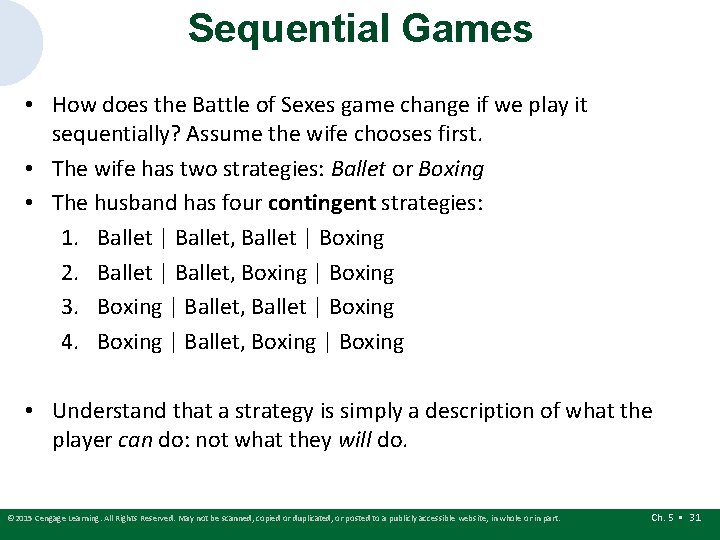
Sequential Games • How does the Battle of Sexes game change if we play it sequentially? Assume the wife chooses first. • The wife has two strategies: Ballet or Boxing • The husband has four contingent strategies: 1. Ballet | Ballet, Ballet | Boxing 2. Ballet | Ballet, Boxing | Boxing 3. Boxing | Ballet, Ballet | Boxing 4. Boxing | Ballet, Boxing | Boxing • Understand that a strategy is simply a description of what the player can do: not what they will do. © 2015 Cengage Learning. All Rights Reserved. May not be scanned, copied or duplicated, or posted to a publicly accessible website, in whole or in part. Ch. 5 • 31
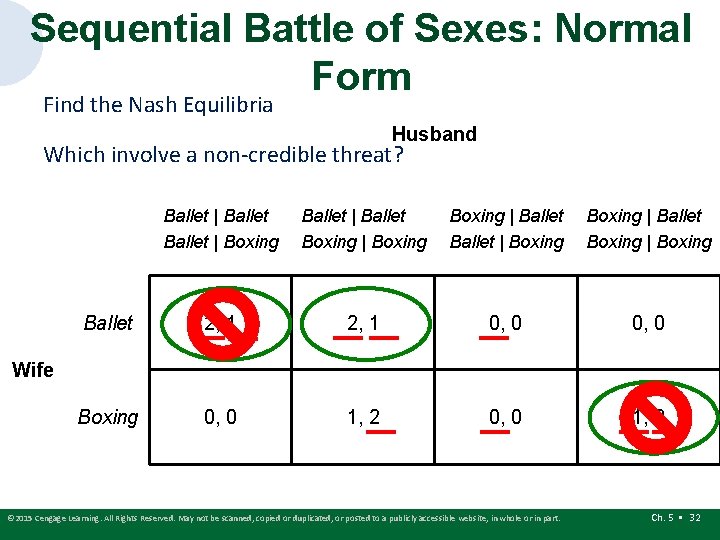
Sequential Battle of Sexes: Normal Form Find the Nash Equilibria Husband Which involve a non-credible threat? Ballet | Boxing Ballet | Ballet Boxing | Ballet | Boxing | Ballet Boxing | Boxing Ballet 2, 1 0, 0 Boxing 0, 0 1, 2 Wife © 2015 Cengage Learning. All Rights Reserved. May not be scanned, copied or duplicated, or posted to a publicly accessible website, in whole or in part. Ch. 5 • 32
Subgame Perfect Equilibrium • A proper subgame is part of the game tree starting with a single node and including everything branching out below it. • A subgame perfect equilibrium (SPE) is a set of strategies that form a Nash equilibrium for every proper subgame. • To find the SPE we want to use backwards induction. © 2015 Cengage Learning. All Rights Reserved. May not be scanned, copied or duplicated, or posted to a publicly accessible website, in whole or in part. Ch. 5 • 33
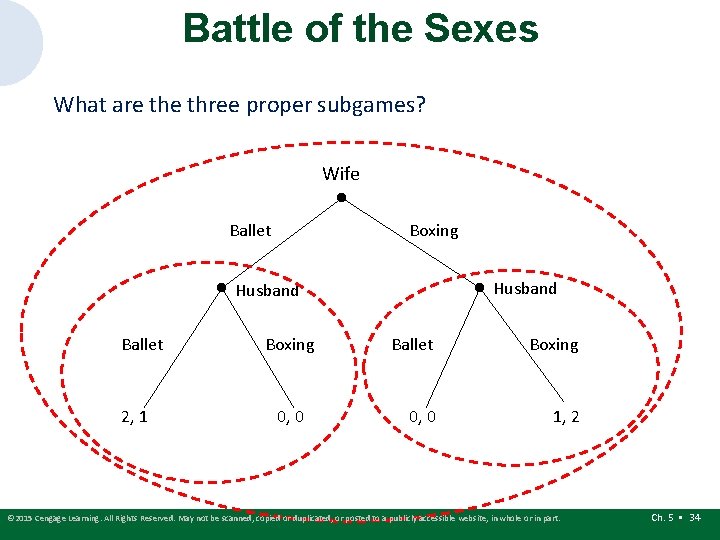
Battle of the Sexes What are three proper subgames? . Wife Ballet 2, 1 Boxing Husband Boxing 0, 0 . Husband Ballet Boxing 0, 0 1, 2 © 2015 Cengage Learning. All Rights Reserved. May not be scanned, copied or duplicated, or posted to a publicly accessible website, in whole or in part. Ch. 5 • 34
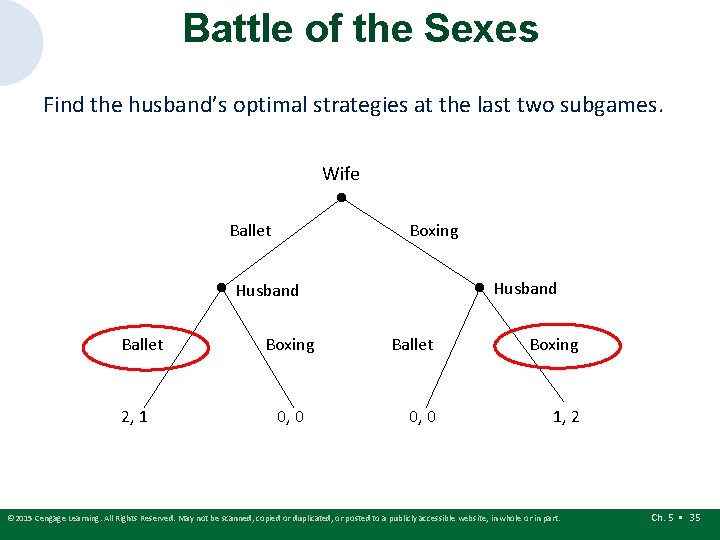
Battle of the Sexes Find the husband’s optimal strategies at the last two subgames. . Wife Ballet 2, 1 Boxing Husband Boxing 0, 0 . Husband Ballet Boxing 0, 0 1, 2 © 2015 Cengage Learning. All Rights Reserved. May not be scanned, copied or duplicated, or posted to a publicly accessible website, in whole or in part. Ch. 5 • 35
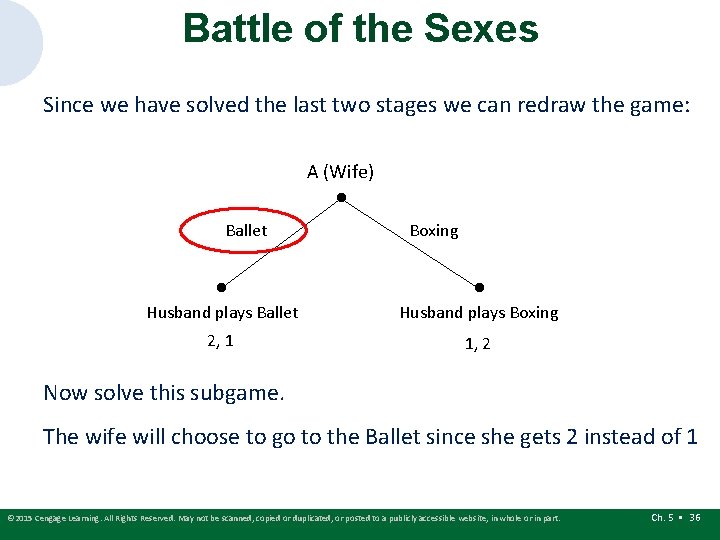
Battle of the Sexes Since we have solved the last two stages we can redraw the game: . A (Wife) Ballet . Boxing . Husband plays Ballet Husband plays Boxing 2, 1 1, 2 Now solve this subgame. The wife will choose to go to the Ballet since she gets 2 instead of 1 © 2015 Cengage Learning. All Rights Reserved. May not be scanned, copied or duplicated, or posted to a publicly accessible website, in whole or in part. Ch. 5 • 36
Repeated Games • Is there a way in which we can sustain cooperation in the Prisoners’ Dilemma? • Repeated game vs. a one-shot game. • A stage game is a simple game that is played repeatedly. • Trigger strategy – a strategy in a repeated game in which one player stops cooperating in order to punish another player for cheating. © 2015 Cengage Learning. All Rights Reserved. May not be scanned, copied or duplicated, or posted to a publicly accessible website, in whole or in part. Ch. 5 • 37
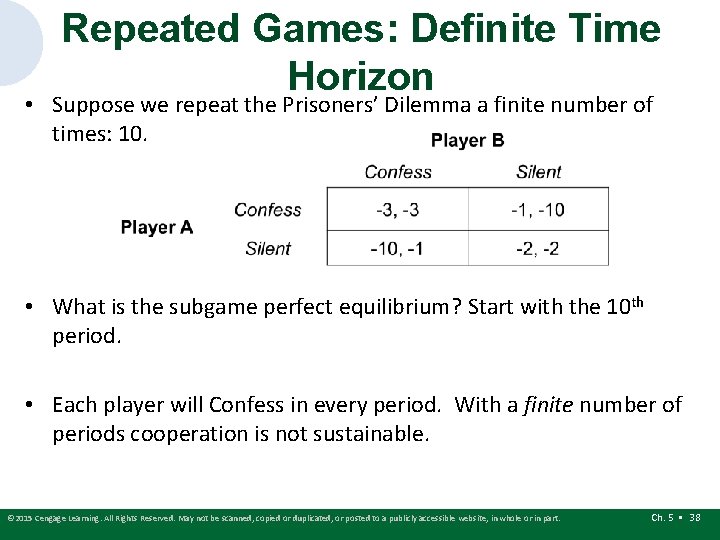
Repeated Games: Definite Time Horizon • Suppose we repeat the Prisoners’ Dilemma a finite number of times: 10. • What is the subgame perfect equilibrium? Start with the 10 th period. • Each player will Confess in every period. With a finite number of periods cooperation is not sustainable. © 2015 Cengage Learning. All Rights Reserved. May not be scanned, copied or duplicated, or posted to a publicly accessible website, in whole or in part. Ch. 5 • 38
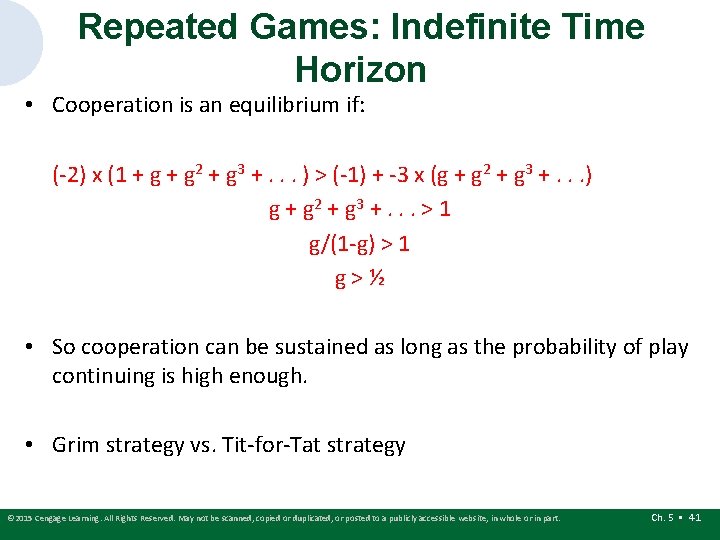
Repeated Games: Indefinite Time Horizon • Now suppose we repeat the Prisoners’ Dilemma an unknown number of times. • Under what conditions is cooperation sustainable? • Consider the following trigger strategy: – A player will stay silent as long as the other player stays silent. – If one player confesses, both players will confess from then on. • g - the probability that the game is repeated for another period. © 2015 Cengage Learning. All Rights Reserved. May not be scanned, copied or duplicated, or posted to a publicly accessible website, in whole or in part. Ch. 5 • 39
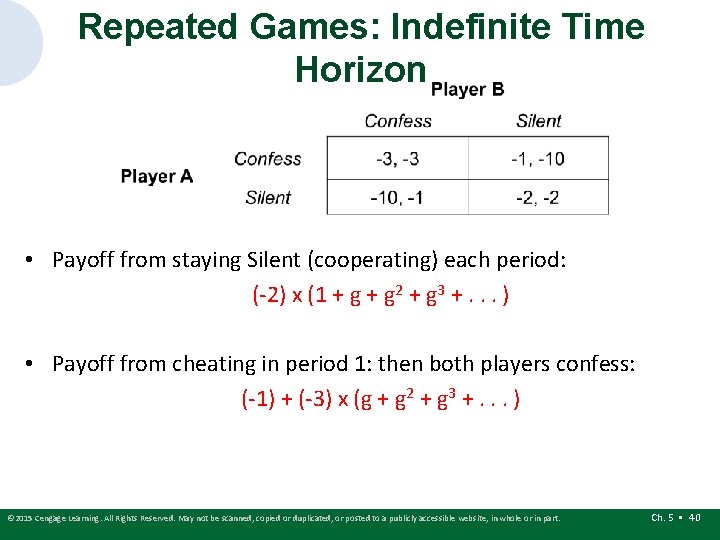
Repeated Games: Indefinite Time Horizon • Payoff from staying Silent (cooperating) each period: (-2) x (1 + g 2 + g 3 +. . . ) • Payoff from cheating in period 1: then both players confess: (-1) + (-3) x (g + g 2 + g 3 +. . . ) © 2015 Cengage Learning. All Rights Reserved. May not be scanned, copied or duplicated, or posted to a publicly accessible website, in whole or in part. Ch. 5 • 40
Repeated Games: Indefinite Time Horizon • Cooperation is an equilibrium if: (-2) x (1 + g 2 + g 3 +. . . ) > (-1) + -3 x (g + g 2 + g 3 +. . . ) g + g 2 + g 3 +. . . > 1 g/(1 -g) > 1 g>½ • So cooperation can be sustained as long as the probability of play continuing is high enough. • Grim strategy vs. Tit-for-Tat strategy © 2015 Cengage Learning. All Rights Reserved. May not be scanned, copied or duplicated, or posted to a publicly accessible website, in whole or in part. Ch. 5 • 41
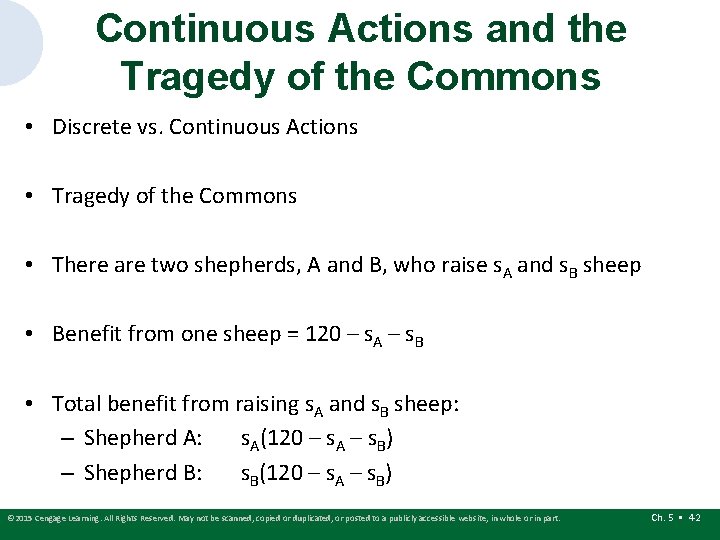
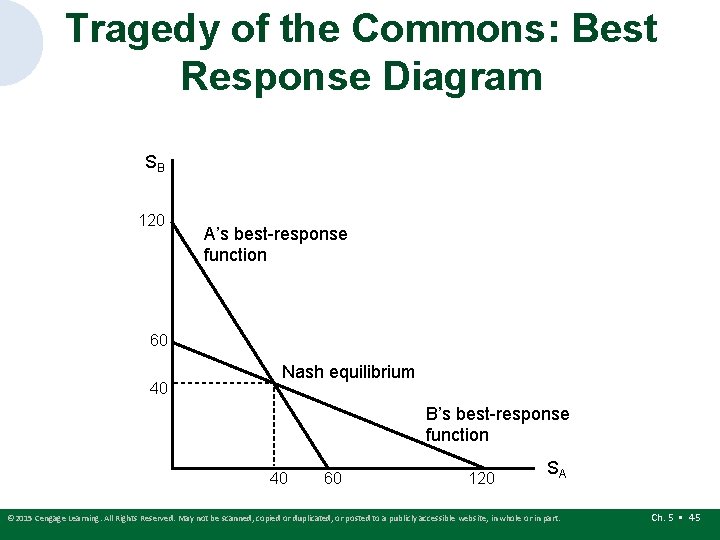
Continuous Actions and the Tragedy of the Commons • Discrete vs. Continuous Actions • Tragedy of the Commons • There are two shepherds, A and B, who raise s. A and s. B sheep • Benefit from one sheep = 120 – s. A – s. B • Total benefit from raising s. A and s. B sheep: – Shepherd A: s. A(120 – s. A – s. B) – Shepherd B: s. B(120 – s. A – s. B) © 2015 Cengage Learning. All Rights Reserved. May not be scanned, copied or duplicated, or posted to a publicly accessible website, in whole or in part. Ch. 5 • 42
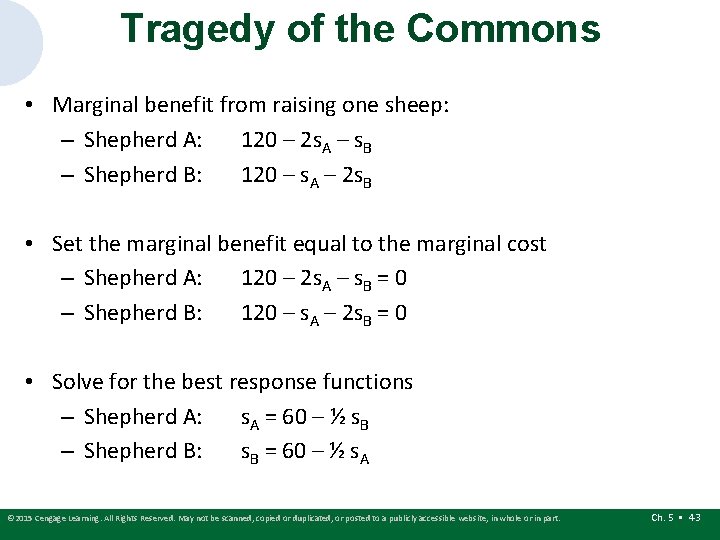
Tragedy of the Commons • Marginal benefit from raising one sheep: – Shepherd A: 120 – 2 s. A – s. B – Shepherd B: 120 – s. A – 2 s. B • Set the marginal benefit equal to the marginal cost – Shepherd A: 120 – 2 s. A – s. B = 0 – Shepherd B: 120 – s. A – 2 s. B = 0 • Solve for the best response functions – Shepherd A: s. A = 60 – ½ s. B – Shepherd B: s. B = 60 – ½ s. A © 2015 Cengage Learning. All Rights Reserved. May not be scanned, copied or duplicated, or posted to a publicly accessible website, in whole or in part. Ch. 5 • 43
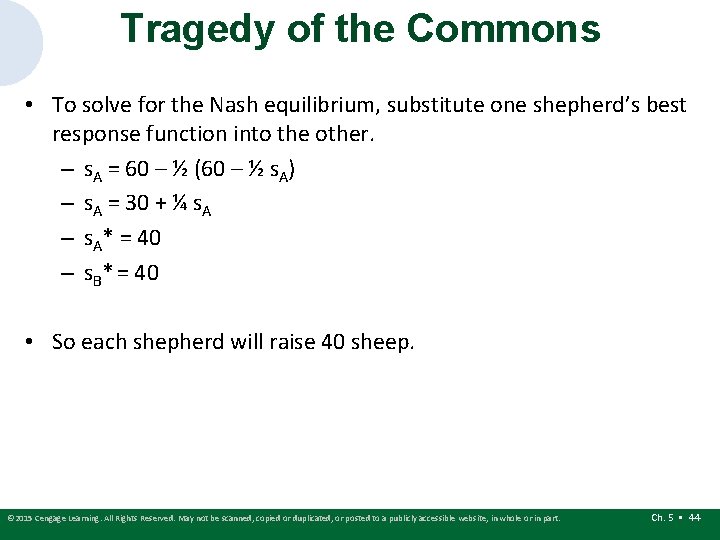
Tragedy of the Commons • To solve for the Nash equilibrium, substitute one shepherd’s best response function into the other. – s. A = 60 – ½ (60 – ½ s. A) – s. A = 30 + ¼ s. A – s. A* = 40 – s. B* = 40 • So each shepherd will raise 40 sheep. © 2015 Cengage Learning. All Rights Reserved. May not be scanned, copied or duplicated, or posted to a publicly accessible website, in whole or in part. Ch. 5 • 44
Tragedy of the Commons: Best Response Diagram SB 120 A’s best-response function 60 40 Nash equilibrium B’s best-response function 40 60 120 SA © 2015 Cengage Learning. All Rights Reserved. May not be scanned, copied or duplicated, or posted to a publicly accessible website, in whole or in part. Ch. 5 • 45
Tragedy of the Commons • Why is this referred to as the “Tragedy” of the Commons? © 2015 Cengage Learning. All Rights Reserved. May not be scanned, copied or duplicated, or posted to a publicly accessible website, in whole or in part. Ch. 5 • 46
Summar y • The basic elements of a game are players, strategies, payoffs, and information. • A Nash equilibrium is a set of strategies, one for each player, such that all players’ strategies are best responses to each other. • All games have at least one Nash equilibrium, which may involve mixed strategies. • If the Prisoners’ Dilemma is repeated an indefinite number of times, it is possible to sustain the cooperative outcome. © 2015 Cengage Learning. All Rights Reserved. May not be scanned, copied or duplicated, or posted to a publicly accessible website, in whole or in part. Ch. 5 • 47
Summar y • Sequential games allow the players to use contingent strategies. © 2015 Cengage Learning. All Rights Reserved. May not be scanned, copied or duplicated, or posted to a publicly accessible website, in whole or in part. Ch. 5 • 48