
Polarimetric Radar and NWP Synergies Jeffrey Snyder NRC
- Slides: 7
Polarimetric Radar and NWP Synergies Jeffrey Snyder (NRC) February 25– 27, 2015 National Weather Center Norman, Oklahoma
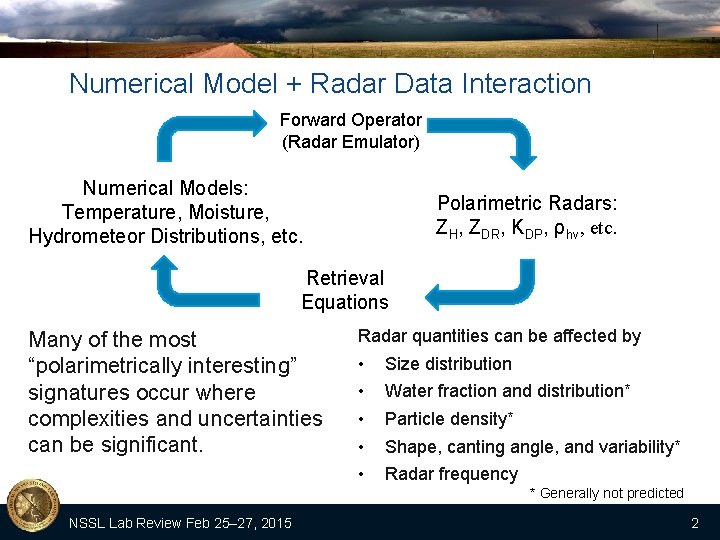
Numerical Model + Radar Data Interaction Forward Operator (Radar Emulator) Numerical Models: Temperature, Moisture, Hydrometeor Distributions, etc. Polarimetric Radars: ZH, ZDR, KDP, ρhv, etc. Retrieval Equations Many of the most “polarimetrically interesting” signatures occur where complexities and uncertainties can be significant. Radar quantities can be affected by • Size distribution • Water fraction and distribution* • Particle density* • Shape, canting angle, and variability* • Radar frequency * Generally not predicted NSSL Lab Review Feb 25– 27, 2015 2
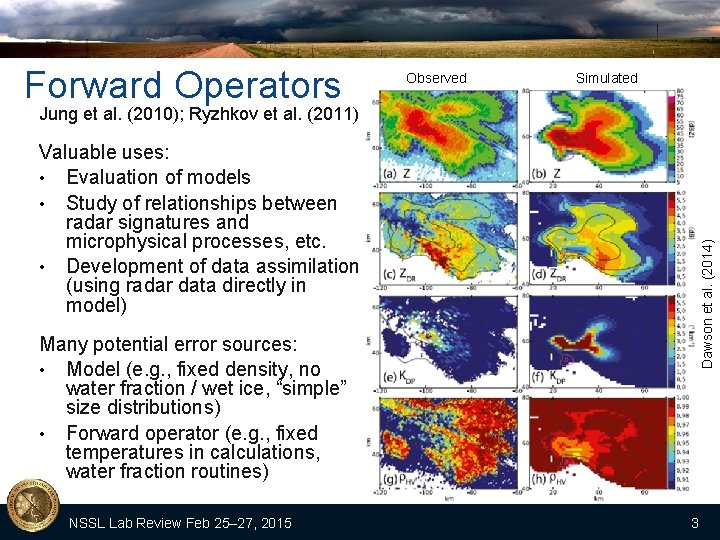
Forward Operators Observed Simulated Valuable uses: • Evaluation of models • Study of relationships between radar signatures and microphysical processes, etc. • Development of data assimilation (using radar data directly in model) Many potential error sources: • Model (e. g. , fixed density, no water fraction / wet ice, “simple” size distributions) • Forward operator (e. g. , fixed temperatures in calculations, water fraction routines) NSSL Lab Review Feb 25– 27, 2015 Dawson et al. (2014) Jung et al. (2010); Ryzhkov et al. (2011) 3
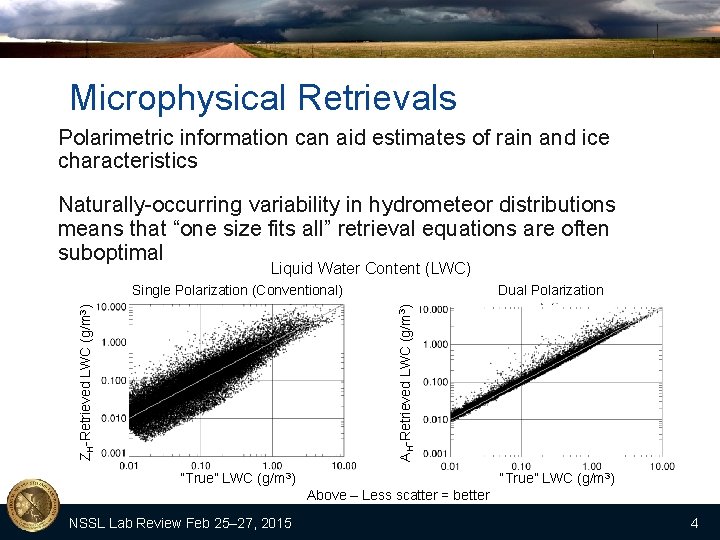
Microphysical Retrievals Polarimetric information can aid estimates of rain and ice characteristics Naturally-occurring variability in hydrometeor distributions means that “one size fits all” retrieval equations are often suboptimal Liquid Water Content (LWC) Single Polarization (Conventional) ZH-Retrieved LWC (g/m 3) AH-Retrieved LWC (g/m 3) Dual Polarization “True” LWC (g/m 3) Above – Less scatter = better NSSL Lab Review Feb 25– 27, 2015 4
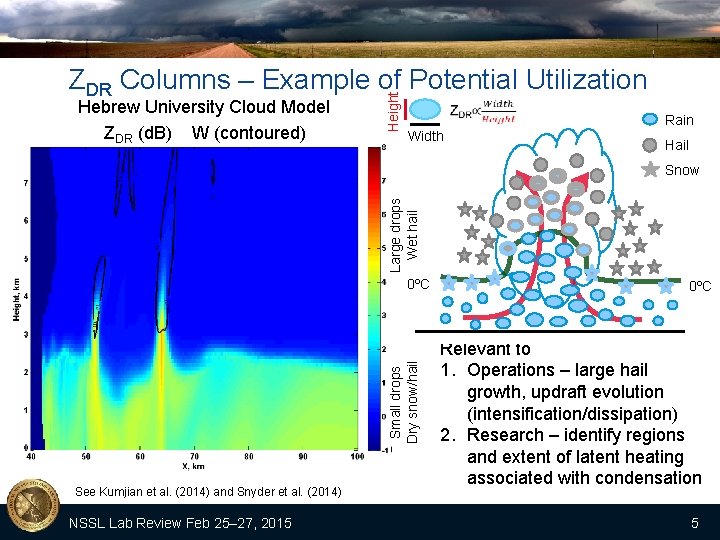
Hebrew University Cloud Model ZZ (d. BZ) W (contoured) DR (d. B) W (contoured) Height ZDR Columns – Example of Potential Utilization Width Rain Hail Large drops Wet hail Snow Small drops Dry snow/hail 0ºC See Kumjian et al. (2014) and Snyder et al. (2014) NSSL Lab Review Feb 25– 27, 2015 0ºC Relevant to 1. Operations – large hail growth, updraft evolution (intensification/dissipation) 2. Research – identify regions and extent of latent heating associated with condensation 5
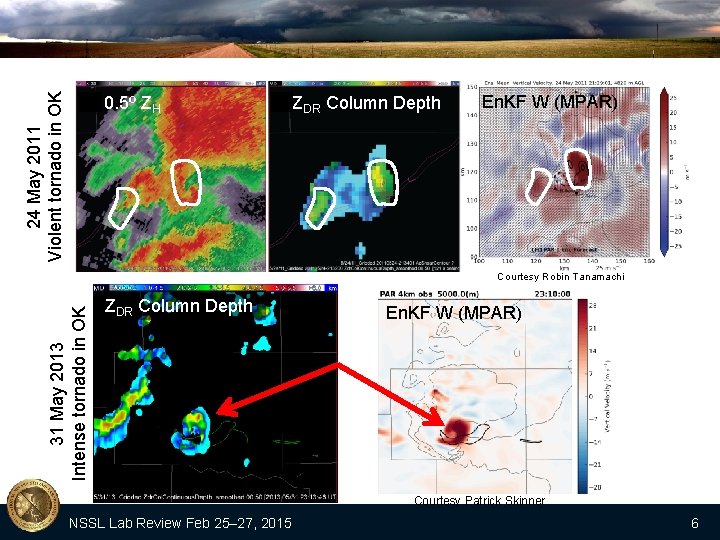
24 May 2011 Violent tornado in OK 0. 5º ZH ZDR Column Depth En. KF W (MPAR) 31 May 2013 Intense tornado in OK Courtesy Robin Tanamachi ZDR Column Depth En. KF W (MPAR) Courtesy Patrick Skinner NSSL Lab Review Feb 25– 27, 2015 6
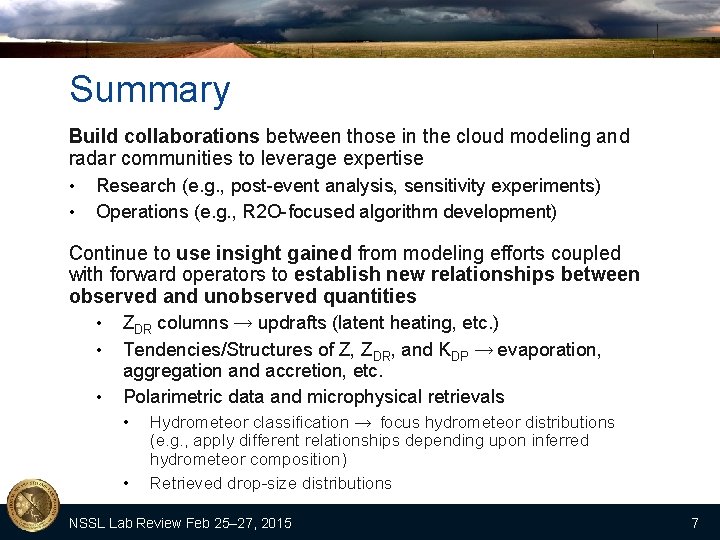
Summary Build collaborations between those in the cloud modeling and radar communities to leverage expertise • • Research (e. g. , post-event analysis, sensitivity experiments) Operations (e. g. , R 2 O-focused algorithm development) Continue to use insight gained from modeling efforts coupled with forward operators to establish new relationships between observed and unobserved quantities • • • ZDR columns → updrafts (latent heating, etc. ) Tendencies/Structures of Z, ZDR, and KDP → evaporation, aggregation and accretion, etc. Polarimetric data and microphysical retrievals • • Hydrometeor classification → focus hydrometeor distributions (e. g. , apply different relationships depending upon inferred hydrometeor composition) Retrieved drop-size distributions NSSL Lab Review Feb 25– 27, 2015 7