Vp CI Chemistry 101 Kristy Gillette Cortec Corporation

- Slides: 41
Vp. CI Chemistry 101 Kristy Gillette Cortec Corporation
CORROSION Natural process as natural as water flowing downhill
Corrosion inhibitors
Outline § § § Corrosion Prevention Corrosion Inhibitors Vapor-phase Corrosion Inhibitors (Vp. CI) Cortec’s Vp. CIs Conclusions
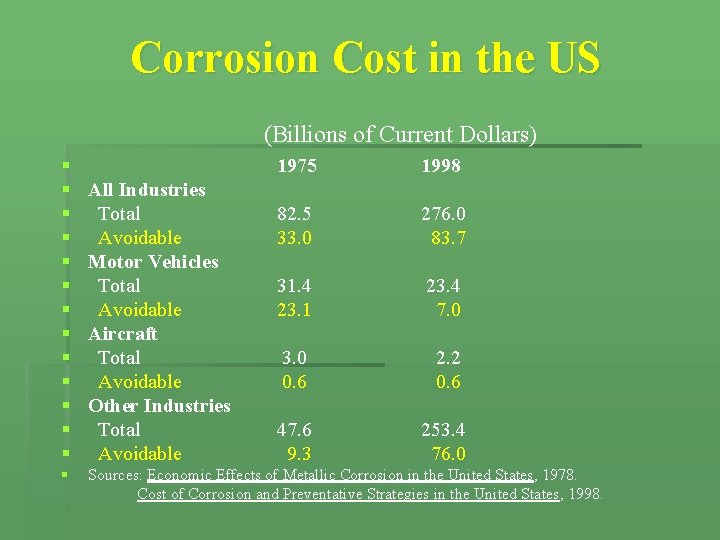
Corrosion Cost in the US (Billions of Current Dollars) § § § § All Industries Total Avoidable Motor Vehicles Total Avoidable Aircraft Total Avoidable Other Industries Total Avoidable § Sources: Economic Effects of Metallic Corrosion in the United States, 1978. Cost of Corrosion and Preventative Strategies in the United States, 1998. 1975 82. 5 33. 0 31. 4 23. 1 3. 0 0. 6 47. 6 9. 3 1998 276. 0 83. 7 23. 4 7. 0 2. 2 0. 6 253. 4 76. 0
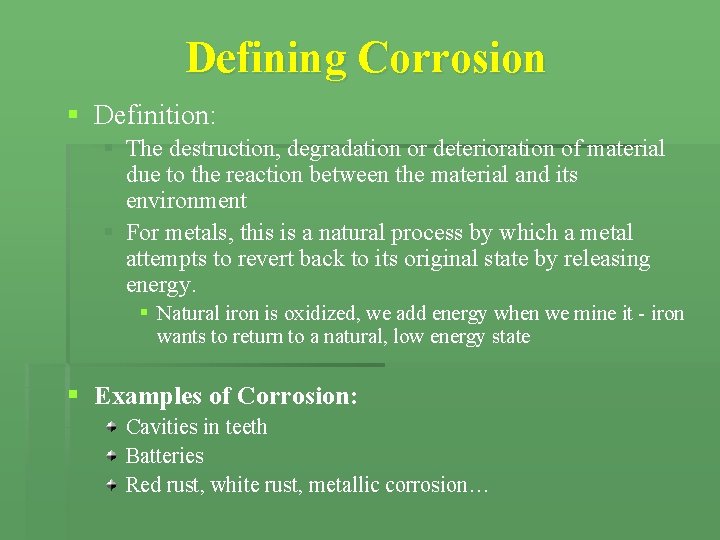
Defining Corrosion § Definition: § The destruction, degradation or deterioration of material due to the reaction between the material and its environment § For metals, this is a natural process by which a metal attempts to revert back to its original state by releasing energy. § Natural iron is oxidized, we add energy when we mine it - iron wants to return to a natural, low energy state § Examples of Corrosion: Cavities in teeth Batteries Red rust, white rust, metallic corrosion…
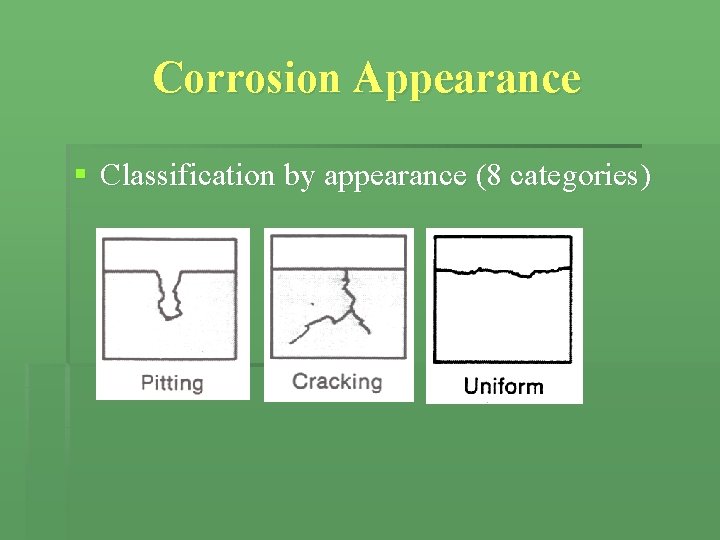
Corrosion Appearance § Classification by appearance (8 categories)
Corrosive Environments § § § § Moist air is more corrosive than dry air Hot air is more corrosive than cold air Hot water is more corrosive than cold water Polluted air is more corrosive than clean air Acids are more corrosive than bases (alkalies) Salt Water is more corrosive than fresh water Stainless steel will outlast ordinary steel No corrosion will occur in a vacuum, even at very high temperatures, etc.
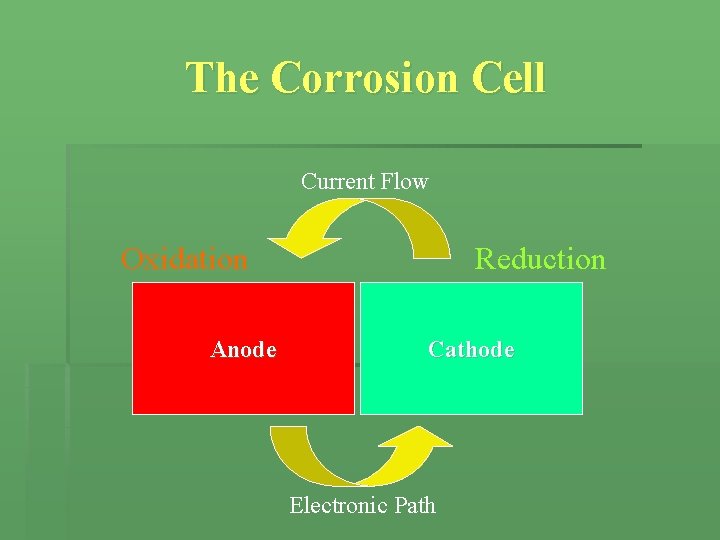
The Corrosion Cell Current Flow Oxidation Anode Reduction Cathode Electronic Path
Corrosion Prevention § Materials selection (more resistant metal) § Coatings (metallic, organic) § Design (eliminate dead spaces, crevices) § Cathodic and anodic protection (potential) § Alteration of environment § Corrosion inhibitors
Benefits of Corrosion Control § Reduce corrosion costs § lower maintenance and repair costs § extended useful lives of equipment and buildings § reduction of or reduced product loss from corrosion damage
Benefits of Corrosion Control § Lower risk of failure § safety § product liability § avoidance of regulation § loss of goodwill
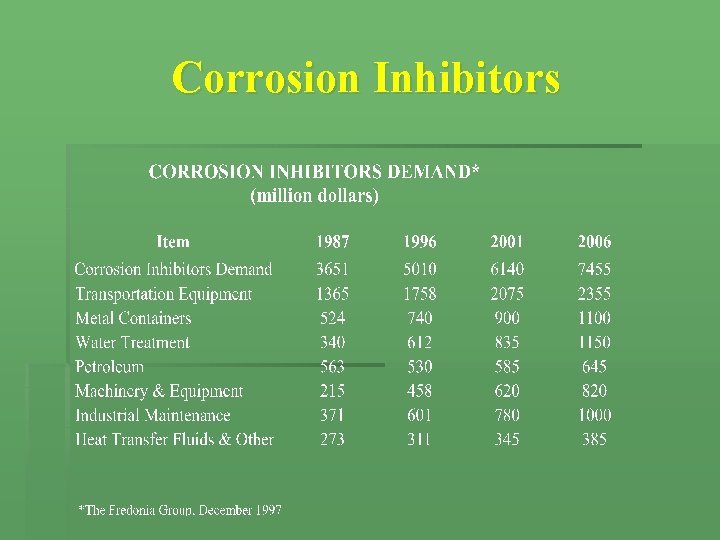
Corrosion Inhibitors
Corrosion Inhibitor Classification § Anodic (nitrites) § Cathodic (arsenic, bismuth, antimony) § Precipitation (silicates, phosphates) § Organic/Filming (amines, sulfonates) § Vapor-phase
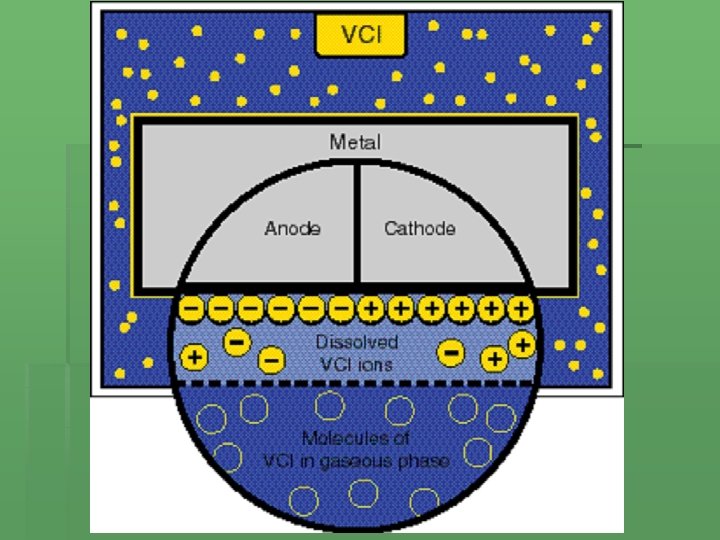
Vapor-Phase Corrosion Inhibitors § Definition: § Vapor-phase corrosion inhibitors condition an enclosed atmosphere with a protective vapor that condenses on all metal surfaces (including recessed areas, cavities) § A multi-metal corrosion inhibitor that protects in 3 phases- contact, vapor and interphase § Practical: § Prevents corrosion, even if not in direct contact allowing cost effective, easy application, use and disposal. Clean, dry and effective protection.
Vapor-Phase Corrosion Inhibitors History § Late 1900 s Discovery § Late 1940 s US Navy (boilers, piping systems) § 1950 s Begins New Research § 1977 Start of the Cortec Corporation
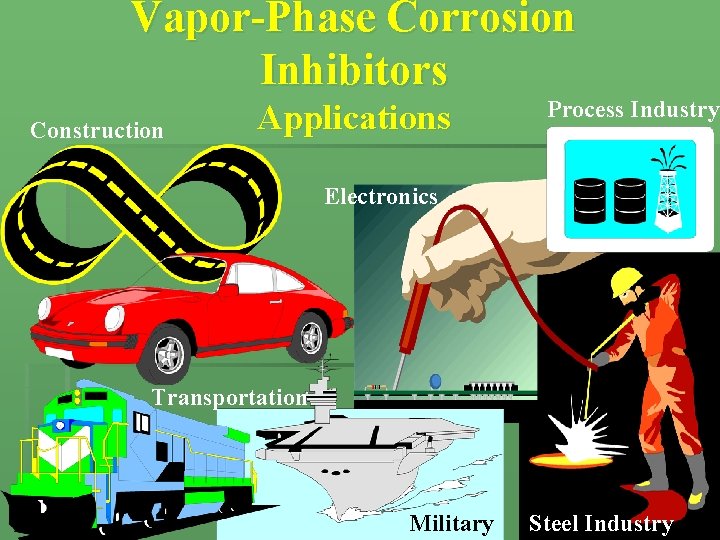
Vapor-Phase Corrosion Inhibitors Construction Applications Process Industry Electronics Transportation Military Steel Industry
How Do Vp. CIs Work? § Corrosion inhibiting molecules are emitted from their source § Molecules naturally diffuse from the source toward the metal § Molecules are adsorbed forming a protective film on metal § Film protects metal from corrosion
Vp. CIs Effectiveness Factors § Vapor Pressure § Diffusion § Evaporation/Sublimation Rates § Chemical Composition § Environmental Factors § Temperature, Air Flow, Humidity, Cleanliness
Vapor Pressure § Definition: § The pressure exerted when a solid or liquid is in equilibrium with its own vapor. The vapor pressure is a function of the substance and of the temperature
Vapor Pressure Explained Vapor pressure reflects HOW MUCH of a substance is required to reach saturation low VP means a small amount is required high VP means a large amount is required Vp. CI vapor pressure is lower than water, therefore, given a specific air space (package or enclosure), only a small quantity of Vp. CI is required to counteract the effects of a relatively large quantity of moisture vapor.
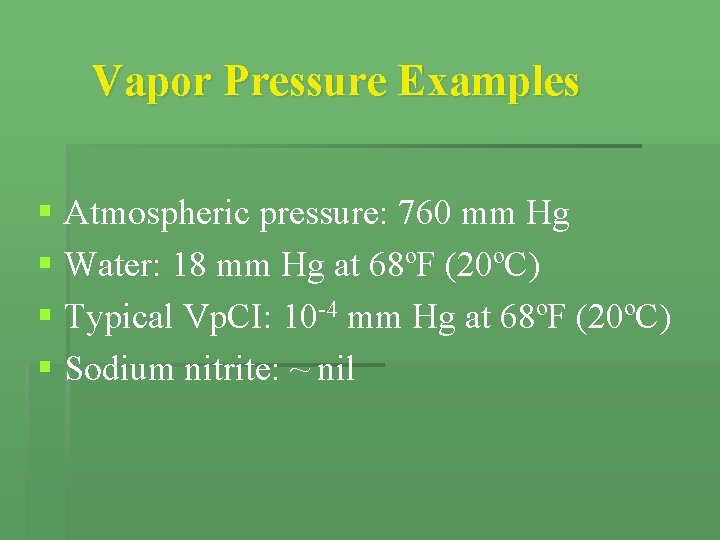
Vapor Pressure Examples § Atmospheric pressure: 760 mm Hg § Water: 18 mm Hg at 68ºF (20ºC) § Typical Vp. CI: 10 -4 mm Hg at 68ºF (20ºC) § Sodium nitrite: ~ nil
Vp. CIs Effectiveness Factors üVapor Pressure § Diffusion § Evaporation/Sublimation Rates § Chemical Composition § Environmental Factors § Temperature, Air Flow, Humidity, Cleanliness
Diffusion § Governed by Fick’s Law § Natural process by which Vp. CI molecules travel from an area of high Vp. CI concentration to an area of low Vp. CI concentration until equilibrium is reached § Examples: § In cell biology, diffusion is the main form of transport for necessary materials through cells (amino acids, ion transport, etc…) § Deflation of helium balloon § Aroma of fresh baked cookies diffuses through the kitchen/home
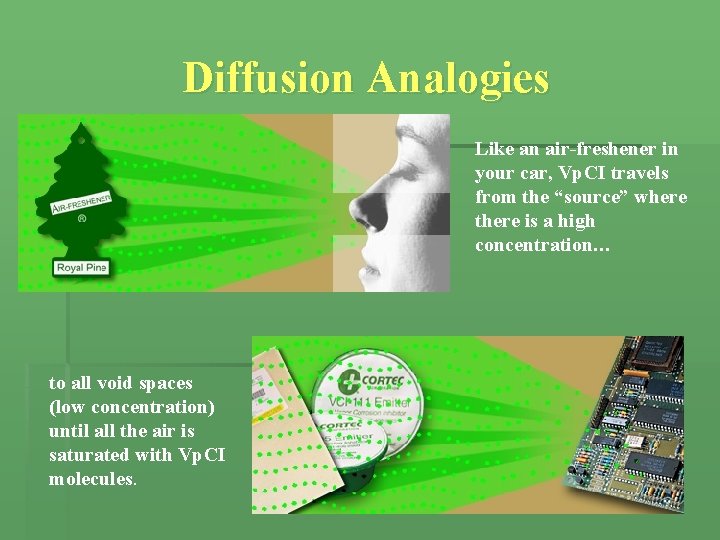
Diffusion Analogies Like an air-freshener in your car, Vp. CI travels from the “source” where there is a high concentration… to all void spaces (low concentration) until all the air is saturated with Vp. CI molecules.
Vp. CIs Effectiveness Factors üVapor Pressure üDiffusion § Evaporation/Sublimation Rates § Chemical Composition § Environmental Factors § Temperature, Air Flow, Humidity, Cleanliness
Evaporation & Sublimation Rates § Determines how quickly saturation occurs § Evaporation (Liquid Gas) § Determines how quickly molecules are released. § Different substances will release gaseous molecules at different rates. § Too fast may mean not long enough protection § Too slow may mean no protection achieved § Sublimation (Solid Gas) § Same as above, but think about Vp. CI powder, which is a solid, but emits a vapor.
Vp. CIs Effectiveness Factors üVapor Pressure üDiffusion üEvaporation/Sublimation Rates § Chemical Composition § Environmental Factors § Temperature, Air Flow, Humidity, Cleanliness
Chemical Composition § Vp. CI molecules are “polar” meaning they are attracted to metal, rather than just passing past the metal. § Vp. CI molecules adsorb onto metal surfaces Adsorption = accumulation of atoms/molecules onto the surface Absorption = diffusion of molecules into a liquid or solid
Vp. CIs Effectiveness Factors üVapor Pressure üDiffusion üEvaporation/Sublimation Rates üChemical Composition § Environmental Factors § Temperature, Air Flow, Humidity, Cleanliness
Environmental Factors § Temperature § The higher the temperature, the higher the vapor pressure § Hot air is more corrosive than cold § Air Flow § Accelerates the depletion of Vp. CIs § Humidity § Moisture is corrosive. § Requires excess Vp. CI to combat the acts of moisture. § Cleanliness § Contamination causes corrosion § Oils and dirt act as barrier to Vp. CIs
Putting It All Together Vp. CI products emit a protective vapor that adsorbs onto multi-metal surfaces, protecting both the anode and cathode. § Quantity to reach saturation = Vapor Pressure § Ability to travel to recessed areas = Diffusion § How quickly molecules go into vapor phase = Evaporation/Sublimation rate
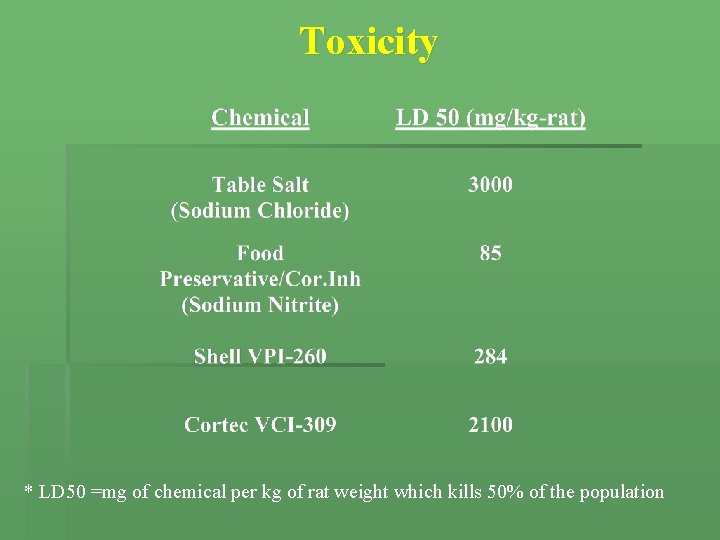
Vapor-Phase Corrosion Inhibitors Benefits § Cost effectiveness (Vp. CI vs. barrier bags + desiccants) § Ease of use (recessed areas) § Cleanliness (thin layer) § Safety/Environment (LD 50)
Toxicity * LD 50 =mg of chemical per kg of rat weight which kills 50% of the population
Cortec’s Vp. CIs § § § Multi-metal protection (Vp. CI-126) Multi-functional (Vp. CI-125, Vp. CI-377) Very low toxicity (Vp. CI-309) Environmental friendly (ISO 14001) Superior quality system (ISO 9001)
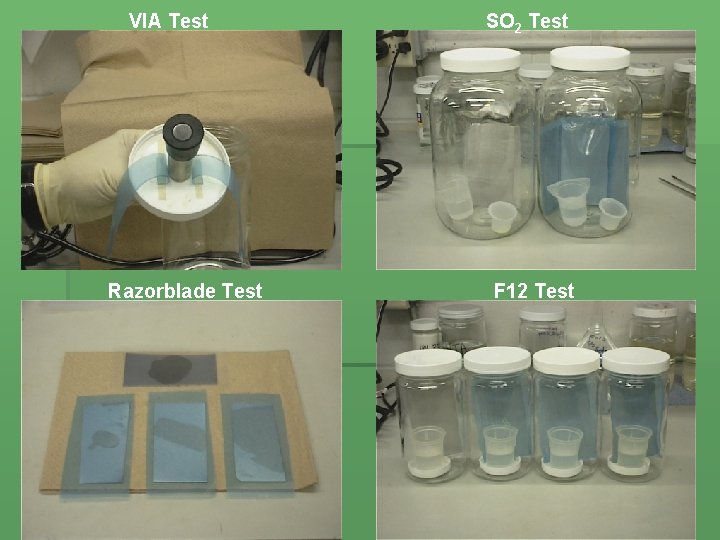
Test Methods n Vapor Inhibiting Ability VIA (Fed. Std. 101 C) n Razorblade n Half Immersion Test n Electro-Chemical Polarization Resistance, Tafel Plots, etc. n SO 2 and F-12 n Others n. Accelerated corrosion testing (humidity, salt spray, QUV, etc…)
VIA Test Razorblade Test SO 2 Test F 12 Test
Important Parameters Of Use § § § Surface cleanliness Surface finish Conditioning Contaminants Source exhaustion Others
Defining Performance § Protection § Long/short term § Distance from source § Conditions § Humidity § Temperature § Corrosive agents, contaminants
Conclusions § § § Corrosion prevention Corrosion inhibitors Vapor-phase corrosion inhibitors Cortec’s Vp. CIs