
VCO Fundamentals John Mc Neill Worcester Polytechnic Institute
![Frequency Range • Change in slope [MHz/V] over tuning voltage range 43](https://slidetodoc.com/presentation_image_h/97ddf48c8c816c0c1e3d8103edd6d76e/image-43.jpg "Frequency Range • Change in slope [MHz/V] over tuning voltage range 43")
- Slides: 62
VCO Fundamentals John Mc. Neill Worcester Polytechnic Institute mcneill@ece. wpi. edu
Overview • • • Functional Block Concept Oscillator Review Basic Performance Metrics Methods of Tuning Advanced Performance Metrics Conclusion 2
Overview • Functional Block Concept – Applications – Specifications • Oscillator Review • Basic Performance Metrics • Methods of Tuning • Advanced Performance Metrics • Conclusion 3
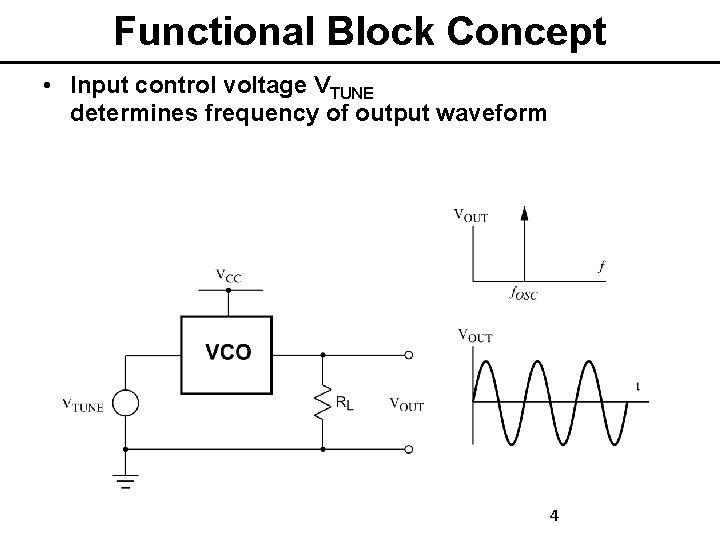
Functional Block Concept • Input control voltage VTUNE determines frequency of output waveform 4
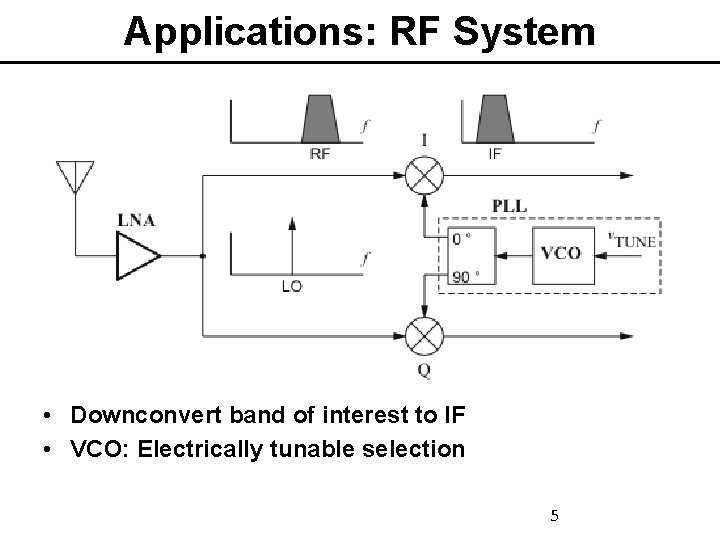
Applications: RF System • Downconvert band of interest to IF • VCO: Electrically tunable selection 5
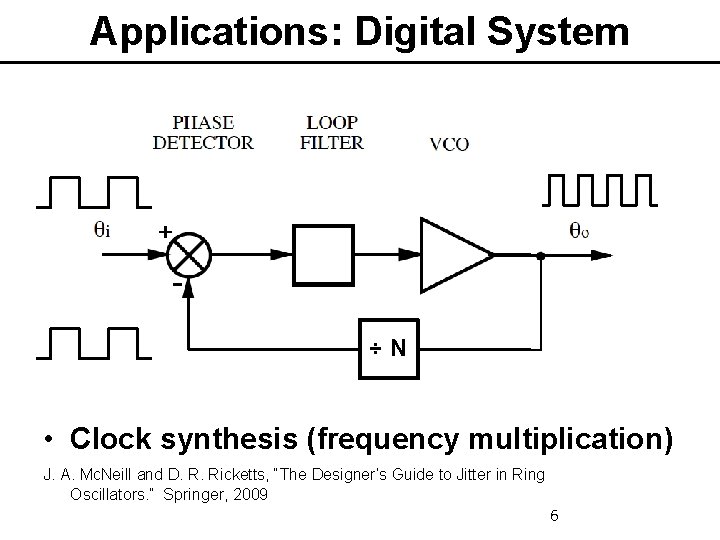
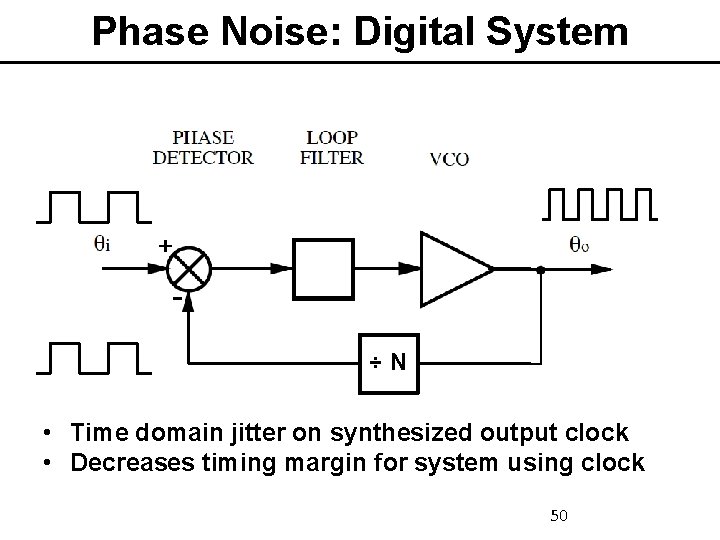
Applications: Digital System ÷N • Clock synthesis (frequency multiplication) J. A. Mc. Neill and D. R. Ricketts, “The Designer’s Guide to Jitter in Ring Oscillators. ” Springer, 2009 6
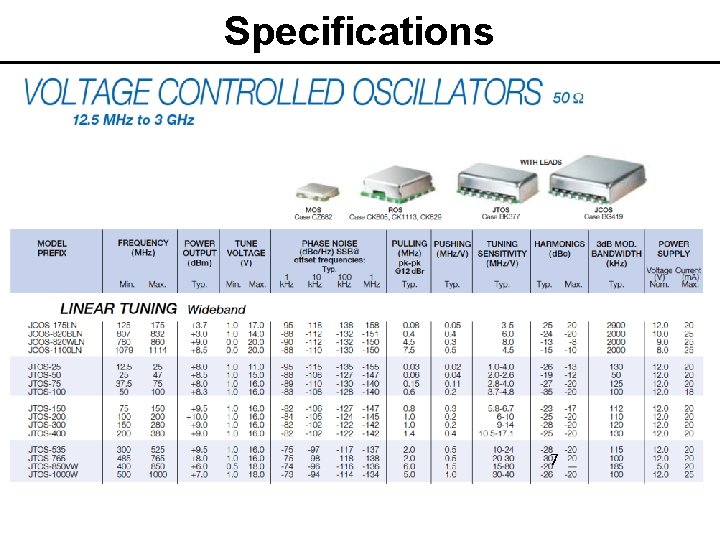
Specifications • from data sheet showing specs 7
Overview • Functional Block Concept • Oscillator Review – Frequency Control – Amplitude Control – Types of Oscillators • Basic Performance Metrics • Methods of Tuning • Advanced Performance Metrics • Conclusion 8
Oscillator Review • Types of Oscillators – Multivibrator – Ring – Resonant – Feedback • Basic Factors in Oscillator Design – Frequency – Amplitude / Output Power – Startup 9
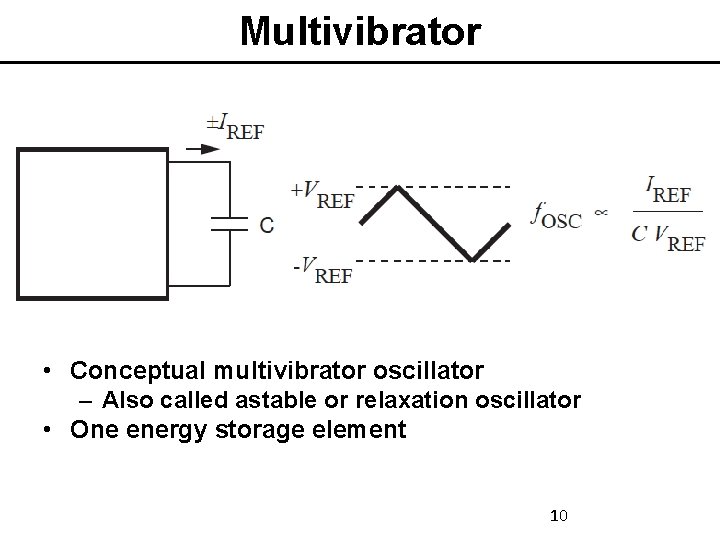
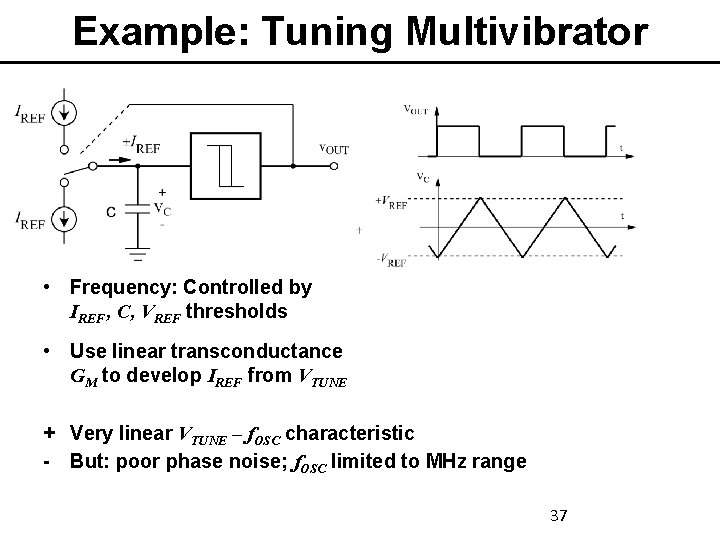
Multivibrator • Conceptual multivibrator oscillator – Also called astable or relaxation oscillator • One energy storage element 10
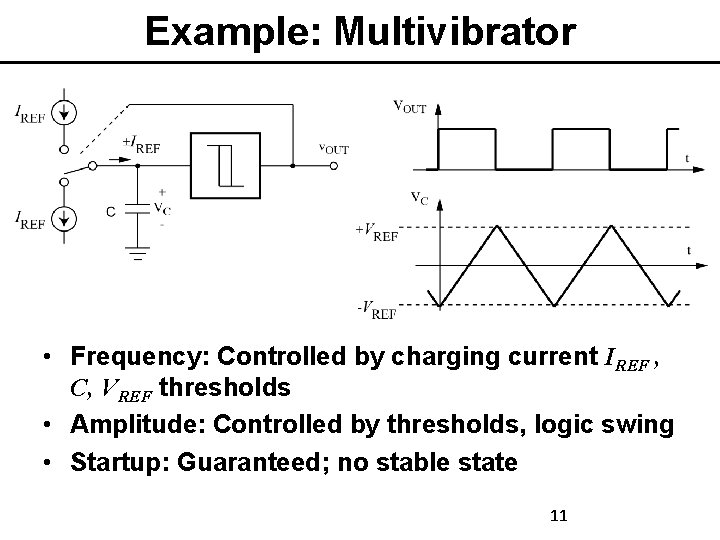
Example: Multivibrator • Frequency: Controlled by charging current IREF , C, VREF thresholds • Amplitude: Controlled by thresholds, logic swing • Startup: Guaranteed; no stable state 11
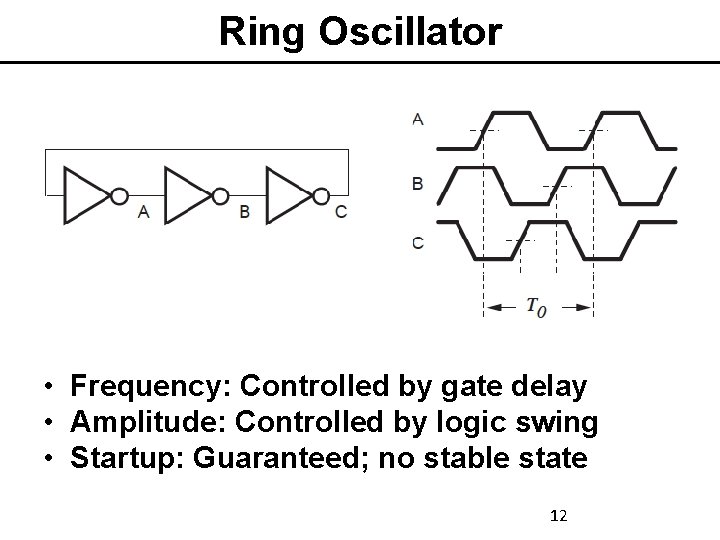
Ring Oscillator • Frequency: Controlled by gate delay • Amplitude: Controlled by logic swing • Startup: Guaranteed; no stable state 12
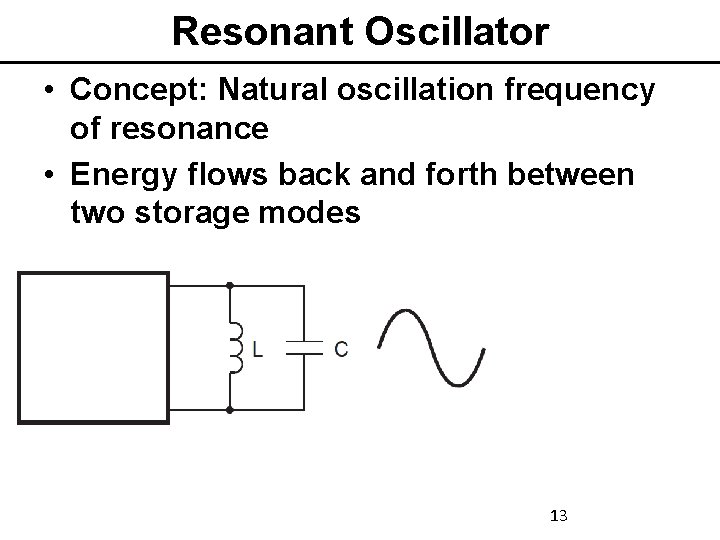
Resonant Oscillator • Concept: Natural oscillation frequency of resonance • Energy flows back and forth between two storage modes 13
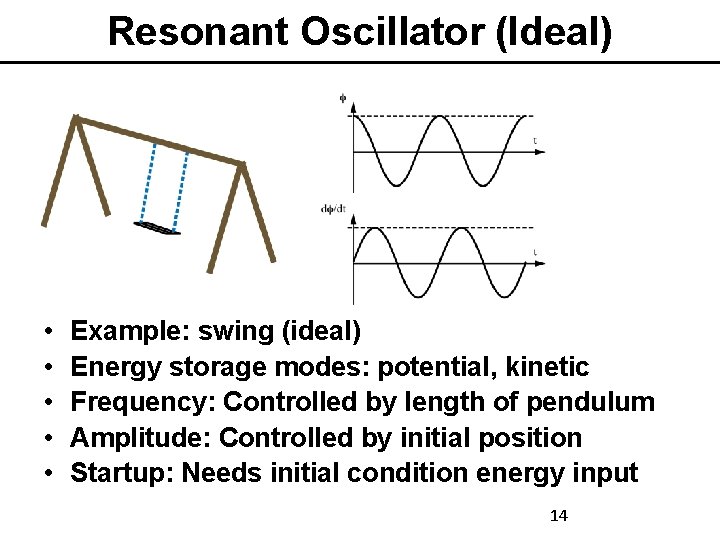
Resonant Oscillator (Ideal) • • • Example: swing (ideal) Energy storage modes: potential, kinetic Frequency: Controlled by length of pendulum Amplitude: Controlled by initial position Startup: Needs initial condition energy input 14
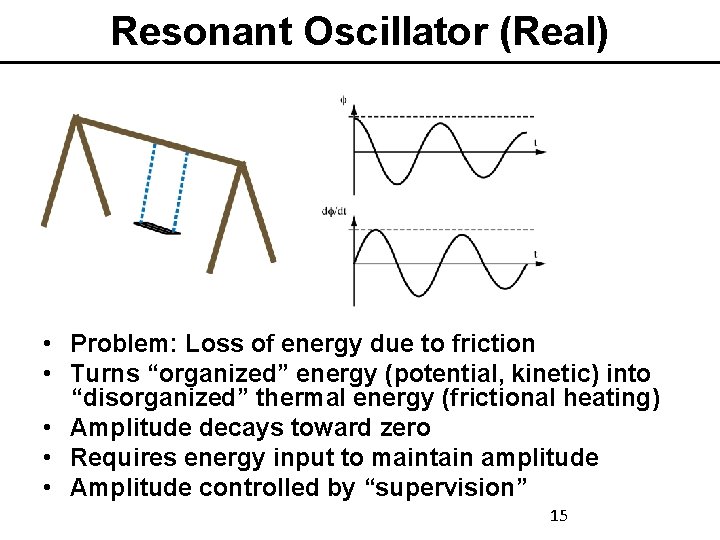
Resonant Oscillator (Real) • Problem: Loss of energy due to friction • Turns “organized” energy (potential, kinetic) into “disorganized” thermal energy (frictional heating) • Amplitude decays toward zero • Requires energy input to maintain amplitude • Amplitude controlled by “supervision” 15
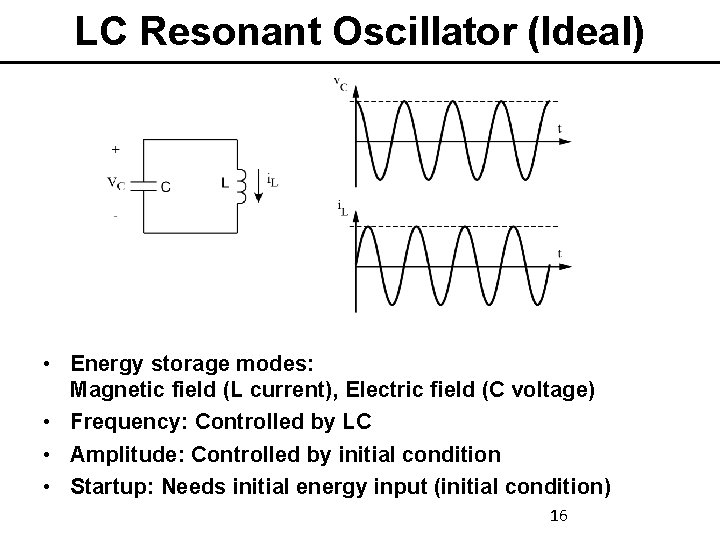
LC Resonant Oscillator (Ideal) • Energy storage modes: Magnetic field (L current), Electric field (C voltage) • Frequency: Controlled by LC • Amplitude: Controlled by initial condition • Startup: Needs initial energy input (initial condition) 16
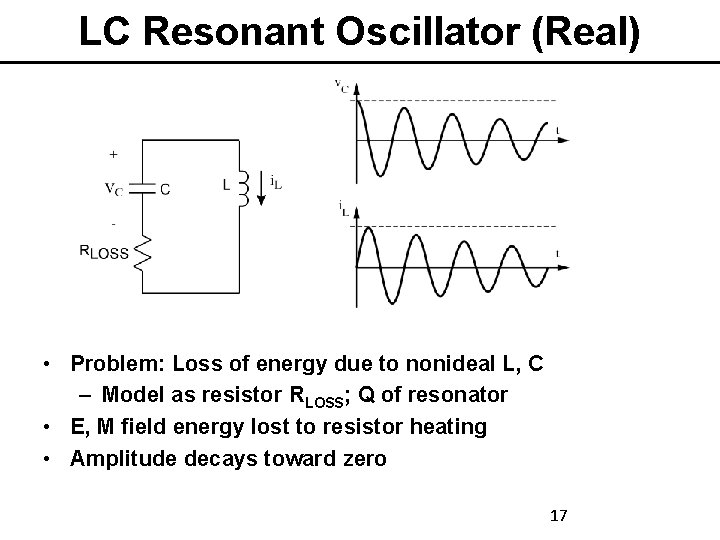
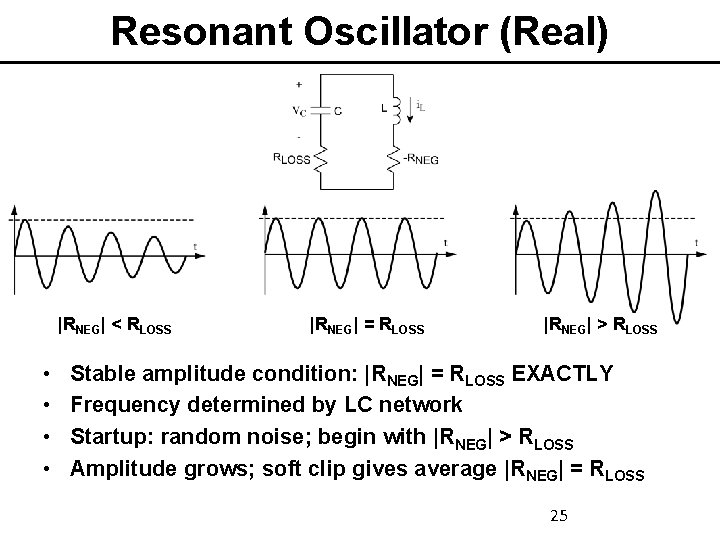
LC Resonant Oscillator (Real) • Problem: Loss of energy due to nonideal L, C – Model as resistor RLOSS; Q of resonator • E, M field energy lost to resistor heating • Amplitude decays toward zero 17
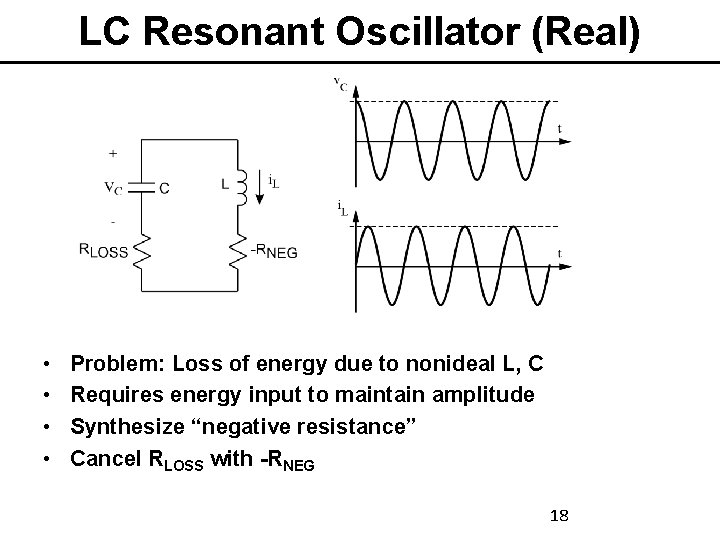
LC Resonant Oscillator (Real) • • Problem: Loss of energy due to nonideal L, C Requires energy input to maintain amplitude Synthesize “negative resistance” Cancel RLOSS with -RNEG 18
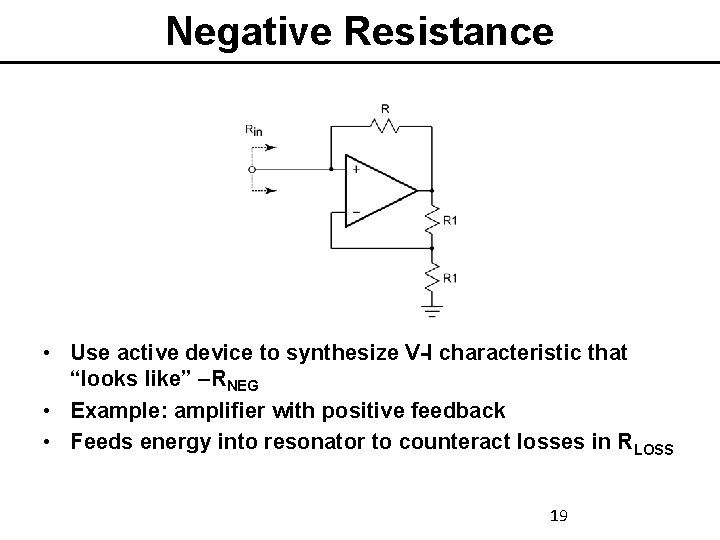
Negative Resistance • Use active device to synthesize V-I characteristic that “looks like” –RNEG • Example: amplifier with positive feedback • Feeds energy into resonator to counteract losses in RLOSS 19
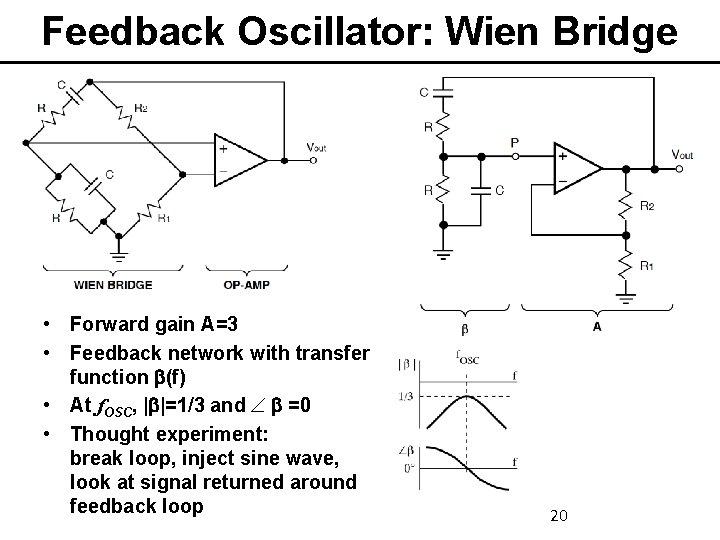
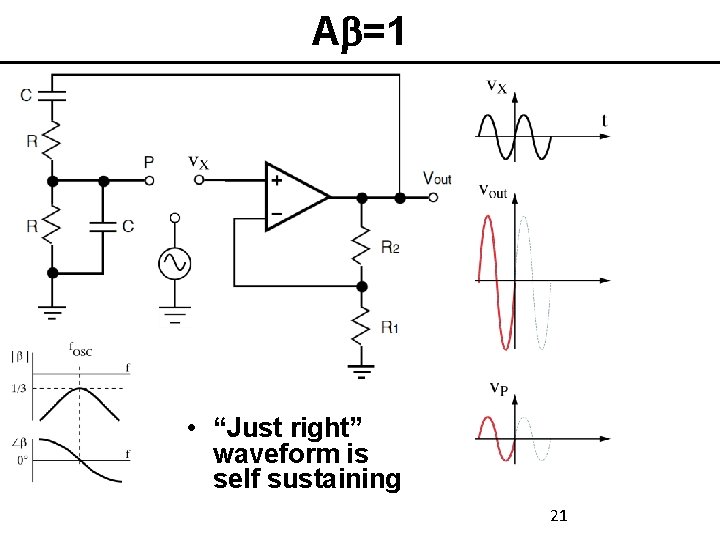
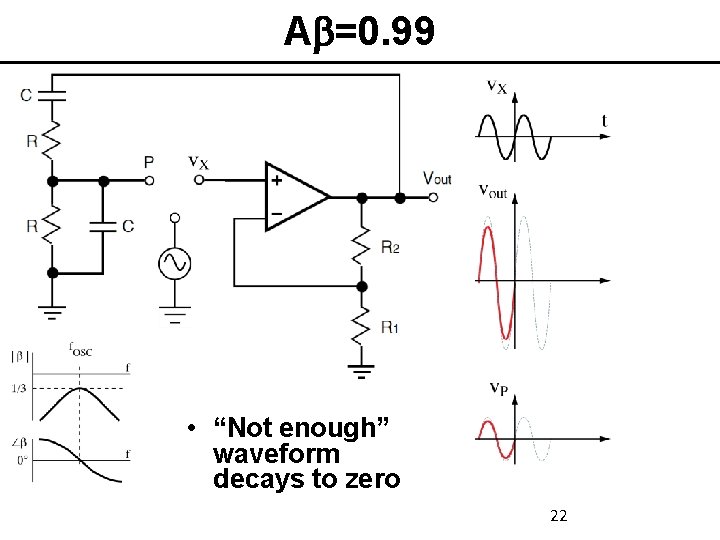
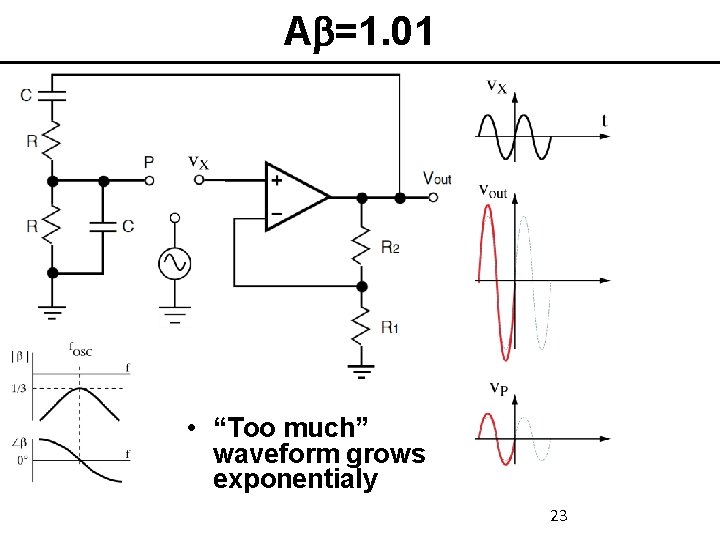
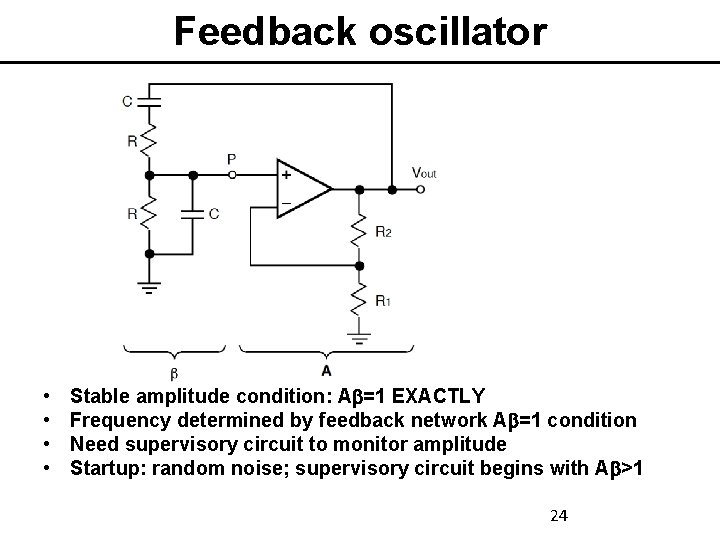
Feedback Oscillator: Wien Bridge • Forward gain A=3 • Feedback network with transfer function b(f) • At f. OSC, |b|=1/3 and b =0 • Thought experiment: break loop, inject sine wave, look at signal returned around feedback loop 20
Ab=1 • “Just right” waveform is self sustaining 21
Ab=0. 99 • “Not enough” waveform decays to zero 22
Ab=1. 01 • “Too much” waveform grows exponentialy 23
Feedback oscillator • • Stable amplitude condition: Ab=1 EXACTLY Frequency determined by feedback network Ab=1 condition Need supervisory circuit to monitor amplitude Startup: random noise; supervisory circuit begins with Ab>1 24
Resonant Oscillator (Real) |RNEG| < RLOSS • • |RNEG| = RLOSS |RNEG| > RLOSS Stable amplitude condition: |RNEG| = RLOSS EXACTLY Frequency determined by LC network Startup: random noise; begin with |RNEG| > RLOSS Amplitude grows; soft clip gives average |RNEG| = RLOSS 25
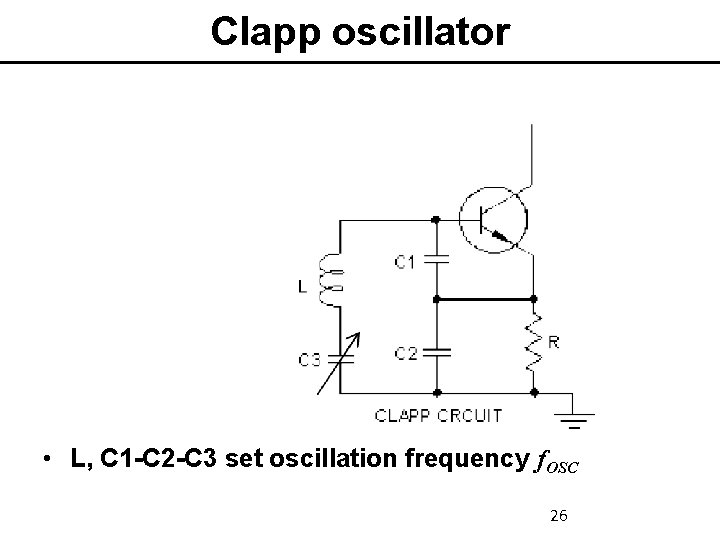
Clapp oscillator • L, C 1 -C 2 -C 3 set oscillation frequency f. OSC 26
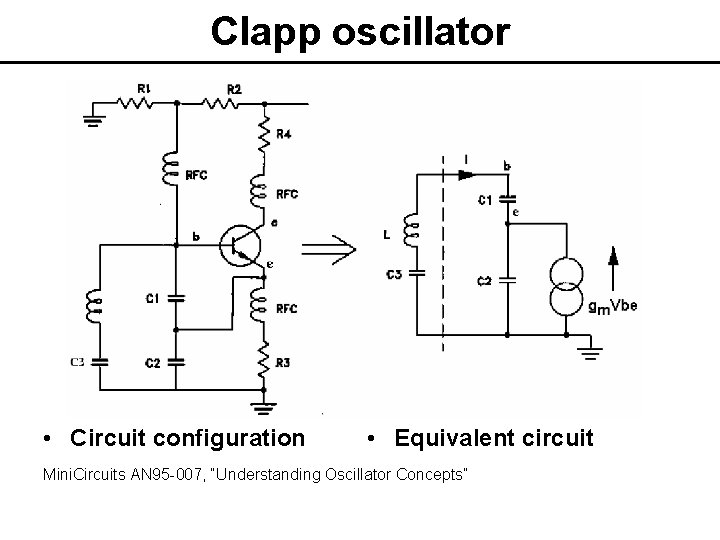
Clapp oscillator • Circuit configuration • Equivalent circuit Mini. Circuits AN 95 -007, “Understanding Oscillator Concepts”
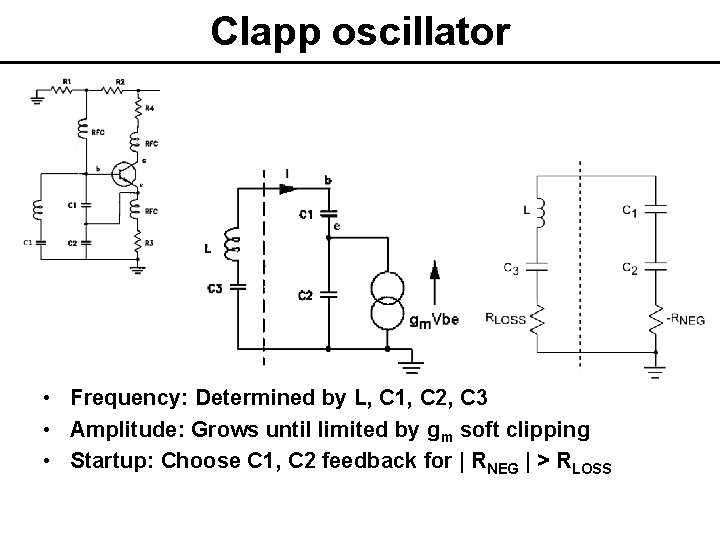
Clapp oscillator • Frequency: Determined by L, C 1, C 2, C 3 • Amplitude: Grows until limited by gm soft clipping • Startup: Choose C 1, C 2 feedback for | RNEG | > RLOSS
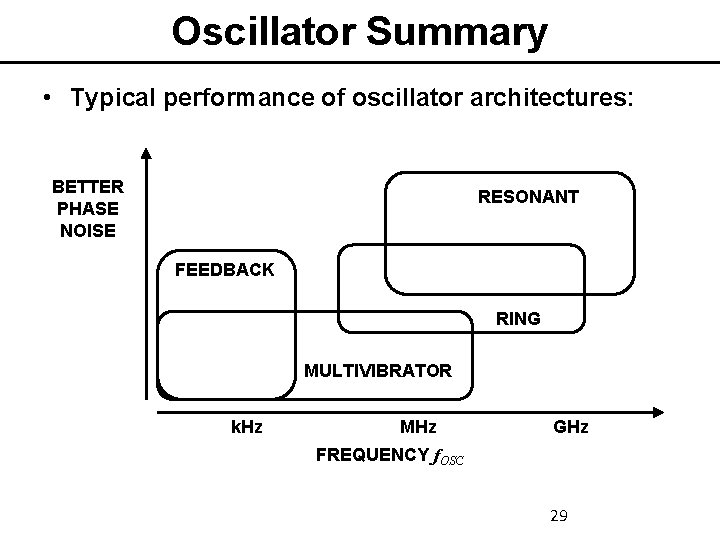
Oscillator Summary • Typical performance of oscillator architectures: BETTER PHASE NOISE RESONANT FEEDBACK RING MULTIVIBRATOR k. Hz MHz GHz FREQUENCY f. OSC 29
Overview • Functional Block Concept • Oscillator Review • Basic Performance Metrics – Frequency Range – Tuning Range • Methods of Tuning • Advanced Performance Metrics • Conclusion 30
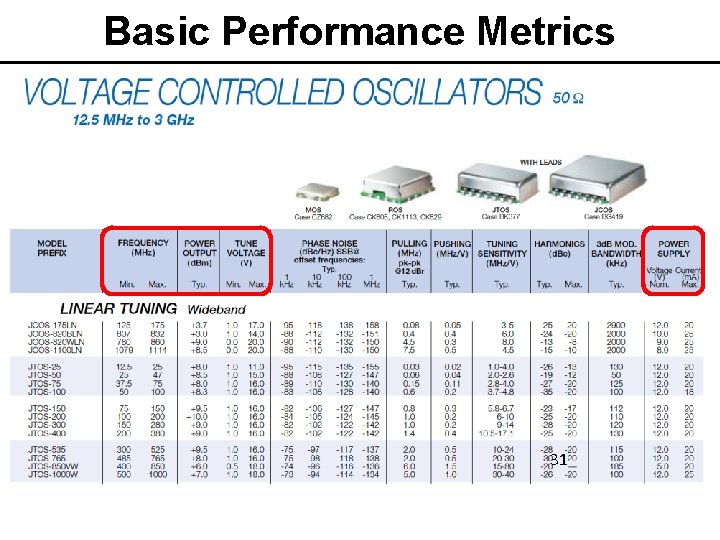
Basic Performance Metrics • from data sheet showing specs 31
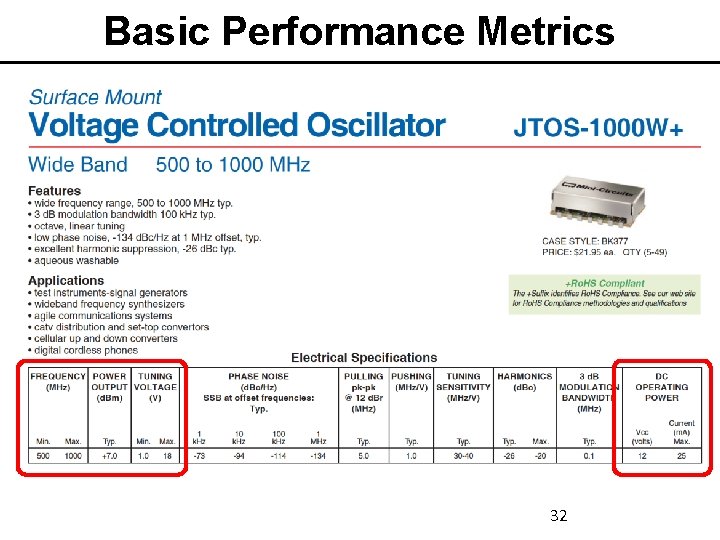
Basic Performance Metrics • from data sheet showing specs 32
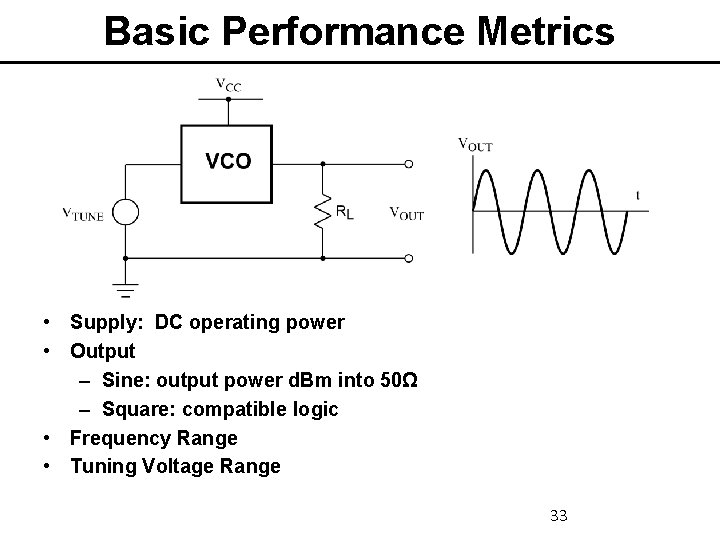
Basic Performance Metrics • Supply: DC operating power • Output – Sine: output power d. Bm into 50Ω – Square: compatible logic • Frequency Range • Tuning Voltage Range 33
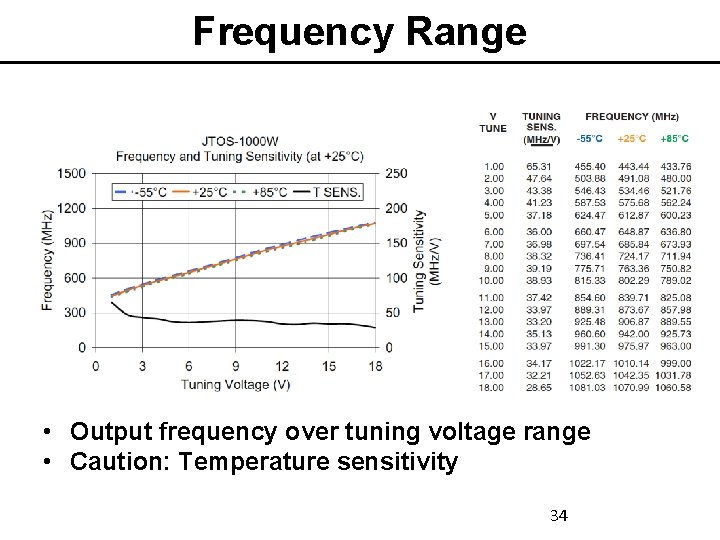
Frequency Range • Output frequency over tuning voltage range • Caution: Temperature sensitivity 34
Overview • • • Functional Block Concept Oscillator Review Basic Performance Metrics Methods of Tuning Advanced Performance Metrics Conclusion 35
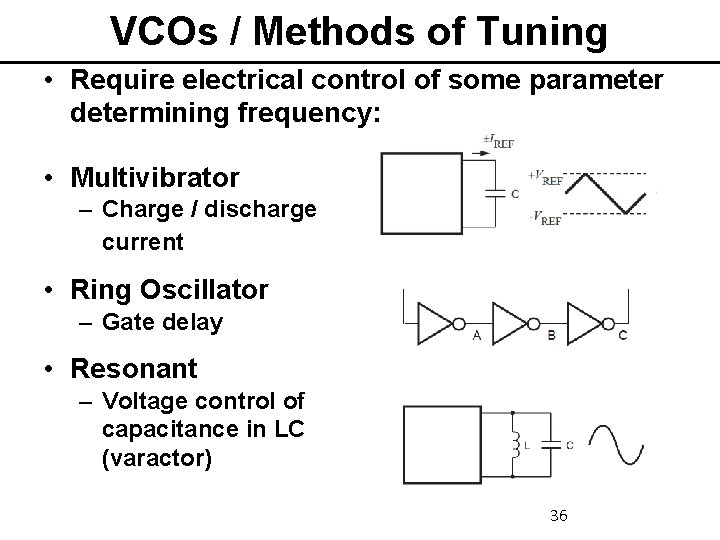
VCOs / Methods of Tuning • Require electrical control of some parameter determining frequency: • Multivibrator – Charge / discharge current • Ring Oscillator – Gate delay • Resonant – Voltage control of capacitance in LC (varactor) 36
Example: Tuning Multivibrator • Frequency: Controlled by IREF , C, VREF thresholds • Use linear transconductance GM to develop IREF from VTUNE + Very linear VTUNE – f. OSC characteristic - But: poor phase noise; f. OSC limited to MHz range 37
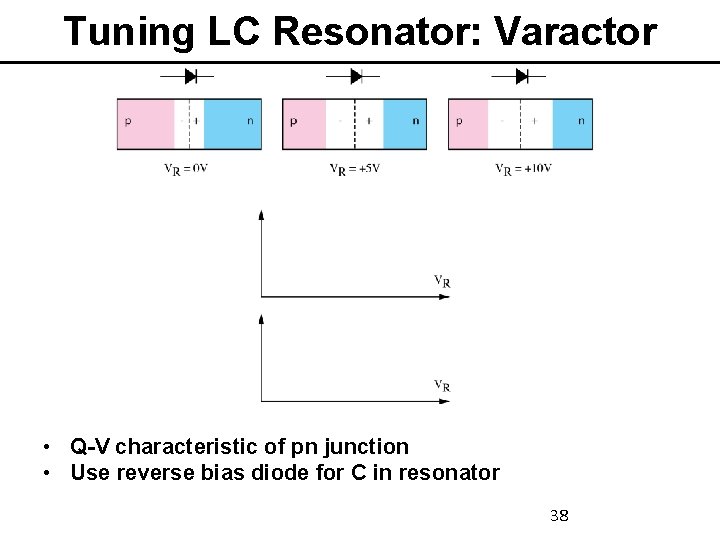
Tuning LC Resonator: Varactor • Q-V characteristic of pn junction • Use reverse bias diode for C in resonator 38
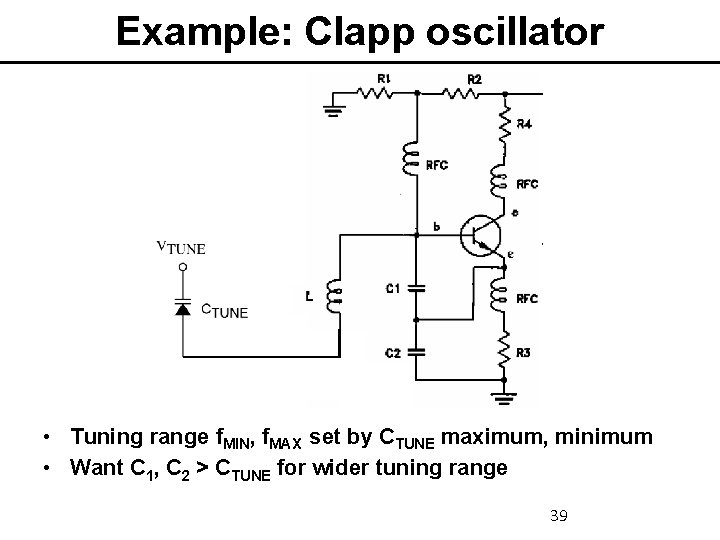
Example: Clapp oscillator • Tuning range f. MIN, f. MAX set by CTUNE maximum, minimum • Want C 1, C 2 > CTUNE for wider tuning range 39
Overview • • • Functional Block Concept Oscillator Review Basic Performance Metrics Methods of Tuning Advanced Performance Metrics – Tuning Sensitivity – Phase Noise – Supply Pushing – Load Pulling • Conclusion 40
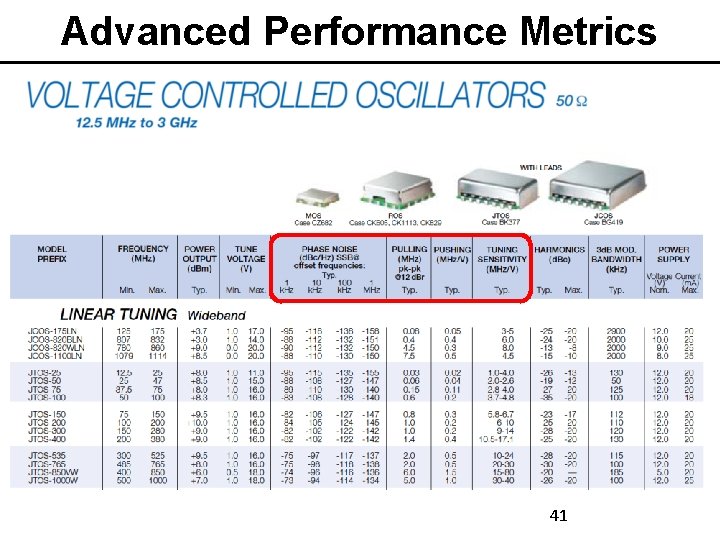
Advanced Performance Metrics • Tuning Sensitivity (V-f linearity) • Phase Noise • Supply/Load Sensitivity 41
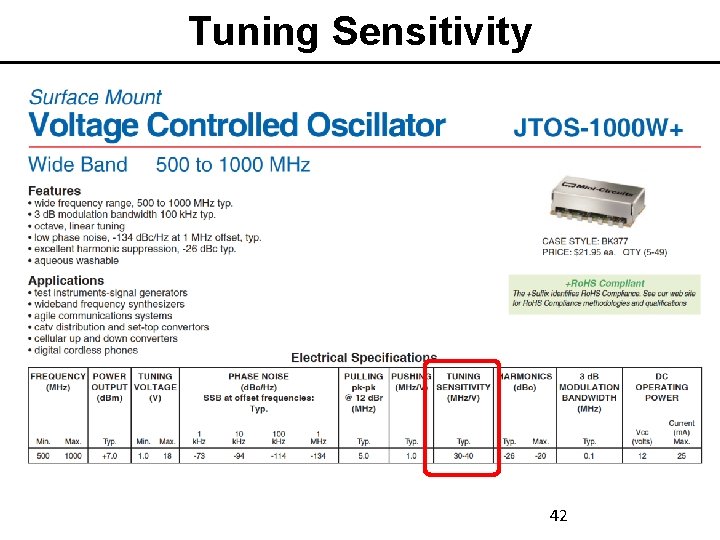
Tuning Sensitivity • from data sheet showing specs 42
Frequency Range • Change in slope [MHz/V] over tuning voltage range 43
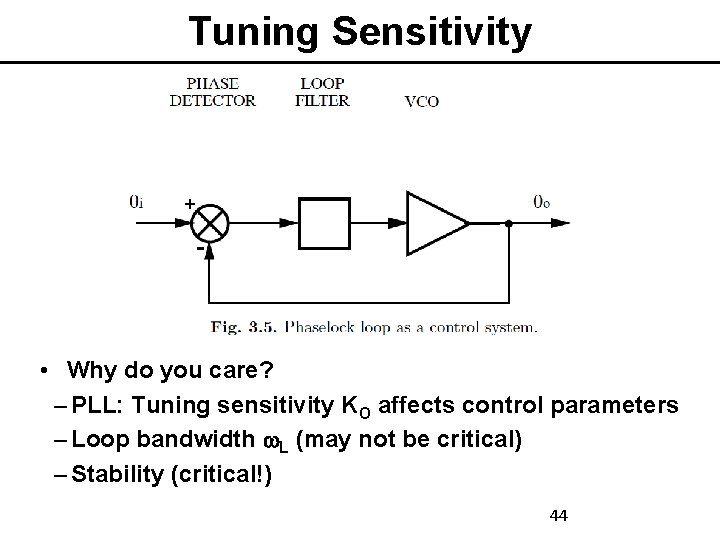
Tuning Sensitivity • Why do you care? – PLL: Tuning sensitivity KO affects control parameters – Loop bandwidth w. L (may not be critical) – Stability (critical!) 44
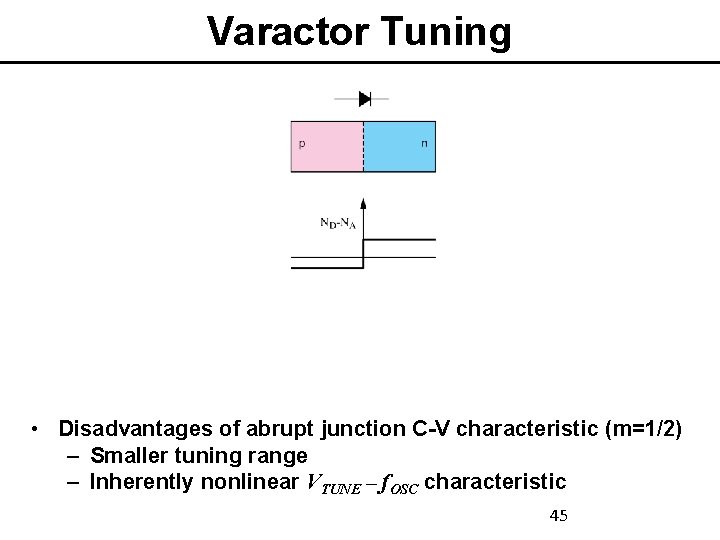
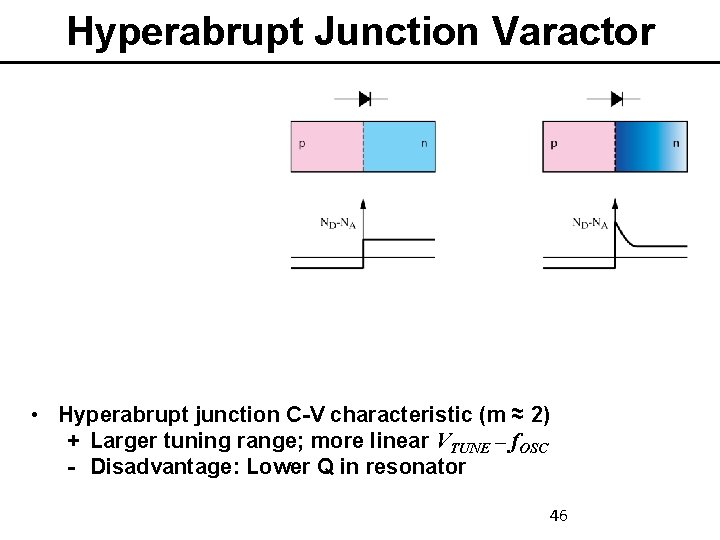
Varactor Tuning • Disadvantages of abrupt junction C-V characteristic (m=1/2) – Smaller tuning range – Inherently nonlinear VTUNE – f. OSC characteristic 45
Hyperabrupt Junction Varactor • Hyperabrupt junction C-V characteristic (m ≈ 2) + Larger tuning range; more linear VTUNE – f. OSC - Disadvantage: Lower Q in resonator 46
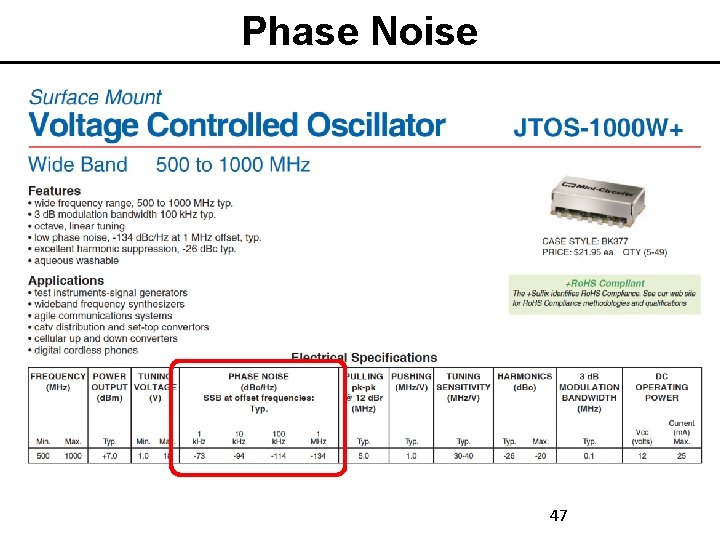
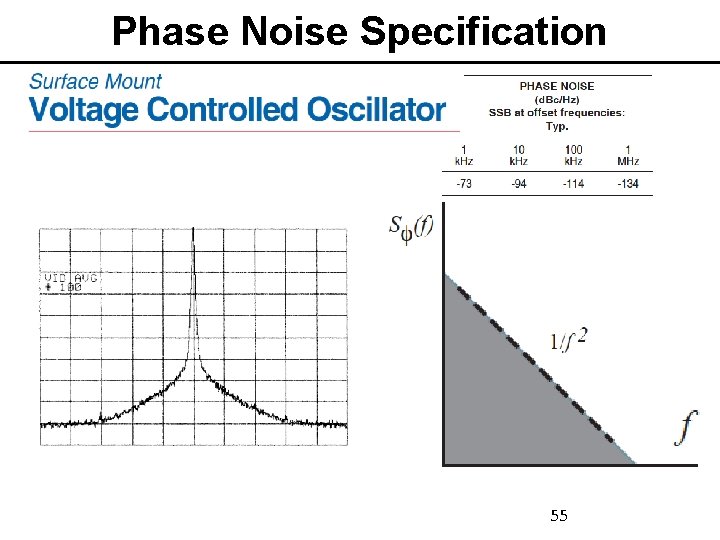
Phase Noise • from data sheet showing specs 47
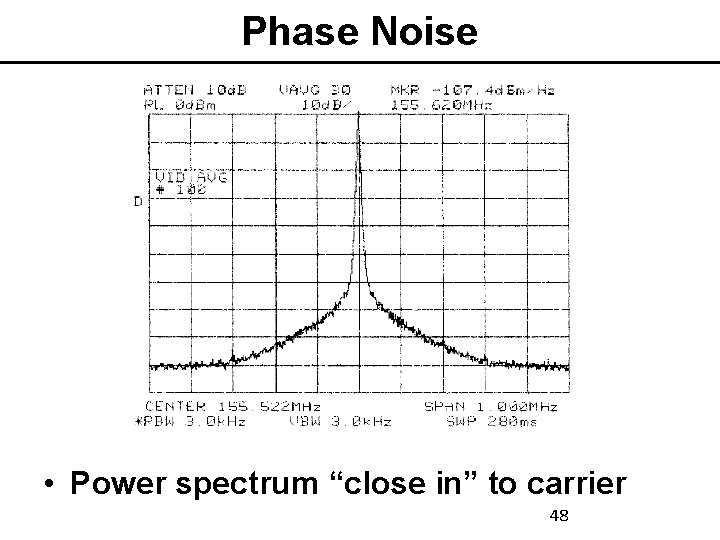
Phase Noise • Power spectrum “close in” to carrier 48
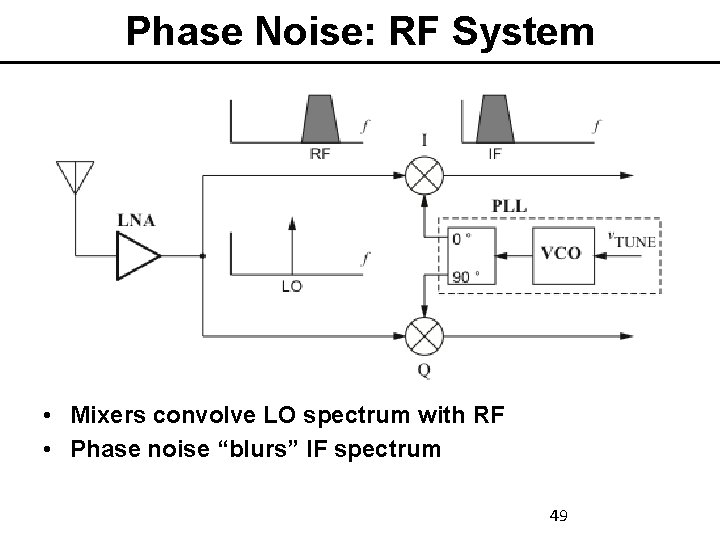
Phase Noise: RF System • Mixers convolve LO spectrum with RF • Phase noise “blurs” IF spectrum 49
Phase Noise: Digital System ÷N • Time domain jitter on synthesized output clock • Decreases timing margin for system using clock 50
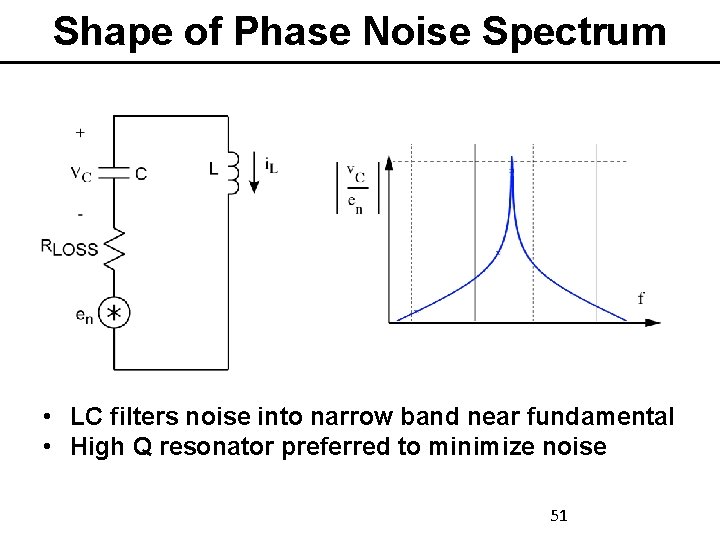
Shape of Phase Noise Spectrum • LC filters noise into narrow band near fundamental • High Q resonator preferred to minimize noise 51
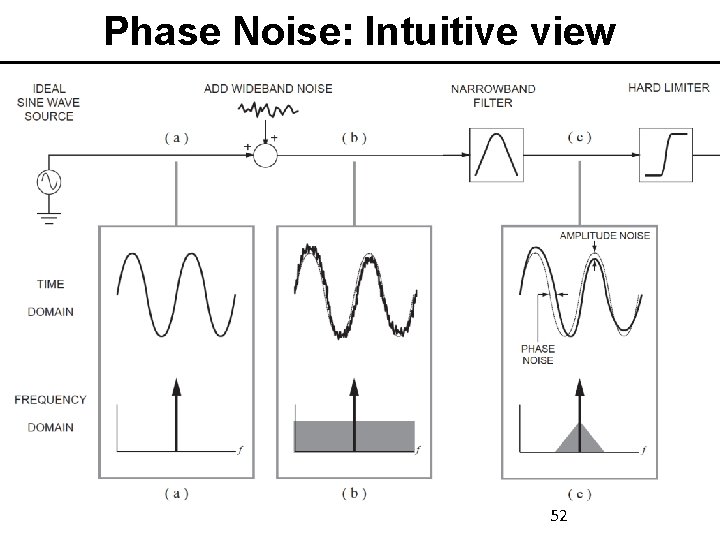
Phase Noise: Intuitive view • Sine wave + white noise; Filter; limit; Result: 52
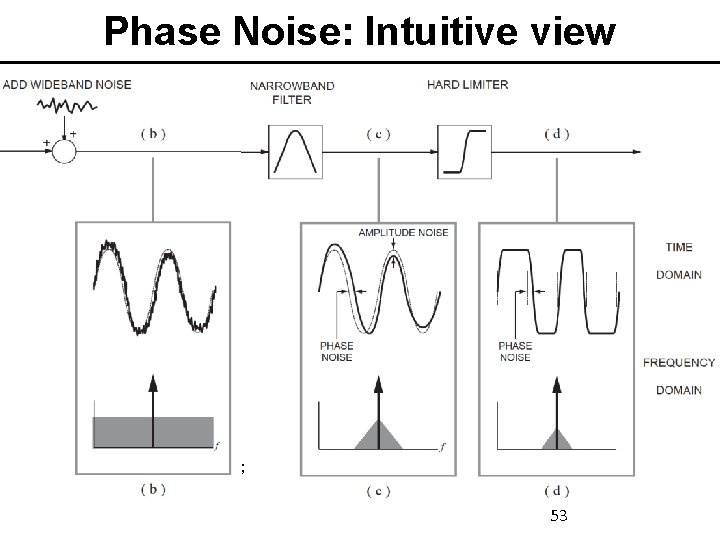
Phase Noise: Intuitive view • Sine wave + white noise; Filter; limit; Result: 53
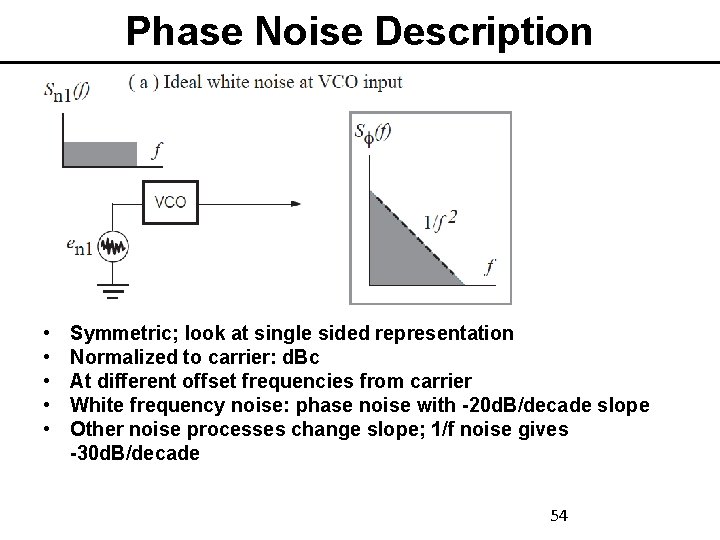
Phase Noise Description • • • Symmetric; look at single sided representation Normalized to carrier: d. Bc At different offset frequencies from carrier White frequency noise: phase noise with -20 d. B/decade slope Other noise processes change slope; 1/f noise gives -30 d. B/decade 54
Phase Noise Specification • • • Symmetric; look at single sided Normalized to carrier: d. Bc At different offset frequencies from carrier 55
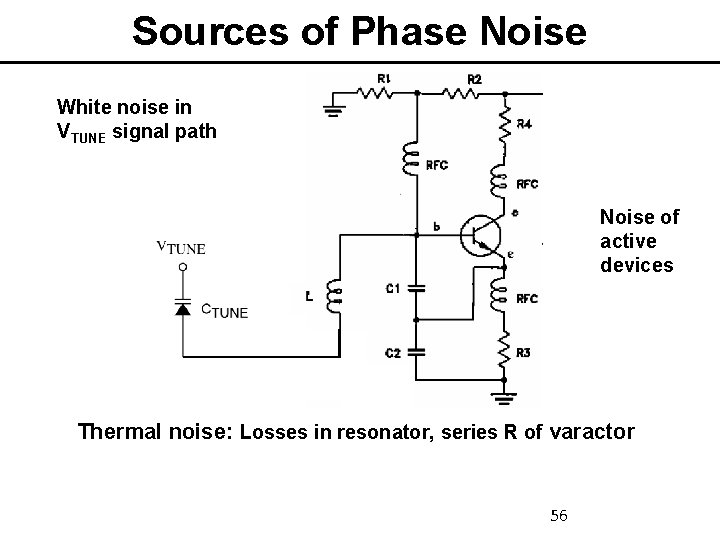
Sources of Phase Noise White noise in VTUNE signal path Noise of active devices Thermal noise: Losses in resonator, series R of varactor 56
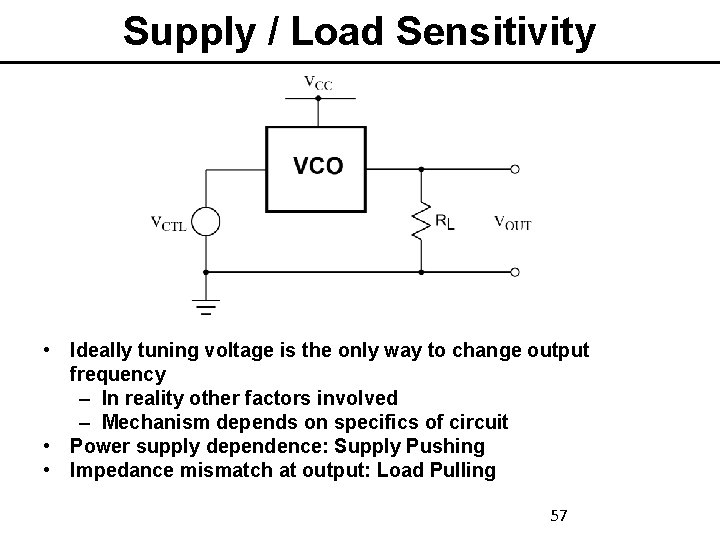
Supply / Load Sensitivity • Ideally tuning voltage is the only way to change output frequency – In reality other factors involved – Mechanism depends on specifics of circuit • Power supply dependence: Supply Pushing • Impedance mismatch at output: Load Pulling 57
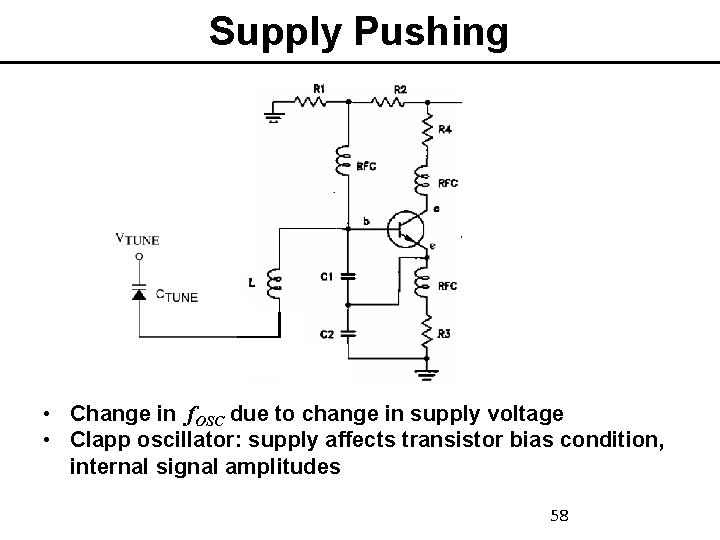
Supply Pushing • Change in f. OSC due to change in supply voltage • Clapp oscillator: supply affects transistor bias condition, internal signal amplitudes 58
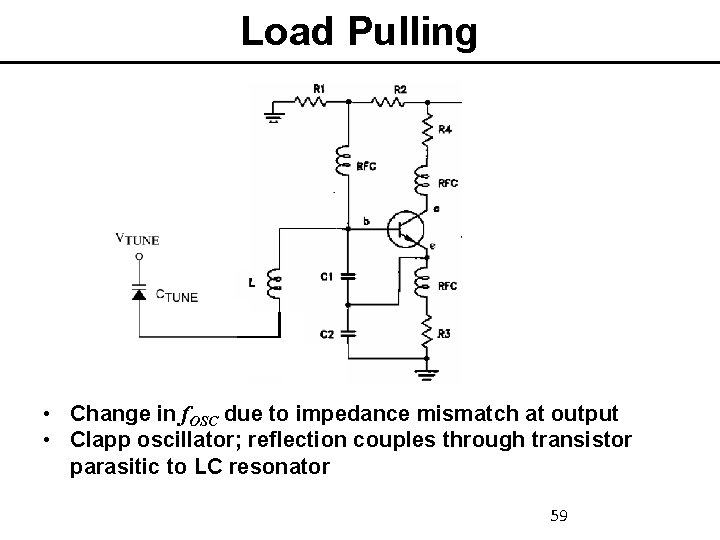
Load Pulling • Change in f. OSC due to impedance mismatch at output • Clapp oscillator; reflection couples through transistor parasitic to LC resonator 59
Overview • • • Functional Block Concept Oscillator Review Basic Performance Metrics Methods of Tuning Advanced Performance Metrics Conclusion 60
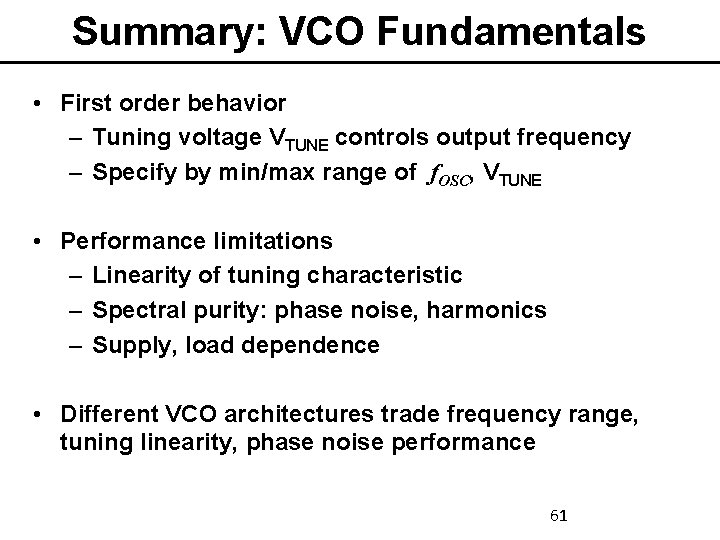
Summary: VCO Fundamentals • First order behavior – Tuning voltage VTUNE controls output frequency – Specify by min/max range of f. OSC, VTUNE • Performance limitations – Linearity of tuning characteristic – Spectral purity: phase noise, harmonics – Supply, load dependence • Different VCO architectures trade frequency range, tuning linearity, phase noise performance 61
Questions? 62