
Alzheimer Disease Update Neill R GraffRadford MBBCh FRCP
Alzheimer Disease: Update Neill R. Graff-Radford, MBBCh, FRCP Professor of Neurology Mayo College of Medicine 1
Disclosures • Dr Graff-Radford is part of multicenter treatment studies funded by Medivation, Allon, Janssen, Forrest • • He is chair of the DSMB for a Baxter study using IGIV He is on the Scientific Advisory Board of Codman He has funding from several NIH and State grants He is on the Editorial Board of the Neurologist and Alzheimer Research and Therapy journals 2
Case One • In 2001 a 71 year old women complained of some memory difficulty and was diagnosed with Mild Cognitive Impairment but her MMSE was 29/30 • In 2004 her MMSE was 27/30 and she still met criteria for MCI • In 2007 she declined and was diagnosed with Probable AD. MMSE 22/30 • In 2009 her MMSE was 16/30 but she played 2 recitals monthly lasting 40 minutes including 9 pieces 3
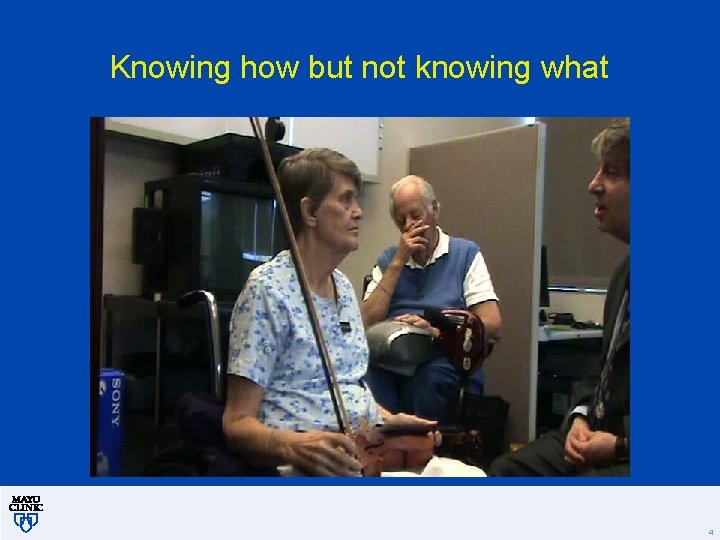
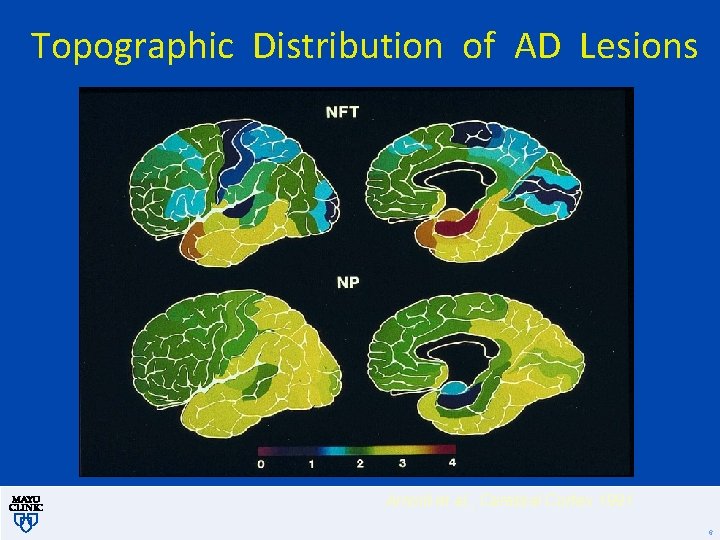
Knowing how but not knowing what 4
Why do AD patients know how but not what? 1. It is the anatomy 2. It is a fluke in this patient 3. It is easier to remember what makes you happy 4. Alzheimer patients have excellent remote memory 5
Topographic Distribution of AD Lesions Arnold et al. , Cerebral Cortex 1991 6
Alzheimer Disease Update • New Diagnostic Criteria • May Study of Aging and Diagnostic Criteria • APP mutation • DIAN biomarkers • Bapineuzumab results for Apo. E 4 patients • AV 45 PET scan 7
Amyloid- accumulation (CSF/PET) Synaptic dysfunction (FDG-PET/s. MRI) Tau-mediated neuronal injury (CSF) Brain structure (volumnetric MRI) Cognition Clinical function Abnormal Normal Preclinical MCI Dementia Clinical Disease Stage R. A. Sperling et al. Alzheimer’s & Dementia; (2011) 1 -13 8
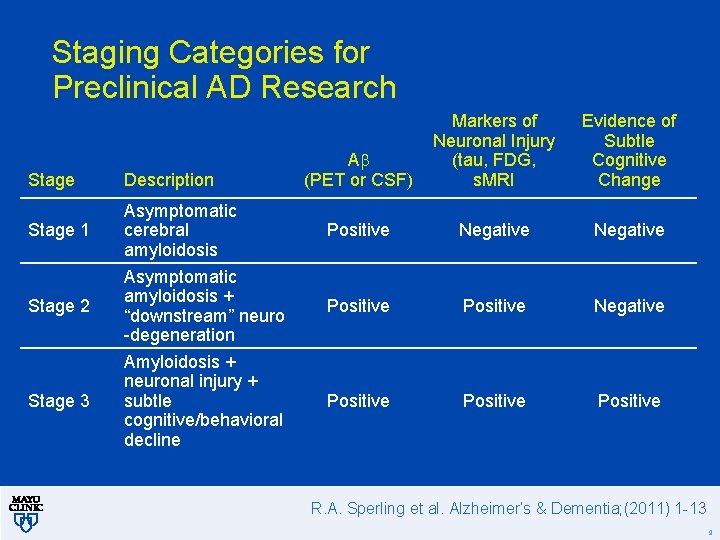
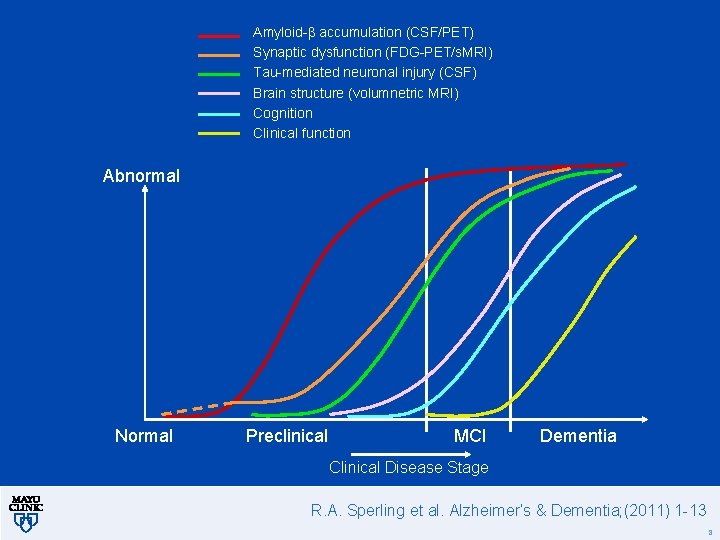
Staging Categories for Preclinical AD Research Stage 1 Stage 2 Stage 3 Description Asymptomatic cerebral amyloidosis Asymptomatic amyloidosis + “downstream” neuro -degeneration Amyloidosis + neuronal injury + subtle cognitive/behavioral decline A (PET or CSF) Markers of Neuronal Injury (tau, FDG, s. MRI Evidence of Subtle Cognitive Change Positive Negative Positive R. A. Sperling et al. Alzheimer’s & Dementia; (2011) 1 -13 9
10
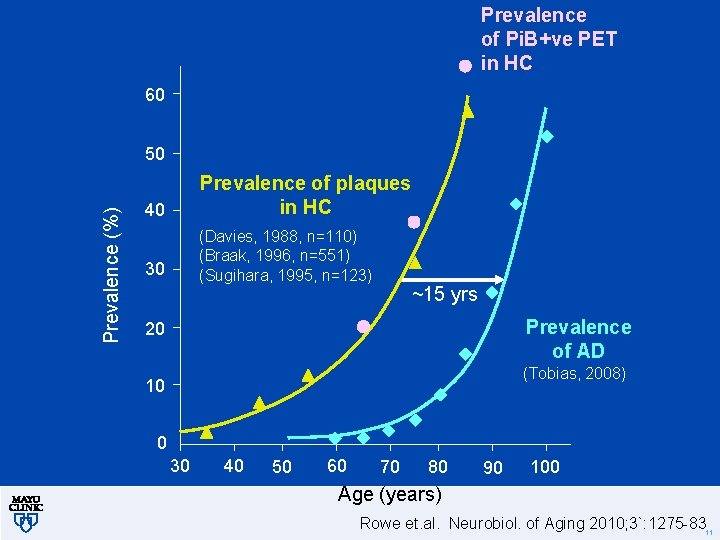
Prevalence of Pi. B+ve PET in HC 60 Prevalence (%) 50 40 Prevalence of plaques in HC 30 (Davies, 1988, n=110) (Braak, 1996, n=551) (Sugihara, 1995, n=123) ~15 yrs Prevalence of AD 20 (Tobias, 2008) 10 0 30 40 50 60 70 80 90 100 Age (years) Rowe et. al. Neurobiol. of Aging 2010; 3`: 1275 -8311
Alzheimer Disease Update • New Diagnostic Criteria • Mayo Study of Aging and Diagnostic Criteria • APP mutation • DIAN biomarkers • Bapineuzumab results for Apo. E 4 patients • AV 45 PET scan 12
13
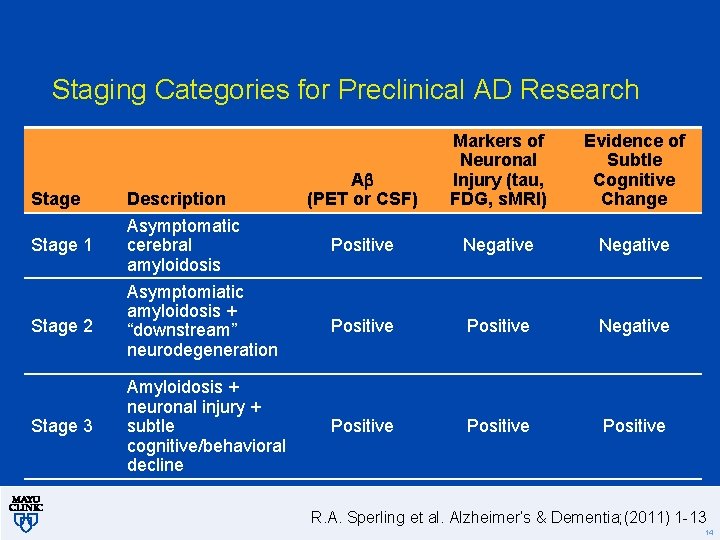
Staging Categories for Preclinical AD Research Stage 1 Stage 2 Stage 3 Description Asymptomatic cerebral amyloidosis Asymptomiatic amyloidosis + “downstream” neurodegeneration Amyloidosis + neuronal injury + subtle cognitive/behavioral decline A (PET or CSF) Markers of Neuronal Injury (tau, FDG, s. MRI) Evidence of Subtle Cognitive Change Positive Negative Positive R. A. Sperling et al. Alzheimer’s & Dementia; (2011) 1 -13 14
15
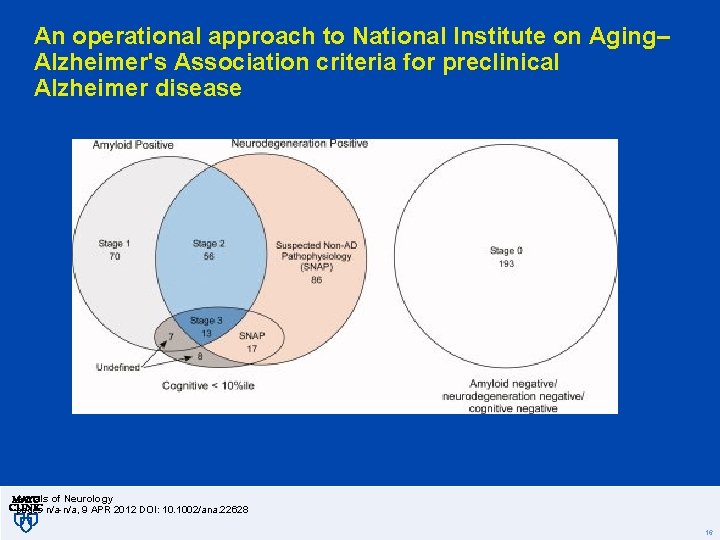
An operational approach to National Institute on Aging– Alzheimer's Association criteria for preclinical Alzheimer disease Annals of Neurology pages n/a-n/a, 9 APR 2012 DOI: 10. 1002/ana. 22628 16
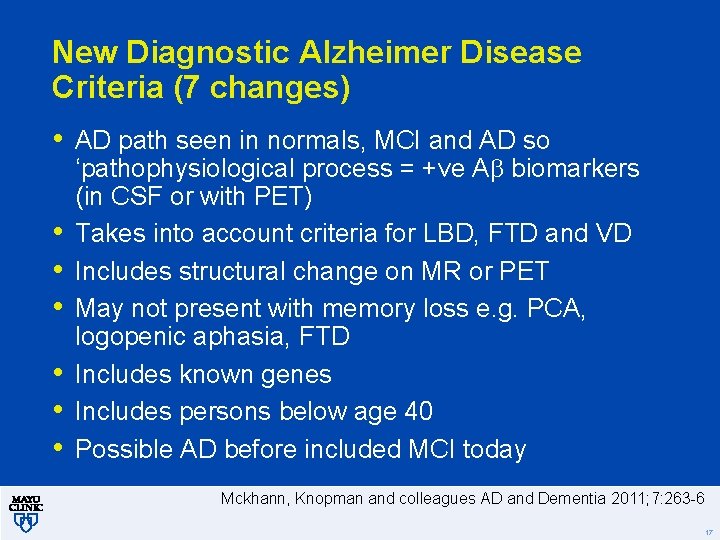
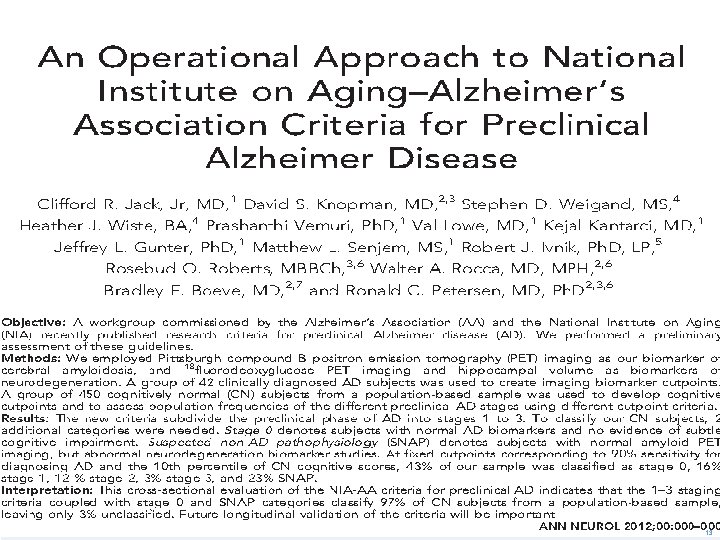
New Diagnostic Alzheimer Disease Criteria (7 changes) • AD path seen in normals, MCI and AD so • • • ‘pathophysiological process = +ve A biomarkers (in CSF or with PET) Takes into account criteria for LBD, FTD and VD Includes structural change on MR or PET May not present with memory loss e. g. PCA, logopenic aphasia, FTD Includes known genes Includes persons below age 40 Possible AD before included MCI today Mckhann, Knopman and colleagues AD and Dementia 2011; 7: 263 -6 17
Alzheimer Disease Update • New Diagnostic Criteria • May Study of Aging and Diagnostic Criteria • APP mutation • DIAN biomarkers • Bapineuzumab results for Apo. E 4 patients • AV 45 PET scan 18
Protective Gene Nature Published on line July 11, 2012 19
A 673 T reduces BACE 1 cleavage of APP. T Jonsson et al. Nature 000, 1 -4 (2012) doi: 10. 1038/nature 11283 © 2011 MFMER | slide-20
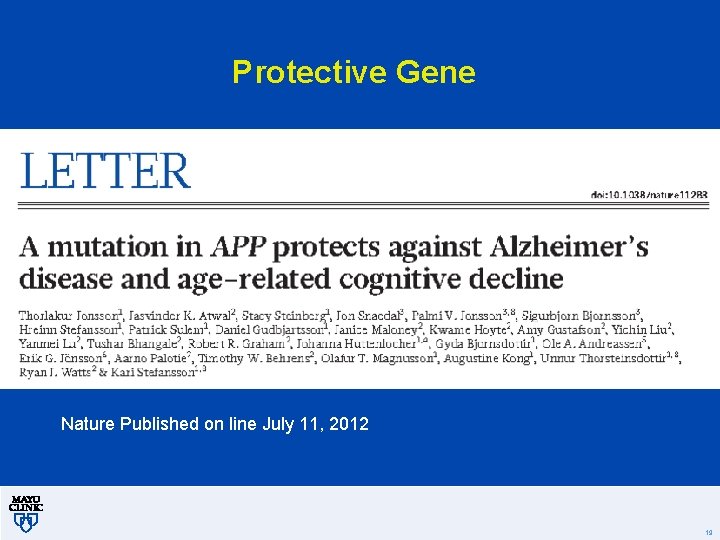
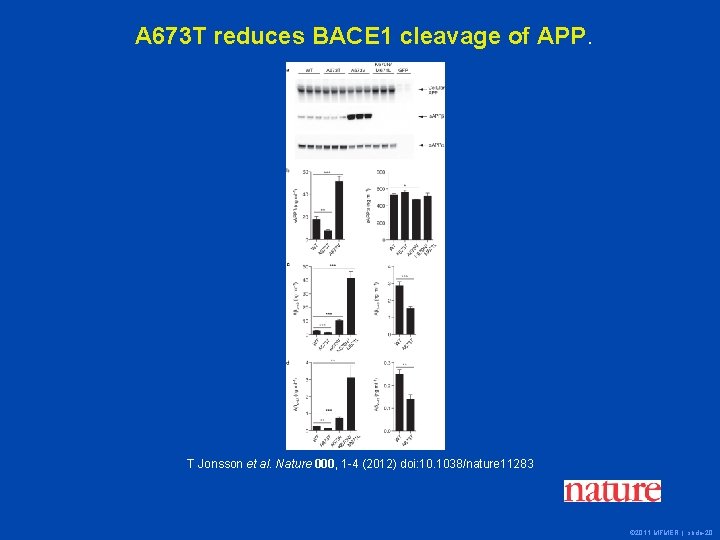
Findings in this study • A coding mutation (A 673 T) in the APP gene protects • • • against Alzheimer’s disease and cognitive decline in the elderly without Alzheimer’s disease. This substitution is adjacent to the aspartyl protease βsite in APP, and results in an approximately 40% reduction in the formation of amyloidogenic peptides in vitro. The strong protective effect of the A 673 T substitution against Alzheimer’s disease provides proof of principle for the hypothesis that reducing the β-cleavage of APP may protect against the disease. Furthermore, as the A 673 T allele also protects against cognitive decline in the elderly without Alzheimer’s disease, the two may be mediated through the same or similar mechanisms. 21
BACE Inhibitors in Clinical Trials • LY 2886721 – Phase 2 • Merck has one as well but not in clinicaltrials. gov 22
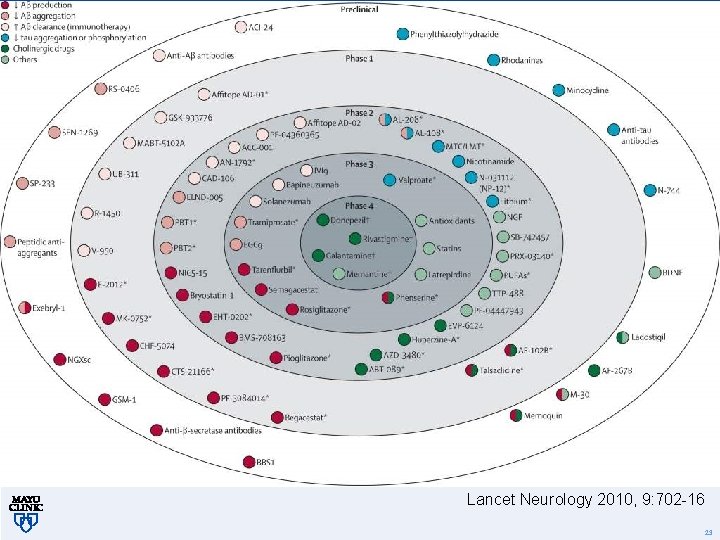
Lancet Neurology 2010, 9: 702 -16 23
Alzheimer Disease Update • New Diagnostic Criteria • May Study of Aging and Diagnostic Criteria • APP mutation • DIAN biomarkers • Bapineuzumab results for Apo. E 4 patients • AV 45 PET scan 24
NEJM July 23, 2012 25
26
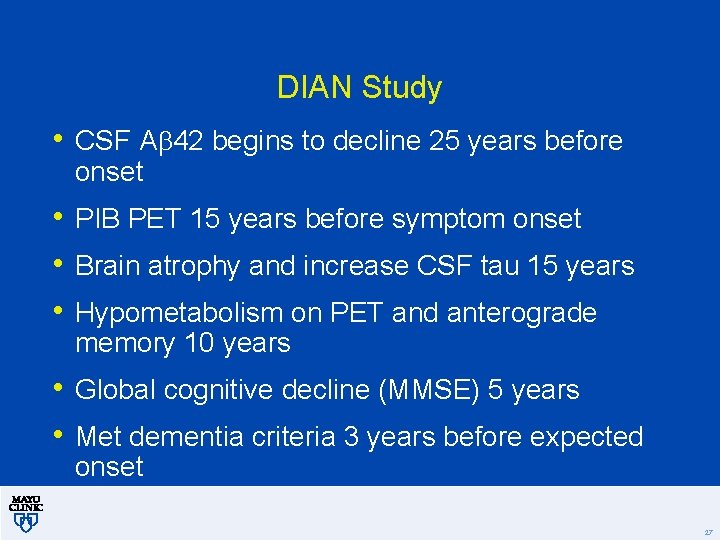
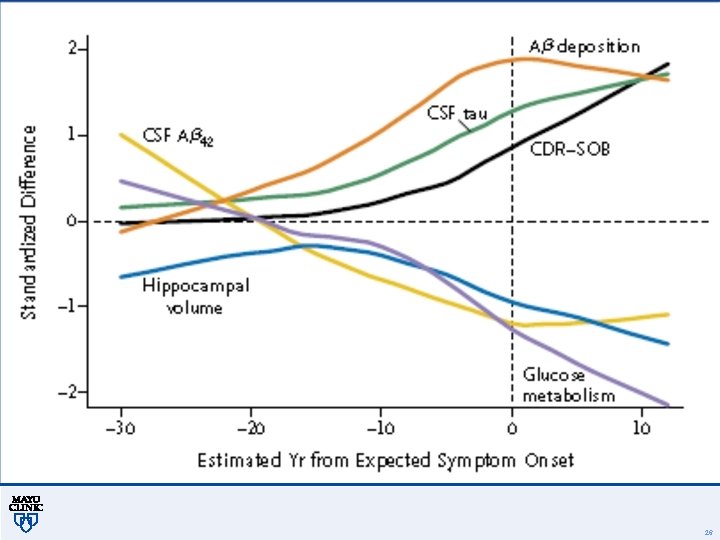
DIAN Study • CSF A 42 begins to decline 25 years before onset • PIB PET 15 years before symptom onset • Brain atrophy and increase CSF tau 15 years • Hypometabolism on PET and anterograde memory 10 years • Global cognitive decline (MMSE) 5 years • Met dementia criteria 3 years before expected onset 27
Alzheimer Disease Update • New Diagnostic Criteria • May Study of Aging and Diagnostic Criteria • APP mutation • DIAN biomarkers • Bapineuzumab results for Apo. E 4 patients • AV 45 PET scan 28
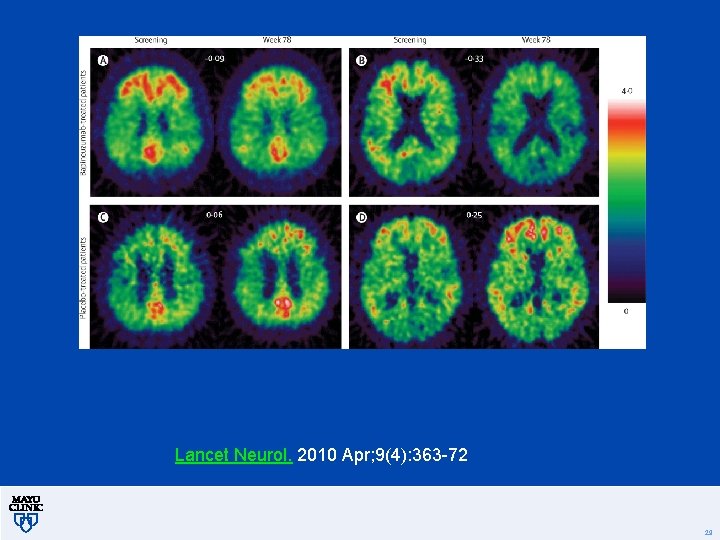
Lancet Neurol. 2010 Apr; 9(4): 363 -72 29
News Release July 23, 2012 • In the 302 study Apo. E 4 +ve mild to moderate AD patients did not improve using bapineuzumab 30
Alzheimer Disease Update • New Diagnostic Criteria • May Study of Aging and Diagnostic Criteria • APP mutation • DIAN biomarkers • Bapineuzumab results for Apo. E 4 patients • AV 45 PET scan 31
Patient information • Amyvid is a radioactive diagnostic agent for PET imaging of the brain to estimate β-amyloid neuritic plaque density in adult patients with cognitive impairment who are being evaluated for Alzheimer’s Disease (AD) and other causes of cognitive decline. • The scan is interpreted as either positive or negative • A positive Amyvid PET scan indicates moderate to frequent amyloid neuritic plaques • The cost of performing and interpreting an Amyvid PET scan is approximately $5000. 32
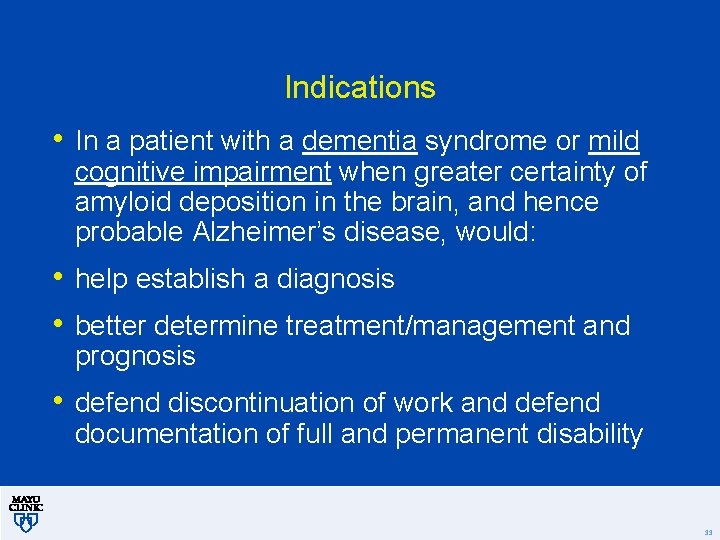
Indications • In a patient with a dementia syndrome or mild cognitive impairment when greater certainty of amyloid deposition in the brain, and hence probable Alzheimer’s disease, would: • help establish a diagnosis • better determine treatment/management and prognosis • defend discontinuation of work and defend documentation of full and permanent disability 33
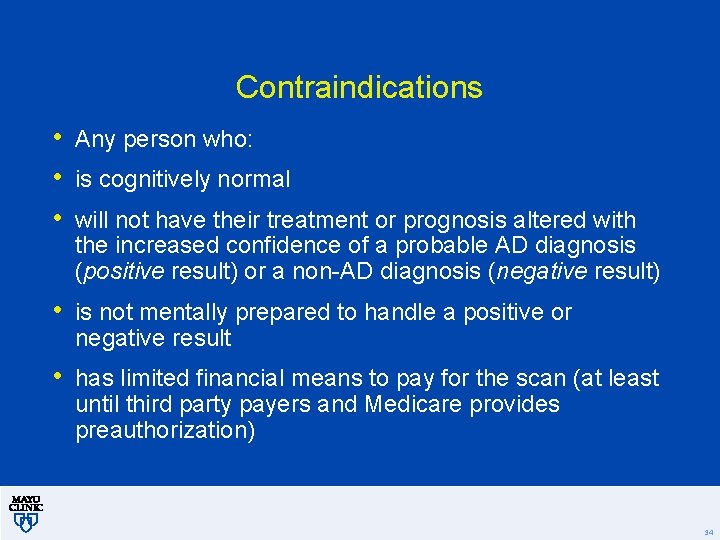
Contraindications • Any person who: • is cognitively normal • will not have their treatment or prognosis altered with the increased confidence of a probable AD diagnosis (positive result) or a non-AD diagnosis (negative result) • is not mentally prepared to handle a positive or negative result • has limited financial means to pay for the scan (at least until third party payers and Medicare provides preauthorization) 34
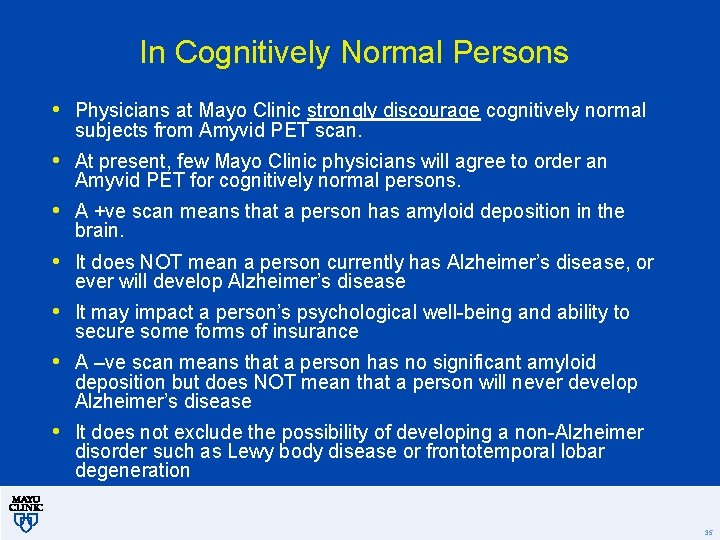
In Cognitively Normal Persons • Physicians at Mayo Clinic strongly discourage cognitively normal subjects from Amyvid PET scan. • At present, few Mayo Clinic physicians will agree to order an Amyvid PET for cognitively normal persons. • A +ve scan means that a person has amyloid deposition in the brain. • It does NOT mean a person currently has Alzheimer’s disease, or ever will develop Alzheimer’s disease • It may impact a person’s psychological well-being and ability to secure some forms of insurance • A –ve scan means that a person has no significant amyloid deposition but does NOT mean that a person will never develop Alzheimer’s disease • It does not exclude the possibility of developing a non-Alzheimer disorder such as Lewy body disease or frontotemporal lobar degeneration 35
- Slides: 35