Therapeutic Diets in School Food Service Most Common



- Slides: 85
Therapeutic Diets in School Food Service, Most Common Therapeutic Diets 2018 Mgr. Zlata Kapounová, Ph. D. , Mgr. Aleksandra Nikolić, Mgr. Veronika Volavá, Bc. Iuliia Pavlovská, Bc. Petra Ferenčuhová
Outline of the seminar: • School Food Service - School meals • Legislation • Therapeutic diets • Vegetarian and other unconventional diets (2 nd Seminar)
SCHOOL FOOD SERVICE IMPORTANCE AND PURPOSE • The main purpose of School Food Service is to ensure high-quality meals for children during the time they spend at school: • Traditional satiating role (35 % daily energy requirements, 60 % for kindergarden) • Health supporting role (norms – recommended consumer basket for school meals, hygienic standards - food safety – nutritional value of meals served corresponding to dietary guidelines) • Educational role - encouraging children to eat a healthy and varied diet (dining etiquette, new meals, good example of a healthy lifestyle) • We must teach children to eat well so that they could keep that pattern in their further life and be protected from “lifestyle“ diseases.
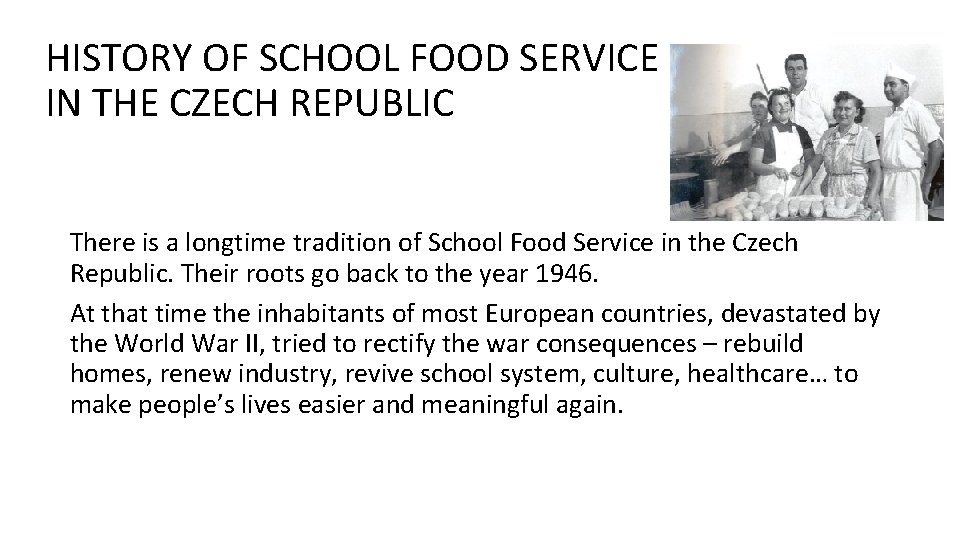
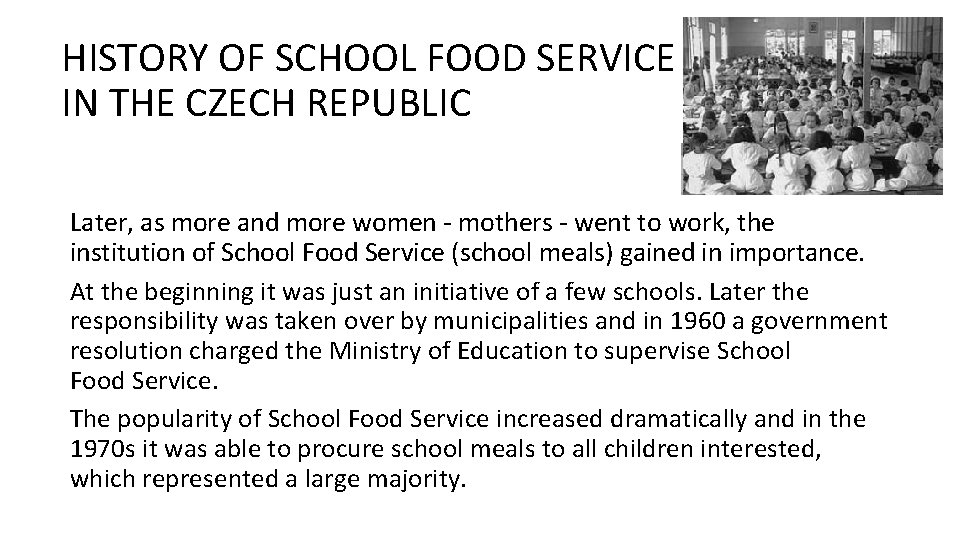
HISTORY OF SCHOOL FOOD SERVICE IN THE CZECH REPUBLIC There is a longtime tradition of School Food Service in the Czech Republic. Their roots go back to the year 1946. At that time the inhabitants of most European countries, devastated by the World War II, tried to rectify the war consequences – rebuild homes, renew industry, revive school system, culture, healthcare… to make people’s lives easier and meaningful again.
HISTORY OF SCHOOL FOOD SERVICE IN THE CZECH REPUBLIC Later, as more and more women - mothers - went to work, the institution of School Food Service (school meals) gained in importance. At the beginning it was just an initiative of a few schools. Later the responsibility was taken over by municipalities and in 1960 a government resolution charged the Ministry of Education to supervise School Food Service. The popularity of School Food Service increased dramatically and in the 1970 s it was able to procure school meals to all children interested, which represented a large majority.
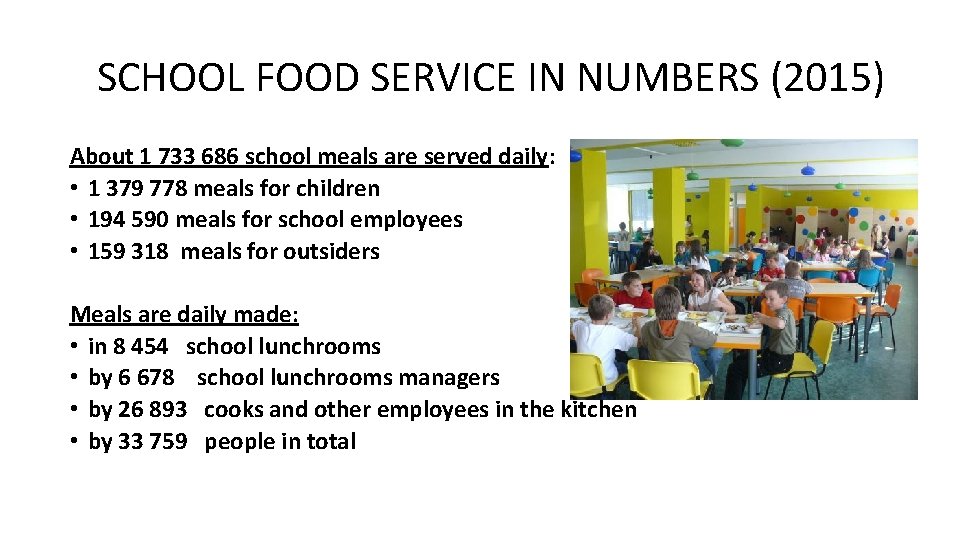
SCHOOL FOOD SERVICE IN NUMBERS (2015) About 1 733 686 school meals are served daily: • 1 379 778 meals for children • 194 590 meals for school employees • 159 318 meals for outsiders Meals are daily made: • in 8 454 school lunchrooms • by 6 678 school lunchrooms managers • by 26 893 cooks and other employees in the kitchen • by 33 759 people in total
LEGISLATION • Education Act no. 561/2004 • Decree on School Food Service no. 107/2005 • Hygiene and food safety regulations • the Labour code
Decree no. 107/2005. , on School Food Service, as amended by Decree no. 107/2008. and Decree no. 17/2015, takes the following wording: • “(4) The boarders whose health condition requires a special restricted diet as confirmed by a registered child/adolescent medical practitioner 8) may be provided with special diet meals. In case of School Food Service this must be under conditions given by their internal rules. In case of a third party provider this must be in accordance with agreements on School Food Service procurement. • (5) The choice of foods, recipes, cooking methods and the menu planning for meals under a therapeutic diet must be done by a dietitian 9). “
DECREE OF MINISTRY OF EDUCATION ON SCHOOL FOOD SERVICE – UPDATE • DECREE no. 210/2017 Coll. • dated from 26 June 2017, • which changes the Decree no. 107/2005 Coll. , on School Food Service, as subsequently amended • According to § 35 section 2, § 121 section 1 and § 123 section 5 of the Act no. 561/2004 Coll. , on Pre-school, Primary, Secondary, Higher Professional and Other Education (Education Act), and in agreement with the Ministry of Health according to § 121 section 2 of the Education Act, the Ministry of Education defines:
Article. I Decree no. 107/2005 Coll. , on School Food Service, as amended by the decree no. 107/2008 Coll. , decree no. 463/2011 Coll. and decree no. 17/2015 Coll. , takes the following wording: § 2 section 5 including footnotes no. 9 and 10 says: „(5) When providing therapeutic diet meals the food service provider uses recipes approved by a: a) dietitian 9, b) medical practitioner with specialization (in)10: 1. general practitioner for children and adolescents 2. pediatry, 3. internal medicine, 4. general practitioner, 5. endocrinology and diabetology, or 6. gastroenterology, or c) medical practitioner with specific qualification in 10: 1. hygiene of children and adolescents, 2. hygiene of nutrition and articles of daily use, 3. endocrinology and diabetology for children, or 4. gastroenterology and hepatology for children”
THE FUTURE SCHOOL FOOD SERVICEACTIONS Despite all obstacles: • the School Food Service continuously tries to raise public awareness of healthy nutrition • a lot of conferences and lectures for school lunchrooms employees take place in Brno and other Czech cities • a largely publicized contest for the Best school lunch is organized every year • children in the whole country are encouraged to taste new healthy meals in a modern and attractive way - the school lunchrooms organize thematic days such as Days of Thai, Norwegian or Spanish cuisine.
THERAPEUTIC DIETS
THERAPEUTIC DIETS IN SCHOOL FOOD SERVICE • Colaboration with a registered dietitian or, newly, with a medical practitioner with specialized qualification or with specific specialized qualification • Diets which will be prepared. • Recipes and technical procedures for those diets. • Menus. • Personal, technical, spatial equipment. • Medical certificate from the boarder. • Staff training. • Therapeutic diets introduction.
THERAPEUTIC DIETS FOR CHILDREN • Most common therapeutic diets in childhood: • Gluten-free diet • Dairy-free or milk-free diet • Diets in other food allergies and intolerances • Bland diet • Diabetic diet
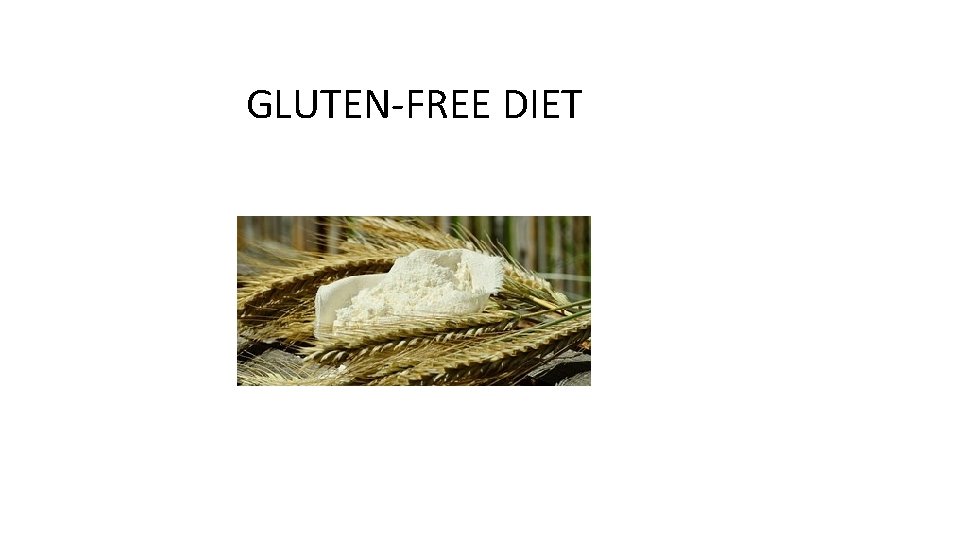
GLUTEN-FREE DIET
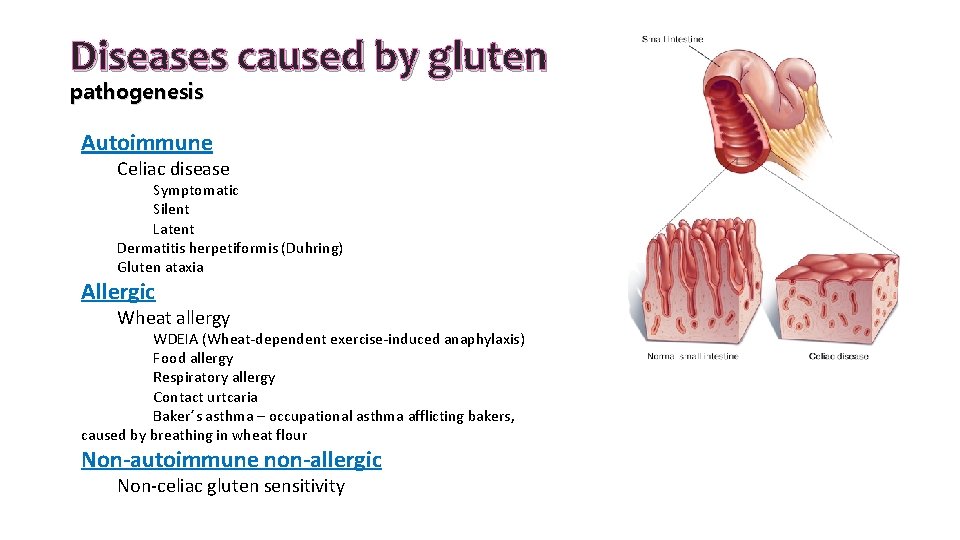
Diseases caused by gluten pathogenesis Autoimmune Celiac disease Symptomatic Silent Latent Dermatitis herpetiformis (Duhring) Gluten ataxia Allergic Wheat allergy WDEIA (Wheat-dependent exercise-induced anaphylaxis) Food allergy Respiratory allergy Contact urtcaria Baker΄s asthma – occupational asthma afflicting bakers, caused by breathing in wheat flour Non-autoimmune non-allergic Non-celiac gluten sensitivity
CELIAC DISEASE = CELIAC SPRUE = GLUTEN ENTEROPATHY • Impaired tolerance of the protein gliadin • Subtotal villus atrophy accompanied by enzyme deficiency • 20 -30 % active clinical form, other in adulthood • Diagnosis • 1. enterobiopsy of small intestine • 2. positive autoantibodies – against gliadin, endomysium and tissue transglutaminase • Gluten-free diet
GLUTEN-FREE DIET Goal: • to reduce the amount of gluten in the diet as much as possible �elimination of all food containg gluten from the diet Adherence to gluten-free diet is imperative: • for people with celiac disease • for people with gluten (wheat) allergy
CELIAC DISEASE x GLUTEN (WHEAT) ALLERGY Celiac disease - lifelong disease caused by gluten intolerance �lifelong adherence to gluten-free diet • people with celiac disease may commonly tolerate approx. 20 mg of gluten - vary significantly from person to person • people with celiac disease should not exceed the total of 20 -50 mg gluten daily. However, in most sensitive individuals histologic changes were observed after consumption of only 10 mg gluten / day.
CELIAC DISEASE x GLUTEN (WHEAT) ALLERGY Gluten (wheat) allergy • disease caused by an excessive immune system reaction • symptoms may appear even after consumption of traces of gluten • risk of meal contamination
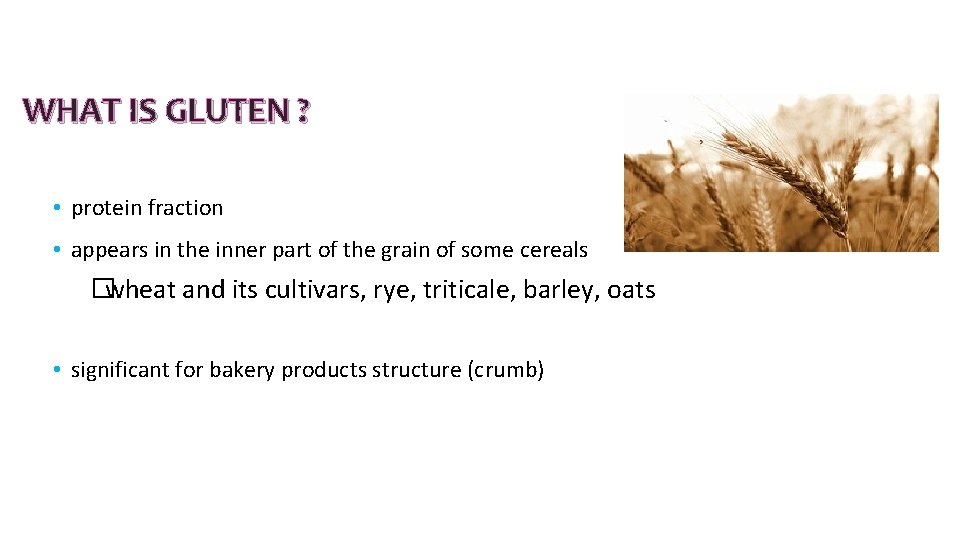
WHAT IS GLUTEN ? • protein fraction • appears in the inner part of the grain of some cereals �wheat and its cultivars, rye, triticale, barley, oats • significant for bakery products structure (crumb)
GLUTEN gluten – protein fraction mixture of water-insoluble proteins glutenins + prolamins (40 -50 %) – different toxicity swells in water, is responsible for dough elasticity and extensibility, gives structure to baked goods. Products made with high-gluten flour have bigger volume and keep their shape better. Prolamins – responsible for development of celiac disease wheat � gliadins, rye � secalins, barley � hordeins contain high amount of glutamine and proline, ß-helix oats � avenins contain moderate amount of glutamine and low amount of proline regarding the celiac disease the following amino acids sequences are described as significant - toxic proline-serine-proline-glutamine-glutamine-proline
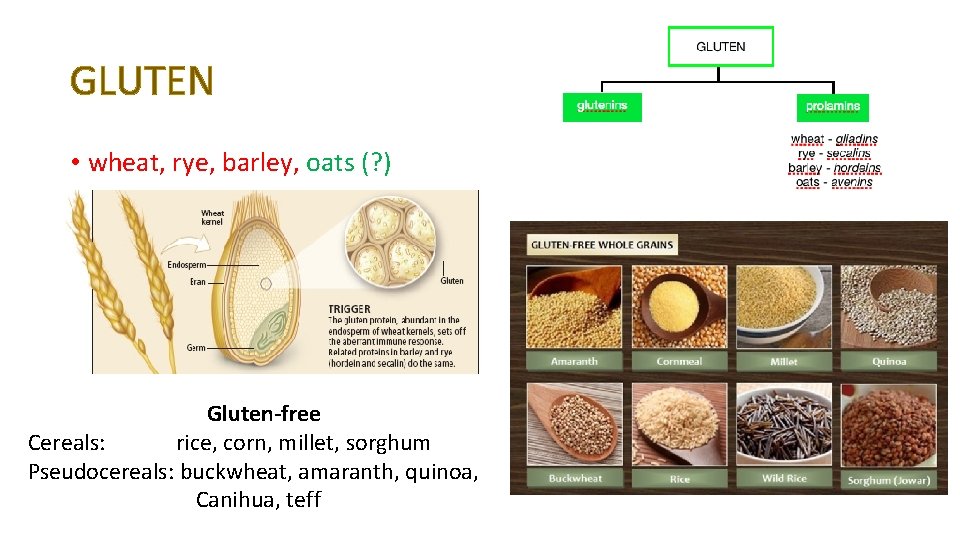
GLUTEN • wheat, rye, barley, oats (? ) Gluten-free Cereals: rice, corn, millet, sorghum Pseudocereals: buckwheat, amaranth, quinoa, Canihua, teff
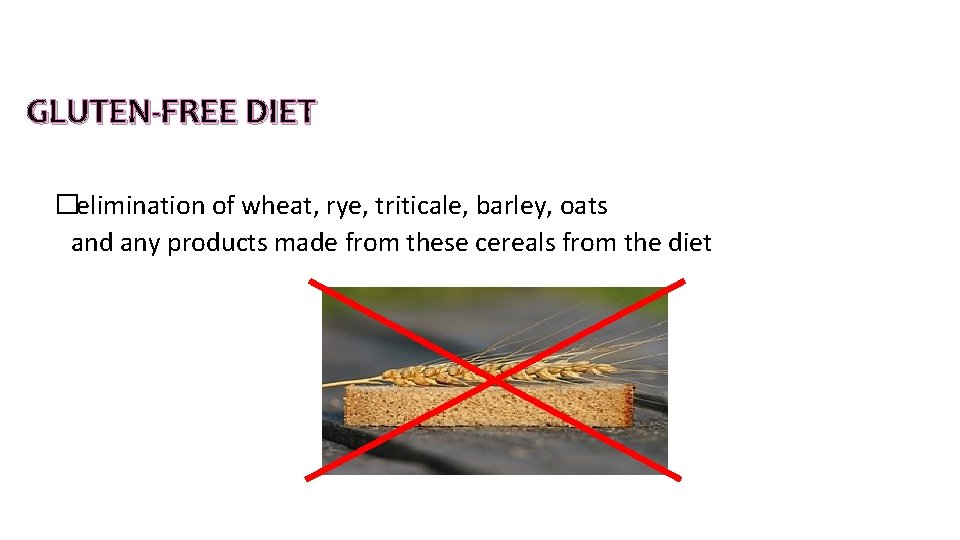
GLUTEN-FREE DIET �elimination of wheat, rye, triticale, barley, oats and any products made from these cereals from the diet
GLUTEN-FREE DIET �elimination of wheat, rye, triticale, barley, oats (? ) and any products made from these cereals from diet • Most people with gluten intolerance can eat oats without experiencing negative effects on their health. However, there is a high risk of contamination with wheat, rye or barley!!! According to Canadian Celiac Association the safe dose of oats is 70 g for adults and 25 g for children.
MAIN GLUTEN SOURCES • flour, starch • bread, baked products, breadcrumbs, crackers, biscuits, wafers • pasta, dumplings • hulled barley, pearl barley, oats, muesli, breakfast cereals, puffed grains • products containing malt
POSSIBLE GLUTEN RESOURCES • products where flour or starch made of gluten-containing cereals may be added • • • instant products meat products dairy products ketchup, mustard, mayo, tartar sauce soya sauce sweets ice-cream fruit and vegetable spreads mixed spices baking powder …
GLUTEN CEREALS SUBSTITUTES • Common • rice, corn, • millet, buckwheat, • quinoa, amaranth • Less known • sorghum, • teff (eragrostis tef), • manioc, • chestnut flour, hemp flour, pumpkin flour, flaxseed flour etc…
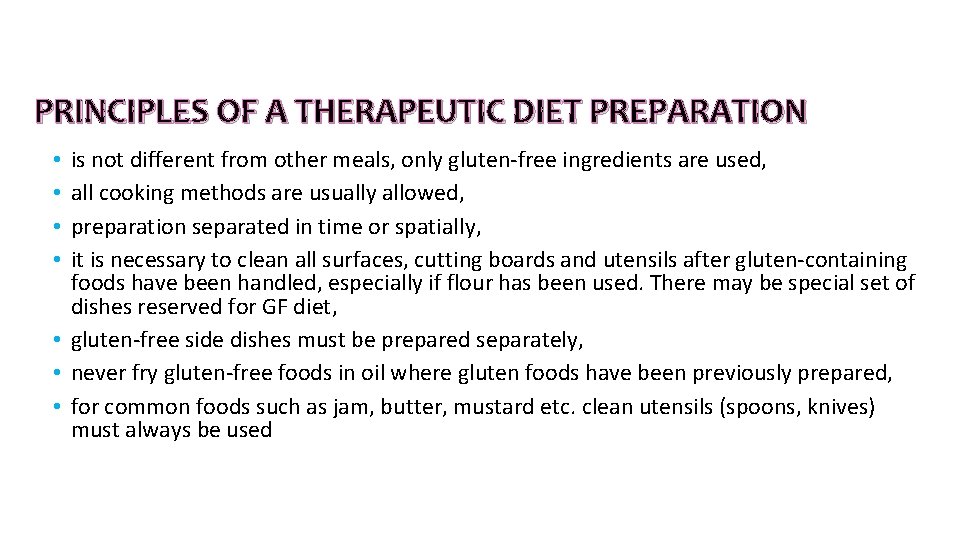
PRINCIPLES OF A THERAPEUTIC DIET PREPARATION is not different from other meals, only gluten-free ingredients are used, all cooking methods are usually allowed, preparation separated in time or spatially, it is necessary to clean all surfaces, cutting boards and utensils after gluten-containing foods have been handled, especially if flour has been used. There may be special set of dishes reserved for GF diet, • gluten-free side dishes must be prepared separately, • never fry gluten-free foods in oil where gluten foods have been previously prepared, • for common foods such as jam, butter, mustard etc. clean utensils (spoons, knives) must always be used • •
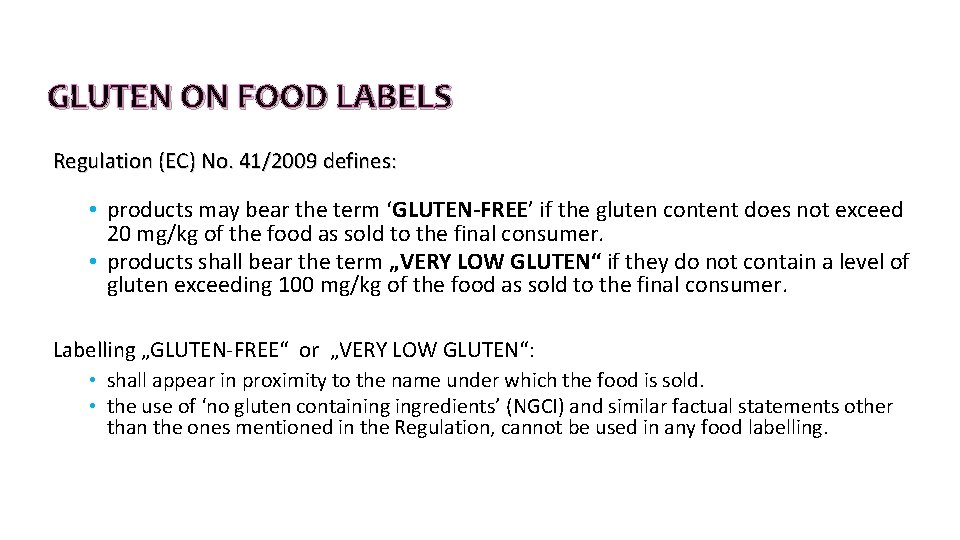
GLUTEN ON FOOD LABELS Regulation (EC) No. 41/2009 defines: • products may bear the term ‘GLUTEN-FREE’ if the gluten content does not exceed 20 mg/kg of the food as sold to the final consumer. • products shall bear the term „VERY LOW GLUTEN“ if they do not contain a level of gluten exceeding 100 mg/kg of the food as sold to the final consumer. Labelling „GLUTEN-FREE“ or „VERY LOW GLUTEN“: • shall appear in proximity to the name under which the food is sold. • the use of ‘no gluten containing ingredients’ (NGCI) and similar factual statements other than the ones mentioned in the Regulation, cannot be used in any food labelling.
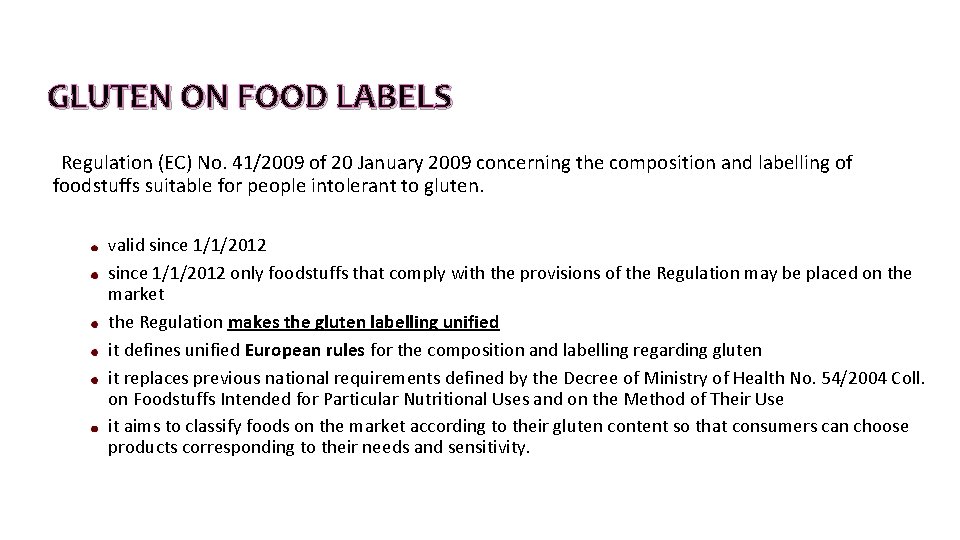
GLUTEN ON FOOD LABELS Regulation (EC) No. 41/2009 of 20 January 2009 concerning the composition and labelling of foodstuffs suitable for people intolerant to gluten. valid since 1/1/2012 only foodstuffs that comply with the provisions of the Regulation may be placed on the market the Regulation makes the gluten labelling unified it defines unified European rules for the composition and labelling regarding gluten it replaces previous national requirements defined by the Decree of Ministry of Health No. 54/2004 Coll. on Foodstuffs Intended for Particular Nutritional Uses and on the Method of Their Use it aims to classify foods on the market according to their gluten content so that consumers can choose products corresponding to their needs and sensitivity.
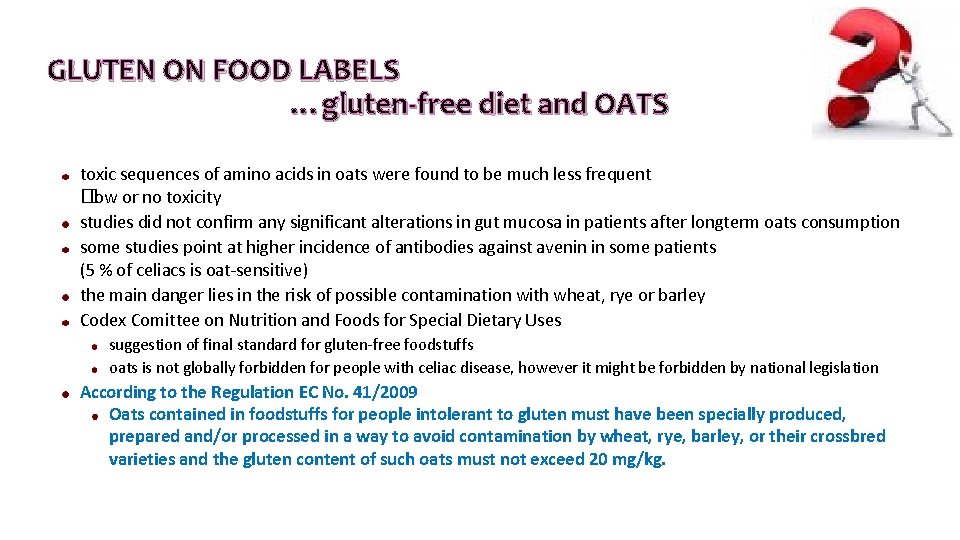
GLUTEN ON FOOD LABELS …gluten-free diet and OATS toxic sequences of amino acids in oats were found to be much less frequent �low or no toxicity studies did not confirm any significant alterations in gut mucosa in patients after longterm oats consumption some studies point at higher incidence of antibodies against avenin in some patients (5 % of celiacs is oat-sensitive) the main danger lies in the risk of possible contamination with wheat, rye or barley Codex Comittee on Nutrition and Foods for Special Dietary Uses suggestion of final standard for gluten-free foodstuffs oats is not globally forbidden for people with celiac disease, however it might be forbidden by national legislation According to the Regulation EC No. 41/2009 Oats contained in foodstuffs for people intolerant to gluten must have been specially produced, prepared and/or processed in a way to avoid contamination by wheat, rye, barley, or their crossbred varieties and the gluten content of such oats must not exceed 20 mg/kg.
…gluten-free diet and OATS • Most people with intolerance to gluten can include oats in their diet without adverse effect on their health. This is an issue of ongoing study and investigation by the scientific community. However, a major concern is the contamination of oats with wheat, rye or barley that can occur during grain harvesting, transport, storage and processing. Therefore, the risk of gluten contamination in products containing oats should be taken into consideration with regard to the relevant information provided on those food products by food business operators.
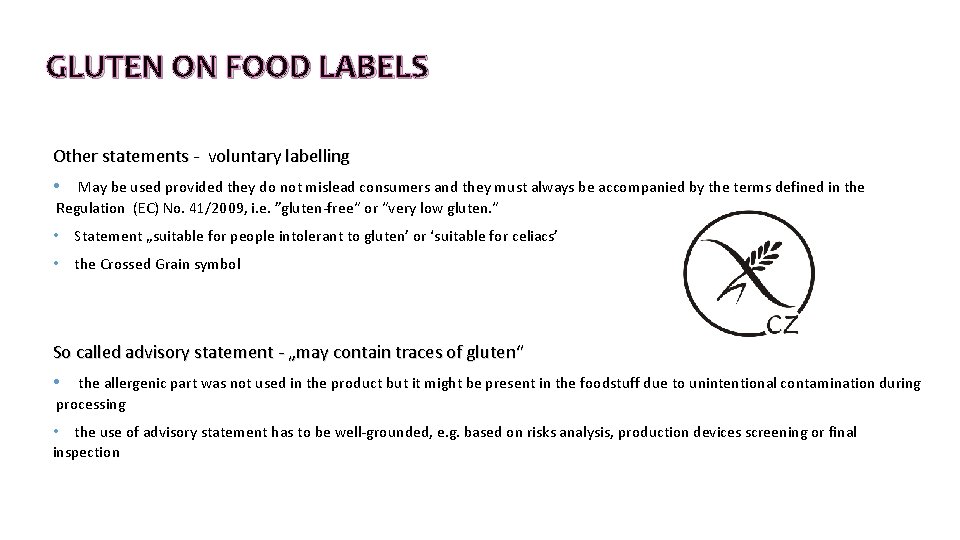
GLUTEN ON FOOD LABELS Other statements - voluntary labelling • May be used provided they do not mislead consumers and they must always be accompanied by the terms defined in the Regulation (EC) No. 41/2009, i. e. ”gluten-free“ or “very low gluten. “ • Statement „suitable for people intolerant to gluten’ or ‘suitable for celiacs’ • the Crossed Grain symbol So called advisory statement - „may contain traces of gluten“ • the allergenic part was not used in the product but it might be present in the foodstuff due to unintentional contamination during processing • the use of advisory statement has to be well-grounded, e. g. based on risks analysis, production devices screening or final inspection
Foodstuffs for specific nutritional uses • Certain foods have been specially produced, prepared and/or processed to reduce the gluten content of one or more gluten-containing ingredients or to substitute the gluten-containing ingredients with other ingredients naturally free of gluten. Other foods are made exclusively from ingredients that are naturally free of gluten. • The removal of gluten from gluten-containing grains presents considerable technical difficulties and economic constraints and therefore the manufacture of totally gluten-free food when using such grains is difficult. Consequently, many foods especially processed to reduce the gluten content of one or more gluten-containing ingredients on the market may contain low residual amounts of gluten.
GLUTEN FREE • In collaboration with the European Food Safety Authority (EFSA), the European Commission has developed a list of ingredients that do not have to be labelled as being from a gluten containing cereal. In this case, the grain has been processed to remove gluten and it has been proved there are no more allergenic residues. In case of cereals, these ingredients are defined in the Decree No. 113/2005 Coll. : • glucose syrups derived from wheat or barley including dextrose • wheat based maltodextrins • distilled ingredients made from cereals that contain gluten e. g. alcoholic spirits
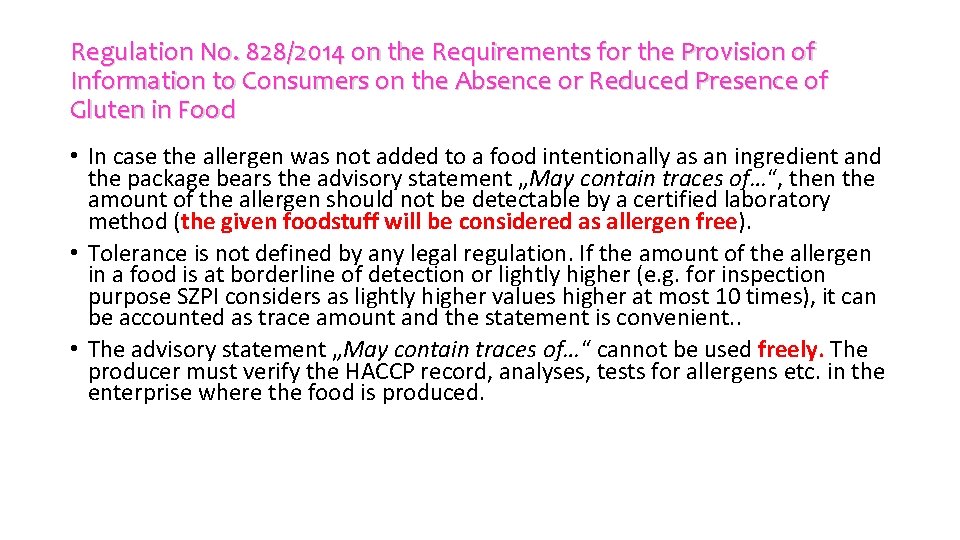
Regulation No. 828/2014 on the Requirements for the Provision of Information to Consumers on the Absence or Reduced Presence of Gluten in Food • In case the allergen was not added to a food intentionally as an ingredient and the package bears the advisory statement „May contain traces of…“, then the amount of the allergen should not be detectable by a certified laboratory method (the given foodstuff will be considered as allergen free). • Tolerance is not defined by any legal regulation. If the amount of the allergen in a food is at borderline of detection or lightly higher (e. g. for inspection purpose SZPI considers as lightly higher values higher at most 10 times), it can be accounted as trace amount and the statement is convenient. . • The advisory statement „May contain traces of…“ cannot be used freely. The producer must verify the HACCP record, analyses, tests for allergens etc. in the enterprise where the food is produced.
Application
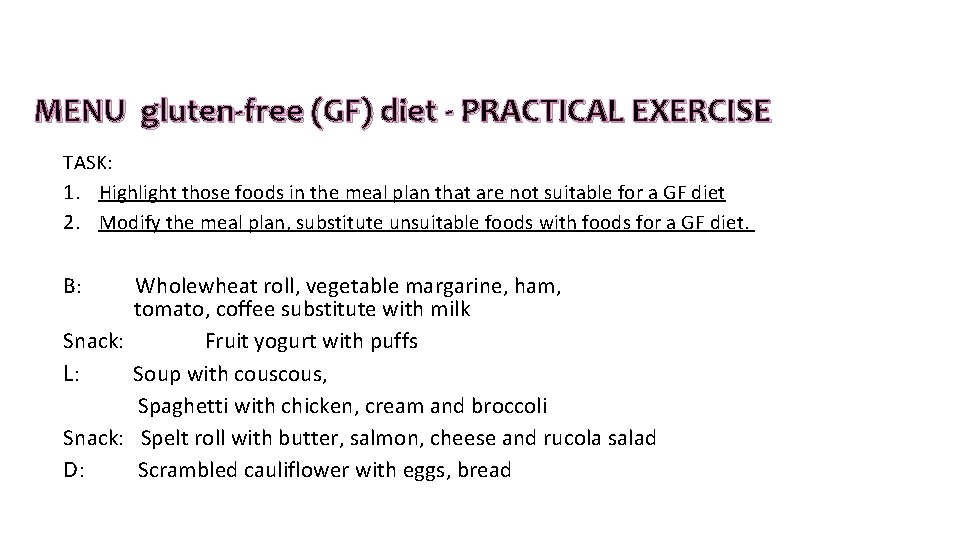
MENU gluten-free (GF) diet - PRACTICAL EXERCISE TASK: 1. Highlight those foods in the meal plan that are not suitable for a GF diet 2. Modify the meal plan, substitute unsuitable foods with foods for a GF diet. B: Wholewheat roll, vegetable margarine, ham, tomato, coffee substitute with milk Snack: Fruit yogurt with puffs L: Soup with cous, Spaghetti with chicken, cream and broccoli Snack: Spelt roll with butter, salmon, cheese and rucola salad D: Scrambled cauliflower with eggs, bread
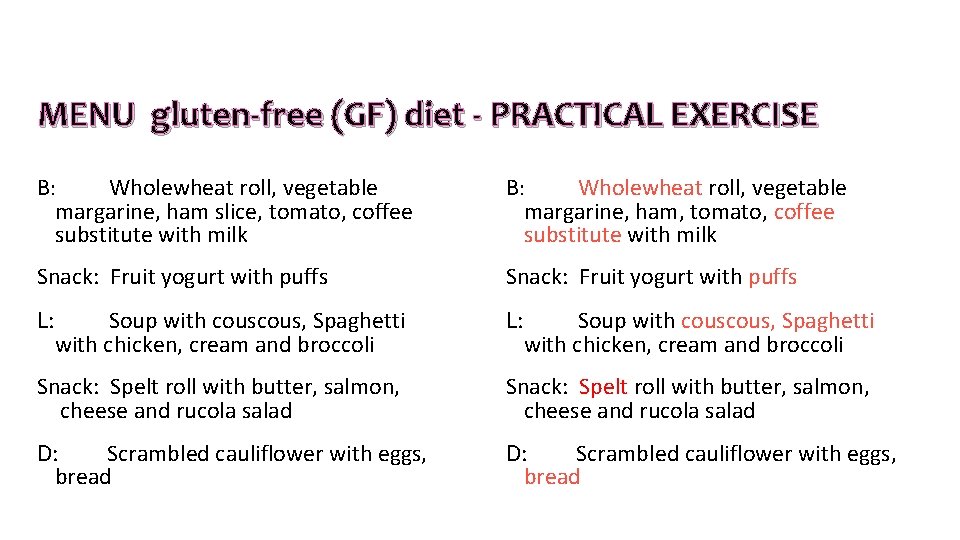
MENU gluten-free (GF) diet - PRACTICAL EXERCISE B: Wholewheat roll, vegetable margarine, ham slice, tomato, coffee substitute with milk B: Wholewheat roll, vegetable margarine, ham, tomato, coffee substitute with milk Snack: Fruit yogurt with puffs L: L: Snack: Spelt roll with butter, salmon, cheese and rucola salad D: Scrambled cauliflower with eggs, bread Soup with couscous, Spaghetti with chicken, cream and broccoli
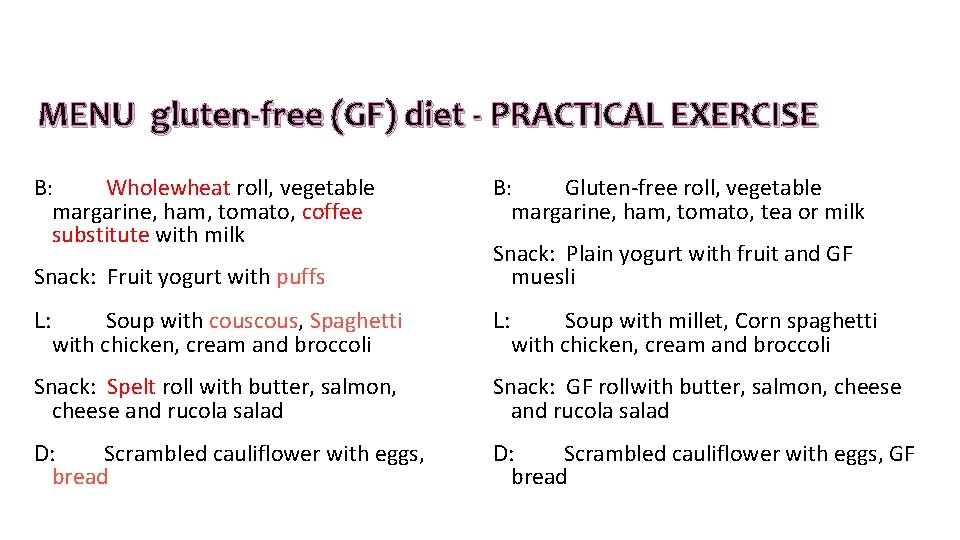
MENU gluten-free (GF) diet - PRACTICAL EXERCISE B: Wholewheat roll, vegetable margarine, ham, tomato, coffee substitute with milk B: Gluten-free roll, vegetable margarine, ham, tomato, tea or milk Snack: Fruit yogurt with puffs Snack: Plain yogurt with fruit and GF muesli L: L: Snack: Spelt roll with butter, salmon, cheese and rucola salad Snack: GF rollwith butter, salmon, cheese and rucola salad D: Scrambled cauliflower with eggs, bread D: Scrambled cauliflower with eggs, GF bread Soup with cous, Spaghetti with chicken, cream and broccoli Soup with millet, Corn spaghetti with chicken, cream and broccoli
FOOD ALLERGY AND INTOLERANCE
FOOD ALLERGY AND INTOLERANCE Food allergy • is an abnormal immune response to food � the immune system excessively reacts to food allergens, which would not represent any danger for an individual under normal conditions • more frequent in children • in central Europe the typical allergies are to milk, eggs, fruits of temperate zone, nuts, poppy seeds and root vegetables Food intolerance • Might be caused by partial or complete deficiency of certain enzyme.
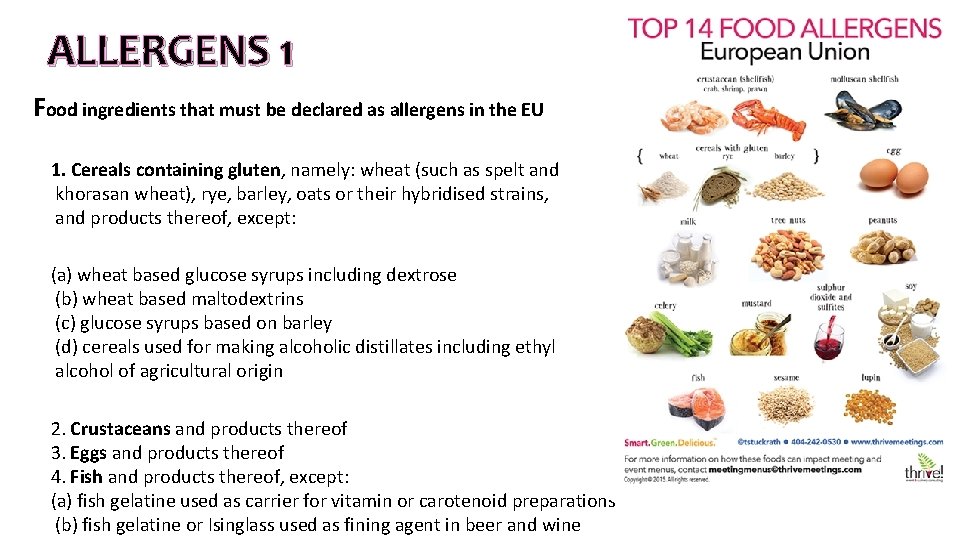
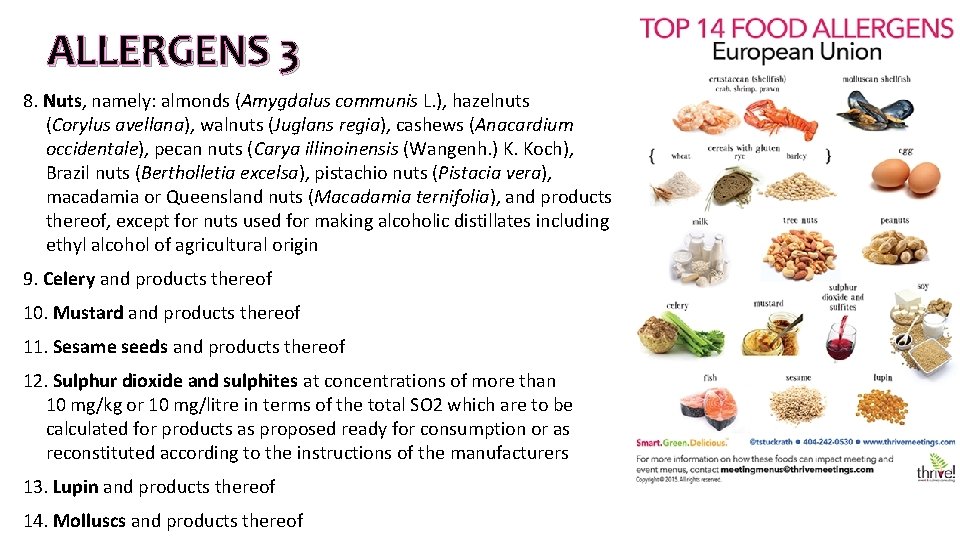
ALLERGENS 1 Food ingredients that must be declared as allergens in the EU 1. Cereals containing gluten, namely: wheat (such as spelt and khorasan wheat), rye, barley, oats or their hybridised strains, and products thereof, except: (a) wheat based glucose syrups including dextrose (b) wheat based maltodextrins (c) glucose syrups based on barley (d) cereals used for making alcoholic distillates including ethyl alcohol of agricultural origin 2. Crustaceans and products thereof 3. Eggs and products thereof 4. Fish and products thereof, except: (a) fish gelatine used as carrier for vitamin or carotenoid preparations (b) fish gelatine or Isinglass used as fining agent in beer and wine
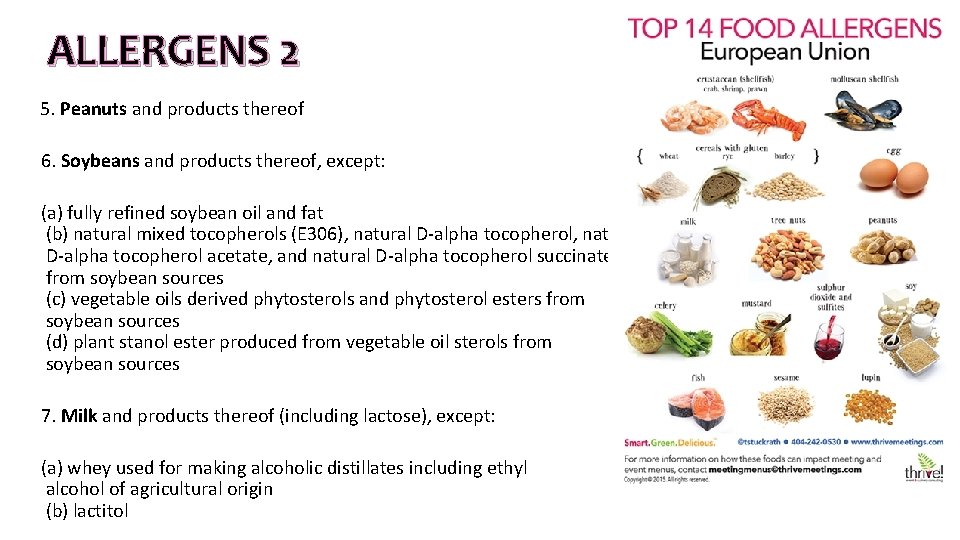
ALLERGENS 2 5. Peanuts and products thereof 6. Soybeans and products thereof, except: (a) fully refined soybean oil and fat (b) natural mixed tocopherols (E 306), natural D-alpha tocopherol acetate, and natural D-alpha tocopherol succinate from soybean sources (c) vegetable oils derived phytosterols and phytosterol esters from soybean sources (d) plant stanol ester produced from vegetable oil sterols from soybean sources 7. Milk and products thereof (including lactose), except: (a) whey used for making alcoholic distillates including ethyl alcohol of agricultural origin (b) lactitol 5. P
ALLERGENS 3 8. Nuts, namely: almonds (Amygdalus communis L. ), hazelnuts (Corylus avellana), walnuts (Juglans regia), cashews (Anacardium occidentale), pecan nuts (Carya illinoinensis (Wangenh. ) K. Koch), Brazil nuts (Bertholletia excelsa), pistachio nuts (Pistacia vera), macadamia or Queensland nuts (Macadamia ternifolia), and products thereof, except for nuts used for making alcoholic distillates including ethyl alcohol of agricultural origin 9. Celery and products thereof 10. Mustard and products thereof 11. Sesame seeds and products thereof 12. Sulphur dioxide and sulphites at concentrations of more than 10 mg/kg or 10 mg/litre in terms of the total SO 2 which are to be calculated for products as proposed ready for consumption or as reconstituted according to the instructions of the manufacturers 13. Lupin and products thereof 14. Molluscs and products thereof
FOOD ALLERGY AND INTOLERANCE • • Diets for people with food allergies are very individual. They depend on the allergic reaction trigger - the allergen. A narrow colaboration with the parents of the child with a food allergy is necessary. Elimination diets are used to treat food allergies and intolerances Main principles for meal preparation: • Meals must be prepared separately, and only with cookware and utensils designated for the given diet • Attention must be paid to possible contamination during preparation, cooking and storing.
COW’S MILK PROTEIN ALLERGY • reaction to one of proteins contained in cow’s milk • 3 -5 % of children in the Czech Republic , mainly under 3 years of age • GI symptoms in about 60% of children, 50 -60% skin reactions, 1/3 respiratory symptoms • more than 80 % of allergic infants can tolerate cow’s milk before 3 years of age
COW’S MILK PROTEIN ALLERGY • abnormal immune response to milk and products that contain milk • allergy is linked to the proteins lactoglobulin, lactalbumin and casein • symptoms: dyspnoea, vomiting, urticaria, GI problems, anaphylaxis (serious, lifethreatening reaction) • treatment: dairy-free diet
COW’S MILK PROTEIN ALLERGY Whey proteins • alfa-lactalbumin, beta-laktoglobulin, milk serum albumin • whey protein allergy is the most common in children under 3 years of age Casein • allergy to casein is less common in young children • caseins often resist to heat and proteolytic enzymes in GIT • it is often a sign of a coming allergy later in age, usually a respiratory allergy Other proteins • gamaglobulins, lactoferin • in adults, allergy to serum proteins is more common, e. g. to bovine serum albumin, crossed allergies - the patient may react not only to cow’s milk but also to beef
! LACTOSE INTOLERANCE (hypolactasia, non-persistent lactose intolerance) • Primary lactose intolerance is a genetically given reduction of gut lactase lactose tolerance = mutation of the gene for lactase (a variable gene) • Secondary lactose intolerance may develop as a consequence of a small intestine infection, inflammatory gut disease or malnutrition • Symptoms: abdominal bloating, flatulence, cramps, diarrhea after consumption of lactose • Treatment: Lactose-free or Low-lactose diet ASIANS 98 % AFRICANS 78 % CZECHS 6– 20 % SCANDINAVIANS 10 %
COW’S MILK PROTEIN ALLERGY Treatment: • elimination of milk and dairy from the diet • elimination of any foods containing milk and dairy • elimination of foods containing milk proteins • But what about butter?
COW’S MILK PROTEIN ALLERGY Milk protein, where you may not expect it… • • Sweet and savoury bakery products Wafers with filling Chocolate, frostings Energy bars Smoked meats Margarines („with butter aroma“) Instant foods
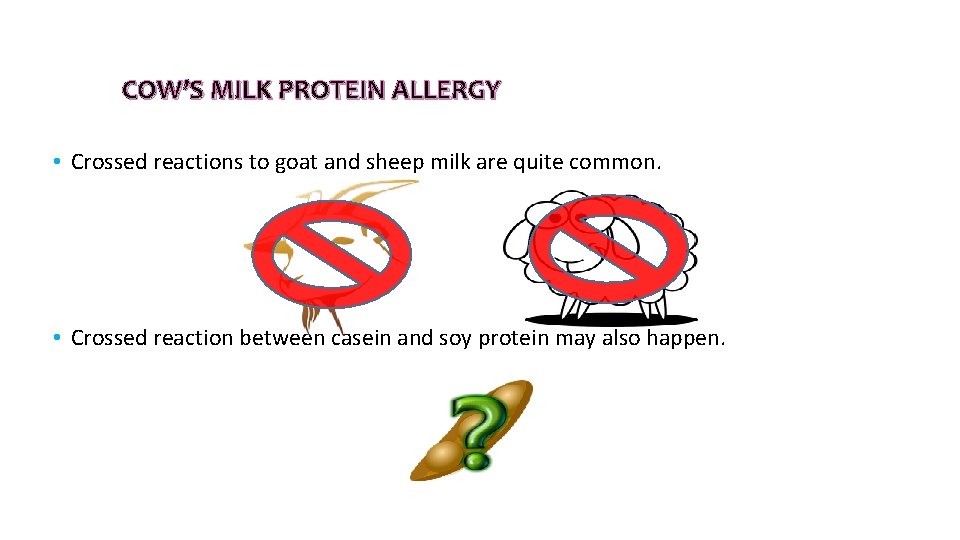
COW’S MILK PROTEIN ALLERGY • Crossed reactions to goat and sheep milk are quite common. • Crossed reaction between casein and soy protein may also happen.
COW’S MILK PROTEIN ALLERGY • And what about heat-treated milk? • It does not have any significant effect and may not reduce the allergenic potential ! • Casein is heat resistant.
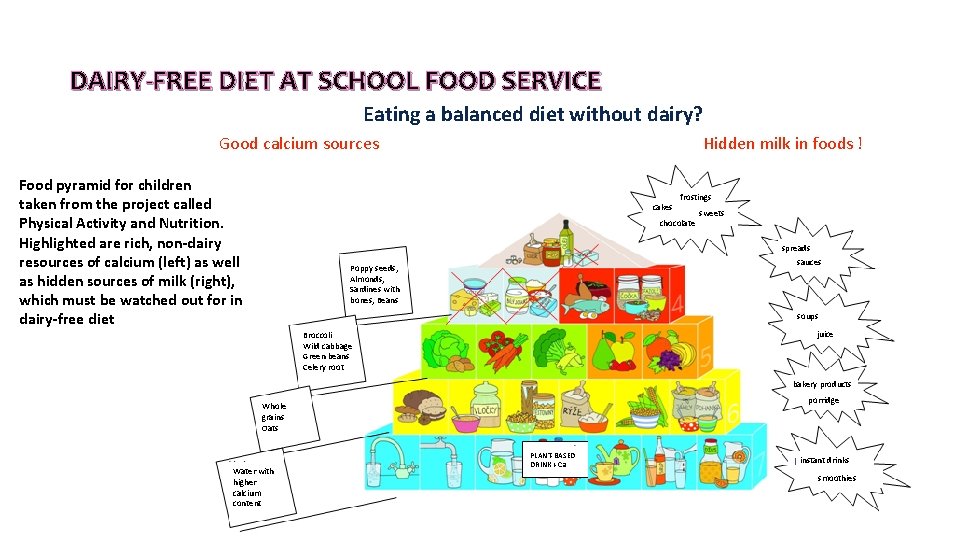
COW’S MILK PROTEIN ALLERGY • Milk substitutes: • Plant-based drinks • Dairy substitutes: • • Butter substitutes – vegetable oils, some margarines Cream substitutes – plant-based substitutes of cream, rice drink thickened with rice flour or starch Yogurt substitutes – plant-based desserts (rice, oat, alternatively soy) Proccessed cheese substitutes – vegetable and legumes spreads (tofu) • It is necessary to watch sufficient calcium intake !
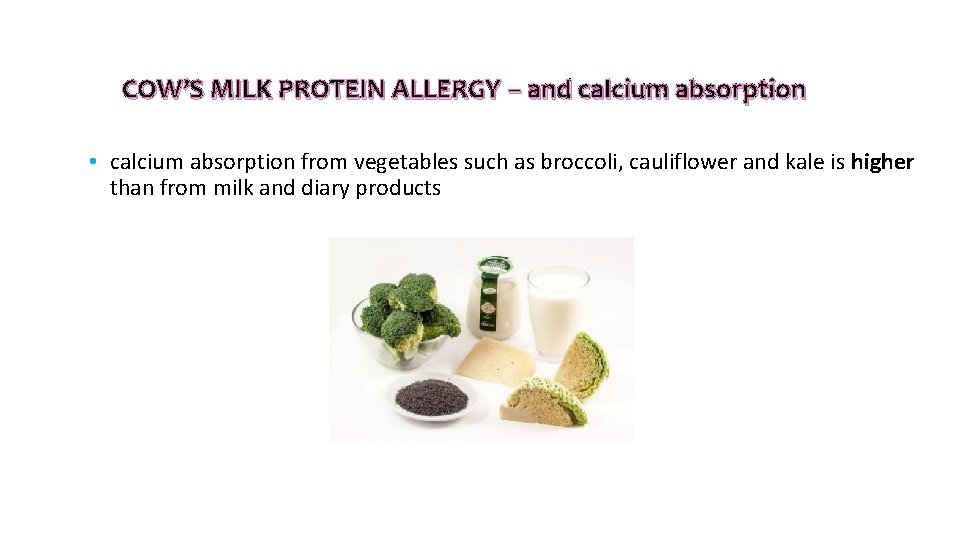
COW’S MILK PROTEIN ALLERGY – and calcium absorption • calcium absorption from vegetables such as broccoli, cauliflower and kale is higher than from milk and diary products
DAIRY-FREE DIET AT SCHOOL FOOD SERVICE Eating a balanced diet without dairy? Good calcium sources Food pyramid for children taken from the project called Physical Activity and Nutrition. Highlighted are rich, non-dairy resources of calcium (left) as well as hidden sources of milk (right), which must be watched out for in dairy-free diet Hidden milk in foods ! cakes frostings chocolate sweets spreads sauces Poppy seeds, Almonds, Sardines with bones, Beans soups juice Broccoli Wild cabbage Green beans Celery root bakery products porridge Whole grains Oats Water with higher calcium content PLANT-BASED DRINK + Ca instant drinks smoothies
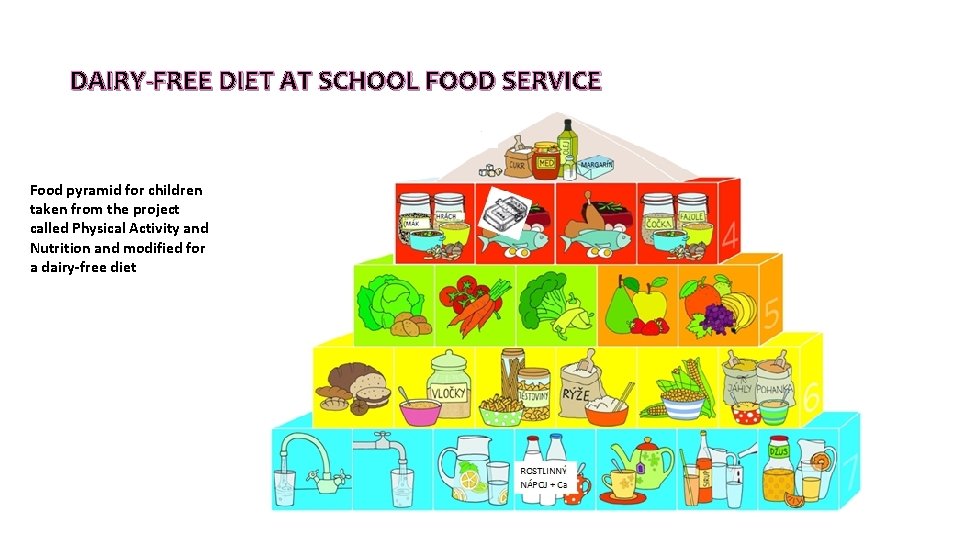
DAIRY-FREE DIET AT SCHOOL FOOD SERVICE Food pyramid for children taken from the project called Physical Activity and Nutrition and modified for a dairy-free diet
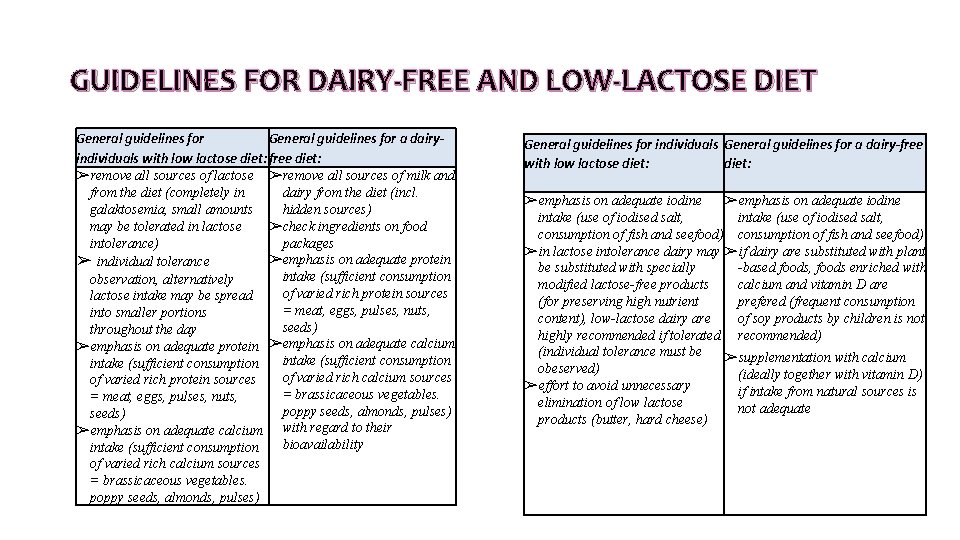
GUIDELINES FOR DAIRY-FREE AND LOW-LACTOSE DIET General guidelines for a dairyindividuals with low lactose diet: free diet: ➢remove all sources of lactose ➢remove all sources of milk and from the diet (completely in dairy from the diet (incl. galaktosemia, small amounts hidden sources) may be tolerated in lactose ➢check ingredients on food intolerance) packages ➢emphasis on adequate protein ➢ individual tolerance intake (sufficient consumption observation, alternatively of varied rich protein sources lactose intake may be spread = meat, eggs, pulses, nuts, into smaller portions seeds) throughout the day ➢emphasis on adequate protein ➢emphasis on adequate calcium intake (sufficient consumption of varied rich calcium sources of varied rich protein sources = brassicaceous vegetables. = meat, eggs, pulses, nuts, poppy seeds, almonds, pulses) seeds) ➢emphasis on adequate calcium with regard to their bioavailability intake (sufficient consumption of varied rich calcium sources = brassicaceous vegetables. poppy seeds, almonds, pulses) General guidelines for individuals General guidelines for a dairy-free with low lactose diet: ➢emphasis on adequate iodine intake (use of iodised salt, consumption of fish and seefood) ➢in lactose intolerance dairy may ➢if dairy are substituted with plant be substituted with specially -based foods, foods enriched with modified lactose-free products calcium and vitamin D are (for preserving high nutrient prefered (frequent consumption content), low-lactose dairy are of soy products by children is not highly recommended if tolerated recommended) (individual tolerance must be ➢supplementation with calcium obeserved) (ideally together with vitamin D) ➢effort to avoid unnecessary if intake from natural sources is elimination of low lactose not adequate products (butter, hard cheese)
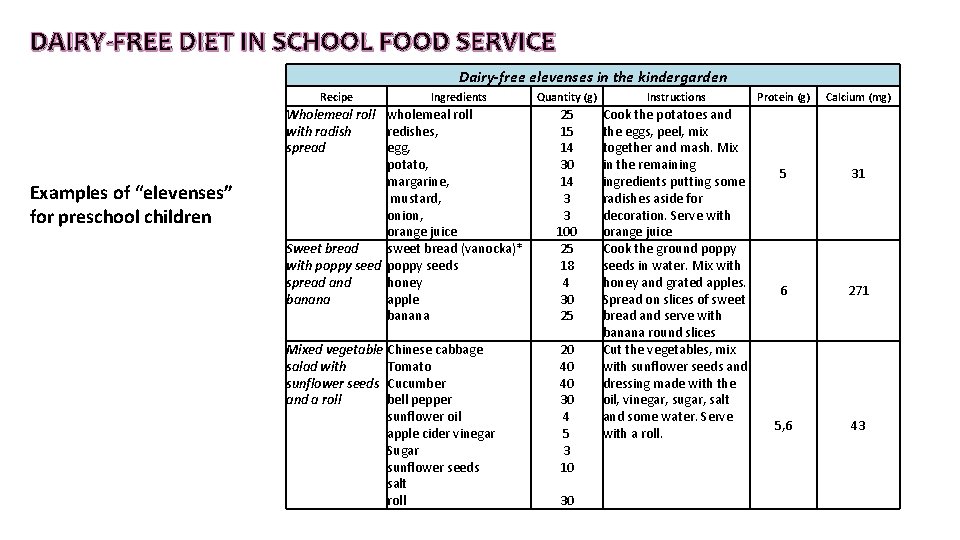
DAIRY-FREE DIET IN SCHOOL FOOD SERVICE Dairy-free elevenses in the kindergarden Recipe Examples of “elevenses” for preschool children Ingredients Quantity (g) Instructions Wholemeal roll with radish redishes, spread egg, potato, margarine, mustard, onion, orange juice Sweet bread sweet bread (vanocka)* with poppy seeds spread and honey banana apple banana 25 15 14 30 14 3 3 100 25 18 4 30 25 Mixed vegetable Chinese cabbage salad with Tomato sunflower seeds Cucumber and a roll bell pepper sunflower oil apple cider vinegar Sugar sunflower seeds salt roll 20 40 40 30 4 5 3 10 Cook the potatoes and the eggs, peel, mix together and mash. Mix in the remaining ingredients putting some radishes aside for decoration. Serve with orange juice Cook the ground poppy seeds in water. Mix with honey and grated apples. Spread on slices of sweet bread and serve with banana round slices Cut the vegetables, mix with sunflower seeds and dressing made with the oil, vinegar, sugar, salt and some water. Serve with a roll. 30 Protein (g) Calcium (mg) 5 31 6 271 5, 6 43
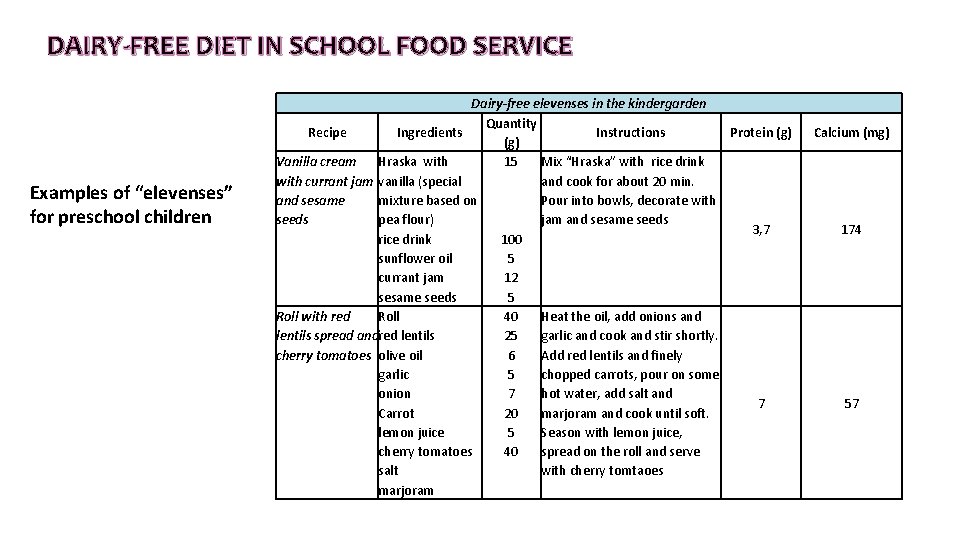
DAIRY-FREE DIET IN SCHOOL FOOD SERVICE Examples of “elevenses” for preschool children Dairy-free elevenses in the kindergarden Quantity Recipe Ingredients Instructions Protein (g) Vanilla cream Hraska with 15 Mix “Hraska” with rice drink with currant jam vanilla (special and cook for about 20 min. and sesame mixture based on Pour into bowls, decorate with seeds pea flour) jam and sesame seeds 3, 7 rice drink 100 sunflower oil 5 currant jam 12 sesame seeds 5 Roll with red Roll 40 Heat the oil, add onions and lentils spread andred lentils 25 garlic and cook and stir shortly. cherry tomatoes olive oil 6 Add red lentils and finely garlic 5 chopped carrots, pour on some onion 7 hot water, add salt and 7 Carrot 20 marjoram and cook until soft. lemon juice 5 Season with lemon juice, cherry tomatoes 40 spread on the roll and serve salt with cherry tomtaoes marjoram Calcium (mg) 174 57
Application
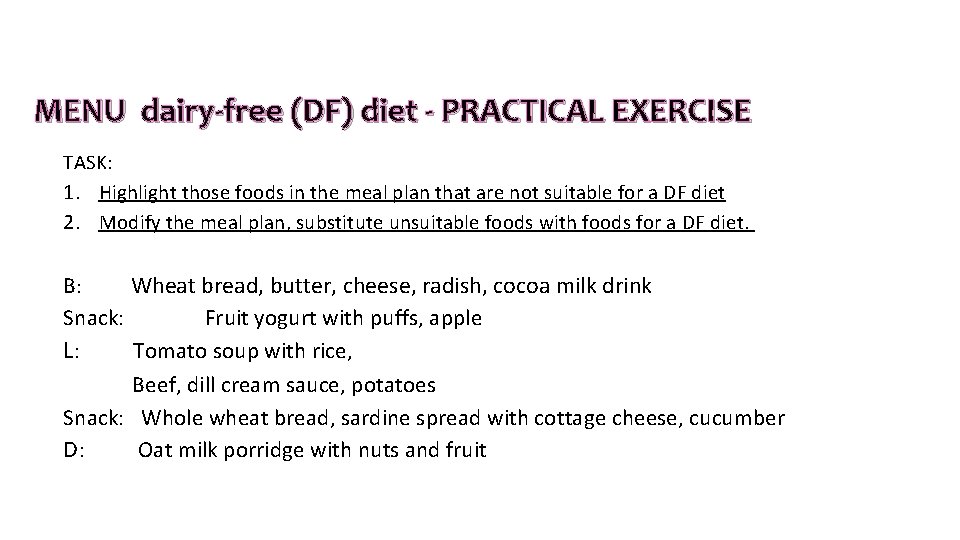
MENU dairy-free (DF) diet - PRACTICAL EXERCISE TASK: 1. Highlight those foods in the meal plan that are not suitable for a DF diet 2. Modify the meal plan, substitute unsuitable foods with foods for a DF diet. B: Wheat bread, butter, cheese, radish, cocoa milk drink Snack: Fruit yogurt with puffs, apple L: Tomato soup with rice, Beef, dill cream sauce, potatoes Snack: Whole wheat bread, sardine spread with cottage cheese, cucumber D: Oat milk porridge with nuts and fruit
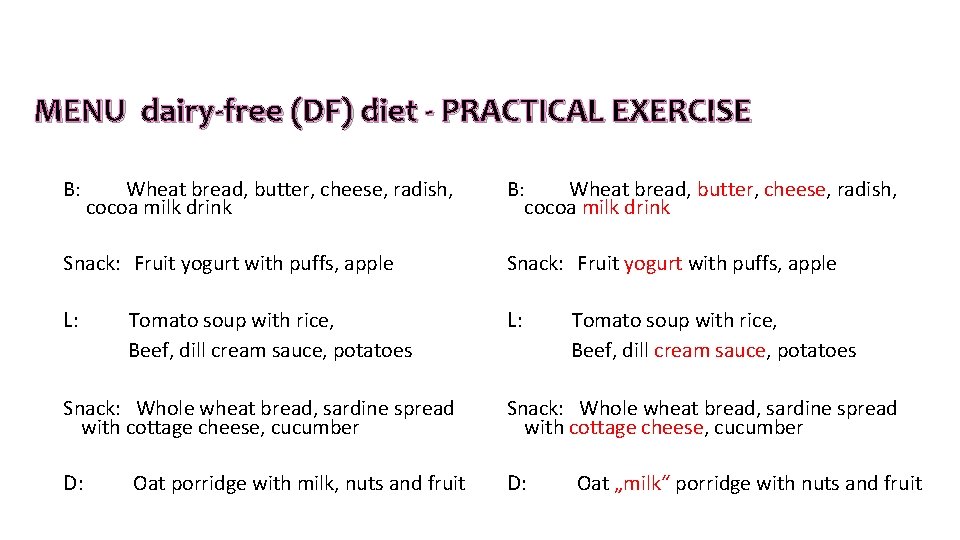
MENU dairy-free (DF) diet - PRACTICAL EXERCISE B: Wheat bread, butter, cheese, radish, cocoa milk drink Snack: Fruit yogurt with puffs, apple L: Tomato soup with rice, Beef, dill cream sauce, potatoes Snack: Whole wheat bread, sardine spread with cottage cheese, cucumber D: Oat porridge with milk, nuts and fruit D: Oat „milk“ porridge with nuts and fruit
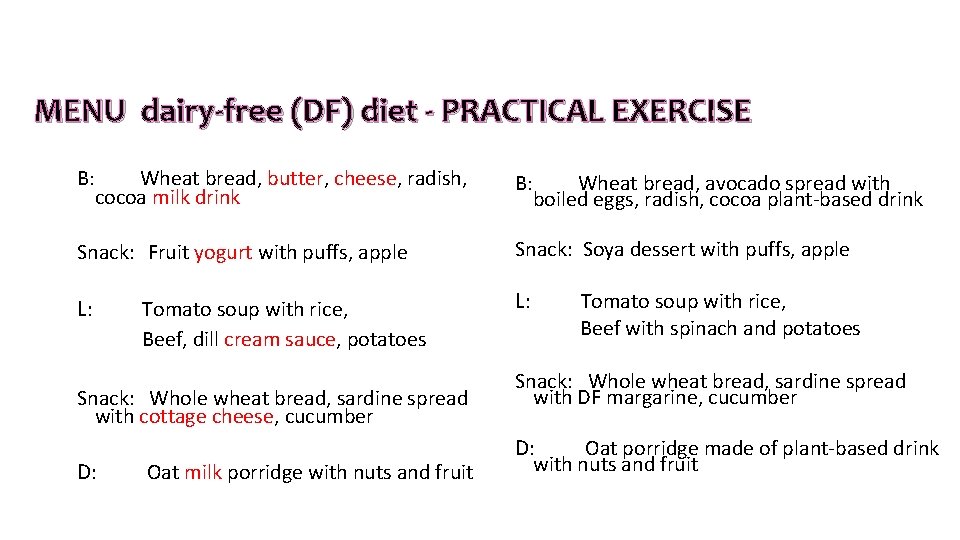
MENU dairy-free (DF) diet - PRACTICAL EXERCISE B: Wheat bread, butter, cheese, radish, cocoa milk drink B: Wheat bread, avocado spread with boiled eggs, radish, cocoa plant-based drink Snack: Fruit yogurt with puffs, apple Snack: Soya dessert with puffs, apple L: Tomato soup with rice, Beef, dill cream sauce, potatoes L: Tomato soup with rice, Beef with spinach and potatoes Snack: Whole wheat bread, sardine spread with cottage cheese, cucumber D: Oat milk porridge with nuts and fruit Snack: Whole wheat bread, sardine spread with DF margarine, cucumber D: Oat porridge made of plant-based drink with nuts and fruit
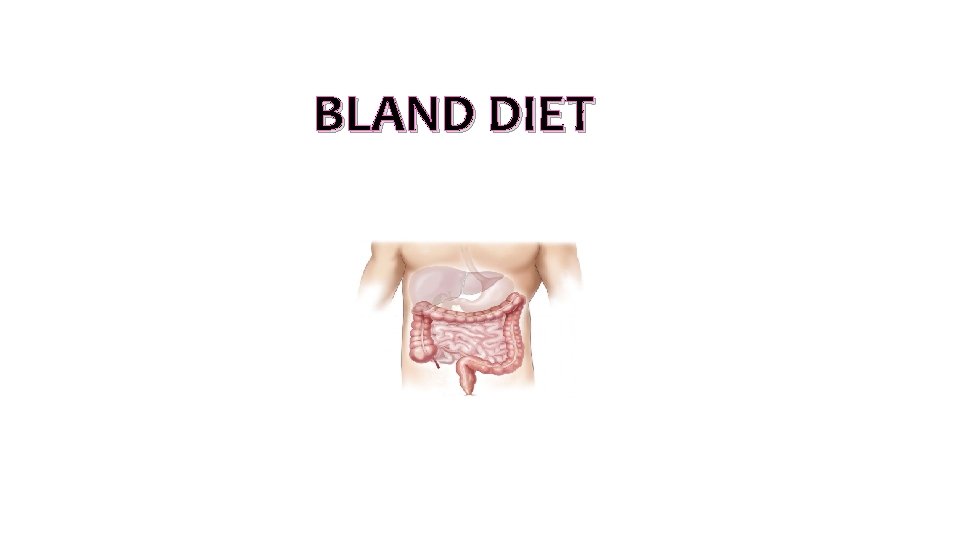
BLAND DIET
BLAND DIET • during recovery period after an acute hepatitis • during remissions in chronic bowel diseases • usually a temporary restriction, progressive loosening of the diet • the diet is varied, balanced, easy to digest and does not cause flatulence; without hot and irritating spices • is GIT-friendly, eliminates chemical and mechanical irritants
BLAND DIET • Mechanical irritants elimination • Fruits and vegetables with tough peels, seeds and woody parts are not served. • Foods with whole seeds and grains are not served. • Meals are cooked until soft, without hard crusts and burnt edges. • Chemical irritants elimination • Hot irritating spices are not used. • Any form of frying or roasting is not applied - only fresh forms of fat may be added to a finished meal
Practical examples follow…
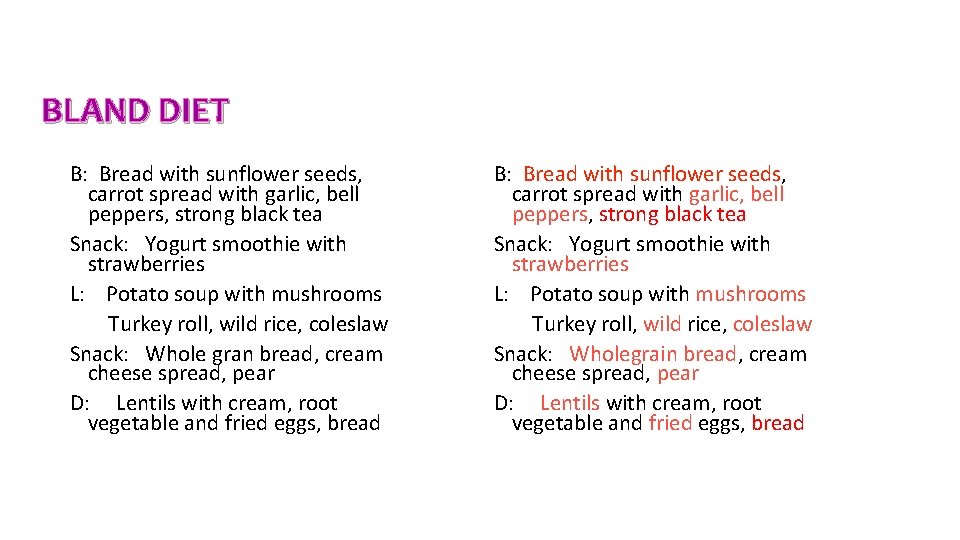
BLAND DIET TASK: 1. Highlight those foods in the meal paln that are not suitable for bland diet 2. Modify the meal plan, substitute unsuitable foods with foods for the bland diet. B: Bread with sunflower seeds, carrot spread with garlic, bell peppers, strong black tea Snack: Yogurt smoothie with strawberries L: Potato soup with mushrooms Turkey roll, wild rice, coleslaw Snack: Whole grain bread, cream cheese spread, pear D: Lentils with cream, root vegetable and fried eggs, bread
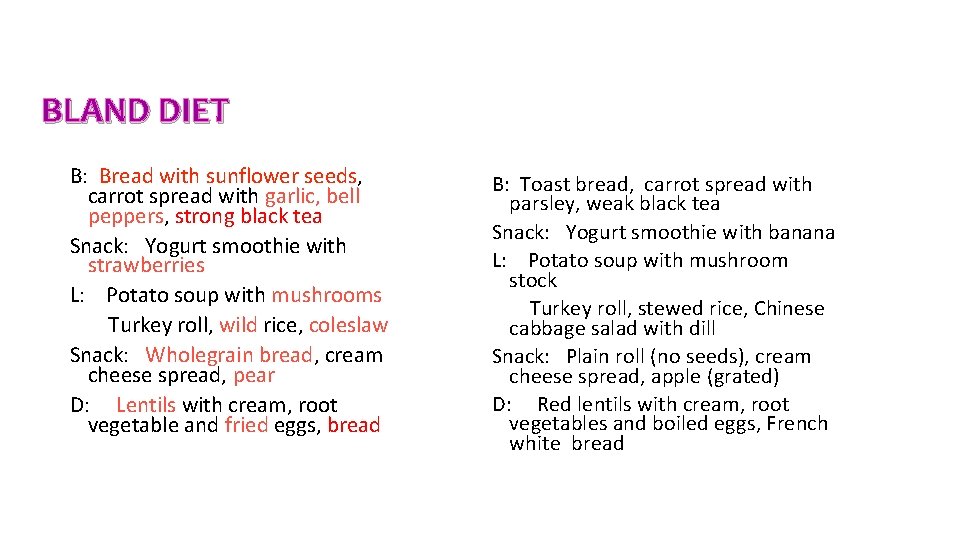
BLAND DIET B: Bread with sunflower seeds, carrot spread with garlic, bell peppers, strong black tea Snack: Yogurt smoothie with strawberries L: Potato soup with mushrooms Turkey roll, wild rice, coleslaw Snack: Whole gran bread, cream cheese spread, pear D: Lentils with cream, root vegetable and fried eggs, bread B: Bread with sunflower seeds, carrot spread with garlic, bell peppers, strong black tea Snack: Yogurt smoothie with strawberries L: Potato soup with mushrooms Turkey roll, wild rice, coleslaw Snack: Wholegrain bread, cream cheese spread, pear D: Lentils with cream, root vegetable and fried eggs, bread
BLAND DIET B: Bread with sunflower seeds, carrot spread with garlic, bell peppers, strong black tea Snack: Yogurt smoothie with strawberries L: Potato soup with mushrooms Turkey roll, wild rice, coleslaw Snack: Wholegrain bread, cream cheese spread, pear D: Lentils with cream, root vegetable and fried eggs, bread B: Toast bread, carrot spread with parsley, weak black tea Snack: Yogurt smoothie with banana L: Potato soup with mushroom stock Turkey roll, stewed rice, Chinese cabbage salad with dill Snack: Plain roll (no seeds), cream cheese spread, apple (grated) D: Red lentils with cream, root vegetables and boiled eggs, French white bread
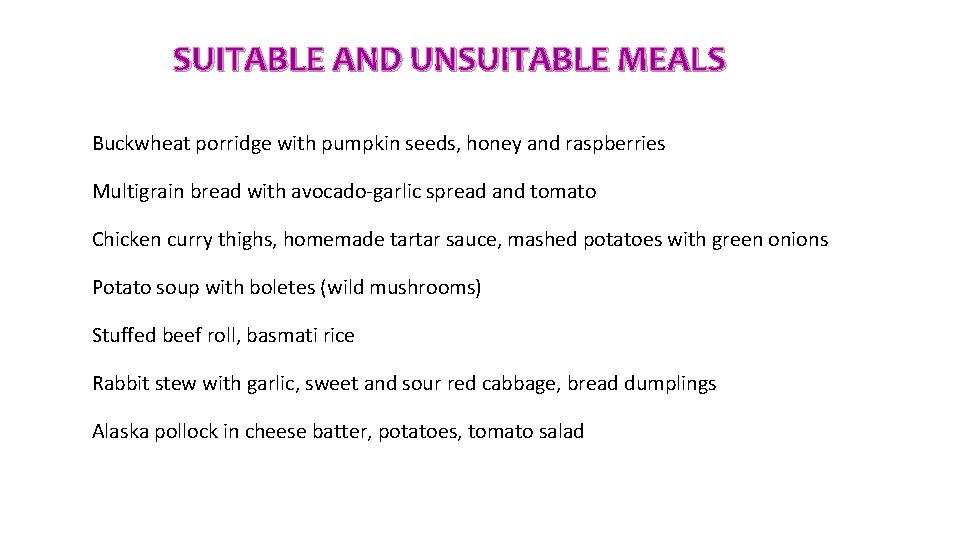
SUITABLE AND UNSUITABLE MEALS Buckwheat porridge with pumpkin seeds, honey and raspberries Multigrain bread with avocado-garlic spread and tomato Chicken curry thighs, homemade tartar sauce, mashed potatoes with green onions Potato soup with boletes (wild mushrooms) Stuffed beef roll, basmati rice Rabbit stew with garlic, sweet and sour red cabbage, bread dumplings Alaska pollock in cheese batter, potatoes, tomato salad
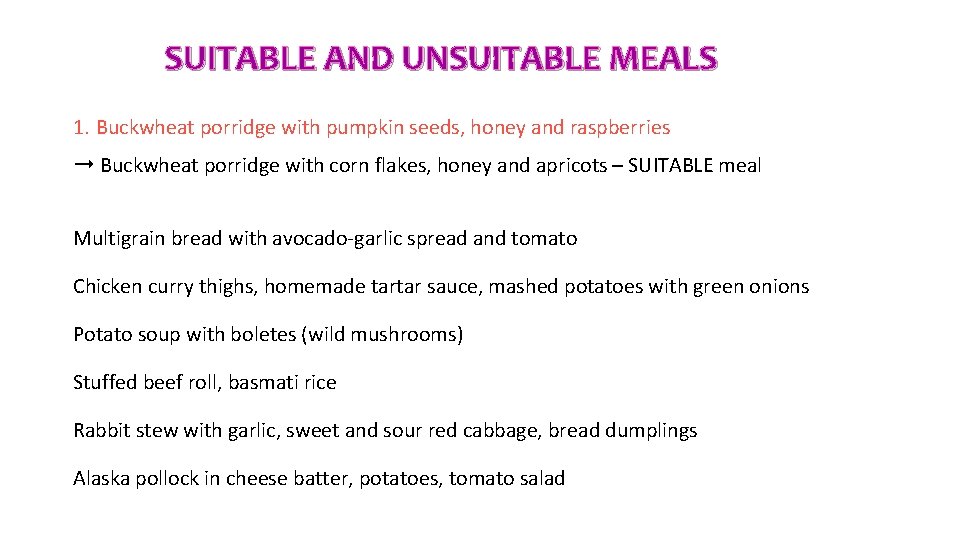
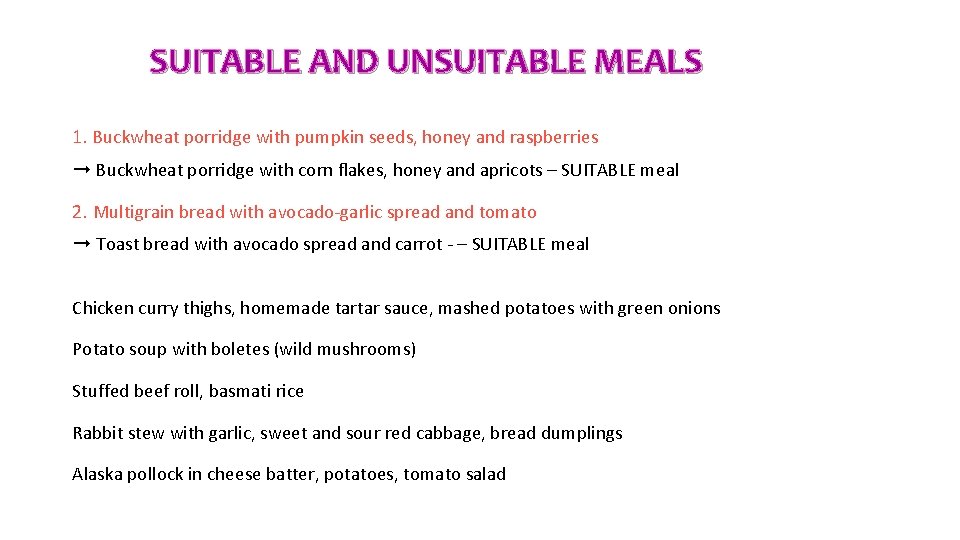
SUITABLE AND UNSUITABLE MEALS 1. Buckwheat porridge with pumpkin seeds, honey and raspberries ➞ Buckwheat porridge with corn flakes, honey and apricots – SUITABLE meal Multigrain bread with avocado-garlic spread and tomato Chicken curry thighs, homemade tartar sauce, mashed potatoes with green onions Potato soup with boletes (wild mushrooms) Stuffed beef roll, basmati rice Rabbit stew with garlic, sweet and sour red cabbage, bread dumplings Alaska pollock in cheese batter, potatoes, tomato salad
SUITABLE AND UNSUITABLE MEALS 1. Buckwheat porridge with pumpkin seeds, honey and raspberries ➞ Buckwheat porridge with corn flakes, honey and apricots – SUITABLE meal 2. Multigrain bread with avocado-garlic spread and tomato ➞ Toast bread with avocado spread and carrot - – SUITABLE meal Chicken curry thighs, homemade tartar sauce, mashed potatoes with green onions Potato soup with boletes (wild mushrooms) Stuffed beef roll, basmati rice Rabbit stew with garlic, sweet and sour red cabbage, bread dumplings Alaska pollock in cheese batter, potatoes, tomato salad
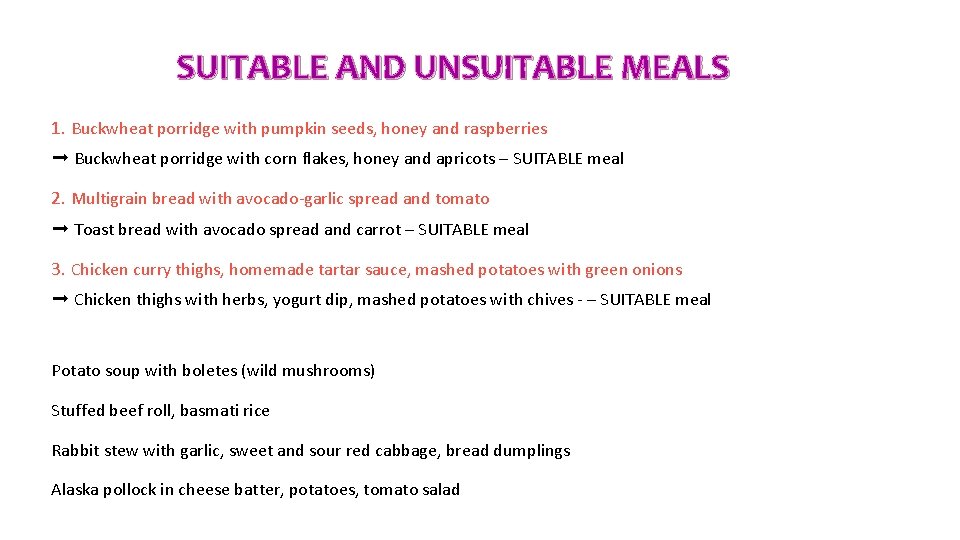
SUITABLE AND UNSUITABLE MEALS 1. Buckwheat porridge with pumpkin seeds, honey and raspberries ➞ Buckwheat porridge with corn flakes, honey and apricots – SUITABLE meal 2. Multigrain bread with avocado-garlic spread and tomato ➞ Toast bread with avocado spread and carrot – SUITABLE meal 3. Chicken curry thighs, homemade tartar sauce, mashed potatoes with green onions ➞ Chicken thighs with herbs, yogurt dip, mashed potatoes with chives - – SUITABLE meal Potato soup with boletes (wild mushrooms) Stuffed beef roll, basmati rice Rabbit stew with garlic, sweet and sour red cabbage, bread dumplings Alaska pollock in cheese batter, potatoes, tomato salad
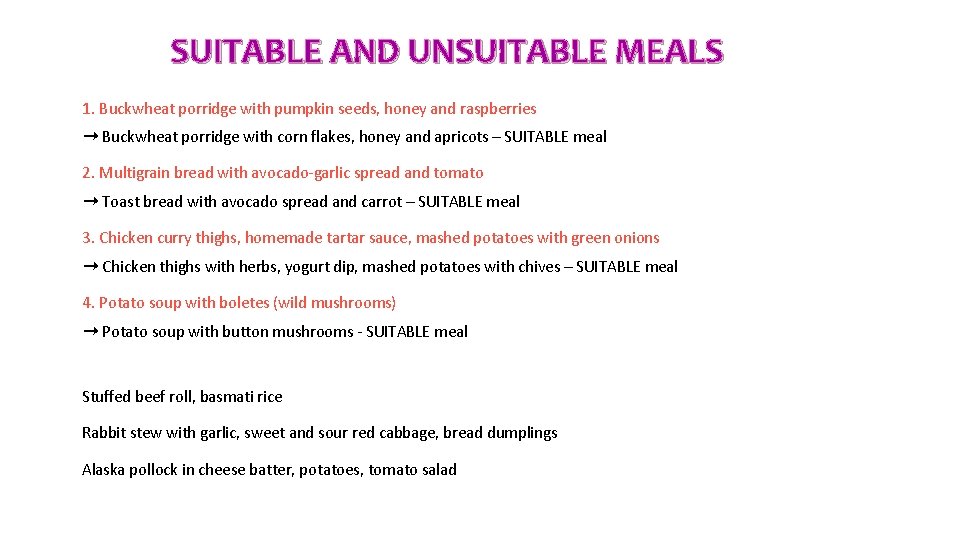
SUITABLE AND UNSUITABLE MEALS 1. Buckwheat porridge with pumpkin seeds, honey and raspberries ➞ Buckwheat porridge with corn flakes, honey and apricots – SUITABLE meal 2. Multigrain bread with avocado-garlic spread and tomato ➞ Toast bread with avocado spread and carrot – SUITABLE meal 3. Chicken curry thighs, homemade tartar sauce, mashed potatoes with green onions ➞ Chicken thighs with herbs, yogurt dip, mashed potatoes with chives – SUITABLE meal 4. Potato soup with boletes (wild mushrooms) ➞ Potato soup with button mushrooms - SUITABLE meal Stuffed beef roll, basmati rice Rabbit stew with garlic, sweet and sour red cabbage, bread dumplings Alaska pollock in cheese batter, potatoes, tomato salad
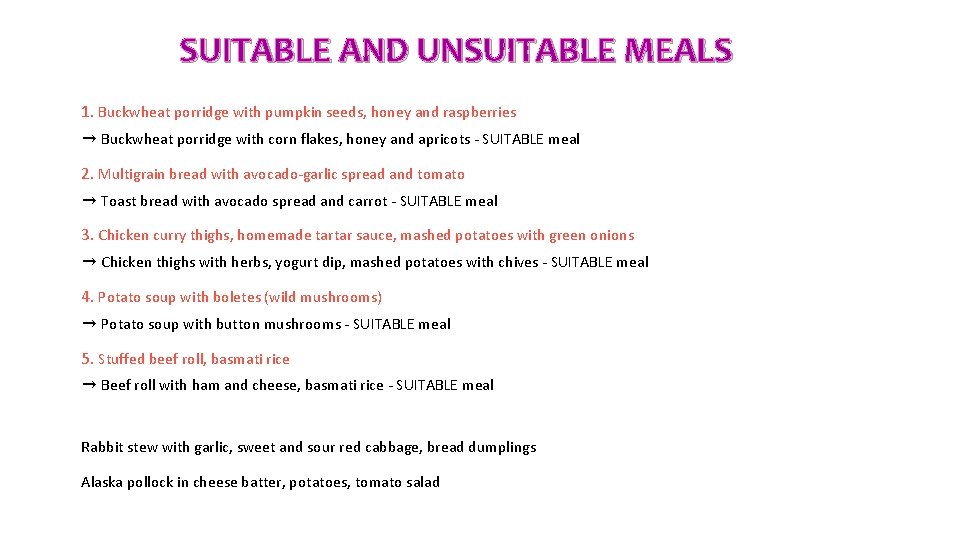
SUITABLE AND UNSUITABLE MEALS 1. Buckwheat porridge with pumpkin seeds, honey and raspberries ➞ Buckwheat porridge with corn flakes, honey and apricots - SUITABLE meal 2. Multigrain bread with avocado-garlic spread and tomato ➞ Toast bread with avocado spread and carrot - SUITABLE meal 3. Chicken curry thighs, homemade tartar sauce, mashed potatoes with green onions ➞ Chicken thighs with herbs, yogurt dip, mashed potatoes with chives - SUITABLE meal 4. Potato soup with boletes (wild mushrooms) ➞ Potato soup with button mushrooms - SUITABLE meal 5. Stuffed beef roll, basmati rice ➞ Beef roll with ham and cheese, basmati rice - SUITABLE meal Rabbit stew with garlic, sweet and sour red cabbage, bread dumplings Alaska pollock in cheese batter, potatoes, tomato salad
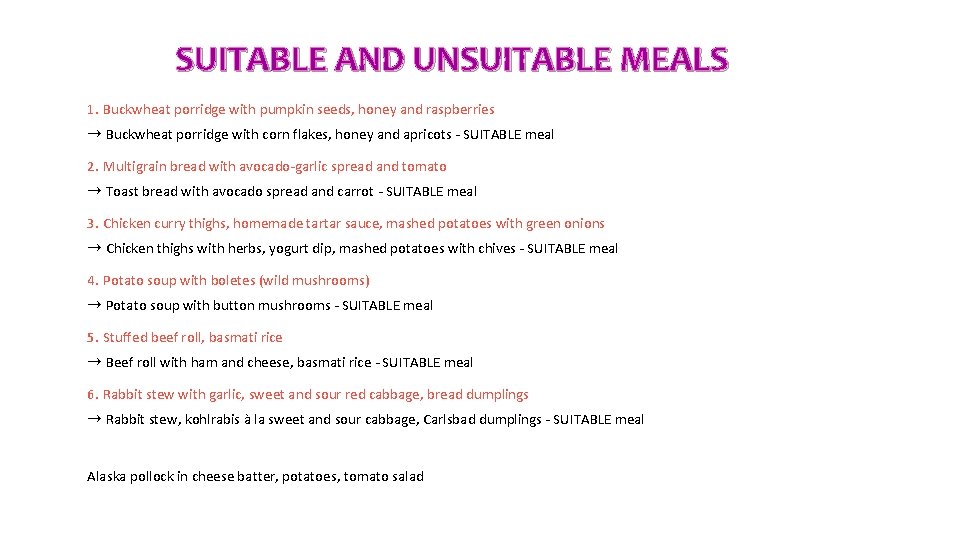
SUITABLE AND UNSUITABLE MEALS 1. Buckwheat porridge with pumpkin seeds, honey and raspberries ➞ Buckwheat porridge with corn flakes, honey and apricots - SUITABLE meal 2. Multigrain bread with avocado-garlic spread and tomato ➞ Toast bread with avocado spread and carrot - SUITABLE meal 3. Chicken curry thighs, homemade tartar sauce, mashed potatoes with green onions ➞ Chicken thighs with herbs, yogurt dip, mashed potatoes with chives - SUITABLE meal 4. Potato soup with boletes (wild mushrooms) ➞ Potato soup with button mushrooms - SUITABLE meal 5. Stuffed beef roll, basmati rice ➞ Beef roll with ham and cheese, basmati rice - SUITABLE meal 6. Rabbit stew with garlic, sweet and sour red cabbage, bread dumplings ➞ Rabbit stew, kohlrabis à la sweet and sour cabbage, Carlsbad dumplings - SUITABLE meal Alaska pollock in cheese batter, potatoes, tomato salad
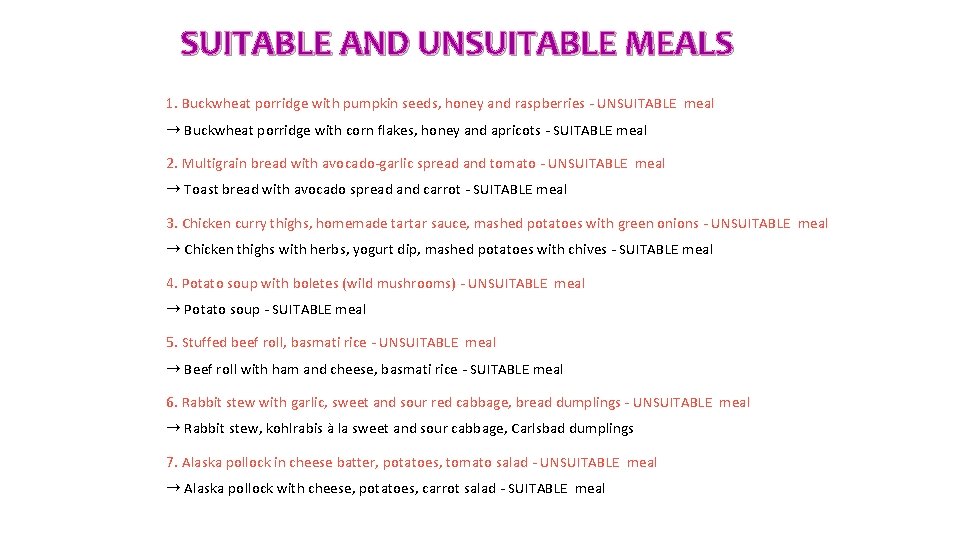
SUITABLE AND UNSUITABLE MEALS 1. Buckwheat porridge with pumpkin seeds, honey and raspberries - UNSUITABLE meal ➞ Buckwheat porridge with corn flakes, honey and apricots - SUITABLE meal 2. Multigrain bread with avocado-garlic spread and tomato - UNSUITABLE meal ➞ Toast bread with avocado spread and carrot - SUITABLE meal 3. Chicken curry thighs, homemade tartar sauce, mashed potatoes with green onions - UNSUITABLE meal ➞ Chicken thighs with herbs, yogurt dip, mashed potatoes with chives - SUITABLE meal 4. Potato soup with boletes (wild mushrooms) - UNSUITABLE meal ➞ Potato soup - SUITABLE meal 5. Stuffed beef roll, basmati rice - UNSUITABLE meal ➞ Beef roll with ham and cheese, basmati rice - SUITABLE meal 6. Rabbit stew with garlic, sweet and sour red cabbage, bread dumplings - UNSUITABLE meal ➞ Rabbit stew, kohlrabis à la sweet and sour cabbage, Carlsbad dumplings 7. Alaska pollock in cheese batter, potatoes, tomato salad - UNSUITABLE meal ➞ Alaska pollock with cheese, potatoes, carrot salad - SUITABLE meal
TYPE 1 DIABETES DIET
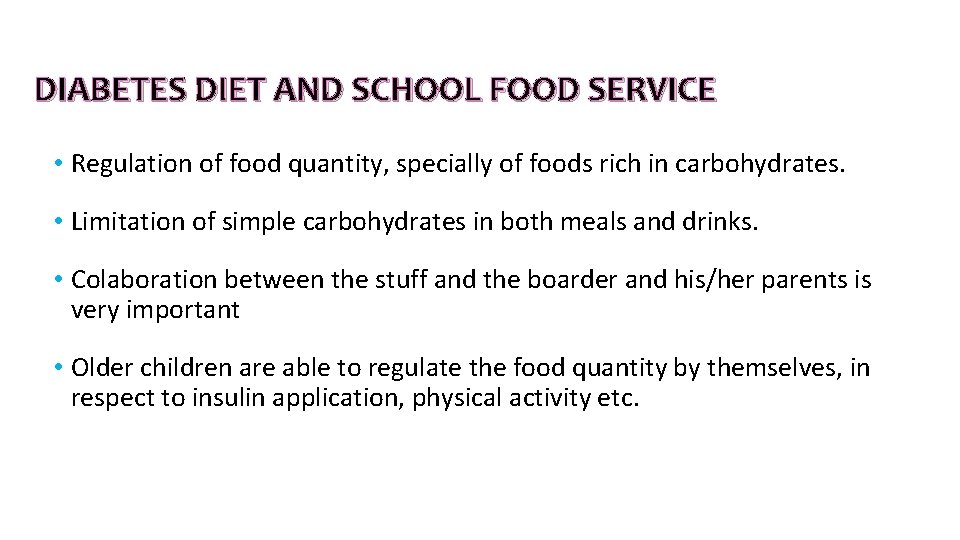
DIABETES DIET AND SCHOOL FOOD SERVICE • Regulation of food quantity, specially of foods rich in carbohydrates. • Limitation of simple carbohydrates in both meals and drinks. • Colaboration between the stuff and the boarder and his/her parents is very important • Older children are able to regulate the food quantity by themselves, in respect to insulin application, physical activity etc.
HOMEWORK ASSIGNMENT • School Lunches You've Probably Never Heard About. . . https: //www. youtube. com/watch? v=-7 YBTX 7 vn. Vc • Write a brief summary, on 1 page A 4, about School Food System in your country. Did you have it in your school? How are the situations where a child must comply with any dietary restrictions or diet dealt with? Did your school offer the possibility of preparing dietary foods for these children or not? Describe how this issue is addressed in your country. • Your homework should be added in Homework Vaults by the next week’s seminar • Bring your summaries for the next class and someone will present us their situation of School Food Service and diets in their country
THANK YOU FOR ATTENTION