
Cushings syndrome Dr Atallah AlRuhaily Consultant Endocrinologist Cushings







- Slides: 35
Cushing’s syndrome Dr. Atallah Al-Ruhaily Consultant Endocrinologist
Cushing’s syndrome Dr. Atallah Al-Ruhaily Consultant Endocrinologist
Cushing’s Syndrome Definitions v Cushing’ Syndrome: A state of chronic glucocorticoid excess leading to constellation of symptoms and signs of hypercortisolism regardless of the cause. v. Cushing’s Disease: The specific type of Cushing’s syndrome due to excessive ACTH secretion from a pituitary tumor. v Ectopic ACTH syndrome: type of Cushing’s syndrome due to ACTH secretion by nonpituitary tumor.
Cushing’s Syndrome n n n The most common cause is iatrogenic due to chronic use of glucocorticoid. Regardless of etiology, all cases of endogenous or spontaneous Cushing’s syndrome are due to overproduction of cortisol by the adrenal glands. Most endogenous types are due to Bilateral Adrenal Hyperplasia due to ACTH secretion by pituitary adenoma. Incidence of pituitary-dependent adrenal hyperplasia in women is 3 times that in men. The most frequent age of onset is 3 rd to 4 th decade.
Cushing’s syndrome: Differential Diagnosis ACTH-dependent Ø pituitary adenoma (Cushing’s disease) Ø non-pituitary neoplasm (ectopic ACTH) ACTH-independent Ø Iatrogenic (glucocorticoid, megestrol acetate) Ø Adrenal neoplasm (adenoma, carcinoma) Ø Nodular adrenal hyperplasia • primary pigmented nodular adrenal disease. • massive macronodular adrenonodular hyperplasia • food-dependent (GIP-mediated) Ø Factitious
Tumors causing ectopic ACTH syndome • small cell carcinoma of the lung (50% of ectopic ACTH cases). • pancreatic islet cell tumors. • carcinoid tumors (lung, thymus, gut, pancreas, ovary). • medullary carcinoma of the thyroid. • pheochromocytoma and related tumors.
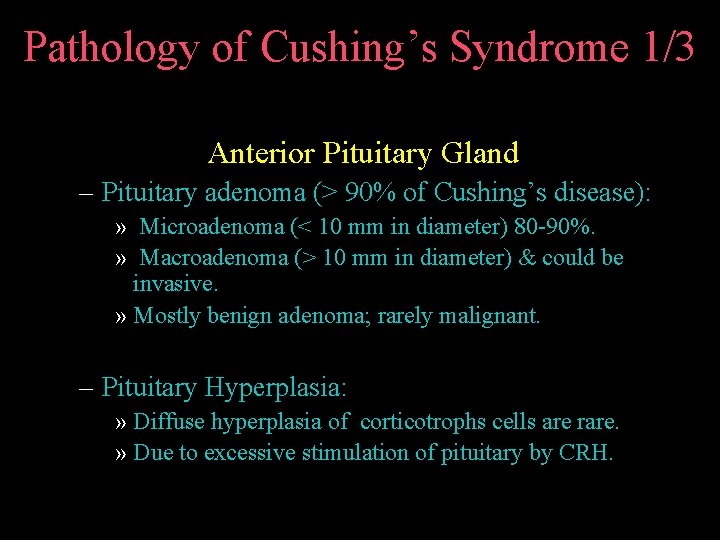
Pathology of Cushing’s Syndrome 1/3 Anterior Pituitary Gland – Pituitary adenoma (> 90% of Cushing’s disease): » Microadenoma (< 10 mm in diameter) 80 -90%. » Macroadenoma (> 10 mm in diameter) & could be invasive. » Mostly benign adenoma; rarely malignant. – Pituitary Hyperplasia: » Diffuse hyperplasia of corticotrophs cells are rare. » Due to excessive stimulation of pituitary by CRH.
Pathology of Cushing’s Syndrome 2/3 Adrenocortical Hyperplasia – Bilateral hyperplasia of adrenal cortex. – Results from chronic ACTH hypersecretion. – There are 3 types of adrenocortical hyperplasia: 1. Simple Adrenocortical Hyperplasia (Cushing’s disease) 2. Ectopic ACTH syndrome 3. Bilateral Nodular Hyperplasia Nodular enlargement of adrenal glands resulting from long-standing ACTH hypersecretion (pituitary or nonpituitary). There are 2 types of Bilateral Nodular Hyperplasia: A. Primary Pigmented Nodular Adrenocortical Disease, PPNAD) B. Massive Macronodular Adrenal Hyperplasia).
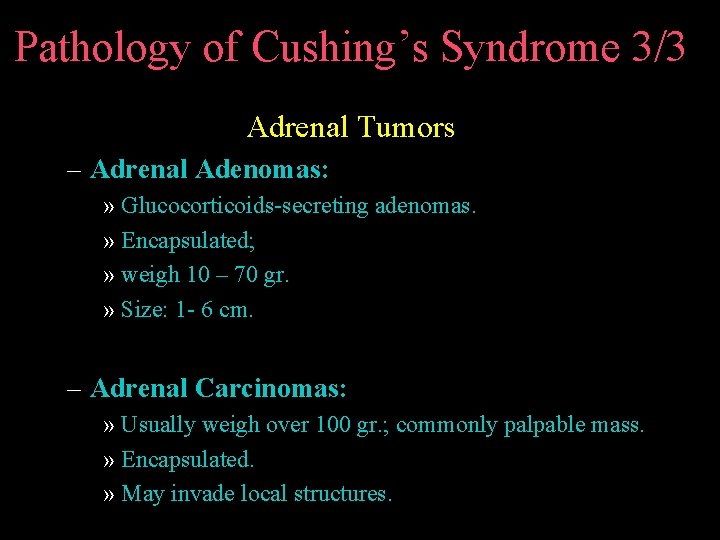
Pathology of Cushing’s Syndrome 3/3 Adrenal Tumors – Adrenal Adenomas: » Glucocorticoids-secreting adenomas. » Encapsulated; » weigh 10 – 70 gr. » Size: 1 - 6 cm. – Adrenal Carcinomas: » Usually weigh over 100 gr. ; commonly palpable mass. » Encapsulated. » May invade local structures.
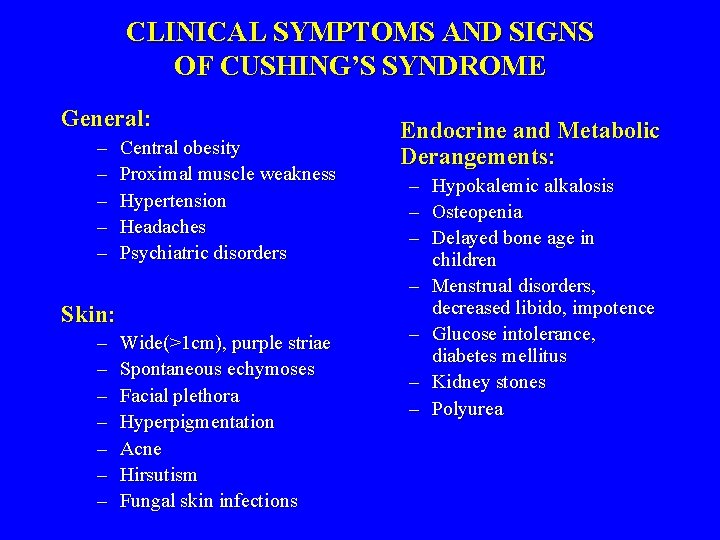
CLINICAL SYMPTOMS AND SIGNS OF CUSHING’S SYNDROME General: – – – Central obesity Proximal muscle weakness Hypertension Headaches Psychiatric disorders Endocrine and Metabolic Derangements: – – Skin: – – – – Wide(>1 cm), purple striae Spontaneous echymoses Facial plethora Hyperpigmentation Acne Hirsutism Fungal skin infections – – – Hypokalemic alkalosis Osteopenia Delayed bone age in children Menstrual disorders, decreased libido, impotence Glucose intolerance, diabetes mellitus Kidney stones Polyurea
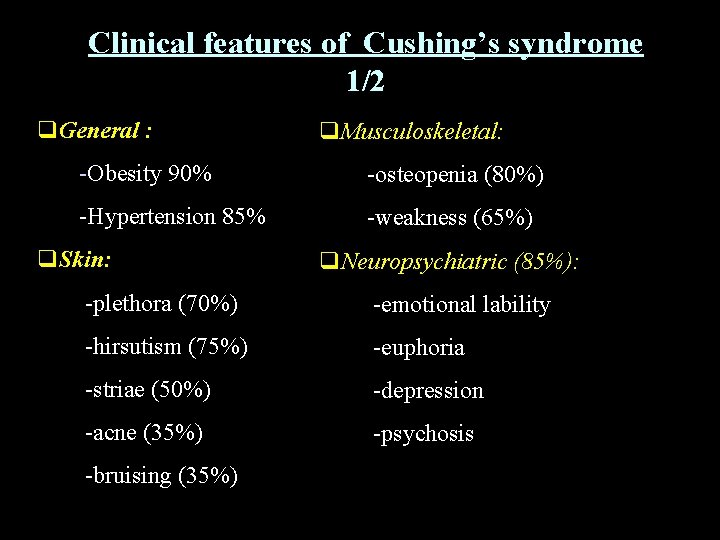
Clinical features of Cushing’s syndrome 1/2 q. General : q. Musculoskeletal: -Obesity 90% -osteopenia (80%) -Hypertension 85% -weakness (65%) q. Skin: q. Neuropsychiatric (85%): -plethora (70%) -emotional lability -hirsutism (75%) -euphoria -striae (50%) -depression -acne (35%) -psychosis -bruising (35%)
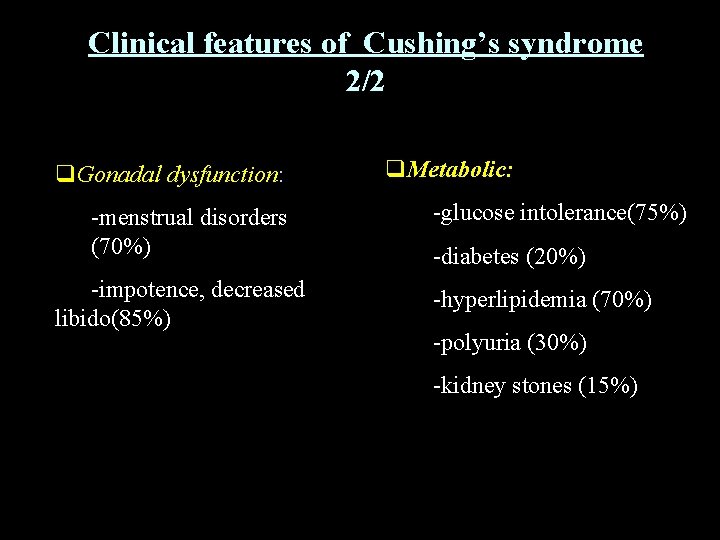
Clinical features of Cushing’s syndrome 2/2 q. Gonadal dysfunction: -menstrual disorders (70%) -impotence, decreased libido(85%) q. Metabolic: -glucose intolerance(75%) -diabetes (20%) -hyperlipidemia (70%) -polyuria (30%) -kidney stones (15%)
Cushing’ Disease n The most common type of endogenous Cushing’s syndrome (70%). n Female : Male Ratio about 8 : 1 n Incidence age ranges from childhood to 70 years.
Ectopic ACTH Hypersecretion n 15 -20% of ACTH-dependent Cushing’ syndrome. n Very high ACTH may result in severe hypercortisolism with lack of classical features of Cushing’s syndrome. n More common in men. n Age incidence: 40 -60 years.
Primary Adrenal Tumors n 10% of cases of Cushing’s syndrome. n Most are benign adrenocortical adenomas. n Adrenocortical carcinomas are uncommon. n Both adenomas & carcinomas are more common in women.
Childhood Cushing’s Syndrome n Adrenal carcinoma is the commonest (51%) & Adrenal adenoma (14%). n More common in girls than in boys. n Most in age 1 – 8 years. n Cushing’s disease more common in adolescents (35%); most at age over 10 years.
Routine Laboratory Findings High normal Hb, Htc & RBC. n WBC usually normal but lymphoctytes may be subnormal. n Eosinophils may be reduced. n Electrolytes: n Hypokalemia & alkalosis in marked steroid hypersecretion (ectopic ACTH). Impaired glucose tolerance or hyperglycemia n Serum Calcium normal but hypercalciuria in 40%. n
Features suggesting specific causes 1. Cushing’s Disease n Typifies classic clinical picture: – – – Female predominance Onset age: 20 – 40 years. Slow progression over several years. n Hyperpigmentation & hypokalemic alkalosis are rare. n Androgenic manifestations are limited to acne & hirsutism. n Moderately increased cortisol & adrenal androgens.
Features suggesting specific causes 2. Ectopic ACTH Syndrome (Carcinoma) n n n n Predominantly in males. Highest incidence at age 40 – 60 years. Clinical manifestations are frequently limited to: weakness, hyperpigmentation & glucose intolerance. Primary tumor is usually apparent. Hyperpigmentation, hypokalemia & alkalosis are common. Weight loss & anemia are common. Hypercortisolism is of rapid onset. Steroid hypersecretion is frequently severe with equally elevated levels of glucocorticoids, androgens & DOC.
Features suggesting specific causes 3. Ectopic ACTH Syndrome (Benign Tumor) n Slowly progressive course with typical features of Cushing’s syndrome. n Presentation may be identical to pituitary-dependent Cushing’s disease & the responsible tumor may not be apparent. n Hyperpigmentation, hypokalemic alkalosis & anemia are variably present.
Features suggesting specific causes 4. Adrenal Adenomas n Usually the clinical picture of glucocorticoid excess alone. n Androgenic effects usually absent. n Gradual onset. n Mild to moderate hypercortisolism.
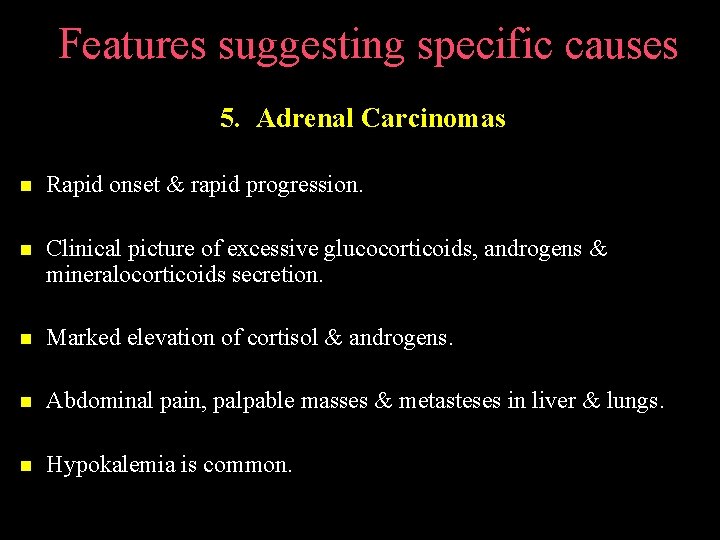
Features suggesting specific causes 5. Adrenal Carcinomas n Rapid onset & rapid progression. n Clinical picture of excessive glucocorticoids, androgens & mineralocorticoids secretion. n Marked elevation of cortisol & androgens. n Abdominal pain, palpable masses & metasteses in liver & lungs. n Hypokalemia is common.
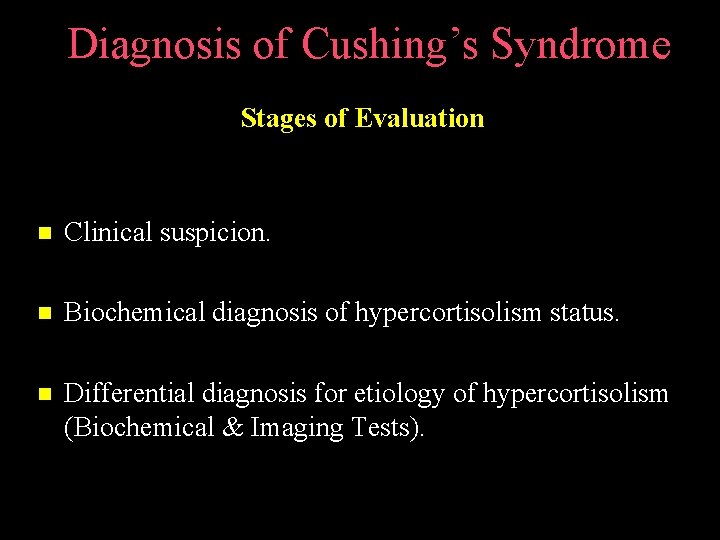
Diagnosis of Cushing’s Syndrome Stages of Evaluation n Clinical suspicion. n Biochemical diagnosis of hypercortisolism status. n Differential diagnosis for etiology of hypercortisolism (Biochemical & Imaging Tests).
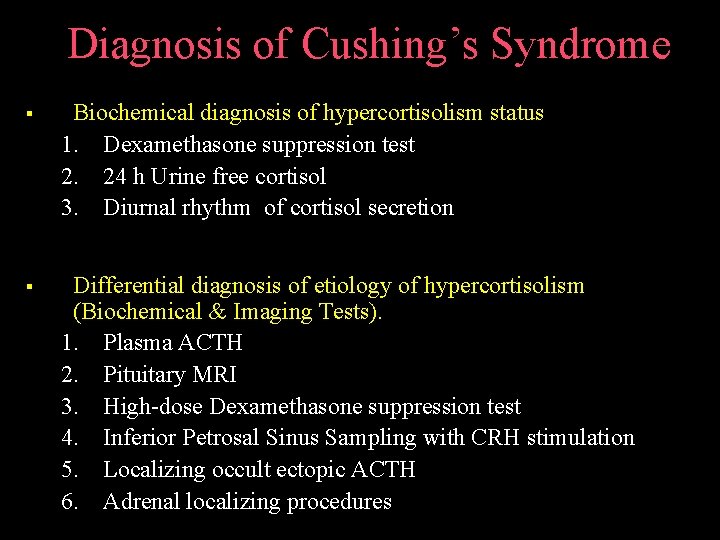
Diagnosis of Cushing’s Syndrome § Biochemical diagnosis of hypercortisolism status 1. Dexamethasone suppression test 2. 24 h Urine free cortisol 3. Diurnal rhythm of cortisol secretion § Differential diagnosis of etiology of hypercortisolism (Biochemical & Imaging Tests). 1. Plasma ACTH 2. Pituitary MRI 3. High-dose Dexamethasone suppression test 4. Inferior Petrosal Sinus Sampling with CRH stimulation 5. Localizing occult ectopic ACTH 6. Adrenal localizing procedures
Diagnosis of Cushing’s syndrome suspected Overnight 1 mg Dexamethasone suppression test High AM cortisol ( 3µg/d. L) 24 -hour urine free cortisol Normal v Repeat screening tests if highly suspected Low AM cortisol (< 3µg/d. L) v Normal Elevated v Hypercortisolism is confirmed v Needs differential diagnosis
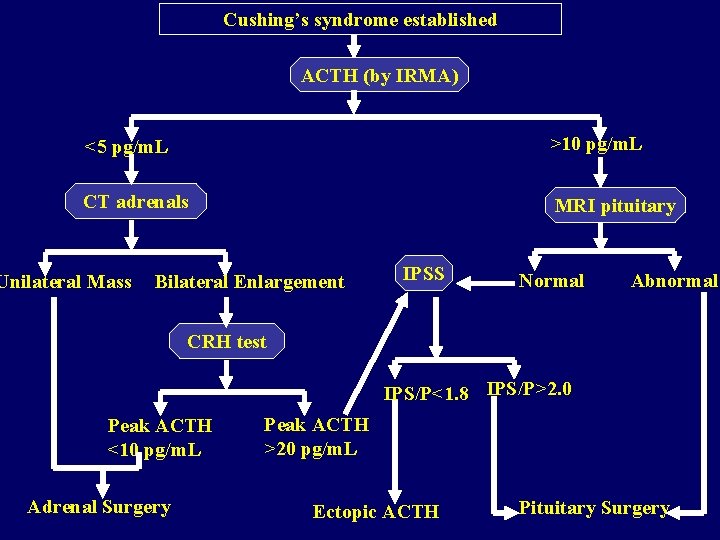
Cushing’s syndrome established ACTH (by IRMA) <5 pg/m. L >10 pg/m. L CT adrenals MRI pituitary Unilateral Mass Bilateral Enlargement IPSS Normal Abnormal CRH test IPS/P<1. 8 IPS/P>2. 0 Peak ACTH <10 pg/m. L Adrenal Surgery Peak ACTH >20 pg/m. L Ectopic ACTH Pituitary Surgery
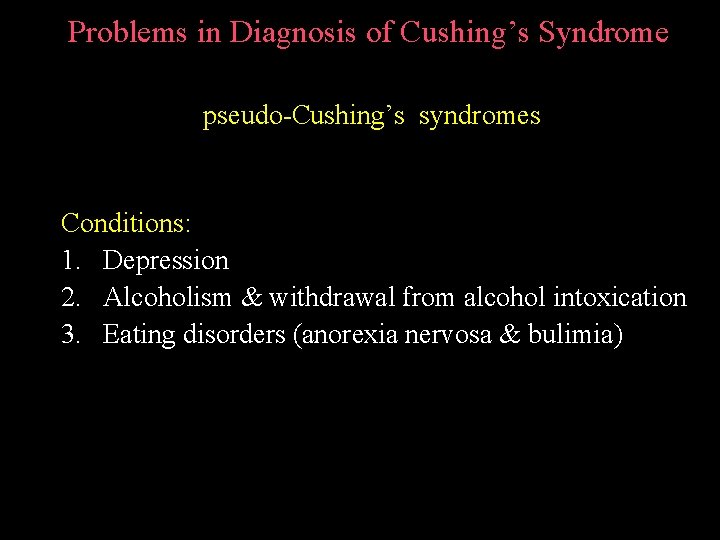
Problems in Diagnosis of Cushing’s Syndrome pseudo-Cushing’s syndromes Conditions: 1. Depression 2. Alcoholism & withdrawal from alcohol intoxication 3. Eating disorders (anorexia nervosa & bulimia)
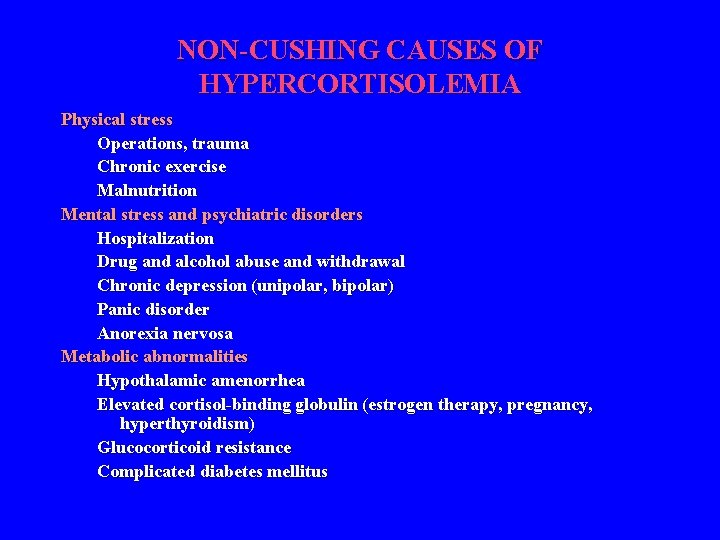
NON-CUSHING CAUSES OF HYPERCORTISOLEMIA Physical stress Operations, trauma Chronic exercise Malnutrition Mental stress and psychiatric disorders Hospitalization Drug and alcohol abuse and withdrawal Chronic depression (unipolar, bipolar) Panic disorder Anorexia nervosa Metabolic abnormalities Hypothalamic amenorrhea Elevated cortisol-binding globulin (estrogen therapy, pregnancy, hyperthyroidism) Glucocorticoid resistance Complicated diabetes mellitus
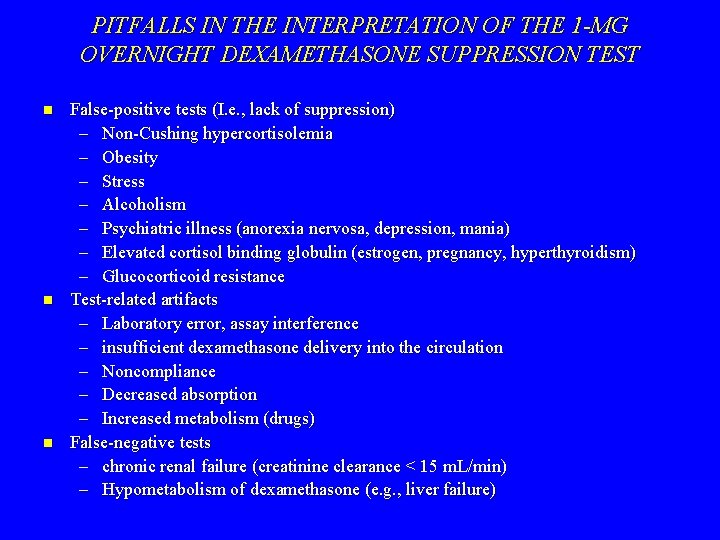
PITFALLS IN THE INTERPRETATION OF THE 1 -MG OVERNIGHT DEXAMETHASONE SUPPRESSION TEST n n n False-positive tests (I. e. , lack of suppression) – Non-Cushing hypercortisolemia – Obesity – Stress – Alcoholism – Psychiatric illness (anorexia nervosa, depression, mania) – Elevated cortisol binding globulin (estrogen, pregnancy, hyperthyroidism) – Glucocorticoid resistance Test-related artifacts – Laboratory error, assay interference – insufficient dexamethasone delivery into the circulation – Noncompliance – Decreased absorption – Increased metabolism (drugs) False-negative tests – chronic renal failure (creatinine clearance < 15 m. L/min) – Hypometabolism of dexamethasone (e. g. , liver failure)
Problems in Diagnosis of Cushing’s Syndrome pseudo-Cushing’s syndromes Similarities in biochemical features of Cushing’s syndrome: 1. Elevation of urine free cortisol 2. Disruption of the normal diurnal pattern of cortisol secretion 3. Lack of suppression of cortisol after overnight 1 mg dexamethasone suppression test
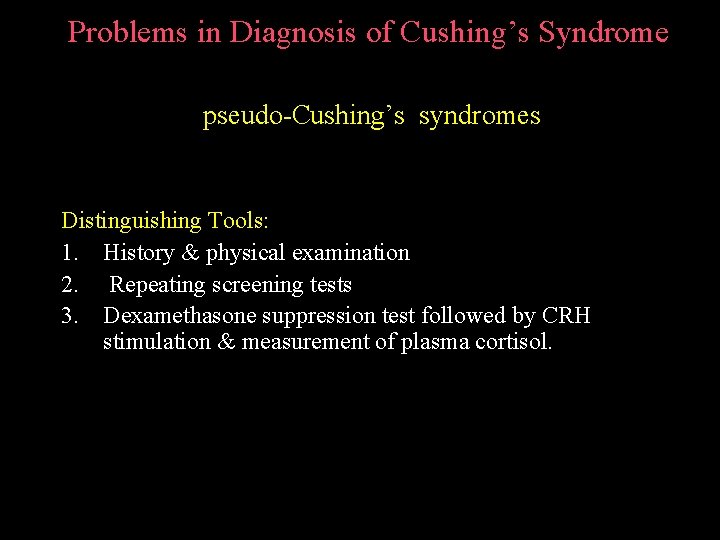
Problems in Diagnosis of Cushing’s Syndrome pseudo-Cushing’s syndromes Distinguishing Tools: 1. History & physical examination 2. Repeating screening tests 3. Dexamethasone suppression test followed by CRH stimulation & measurement of plasma cortisol.
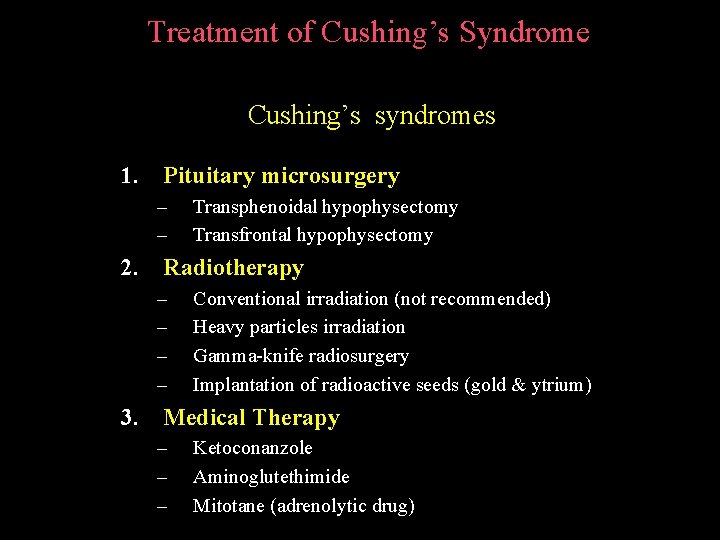
Treatment of Cushing’s Syndrome Cushing’s syndromes 1. Pituitary microsurgery – – Transphenoidal hypophysectomy Transfrontal hypophysectomy 2. Radiotherapy – – Conventional irradiation (not recommended) Heavy particles irradiation Gamma-knife radiosurgery Implantation of radioactive seeds (gold & ytrium) 3. Medical Therapy – – – Ketoconanzole Aminoglutethimide Mitotane (adrenolytic drug)
Treatment of Cushing’s Syndrome Other types of Cushing’s syndromes 1. 2. 3. 4. Ectopic ACTH syndromes Adrenal Adenomas Adrenal Carcinomas Nodular Adrenal Hyperplasia
Prognosis of Cushing’s Syndrome 1. 2. 3. 4. 5. Cushing’s Disease Ectopic ACTH syndromes Adrenal Adenomas Adrenal Carcinomas Nodular Adrenal Hyperplasia
Other Adrenal Disorders Not covered in this lecture and need to be studied: u Pheochromocytoma u. Hyperaldoteronism u Syndomes of congenital adrenal hyperplasia (CAH). u Hirsutism u Virilization