The RNA secondary structure dependence of RNA protein


- Slides: 23
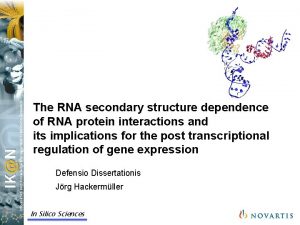
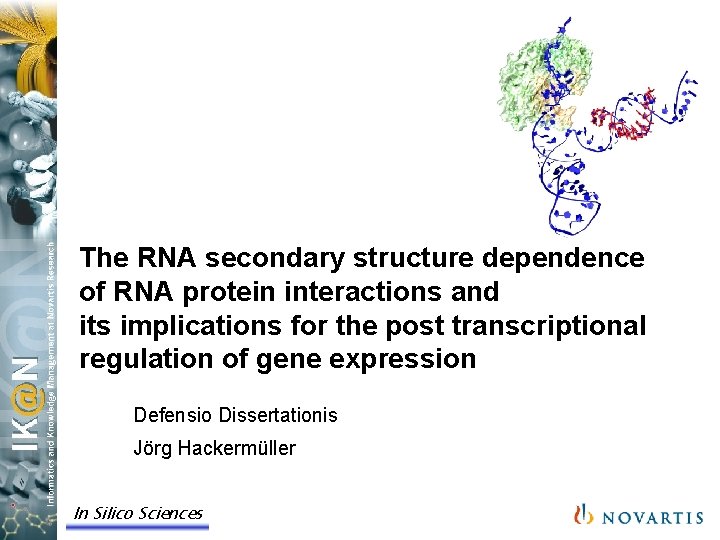
The RNA secondary structure dependence of RNA protein interactions and its implications for the post transcriptional regulation of gene expression Defensio Dissertationis Jörg Hackermüller In Silico Sciences
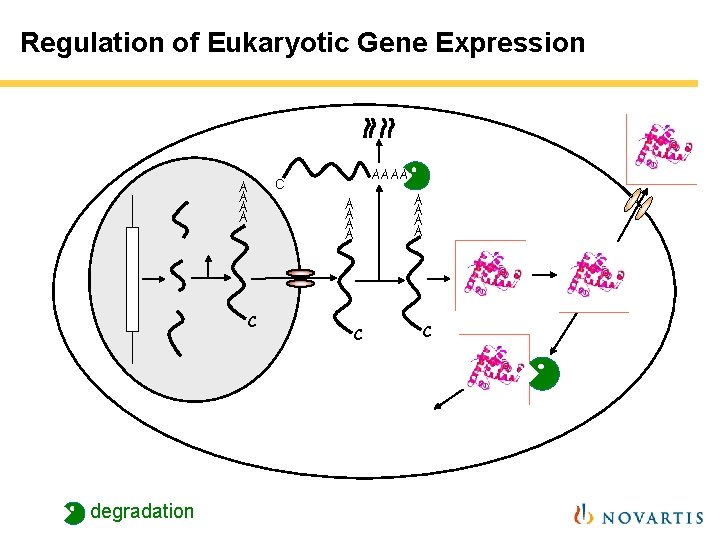
Regulation of Eukaryotic Gene Expression A A A A C degradation AAAA C A A C C
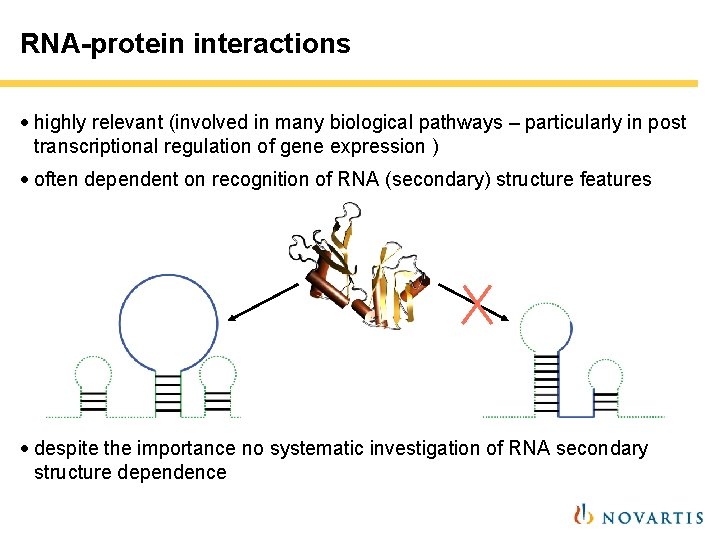
RNA-protein interactions · highly relevant (involved in many biological pathways – particularly in post transcriptional regulation of gene expression ) · often dependent on recognition of RNA (secondary) structure features · despite the importance no systematic investigation of RNA secondary structure dependence
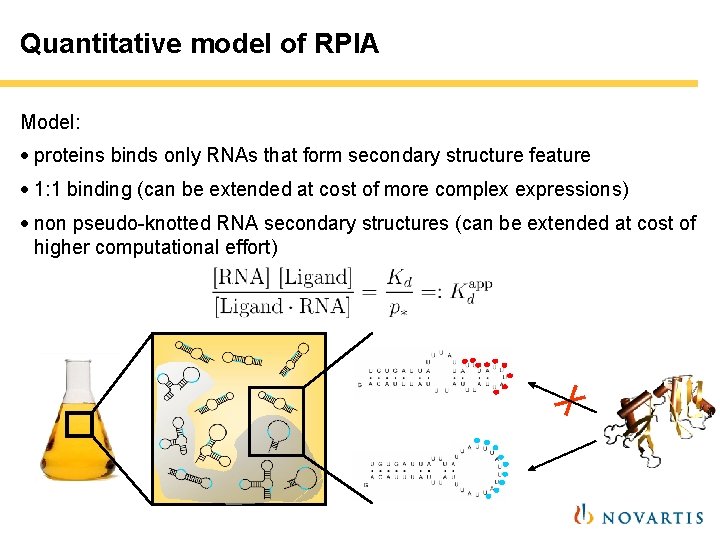
Quantitative model of RPIA Model: · proteins binds only RNAs that form secondary structure feature · 1: 1 binding (can be extended at cost of more complex expressions) · non pseudo-knotted RNA secondary structures (can be extended at cost of higher computational effort)
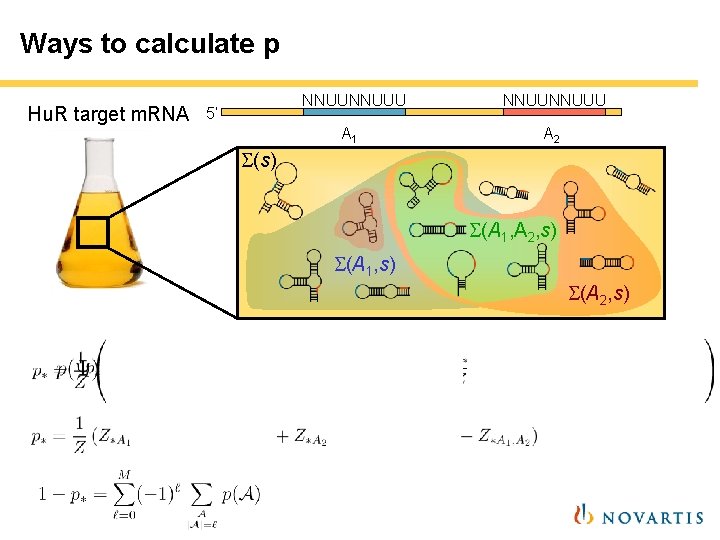
Ways to calculate p Hu. R target m. RNA NNUUU 5‘ A 1 NNUUU A 2 S(s) S(A 1, A 2, s) S(A 1, s) S(A 2, s)
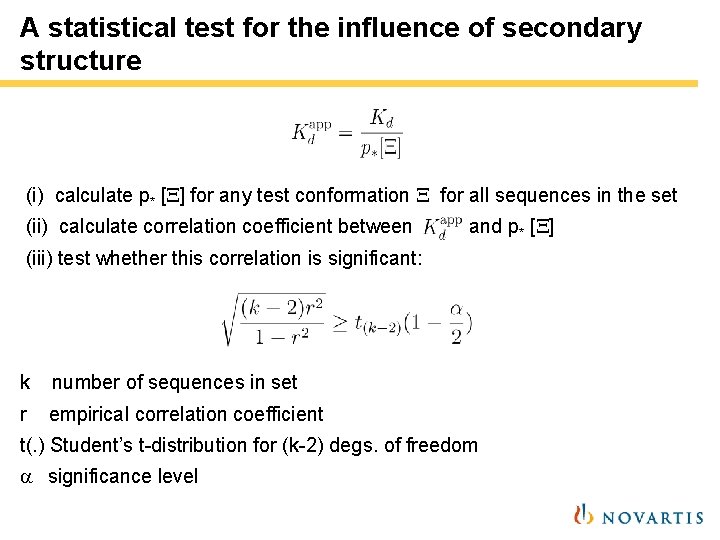
A statistical test for the influence of secondary structure (i) calculate p* [ ] for any test conformation for all sequences in the set (ii) calculate correlation coefficient between and p* [ ] (iii) test whether this correlation is significant: k number of sequences in set r empirical correlation coefficient t(. ) Student’s t-distribution for (k-2) degs. of freedom a significance level
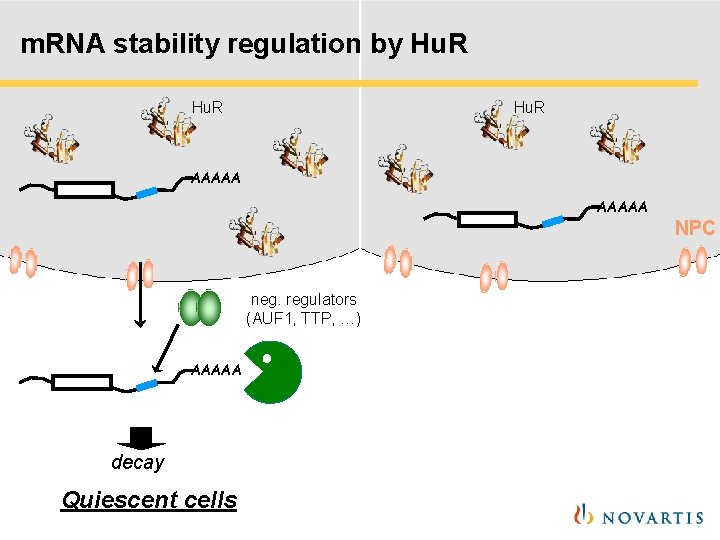
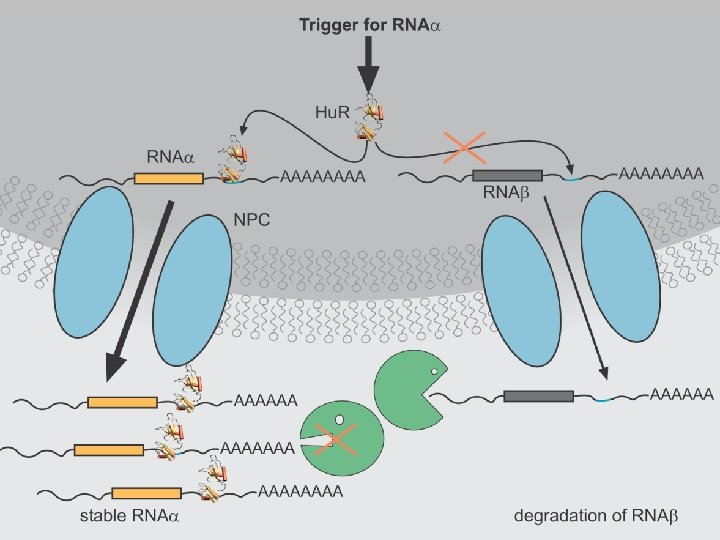
m. RNA stability regulation by Hu. R AAAAA NPC neg. regulators (AUF 1, TTP, …) AAAAA decay Quiescent cells
m. RNA stability regulation by Hu. R AAAAA NPC neg. regulators (AUF 1, TTP, …) AAAAA decay Quiescent cells upregulation Trigger
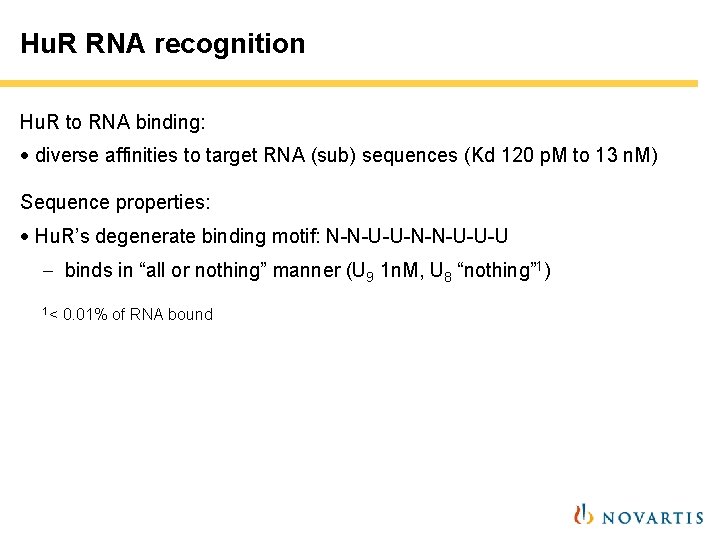
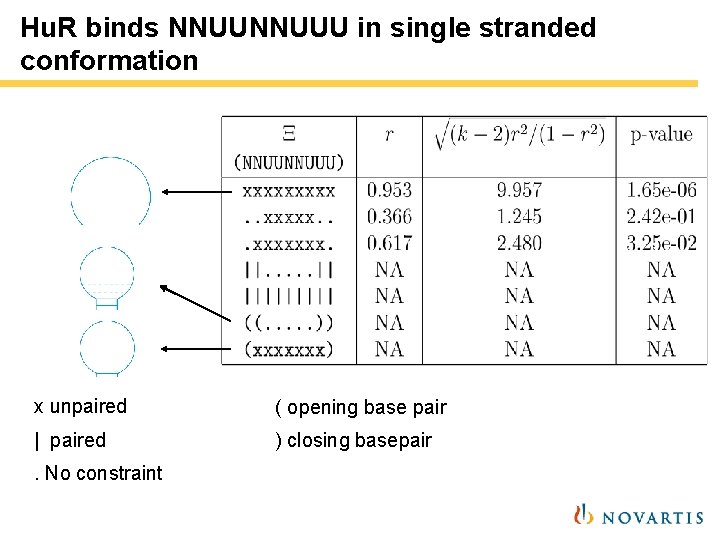
Hu. R RNA recognition Hu. R to RNA binding: · diverse affinities to target RNA (sub) sequences (Kd 120 p. M to 13 n. M) Sequence properties: · Hu. R’s degenerate binding motif: N-N-U-U-U - binds in “all or nothing” manner (U 9 1 n. M, U 8 “nothing” 1) 1< 0. 01% of RNA bound
Hu. R binds NNUUU in single stranded conformation x unpaired ( opening base pair | paired ) closing basepair . No constraint
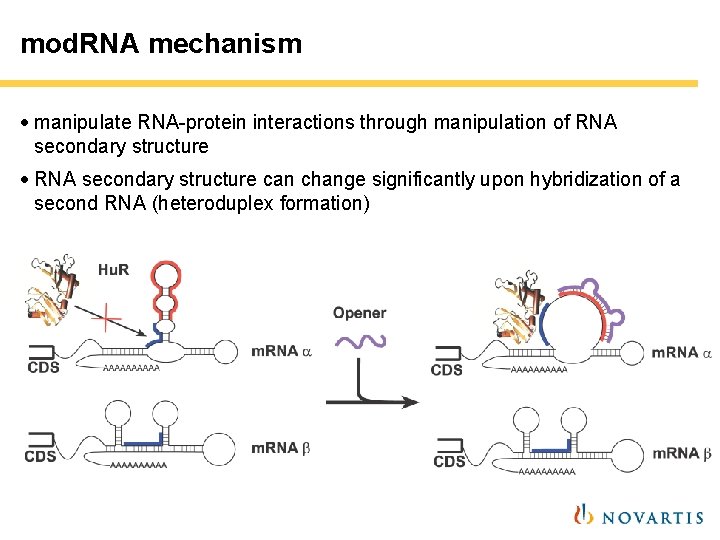
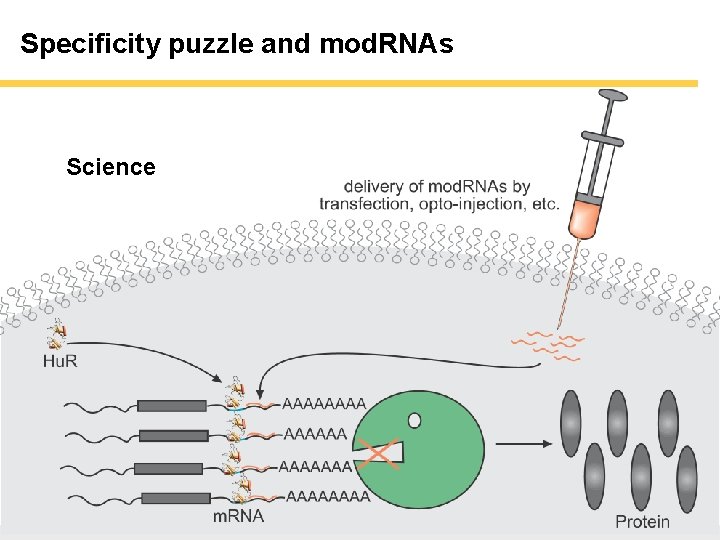
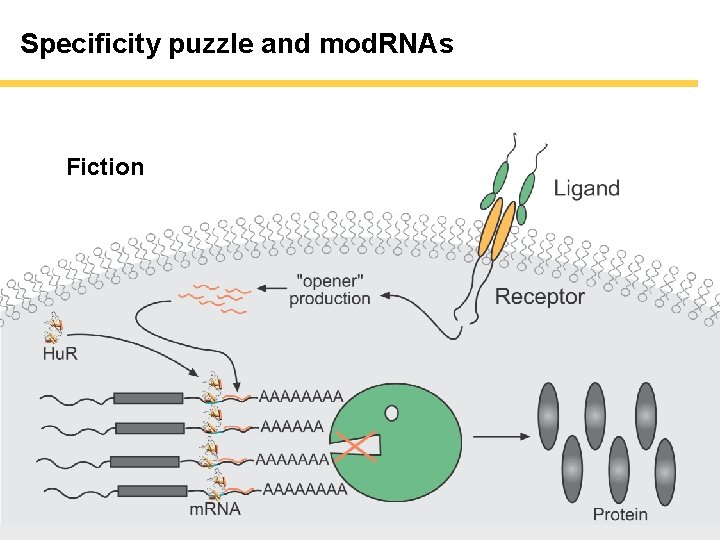
mod. RNA mechanism · manipulate RNA-protein interactions through manipulation of RNA secondary structure · RNA secondary structure can change significantly upon hybridization of a second RNA (heteroduplex formation)
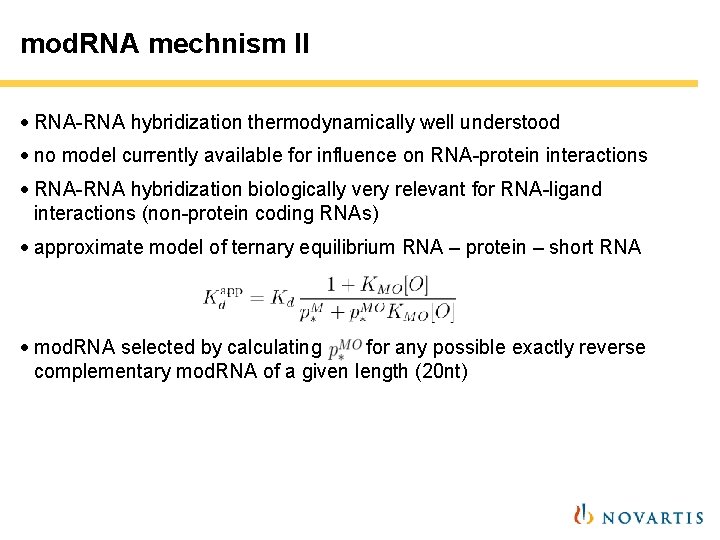
mod. RNA mechnism II · RNA-RNA hybridization thermodynamically well understood · no model currently available for influence on RNA-protein interactions · RNA-RNA hybridization biologically very relevant for RNA-ligand interactions (non-protein coding RNAs) · approximate model of ternary equilibrium RNA – protein – short RNA · mod. RNA selected by calculating for any possible exactly reverse complementary mod. RNA of a given length (20 nt)
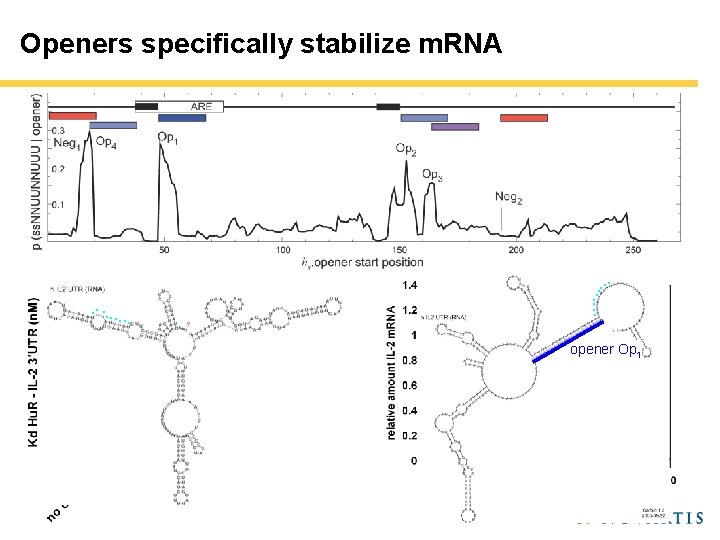
Openers specifically stabilize m. RNA . . . . opener Op 1
Specificity puzzle and mod. RNAs Science
Specificity puzzle and mod. RNAs Fiction
Outlook · endogenous mod. RNAs? · potential origin · bioinformatic strategies to find ‘em · mod. RNAs as tools in biology · may serve as complementary technique for RNAi · issue of delivery · mod. RNAs in drug discovery · mod. RNAs as pharmaceutic agents · mod. RNAs as tools in pharma research
People involved Summary NIBR DT - IST Volker Uhl Jan-Marcus Seifert Martin Hintersteiner NIBR IK@N-ISS Torsten Schindler Siegfried Höfinger Markus Jaritz Nicole-Claudia Meisner Jörg Hackermüller Manfred Auer Andras Aszodi Univ. Salzburg Fatima Ferreira Univ. Leipzig Peter F. Stadler Oe. AW DOC 11/2000 Univ. Vienna Christoph Flamm Ivo Hofacker Kurt Gruenberger
Backup slides
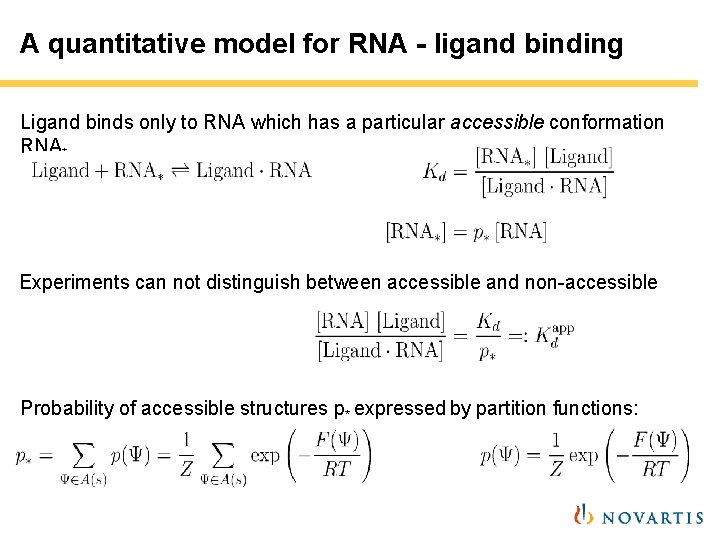
A quantitative model for RNA - ligand binding Ligand binds only to RNA which has a particular accessible conformation RNA* Experiments can not distinguish between accessible and non-accessible Probability of accessible structures p* expressed by partition functions:
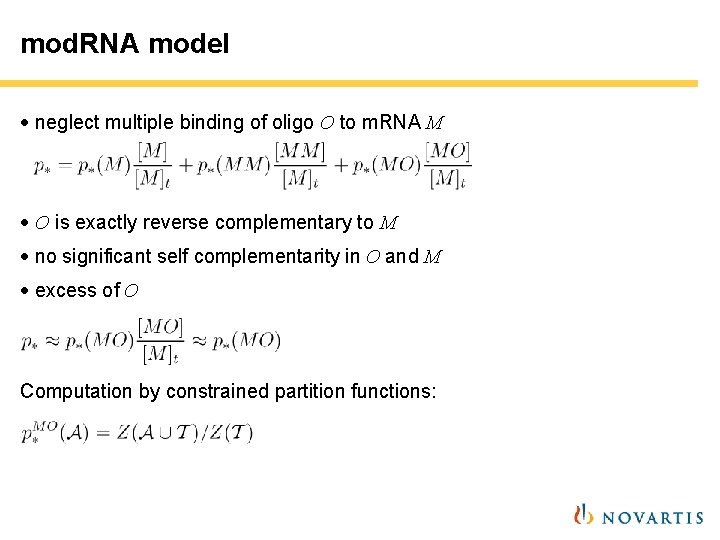
mod. RNA model · neglect multiple binding of oligo O to m. RNA M · O is exactly reverse complementary to M · no significant self complementarity in O and M · excess of O Computation by constrained partition functions:
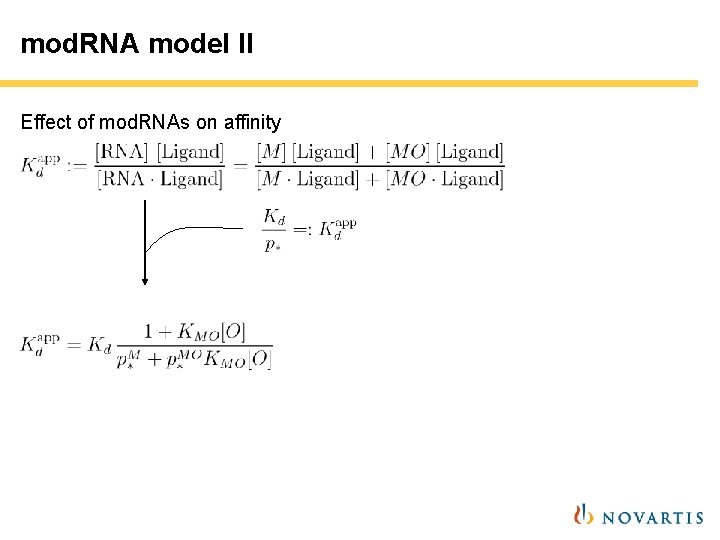
mod. RNA model II Effect of mod. RNAs on affinity