The Inheritance of Loss KIRAN DESAI A story

- Slides: 30
The Inheritance of Loss KIRAN DESAI «A story of exiles at home and abroad, of families broken and fixed, of love both bitter and bittersweet. » Chicago Tribune
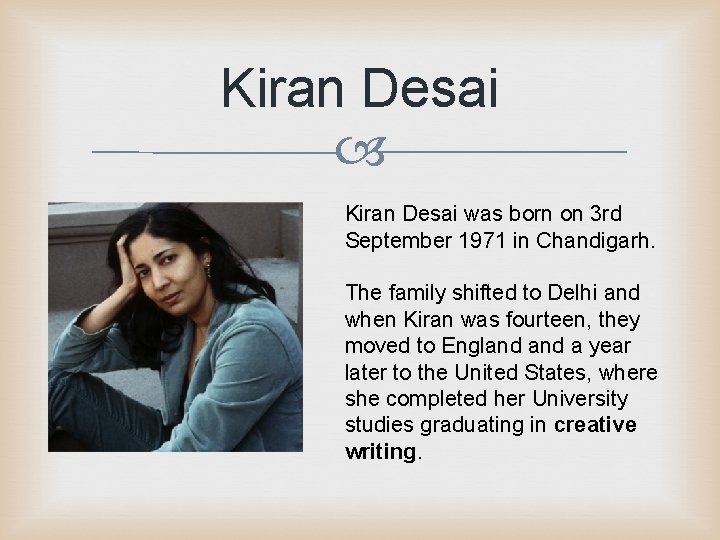
Kiran Desai was born on 3 rd September 1971 in Chandigarh. The family shifted to Delhi and when Kiran was fourteen, they moved to England a year later to the United States, where she completed her University studies graduating in creative writing.
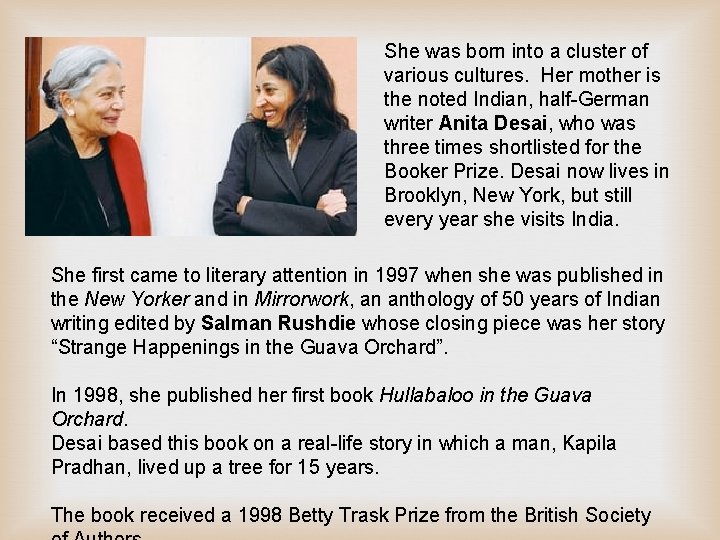
She was born into a cluster of various cultures. Her mother is the noted Indian, half-German writer Anita Desai, who was three times shortlisted for the Booker Prize. Desai now lives in Brooklyn, New York, but still every year she visits India. She first came to literary attention in 1997 when she was published in the New Yorker and in Mirrorwork, an anthology of 50 years of Indian writing edited by Salman Rushdie whose closing piece was her story “Strange Happenings in the Guava Orchard”. In 1998, she published her first book Hullabaloo in the Guava Orchard. Desai based this book on a real-life story in which a man, Kapila Pradhan, lived up a tree for 15 years. The book received a 1998 Betty Trask Prize from the British Society
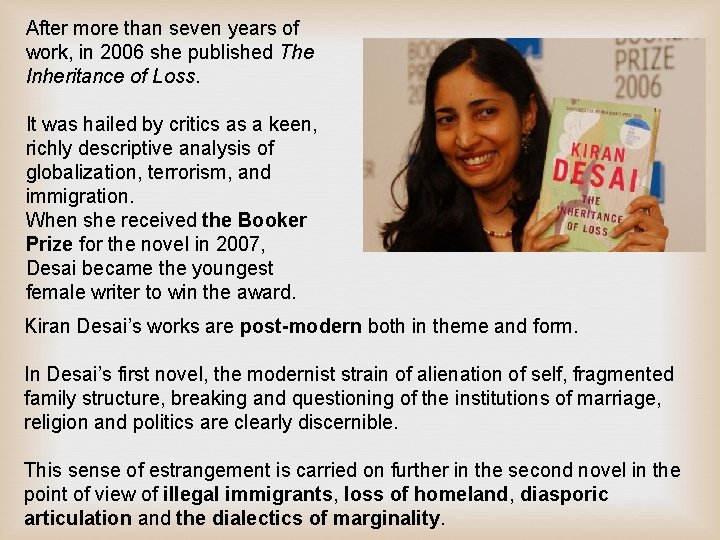
After more than seven years of work, in 2006 she published The Inheritance of Loss. It was hailed by critics as a keen, richly descriptive analysis of globalization, terrorism, and immigration. When she received the Booker Prize for the novel in 2007, Desai became the youngest female writer to win the award. Kiran Desai’s works are post-modern both in theme and form. In Desai’s first novel, the modernist strain of alienation of self, fragmented family structure, breaking and questioning of the institutions of marriage, religion and politics are clearly discernible. This sense of estrangement is carried on further in the second novel in the point of view of illegal immigrants, loss of homeland, diasporic articulation and the dialectics of marginality.
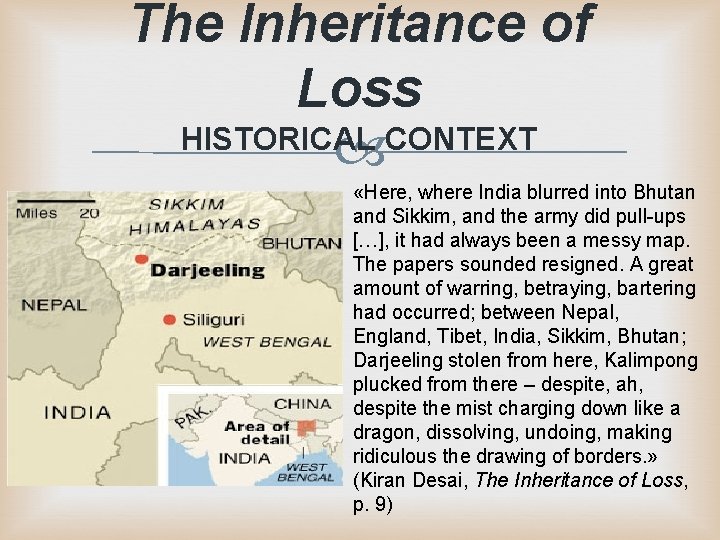
The Inheritance of Loss HISTORICAL CONTEXT «Here, where India blurred into Bhutan and Sikkim, and the army did pull-ups […], it had always been a messy map. The papers sounded resigned. A great amount of warring, betraying, bartering had occurred; between Nepal, England, Tibet, India, Sikkim, Bhutan; Darjeeling stolen from here, Kalimpong plucked from there – despite, ah, despite the mist charging down like a dragon, dissolving, undoing, making ridiculous the drawing of borders. » (Kiran Desai, The Inheritance of Loss, p. 9)
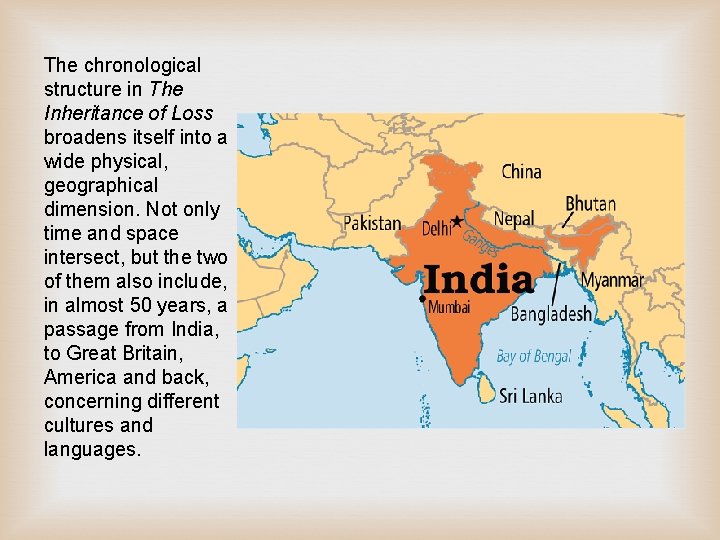
The chronological structure in The Inheritance of Loss broadens itself into a wide physical, geographical dimension. Not only time and space intersect, but the two of them also include, in almost 50 years, a passage from India, to Great Britain, America and back, concerning different cultures and languages.
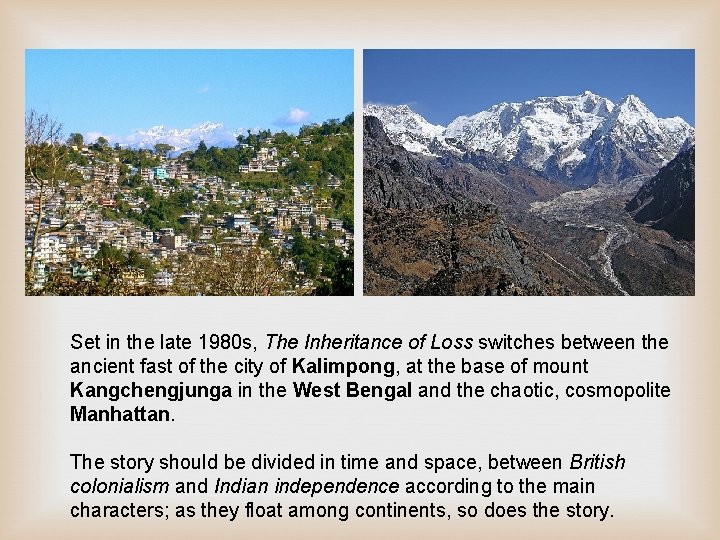
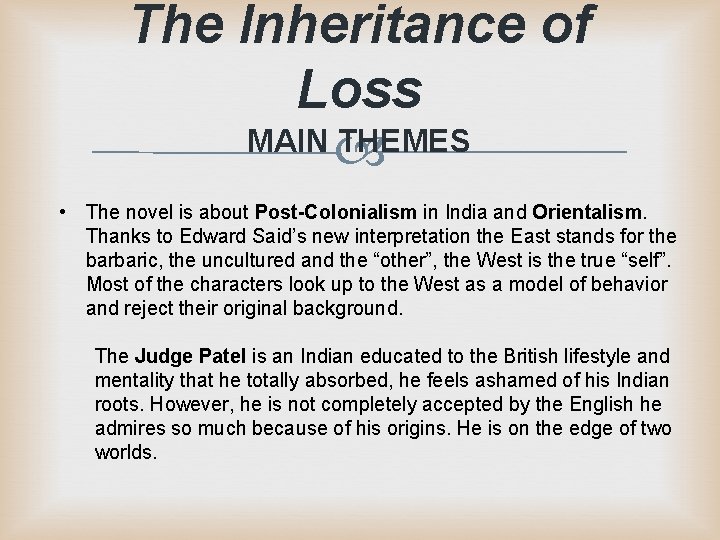
Set in the late 1980 s, The Inheritance of Loss switches between the ancient fast of the city of Kalimpong, at the base of mount Kangchengjunga in the West Bengal and the chaotic, cosmopolite Manhattan. The story should be divided in time and space, between British colonialism and Indian independence according to the main characters; as they float among continents, so does the story.
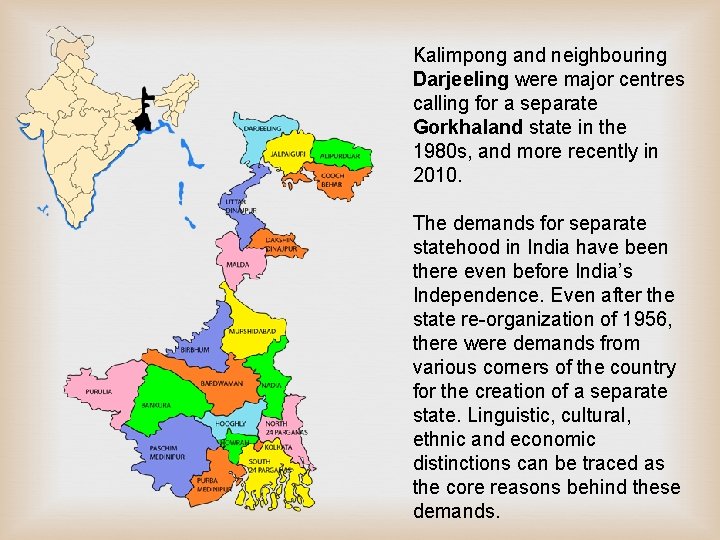
Kalimpong and neighbouring Darjeeling were major centres calling for a separate Gorkhaland state in the 1980 s, and more recently in 2010. The demands for separate statehood in India have been there even before India’s Independence. Even after the state re-organization of 1956, there were demands from various corners of the country for the creation of a separate state. Linguistic, cultural, ethnic and economic distinctions can be traced as the core reasons behind these demands.
What is the Gorkhaland Issue? • Gorkhaland consists of Nepali-speaking people of Darjeeling, Kalimpong, Kurseong and other hilly districts of West-Bengal. The people belonging to these areas have ethical, cultural and language differences with the Bengali community of West-Bengal. • Nepalese living in India want to be known as Gorkhas so as to create a separate identity for themselves. • Gorkha is a district in central Nepal which lends its name to the Nepalese troops in Indian army and the Nepalese troops of British Army. • The demand of Darjeeling as a separate administrative region dates back to 1907. But, the term “Gorkhaland” was coined recently, in the 1980 s, by Subhash Ghising, the founder of Gorkha National Liberation Front (GNLF). • GNLF launched a most violent agitation in Gorkhaland movement history in 1986. • In 1988, Darjeeling Gorkha Hill Council accord is signed by GNLF, the state of Bengal and the Centre. Darjeeling Gorkha Hill Council came into action. GNLF dropped the demand for the separate state.
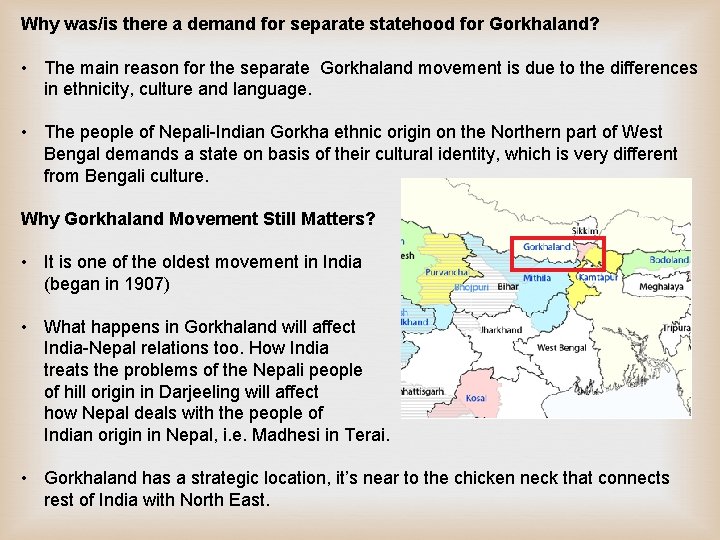
Why was/is there a demand for separate statehood for Gorkhaland? • The main reason for the separate Gorkhaland movement is due to the differences in ethnicity, culture and language. • The people of Nepali-Indian Gorkha ethnic origin on the Northern part of West Bengal demands a state on basis of their cultural identity, which is very different from Bengali culture. Why Gorkhaland Movement Still Matters? • It is one of the oldest movement in India (began in 1907) • What happens in Gorkhaland will affect India-Nepal relations too. How India treats the problems of the Nepali people of hill origin in Darjeeling will affect how Nepal deals with the people of Indian origin in Nepal, i. e. Madhesi in Terai. • Gorkhaland has a strategic location, it’s near to the chicken neck that connects rest of India with North East.
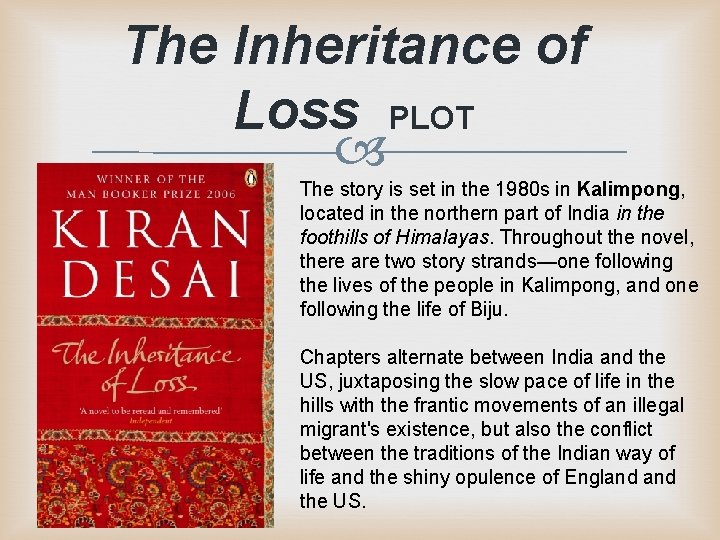
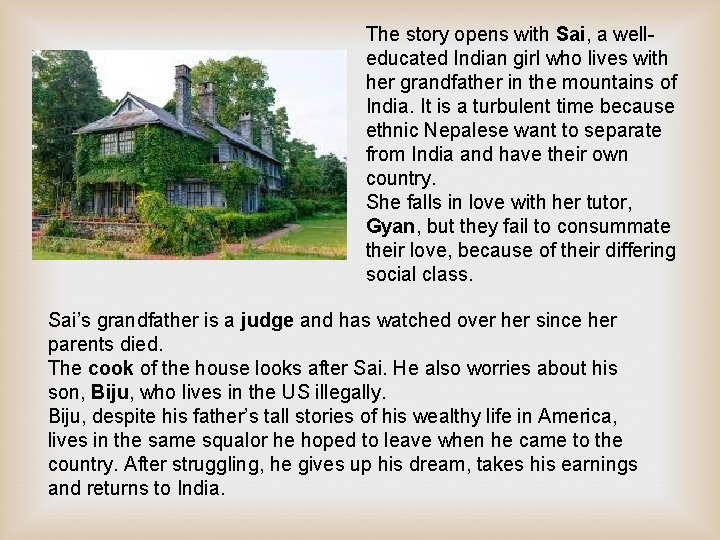
The Inheritance of Loss PLOT The story is set in the 1980 s in Kalimpong, located in the northern part of India in the foothills of Himalayas. Throughout the novel, there are two story strands—one following the lives of the people in Kalimpong, and one following the life of Biju. Chapters alternate between India and the US, juxtaposing the slow pace of life in the hills with the frantic movements of an illegal migrant's existence, but also the conflict between the traditions of the Indian way of life and the shiny opulence of England the US.
The story opens with Sai, a welleducated Indian girl who lives with her grandfather in the mountains of India. It is a turbulent time because ethnic Nepalese want to separate from India and have their own country. She falls in love with her tutor, Gyan, but they fail to consummate their love, because of their differing social class. Sai’s grandfather is a judge and has watched over her since her parents died. The cook of the house looks after Sai. He also worries about his son, Biju, who lives in the US illegally. Biju, despite his father’s tall stories of his wealthy life in America, lives in the same squalor he hoped to leave when he came to the country. After struggling, he gives up his dream, takes his earnings and returns to India.
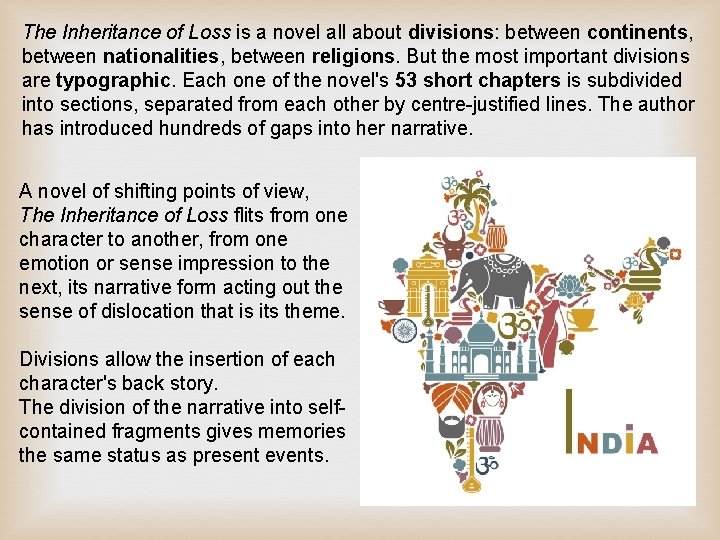
The Inheritance of Loss is a novel all about divisions: between continents, between nationalities, between religions. But the most important divisions are typographic. Each one of the novel's 53 short chapters is subdivided into sections, separated from each other by centre-justified lines. The author has introduced hundreds of gaps into her narrative. A novel of shifting points of view, The Inheritance of Loss flits from one character to another, from one emotion or sense impression to the next, its narrative form acting out the sense of dislocation that is its theme. Divisions allow the insertion of each character's back story. The division of the narrative into selfcontained fragments gives memories the same status as present events.
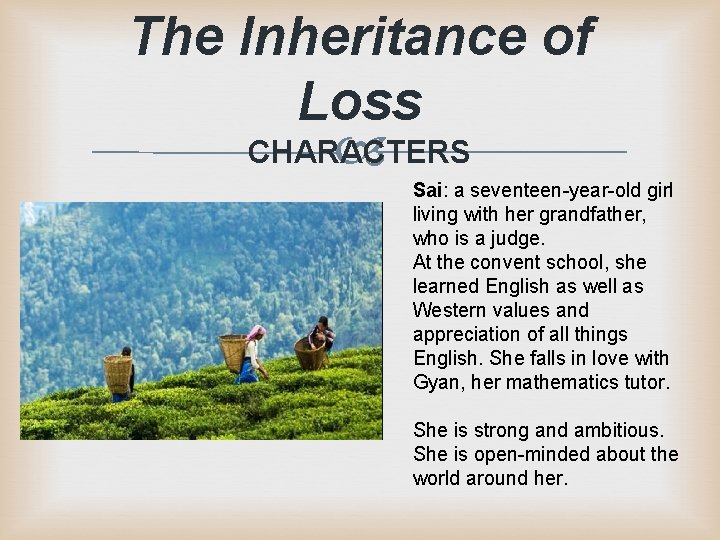
The Inheritance of Loss CHARACTERS Sai: a seventeen-year-old girl living with her grandfather, who is a judge. At the convent school, she learned English as well as Western values and appreciation of all things English. She falls in love with Gyan, her mathematics tutor. She is strong and ambitious. She is open-minded about the world around her.
The judge (Jemubhai Patel): an angry and stern old man who attended Cambridge University. When he returns to India, he feels like a foreigner. In addition, he is ridiculed because of his westernized way of life and in particular for the obsession with powdering his face. Jemubhai meets with his wife after being separated from her while he was in England. No longer interested in being married to an Indian woman, he sends her back to her parents, an act that brings shame to his own family. Gyan: Sai's tutor and boyfriend. He is a young Nepali. Even though he is much lower in caste, she still treats him as her equal. Gyan gradually becomes attracted to the Nepali insurgency movement. Biju: son of the Judge's cook. He manages to get a tourist visa to move to New York to try to make a better life for himself. He is uneducated. In fact, he could not even understand the announcements at the American embassy: "Where is the Amriken embassy? " "It is there". The man pointed back at the same building. "That is U. S. “ "It is the same thing", said the man impatiently. (p. 182) Biju lives a “secret” life in poverty and humiliation.
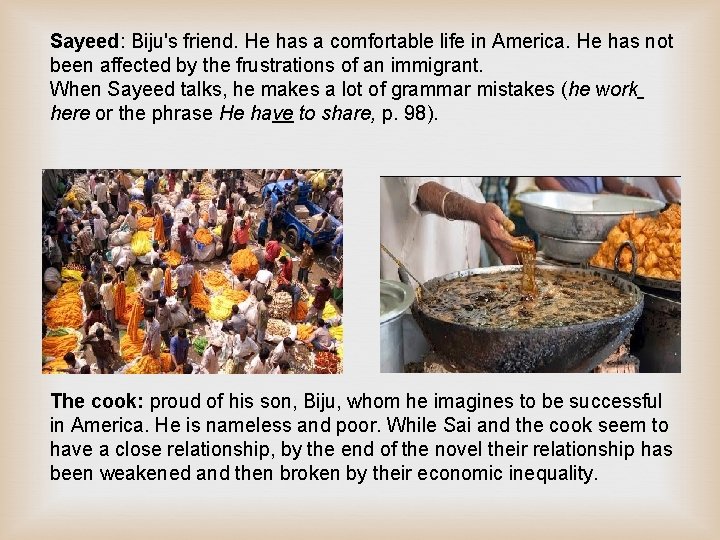
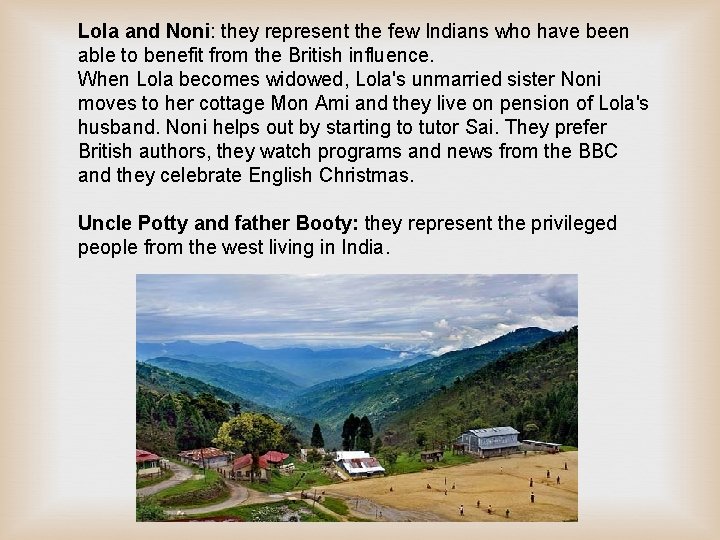
Sayeed: Biju's friend. He has a comfortable life in America. He has not been affected by the frustrations of an immigrant. When Sayeed talks, he makes a lot of grammar mistakes (he work here or the phrase He have to share, p. 98). The cook: proud of his son, Biju, whom he imagines to be successful in America. He is nameless and poor. While Sai and the cook seem to have a close relationship, by the end of the novel their relationship has been weakened and then broken by their economic inequality.
Lola and Noni: they represent the few Indians who have been able to benefit from the British influence. When Lola becomes widowed, Lola's unmarried sister Noni moves to her cottage Mon Ami and they live on pension of Lola's husband. Noni helps out by starting to tutor Sai. They prefer British authors, they watch programs and news from the BBC and they celebrate English Christmas. Uncle Potty and father Booty: they represent the privileged people from the west living in India.
The Inheritance of Loss MAIN THEMES • The novel is about Post-Colonialism in India and Orientalism. Thanks to Edward Said’s new interpretation the East stands for the barbaric, the uncultured and the “other”, the West is the true “self”. Most of the characters look up to the West as a model of behavior and reject their original background. The Judge Patel is an Indian educated to the British lifestyle and mentality that he totally absorbed, he feels ashamed of his Indian roots. However, he is not completely accepted by the English he admires so much because of his origins. He is on the edge of two worlds.
• Also the cook admires the West and he believes in the American dream: he sends his only son to USA to find a job and a better life there and he considers a degradation to work for non-English people. His son is an illegal immigrant in America who jumps from an illegal job to another. • Sai is also anglicized. She is brought up in a convent and educated to the English way of life and language. • In the end, all the characters are defeated. They experience an identity crisis because they are split between two different cultures. So Hybridity is not achieved. • Migrancy and diasporic displacement increase with globalization. Biju is a migrant but he fails in finding a new home in New York, in his process of “reterritoralization”, because he entered the invisible area of illegal immigrants from the third world. • The novel concerns the problem of race and racism resulting from the destabilizing meeting of West and East. Every character somehow experiences or practices racist attitudes. First, there is the judge that carries out intolerance. Biju experiences racism as well as exploitation. Lastly, there is Gyan that, because of his biases against the English, loses Sai and joins a terrorist force.
• The novel deals with Indian social classes and injustice. Indians are divided into religious castes which are strictly respected. The judge and his granddaughter Sai belong to the upper middle class. Therefore, they are well educated and have lived in the West. The cook and his son Biju belong to the lower class and they work as servants. Sai and Gyan are in love but they cannot marry because he is of a lower class. They are in the same house but utterly separated by social status. • The author depicts the traditional gender gap between men and women. Women are subjected to men and live in their shadows as loyal, servile wives. The judge’s father buys to his son a bride. He beats her, abuses her, despises her for being Indian. • Another topic discussed here is about politics and the Gorkha insurgency. In the ‘ 80 s they started to protest to create their own land, independent from India, and to find their own national identity.
The Inheritance of Loss POSTCOLONIAL STUDIES Edward Said Orientalism (1978) Discrimination due to race and ethnicity. Through the main characters in The Inheritance of Loss, in particular Jemubhai, Desai shows how discrimination due to race can influence and wound, and in some cases, even destroy the human mind. The experiences of Jemubhai also expand theme of race into a universal subject. The reader recognizes a pattern of white, imperial superiority and power and how people from colonized countries are not accepted or welcomed into the western “world”.
“My contention is that without examining Orientalism as a discourse one cannot possibly understand the enormously systematic discipline by which European culture was able to manage-and even produce-the Orient politically, sociologically, militarily, ideologically, scientifically, and imaginatively during the post-Enlightenment period” (Said Orientalism, 3). The issues of stereotypical views are often linked to matters of race, discrimination and integration. Stereotype can be defined as: “A grossly oversimplified view of the characteristics of the members of a group (usually but not always derogatory), in which the characteristics thought to be prevalent in the group are attributed to each member, regardless of individual differences”. Stereotyped views are also traceable in The Inheritance of Loss (Biju for instance).
Homi Bhabha 1) The World and the Home (1992) When Sai seeks out Gyan and enters the prohibited domain of “other” her face unconsciously mirrors her distaste and Gyan is no longer her beloved “momo” but a “dirty hypocrite”. The act of betrayal by Gyan stems from the fact that Sai is not one of them and that she cannot speak any other languages than English and Hindi. Sai and the two Afghan princesses undergo what Homi Bhabha refers to as ―unhomeliness, this feeling of being caught between cultures, of belonging to neither rather than to both, of finding oneself arrested in a psychological limbo that results not from some individual psychological disorder but from the trauma of the Cultural displacement, within which one lives. The novel is about patterns of loss. The Indian immigrants in America long for “home” the root itself and they long for love and acceptance. New identities are generated into new spaces of knowledge that one has experienced. These identities born in such interactive spaces, inevitably retain influences not only from memories of origins or roots, but also absorb influences of the new culture in the transnational space. The individual living in this space, being conscious, constructs himself by uniquely combining the cultures of his roots (the old one) and of his land of domicile (the new one). There is the celebration of this space as the ―Third Space of enumeration. Home can only have meaning once one experiences a level of displacement from it.
2)Of Mimicry and Man: The Ambivalence of Colonial Discourse (1984) Jemubai, a judge whose whole life has been a tragic mimicry (Bhabha, 1994), whose Anglo-philia can only turn into self -hatred. The ambivalence of mimicry (almost the same, but not quite) Mimicry=the situation in which the natives, urged by colonial discourses to imitate the behavior of the colonizers, give rise to a hybridization, which in some way represents a parody or a revisitation of the original. Kiran Desai is far from the optimistic view of West’s consumer-driven multiculturalism.
Pankaj Mishra CRITICAL READING Wounded by the West (2006) What binds these characters is a shared historical legacy and a common experience of impotence and humiliation. "Certain moves made long ago had produced all of them, " Desai writes, referring to centuries of subjection by the economic and cultural power of the West. (postcolonial melancholy) - Jemu is very cold to those who are within his life. He is annoyed by many and shows no affection for anyone except his dog. - Gyan and Sai= impossible love. - The cook’s son Biju is in NYC serving as cook in restaurants. He is discriminated against because of his culture.
Biju’s daily life in America reflectshis insight of being an exile. He finally decides to return to India. It is the breaking up of the American dream and also the breaking up of the hallucination about India.
The Inheritance of Loss STYLE • Descriptive and narrative style (nature and events) • Simple Syntax (coordinate clauses more frequent than subordinate clauses) • Many digressions, no linear development of the story and of themes
Narrator • Omniscient narrator (explanations, comments, view from above of what happens) • Many points of view described – every character’s feelings and thoughts • Use of (almost omnipresent) past simple to describe events – many flashbacks (almost entire narration as a flashback) • Narration changes quickly (from time to time, from one space to another- but everything is connected, the past influences the present- glocality)
Language and rhetorical devices • International and intercultural language (words from many languages)- estrangement effect (different cultures are connected, they don’t always understand each other, sometimes the reader doesn’t understand what is said) • Use of many rhetorical devices: methaphors, similes, hyperboles, etc. (nature, events) • Irony and conversational implicatures (things are not said directly but implied in the discourse, what is implied is sometimes explained in digressions, sometimes it remains ambiguous)
KIRAN DESAI’S INTERVIEW: https: //www. bing. com/videos/search? q=kiran+desai+youtube&view =detail&mid=793 F 69 AD 516 FD 32 C 8 A 06 &FORM=VIRE CONSULTED EDITION: Desai Kiran, The Inheritance of Loss, London, Penguin Books, 2008 PRESENTATION MADE BY: v Zaira Filangieri v Chiara Ghezzi v Roberto Rossodivita v Rossana Carotenuto v Maria Stella Caldarelli v Sabrina Del Gaiso v Michael Santo Orefice v Elisabetta Varriale