
Is it feasible and acceptable to deliver contingency
Is it feasible and acceptable to deliver contingency management in UK drug treatment settings? Findings and observations on the implementation of a Contingency Management Research Programme Funders: National Institute for Health Research Tim Weaver Imperial College Faculty of Medicine
Objectives of this Presentation • Describe the design and rationale for the research programme. – Comprised 2 RCTs + investigation of ‘process’ • Discuss selected findings and emergent issues that relate to the questions of feasibility and acceptability.
The Research Team Prof John Strang (PI), Dr Nicola Metrebian, Roopal Desai, Vikki Charles, Jo Milward, Riti Patel, Lindsey Hines (Addictions, Io. PPN, Kings College London) Dr Tim Weaver, Dilkushi Poovendran, Hortencia Mc. Kechnie (Imperial College London) Prof Stephen Pilling, Nicholas Little, Bishop Ellie, Claire Goodfellow (University College London) Jennifer Hellier, Caroline Murphy (Biostatistics, Io. PNN, Kings College London) Prof Sarah Byford, Dr James Shearer (CEMPH, Io. PNN, Kings College London) Dr Luke Mitcheson, Dr Emily Finch, Mark Allen (South London & Maudsley NHS Foundation Trust) Dr Ed Day, Shabana Akhtar, Carmel Bennett, Ruth Pauli (Birmingham & Solihull Mental Health NHS Trust) Dr Anthony Glasper (Sussex Partnership Trust) Dr Owen Bowden-Jones (Central & North West London NHS Foundation Trust) Dr Frank Ryan, Dr John Dunn (Camden and Islington NHS Trust) Jalpa Bajaria (South Essex Partnership) Rachid Rafia, Peter Dodd, Dr. Alan Brennan, Dr Petra Meier, Prof Mike Campbell (School of Health & Related Research, University of Sheffield) Peter Mc. Dermott (The Alliance, National Drug User Group) Prof Nancy Petry (University of Connecticut, USA)
Programme Aims & Objectives AIM: • Evaluate the feasibility, acceptability, clinical and costeffectiveness of Contingency Management in UK drug services OBJECTIVES: • Develop, implement and evaluate (using 2 cluster RCTs) voucher-based CM interventions targeting: – Completion of Hep B vaccination programmes – Attendance at keywork sessions and reduced heroin use • To develop, deliver and evaluate staff training which supports the introduction of CM.
Our point of departure … There is good evidence of efficacy … – Good evidence that CM can shape behaviour and promote attendance, retention & abstinence … but unanswered questions. – Limited data about outcomes after withdrawal of reinforcement – Limited data about compliance with CM in routine practice We need to establish whether CM can be effective when applied in a UK context.
Implementation in the USA • Concentrated in centres of excellence • Delivery often by specialist CM practitioners • Thought and creativity focused on design of reinforcement strategies (e. g. escalating schedules, ‘fishbowl’ prize draw techniques) • Criticism that scientific enquiry gives limited recognition to the needs of practitioners. • Implementation in routine practice ‘lags’ and implementation technologies are ‘in their infancy’ (Hartzler et al, 2012)
Our Guiding Principles § Address research questions relevant to the needs of UK drug treatment services § Test the effectiveness of CM models which can be implemented in the real world We have tried to: – Build on the US evidence, but not feel obligated to attempt slavish replication – Build capacity to deliver CM in routine practice – Ensure the CM interventions we test ‘fit’ with UK practice, and are informed by UK experience
Key Questions • Can we implement voucher-based CM in UK drug treatment? (Can we develop & deliver staff training which supports this? ) • Can we replicate the positive outcomes observed outside the UK? • What organisational, professional and contextual factors promotes +ive or –ive outcomes. • Is contingency management acceptable to provider agencies, clinicians and service users?
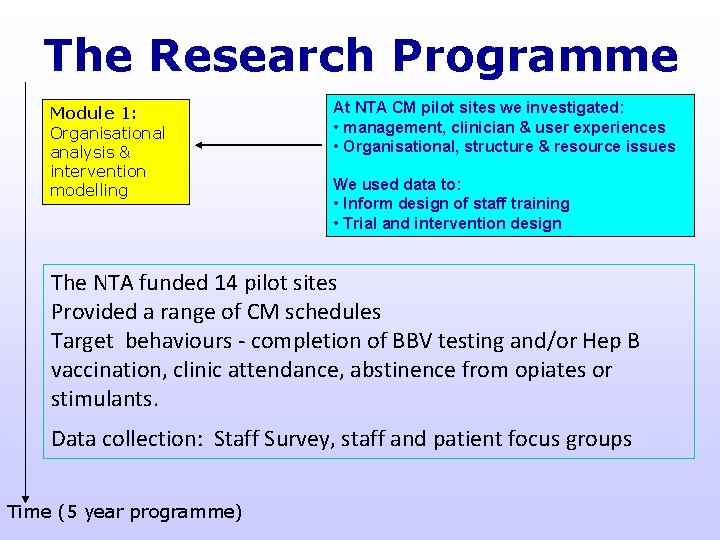
The Research Programme Module 1: Organisational analysis & intervention modelling At NTA CM pilot sites we investigated: • management, clinician & user experiences • Organisational, structure & resource issues We used data to: • Inform design of staff training • Trial and intervention design The NTA funded 14 pilot sites Provided a range of CM schedules Target behaviours - completion of BBV testing and/or Hep B vaccination, clinic attendance, abstinence from opiates or stimulants. Data collection: Staff Survey, staff and patient focus groups Time (5 year programme)
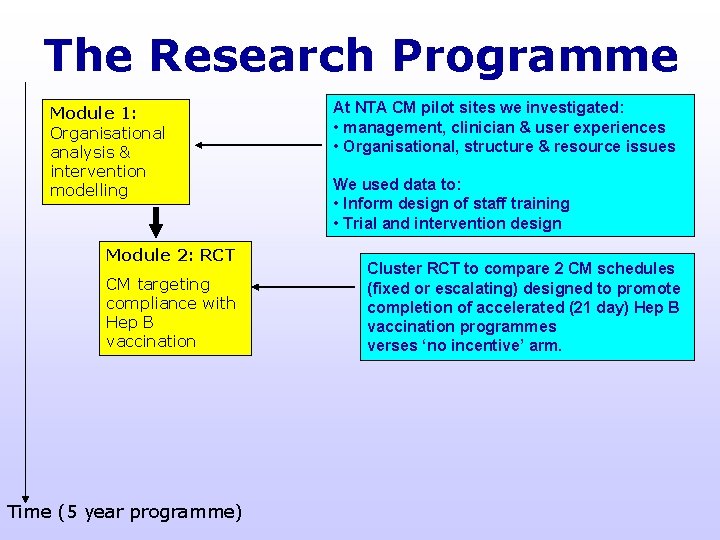
The Research Programme Module 1: Organisational analysis & intervention modelling Module 2: RCT CM targeting compliance with Hep B vaccination Time (5 year programme) At NTA CM pilot sites we investigated: • management, clinician & user experiences • Organisational, structure & resource issues We used data to: • Inform design of staff training • Trial and intervention design Cluster RCT to compare 2 CM schedules (fixed or escalating) designed to promote completion of accelerated (21 day) Hep B vaccination programmes verses ‘no incentive’ arm.
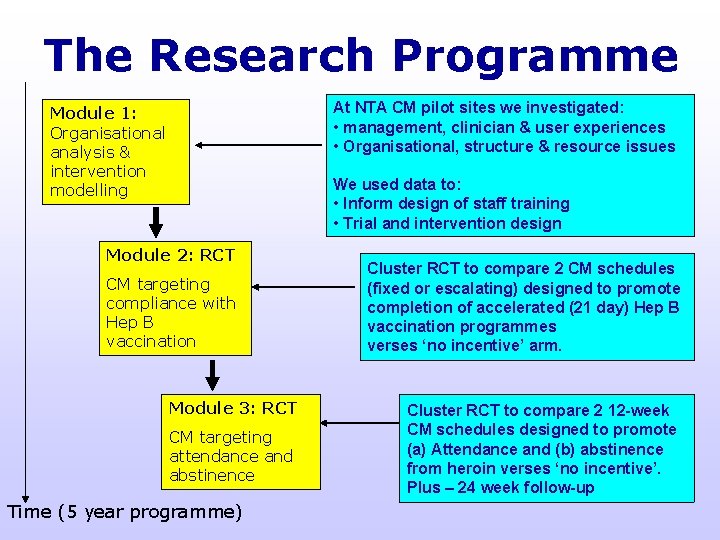
The Research Programme At NTA CM pilot sites we investigated: • management, clinician & user experiences • Organisational, structure & resource issues Module 1: Organisational analysis & intervention modelling We used data to: • Inform design of staff training • Trial and intervention design Module 2: RCT CM targeting compliance with Hep B vaccination Module 3: RCT CM targeting attendance and abstinence Time (5 year programme) Cluster RCT to compare 2 CM schedules (fixed or escalating) designed to promote completion of accelerated (21 day) Hep B vaccination programmes verses ‘no incentive’ arm. Cluster RCT to compare 2 12 -week CM schedules designed to promote (a) Attendance and (b) abstinence from heroin verses ‘no incentive’. Plus – 24 week follow-up
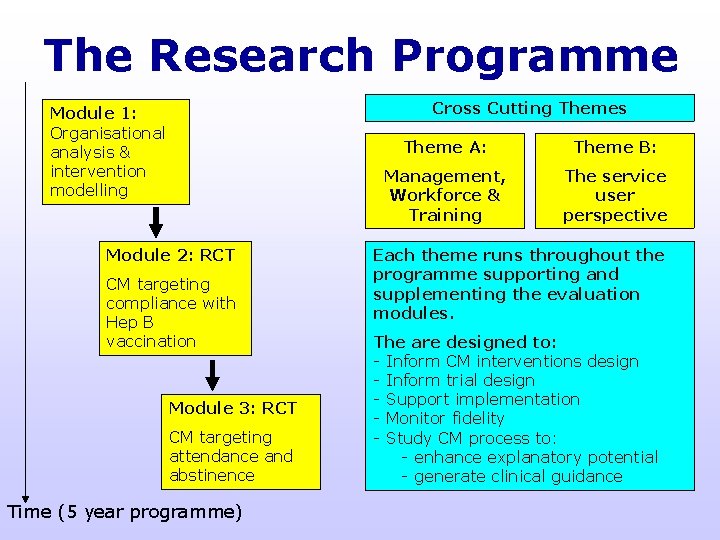
The Research Programme Cross Cutting Themes Module 1: Organisational analysis & intervention modelling Module 2: RCT CM targeting compliance with Hep B vaccination Module 3: RCT CM targeting attendance and abstinence Time (5 year programme) Theme A: Theme B: Management, Workforce & Training The service user perspective Each theme runs throughout the programme supporting and supplementing the evaluation modules. The are designed to: - Inform CM interventions design - Inform trial design - Support implementation - Monitor fidelity - Study CM process to: - enhance explanatory potential - generate clinical guidance
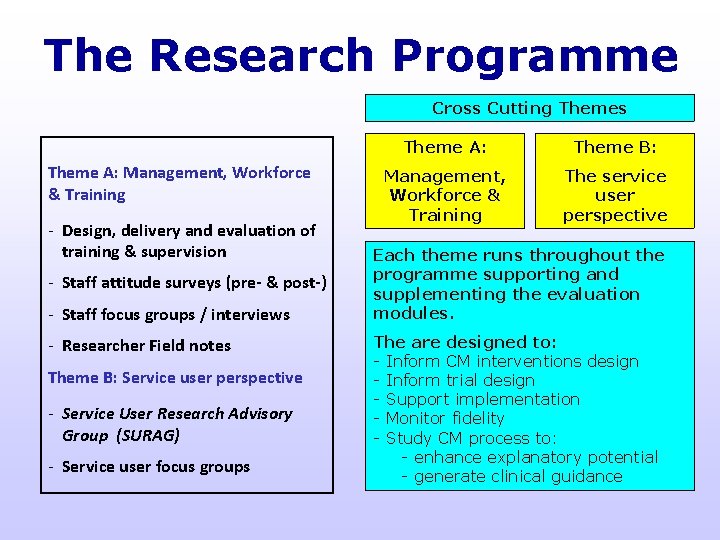
The Research Programme Cross Cutting Themes Theme A: Management, Workforce & Training - Design, delivery and evaluation of training & supervision - Staff attitude surveys (pre- & post-) - Staff focus groups / interviews - Researcher Field notes Theme B: Service user perspective - Service User Research Advisory Group (SURAG) - Service user focus groups Theme A: Theme B: Management, Workforce & Training The service user perspective Each theme runs throughout the programme supporting and supplementing the evaluation modules. The are designed to: - Inform CM interventions design - Inform trial design - Support implementation - Monitor fidelity - Study CM process to: - enhance explanatory potential - generate clinical guidance
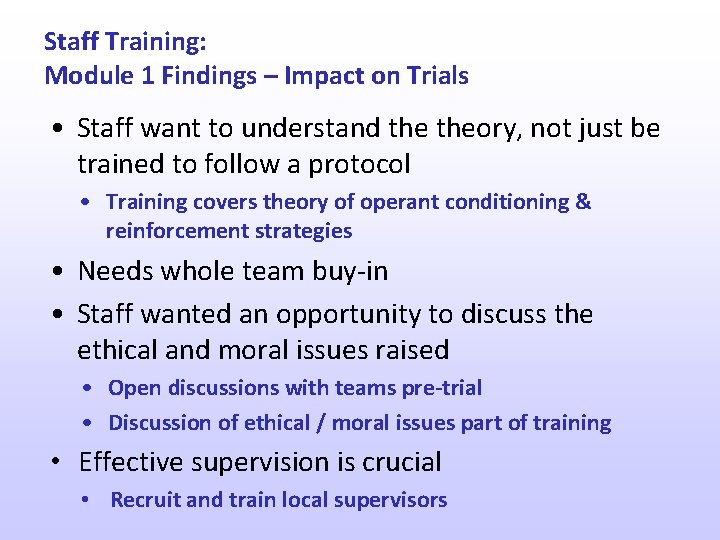
Staff Training: Module 1 Findings – Impact on Trials • Staff want to understand theory, not just be trained to follow a protocol • Training covers theory of operant conditioning & reinforcement strategies • Needs whole team buy-in • Staff wanted an opportunity to discuss the ethical and moral issues raised • Open discussions with teams pre-trial • Discussion of ethical / moral issues part of training • Effective supervision is crucial • Recruit and train local supervisors
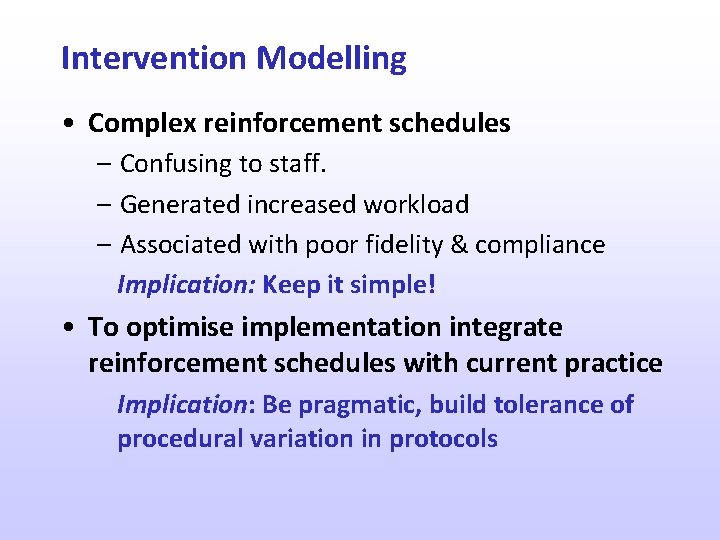
Intervention Modelling • Complex reinforcement schedules – Confusing to staff. – Generated increased workload – Associated with poor fidelity & compliance Implication: Keep it simple! • To optimise implementation integrate reinforcement schedules with current practice Implication: Be pragmatic, build tolerance of procedural variation in protocols
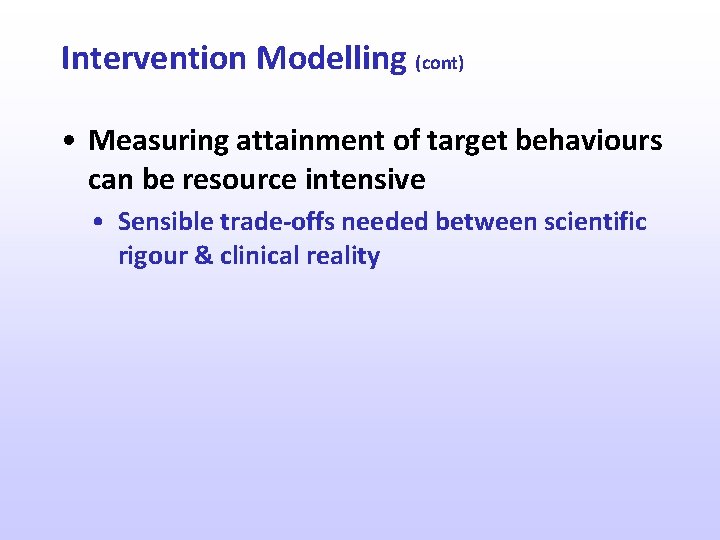
Intervention Modelling (cont) • Measuring attainment of target behaviours can be resource intensive • Sensible trade-offs needed between scientific rigour & clinical reality
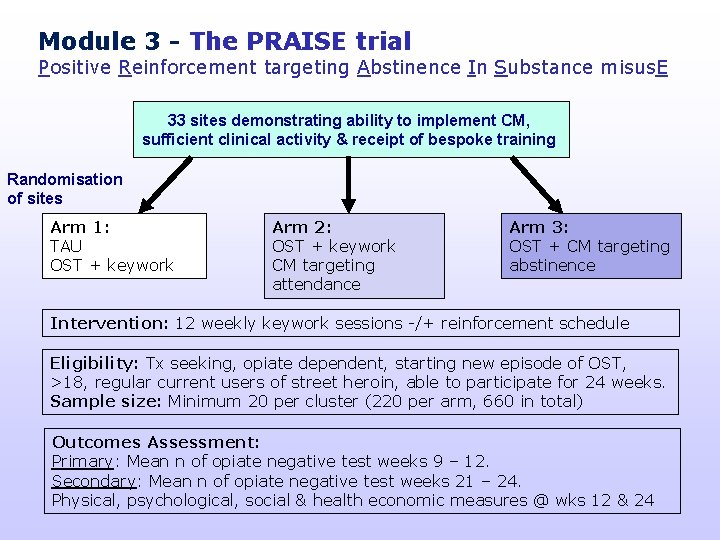
Module 3 - The PRAISE trial Positive Reinforcement targeting Abstinence In Substance misus. E 33 sites demonstrating ability to implement CM, sufficient clinical activity & receipt of bespoke training Randomisation of sites Arm 1: TAU OST + keywork Arm 2: OST + keywork CM targeting attendance Arm 3: OST + CM targeting abstinence Intervention: 12 weekly keywork sessions -/+ reinforcement schedule Eligibility: Tx seeking, opiate dependent, starting new episode of OST, >18, regular current users of street heroin, able to participate for 24 weeks. Sample size: Minimum 20 per cluster (220 per arm, 660 in total) Outcomes Assessment: Primary: Mean n of opiate negative test weeks 9 – 12. Secondary: Mean n of opiate negative test weeks 21 – 24. Physical, psychological, social & health economic measures @ wks 12 & 24
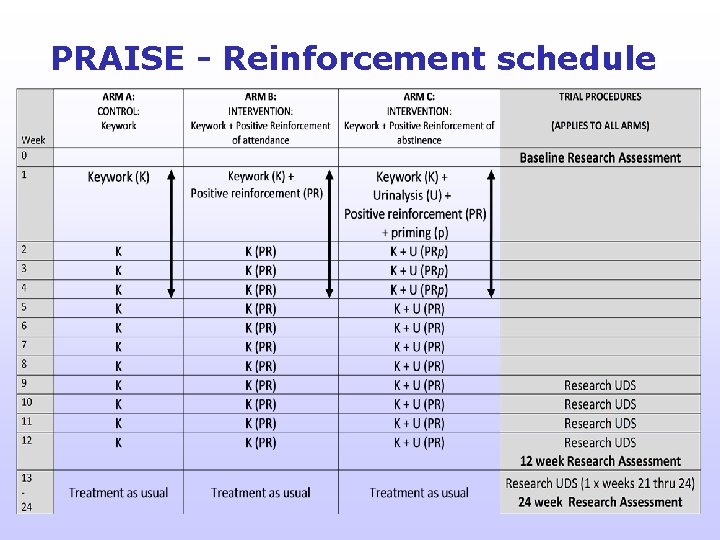
PRAISE - Reinforcement schedule
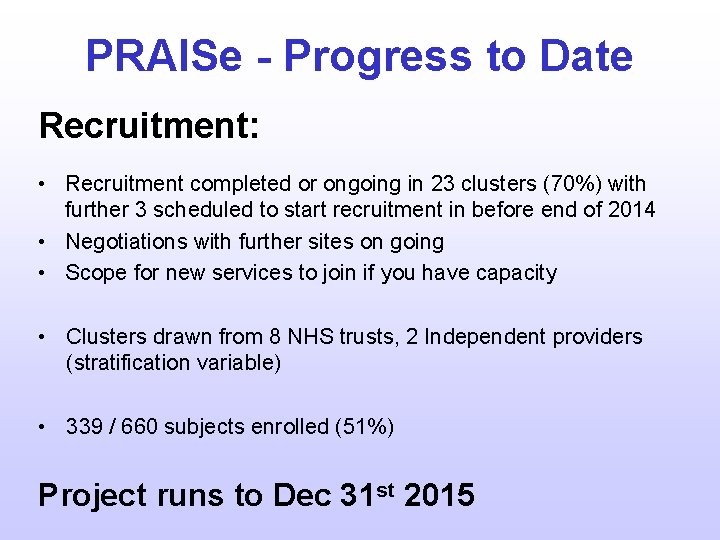
PRAISe - Progress to Date Recruitment: • Recruitment completed or ongoing in 23 clusters (70%) with further 3 scheduled to start recruitment in before end of 2014 • Negotiations with further sites on going • Scope for new services to join if you have capacity • Clusters drawn from 8 NHS trusts, 2 Independent providers (stratification variable) • 339 / 660 subjects enrolled (51%) Project runs to Dec 31 st 2015
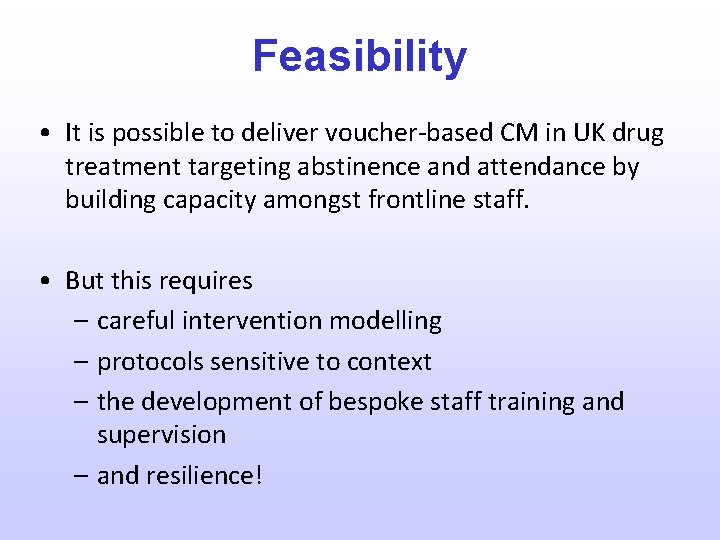
Feasibility • It is possible to deliver voucher-based CM in UK drug treatment targeting abstinence and attendance by building capacity amongst frontline staff. • But this requires – careful intervention modelling – protocols sensitive to context – the development of bespoke staff training and supervision – and resilience!
Given budget cuts, periodic re-tendering of services and the shift from NHS to nonstatutory provision, it’s a hugely challenging context in which to conduct research. Only a few more patients to recruit …!
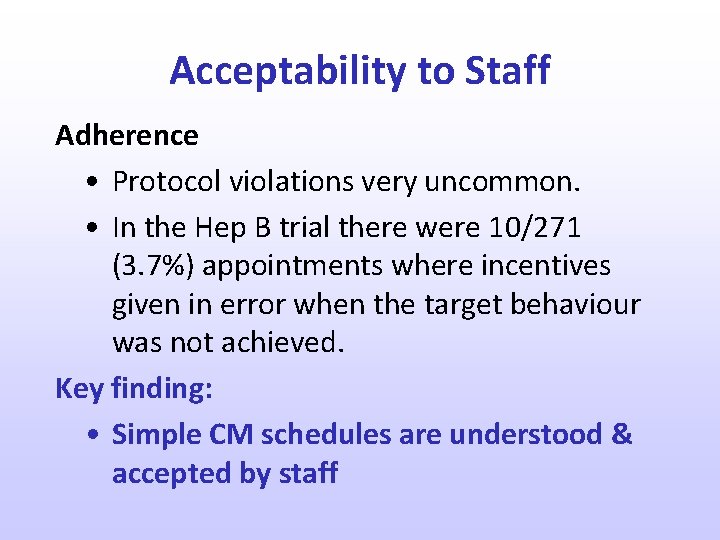
Acceptability to Staff Adherence • Protocol violations very uncommon. • In the Hep B trial there were 10/271 (3. 7%) appointments where incentives given in error when the target behaviour was not achieved. Key finding: • Simple CM schedules are understood & accepted by staff
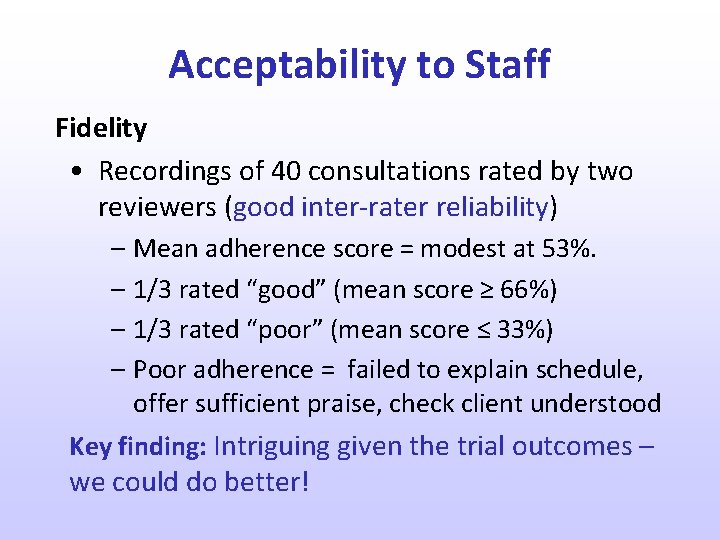
Acceptability to Staff Fidelity • Recordings of 40 consultations rated by two reviewers (good inter-rater reliability) – Mean adherence score = modest at 53%. – 1/3 rated “good” (mean score ≥ 66%) – 1/3 rated “poor” (mean score ≤ 33%) – Poor adherence = failed to explain schedule, offer sufficient praise, check client understood Key finding: Intriguing given the trial outcomes – we could do better!
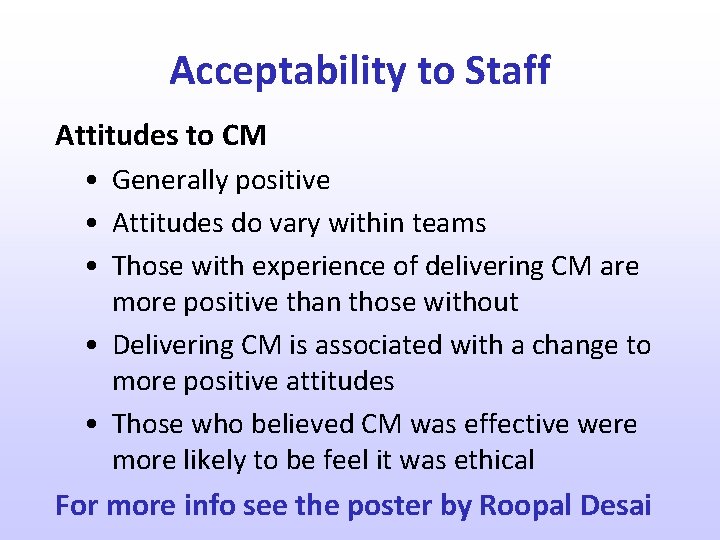
Acceptability to Staff Attitudes to CM • Generally positive • Attitudes do vary within teams • Those with experience of delivering CM are more positive than those without • Delivering CM is associated with a change to more positive attitudes • Those who believed CM was effective were more likely to be feel it was ethical For more info see the poster by Roopal Desai
Acceptability to Clients • Generally positive about the principle of positive reinforcement • Vouchers valued, but a range of views about reinforcer type. • Positive impact on therapeutic relationship with keyworkers commonly reported. • Most use vouchers for food, treats, gifts. • Some reported spend on alcohol but little evidence vouchers sold and/or used to acquire drugs.
Conclusions We have shown that its feasible to implement different CM schedules across a variety of drug treatment settings Staff and patients find CM acceptable and exposure to CM is associated with a shift to more positive attitudes. CM was acceptable to the management of services but we supplied the vouchers. (Would the NHS do this? )

Public & Media Reaction
Daily Mail – 26 th Jan 2007 Drug addicts told 'kick habit and win an i. Pod‘ Drug addicts who kick their habit are to be rewarded with i. Pods, televisions and shopping vouchers on the NHS under controversial guidelines … While cancer and Alzheimer's patients are denied life-prolonging treatments on the NHS, the National Institute for Health and Clinical Excellence (NICE) revealed a plan to offer junkies prizes for staying clean. NICE, which three months ago ruled Alzheimer's drugs costing just £ 2. 50 a day too expensive to provide on the NHS, believes such incentives would be cost effective. All would be paid for by the taxpayer, but critics described the move as "lunacy".
Daily Mail – 9 th April 2014 £ 10 supermarket voucher 'bribe' to help heroin addicts stay clear of drugs Heroin addicts are to be given weekly £ 10 supermarket vouchers in a bid to help them give up their habit. The NHS will reward drug users with the vouchers for remaining clean during a 12 -week treatment programme – meaning they could ‘earn’ up to £ 120 in total. The trial – which is taking place at 33 sites around Britain – follows a study by researchers who found that the number of heroin addicts who completed a course of three hepatitis B jabs soared when they were rewarded with shopping vouchers. The researchers said the financial incentive had been a ‘game-changer’ and could have a huge impact on drug treatment as well as other public health initiatives. . However Joyce Robins, co-director of the campaign group Patient Concern, questioned whether addicts should be paid for changing their ways. ‘In a time of austerity this is not the best way of spending taxpayers’ money, ’ she said.
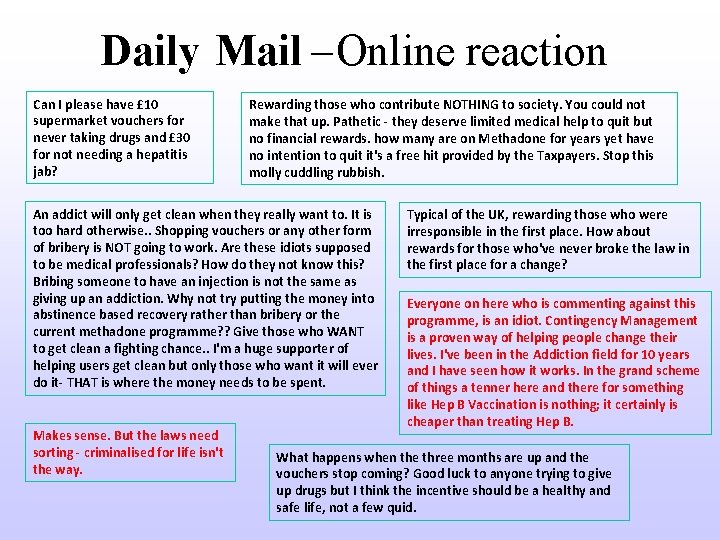
Daily Mail – Online reaction Can I please have £ 10 supermarket vouchers for never taking drugs and £ 30 for not needing a hepatitis jab? Rewarding those who contribute NOTHING to society. You could not make that up. Pathetic - they deserve limited medical help to quit but no financial rewards. how many are on Methadone for years yet have no intention to quit it's a free hit provided by the Taxpayers. Stop this molly cuddling rubbish. An addict will only get clean when they really want to. It is too hard otherwise. . Shopping vouchers or any other form of bribery is NOT going to work. Are these idiots supposed to be medical professionals? How do they not know this? Bribing someone to have an injection is not the same as giving up an addiction. Why not try putting the money into abstinence based recovery rather than bribery or the current methadone programme? ? Give those who WANT to get clean a fighting chance. . I'm a huge supporter of helping users get clean but only those who want it will ever do it- THAT is where the money needs to be spent. Makes sense. But the laws need sorting - criminalised for life isn't the way. Typical of the UK, rewarding those who were irresponsible in the first place. How about rewards for those who've never broke the law in the first place for a change? Everyone on here who is commenting against this programme, is an idiot. Contingency Management is a proven way of helping people change their lives. I've been in the Addiction field for 10 years and I have seen how it works. In the grand scheme of things a tenner here and there for something like Hep B Vaccination is nothing; it certainly is cheaper than treating Hep B. What happens when the three months are up and the vouchers stop coming? Good luck to anyone trying to give up drugs but I think the incentive should be a healthy and safe life, not a few quid.
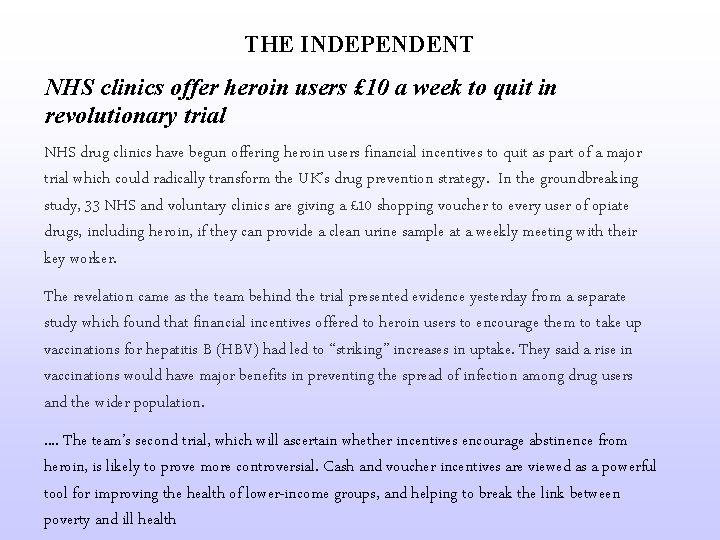
THE INDEPENDENT NHS clinics offer heroin users £ 10 a week to quit in revolutionary trial NHS drug clinics have begun offering heroin users financial incentives to quit as part of a major trial which could radically transform the UK’s drug prevention strategy. In the groundbreaking study, 33 NHS and voluntary clinics are giving a £ 10 shopping voucher to every user of opiate drugs, including heroin, if they can provide a clean urine sample at a weekly meeting with their key worker. The revelation came as the team behind the trial presented evidence yesterday from a separate study which found that financial incentives offered to heroin users to encourage them to take up vaccinations for hepatitis B (HBV) had led to “striking” increases in uptake. They said a rise in vaccinations would have major benefits in preventing the spread of infection among drug users and the wider population. . . The team’s second trial, which will ascertain whether incentives encourage abstinence from heroin, is likely to prove more controversial. Cash and voucher incentives are viewed as a powerful tool for improving the health of lower-income groups, and helping to break the link between poverty and ill health
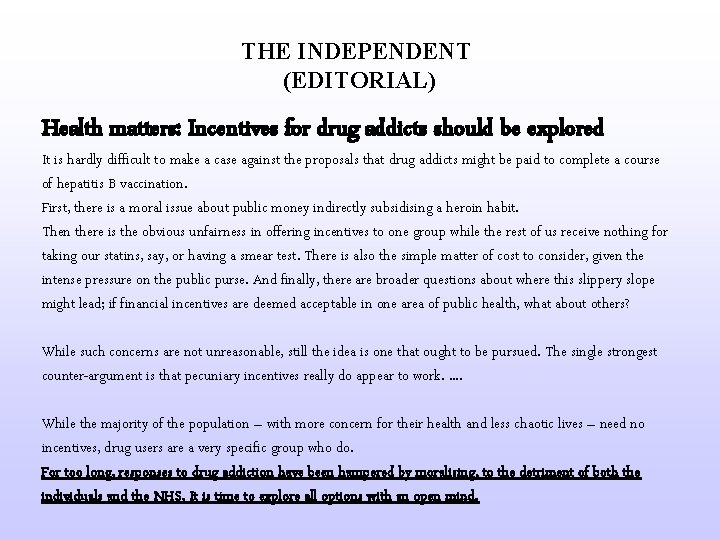
THE INDEPENDENT (EDITORIAL) Health matters: Incentives for drug addicts should be explored It is hardly difficult to make a case against the proposals that drug addicts might be paid to complete a course of hepatitis B vaccination. First, there is a moral issue about public money indirectly subsidising a heroin habit. Then there is the obvious unfairness in offering incentives to one group while the rest of us receive nothing for taking our statins, say, or having a smear test. There is also the simple matter of cost to consider, given the intense pressure on the public purse. And finally, there are broader questions about where this slippery slope might lead; if financial incentives are deemed acceptable in one area of public health, what about others? While such concerns are not unreasonable, still the idea is one that ought to be pursued. The single strongest counter-argument is that pecuniary incentives really do appear to work. . . While the majority of the population – with more concern for their health and less chaotic lives – need no incentives, drug users are a very specific group who do. For too long, responses to drug addiction have been hampered by moralising, to the detriment of both the individuals and the NHS. It is time to explore all options with an open mind.
The Research Team Prof John Strang (PI), Dr Nicola Metrebian, Roopal Desai, Vikki Charles, Jo Milward, Riti Patel, Lindsey Hines (Addictions, Io. PPN, Kings College London) Dr Tim Weaver, Dilkushi Poovendran, Hortencia Mc. Kechnie (Imperial College London) Prof Stephen Pilling, Nicholas Little, Bishop Ellie, Claire Goodfellow (University College London) Jennifer Hellier, Caroline Murphy (Biostatistics, Io. PNN, Kings College London) Prof Sarah Byford, Dr James Shearer (CEMPH, Io. PNN, Kings College London) Dr Luke Mitcheson, Dr Emily Finch, Mark Allen (South London & Maudsley NHS Foundation Trust) Dr Ed Day, Shabana Akhtar, Carmel Bennett, Ruth Pauli (Birmingham & Solihull Mental Health NHS Trust) Dr Anthony Glasper (Sussex Partnership Trust) Dr Owen Bowden-Jones (Central & North West London NHS Foundation Trust) Dr Frank Ryan, Dr John Dunn (Camden and Islington NHS Trust) Jalpa Bajaria (South Essex Partnership) Rachid Rafia, Peter Dodd, Dr. Alan Brennan, Dr Petra Meier, Prof Mike Campbell (School of Health & Related Research, University of Sheffield) Peter Mc. Dermott (The Alliance, National Drug User Group) Prof Nancy Petry (University of Connecticut, USA)
- Slides: 33