
Priyank Desai MD Ryan Griffin RN A SIGNIFICANT

- Slides: 24
Priyank Desai, MD Ryan Griffin, RN
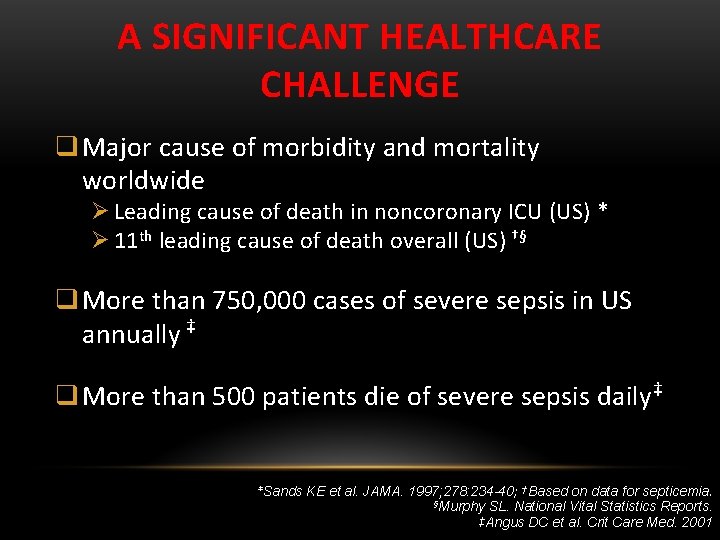
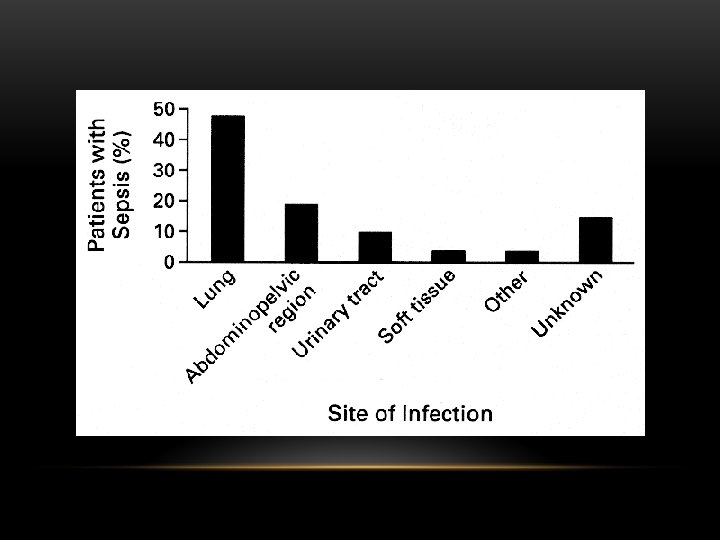
A SIGNIFICANT HEALTHCARE CHALLENGE q Major cause of morbidity and mortality worldwide Ø Leading cause of death in noncoronary ICU (US) * Ø 11 th leading cause of death overall (US) †§ q More than 750, 000 cases of severe sepsis in US annually ‡ q More than 500 patients die of severe sepsis daily ‡ *Sands KE et al. JAMA. 1997; 278: 234 -40; †Based on data for septicemia. §Murphy SL. National Vital Statistics Reports. ‡Angus DC et al. Crit Care Med. 2001
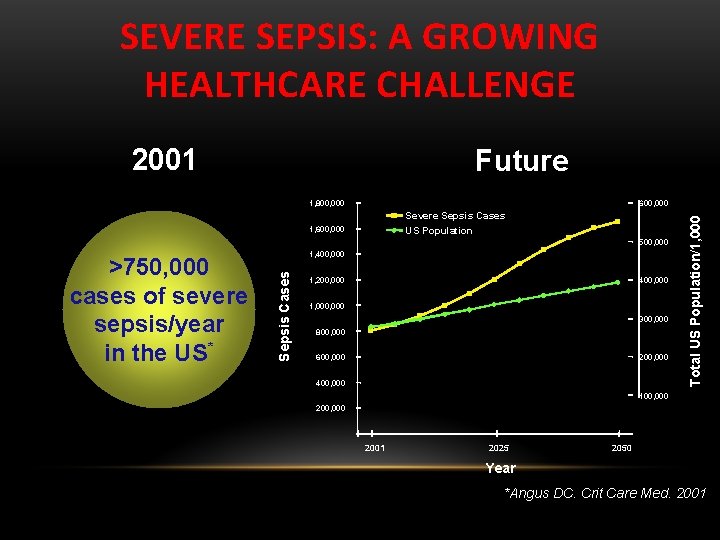
SEVERE SEPSIS: A GROWING HEALTHCARE CHALLENGE 2001 Future 600, 000 Severe Sepsis Cases US Population 1, 600, 000 500, 000 Sepsis Cases >750, 000 cases of severe sepsis/year in the US* 1, 400, 000 1, 200, 000 400, 000 1, 000 300, 000 800, 000 200, 000 600, 000 400, 000 Total US Population/1, 000 1, 800, 000 100, 000 2001 2025 2050 Year *Angus DC. Crit Care Med. 2001
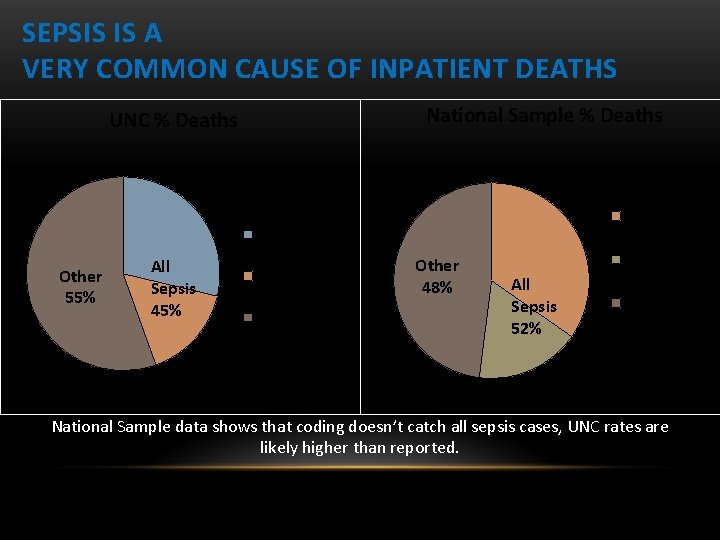
SEPSIS IS A VERY COMMON CAUSE OF INPATIENT DEATHS National Sample % Deaths UNC % Deaths Other 55% All Sepsis 45% Sepsis POA Documented Sepsis Documented Other 48% All Sepsis 52% Sepsis by Review Other Source: UHC Data, 2013, excl NNB, Psych, Rehab National Sample data shows that coding doesn’t catch all sepsis cases, UNC rates are likely higher than reported. Hospital Deaths in Patients with Sepsis from Two Independent Cohorts Liu et al JAMA May 18, 2014
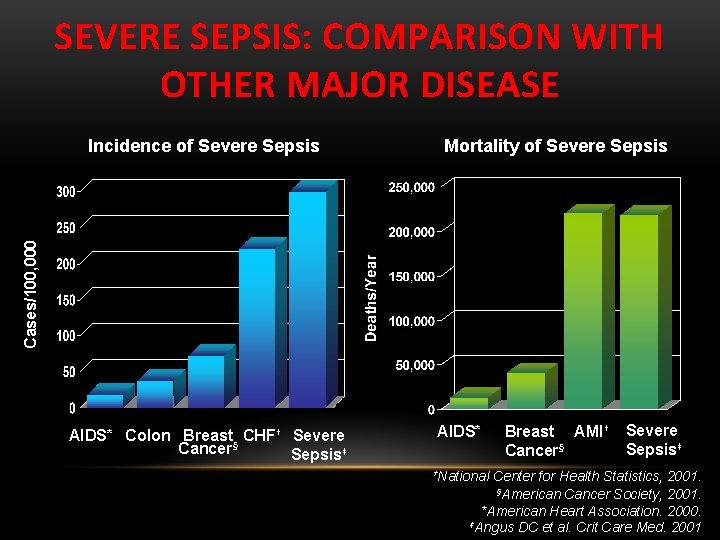
SEVERE SEPSIS: COMPARISON WITH OTHER MAJOR DISEASE Mortality of Severe Sepsis Cases/100, 000 Incidence of Severe Sepsis AIDS* Colon Breast§ CHF† Severe Cancer Sepsis‡ AIDS* †National Breast AMI† Cancer§ Severe Sepsis‡ Center for Health Statistics, 2001. §American Cancer Society, 2001. *American Heart Association. 2000. ‡Angus DC et al. Crit Care Med. 2001
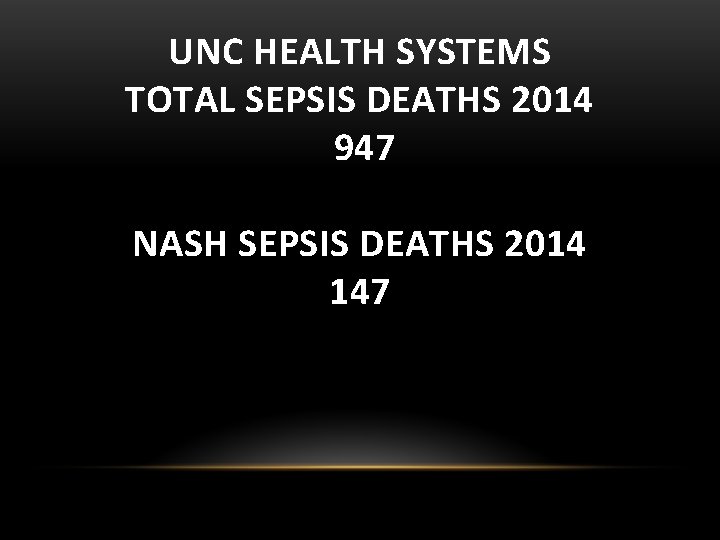
UNC HEALTH SYSTEMS TOTAL SEPSIS DEATHS 2014 947 NASH SEPSIS DEATHS 2014 147
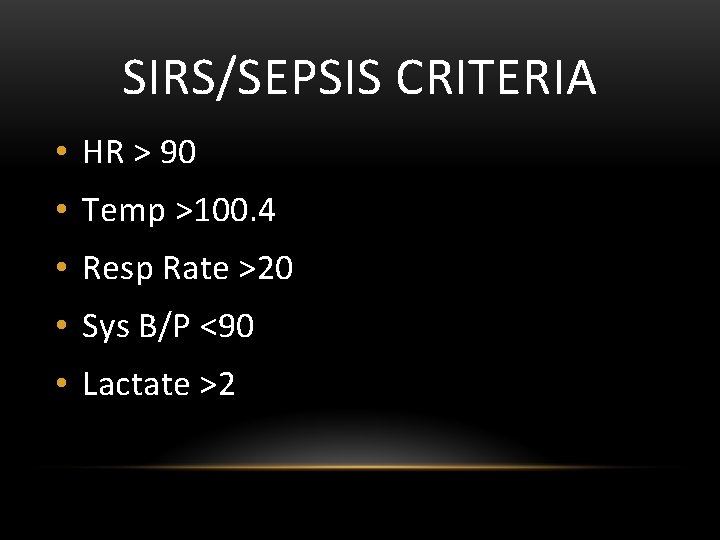
SIRS/SEPSIS CRITERIA • HR > 90 • Temp >100. 4 • Resp Rate >20 • Sys B/P <90 • Lactate >2
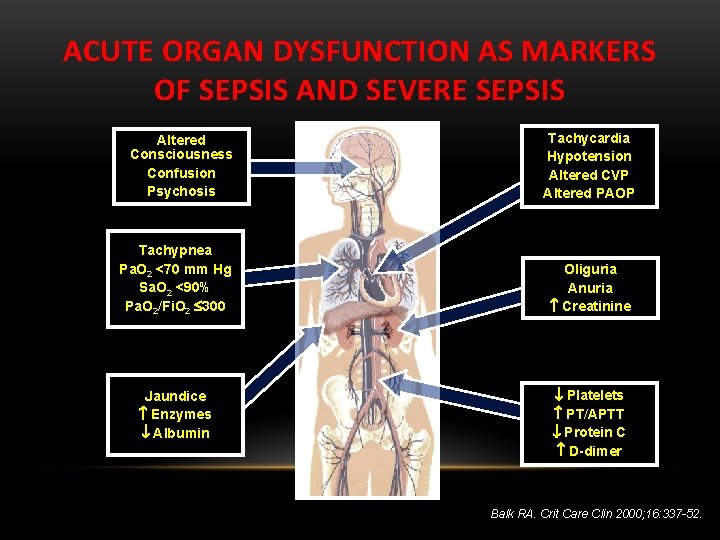
ACUTE ORGAN DYSFUNCTION AS MARKERS OF SEPSIS AND SEVERE SEPSIS Altered Consciousness Confusion Psychosis Tachypnea Pa. O 2 <70 mm Hg Sa. O 2 <90% Pa. O 2/Fi. O 2 300 Jaundice Enzymes Albumin Tachycardia Hypotension Altered CVP Altered PAOP Oliguria Anuria Creatinine Platelets PT/APTT Protein C D-dimer Balk RA. Crit Care Clin 2000; 16: 337 -52.
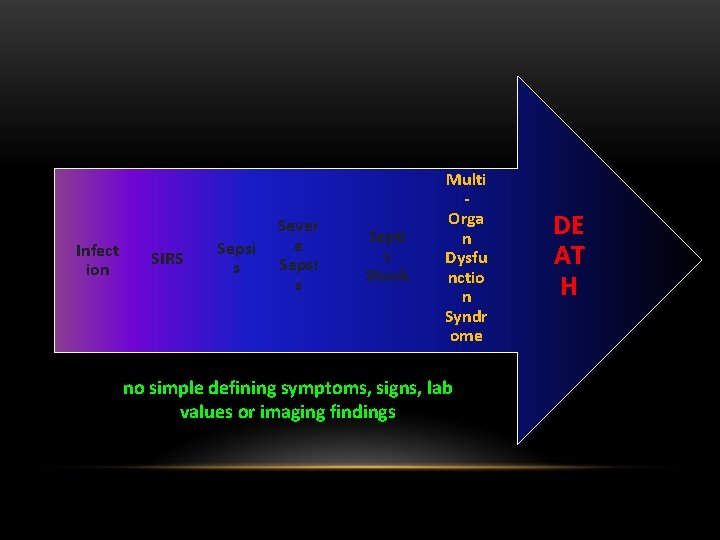
Infect ion SIRS Sepsi s Sever e Sepsi s Septi c Shock Multi Orga n Dysfu nctio n Syndr ome no simple defining symptoms, signs, lab values or imaging findings DE AT H
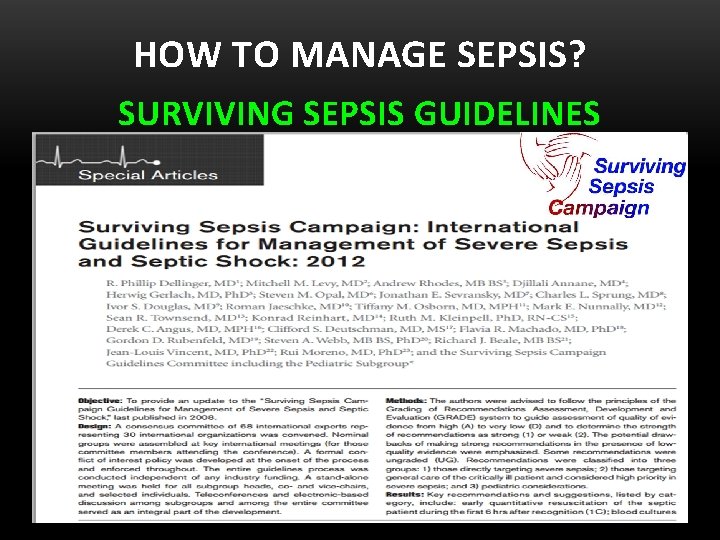
HOW TO MANAGE SEPSIS? SURVIVING SEPSIS GUIDELINES
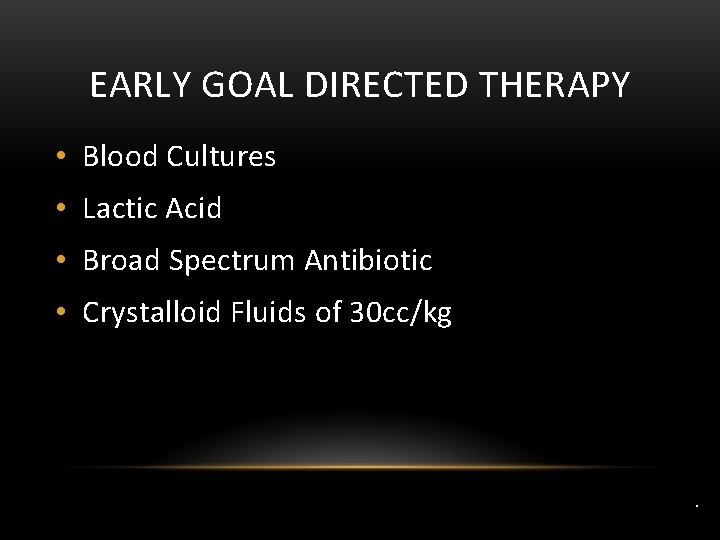
EARLY GOAL DIRECTED THERAPY • Blood Cultures • Lactic Acid • Broad Spectrum Antibiotic • Crystalloid Fluids of 30 cc/kg .
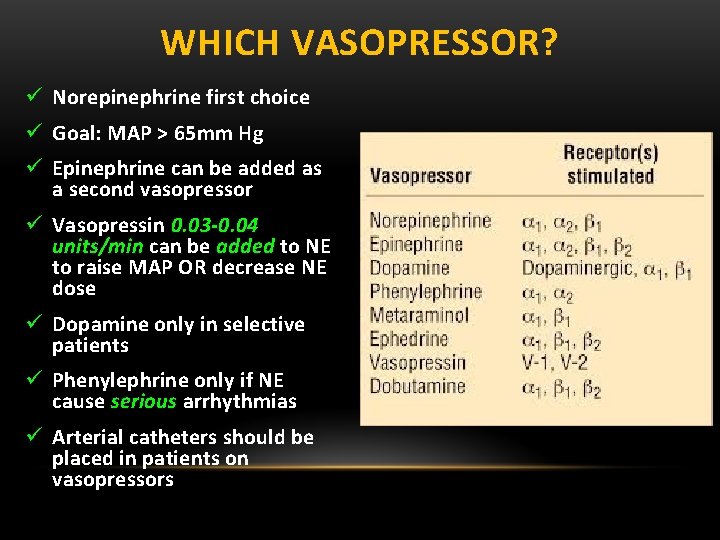
WHICH VASOPRESSOR? ü Norepinephrine first choice ü Goal: MAP > 65 mm Hg ü Epinephrine can be added as a second vasopressor ü Vasopressin 0. 03 -0. 04 units/min can be added to NE to raise MAP OR decrease NE dose ü Dopamine only in selective patients ü Phenylephrine only if NE cause serious arrhythmias ü Arterial catheters should be placed in patients on vasopressors
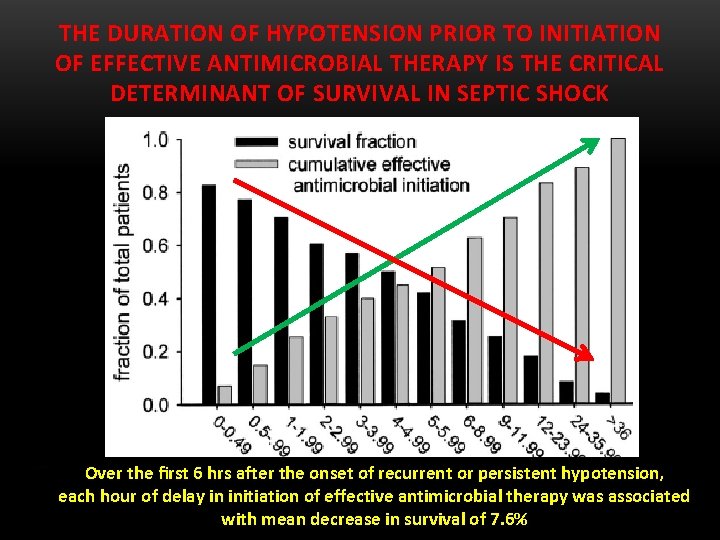
THE DURATION OF HYPOTENSION PRIOR TO INITIATION OF EFFECTIVE ANTIMICROBIAL THERAPY IS THE CRITICAL DETERMINANT OF SURVIVAL IN SEPTIC SHOCK Over the first 6 hrs after the onset of recurrent or persistent hypotension, each hour of delay in initiation of effective antimicrobial therapy was associated with mean decrease in survival of 7. 6%
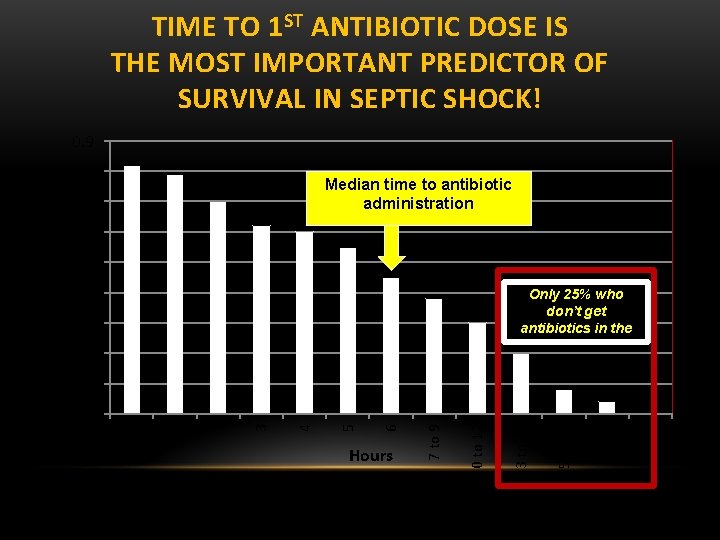
TIME TO 1 ST ANTIBIOTIC DOSE IS THE MOST IMPORTANT PREDICTOR OF SURVIVAL IN SEPTIC SHOCK! 0. 9 0. 8 Median time to antibiotic administration 0. 6 0. 5 0. 4 Only 25% who don’t get antibiotics in the 0. 3 0. 2 >36 25 to 35 13 to 24 10 to 12 Hours 7 to 9 6 5 4 3 2 0 1 0. 5 Survival Fraction 0. 7 Kumar et al. Critical Care Medicine 2006 34: 1589
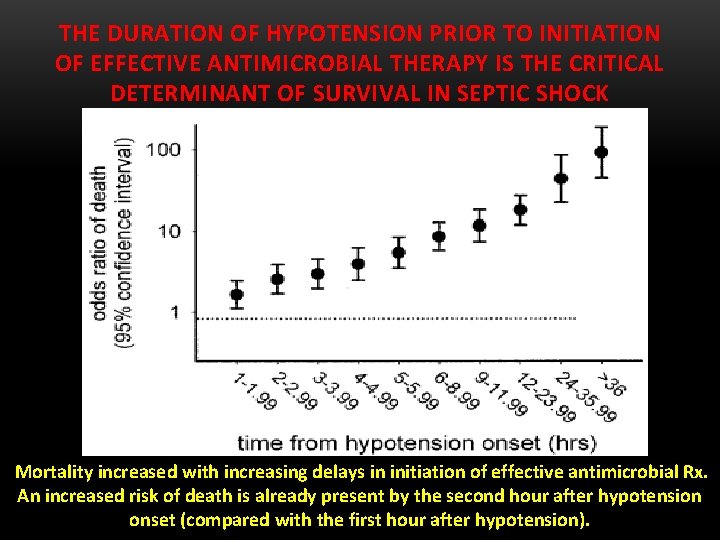
THE DURATION OF HYPOTENSION PRIOR TO INITIATION OF EFFECTIVE ANTIMICROBIAL THERAPY IS THE CRITICAL DETERMINANT OF SURVIVAL IN SEPTIC SHOCK Mortality increased with increasing delays in initiation of effective antimicrobial Rx. An increased risk of death is already present by the second hour after hypotension onset (compared with the first hour after hypotension).
MORTALITY INCREASES BY 7. 6% EVERY HOUR THAT TREATMENT IS DELAYED
SEVERE SEPSIS THERAPY: SURVIVING SEPSIS GUIDELINES q. Antibiotics q. Renal Replacement Therapy q. Source Control q. Nutrition q. Mechanical Ventilation q. Supportive measures q. Hemodynamic Support
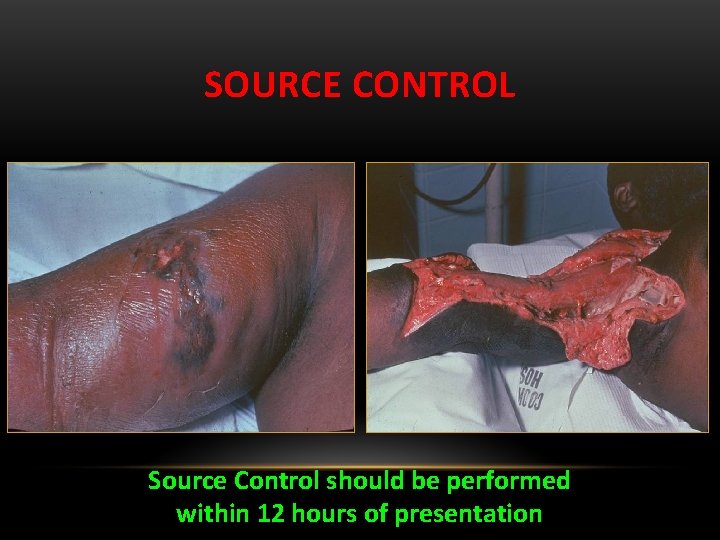
SOURCE CONTROL Source Control should be performed within 12 hours of presentation
SEVERE SEPSIS THERAPY: SURVIVING SEPSIS GUIDELINES q. Antibiotics q. Renal Replacement Therapy q. Source Control q. Nutrition q. Mechanical Ventilation q. Supportive measures q. Hemodynamic Support
KEY POINTS / GOALS COMPLETE WITHIN 3 HOURS q Measure lactate level q Obtain blood cultures prior to administration of antibiotics q Administer broad spectrum antibiotics q Hypotension/Lactate ≥ 4 Ø 30 cc/kg crystalloid
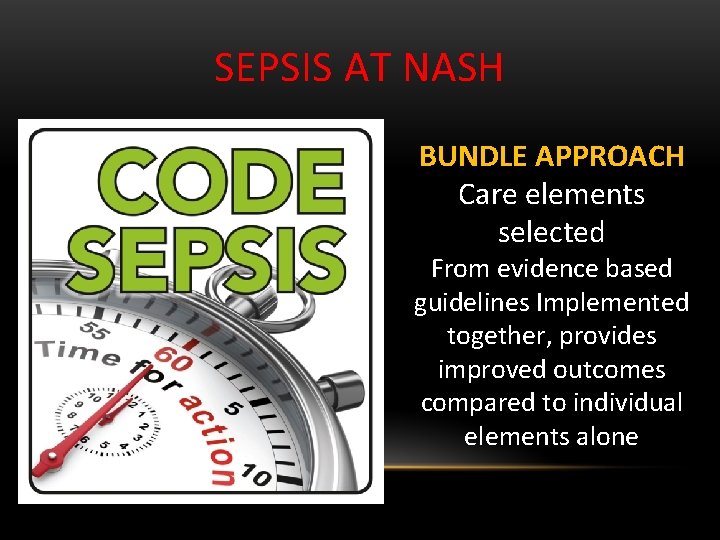
SEPSIS AT NASH BUNDLE APPROACH Care elements selected From evidence based guidelines Implemented together, provides improved outcomes compared to individual elements alone
CARE ELEMENTS TO BE MEASURED @ NASH ü Lactate completed within 1 hour ü Blood cultures x 2 prior to antibiotics (do not hold antibiotics if unable to obtain) ü Antibiotics started within 1 hour ü Fluid Resuscitation of 30 ml/kg in the first hour with a diagnosis of Septic shock (SBP<90 or Lactate >4) or 2 liters bolus if diagnosis of sepsis
Thank you