
Presentation by Anand Desai Managing Partner DSK Legal
Presentation by Anand Desai Managing Partner © DSK Legal 2016 │ All rights reserved │ Not for circulation The Game of Chance & Game of Skill : Legality of Online Poker in India 1
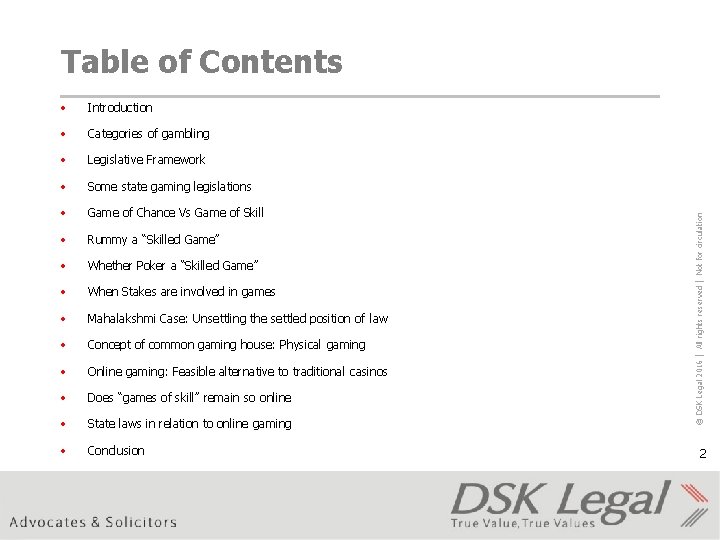
• Introduction • Categories of gambling • Legislative Framework • Some state gaming legislations • Game of Chance Vs Game of Skill • Rummy a “Skilled Game” • Whether Poker a “Skilled Game” • When Stakes are involved in games • Mahalakshmi Case: Unsettling the settled position of law • Concept of common gaming house: Physical gaming • Online gaming: Feasible alternative to traditional casinos • Does “games of skill” remain so online • State laws in relation to online gaming • Conclusion © DSK Legal 2016 │ All rights reserved │ Not for circulation Table of Contents 2
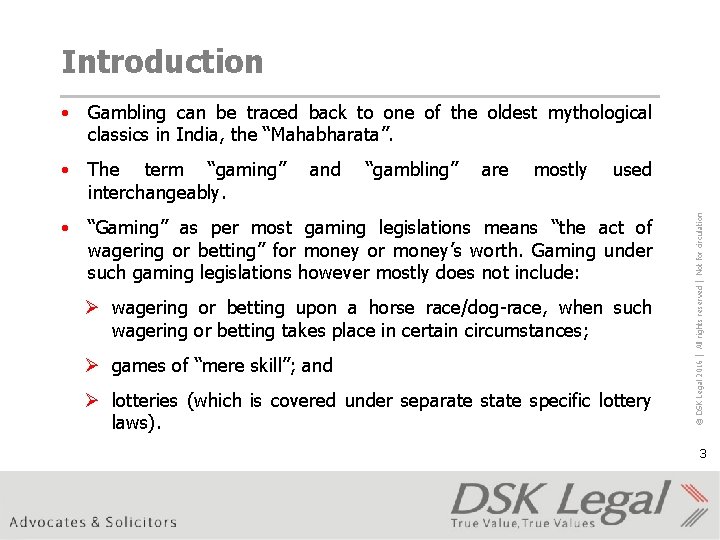
Introduction • Gambling can be traced back to one of the oldest mythological classics in India, the “Mahabharata”. and “gambling” are mostly used • “Gaming” as per most gaming legislations means “the act of wagering or betting” for money’s worth. Gaming under such gaming legislations however mostly does not include: Ø wagering or betting upon a horse race/dog-race, when such wagering or betting takes place in certain circumstances; Ø games of “mere skill”; and Ø lotteries (which is covered under separate state specific lottery laws). © DSK Legal 2016 │ All rights reserved │ Not for circulation • The term “gaming” interchangeably. 3
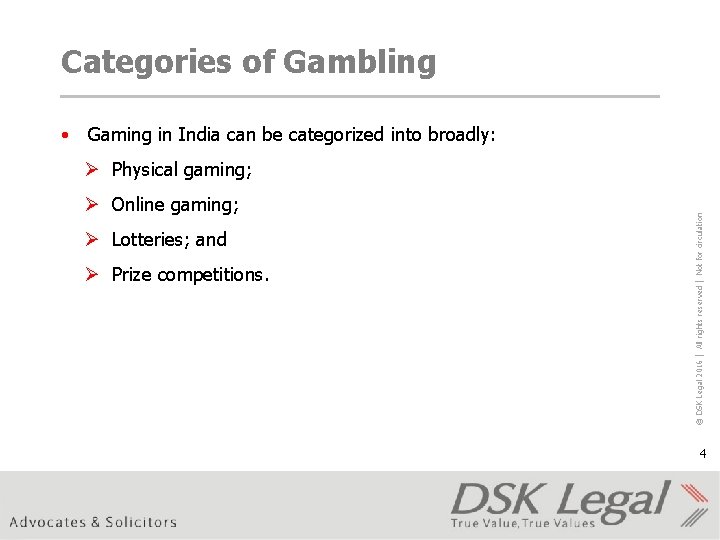
Categories of Gambling • Gaming in India can be categorized into broadly: Ø Online gaming; Ø Lotteries; and Ø Prize competitions. © DSK Legal 2016 │ All rights reserved │ Not for circulation Ø Physical gaming; 4
Legislative framework • The 7 th Schedule, List II, Entry No. 34 of the Constitution of India empowers state legislatures to frame state specific laws on betting and gambling. Accordingly, various State Governments have promulgated legislations regulating gaming/gambling. • The Prize Competition Act, 1955 governs prize competitions such as word prize competitions, puzzles where prizes are offered. • Lotteries are permitted to be organized and conducted by State Governments. Lotteries have excluded from the purview of gaming legislations and are governed by Lotteries (Regulation) Act, 1998 and certain other state legislations. © DSK Legal 2016 │ All rights reserved │ Not for circulation • The Public Gambling Act, 1867 is the only central legislation in India governing gambling. 5
Some State gaming legislations • Assam Game and Betting Act, 1970. • Sikkim Online Gaming (Regulation) Act, 2008; only legislation governing online gaming. • Orissa (Prevention of) Gambling Act, 1955. • Delhi Public Gambling Act, 1955. • Bombay Prevention of Gambling Act, 1887. • Meghalaya Prevention of Gambling Act, 1970. © DSK Legal 2016 │ All rights reserved │ Not for circulation • The West Bengal Gambling and Prize Competitions Act, 1957. 6
Game of Skill Vs Game of Chance • A game of skill is considered to be one where the outcome is determined mainly by mental or physical prowess, rather than by chance. • Provisions of gaming legislations are not applicable in case of games based on “mere skill” wherever played. © DSK Legal 2016 │ All rights reserved │ Not for circulation • Examples of game of chance: throw of dice, turning of wheel etc; 7
• The exclusion of games of “mere skill” from the ambit of gambling has created ambiguity as to which games are games of “mere skill” as opposed to “games of chance”. • In Dr. K. R Lakshmanan Vs State of Tamil Nadu and Another (AIR 1996 SC 1153), the Supreme Court held that the expression “mere skill” would mean substantial degree or preponderance of skill. • Whether a game is of chance or skills is a question of fact to be decided on the facts and circumstances of each case (Manoranjithan Manamyil Mandram v. State of Tamil Nadu, AIR 2005 Mad 261). © DSK Legal 2016 │ All rights reserved │ Not for circulation Game of Skill Vs Game of Chance contd. 8
• In State of Andhra Pradesh Vs K. Satyanarayana and Ors. , (AIR 1968 SC 825) the game of Rummy was examined on the principles of skill versus chance and it was held that rummy is not a game entirely of chance like the ‘three-card’ game which is a game of pure chance. • The Supreme Court provided a reasoning that rummy requires certain amount of skill because the fall of the cards has to be memorized and building up of rummy requires considerable skill in holding and discarding cards. © DSK Legal 2016 │ All rights reserved │ Not for circulation Game of Rummy held to be game of skill 9
• The Karnataka High Court in Indian Poker Association and Ors. Vs State of Karnataka and Ors (Writ Petition Nos. 39167 to 39169 of 2013 decided on October 8, 2013) recently clarified that no specific license or permission was required in Karnataka for conducting the game of poker if it is played as a game of skill. The court did not go into the substantial merits of whether poker was a game of skill or not. • In West Bengal, games of cards like Poker is specifically excluded from the definition of “gaming and gambling” and one can organise such games by obtaining appropriate license under the law. © DSK Legal 2016 │ All rights reserved │ Not for circulation Whether Poker is a “skilled game” 10
Whether Poker a “skilled game” contd. • One can argue that since institutions like International Minds Sports Association have recognized Poker as mind sports, therefore the same should be considered as game of skill. • However, in view of lack of clear jurisprudence, this area remains grey. © DSK Legal 2016 │ All rights reserved │ Not for circulation • The decision on whether poker is a game of skill is currently pending with the Delhi High Court in the case of Gaussian Network Private Ltd Vs. Monica Lakhanpal and Another. 11
are involved in • Can owners of gaming houses derive profits from players? • The Supreme Court in State of Andhra Pradesh Vs. K. Satyanarayana and Ors. , (AIR 1968 SC 825) addressed this point, in context of physical clubs and held: Ø An extra charge for playing cards (unless it is extravagant) would not show that the club was making a profit or gain so as to render the club into a common gambling house. Ø The court also noted that, any nominal fee charged person for playing in the card room, as sitting fees, is not such a heavy charge in a members' club as to be described as an attempt to make a profit or gain for the club. The court also noted that, if there is evidence of gambling in some other way or that the owner of the house or the club is making a profit or gain from the game of Rummy or any other game played for stakes, the offence may be brought home. © DSK Legal 2016 │ All rights reserved │ Not for circulation When “Stakes” games 12
When “Stakes” games contd. are involved in • However, the Madras High Court in the Director General of Police, Chennai Vs Mahalakshmi Cultural Association (MANU/TN/0741/2012) unsettled a settled position of law when it held that rummy when played with stakes is illegal. • The brief facts and series of events in the case are set out in the next few slides. © DSK Legal 2016 │ All rights reserved │ Not for circulation • The High Court of Andhra Pradesh in Executive Club formed by Lalitha Real Estates Private Limited, Vijayawada and others Vs State of Andhra Pradesh (1999 Cri. LJ 35) has taken a view that playing rummy for stakes cannot be construed as an offence. 13
• The premises of one Mahalakshmi Cultural Association (“Association”) was raided by the Inspector of Police, Chennai, basis, its premises was being used for gambling and that the members were playing Rummy with stakes. Hence, case was registered. • Aggrieved by this, the Association filed a writ petition seeking directions to forbear the police from inter alia interfering with its activities in any manner, including playing 13 cards Rummy with or without stakes. This petition was disposed of by the court in favor of the Association, on the ground that Rummy is a skill based game and hence is not illegal. • This single judge’s order was challenged by the police in the writ appeal before the Madras High Court, where the court has inter alia held that, the police can invoke the provisions of the Chennai City Police Act, if it is found that the club / association allows its members or guests to play Rummy with stakes or make any profit or gain out of such play. © DSK Legal 2016 │ All rights reserved │ Not for circulation Mahalakshmi Case: Unsettling the settled position of law 14
• The Supreme Court (“SC”) permitted the withdrawal of the original writ petition filed before the Madras High Court before deciding the case. • The SC observed that since the original writ petition was dismissed as withdrawn, the observations made by the Madras High Court would not survive. • The SC also abstained from making any observations in relation to online rummy. • Therefore, can a view be taken that original position of law as fortified by many courts that “games of skill being out of reach of state gambling laws may be played with stakes” can be reverted to? © DSK Legal 2016 │ All rights reserved │ Not for circulation Mahalakshmi Case: Unsettling the settled position of law contd. 15
Concept of common gaming house: Physical gaming Concept of common gaming house (as defined under the Public Gambling Act, 1867. Ø Any place in which cards, dice, tables or other instruments of gaming are kept or used in any manner for profit or gain of the person, occupying, using or keeping such place, such house qualifies as a common gaming house. • Punitive actions may be taken against any person who either on his own accord opens, keeps, uses any place as a common gaming-house or knowingly permits to be opened, occupied, used or kept by any other person any place as a common gaming-house. • Intent to derive profit or gain from use of the common gaming house is not permitted. © DSK Legal 2016 │ All rights reserved │ Not for circulation • 16
Online gaming: Feasible alternative to traditional casinos? • While in the United States, states of Nevada and Delaware signed the nation’s first multistate Internet gaming agreement, which will allow players in both states to play online poker against each other over a shared platform, in India there are still no specific regulations on online gaming. • Most of the gaming legislations in India were enacted prior to the dawn of internet gaming, and dealt with gaming in physical medium termed as “common gaming houses”. © DSK Legal 2016 │ All rights reserved │ Not for circulation • With the expansion of internet, brick and mortar rooms have been replaced by online gaming sites. 17
Online gaming: Feasible alternative to traditional casinos? contd. • Question is whether a corollary can be drawn that the term “any place as a common gaming house” mentioned in the Public Gambling Act, 1867 may be construed to include a virtual platform. • Can organizers of online tournaments, collect stakes from players participating in such tournaments ? Will it still fall under permissible limits of law, and not a “common gaming house”? • With recent orders of the Supreme Court in the Mahalakshmi case, where the Supreme Court has refused to comment on the legality of online rummy, it will be interesting to note the stance taken by online gaming websites. © DSK Legal 2016 │ All rights reserved │ Not for circulation • In Super Cassettes Industries Ltd. Vs. Myspace Inc. & Anr. (2011 (48) PTC 49 (Del), High Court of Delhi has held that the word “place” includes an internet or web space for the purposes of the Copyright Act, 1957. 18
Does “games of skill” remain so online? © DSK Legal 2016 │ All rights reserved │ Not for circulation • Courts have held that in online gaming, various factors increase the degree of chance and predominance of skill over chance is questionable and various manipulation including cheating, collusion etc. cannot be ruled out. 19
State laws in relation to online gaming The state laws of Sikkim govern certain online gaming and sports betting. Online games like Roulette, Black Jack, Pontoon, Poker Dice, Baccarat, Chemin-de-for, Backgammon, Keno etc. can be played by obtaining a licence. • In Goa, casinos are permitted to operate on an offshore vessel. © DSK Legal 2016 │ All rights reserved │ Not for circulation • 20
• If four poker players residing in India, Sydney, Las Vegas and Tokyo respectively, play online poker against each other, using a server based in Germany, what nation has jurisdiction over whom and why? • The Court in the case of Banyan Tree Holdings (P) Ltd. V. A. Murali Krishna Reddy and Another (2010 (42) PTC 361 (Del), examined whether a cause of action arises under Section 20(3) CPC based on the fact that the website of the defendant was accessible in Delhi and was used for soliciting business in Delhi. The Court held that it would have to be prima facie shown that the nature of the activity indulged in by the defendant by the use of the website was with an intention to conclude a commercial transaction with the website user and that the specific targeting of the forum state by the defendant resulted in an injury or harm to the plaintiff within the forum state. • Therefore, applying the principal of the Banyan Tree case, whether legality of foreign online websites (where gambling is legal) accessible in India can be questioned? © DSK Legal 2016 │ All rights reserved │ Not for circulation The jurisdiction question 21
Some thoughts… • Can a private house with lack of intent on the part of the owner to derive any profit or gain from the use of his house for gaming purposes be considered as a common gaming house? • Do games of skill remain so online – across jurisdictions? • What about gaming apps? • Would “gambling” with bitcoins be legal? • Does the governing law in casual games like “Farmville” etc. on Facebook need to be examined? © DSK Legal 2016 │ All rights reserved │ Not for circulation • With the recent Lodha committee report on legalizing sports betting, will legalizing gambling also be considered? 22

© DSK Legal 2016 │ All rights reserved │ Not for circulation THANK YOU 23
Delhi Office: 4, Aradhana Enclave, R. K Puram, Sector 13, Opposite Hotel Hyatt, New Delhi 110 066 Tel +91 11 6666 Fax +91 11 6661 6600 Mumbai Office (Litigation Group): C-16, Dhanraj Mahal, Chhatrapati Shivaji Marg, Apollo Bunder, Mumbai 400001 Tel +91 22 6152 6000 Fax +91 22 6152 6001 Pune Office: 301, Power Point, Lane No. 6, Koregoan Park, Pune 411 001 Tel + 91 20 6900 0930 For more details: www. dsklegal. com Disclaimer The contents of this document are privileged and confidential and not for public circulation. This document is for general information of our clients and others to whom it is specifically provided. The information contained in this document is derived from public sources, which we believe to be reliable but which, without further investigation, cannot be warranted as to their accuracy, completeness or correctness and we are not obligated to update or amend the same. The information contained in this document is not intended to be nor should be regarded as legal advice and no one should act on such information without appropriate professional advice. DSK Legal accepts no responsibility for any loss arising from any action taken or not taken by anyone using this material. © DSK Legal 2016 │ All rights reserved │ Not for circulation Comments and feedback: anand. desai@dsklegal. com Mumbai Office: 1203, One Indiabulls Centre, Tower 2, Floor 12 -B, 841, Senapati Bapat Marg, Elphinstone Road, Mumbai 400013 Tel +91 22 6658 8000 Fax +91 22 6658 8001 24
- Slides: 24