The Greek Mind Chapter 8 Lesson 2 In

- Slides: 23
The Greek Mind Chapter 8, Lesson 2
► In Phillip II of Macedonia previous lessons you learned about the Persians and how they tried to conquer the Greek city-states but failed. ► The Macedonians were people who lived north of Greece. ► In the 300 s B. C. , they conquered Greece.
► The Conquering Greece Macedonians were farmers who grew crops in their river valleys and raised sheep and horses. ► Macedonia was not a very powerful kingdom but under King Philip II, it became a superpower in the ancient world. ► As a young man Philip lived in Greece where he came to admire its culture and military skill. ► In 359 B. C. he became king of Macedonia, creating a strong army, with the goal of destroying the Persian Empire.
Conquering Greece ► He created a strong army and planned to Greek city-states under his rule to destroy the mighty Persian Empire. § He trained many foot soldiers to fight like the Greeks at a time when the Greek city-states were weak as a result of the Peloponnesian War. § Greek city-states could not defend themselves against Philip’s power army and he conquered them one by one. ►In some cases all he had to do was bribe their leaders into surrendering and a few other volunteered to join him.
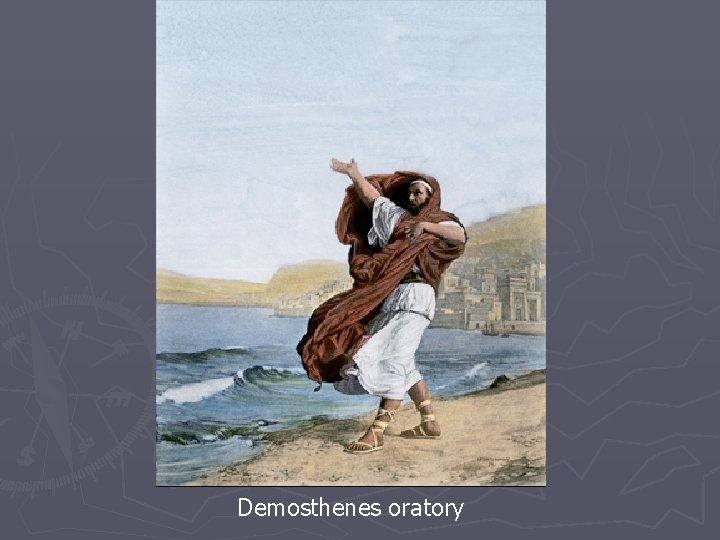
► Some Conquering Greece Greeks worried about Philips plans. ► Demosthenes (dih-MAHS thuh-neez) was one who challenged him. § He was lawyer and one of Athens’ great public speakers who warned them of the impending danger for Greek freedom. "Remember only that Philip is our enemy, that he has long been robbing and insulting us. . . that the future depends on ourselves, and that unless we are willing to fight him there we shall perhaps be forced to fight here. . . You need not speculate [guess] about the future except to assure yourselves that it will be disastrous unless you face the facts and are willing to do your duty. “ —Demosthenes, "The First Philippic" in Orations of Demosthenes
Demosthenes oratory
► By Conquering Greece the time they united to take on Philip it was too late. § The Athenians united with Thebes and other free city-states to battle Philip’s army but could not stop his invasion. § In 338 B. C. The Greeks and the Macedonians clashed in one last major battle. § At the Battle of Chaeronea (kehr-uh-NEE-uh) Philip’s army crushed the Greeks, setting him up to rule over most of Greece.
► After Alexander Takes Over conquering Greece, Philip had hoped to go to war with the Persian Empire but he is killed. ► His son Alexander is now king. § Philip prepared Alexander for this role however. § Alexander was only 20 he was king, but when he was 16 he was already a commander in the Macedonian army and has quickly won the respect of his soldiers. ►They ► After admired him for his bravery and military skill. his father’s death, he was prepared to invade the Persian Empire.
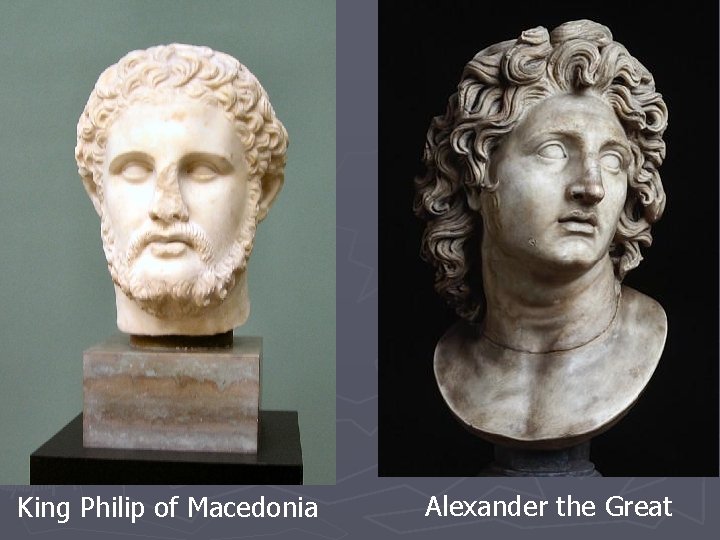
King Philip of Macedonia Alexander the Great
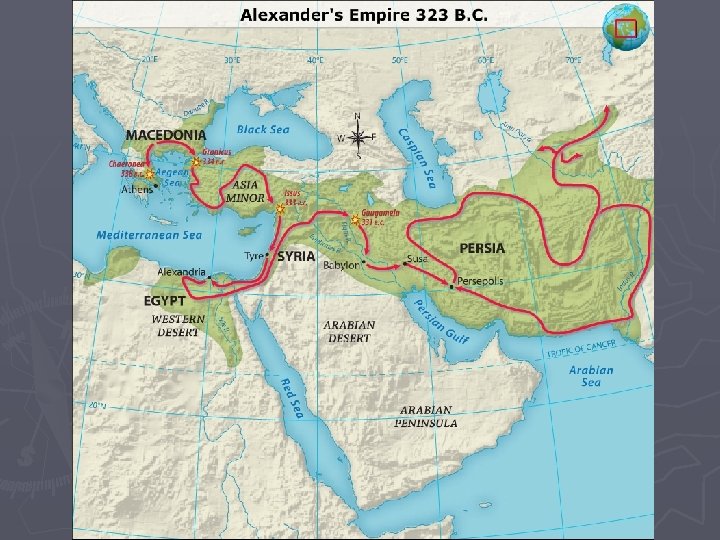
► Alexander War with Persia led about 40, 000 Macedonian and Greek soldiers into Asia Minor in 334 B. C. ► The goal was to take down the Persian Army, one of the strongest armies in the world. ► Alexander’s cavalry (soldiers on horseback) were the stronger ones. ► They fought a battle at Granicus, in what today is Northwestern Turkey. § Alexander’s cavalry defeated the Persian forces and continued to march across Asia Minor, freeing Greek city -states that had been under Persian rule.
War with Persia ► In November 333 B. C. , a year and half after Granicus, The next major battle is fought against the Persians at Issus (IH-suhs), in Syria. § Alexander’s military skill earned him another victory, forcing the Persian king Darius III to flee from Issus. ►He chose not to pursue Darius III and instead moved along the Mediterranean coast. ► Earlier in 331 B. C. , he conquered Egypt and built a city named Alexandria after himself. § As a center of business and trade it became one of the most important cities of the ancient world and remains so to this day.
War with Persia ► In November 333 B. C. , a year and half after Granicus, The next major battle is fought against the Persians at Issus (IH-suhs), in Syria. § Alexander’s military skill earned him another victory, forcing the Persian king Darius III to flee from Issus. ►He chose not to pursue Darius III and instead moved along the Mediterranean coast. ► Earlier in 331 B. C. , he conquered Egypt and built a city named Alexandria after himself. § As a center of business and trade it became one of the most important cities of the ancient world and remains so to this day.
► In War with Persia late 331 B. C. , Alexander’s army headed back north. § He turns his gaze eastward and decides its time to invade Mesopotamia, which is currently controlled by the Persians. § He obliterates Darius’ forces at Gaugamela (gaw -guh-MEE-luk) near the Tigris River. ► After this win, he proceeds to take over the rest of the Persian Empire. ► He did not stop at conquering only Persia.
► In War with Persia 327 B. C. , he made his way to into northwestern India where he fought plenty of bloody battles. § His soldiers grew tired of the fighting and refused to go any farther. § Alexander agreed to return home with his troops. ► On the way back they ended up crossing a desert through what is now southern Iran. § He and thirst killed thousands of soldiers. § At one point, a group of soldiers located a small bit of water and scooped it up in a helmet to give to Alexander.
► Alexander War with Persia took the water and in front of all his troops poured the water on the ground. § He refused to drink water when the rest of his troops would continue to remain thirsty. ► In 323 B. C. , Alexander returned to Babylon, a Persian city that was now under his control. § It was here, that the hardships of the journey took its toll. § Suffering from wounds and worn out be fever, Alexander died at the age of 32.
Alexander’s Legacy ► Alexander has been immortalized as a great general who feared nothing and rode into battle ahead of his soldiers and into unknown lands. § They key to this may have been his early education. § He read Greek epics and his role model was Homer’s warrior-hero Achilles. Now, he is often referred to as Alexander the Great. ► His armies extended Greek rule over a vast region. ► § This allowed them to spread Greek language, ideas, art, and architecture throughout southwest Asia and Egypt. ► Alexander’s success marked the beginning of the Hellenistic Era (Hellenistic means “like the Greeks”) § It refers to a time when Greek culture spread to non-Greek peoples that Alexander conquered.
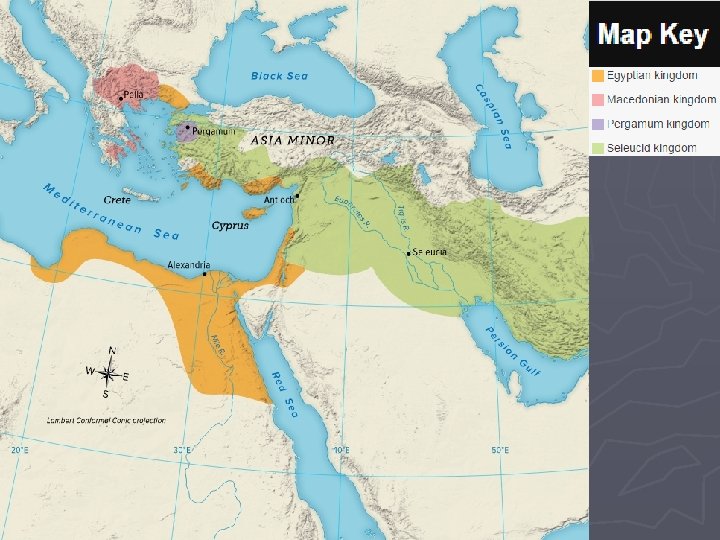
A Divided Empire ► Alexander had planned to unite Macedonians, Greeks, Egyptians, and Asians in his new empire. § The dream of creating one expansive empire did not last, though. § His General divided the empire into the four separate kingdoms of Macedonia, Pergamum (PUHR-guh-muhm), Egypt, and Seleucid (suh. LOO-suhd).
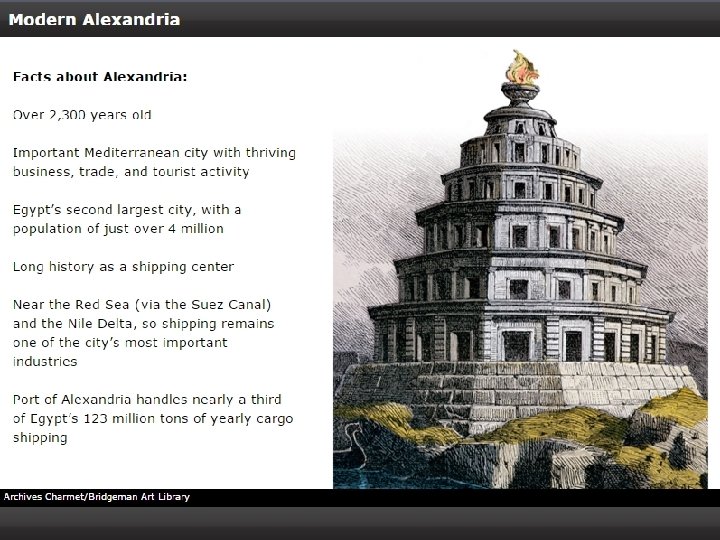
► People The Hellenistic Kings serving in the governments of the Hellenistic kings had to speak Greek. § They preferred to give employment to those who were either Greek or Macedonian which would allow them to keep control of their government. ► By 100 B. C. , Alexandria was the largest city in the Mediterranean world. § It had two excellent harbors and a massive lighthouse. § It stood on a harbor island with a burning flame at the top.
► The Hellenistic Kings library in Alexandria had the largest collection of writings in ancient times. ► The Hellenistic kings also created new cities and military posts. § These new communities needed architects, artists, engineers, and philosophers. § The kings encouraged Greeks and Macedonians to settle into these new locations. § This further spread Greek culture into Egypt and India.