TERMINAL DE GNL SINES SEISMIC STUDY The European


- Slides: 44
TERMINAL DE GNL - SINES SEISMIC STUDY The European Standard EN 1473: 1997, states in item “ 4. 2. 4. Seismology”, that “a site specific earthquake analysis shall be performed” for Liquefied Natural Gas installation and equipment. The study shall report geological and seismic characteristics of the location of the LNG facilities and surrounding region as well as geotectonic information from the location. As a conclusion: The report shall recommend all seismic parameters required for the design.
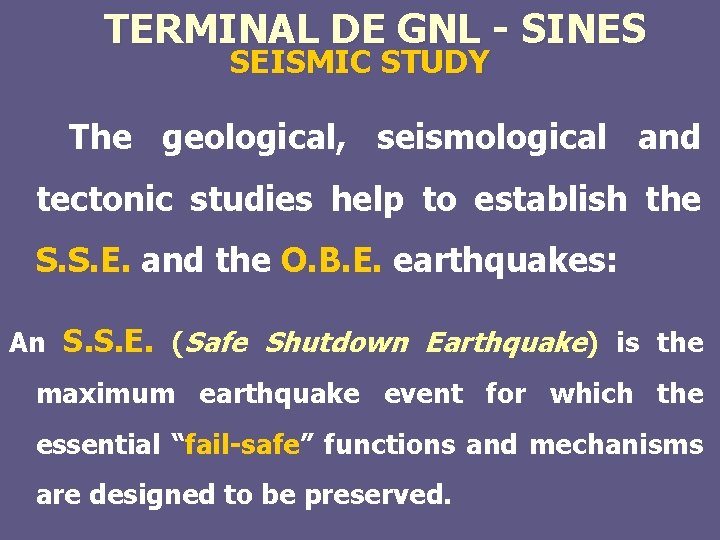
TERMINAL DE GNL - SINES SEISMIC STUDY The geological, seismological and tectonic studies help to establish the S. S. E. and the O. B. E. earthquakes: An S. S. E. (Safe Shutdown Earthquake) is the maximum earthquake event for which the essential “fail-safe” functions and mechanisms are designed to be preserved.
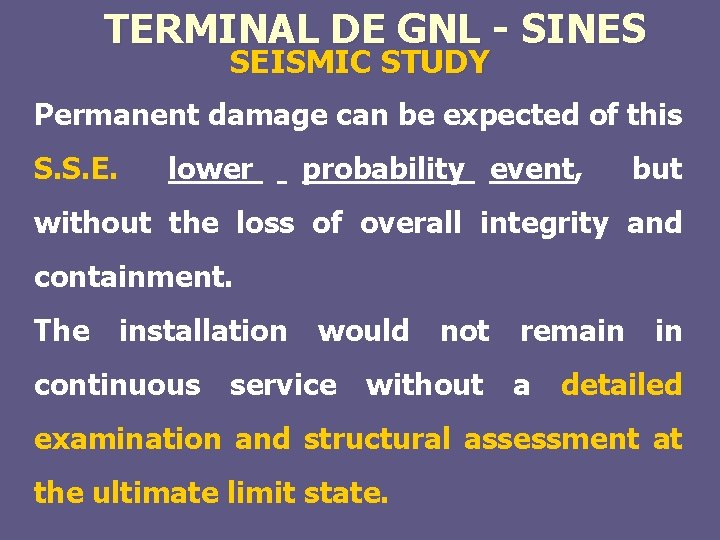
TERMINAL DE GNL - SINES SEISMIC STUDY Permanent damage can be expected of this S. S. E. lower probability event, but without the loss of overall integrity and containment. The installation would not remain in continuous service without a detailed examination and structural assessment at the ultimate limit state.
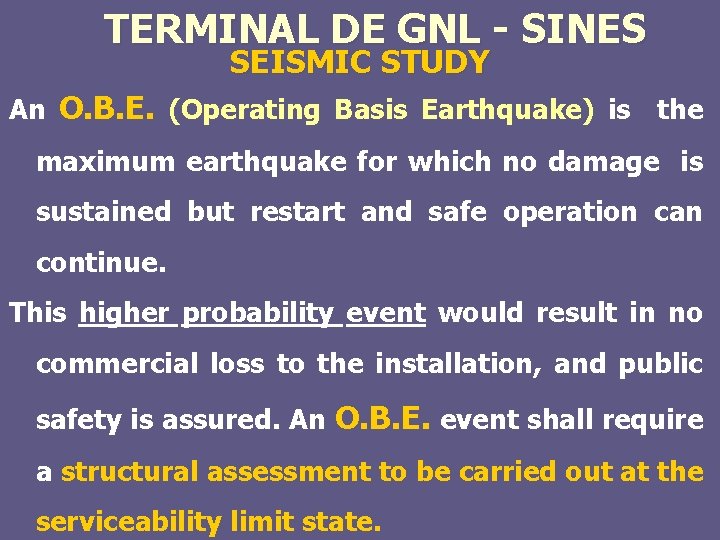
TERMINAL DE GNL - SINES SEISMIC STUDY An O. B. E. (Operating Basis Earthquake) is the maximum earthquake for which no damage is sustained but restart and safe operation can continue. This higher probability event would result in no commercial loss to the installation, and public safety is assured. An O. B. E. event shall require a structural assessment to be carried out at the serviceability limit state.
TERMINAL DE GNL - SINES SEISMIC STUDY These earthquakes shall be established probabilistically, as those that produce ground motions with the mean recurrence as a minimum interval of 10. 000 years for the S. S. E. and 475 years for the O. B. E. , and/or
TERMINAL DE GNL - SINES SEISMIC STUDY Deterministically, assuming that earthquakes which are analogous to maximum historically known earthquakes, are liable to occur in future with an epicenter position, which is the most severe, with regard to its effects in terms of intensity on the site, while remaining compatible with geological and seismic data. In this case, the O. B. E. accelerations shall be one-half those determined for the S. S. E. .
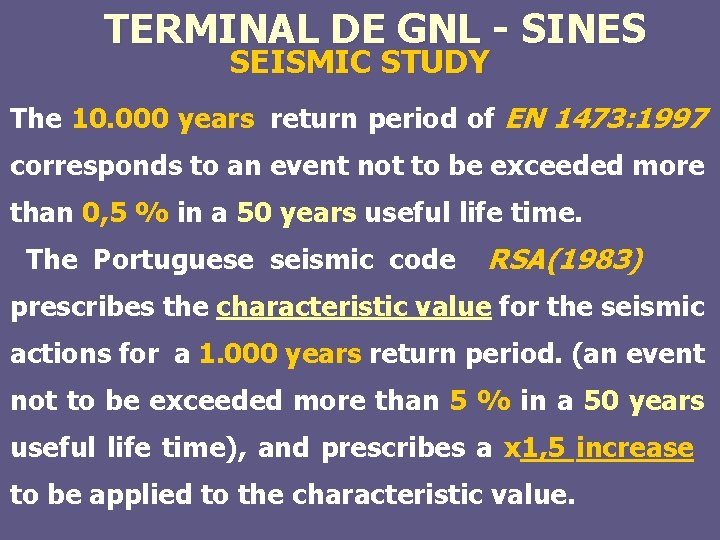
TERMINAL DE GNL - SINES SEISMIC STUDY The 10. 000 years return period of EN 1473: 1997 corresponds to an event not to be exceeded more than 0, 5 % in a 50 years useful life time. The Portuguese seismic code RSA(1983) prescribes the characteristic value for the seismic actions for a 1. 000 years return period. (an event not to be exceeded more than 5 % in a 50 years useful life time), and prescribes a x 1, 5 increase to be applied to the characteristic value.
TERMINAL DE GNL - SINES SEISMIC STUDY SEISMIC DATA. There are very few instrumental seismic data of medium to severe seismic events in Portugal. The used seismic catalogue produced by Paula, A. e Oliveira. C. S. (1997) for the period 33 to 1991, contains 13. 650 seismic events. It was considered that events with Magnitudes less than 4 do not have produced effects in Sines to be considered in the probabilistic studies.
TERMINAL DE GNL - SINES SEISMIC STUDY After eliminating magnitudes less than M=4, the number of events was reduced to 1. 473. To use only independent events, the principal one has to be separated from his after shocks. To simplify the study only the event of highest magnitude in each year was used. With such a criterion the list was reduced to 196 events.
TERMINAL DE GNL - SINES SEISMIC STUDY SEISMOGENIC ZONES. Continental Portugal belongs to the Eurasian Plate (Iberia). Seismic effects are due to the activity of faults: Ø in the continental area (intraplate events) and Ø in the plate boundary zone between Eurasia and Nubia south of Portugal (interplate events).
TERMINAL DE GNL - SINES SEISMIC STUDY The most important effects of interplate earthquakes have not been clearly identified because of complex tectonics of SW Iberia. The zone of the Gorringe Bank, 150 km southeast of S. Vicente Cape, is one of the numerous sources that has been proposed for the 1755, 1 November (magnitude 8, 5 to 8, 8) and for the 28 February 1969, (magnitude 7, 5).
TERMINAL DE GNL - SINES SEISMIC STUDY Magnitude and epicenter location of the 1755 Lisbon earthquake are of very large uncertainty. Taking in account the importance of these factors although the values in the seismic catalogue are M=8, 5 with latitude 36. 00, for the sake of security the values of M=9 (estimated by many authors) with latitude 37. 00 were considered, setting the source much closer to Sines.
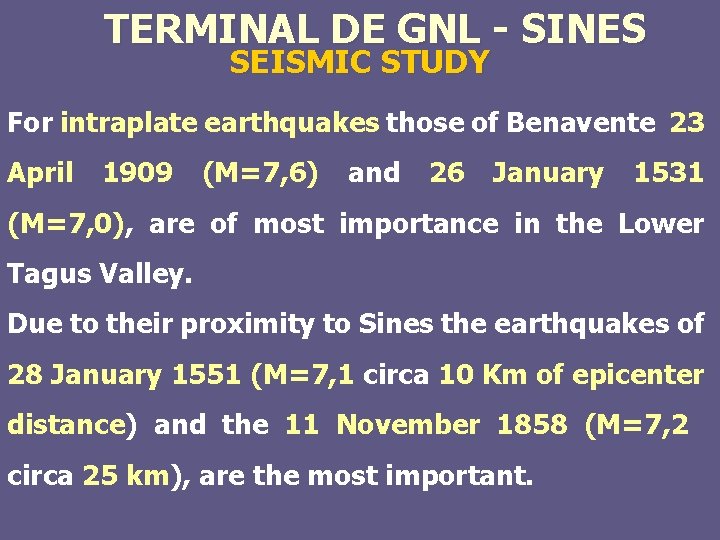
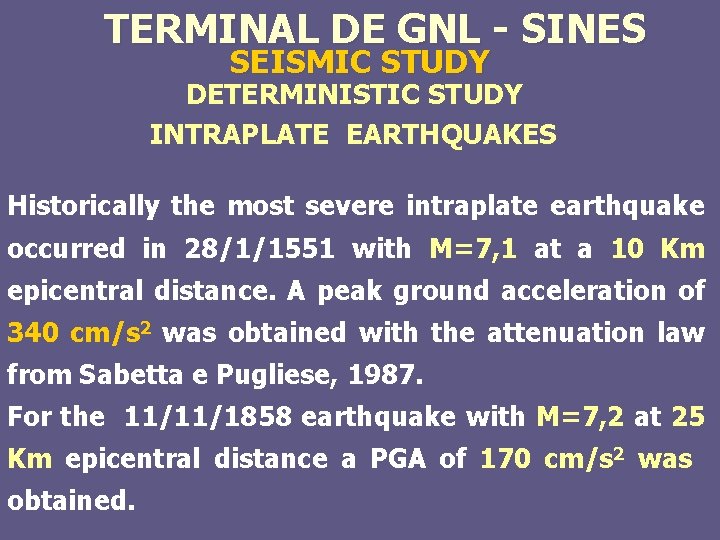
TERMINAL DE GNL - SINES SEISMIC STUDY For intraplate earthquakes those of Benavente 23 April 1909 (M=7, 6) and 26 January 1531 (M=7, 0), are of most importance in the Lower Tagus Valley. Due to their proximity to Sines the earthquakes of 28 January 1551 (M=7, 1 circa 10 Km of epicenter distance) and the 11 November 1858 (M=7, 2 circa 25 km), are the most important.
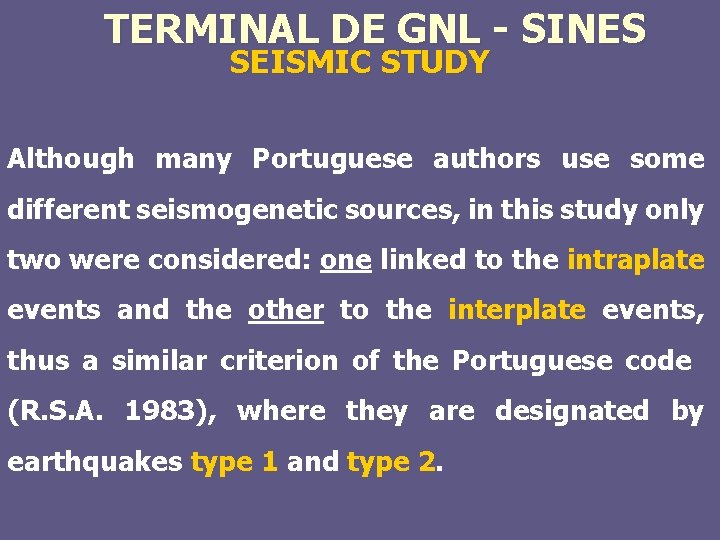
TERMINAL DE GNL - SINES SEISMIC STUDY Although many Portuguese authors use some different seismogenetic sources, in this study only two were considered: one linked to the intraplate events and the other to the interplate events, thus a similar criterion of the Portuguese code (R. S. A. 1983), where they are designated by earthquakes type 1 and type 2.
TERMINAL DE GNL - SINES SEISMIC STUDY ATTENUATION LAWS INTRAPLATE EARTHQUAKES A large number of attenuation laws can be found in literature to be used for the seismic hazard evaluation, in terms of peak ground acceleration, using magnitude and epicentral or focal distances.
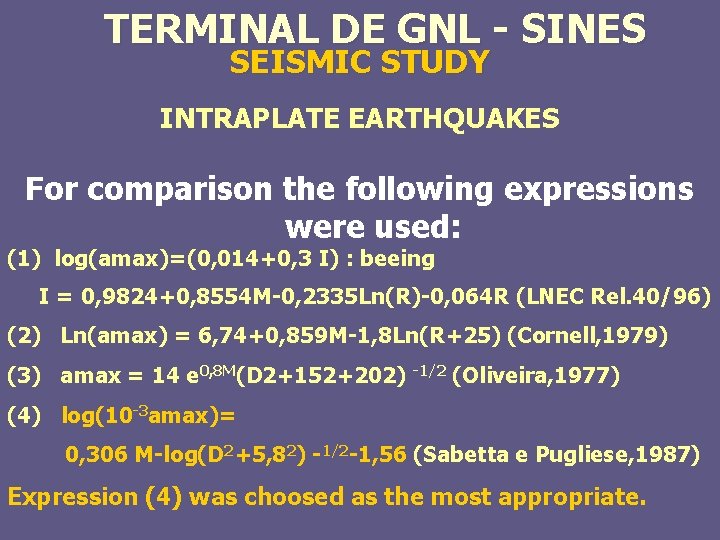
TERMINAL DE GNL - SINES SEISMIC STUDY INTRAPLATE EARTHQUAKES For comparison the following expressions were used: (1) log(amax)=(0, 014+0, 3 I) : beeing I = 0, 9824+0, 8554 M-0, 2335 Ln(R)-0, 064 R (LNEC Rel. 40/96) (2) Ln(amax) = 6, 74+0, 859 M-1, 8 Ln(R+25) (Cornell, 1979) (3) amax = 14 e 0, 8 M(D 2+152+202) -1/2 (Oliveira, 1977) (4) log(10 -3 amax)= 0, 306 M-log(D 2+5, 82) -1/2 -1, 56 (Sabetta e Pugliese, 1987) Expression (4) was choosed as the most appropriate.
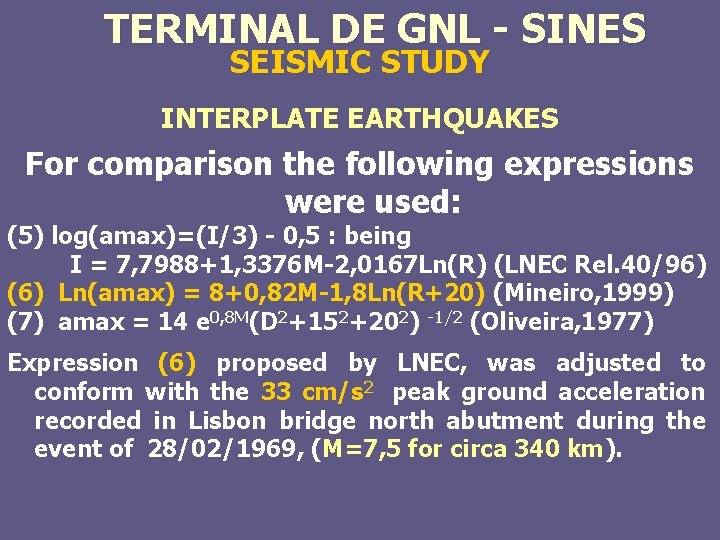
TERMINAL DE GNL - SINES SEISMIC STUDY INTERPLATE EARTHQUAKES For comparison the following expressions were used: (5) log(amax)=(I/3) - 0, 5 : being I = 7, 7988+1, 3376 M-2, 0167 Ln(R) (LNEC Rel. 40/96) (6) Ln(amax) = 8+0, 82 M-1, 8 Ln(R+20) (Mineiro, 1999) (7) amax = 14 e 0, 8 M(D 2+152+202) -1/2 (Oliveira, 1977) Expression (6) proposed by LNEC, was adjusted to conform with the 33 cm/s 2 peak ground acceleration recorded in Lisbon bridge north abutment during the event of 28/02/1969, (M=7, 5 for circa 340 km).
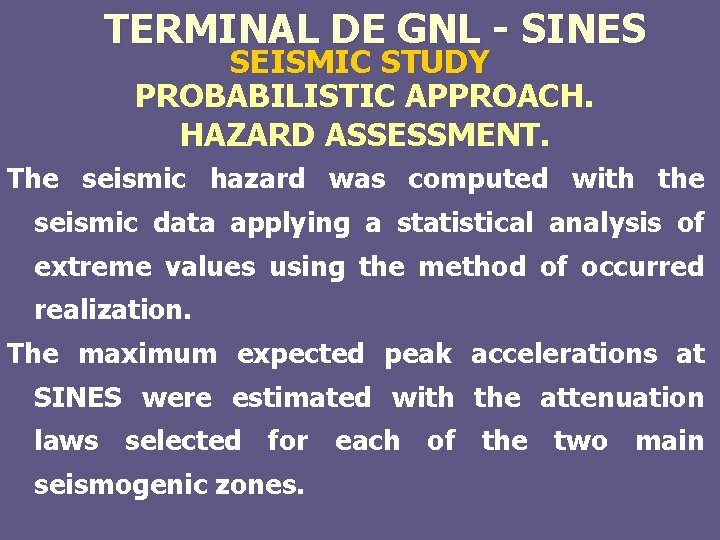
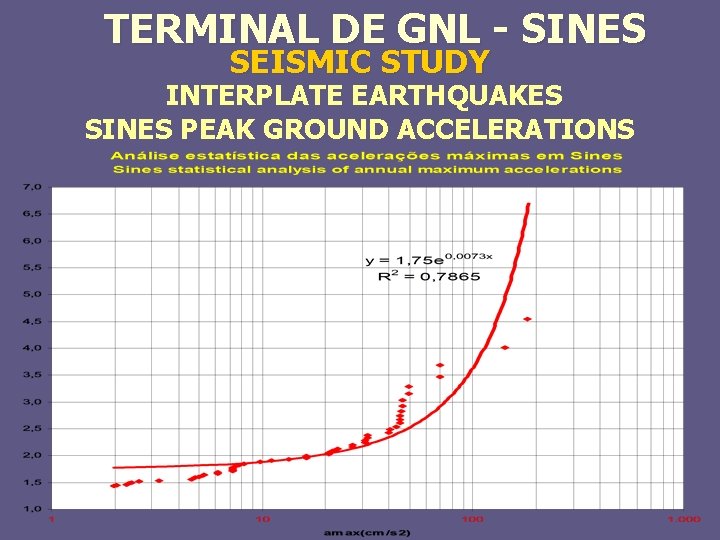
TERMINAL DE GNL - SINES SEISMIC STUDY PROBABILISTIC APPROACH. HAZARD ASSESSMENT. The seismic hazard was computed with the seismic data applying a statistical analysis of extreme values using the method of occurred realization. The maximum expected peak accelerations at SINES were estimated with the attenuation laws selected for each of the two main seismogenic zones.
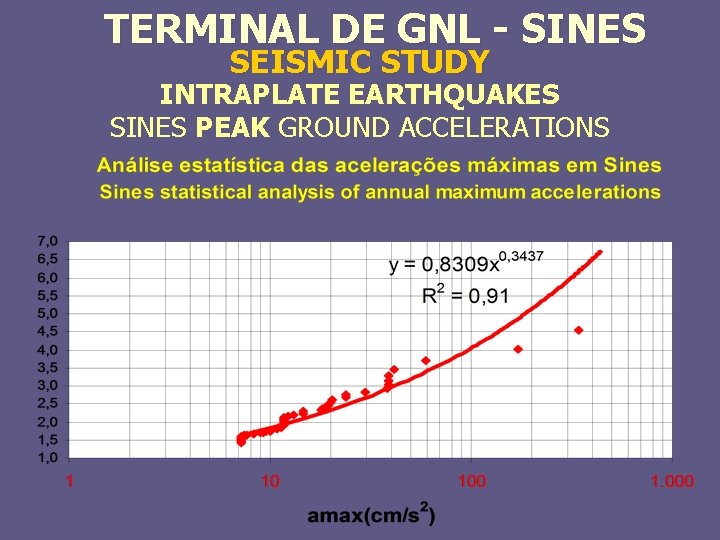
TERMINAL DE GNL - SINES SEISMIC STUDY INTRAPLATE EARTHQUAKES SINES PEAK GROUND ACCELERATIONS
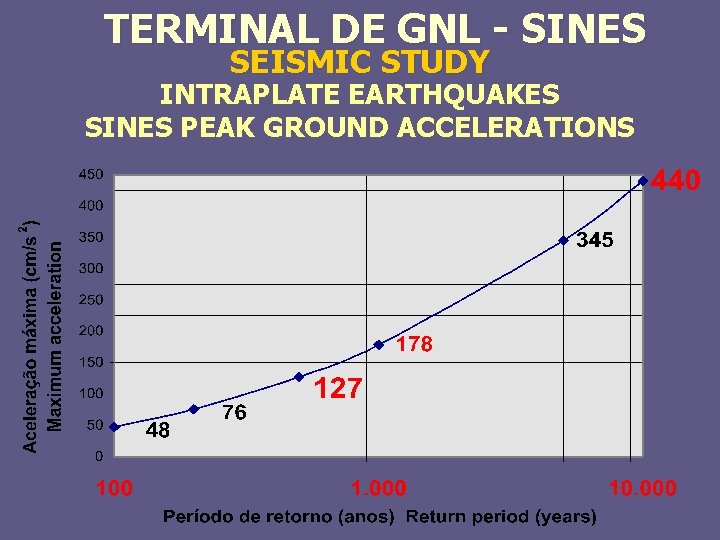
TERMINAL DE GNL - SINES SEISMIC STUDY INTRAPLATE EARTHQUAKES SINES PEAK GROUND ACCELERATIONS
TERMINAL DE GNL - SINES SEISMIC STUDY INTERPLATE EARTHQUAKES SINES PEAK GROUND ACCELERATIONS
TERMINAL DE GNL - SINES SEISMIC STUDY INTERPLATE EARTHQUAKES SINES PEAK GROUND ACCELERATIONS
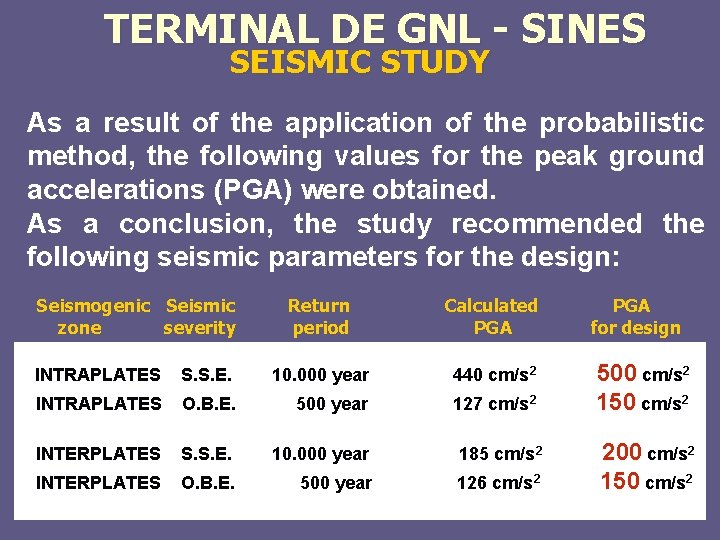
TERMINAL DE GNL - SINES SEISMIC STUDY As a result of the application of the probabilistic method, the following values for the peak ground accelerations (PGA) were obtained. As a conclusion, the study recommended the following seismic parameters for the design: Seismogenic Seismic zone severity Return period Calculated PGA INTRAPLATES S. S. E. 10. 000 year 440 cm/s 2 INTRAPLATES O. B. E. 500 year 127 cm/s 2 INTERPLATES S. S. E. 10. 000 year 185 cm/s 2 INTERPLATES O. B. E. 500 year 126 cm/s 2 PGA for design 500 cm/s 2 150 cm/s 2 200 cm/s 2 150 cm/s 2
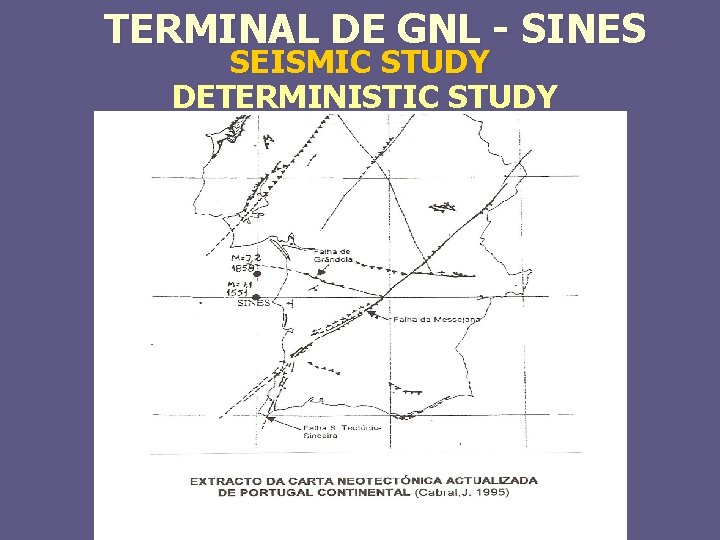
TERMINAL DE GNL - SINES SEISMIC STUDY DETERMINISTIC STUDY The regional Seismotectonic study detected the following seismic faults: Grândola, Messejana (Odemira-Ávila) and the fracture alignment S. Teotónio-Aljezur-Sinceira. These faults have been considered as active on the region within 80 km from the Sines site. Next slide shows the extract of the Carta Neotectónica of Portugal Continental reviewed by Cabral, J. (1995) showing the active faults.
TERMINAL DE GNL - SINES SEISMIC STUDY DETERMINISTIC STUDY
TERMINAL DE GNL - SINES SEISMIC STUDY DETERMINISTIC STUDY INTRAPLATE EARTHQUAKES Historically the most severe intraplate earthquake occurred in 28/1/1551 with M=7, 1 at a 10 Km epicentral distance. A peak ground acceleration of 340 cm/s 2 was obtained with the attenuation law from Sabetta e Pugliese, 1987. For the 11/11/1858 earthquake with M=7, 2 at 25 Km epicentral distance a PGA of 170 cm/s 2 was obtained.
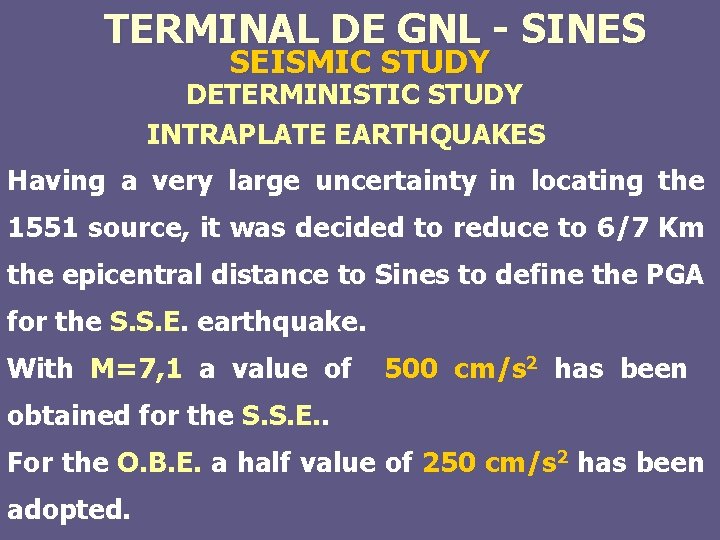
TERMINAL DE GNL - SINES SEISMIC STUDY DETERMINISTIC STUDY INTRAPLATE EARTHQUAKES Having a very large uncertainty in locating the 1551 source, it was decided to reduce to 6/7 Km the epicentral distance to Sines to define the PGA for the S. S. E. earthquake. With M=7, 1 a value of 500 cm/s 2 has been obtained for the S. S. E. . For the O. B. E. a half value of 250 cm/s 2 has been adopted.
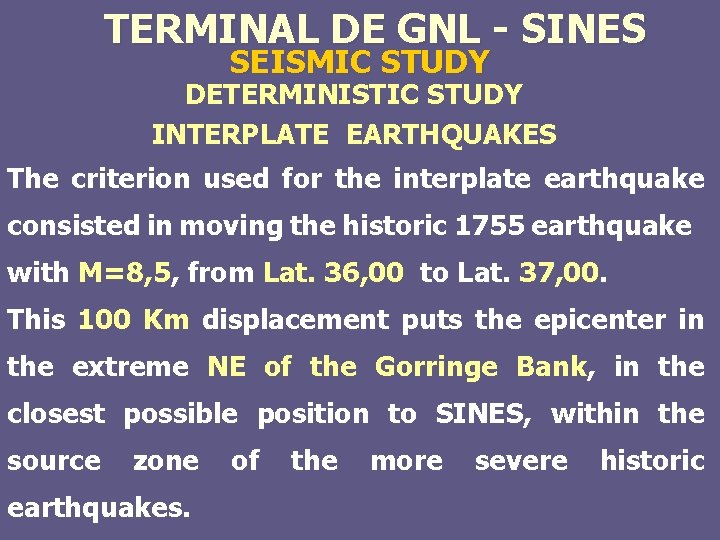
TERMINAL DE GNL - SINES SEISMIC STUDY DETERMINISTIC STUDY INTERPLATE EARTHQUAKES The criterion used for the interplate earthquake consisted in moving the historic 1755 earthquake with M=8, 5, from Lat. 36, 00 to Lat. 37, 00. This 100 Km displacement puts the epicenter in the extreme NE of the Gorringe Bank, in the closest possible position to SINES, within the source zone earthquakes. of the more severe historic
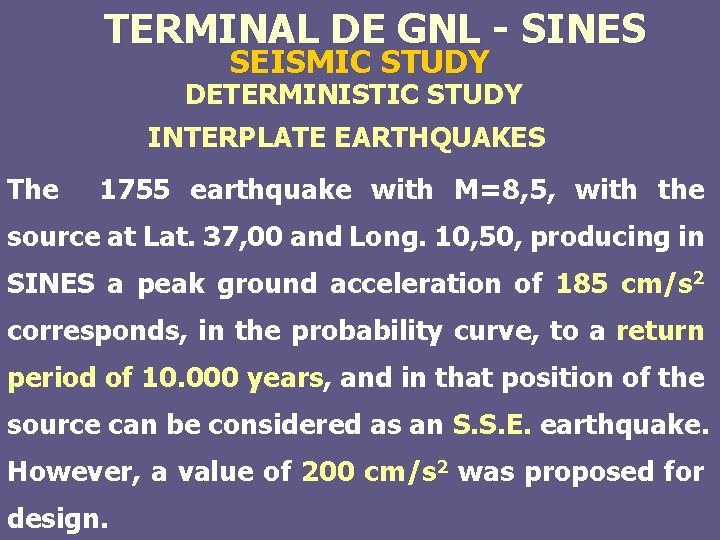
TERMINAL DE GNL - SINES SEISMIC STUDY DETERMINISTIC STUDY INTERPLATE EARTHQUAKES The 1755 earthquake with M=8, 5, with the source at Lat. 37, 00 and Long. 10, 50, producing in SINES a peak ground acceleration of 185 cm/s 2 corresponds, in the probability curve, to a return period of 10. 000 years, and in that position of the source can be considered as an S. S. E. earthquake. However, a value of 200 cm/s 2 was proposed for design.
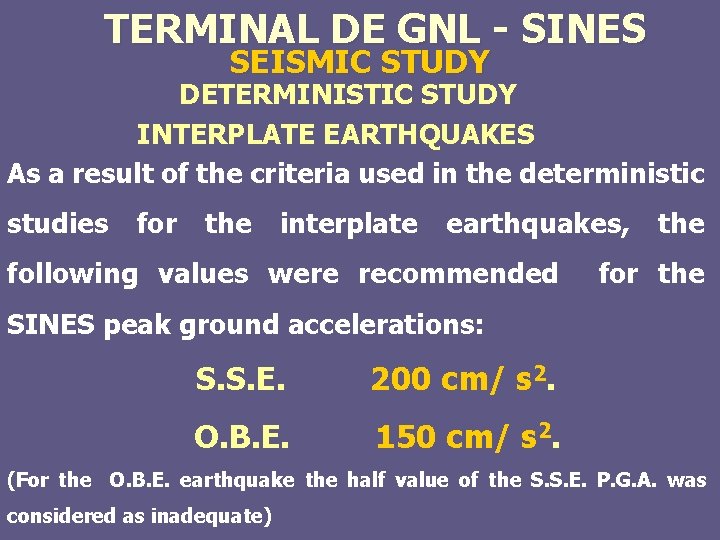
TERMINAL DE GNL - SINES SEISMIC STUDY DETERMINISTIC STUDY INTERPLATE EARTHQUAKES As a result of the criteria used in the deterministic studies for the interplate earthquakes, following values were recommended the for the SINES peak ground accelerations: S. S. E. 200 cm/ s 2. O. B. E. 150 cm/ s 2. (For the O. B. E. earthquake the half value of the S. S. E. P. G. A. was considered as inadequate)
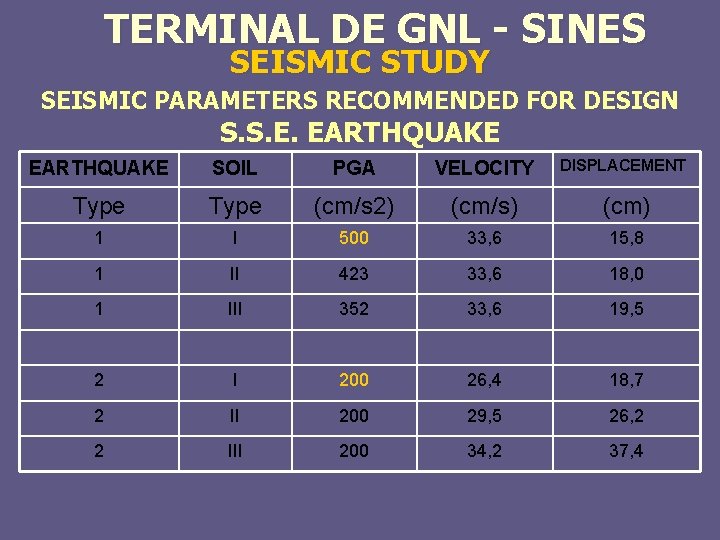
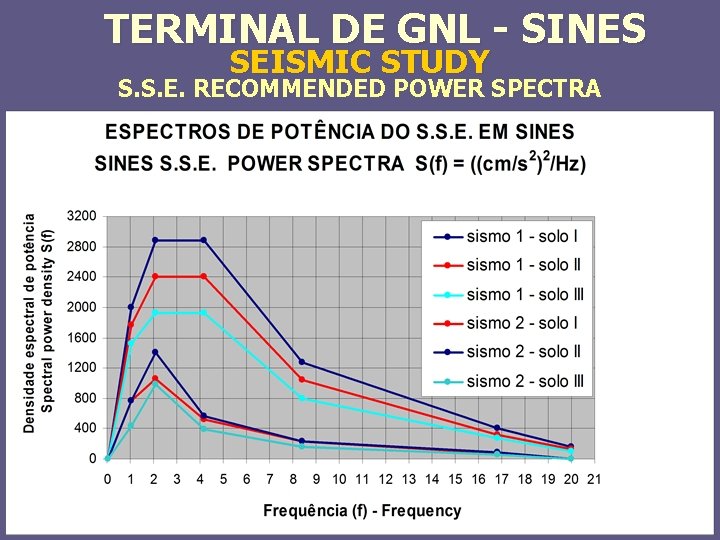
TERMINAL DE GNL - SINES SEISMIC STUDY SEISMIC PARAMETERS RECOMMENDED FOR DESIGN S. S. E. EARTHQUAKE SOIL PGA VELOCITY DISPLACEMENT Type (cm/s 2) (cm/s) (cm) 1 I 500 33, 6 15, 8 1 II 423 33, 6 18, 0 1 III 352 33, 6 19, 5 2 I 200 26, 4 18, 7 2 II 200 29, 5 26, 2 2 III 200 34, 2 37, 4
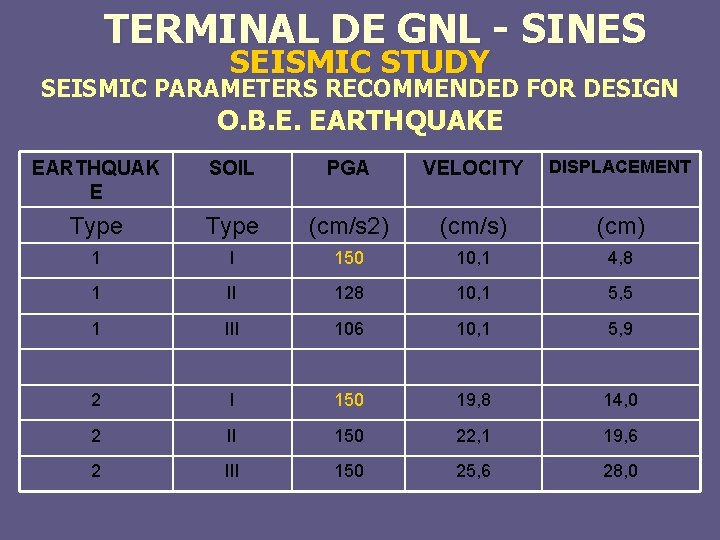
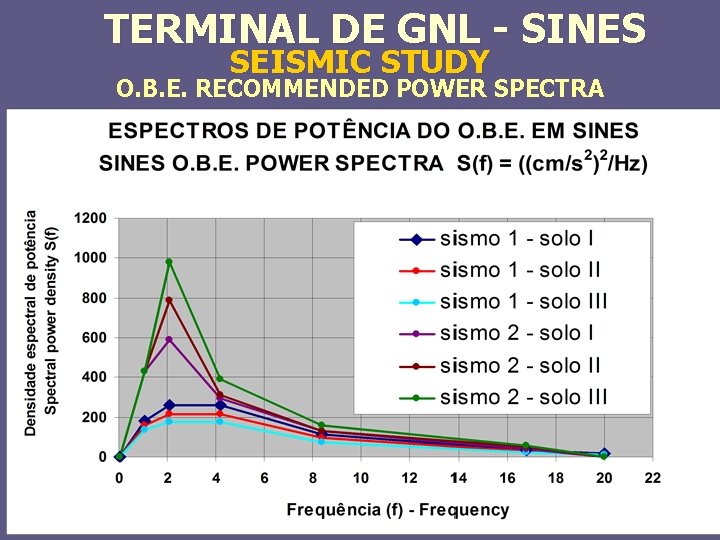
TERMINAL DE GNL - SINES SEISMIC STUDY SEISMIC PARAMETERS RECOMMENDED FOR DESIGN O. B. E. EARTHQUAKE EARTHQUAK E SOIL PGA VELOCITY DISPLACEMENT Type (cm/s 2) (cm/s) (cm) 1 I 150 10, 1 4, 8 1 II 128 10, 1 5, 5 1 III 106 10, 1 5, 9 2 I 150 19, 8 14, 0 2 II 150 22, 1 19, 6 2 III 150 25, 6 28, 0
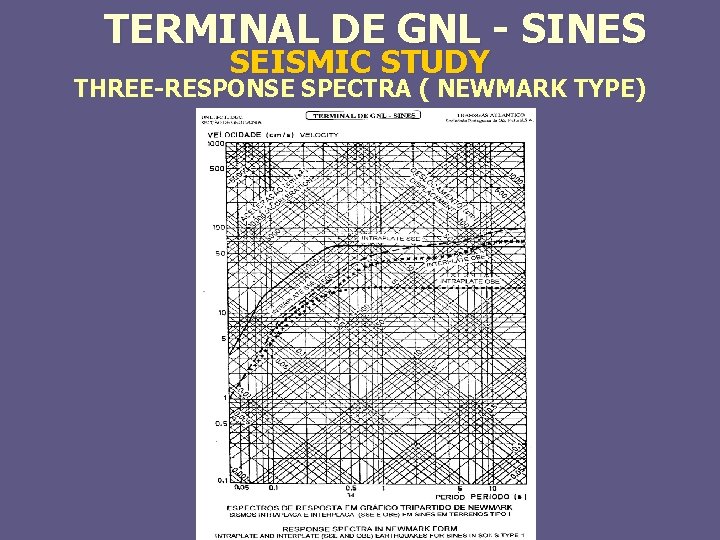
TERMINAL DE GNL - SINES SEISMIC STUDY THREE-RESPONSE SPECTRA ( NEWMARK TYPE)
TERMINAL DE GNL - SINES SEISMIC STUDY S. S. E. RECOMMENDED POWER SPECTRA
TERMINAL DE GNL - SINES SEISMIC STUDY O. B. E. RECOMMENDED POWER SPECTRA
TERMINAL DE GNL - SINES SEISMIC STUDY ACCELEROGRAMS AND RESPONSE SPECTRA A CD-ROM exists with more than one hundred accelerograms fitting the portuguese code for type 1 (Intraplate earthquakes), and type 2 (interplate earthquakes) for different types of soils (I, II e III). The code accelerograms and response spectra are related to a return period of 1. 000 years. To be used in SINES the ordinates must be multiplied by the following factors:
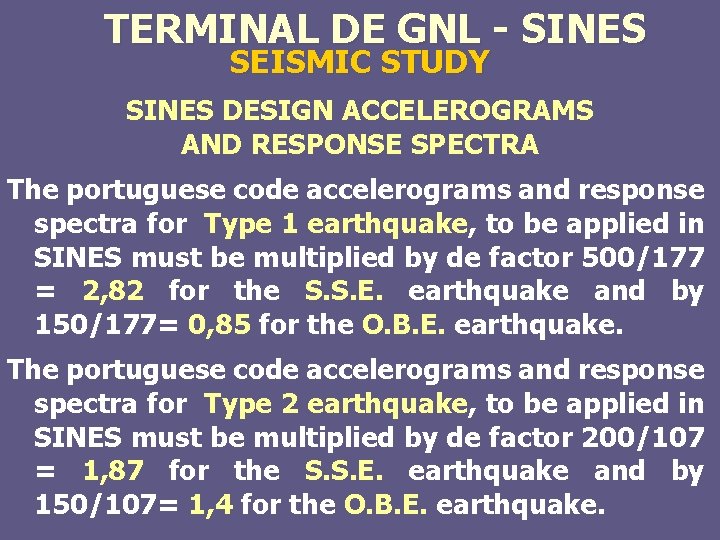
TERMINAL DE GNL - SINES SEISMIC STUDY SINES DESIGN ACCELEROGRAMS AND RESPONSE SPECTRA The portuguese code accelerograms and response spectra for Type 1 earthquake, to be applied in SINES must be multiplied by de factor 500/177 = 2, 82 for the S. S. E. earthquake and by 150/177= 0, 85 for the O. B. E. earthquake. The portuguese code accelerograms and response spectra for Type 2 earthquake, to be applied in SINES must be multiplied by de factor 200/107 = 1, 87 for the S. S. E. earthquake and by 150/107= 1, 4 for the O. B. E. earthquake.
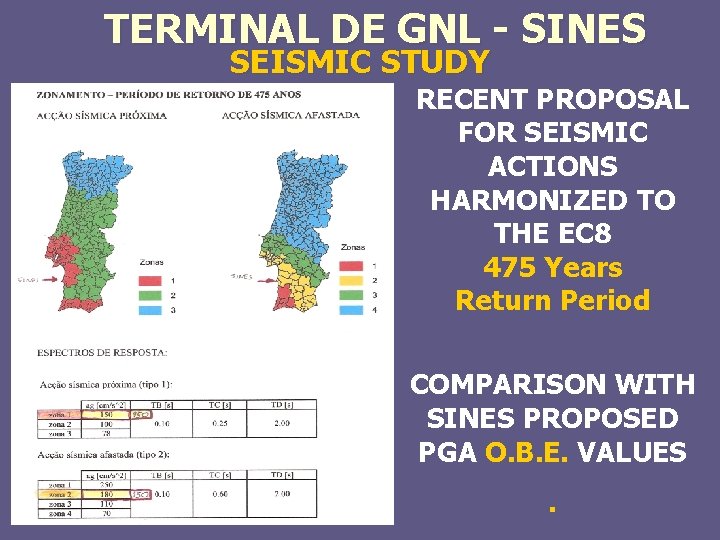
TERMINAL DE GNL - SINES SEISMIC STUDY RECENT PROPOSAL FOR SEISMIC ACTIONS HARMONIZED TO THE EC 8 475 Years Return Period COMPARISON WITH SINES PROPOSED PGA O. B. E. VALUES.
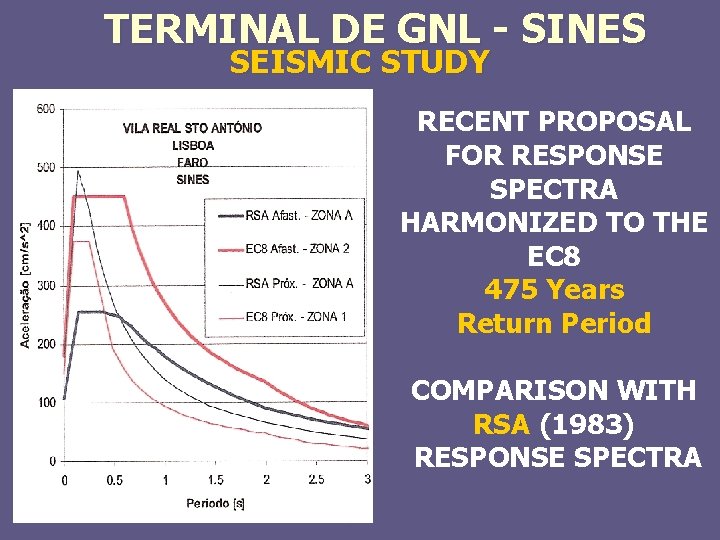
TERMINAL DE GNL - SINES SEISMIC STUDY RECENT PROPOSAL FOR RESPONSE SPECTRA HARMONIZED TO THE EC 8 475 Years Return Period COMPARISON WITH RSA (1983) RESPONSE SPECTRA
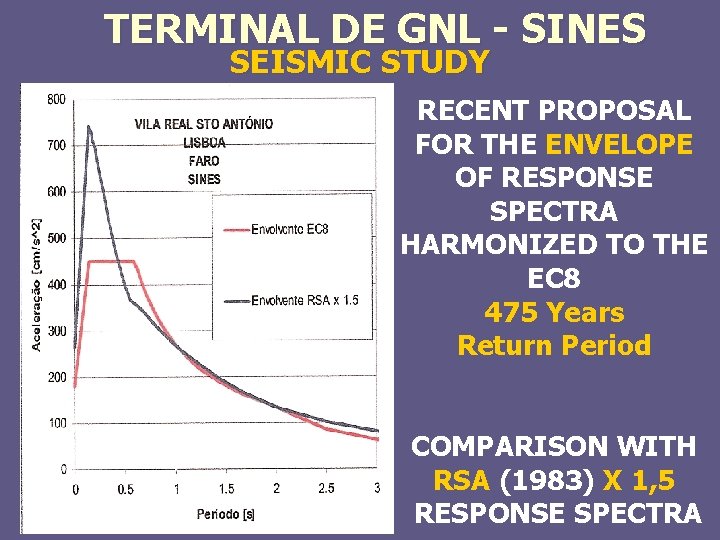
TERMINAL DE GNL - SINES SEISMIC STUDY RECENT PROPOSAL FOR THE ENVELOPE OF RESPONSE SPECTRA HARMONIZED TO THE EC 8 475 Years Return Period COMPARISON WITH RSA (1983) X 1, 5 RESPONSE SPECTRA
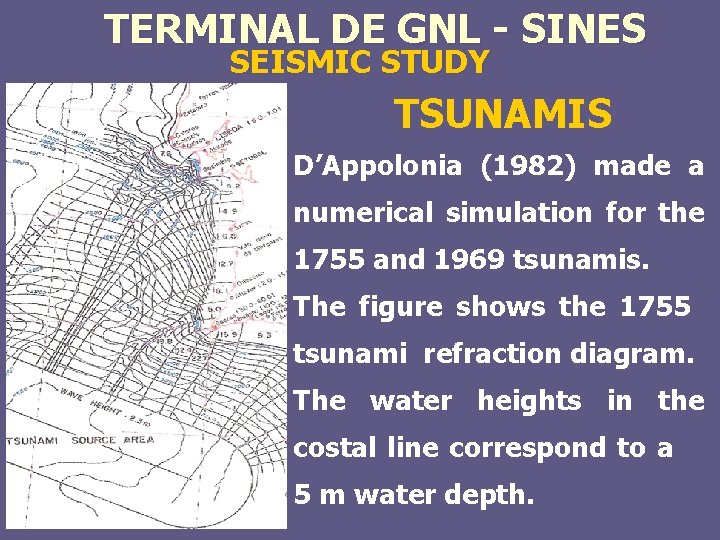
TERMINAL DE GNL - SINES SEISMIC STUDY TSUNAMIS D’Appolonia (1982) made a numerical simulation for the 1755 and 1969 tsunamis. The figure shows the 1755 tsunami refraction diagram. The water heights in the costal line correspond to a 5 m water depth.
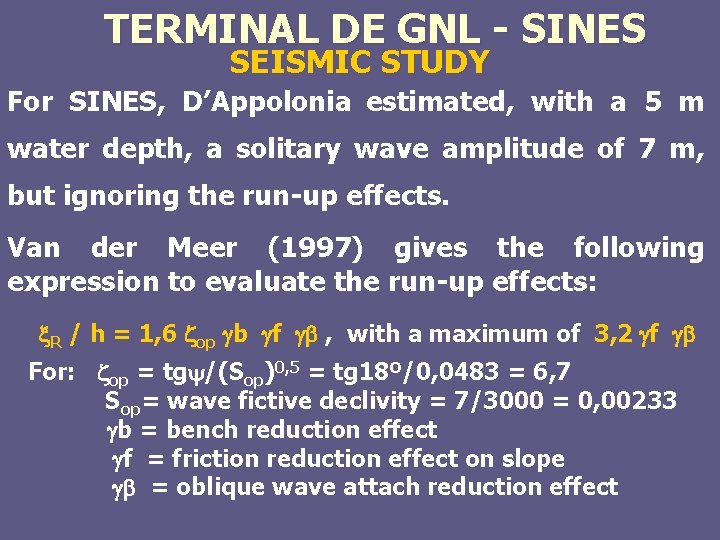
TERMINAL DE GNL - SINES SEISMIC STUDY For SINES, D’Appolonia estimated, with a 5 m water depth, a solitary wave amplitude of 7 m, but ignoring the run-up effects. Van der Meer (1997) gives the following expression to evaluate the run-up effects: R / h = 1, 6 op b f , with a maximum of 3, 2 f For: op = tg /(Sop)0, 5 = tg 18º/0, 0483 = 6, 7 Sop= wave fictive declivity = 7/3000 = 0, 00233 b = bench reduction effect f = friction reduction effect on slope = oblique wave attach reduction effect
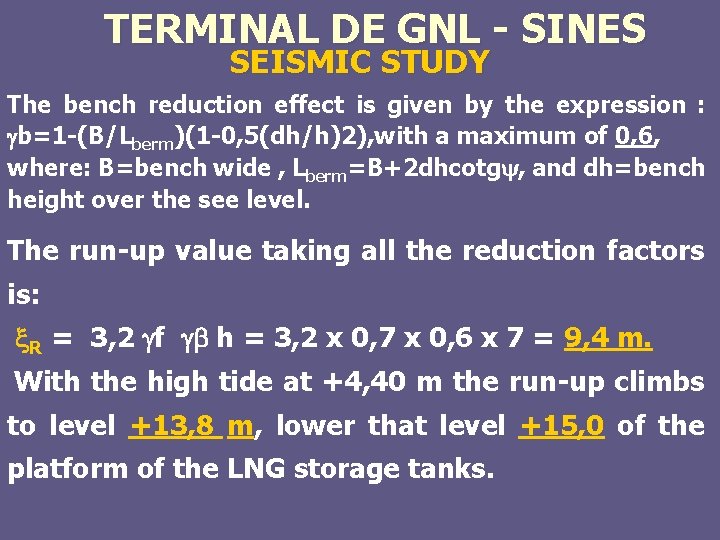
TERMINAL DE GNL - SINES SEISMIC STUDY The bench reduction effect is given by the expression : b=1 -(B/Lberm)(1 -0, 5(dh/h)2), with a maximum of 0, 6, where: B=bench wide , Lberm=B+2 dhcotg , and dh=bench height over the see level. The run-up value taking all the reduction factors is: R = 3, 2 f h = 3, 2 x 0, 7 x 0, 6 x 7 = 9, 4 m. With the high tide at +4, 40 m the run-up climbs to level +13, 8 m, lower that level +15, 0 of the platform of the LNG storage tanks.
TERMINAL DE GNL - SINES SEISMIC STUDY THANK YOU FOR YOUR ATTENTION