Techniques to avoid OHSS and staying out of
- Slides: 64
Techniques to avoid OHSS and staying out of danger Midwest Reproductive Symposium - Nurse Practicum Workshop Chicago, USA June 19 -21, 2014 Frank J Broekmans Professor Reproductive Medicine University Medical Center Utrecht, The Netherlands 30 20
Learning Objectives Understand the pathofysiology of and risk factors of the OHSS Understand the approach of primary prevention: avoid excessive response and/or h. CG Understand the approach in secondary prevention: avoid pregnancy Have knowledge on treatment of the OHSS: avoid hemoconcentration
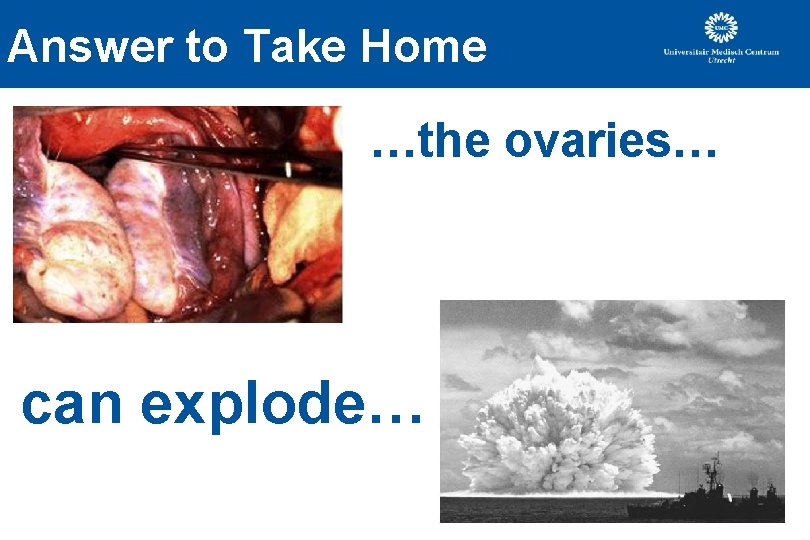
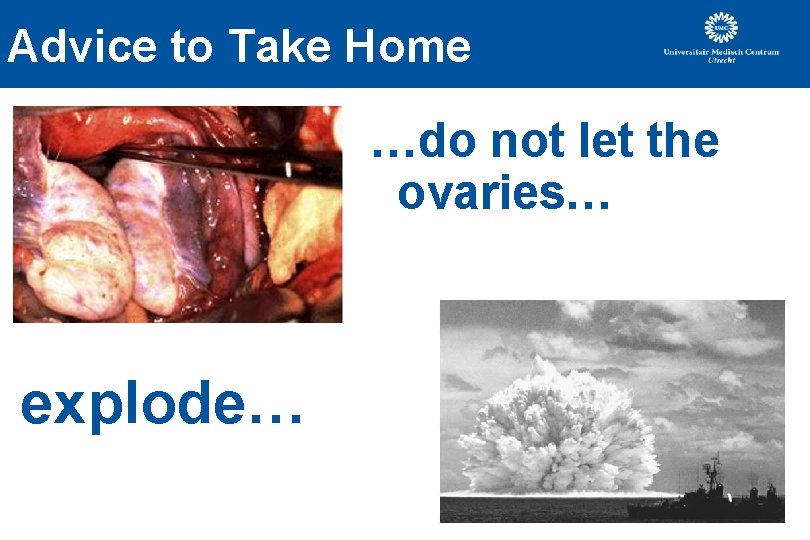
Answer to Take Home …the ovaries… can explode…
OS and the High Responder Agenda 1. 2. 3. 4. 5. 6. Ovarian Physiology OS Backgrounds OS Predicted High Responders OS Actual High Responders OHSS secondary prevention Conclusions and take homers
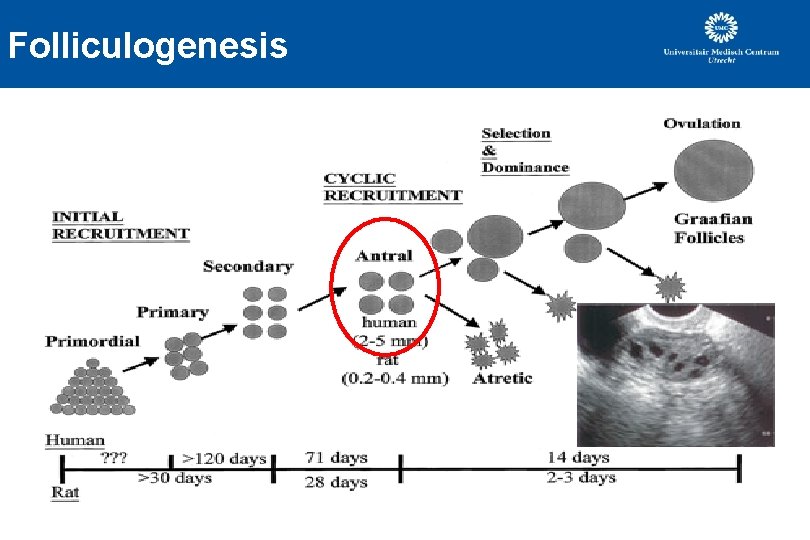
Folliculogenesis
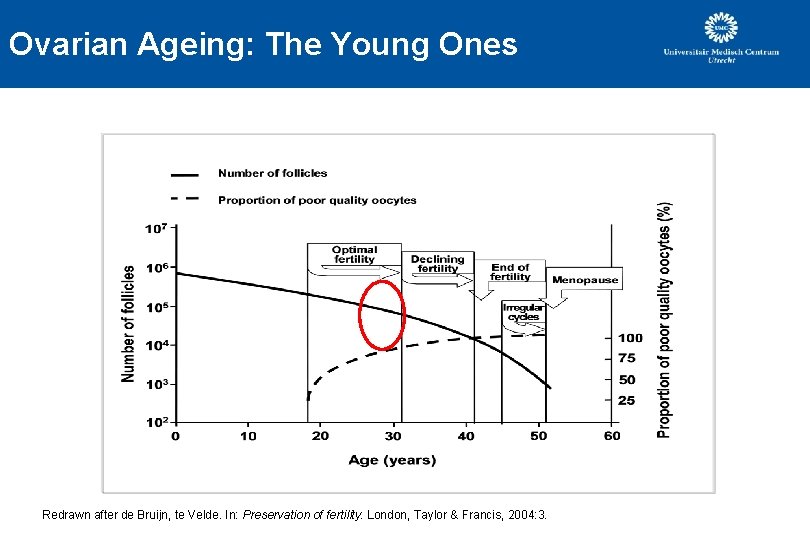
Ovarian Ageing: The Young Ones Redrawn after de Bruijn, te Velde. In: Preservation of fertility. London, Taylor & Francis, 2004: 3.
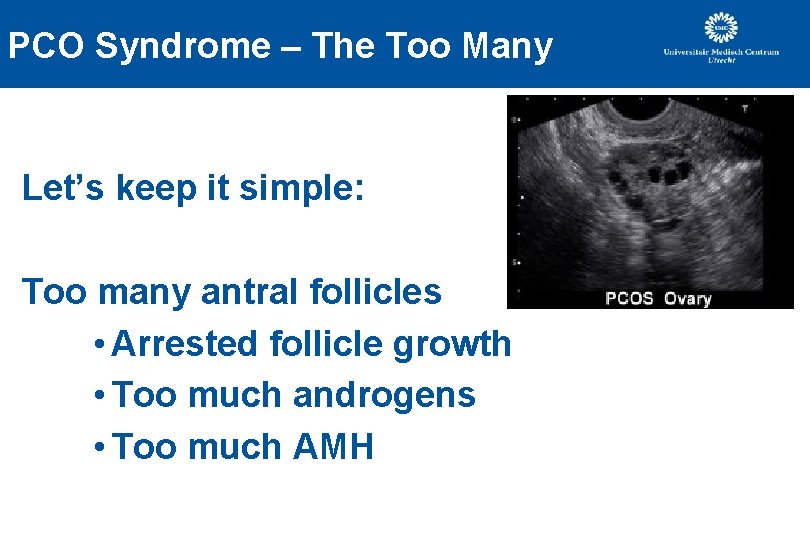
PCO Syndrome – The Too Many Let’s keep it simple: Too many antral follicles • Arrested follicle growth • Too much androgens • Too much AMH
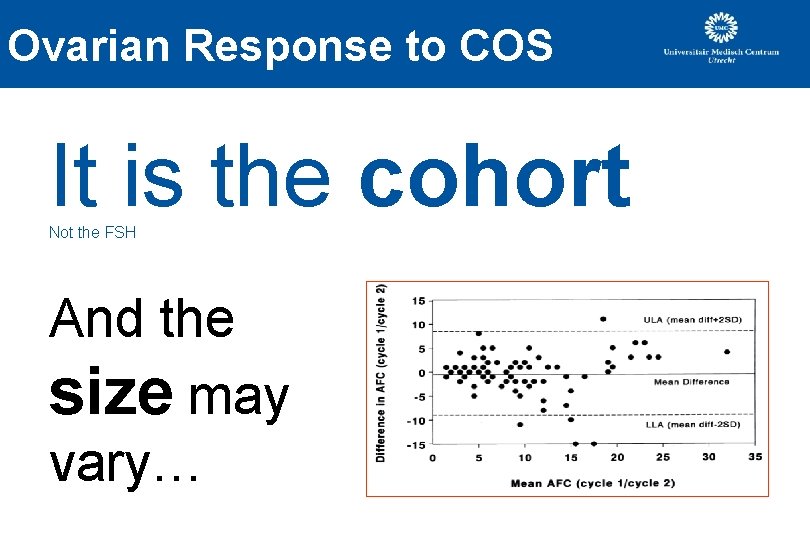
Ovarian Response to COS It is the cohort Not the FSH And the size may vary…
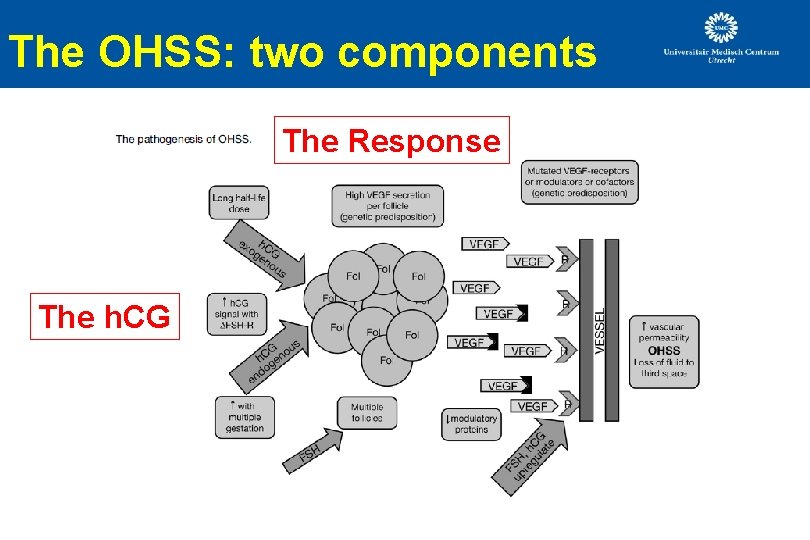
The OHSS: two components The Response The h. CG
OS and the High Responder Agenda 1. 2. 3. 4. 5. 6. Ovarian Physiology OS Backgrounds OS Predicted High Responders OS Actual High Responders OHSS secondary prevention Conclusions and take homers
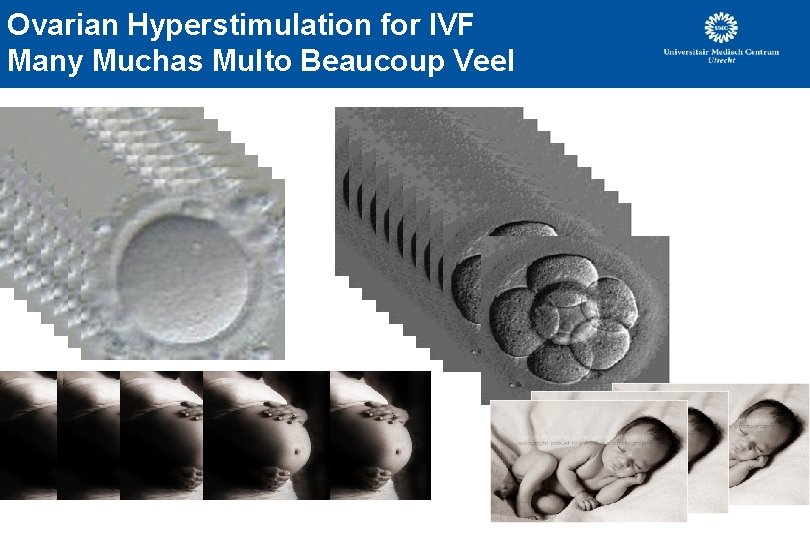
Ovarian Hyperstimulation for IVF Many Muchas Multo Beaucoup Veel
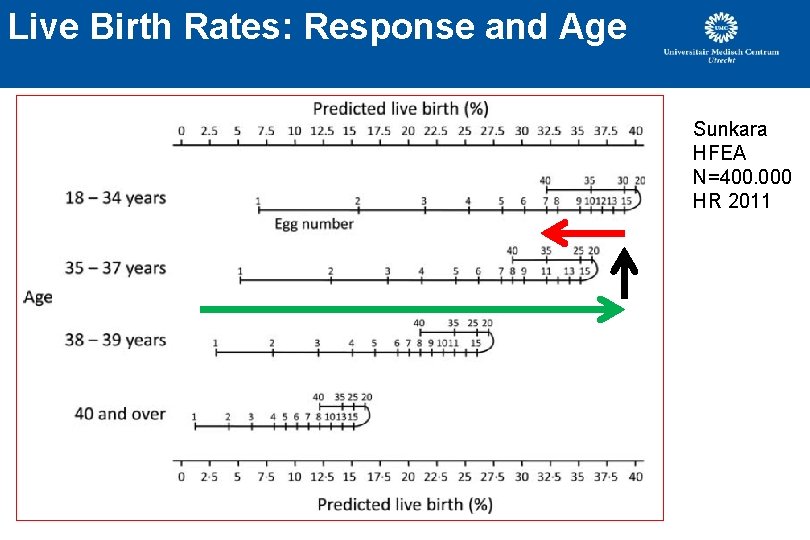
Live Birth Rates: Response and Age Sunkara HFEA N=400. 000 HR 2011
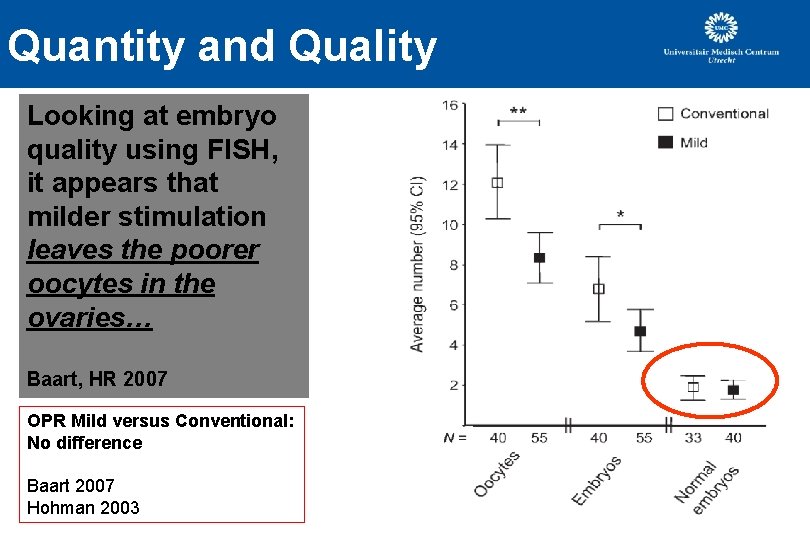
Quantity and Quality Looking at embryo quality using FISH, it appears that milder stimulation leaves the poorer oocytes in the ovaries… Baart, HR 2007 OPR Mild versus Conventional: No difference Baart 2007 Hohman 2003
Ovarian Response to COS It is the cohort and 7 – 15 oocytes is sufficient/optimal
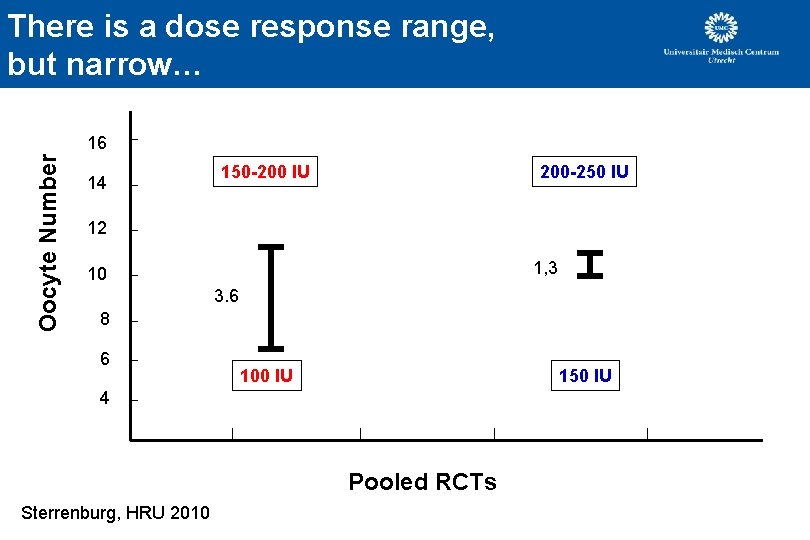
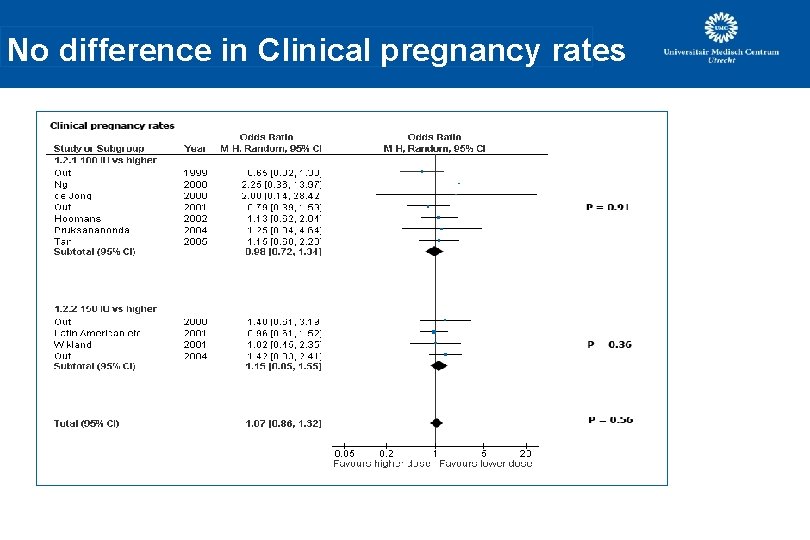
There is a dose response range, but narrow… Oocyte Number 16 14 150 -200 IU 200 -250 IU 12 1, 3 10 3. 6 8 6 100 IU 150 IU 4 Pooled RCTs Sterrenburg, HRU 2010
No difference in Clinical pregnancy rates
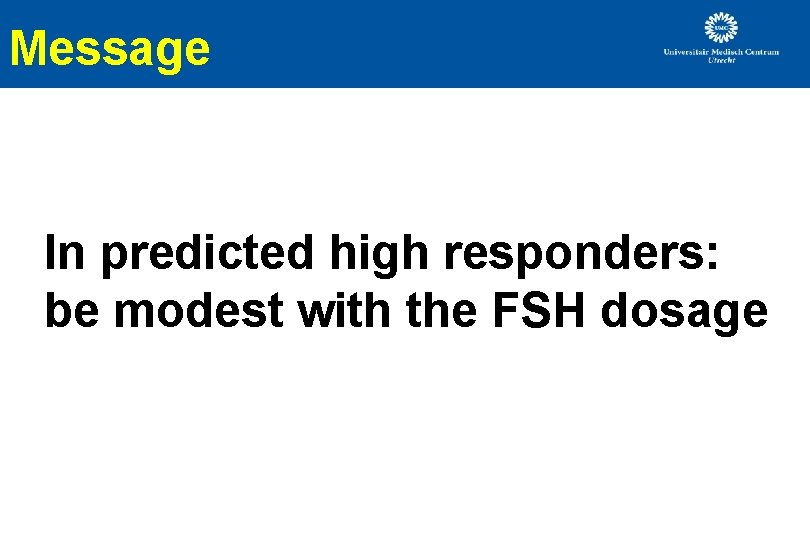
Message In predicted high responders: be modest with the FSH dosage
OS and the High Responder Agenda 1. 2. 3. 4. 5. 6. Ovarian Physiology OS Backgrounds OS Predicted High Responders OS Actual High Responders OHSS secondary prevention Conclusions and take homers
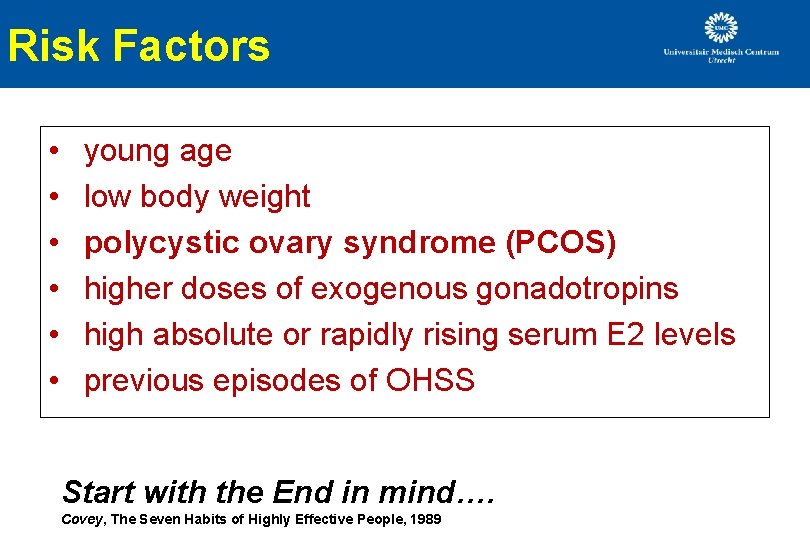
Risk Factors • • • young age low body weight polycystic ovary syndrome (PCOS) higher doses of exogenous gonadotropins high absolute or rapidly rising serum E 2 levels previous episodes of OHSS Start with the End in mind…. Covey, The Seven Habits of Highly Effective People, 1989
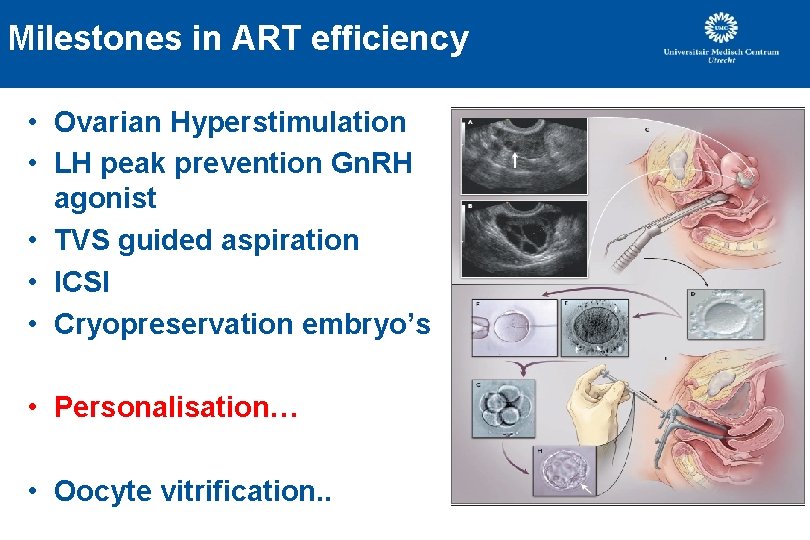
Milestones in ART efficiency • Ovarian Hyperstimulation • LH peak prevention Gn. RH agonist • TVS guided aspiration • ICSI • Cryopreservation embryo’s • Personalisation… • Oocyte vitrification. .
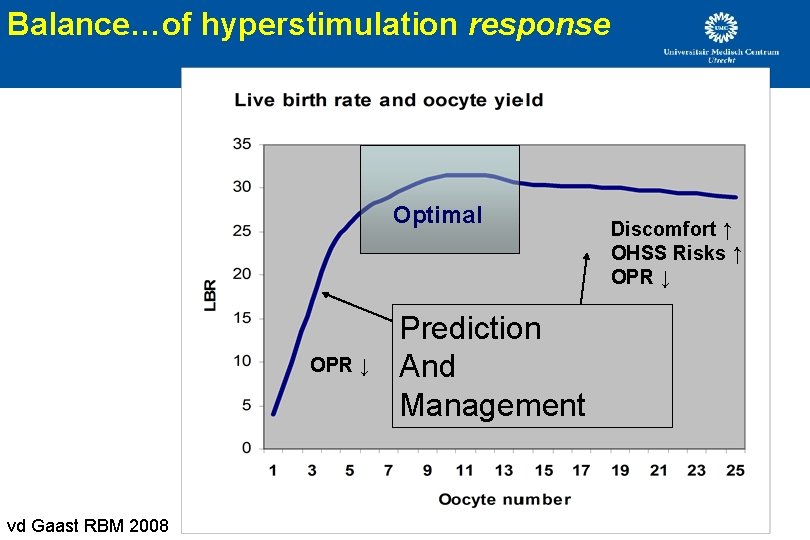
Balance…of hyperstimulation response Optimal OPR ↓ vd Gaast RBM 2008 Prediction And Management Discomfort ↑ OHSS Risks ↑ OPR ↓
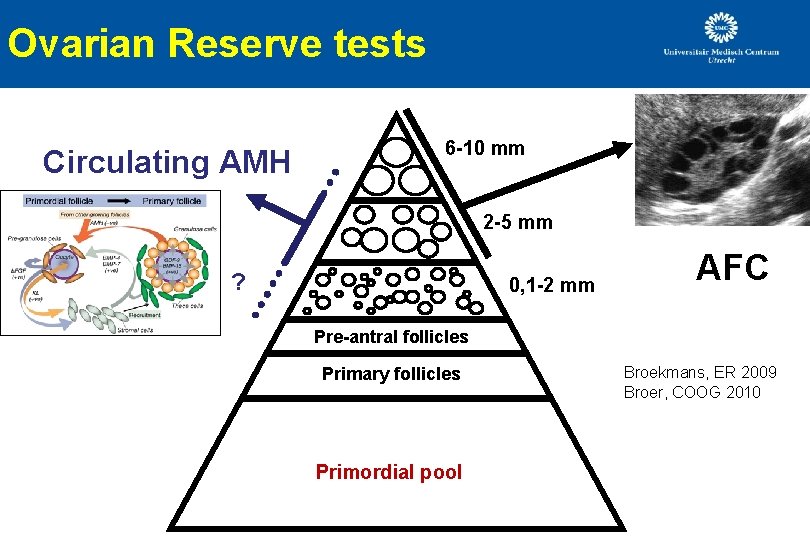
Ovarian Reserve tests Circulating AMH 6 -10 mm 2 -5 mm ? 0, 1 -2 mm AFC Pre-antral follicles Primary follicles Primordial pool Broekmans, ER 2009 Broer, COOG 2010
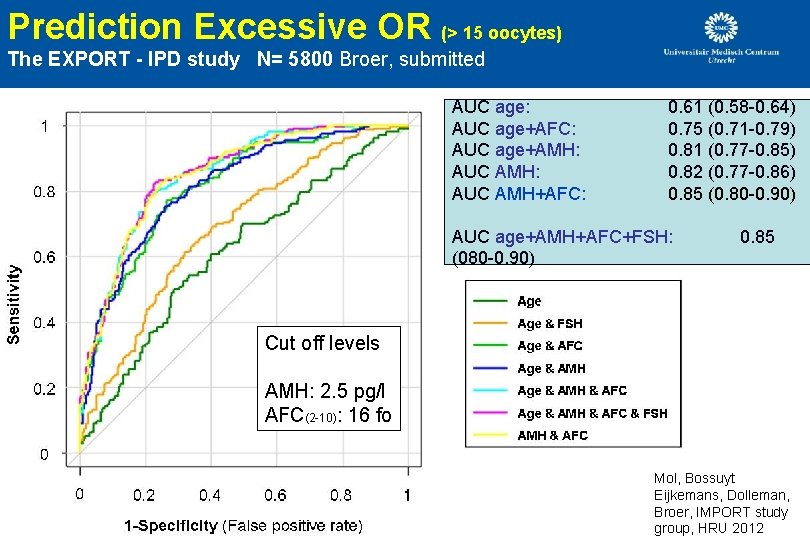
Prediction Excessive OR (> 15 oocytes) The EXPORT - IPD study N= 5800 Broer, submitted AUC age: AUC age+AFC: AUC age+AMH: AUC AMH+AFC: 0. 61 (0. 58 -0. 64) 0. 75 (0. 71 -0. 79) 0. 81 (0. 77 -0. 85) 0. 82 (0. 77 -0. 86) 0. 85 (0. 80 -0. 90) AUC age+AMH+AFC+FSH: (080 -0. 90) 0. 85 Cut off levels AMH: 2. 5 pg/l AFC(2 -10): 16 fo Mol, Bossuyt Eijkemans, Dolleman, Broer, IMPORT study group, HRU 2012
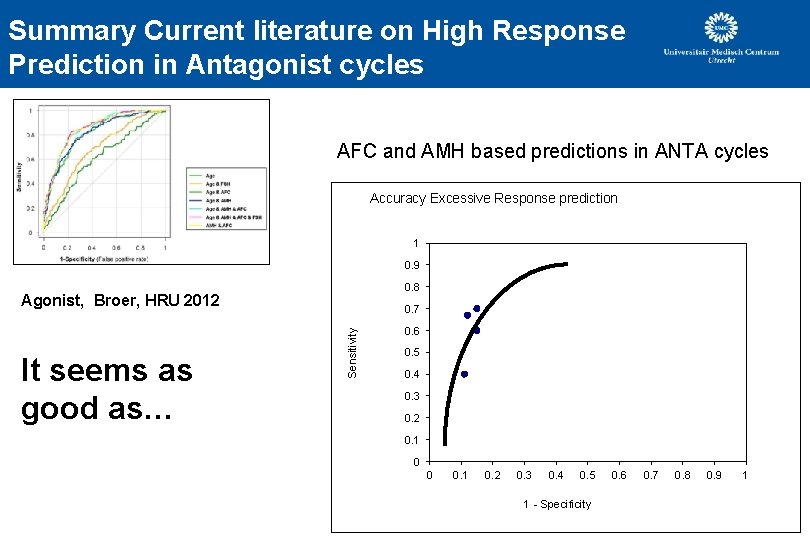
Summary Current literature on High Response Prediction in Antagonist cycles AFC and AMH based predictions in ANTA cycles Accuracy Excessive Response prediction 1 0. 9 0. 8 Agonist, Broer, HRU 2012 Sensitivity It seems as good as… 0. 7 0. 6 0. 5 0. 4 0. 3 0. 2 0. 1 0 0 0. 1 0. 2 0. 3 0. 4 0. 5 1 - Specificity 0. 6 0. 7 0. 8 0. 9 1
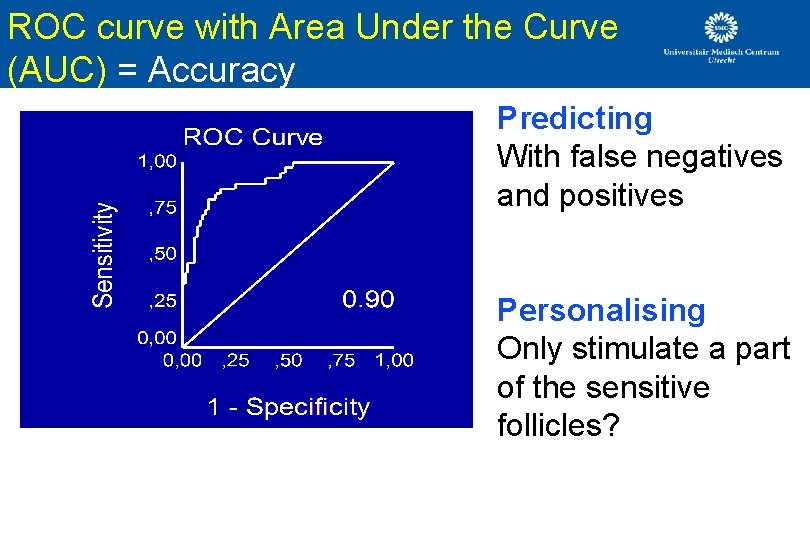
ROC curve with Area Under the Curve (AUC) = Accuracy Predicting With false negatives and positives Personalising Only stimulate a part of the sensitive follicles?
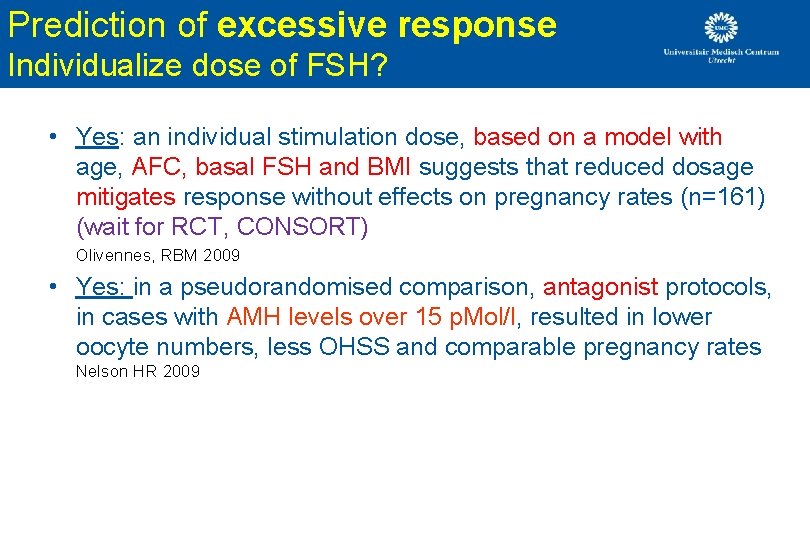
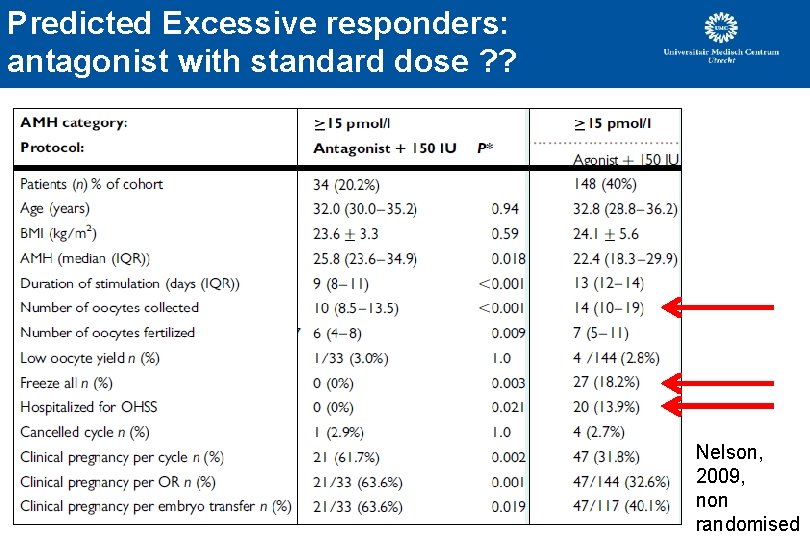
Prediction of excessive response Individualize dose of FSH? • Yes: an individual stimulation dose, based on a model with age, AFC, basal FSH and BMI suggests that reduced dosage mitigates response without effects on pregnancy rates (n=161) (wait for RCT, CONSORT) Olivennes, RBM 2009 • Yes: in a pseudorandomised comparison, antagonist protocols, in cases with AMH levels over 15 p. Mol/l, resulted in lower oocyte numbers, less OHSS and comparable pregnancy rates Nelson HR 2009
Predicted Excessive responders: antagonist with standard dose ? ? Nelson, 2009, non randomised
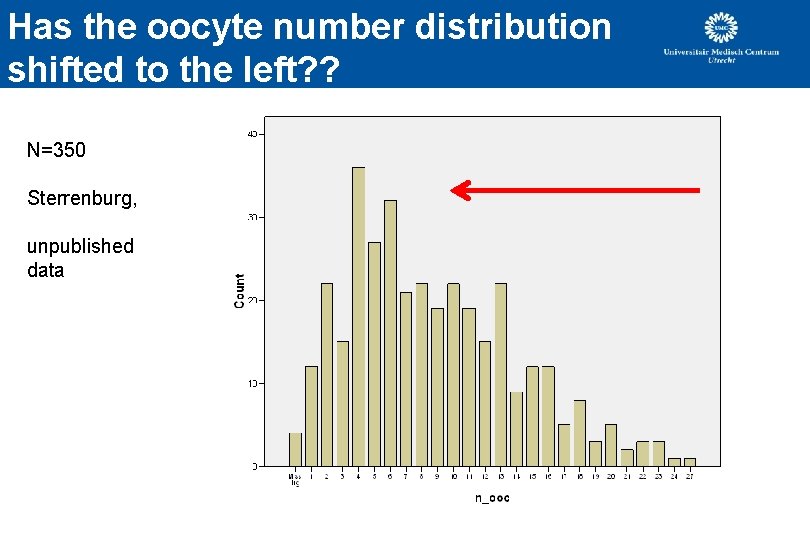
Has the oocyte number distribution shifted to the left? ? N=350 Sterrenburg, unpublished data
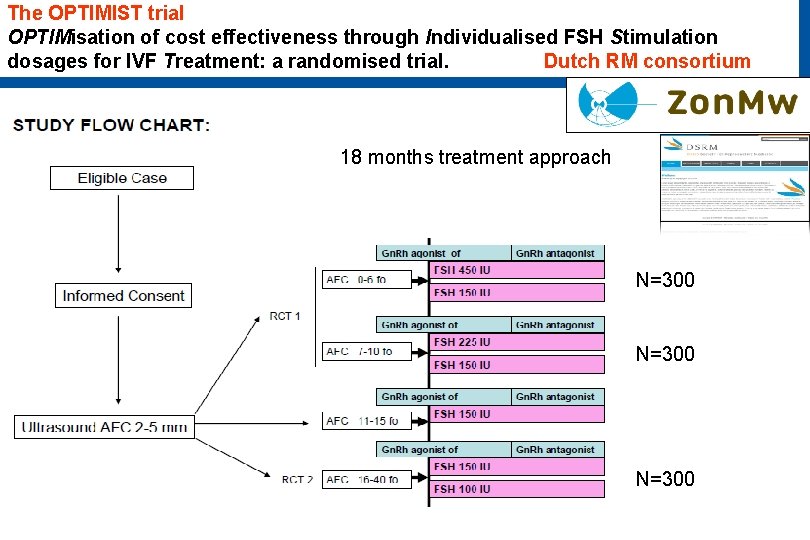
The OPTIMIST trial OPTIMisation of cost effectiveness through Individualised FSH Stimulation dosages for IVF Treatment: a randomised trial. Dutch RM consortium 18 months treatment approach N=300
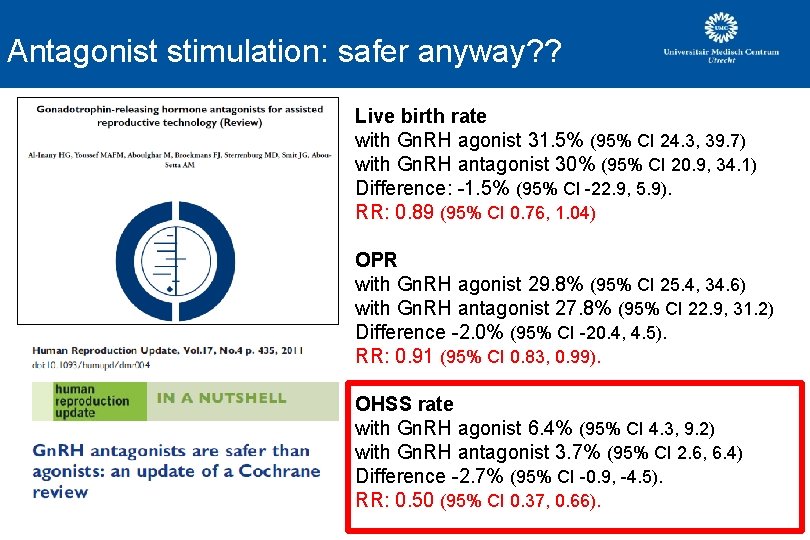
Antagonist stimulation: safer anyway? ? Live birth rate with Gn. RH agonist 31. 5% (95% CI 24. 3, 39. 7) with Gn. RH antagonist 30% (95% CI 20. 9, 34. 1) Difference: -1. 5% (95% CI -22. 9, 5. 9). RR: 0. 89 (95% CI 0. 76, 1. 04) OPR with Gn. RH agonist 29. 8% (95% CI 25. 4, 34. 6) with Gn. RH antagonist 27. 8% (95% CI 22. 9, 31. 2) Difference -2. 0% (95% CI -20. 4, 4. 5). RR: 0. 91 (95% CI 0. 83, 0. 99). OHSS rate with Gn. RH agonist 6. 4% (95% CI 4. 3, 9. 2) with Gn. RH antagonist 3. 7% (95% CI 2. 6, 6. 4) Difference -2. 7% (95% CI -0. 9, -4. 5). RR: 0. 50 (95% CI 0. 37, 0. 66).
OS and the High Responder Agenda 1. 2. 3. 4. 5. 6. Ovarian Physiology OS Backgrounds OS Predicted High Responders OS Actual High Responders OHSS secondary prevention Conclusions and take homers
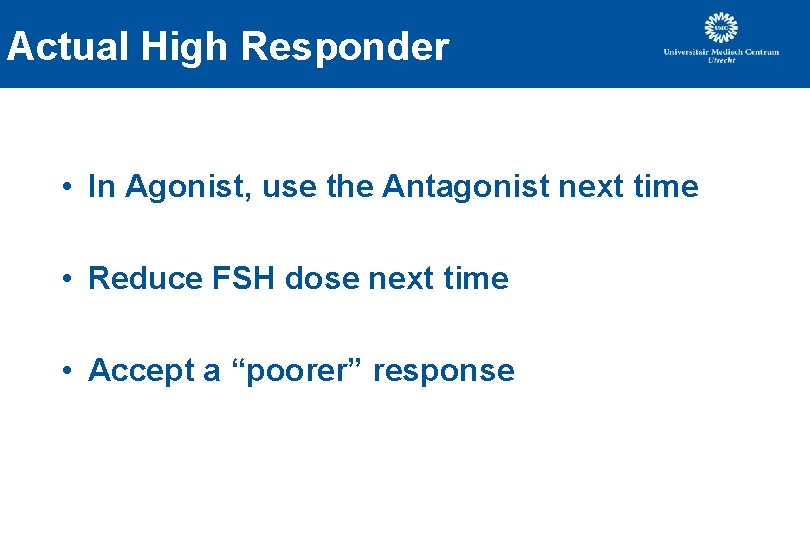
Actual High Responder • In Agonist, use the Antagonist next time • Reduce FSH dose next time • Accept a “poorer” response
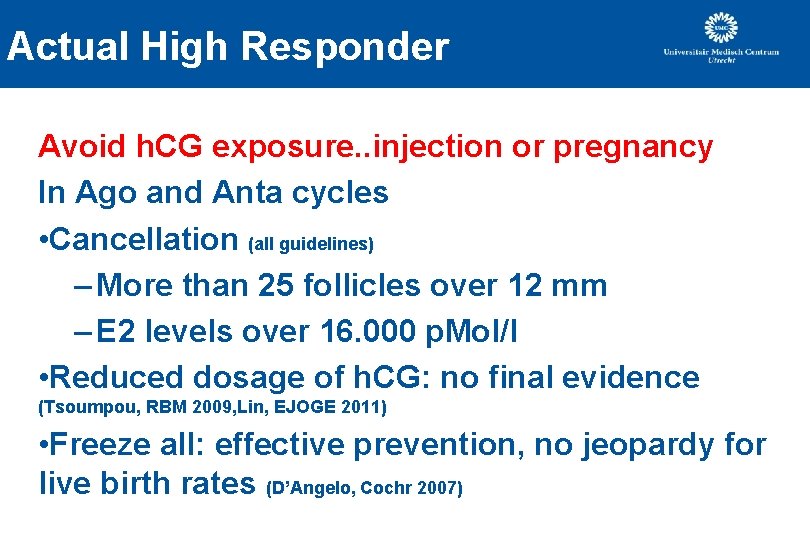
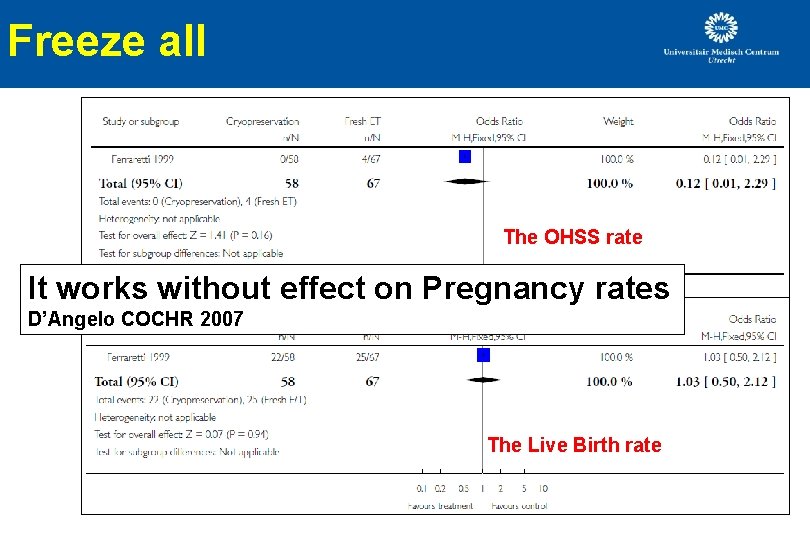
Actual High Responder Avoid h. CG exposure. . injection or pregnancy In Ago and Anta cycles • Cancellation (all guidelines) – More than 25 follicles over 12 mm – E 2 levels over 16. 000 p. Mol/l • Reduced dosage of h. CG: no final evidence (Tsoumpou, RBM 2009, Lin, EJOGE 2011) • Freeze all: effective prevention, no jeopardy for live birth rates (D’Angelo, Cochr 2007)
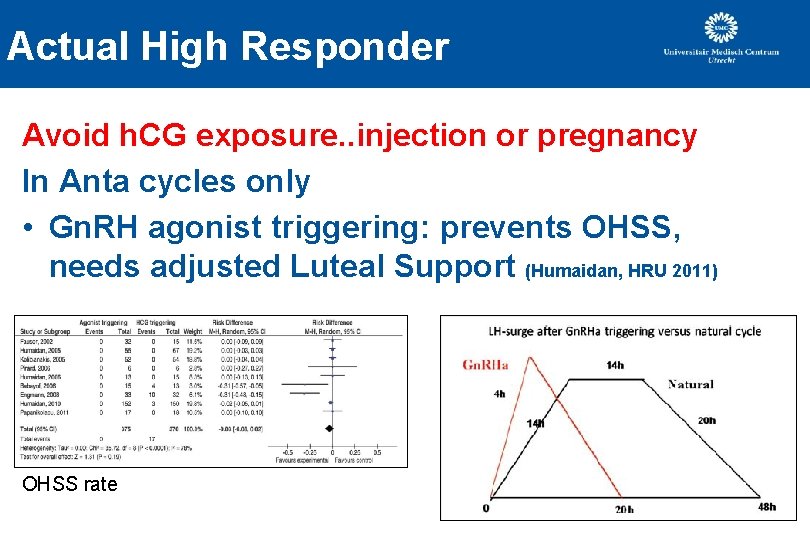
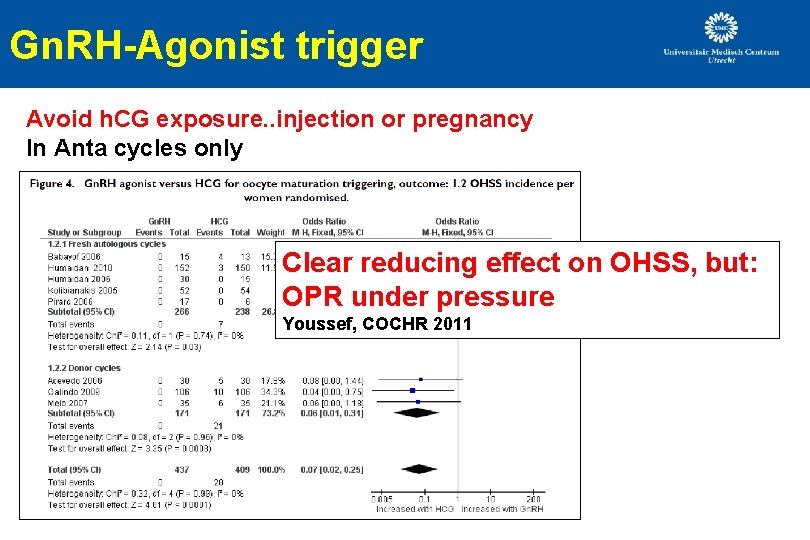
Actual High Responder Avoid h. CG exposure. . injection or pregnancy In Anta cycles only • Gn. RH agonist triggering: prevents OHSS, needs adjusted Luteal Support (Humaidan, HRU 2011) OHSS rate
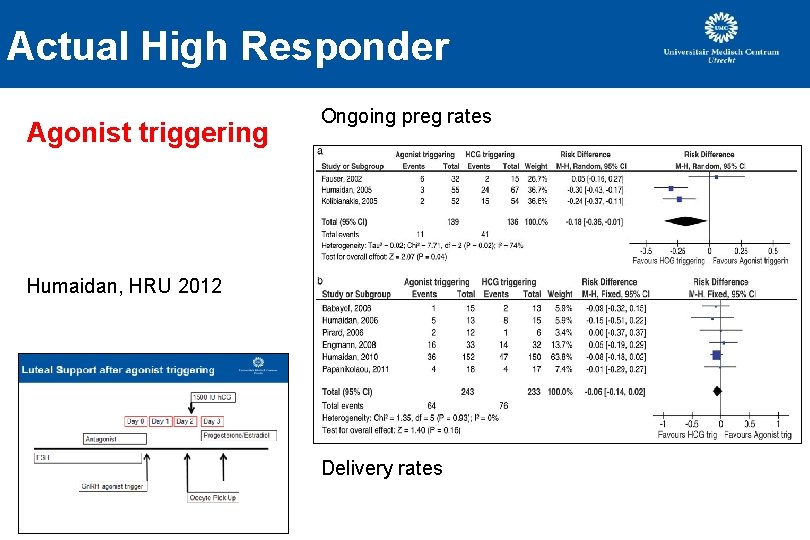
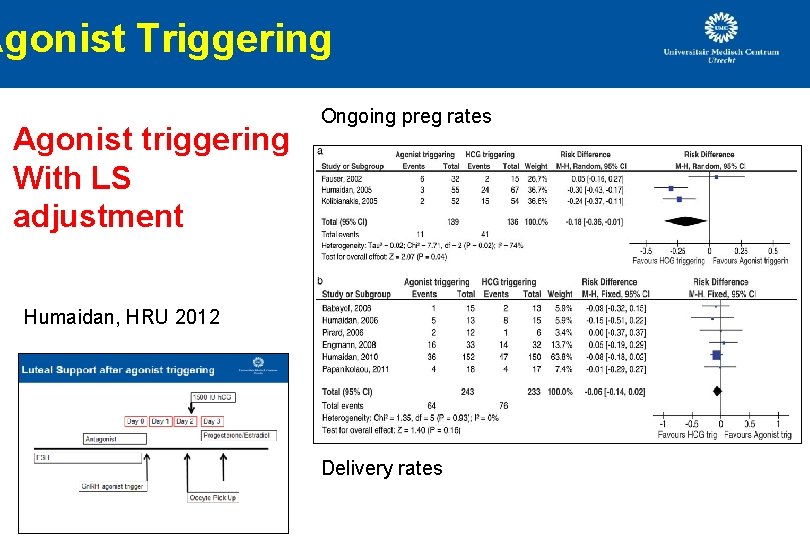
Actual High Responder Agonist triggering Ongoing preg rates Humaidan, HRU 2012 Delivery rates
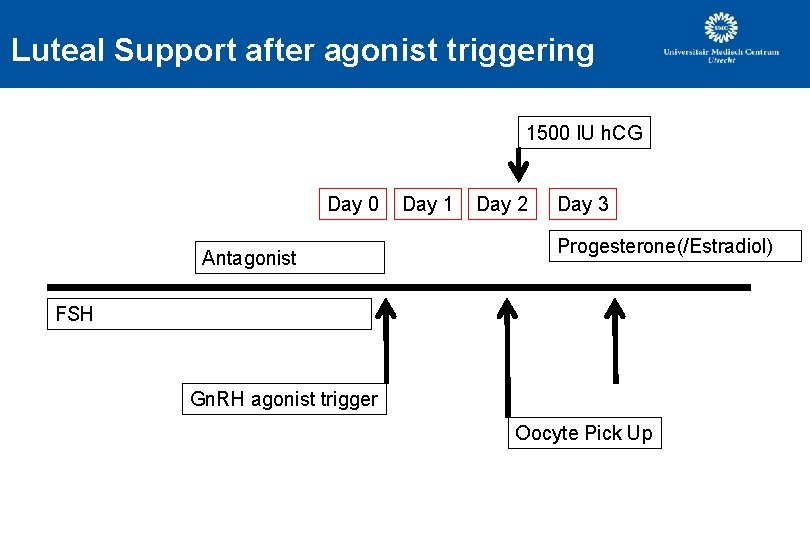
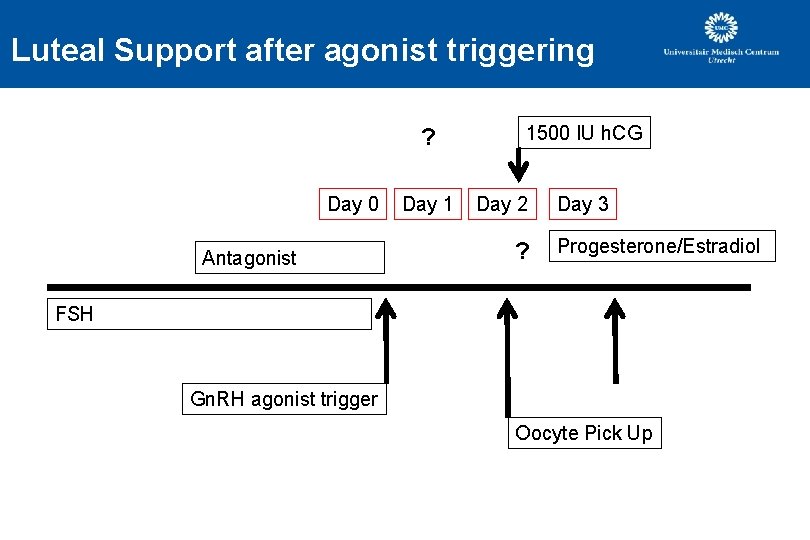
Luteal Support after agonist triggering 1500 IU h. CG Day 0 Antagonist Day 1 Day 2 Day 3 Progesterone(/Estradiol) FSH Gn. RH agonist trigger Oocyte Pick Up
OS and the High Responder Agenda 1. 2. 3. 4. 5. 6. Ovarian Physiology OS Backgrounds OS Predicted High Responders OS Actual High Responders OHSS secondary prevention Conclusions and take homers
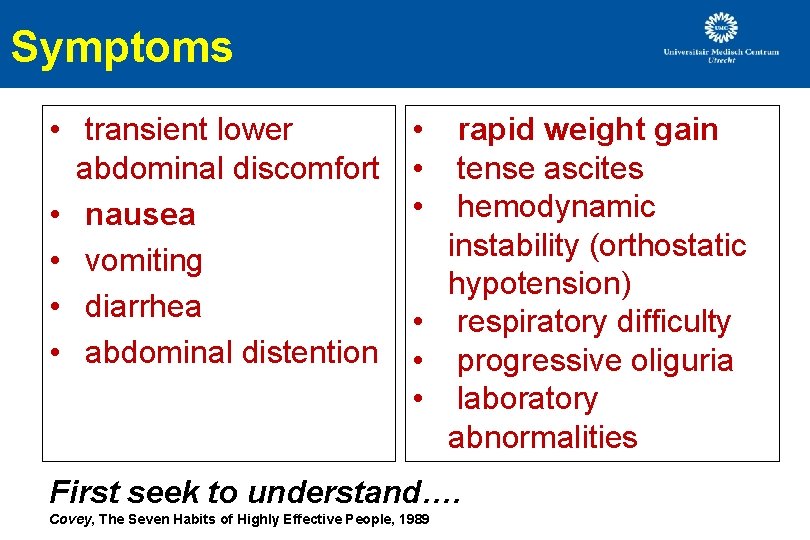
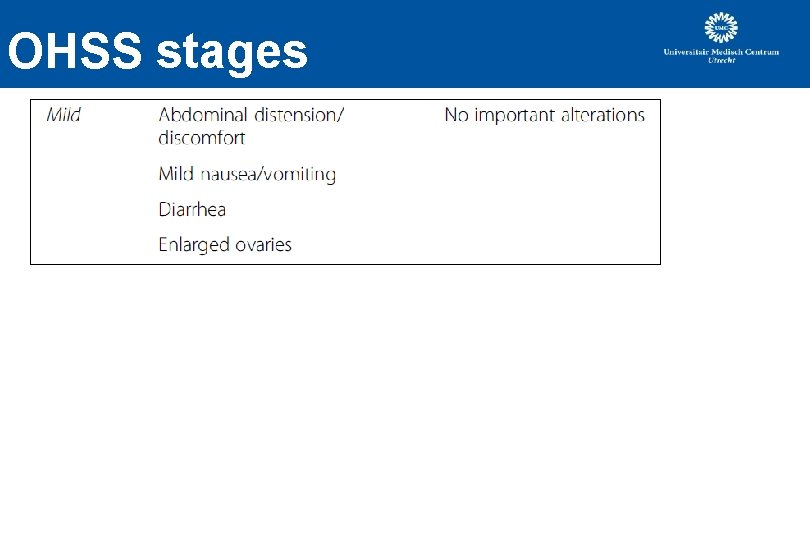
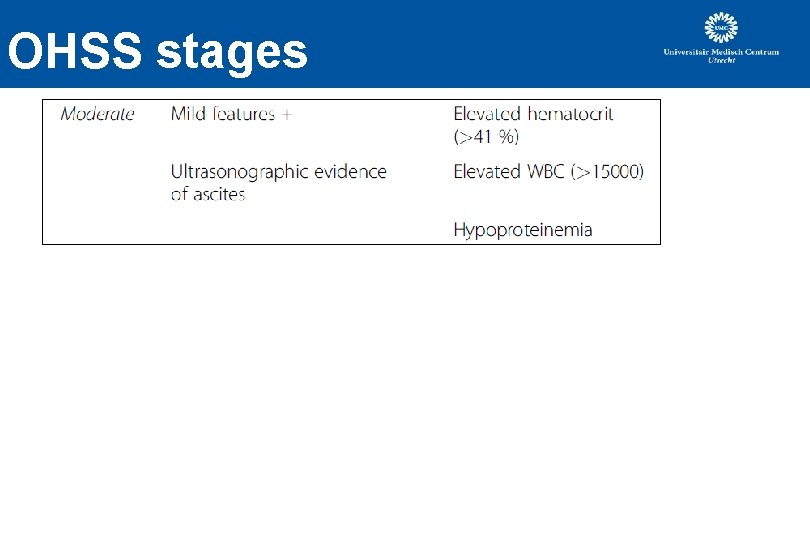
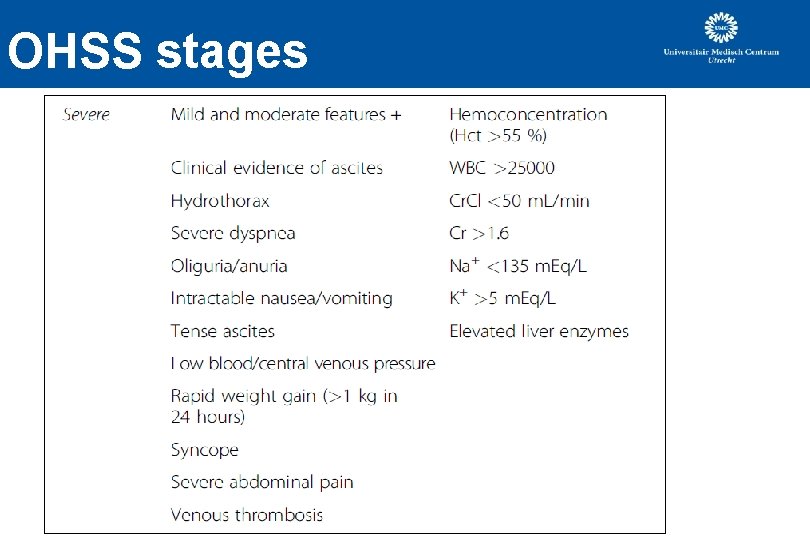
Symptoms • transient lower abdominal discomfort • nausea • vomiting • diarrhea • abdominal distention • • • rapid weight gain tense ascites hemodynamic instability (orthostatic hypotension) • respiratory difficulty • progressive oliguria • laboratory abnormalities First seek to understand…. Covey, The Seven Habits of Highly Effective People, 1989
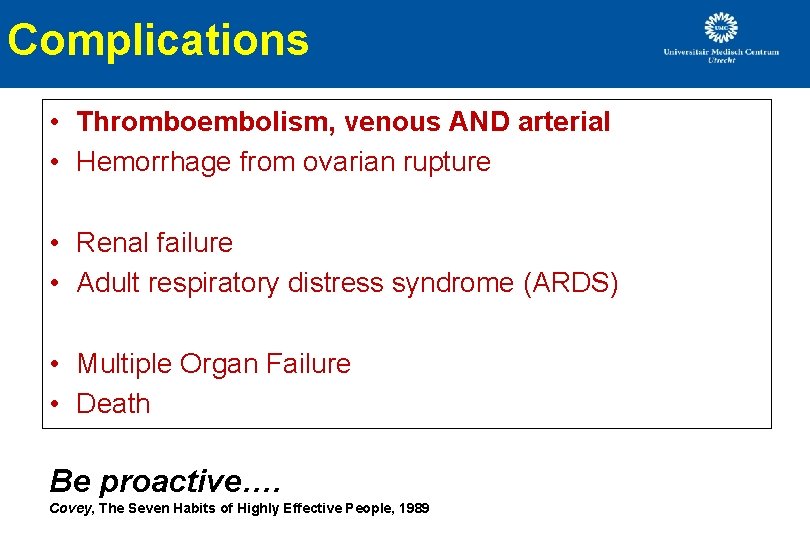
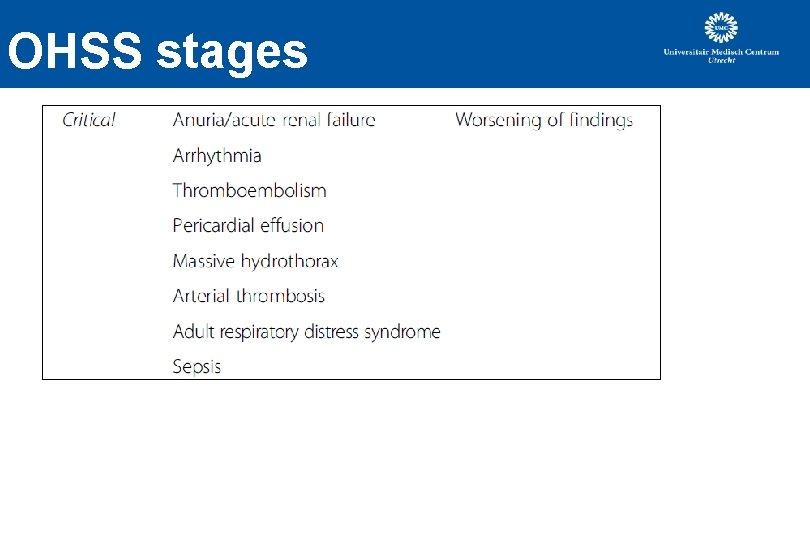
Complications • Thromboembolism, venous AND arterial • Hemorrhage from ovarian rupture • Renal failure • Adult respiratory distress syndrome (ARDS) • Multiple Organ Failure • Death Be proactive…. Covey, The Seven Habits of Highly Effective People, 1989
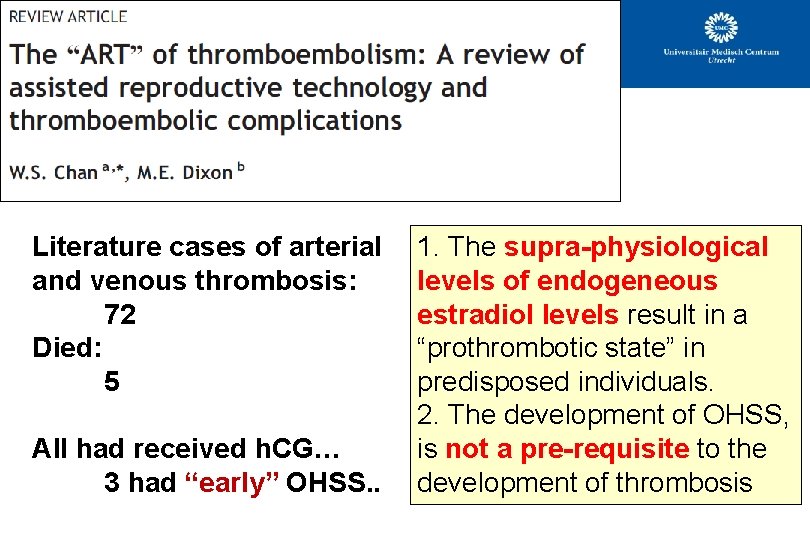
Literature cases of arterial and venous thrombosis: 72 Died: 5 All had received h. CG… 3 had “early” OHSS. . 1. The supra-physiological levels of endogeneous estradiol levels result in a “prothrombotic state” in predisposed individuals. 2. The development of OHSS, is not a pre-requisite to the development of thrombosis
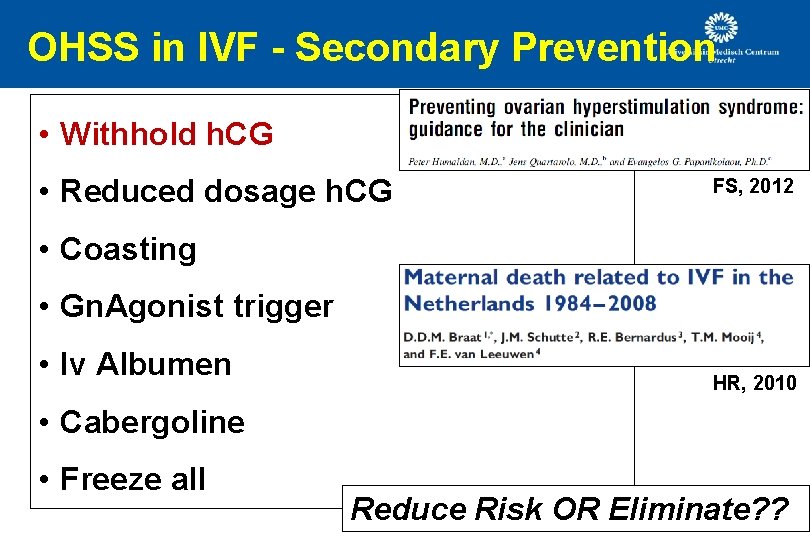
OHSS in IVF - Secondary Prevention • Withhold h. CG • Reduced dosage h. CG FS, 2012 • Coasting • Gn. Agonist trigger • Iv Albumen HR, 2010 • Cabergoline • Freeze all Reduce Risk OR Eliminate? ?
Withhold h. CG Avoid h. CG exposure. . injection or pregnancy In Ago and Anta cycles • Cancellation (all guidelines) – More than 25 follicles over 12 mm – E 2 levels over 16. 000 p. Mol/l
Reduced dosage h. CG The majority of studies concluded that the clinical outcomes were similar between women receiving 5000 or 10, 000 IU of u-HCG. The incidence of OHSS was not reduced in the high-risk population even with lower dose of u. HCG Symposium: Update on prediction and management of OHSS. Optimal dose of HCG for final oocyte maturation in IVF cycles: absence of evidence? Tsoumpou, 2009, RBM online
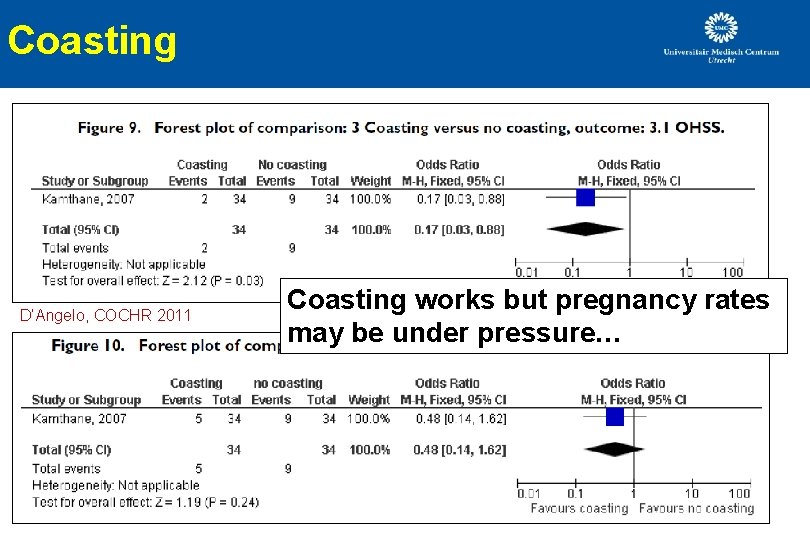
Coasting D’Angelo, COCHR 2011 Coasting works but pregnancy rates may be under pressure…
Gn. RH-Agonist trigger Avoid h. CG exposure. . injection or pregnancy In Anta cycles only Clear reducing effect on OHSS, but: OPR under pressure Youssef, COCHR 2011
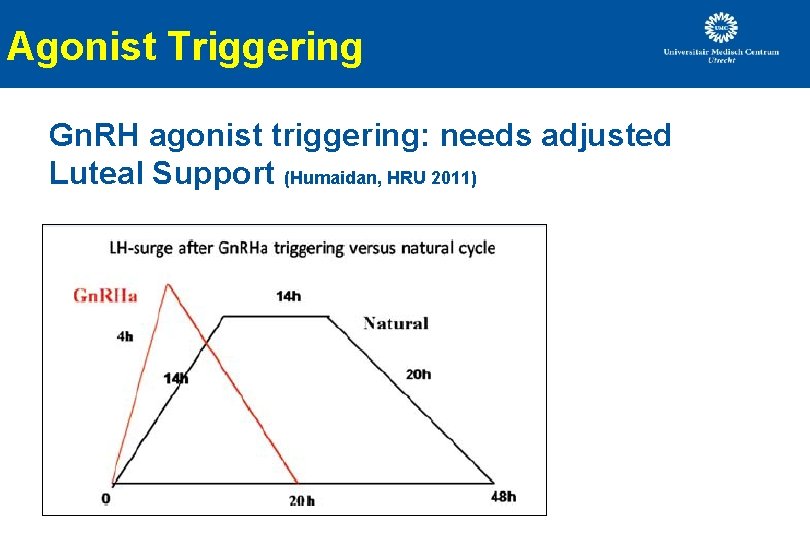
Agonist Triggering Gn. RH agonist triggering: needs adjusted Luteal Support (Humaidan, HRU 2011)
Agonist Triggering Agonist triggering With LS adjustment Ongoing preg rates Humaidan, HRU 2012 Delivery rates
Luteal Support after agonist triggering ? Day 0 Antagonist Day 1 1500 IU h. CG Day 2 ? Day 3 Progesterone/Estradiol FSH Gn. RH agonist trigger Oocyte Pick Up
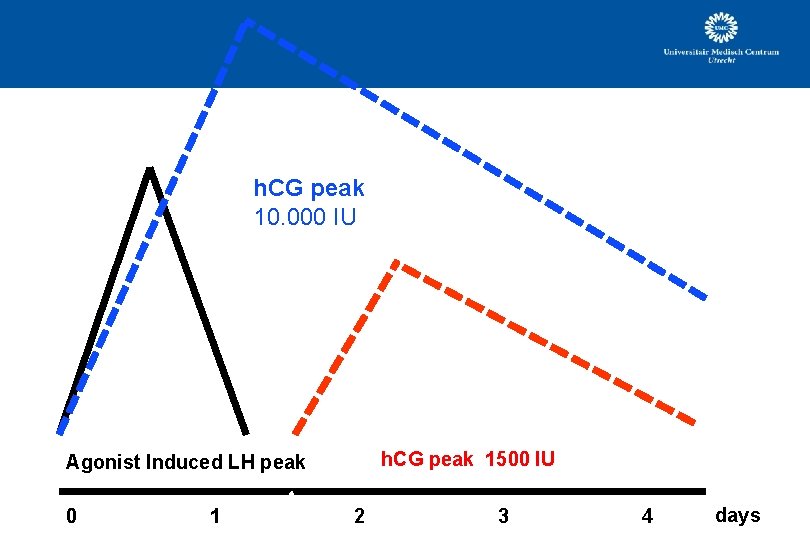
h. CG peak 10. 000 IU h. CG peak 1500 IU Agonist Induced LH peak 0 1 2 3 4 days
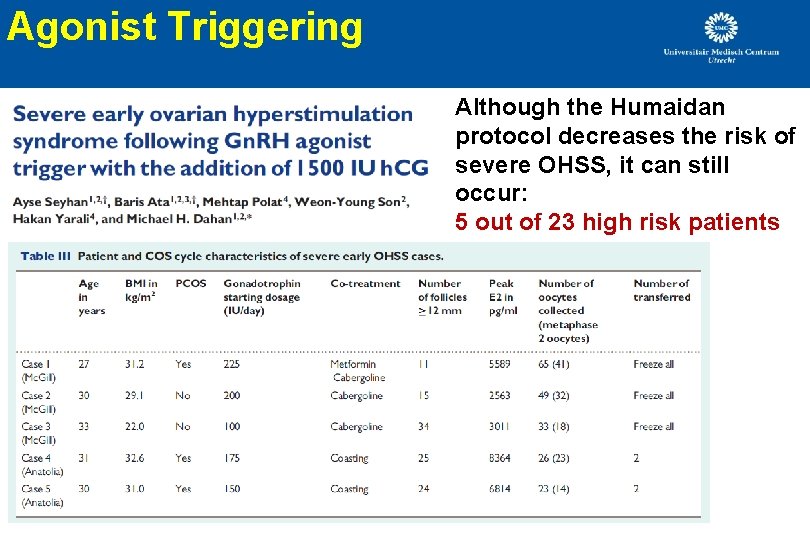
Agonist Triggering Although the Humaidan protocol decreases the risk of severe OHSS, it can still occur: 5 out of 23 high risk patients
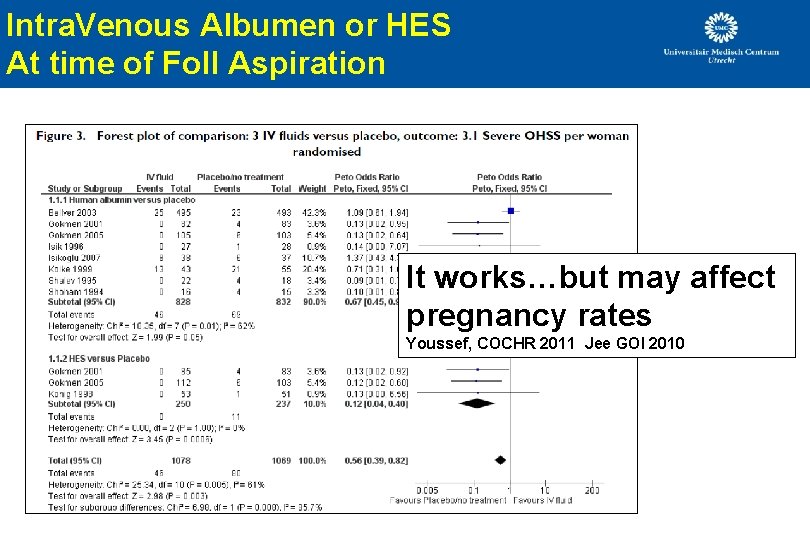
Intra. Venous Albumen or HES At time of Foll Aspiration It works…but may affect pregnancy rates Youssef, COCHR 2011 Jee GOI 2010
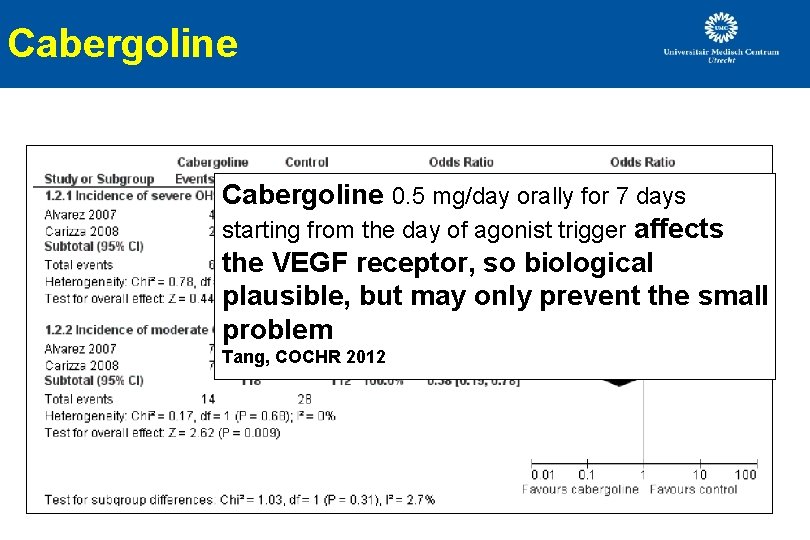
Cabergoline 0. 5 mg/day orally for 7 days starting from the day of agonist trigger affects the VEGF receptor, so biological plausible, but may only prevent the small problem Tang, COCHR 2012
Freeze all The OHSS rate It works without effect on Pregnancy rates D’Angelo COCHR 2007 The Live Birth rate
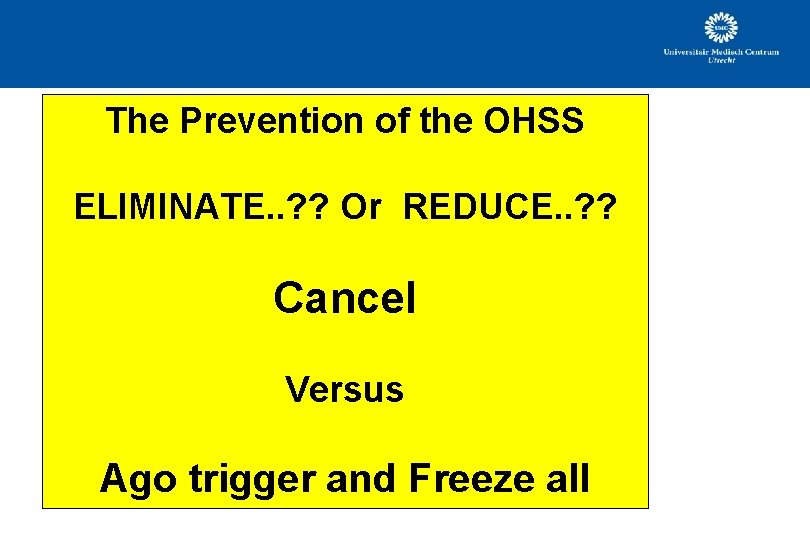
The Prevention of the OHSS ELIMINATE. . ? ? Or REDUCE. . ? ? Cancel Versus Ago trigger and Freeze all
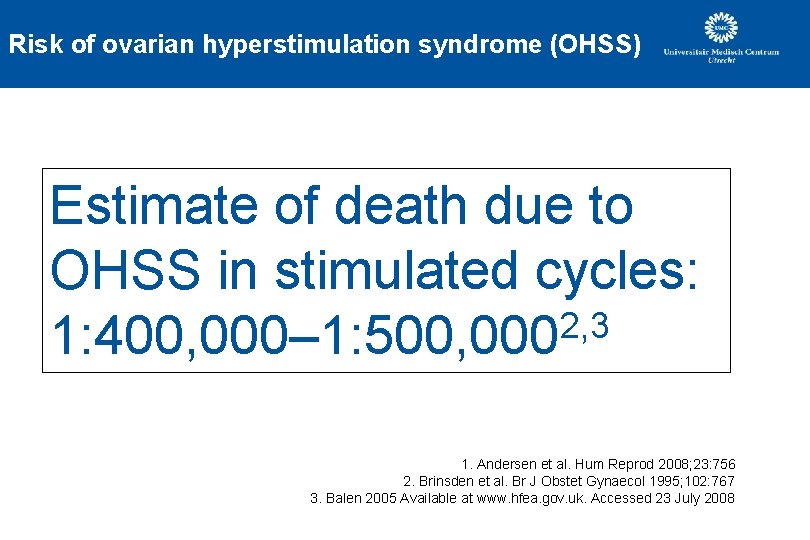
Risk of ovarian hyperstimulation syndrome (OHSS) Estimate of death due to OHSS in stimulated cycles: 2, 3 1: 400, 000– 1: 500, 000 1. Andersen et al. Hum Reprod 2008; 23: 756 2. Brinsden et al. Br J Obstet Gynaecol 1995; 102: 767 3. Balen 2005 Available at www. hfea. gov. uk. Accessed 23 July 2008
OHSS stages
OHSS stages
OHSS stages
OHSS stages
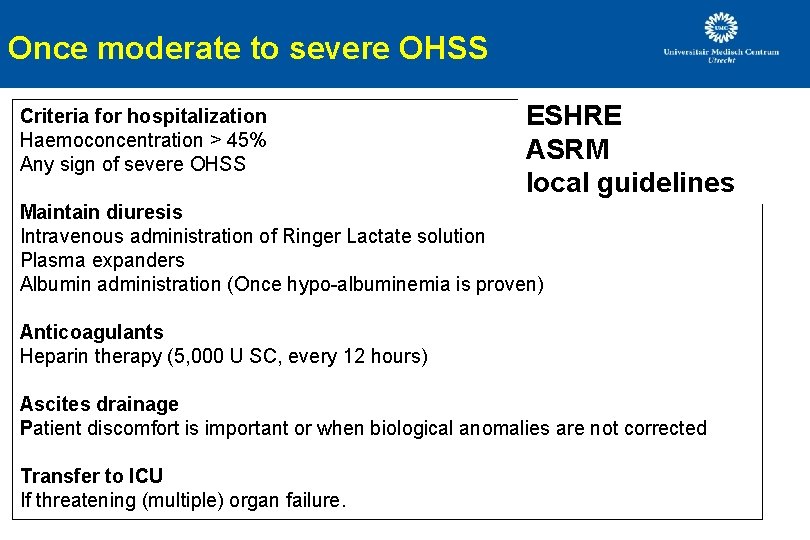
Once moderate to severe OHSS Criteria for hospitalization Haemoconcentration > 45% Any sign of severe OHSS ESHRE ASRM local guidelines Maintain diuresis Intravenous administration of Ringer Lactate solution Plasma expanders Albumin administration (Once hypo-albuminemia is proven) Anticoagulants Heparin therapy (5, 000 U SC, every 12 hours) Ascites drainage Patient discomfort is important or when biological anomalies are not corrected Transfer to ICU If threatening (multiple) organ failure.
OS and the High Responder Agenda 1. 2. 3. 4. 5. 6. Ovarian Physiology OS Backgrounds OS Predicted High Responders OS Actual High Responders OHSS secondary prevention Conclusions and take homers
Advice to Take Home …do not let the ovaries… explode…
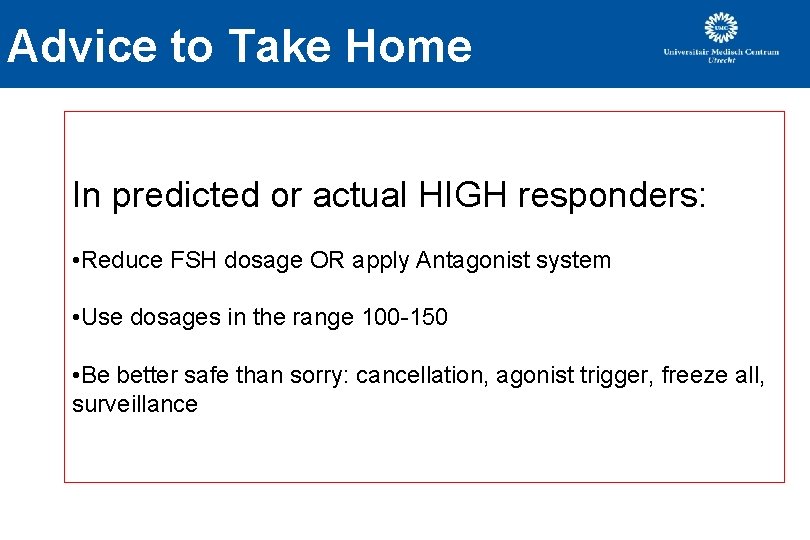
Advice to Take Home In predicted or actual HIGH responders: • Reduce FSH dosage OR apply Antagonist system • Use dosages in the range 100 -150 • Be better safe than sorry: cancellation, agonist trigger, freeze all, surveillance
Thank You Frank Broekmans Professor Reproductive Medicine and Surgery University Medical Centre Utrecht The Netherlands the IMPORT* studygroup Richard A. Anderson Mahnaz Ashrafi László Bancsi, Ettore Caroppo, Alan B. Copperman, Thomas Ebner, Talia Eldar-Geva, Mehmet Erdem, Ellen M. Greenblatt, Kannamannadiar. Jayaprakasan, Nick Raine-Fenning, Ellen Klinkert, Janet Kwee, Antonio La Marca, Myvanwy. Mc. Ilveen, Luis T. Merce, Shanthi Muttukrishna, Scott M. Nelson, Ernest H. Y. Ng, Biljana Popovic Todorovic, Jesper M. J. Smeenk, Candido Tomás Paul J. Q. Van der Linden, K. Vladimirov, Patrick Bossuyt Simone Broer Jeroen van Disseldorp Monique Sterrenburg Marieke Verberg Dave Hendriks Ellen Klinkert Ilse van Rooij Laszlo Bancsi Kim Broeze (AMC) Brent Opmeer (AMC) Madeleine Dolleman Bart Fauser Nick Macklon (Southampton) Ben W Mol (AMC) Nils Lambalk (VUMC)