
Avoiding the Offending Allergen Ingredient Lists and Labelling
Avoiding the Offending Allergen Ingredient Lists and Labelling Laws
Canada’s Food Labelling Laws On February 16 th 2011 Health Canada Published Amendments to the Food Allergen Labelling Regulations in Canada Gazette, Part II (CGII) The new Regulations were designed to enhance labelling requirements for specific priority allergens, gluten sources and added sulphites in prepackaged foods sold in Canada The new food allergen labelling regulations came into force on August 4, 2012 http: //www. hc-sc. gc. ca/fn-an/label-etiquet/allergen/index-eng. php 2
Reasons for the New Laws Health Canada's policy for enhancing the protection of food-allergic consumers in Canada is based on two guiding principles: Prevent the inadvertent consumption of undeclared allergens by sensitive consumers Enable a variety of safe and nutritious food choices for the allergic consumer 3
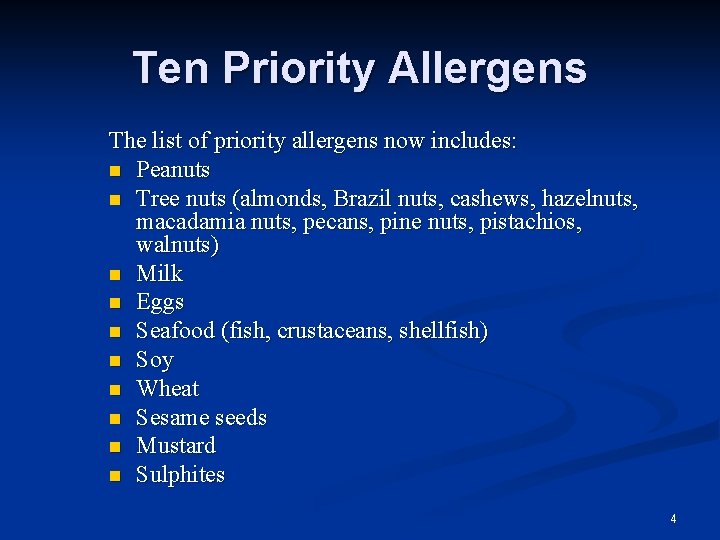
Ten Priority Allergens The list of priority allergens now includes: Peanuts Tree nuts (almonds, Brazil nuts, cashews, hazelnuts, macadamia nuts, pecans, pine nuts, pistachios, walnuts) Milk Eggs Seafood (fish, crustaceans, shellfish) Soy Wheat Sesame seeds Mustard Sulphites 4
Labelling of "hidden" priority allergens Previously, food labels did not have to declare when a priority allergen was used to make an ingredient like spices or flavours Now, labels on products will have to let consumers know when these allergens are in the product, either in the ingredient list or in a "contains" statement The allergen may appear in the ingredient list Components of an ingredient like spices may be in brackets And/or the allergen may appear in a "contains" statement after the ingredients, like "Contains: XX” 5
Plain Language Previously a number of names for an ingredient, some of which were unfamiliar to the general public, could appear on labels With the new food labels, companies will have to use commonly understood names for the priority allergens E. g. “casein”, whey”, “lactalbumin”, “lactose”, etc E. g. for the ingredients above, “milk” must appear on the label The names, such as "wheat" or "milk, " will have to be used either in the ingredient list or in the "contains" statement Some manufacturers include them in both 6
Precautionary Statements Previously a number of precautionary statements appeared on labels, eg: May contain trace amounts of [X] Produced on shared equipment with [X] Manufactured in a facility that also manufactures [X] Health Canada and the CFIA are recommending that food manufacturers and importers begin to use only one precautionary statement on food labels: "may contain [X]" where X is the name by which the allergen is commonly known 7
“Natural” Foods Nature", "natural", "Mother Nature", "Nature's Way" are terms often misused on labels and in advertisements “Advertisements should not convey the impression that "Nature" has, by some miraculous process, made some foods nutritionally superior to others or has engineered some foods specially to take care of human needs” Some consumers may consider foods described as "natural" of greater worth than foods not so described http: //www. inspection. gc. ca/english/fssa/labeti/guide/ch 4 ae. shtml 8
Manufactured Foods or ingredients of foods submitted to processes that have significantly altered their original physical, chemical or biological state should not be described as "natural“ E. g: the removal of caffeine from coffee A natural food or ingredient of a food is not expected to contain, or to ever have contained, an added vitamin, mineral nutrient, artificial flavouring agent or food additive. A natural food or ingredient of a food does not have any constituent or fraction thereof removed or significantly changed, except the removal of water 9
“Natural” Additives Some food additives, vitamins and mineral nutrients may be derived from natural sources Some of these additives may be regarded as natural ingredients, in which case the acceptable claim would be that this food contains "natural ingredients“ If the additive is derived from a priority allergen, the allergen must be listed on the label Note that while the ingredient can be described as "natural", the food itself cannot, since it contains an added component. The list of ingredients of such foods must declare acids, bases, salts or sweeteners which are present by their proper common names 10
Food Additive Ingredients Food additives are considered ingredients in any prepackaged food and must be: Included in the ingredients’ list Listed by the common name associated with the active ingredient in the preparation In general, food ingredients are listed in descending order of proportion by weight However, food additives, spices, seasonings, herbs (except salt), natural and artificial flavours, flavour enhancers, vitamins and mineral nutrients and their derivatives and salts, may be placed at the end of the ingredients list in any order 11
Food Additives Foods meant for human consumption may contain additives under the GRAS (generally recognized as safe) designation Level of food additives may be allowed according to “good manufacturing practices”: Amount determined by standards for the product E. g: annatto is added to butter to the amount required to bring it to an established standard yellow colour 12
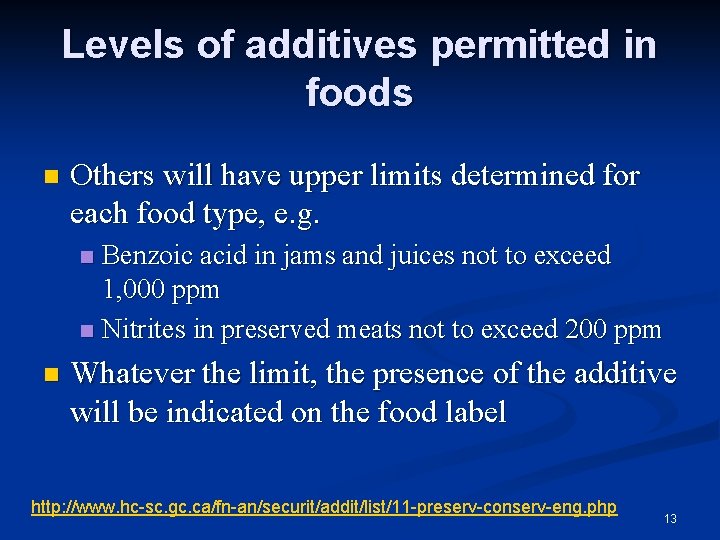
Levels of additives permitted in foods Others will have upper limits determined for each food type, e. g. Benzoic acid in jams and juices not to exceed 1, 000 ppm Nitrites in preserved meats not to exceed 200 ppm Whatever the limit, the presence of the additive will be indicated on the food label http: //www. hc-sc. gc. ca/fn-an/securit/addit/list/11 -preserv-conserv-eng. php 13
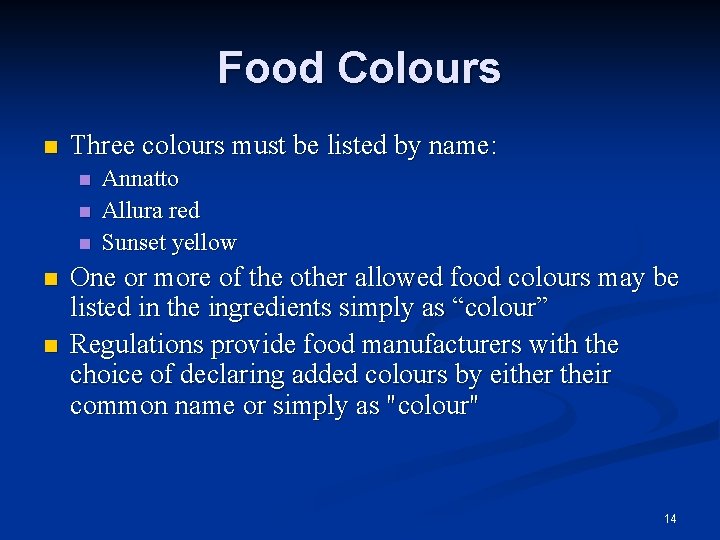
Food Colours Three colours must be listed by name: Annatto Allura red Sunset yellow One or more of the other allowed food colours may be listed in the ingredients simply as “colour” Regulations provide food manufacturers with the choice of declaring added colours by either their common name or simply as "colour" 14
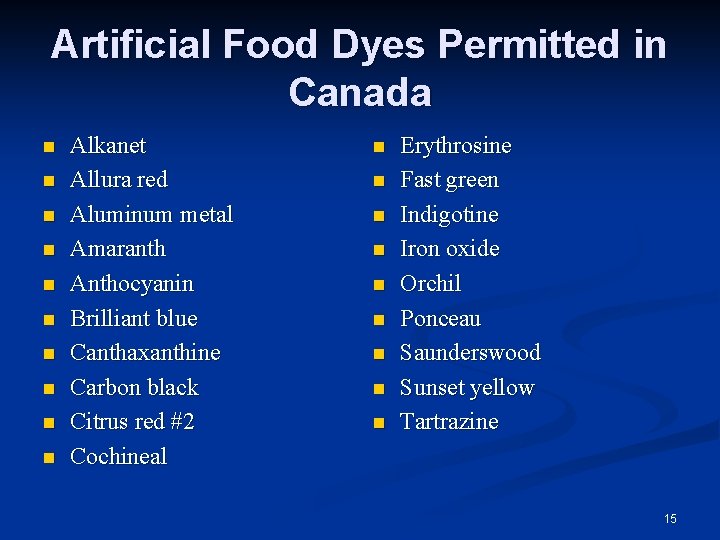
Artificial Food Dyes Permitted in Canada Alkanet Allura red Aluminum metal Amaranth Anthocyanin Brilliant blue Canthaxanthine Carbon black Citrus red #2 Cochineal Erythrosine Fast green Indigotine Iron oxide Orchil Ponceau Saunderswood Sunset yellow Tartrazine 15
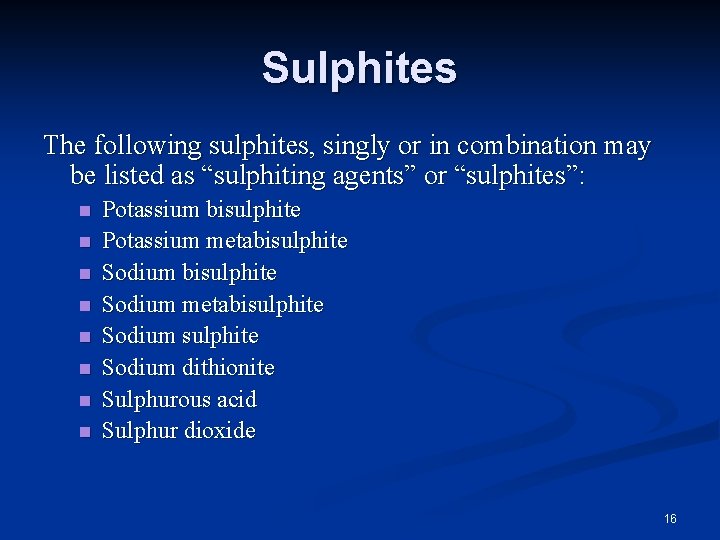
Sulphites The following sulphites, singly or in combination may be listed as “sulphiting agents” or “sulphites”: Potassium bisulphite Potassium metabisulphite Sodium dithionite Sulphurous acid Sulphur dioxide 16
Monosodium glutamate (MSG) There are no regulations requiring this flavour to be identified specifically Manufacturers can list the additive by the source, e. g. Hydrolysed vegetable protein (HVP) Hydrolysed plant protein (HPP) Hydrolysed soy protein (HSP) If the hydrolysate is derived from a priority allergen it should appear on the label HSP should identify “soy” as an allergen 17
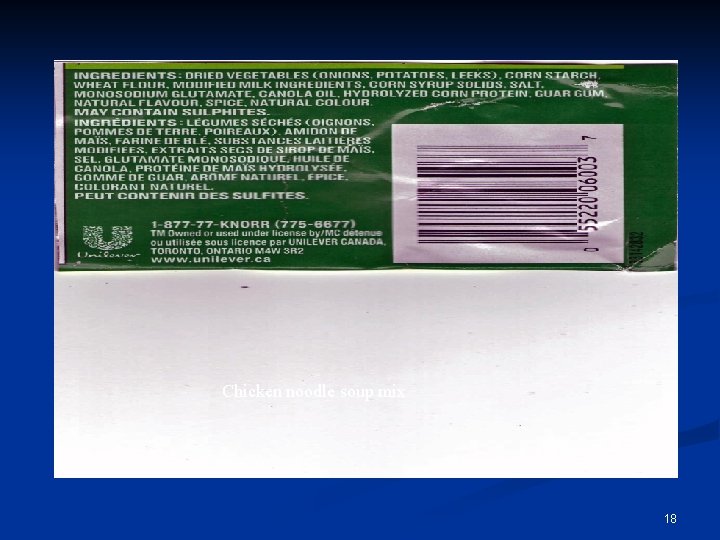
Chicken noodle soup mix 18

Grissol Melba Toast 19
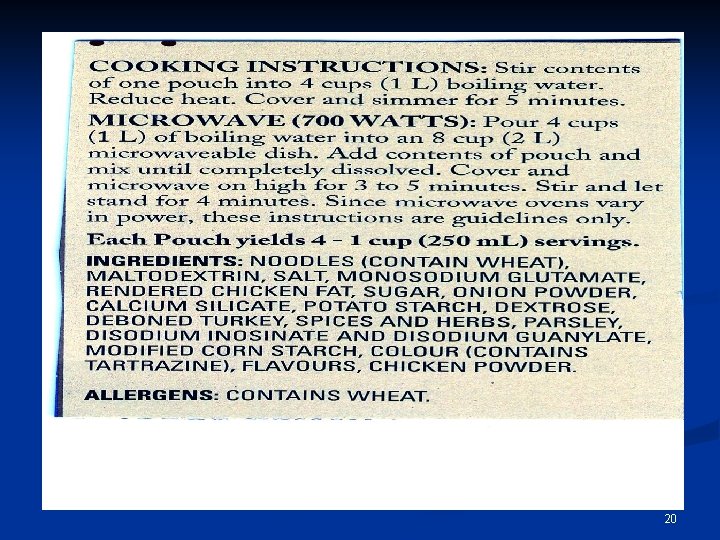
Chicken noodle soup mix 20
Food Services Role of the dietitian is to ensure all meals provided to identified food allergic individuals are free from their offending allergens Concern when patients designate food aversions as “allergies” Request confirmation of allergy from medical practitioner if necessary 21
Identification of Allergens Computer coding, example: List of ingredients with allergens identified in side-by-side columns List priority allergens List allergens of common concern, e. g. Corn Rice Individual meats, fruits, vegetables List additives of concern, e. g. Sulphites MSG Tartrazine 22
What about secondary ingredients? If not listed on label, need not include as allergens, e. g. Sulphite in fruit purée If label identifies a priority allergen in a precautionary statement (as “may contain”) list as allergen present 23
Food Preparation Is it practical to designate areas as allergenfree? Which allergens should be excluded? All priority allergens? Are all prepackaged and preprepared foods entering the facility adequately labelled? How can meals on an assembly line be considered “allergen-free” 24
Precautionary Statements Dietitian can only ensure that an allergic patient’s meals are free from known sources of the allergen Contamination from foods prepared in the same area cannot be avoided “Prepared in a facility that also processes foods containing [X]” New labelling rules suggest this should read, “may contain [X]” 25
PREVENTION OF ALLERGY Recent Changes in Direction
Prevention of Allergy: Historical Perspective Measures of prevention were all designed to avoid sensitization to allergens during what were considered the most vulnerable periods: This meant reduction in exposure to highly allergenic foods: Intra-uterine life From birth to 2 -3 years Mother’s diet during pregnancy and lactation Delay in introduction of highly allergenic foods during weaning In spite of these stringent measures to prevent allergy, incidence of all types of allergies have increased significantly 27
Change in Direction During the Past Five Years Understanding of the importance of immunological sensitization and tolerance Recognition that tolerance not sensitization is the critical step in allergy prevention Finding that exposure to the allergenic food at an optimum stage is probably a critical step in allergy prevention Recognition that tolerance can be induced after allergy has been established – leading to important measures for allergy management 28
Allergy is a Response of the Immune System Our immune systems are designed to protect the body from invasion by foreign materials All foods contain proteins – derived from plants and animals – all of which are foreign to the human body In order food to be absorbed, metabolized, and utilized by the body, the immune system needs to be “educated” that the foreign material is safe ____ Herz 2008 29
Oral Tolerance “Education” of the T cells to not respond to that food protein when it enters via the oral route – called oral tolerance Contrasts with the active immune responses needed to protect the gut against continual bombardment by invading pathogens and their products (toxins, etc) 30
Prevention of Food Allergy in Clinical Practice Significant change in directives within the past 5 years: Previously: Avoidance of allergen to prevent sensitization (allergen-specific Ig. E) Current: Active stimulation of the immature immune system to induce tolerance of the antigens in food ________ Rautava et al 2005 31
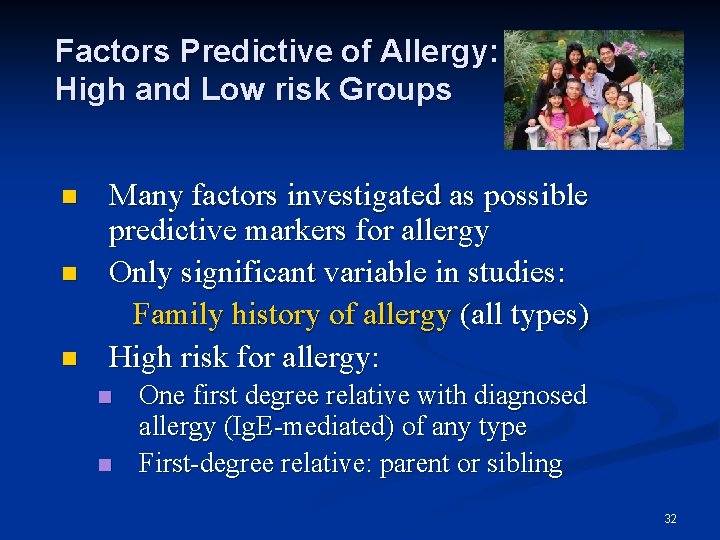
Factors Predictive of Allergy: High and Low risk Groups Many factors investigated as possible predictive markers for allergy Only significant variable in studies: Family history of allergy (all types) High risk for allergy: One first degree relative with diagnosed allergy (Ig. E-mediated) of any type First-degree relative: parent or sibling 32
When does Tolerance of Foods Begin? Food proteins demonstrated to cross the placenta and can be detected in amniotic fluid Exposure to small quantities of food antigens from mother’s diet thought to tolerize the fetus, by means of Ig. G 1 and Ig. G 3, within a “protected environment” 33
Diet During Pregnancy Current directive: the atopic mother should strictly avoid her own allergens and replace the foods with nutritionally equivalent substitutes There are no indications for mother to avoid other foods during pregnancy A nutritionally complete, well-balanced diet is essential Authorities recommend avoidance of excessive intake of highly allergenic foods such as peanuts and nuts to prevent “allergen overload”, but there is no scientific data to support this ________ Kramer et al 2006 ________ Sicherer et al 2010 34
Implications of Research Data Exclusive breast-feeding with exclusion of mother’s and baby’s allergens will reduce signs of allergy in the first 1 -2 years; specifically: Reduction or prevention of early food allergy by breast-feeding does not seem to have long-term effects on the development of: Cow’s milk allergy Eczema (atopic dermatitis) Asthma Allergic rhinitis (hay fever) Exclusive breast-feeding for 4 -6 months is strongly encouraged 35
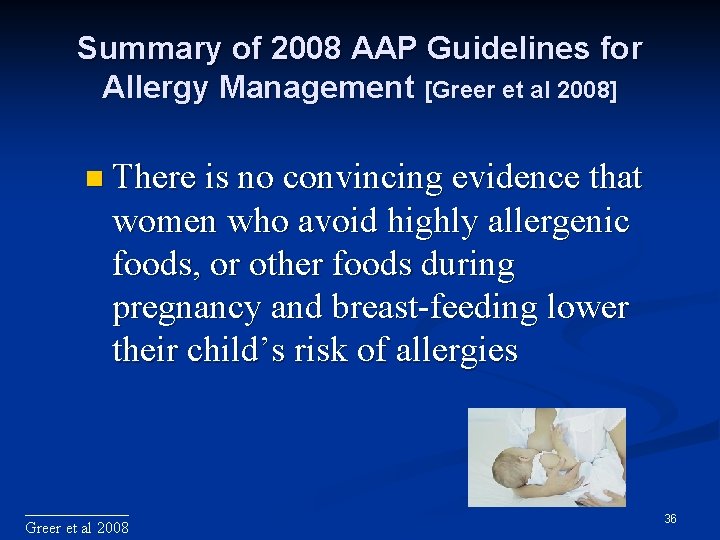
Summary of 2008 AAP Guidelines for Allergy Management [Greer et al 2008] There is no convincing evidence that women who avoid highly allergenic foods, or other foods during pregnancy and breast-feeding lower their child’s risk of allergies _______ Greer et al 2008 36
Value of Breast-feeding For high-risk for allergy infants (one first- degree relative with established allergy), exclusive breast-feeding for at least 4 months prevents or delays the occurrence of: Atopic dermatitis (eczema) Cow’s milk allergy (CMA) Wheezing __________ Sicherer and Burks 2008 37
Preventive Effect of Breastfeeding: KOALA Study Longer duration of breastfeeding is associated with lower risk for eczema in non-atopic mothers Slightly lower risk for mothers with allergy but no asthma Longer duration of breastfeeding reduced risk for wheezing in infants: possibly due to reduction in respiratory infections There is a lack of evidence that exclusive or prolonged breast-feeding has any positive effect on the development of asthma in older children ______________ Snijders et al 2007 KOALA study 38
Summary of 2008 AAP Guidelines continued In infants at high risk for allergy who are not exclusively breast-fed for 4 -6 months there is modest evidence that the onset of allergy, especially eczema, may be delayed or prevented by the use of hydrolyzed formulas There is no good evidence that soy-based infant formulas have any preventive effect on the development of allergy 39
Preventive Effect of Hydrolyzed Infant Formulae No evidence of any reduction in allergy with hydrolyzed formula compared to breastfeeding Limited evidence that prolonged feeding with hydrolyzed formula compared to cow’s milk reduces incidence of CMA and eczema No evidence that hydrolyzed formulas have any effect on the development of rhinitis and asthma later Extensively hydrolyzed cow’s milk (Ehf) formulas better than partially hydrolyzed whey (Phf) in prevention _________________ Osborn and Sinn 2009 Cochrane Review _____________ Von Berg et al GINI Study 2009 40
Infant Formulae for the Allergic Baby Current Recommendations Cow’s milk based formula if there are no signs of milk allergy Partially hydrolysed (phf) whey-based formula if there are no signs of milk allergy in high risk for allergy group Extensively hydrolysed (ehf) casein based formula if milk allergy is proven _________ Greer et al AAP 2008 Von Berg et al 2007 41
Recommendations for Introduction of Solids to High Risk for Allergy Infants Little evidence that delaying the introduction of complementary foods beyond 4 -6 months of age prevents allergy Introduction of solid foods should be individualized Foods should be introduced one at a time in small amounts Mixed foods containing various potential food allergens should not be given unless tolerance to each ingredient has been assessed __________ Greer et al AAP 2008 ___________ Thygaran and Burks 2008 42
Introduction of Solid Foods in Relationship to Celiac Disease Results suggest that in high risk for celiac disease infants introduction of gluten-containing grains before 3 months or after 7 months increases incidences of development of CD 1 Introduction of gluten while breast-feeding offers protection or delays onset of celiac disease in at-risk infants 2 Recommendations: Introduce gluten grains in small amounts between 4 and 6 months while infant is breastfed Continue breast-feeding for a further 2 -3 months Similar results for wheat allergy 3 ________ 1 Norris et al 2005 _______ 2 Guandalini 2007 ______ 3 Poole et al 2006 43
Introduction of Peanuts Directives from pediatric societies (1998 - 2007) recommended avoidance of peanuts by mothers during pregnancy and lactation, and delaying introduction of peanuts until after 2 or even 3 years of age Research indicates that incidence of peanut allergy in children rose dramatically in the years following release of these directives Recent research suggests: Avoidance of peanuts reduced development of tolerance Early exposure leads to reduced incidence of peanut allergy _________ Hourihane et al 2007 _______ Du Toit et al 2008 44
Introduction of Fish Historically, fish consumption during infancy was considered to be a risk factor for allergy Recent research indicates otherwise: Regular fish consumption during the first year of life associated with a reduced risk for allergic disease by age 4 years (n=4089)1 Babies of mothers who frequently consumed fish (2 -3 times per week or more) during pregnancy had one third less food sensitivities than those whose mothers did not consume fish during pregnancy 2 _______ 1 Kull et al 2006 ________ 2 Calvani et al 2006 45
The Natural History of Food Allergy Food allergy most often begins in the first 1 to 2 years of life Child is sensitized to the food protein by the immune system developing allergen-specific Ig. E to that protein Sensitization does not necessarily mean that the child will develop symptoms when that food is eaten Over time most food allergy is lost _____ Wood 2003 46
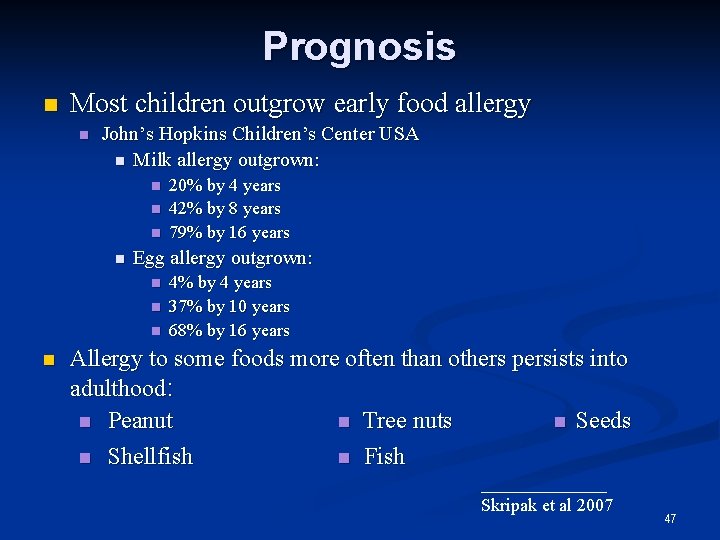
Prognosis Most children outgrow early food allergy John’s Hopkins Children’s Center USA Milk allergy outgrown: Egg allergy outgrown: 20% by 4 years 42% by 8 years 79% by 16 years 4% by 4 years 37% by 10 years 68% by 16 years Allergy to some foods more often than others persists into adulthood: Peanut Tree nuts Seeds Shellfish Fish _______ Skripak et al 2007 47
Induction of Oral Tolerance to a specific food can be induced by oral administration of the offending food by process of “low dose continuous exposure” Designated (SOTI: specific oral tolerance induction) Starting with very low dosages Gradually increasing daily dosage up to the equivalent of the usual daily intake Followed by daily maintenance dose _________ Niggemann et al 2006 _______ Calvani et al 2010 48
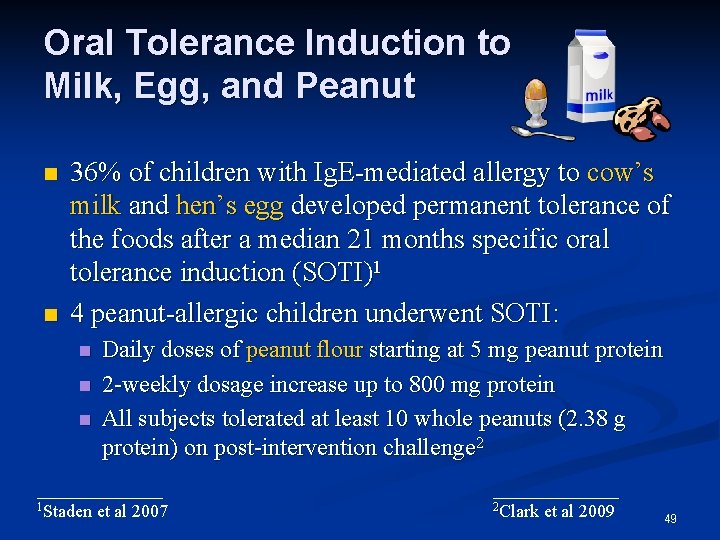
Oral Tolerance Induction to Milk, Egg, and Peanut 36% of children with Ig. E-mediated allergy to cow’s milk and hen’s egg developed permanent tolerance of the foods after a median 21 months specific oral tolerance induction (SOTI)1 4 peanut-allergic children underwent SOTI: Daily doses of peanut flour starting at 5 mg peanut protein 2 -weekly dosage increase up to 800 mg protein All subjects tolerated at least 10 whole peanuts (2. 38 g protein) on post-intervention challenge 2 _______ 1 Staden et al 2007 _______ 2 Clark et al 2009 49
Progression of Peanut Allergy Peanut allergy, like many early food allergies, can be outgrown In 2001 pediatric allergists in the U. S. reported that about 21. 5 per cent of children will eventually outgrow their peanut allergy 1 Those with a mild peanut allergy, as determined by the level of peanut-specific Ig. E in their blood, have a 50% chance of outgrowing the allergy 2 Only about 9% of patients are reported to outgrow their allergy to tree nuts 3 _________ 1 Skolnick et al 2001 2 Fleischer et al 2003 3 Fleischer et al 2005 50
Maintaining Tolerance of Peanut When there is no longer any evidence of symptoms developing after a child has consumed peanuts, it is preferable for that child to eat peanuts regularly, rather than avoid them, in order to maintain tolerance to the peanut Children who outgrow peanut allergy are at risk for recurrence, but the risk has been shown to be significantly higher for those who continue to avoid peanuts after resolution of their symptoms _________ Fleischer et al 2004 51
- Slides: 51