
The Use of Articles Lic Natalia Reshetina ARTICLES




- Slides: 24
The Use of Articles Lic. Natalia Reshetina
ARTICLES v. Do you know what Articles are? v. When should Articles be used? v. What is the Zero Article? v. What are the rules of Articles? v. What are the Definite and Indefinite Articles? Lic. Natalia Reshetina
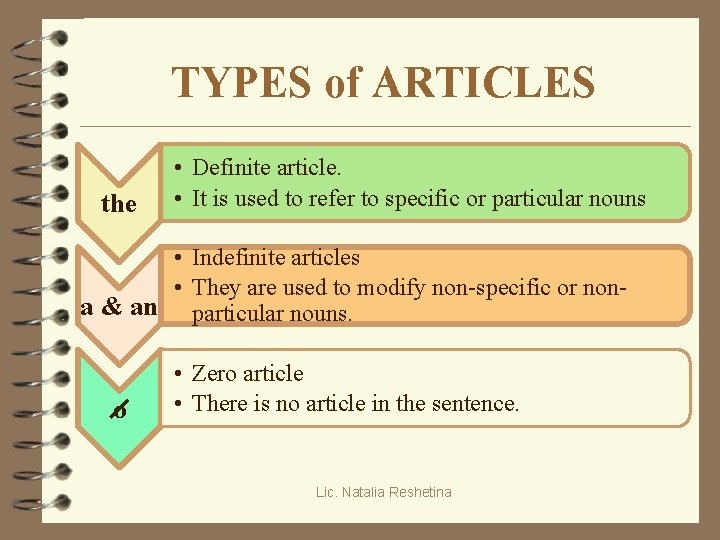
TYPES of ARTICLES the • Definite article. • It is used to refer to specific or particular nouns • Indefinite articles • They are used to modify non-specific or nona & an particular nouns. o • Zero article • There is no article in the sentence. Lic. Natalia Reshetina
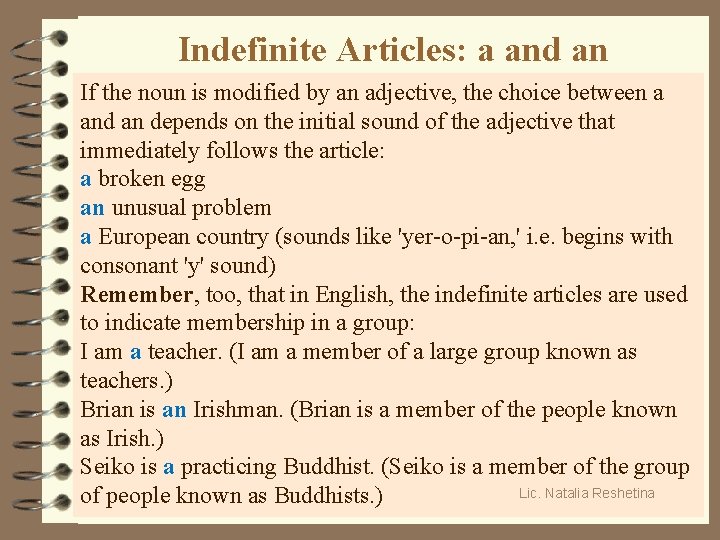
Indefinite Articles: a and an If the noun is modified by an adjective, the choice between a Remember, athat or an that and an depends on the initial soundmodified ofon thethe adjective that begins "A" and "an"using signal thedepends noun issound indefinite, thereferring next word. So. . . immediately follows the article: to any member of a group. For example: +My singular beginning consonant: a boy; a car; a a§a broken eggnounreally daughter wants with a doga for Christmas. bike; a zoo; a dog an unusual This refersproblem to any dog. We don't know which dog because we + singular noun beginning with a vowel: ani. e. elephant; an aan. European country (sounds like 'yer-o-pi-an, ' begins with haven't the yet. egg; an found apple; an dog idiot; an orphan consonant 'y' sound) §a +Somebody callthat a policeman! singular noun beginning withthe a consonant user Remember, too, in English, indefinite sound: articlesaare used (sounds like i. e. consonant 'y' sound, so to indicate membership in abegins group: This refers to'yoo-zer, ' any policeman. Wewith don'ta need a specific 'a'am is aused); a university; apoliceman unicycle Ipoliceman; teacher. (I am any a member of a who largeisgroup known as we need available. In some cases where "h" is pronounced, such as "historical, " teachers. ) § When I was at the zoo, I saw an elephant! use an: Brian is an Irishman. (Brian is a member of the people known Here, we're talking a single, non-specific thing, in this An historical event isabout worth recording. as Irish. ) case an There areevent" probably several elephants at group the In writing, "a historical is more commonly used. Seiko is elephant. a practicing Buddhist. (Seiko is a member of the Lic. Natalia Reshetina of people knownonly as Buddhists. ) zoo, but there's one we're talking about here.
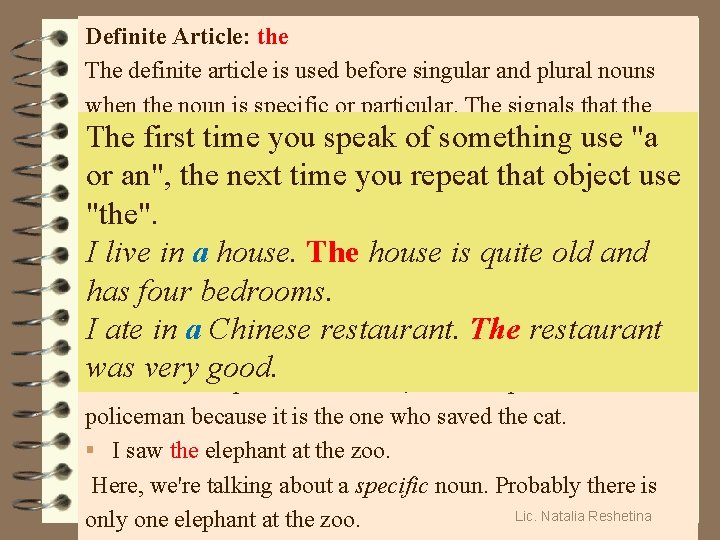
Definite Article: the The definite article is used before singular and plural nouns when the noun is specific or particular. The signals that the The isfirst timethatyou speak something noun definite, it refers to a of particular memberuse of a "a group (a specific object that you both the personthat speaking anduse the or an", the next time repeat object listener "the". know) § The dog that bit me ran away. I live in a house. The house is quite old and Here, we're talking about a specific dog, the dog that bit me. has four bedrooms. § I was happy to see the policeman who saved my cat! IHere, ate we're in a talking Chinese restaurant. The restaurant about a particular policeman. Even if we was know verythe good. don't policeman's name, it's still a particular policeman because it is the one who saved the cat. § I saw the elephant at the zoo. Here, we're talking about a specific noun. Probably there is Lic. Natalia Reshetina only one elephant at the zoo.
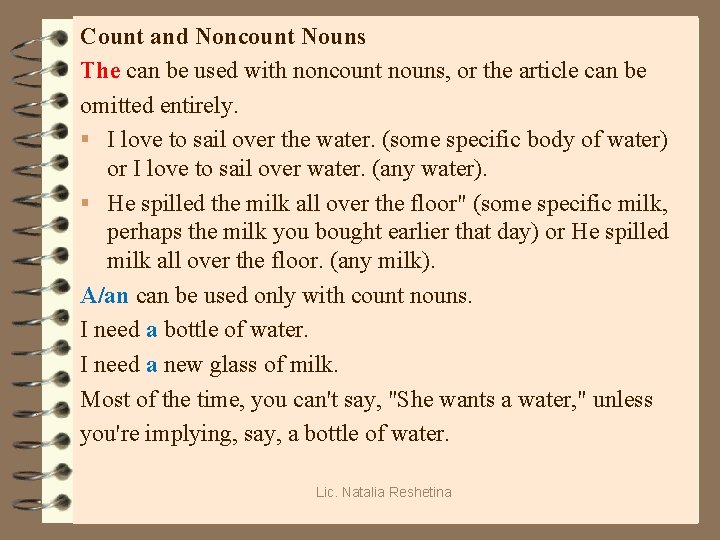
Count and Noncount Nouns The can be used with noncount nouns, or the article can be omitted entirely. § I love to sail over the water. (some specific body of water) or I love to sail over water. (any water). § He spilled the milk all over the floor" (some specific milk, perhaps the milk you bought earlier that day) or He spilled milk all over the floor. (any milk). A/an can be used only with count nouns. I need a bottle of water. I need a new glass of milk. Most of the time, you can't say, "She wants a water, " unless you're implying, say, a bottle of water. Lic. Natalia Reshetina
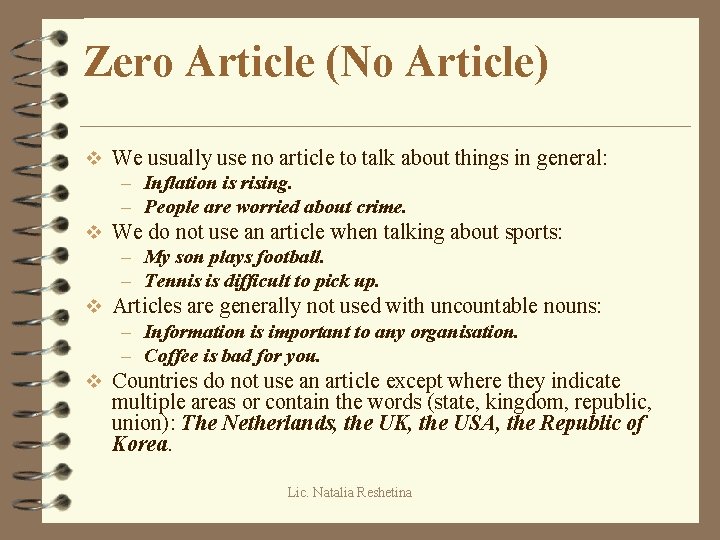
Zero Article (No Article) v We usually use no article to talk about things in general: – Inflation is rising. – People are worried about crime. v We do not use an article when talking about sports: – My son plays football. – Tennis is difficult to pick up. v Articles are generally not used with uncountable nouns: – Information is important to any organisation. – Coffee is bad for you. v Countries do not use an article except where they indicate multiple areas or contain the words (state, kingdom, republic, union): The Netherlands, the UK, the USA, the Republic of Korea. Lic. Natalia Reshetina
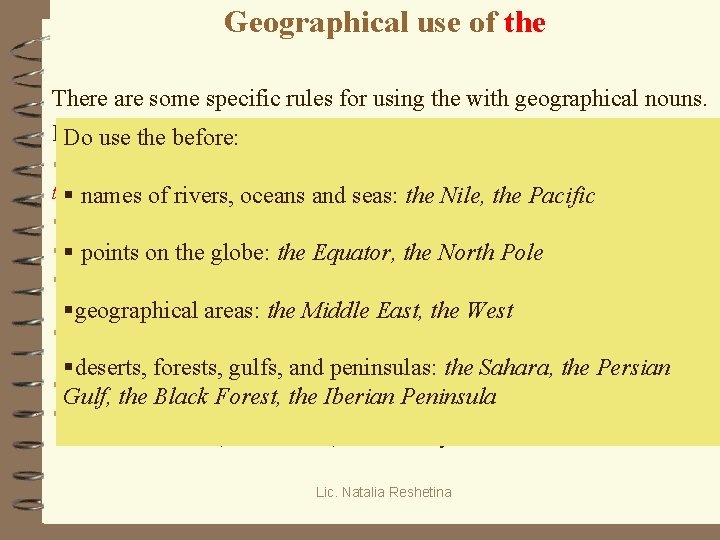
Geographical use of the There are some specific rules for using the with geographical nouns. Do before: Donot useuse thethe before: names of most countries/territories: Italy, Mexico, Bolivia; however, the Netherlands, the Dominican United States § names of rivers, oceans Republic, and seas: the. Philippines, Nile, the Pacific § names of cities, towns, or states: Seoul, Manitoba, Miami § § names streets: Washington Blvd. , Main St. North Pole pointsofon the globe: the Equator, the § names of lakes and bays: Lake Titicaca, Lake Erie except with a group of lakes like the Great Lakes §geographical areas: the Middle East, the West § names of mountains: Mount Everest, Mount Fuji except with ranges of mountains like the Andes or the Rockies or unusual names like the Matterhorn §deserts, forests, gulfs, and peninsulas: the Sahara, the Persian § names of continents (Asia, Europe) Gulf, the Black Forest, the Iberian Peninsula § names of islands (Easter Island, Maui, Key West) except with island chains like the Aleutians, the Hebrides, or the Canary Islands § Lic. Natalia Reshetina
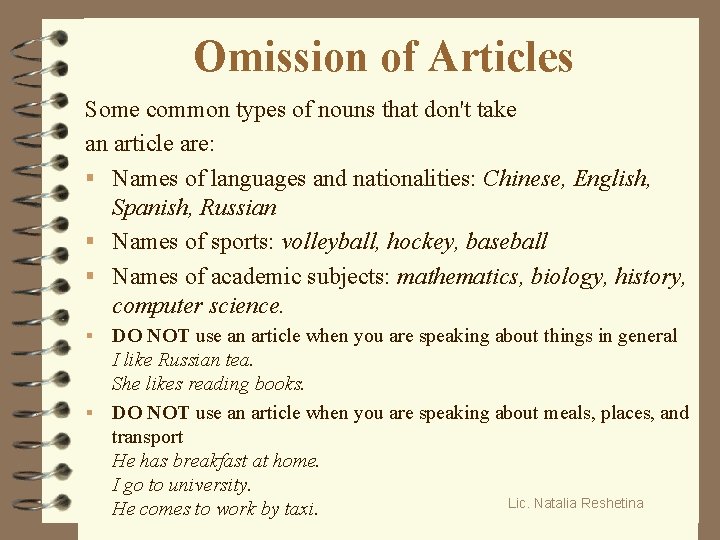
Omission of Articles Some common types of nouns that don't take an article are: § Names of languages and nationalities: Chinese, English, Spanish, Russian § Names of sports: volleyball, hockey, baseball § Names of academic subjects: mathematics, biology, history, computer science. DO NOT use an article when you are speaking about things in general I like Russian tea. She likes reading books. § DO NOT use an article when you are speaking about meals, places, and transport He has breakfast at home. I go to university. Lic. Natalia Reshetina He comes to work by taxi. §
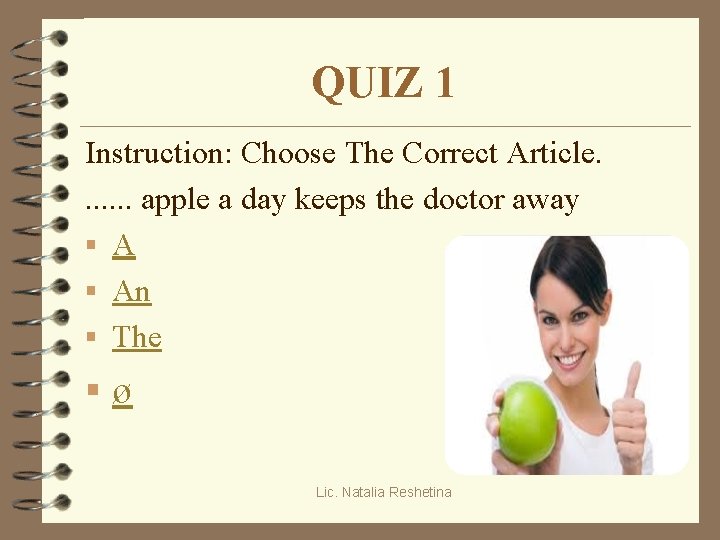
QUIZ 1 Instruction: Choose The Correct Article. . . . apple a day keeps the doctor away § An § The §ø Lic. Natalia Reshetina
Lic. Natalia Reshetina
Lic. Natalia Reshetina
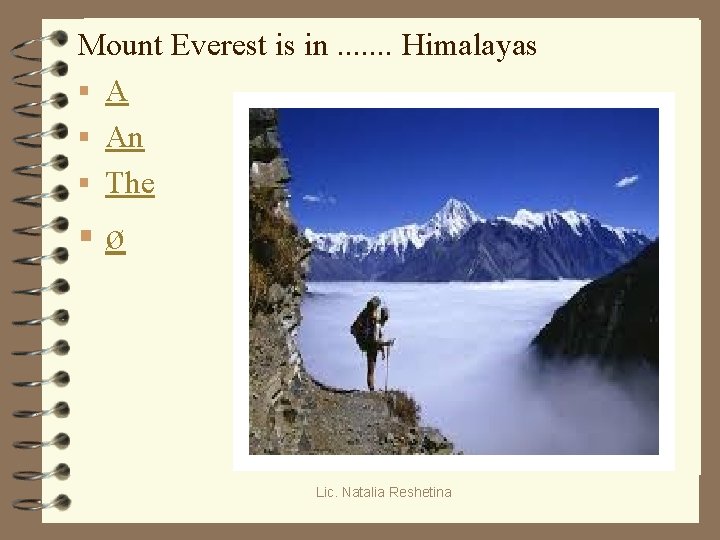
Mount Everest is in. . . . Himalayas § An § The §ø Lic. Natalia Reshetina
Lic. Natalia Reshetina
Lic. Natalia Reshetina
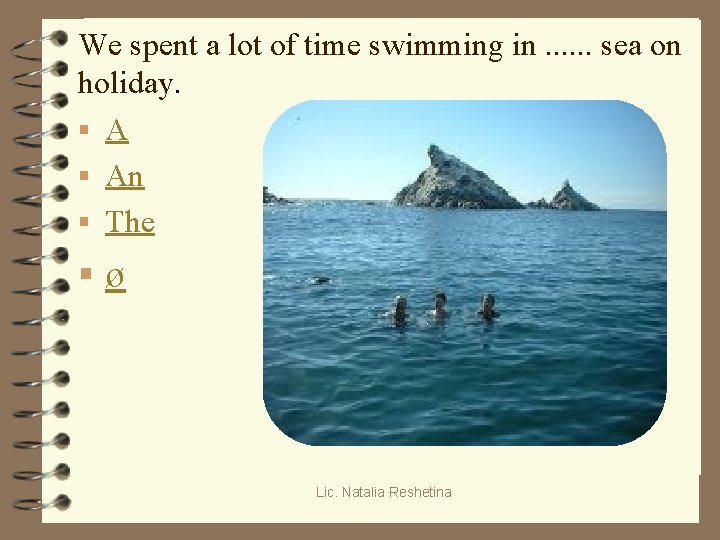
We spent a lot of time swimming in. . . sea on holiday. § An § The §ø Lic. Natalia Reshetina
Lic. Natalia Reshetina
Lic. Natalia Reshetina
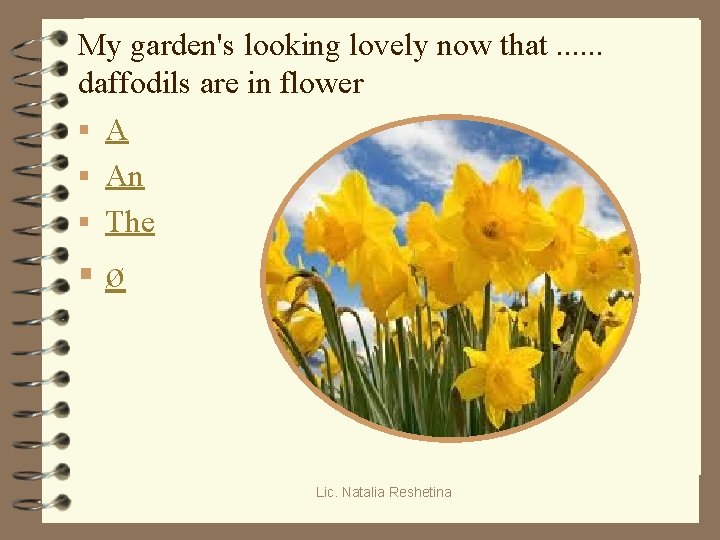
My garden's looking lovely now that. . . daffodils are in flower § An § The §ø Lic. Natalia Reshetina
Lic. Natalia Reshetina
Lic. Natalia Reshetina
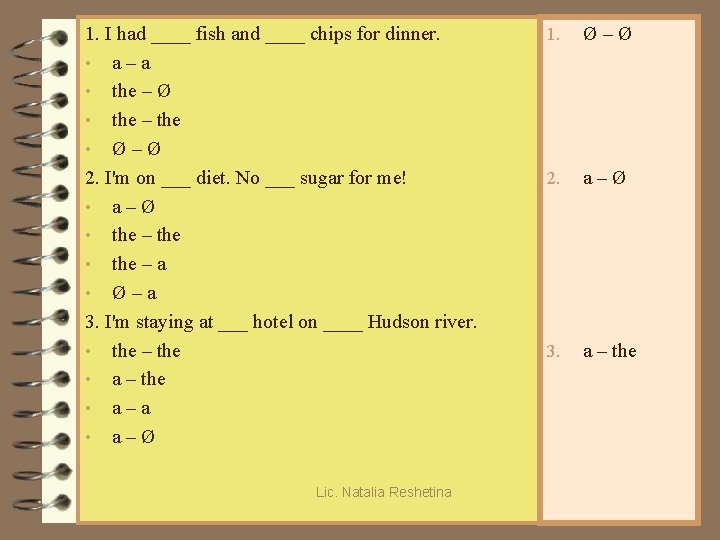
1. I had ____ fish and ____ chips for dinner. • a–a • the – Ø • the – the • Ø–Ø 2. I'm on ___ diet. No ___ sugar for me! • a–Ø • the – the • the – a • Ø–a 3. I'm staying at ___ hotel on ____ Hudson river. • the – the • a–a • a–Ø Lic. Natalia Reshetina 1. Ø–Ø 2. a–Ø 3. a – the
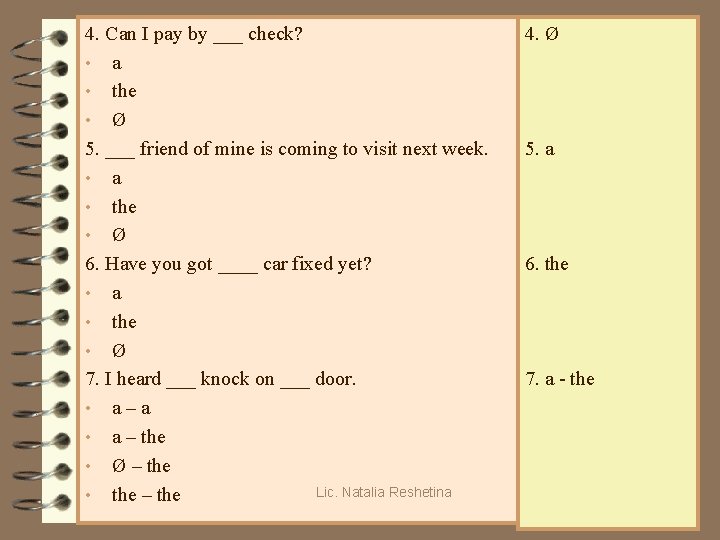
4. Can I pay by ___ check? • a • the • Ø 5. ___ friend of mine is coming to visit next week. • a • the • Ø 6. Have you got ____ car fixed yet? • a • the • Ø 7. I heard ___ knock on ___ door. • a–a • a – the • Ø – the Lic. Natalia Reshetina • the – the 4. Ø 5. a 6. the 7. a - the
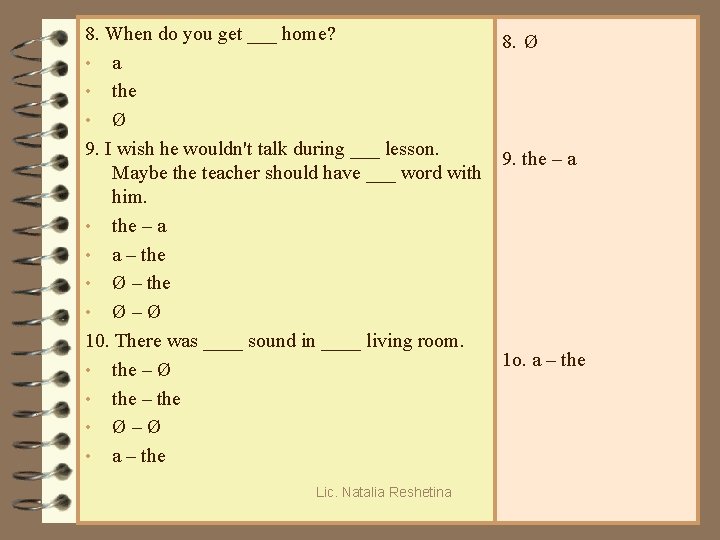
8. When do you get ___ home? 8. Ø • a • the • Ø 9. I wish he wouldn't talk during ___ lesson. 9. the – a Maybe the teacher should have ___ word with him. • the – a • a – the • Ø–Ø 10. There was ____ sound in ____ living room. 1 o. a – the • the – Ø • the – the • Ø–Ø • a – the Lic. Natalia Reshetina