Stoichiometry Limiting Reagent Reactant Dr Ron Rusay Limiting
- Slides: 23
Stoichiometry Limiting Reagent (Reactant) Dr. Ron Rusay
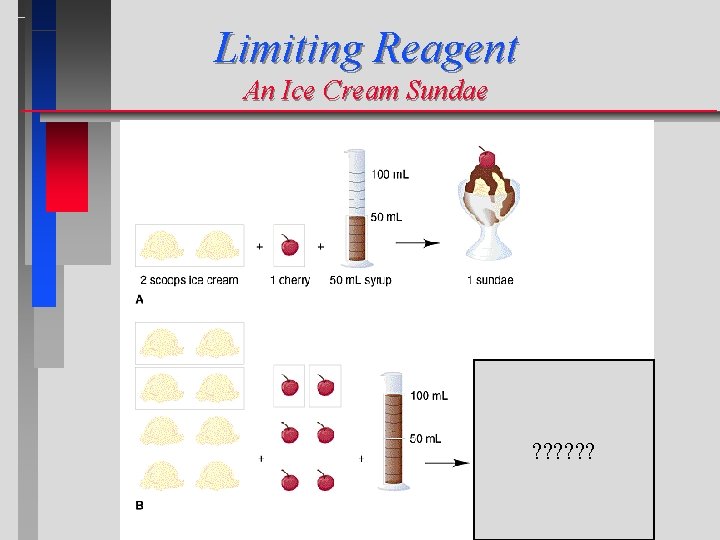
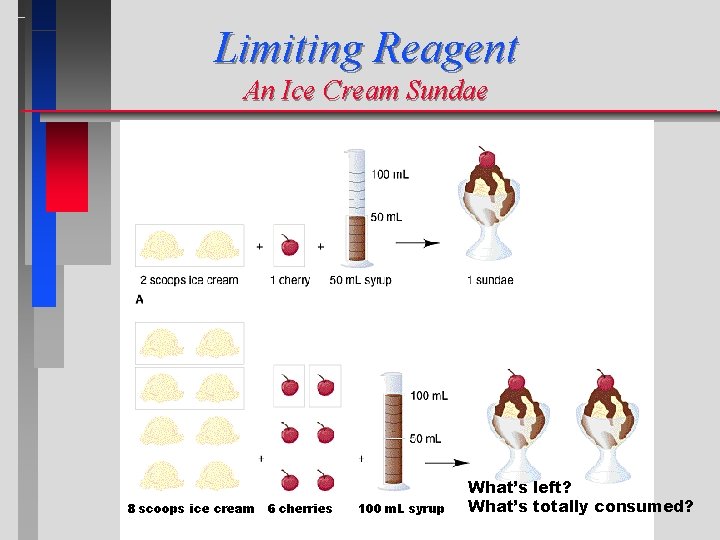
Limiting Reagent An Ice Cream Sundae ? ? ?
Limiting Reagent An Ice Cream Sundae 8 scoops ice cream 6 cherries 100 m. L syrup What’s left? What’s totally consumed?
Limiting Reagent
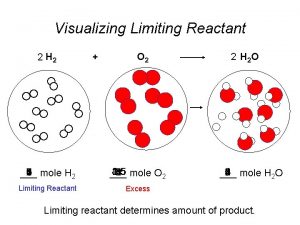
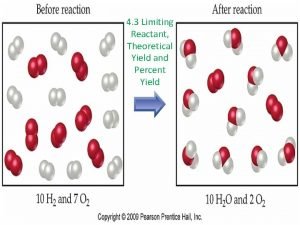
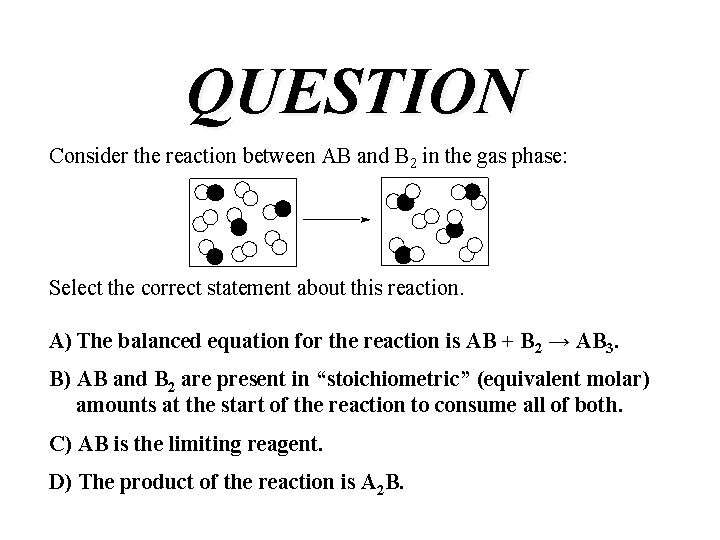
QUESTION Consider the reaction between AB and B 2 in the gas phase: Select the correct statement about this reaction. A) The balanced equation for the reaction is AB + B 2 → AB 3. B) AB and B 2 are present in “stoichiometric” (equivalent molar) amounts at the start of the reaction to consume all of both. C) AB is the limiting reagent. D) The product of the reaction is A 2 B.
QUESTION
http: //www. cnafun. moa. gov. cn/zl/tjzl/201306/P 020130620619849846691. pdf QUESTION
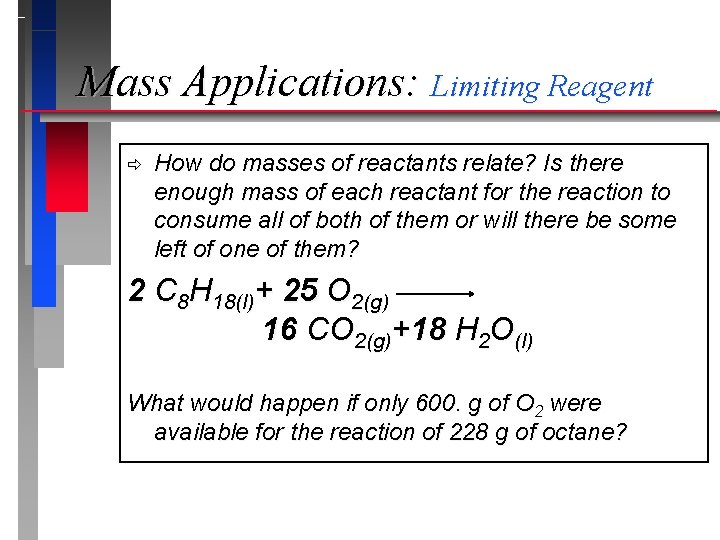
Mass Applications: Limiting Reagent ð How do masses of reactants relate? Is there enough mass of each reactant for the reaction to consume all of both of them or will there be some left of one of them? 2 C 8 H 18(l)+ 25 O 2(g) 16 CO 2(g)+18 H 2 O(l) What would happen if only 600. g of O 2 were available for the reaction of 228 g of octane?
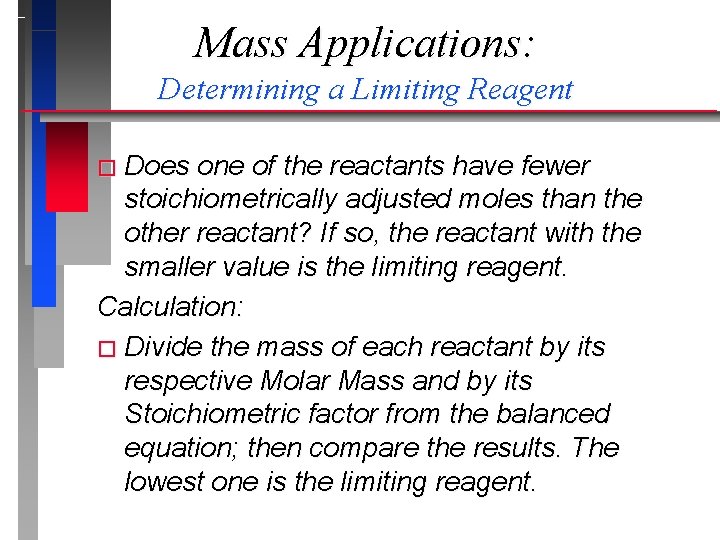
Mass Applications: Determining a Limiting Reagent � Does one of the reactants have fewer stoichiometrically adjusted moles than the other reactant? If so, the reactant with the smaller value is the limiting reagent. Calculation: � Divide the mass of each reactant by its respective Molar Mass and by its Stoichiometric factor from the balanced equation; then compare the results. The lowest one is the limiting reagent.
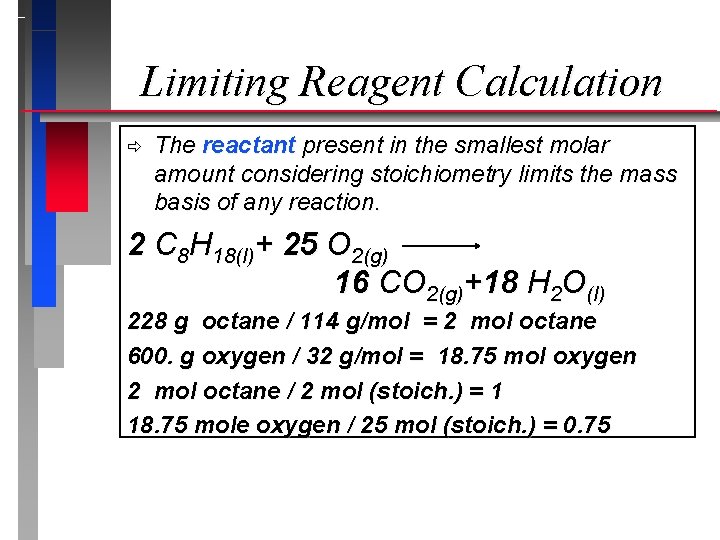
Limiting Reagent Calculation ð The reactant present in the smallest molar amount considering stoichiometry limits the mass basis of any reaction. 2 C 8 H 18(l)+ 25 O 2(g) 16 CO 2(g)+18 H 2 O(l) 228 g octane / 114 g/mol = 2 mol octane 600. g oxygen / 32 g/mol = 18. 75 mol oxygen 2 mol octane / 2 mol (stoich. ) = 1 18. 75 mole oxygen / 25 mol (stoich. ) = 0. 75
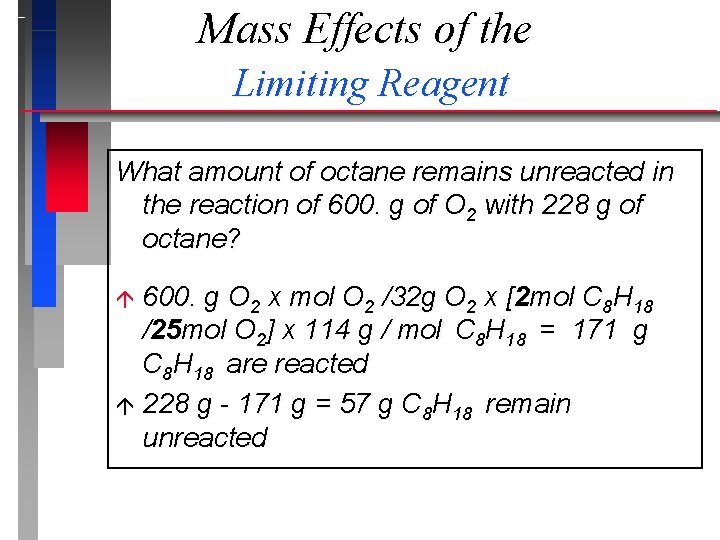
Mass Effects of the Limiting Reagent What amount of octane remains unreacted in the reaction of 600. g of O 2 with 228 g of octane? 600. g O 2 x mol O 2 /32 g O 2 x [2 mol C 8 H 18 /25 mol O 2] x 114 g / mol C 8 H 18 = 171 g C 8 H 18 are reacted á 228 g - 171 g = 57 g C 8 H 18 remain unreacted á
QUESTION
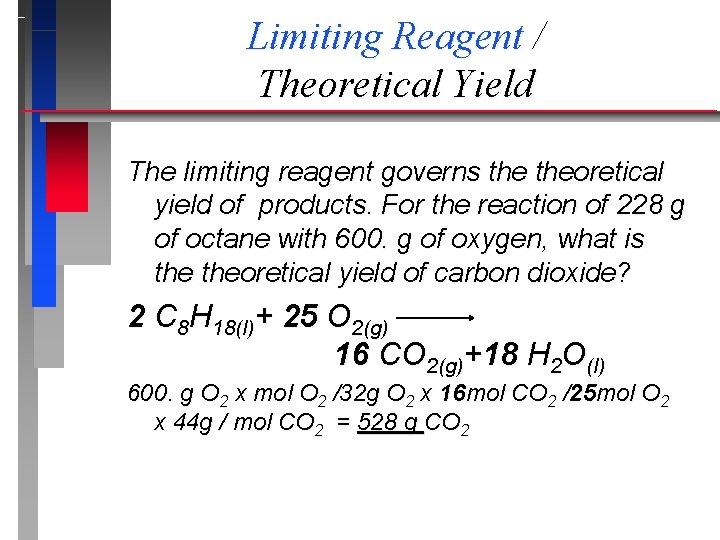
Limiting Reagent / Theoretical Yield The limiting reagent governs theoretical yield of products. For the reaction of 228 g of octane with 600. g of oxygen, what is theoretical yield of carbon dioxide? 2 C 8 H 18(l)+ 25 O 2(g) 16 CO 2(g)+18 H 2 O(l) 600. g O 2 x mol O 2 /32 g O 2 x 16 mol CO 2 /25 mol O 2 x 44 g / mol CO 2 = 528 g CO 2
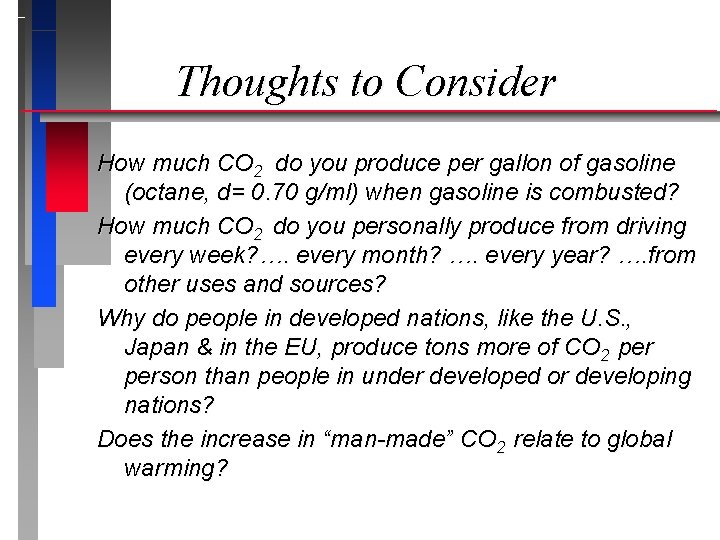
Thoughts to Consider How much CO 2 do you produce per gallon of gasoline (octane, d= 0. 70 g/ml) when gasoline is combusted? How much CO 2 do you personally produce from driving every week? …. every month? …. every year? …. from other uses and sources? Why do people in developed nations, like the U. S. , Japan & in the EU, produce tons more of CO 2 person than people in under developed or developing nations? Does the increase in “man-made” CO 2 relate to global warming?
Greenhouse Gases: The Chemistry of Warming
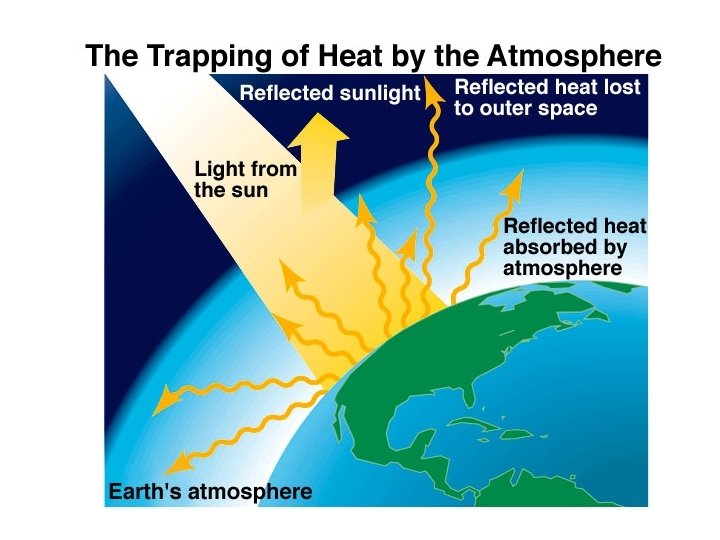
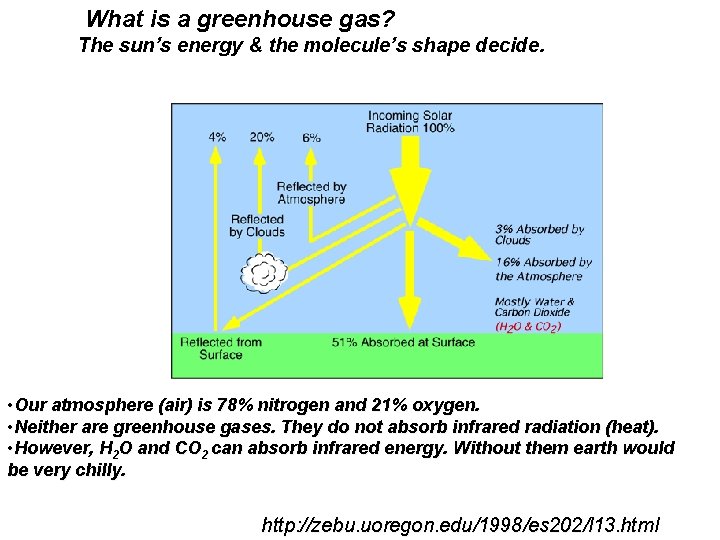
What is a greenhouse gas? The sun’s energy & the molecule’s shape decide. • Our atmosphere (air) is 78% nitrogen and 21% oxygen. • Neither are greenhouse gases. They do not absorb infrared radiation (heat). • However, H 2 O and CO 2 can absorb infrared energy. Without them earth would be very chilly. http: //zebu. uoregon. edu/1998/es 202/l 13. html
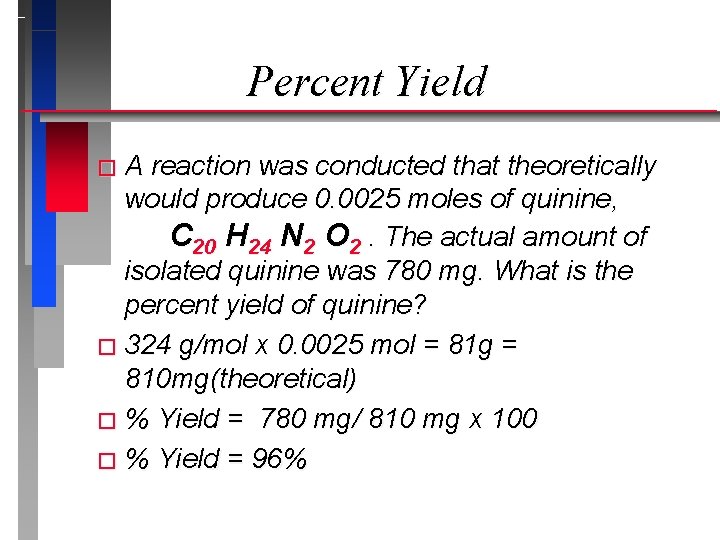
Percent Yield In synthesis, the actual yield (g) is measured and compared to theoretical yield (g). This is the percent yield: % Yield = actual (g) / theoretical (g) x 100 Theoretical yield is the 100% yield based on calculation. Some DVC Chem 226 students will have percent yields greater than 100% in their first synthesis experiment. Hmmm? . . . . Why is this not possible?
Percent Yield �A reaction was conducted that theoretically would produce 0. 0025 moles of quinine, C 20 H 24 N 2 O 2. The actual amount of isolated quinine was 780 mg. What is the percent yield of quinine? � 324 g/mol x 0. 0025 mol = 81 g = 810 mg(theoretical) � % Yield = 780 mg/ 810 mg x 100 � % Yield = 96%
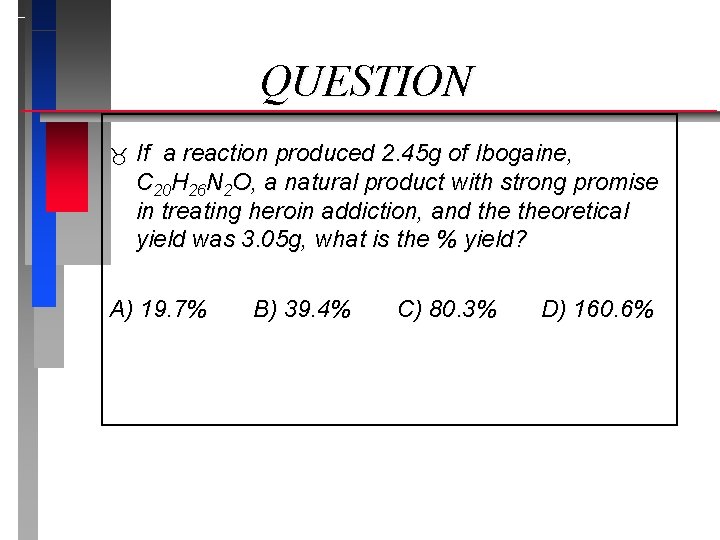
QUESTION If a reaction produced 2. 45 g of Ibogaine, C 20 H 26 N 2 O, a natural product with strong promise in treating heroin addiction, and theoretical yield was 3. 05 g, what is the % yield? A) 19. 7% B) 39. 4% C) 80. 3% D) 160. 6%
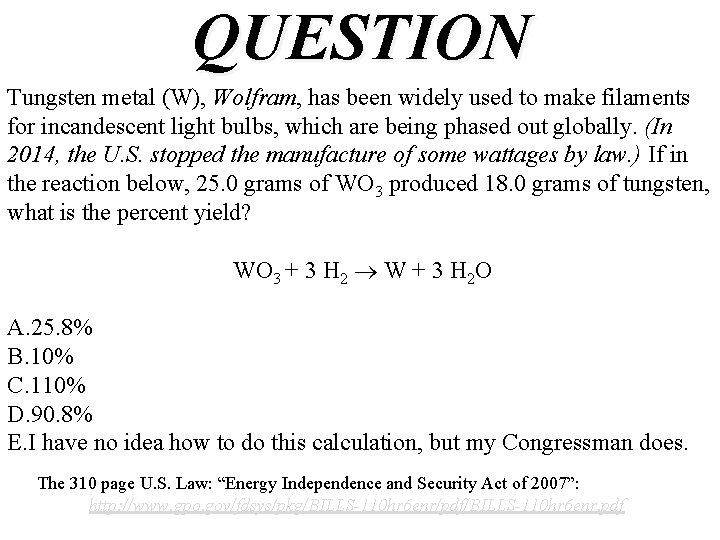
QUESTION Tungsten metal (W), Wolfram, has been widely used to make filaments for incandescent light bulbs, which are being phased out globally. (In 2014, the U. S. stopped the manufacture of some wattages by law. ) If in the reaction below, 25. 0 grams of WO 3 produced 18. 0 grams of tungsten, what is the percent yield? WO 3 + 3 H 2 W + 3 H 2 O A. 25. 8% B. 10% C. 110% D. 90. 8% E. I have no idea how to do this calculation, but my Congressman does. The 310 page U. S. Law: “Energy Independence and Security Act of 2007”: http: //www. gpo. gov/fdsys/pkg/BILLS-110 hr 6 enr/pdf/BILLS-110 hr 6 enr. pdf
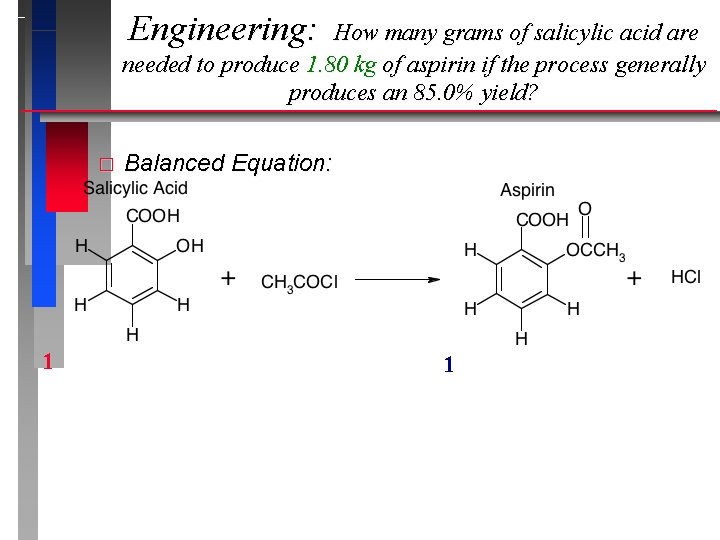
Engineering: How many grams of salicylic acid are needed to produce 1. 80 kg of aspirin if the process generally produces an 85. 0% yield? � 1 Balanced Equation: 1
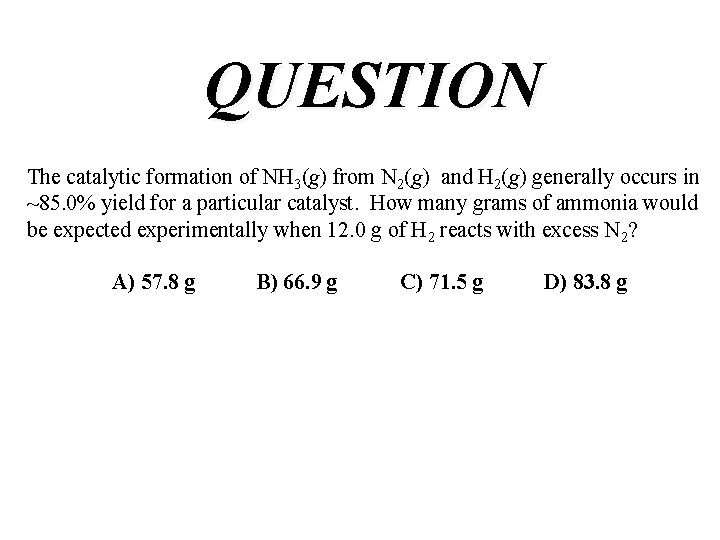
QUESTION The catalytic formation of NH 3(g) from N 2(g) and H 2(g) generally occurs in ~85. 0% yield for a particular catalyst. How many grams of ammonia would be expected experimentally when 12. 0 g of H 2 reacts with excess N 2? A) 57. 8 g B) 66. 9 g C) 71. 5 g D) 83. 8 g