
Limiting Reagents Caution this stuff is difficult to

- Slides: 18
Limiting Reagents Caution: this stuff is difficult to follow at first. Be patient.
Balloon & Flask Demonstration 1 2 3 g of Na. HCO 3 10 10 10 m. L of 3 M HCl 25 50 100 How can we prove that our conclusions about limiting reagents is correct?
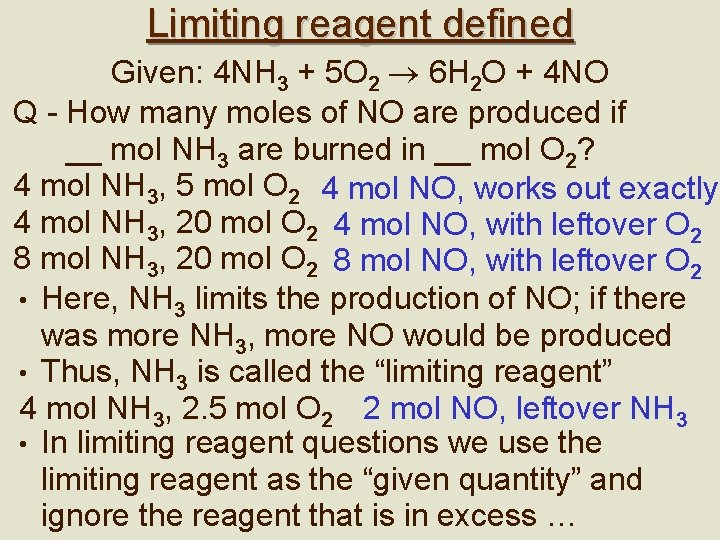
Limiting reagent defined Given: 4 NH 3 + 5 O 2 6 H 2 O + 4 NO Q - How many moles of NO are produced if __ mol NH 3 are burned in __ mol O 2? 4 mol NH 3, 5 mol O 2 4 mol NO, works out exactly 4 mol NH 3, 20 mol O 2 4 mol NO, with leftover O 2 8 mol NH 3, 20 mol O 2 8 mol NO, with leftover O 2 • Here, NH 3 limits the production of NO; if there was more NH 3, more NO would be produced • Thus, NH 3 is called the “limiting reagent” 4 mol NH 3, 2. 5 mol O 2 2 mol NO, leftover NH 3 • In limiting reagent questions we use the limiting reagent as the “given quantity” and ignore the reagent that is in excess …
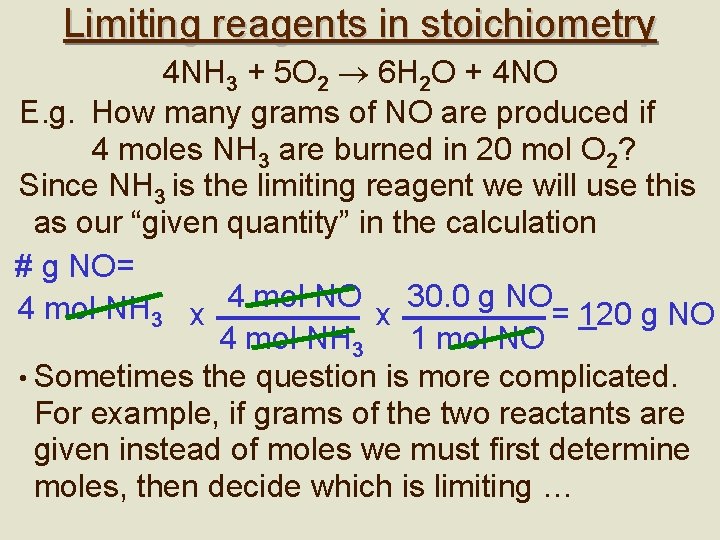
Limiting reagents in stoichiometry 4 NH 3 + 5 O 2 6 H 2 O + 4 NO E. g. How many grams of NO are produced if 4 moles NH 3 are burned in 20 mol O 2? Since NH 3 is the limiting reagent we will use this as our “given quantity” in the calculation # g NO= 4 mol NH 3 x 4 mol NO x 30. 0 g NO= 120 g NO 4 mol NH 3 1 mol NO • Sometimes the question is more complicated. For example, if grams of the two reactants are given instead of moles we must first determine moles, then decide which is limiting …
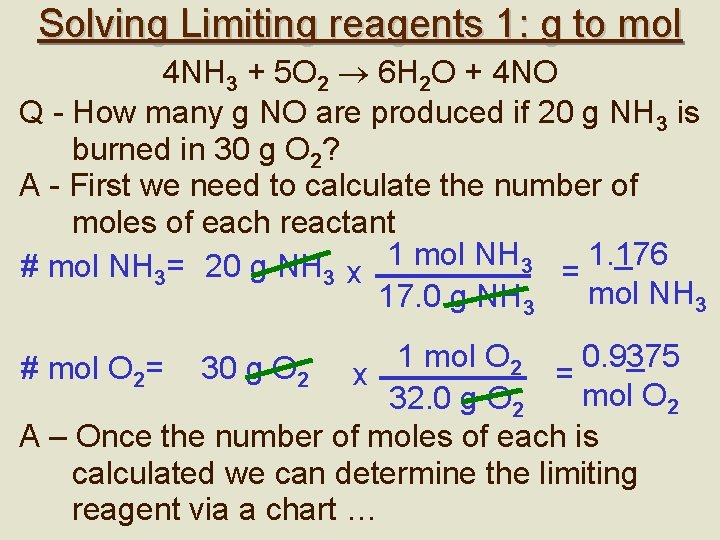
Solving Limiting reagents 1: g to mol 4 NH 3 + 5 O 2 6 H 2 O + 4 NO Q - How many g NO are produced if 20 g NH 3 is burned in 30 g O 2? A - First we need to calculate the number of moles of each reactant # mol NH 3= 20 g NH 3 x 1 mol NH 3 = 1. 176 mol NH 3 17. 0 g NH 3 1 mol O 2 0. 9375 x = mol O 2 32. 0 g O 2 A – Once the number of moles of each is calculated we can determine the limiting reagent via a chart … # mol O 2= 30 g O 2
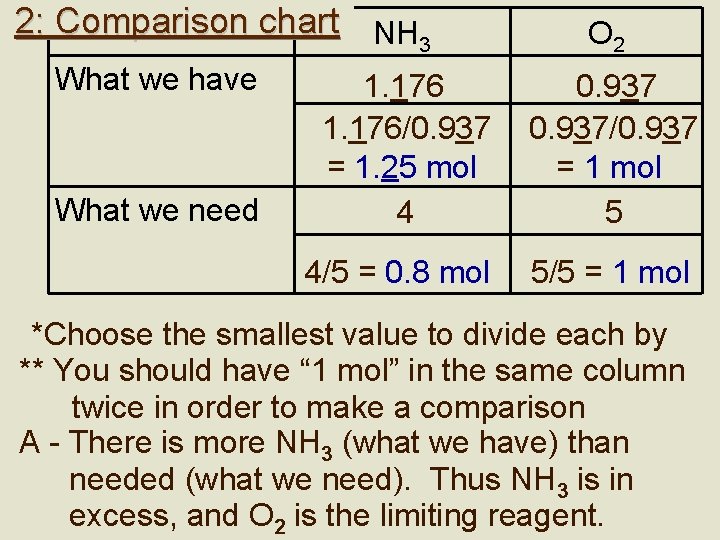
2: Comparison chart NH 3 What we have What we need O 2 1. 176/0. 937 = 1. 25 mol 4 0. 937/0. 937 = 1 mol 5 4/5 = 0. 8 mol 5/5 = 1 mol *Choose the smallest value to divide each by ** You should have “ 1 mol” in the same column twice in order to make a comparison A - There is more NH 3 (what we have) than needed (what we need). Thus NH 3 is in excess, and O 2 is the limiting reagent.
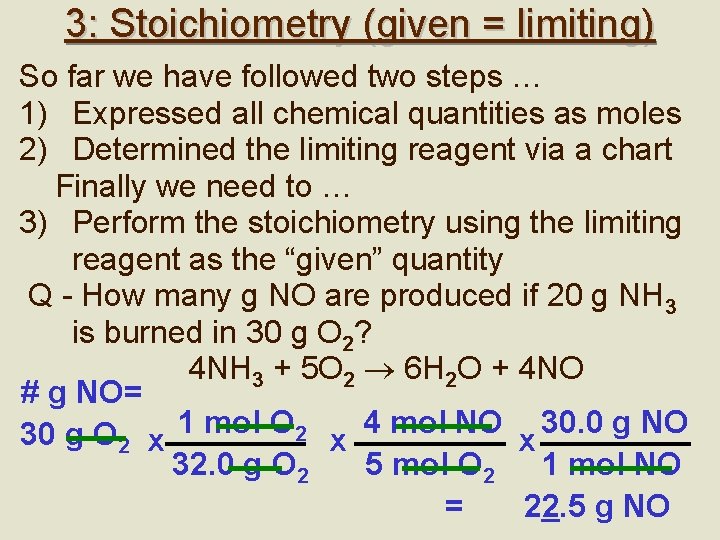
3: Stoichiometry (given = limiting) So far we have followed two steps … 1) Expressed all chemical quantities as moles 2) Determined the limiting reagent via a chart Finally we need to … 3) Perform the stoichiometry using the limiting reagent as the “given” quantity Q - How many g NO are produced if 20 g NH 3 is burned in 30 g O 2? 4 NH 3 + 5 O 2 6 H 2 O + 4 NO # g NO= 30 g O 2 x 1 mol O 2 x 4 mol NO x 30. 0 g NO 32. 0 g O 2 5 mol O 2 1 mol NO = 22. 5 g NO
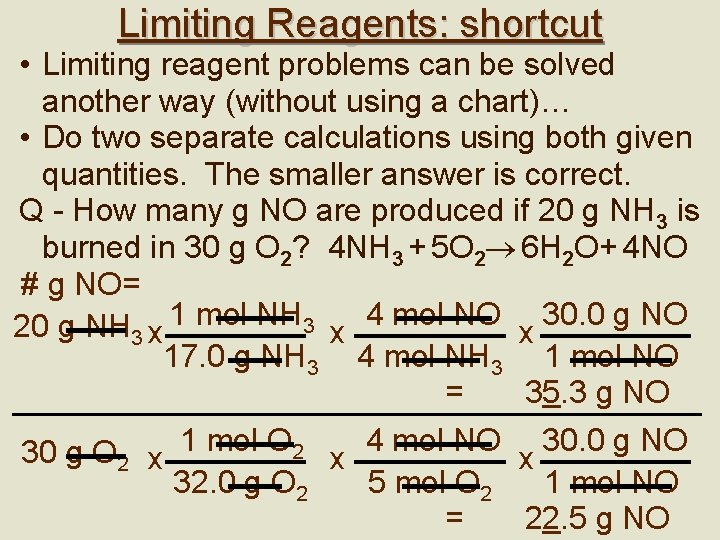
Limiting Reagents: shortcut • Limiting reagent problems can be solved another way (without using a chart)… • Do two separate calculations using both given quantities. The smaller answer is correct. Q - How many g NO are produced if 20 g NH 3 is burned in 30 g O 2? 4 NH 3 + 5 O 2 6 H 2 O+ 4 NO # g NO= 20 g NH 3 x 1 mol NH 3 x 4 mol NO x 30. 0 g NO 17. 0 g NH 3 4 mol NH 3 1 mol NO = 35. 3 g NO 30 g O 2 x 1 mol O 2 x 4 mol NO x 30. 0 g NO 32. 0 g O 2 5 mol O 2 1 mol NO = 22. 5 g NO
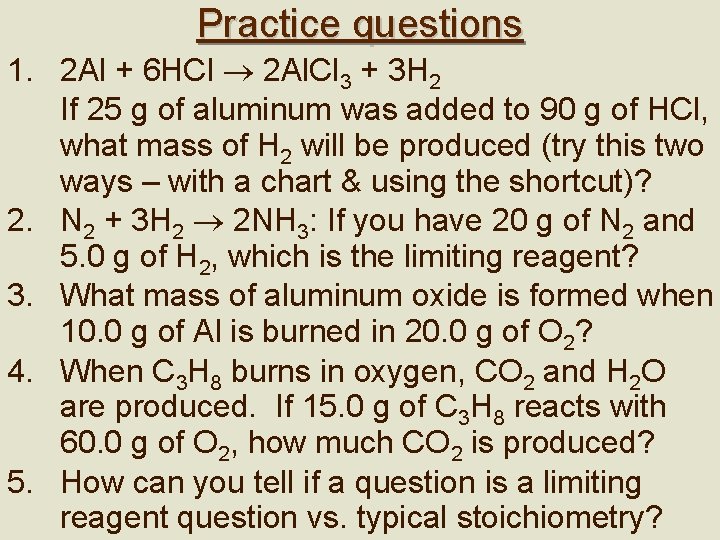
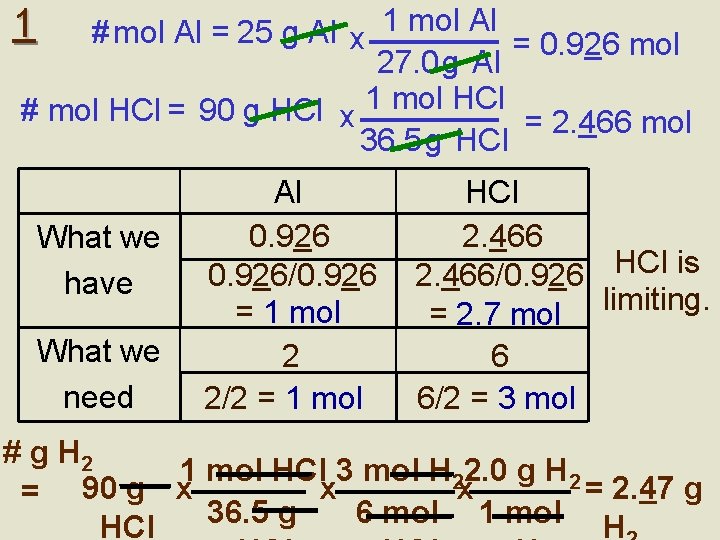
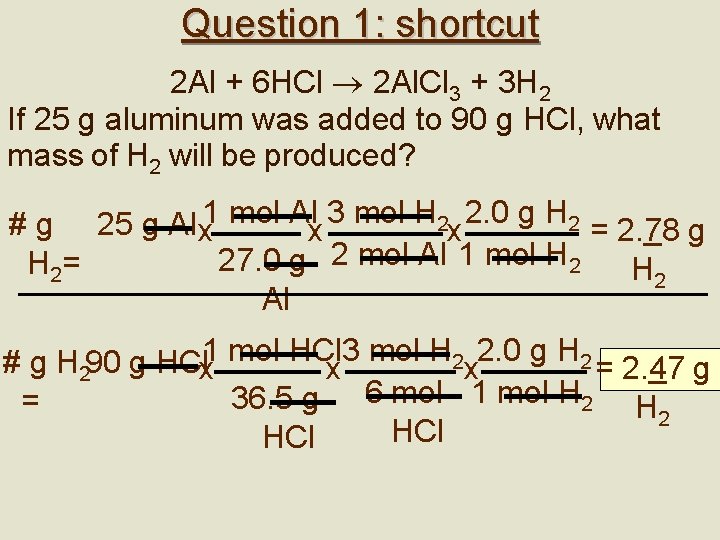
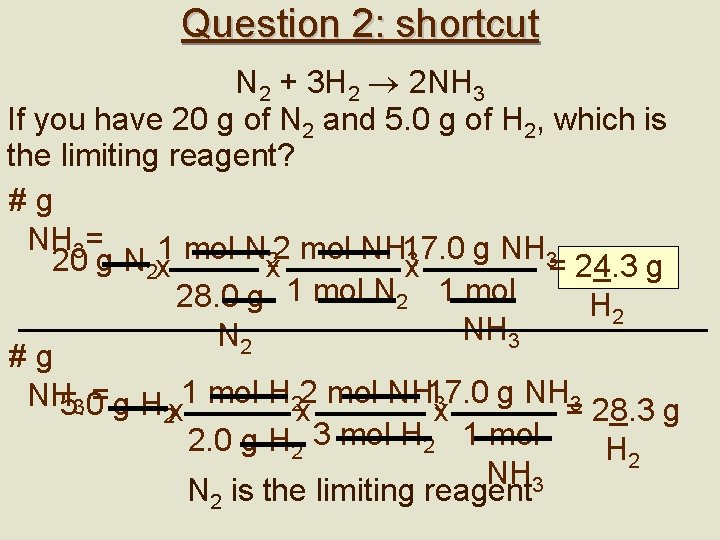
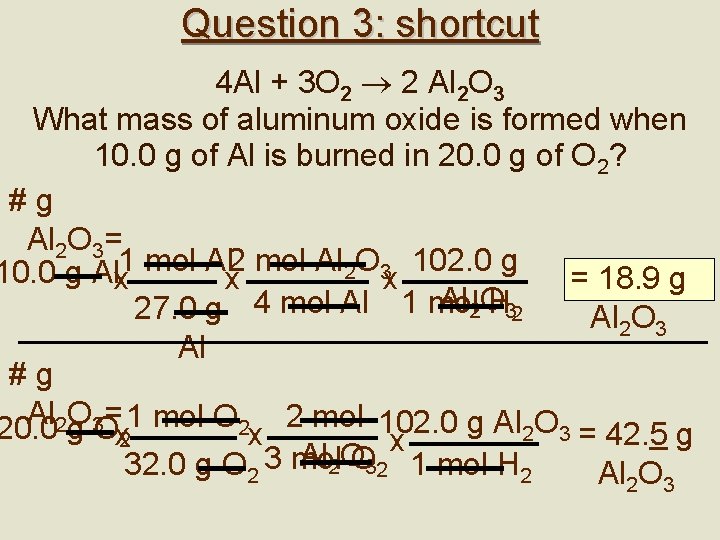
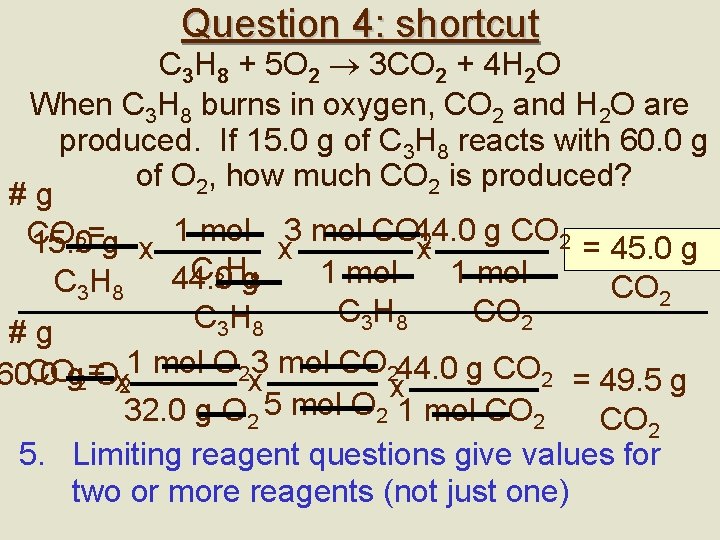
Practice questions 1. 2 Al + 6 HCl 2 Al. Cl 3 + 3 H 2 If 25 g of aluminum was added to 90 g of HCl, what mass of H 2 will be produced (try this two ways – with a chart & using the shortcut)? 2. N 2 + 3 H 2 2 NH 3: If you have 20 g of N 2 and 5. 0 g of H 2, which is the limiting reagent? 3. What mass of aluminum oxide is formed when 10. 0 g of Al is burned in 20. 0 g of O 2? 4. When C 3 H 8 burns in oxygen, CO 2 and H 2 O are produced. If 15. 0 g of C 3 H 8 reacts with 60. 0 g of O 2, how much CO 2 is produced? 5. How can you tell if a question is a limiting reagent question vs. typical stoichiometry?
1 # mol Al = 25 g Al x 1 mol Al = 0. 926 mol 27. 0 g Al # mol HCl = 90 g HCl x 1 mol HCl = 2. 466 mol 36. 5 g HCl What we have What we need Al 0. 926/0. 926 = 1 mol 2 2/2 = 1 mol HCl 2. 466/0. 926 HCl is limiting. = 2. 7 mol 6 6/2 = 3 mol # g H 2 1 mol HCl 3 mol H 22. 0 g H 2 x x = 2. 47 g = 90 g x 36. 5 g 6 mol 1 mol HCl H
Question 1: shortcut 2 Al + 6 HCl 2 Al. Cl 3 + 3 H 2 If 25 g aluminum was added to 90 g HCl, what mass of H 2 will be produced? # g 25 g Al x 1 mol Alx 3 mol H 2 x 2. 0 g H 2 = 2. 78 g 27. 0 g 2 mol Al 1 mol H 2= H 2 Al 3 mol H 2 2. 0 g H 2 # g H 290 g HClx 1 mol HCl x = 2. 47 g x 36. 5 g 6 mol 1 mol H 2 H = 2 HCl
Question 2: shortcut N 2 + 3 H 2 2 NH 3 If you have 20 g of N 2 and 5. 0 g of H 2, which is the limiting reagent? #g NH 3= g NH 3 3 20 g N 2 x 1 mol Nx 22 mol NH 17. 0 x = 24. 3 g 28. 0 g 1 mol N 2 1 mol H 2 NH 3 N 2 #g 2 mol NH 17. 0 g NH 3 NH 5. 0 3 3 = g H 2 x 1 mol H 2 x x = 28. 3 g 2. 0 g H 2 3 mol H 2 1 mol H 2 NH 3 N 2 is the limiting reagent
Question 3: shortcut 4 Al + 3 O 2 2 Al 2 O 3 What mass of aluminum oxide is formed when 10. 0 g of Al is burned in 20. 0 g of O 2? #g Al 2 O 3= 10. 0 g Alx 1 mol Alx 2 mol Al 2 O 3 x 10². 0 g = 18. 9 g Al 2 O H 32 27. 0 g 4 mol Al 1 mol Al 2 O 3 Al #g Al O = 2 3 g Al 2 O 3 = 42. 5 g 20. 0 g Ox 21 mol O 2 x 2 mol 102. 0 x Al 2 OO 32 1 mol H 32. 0 g O 2 3 mol 2 Al O 2 3
Question 4: shortcut C 3 H 8 + 5 O 2 3 CO 2 + 4 H 2 O When C 3 H 8 burns in oxygen, CO 2 and H 2 O are produced. If 15. 0 g of C 3 H 8 reacts with 60. 0 g of O 2, how much CO 2 is produced? #g g CO 2 2=g x 1 mol x 3 mol CO 44. 0 15. 0 = 45. 0 g x C 3 Hg 8 1 mol C 3 H 8 44. 0 CO 2 C 3 H 8 CO 2 C H 3 8 #g COg 2=Ox 21 mol O 2 x 3 mol CO 2 x 44. 0 g CO 2 = 49. 5 g 60. 0 32. 0 g O 2 5 mol O 2 1 mol CO 2 5. Limiting reagent questions give values for two or more reagents (not just one)
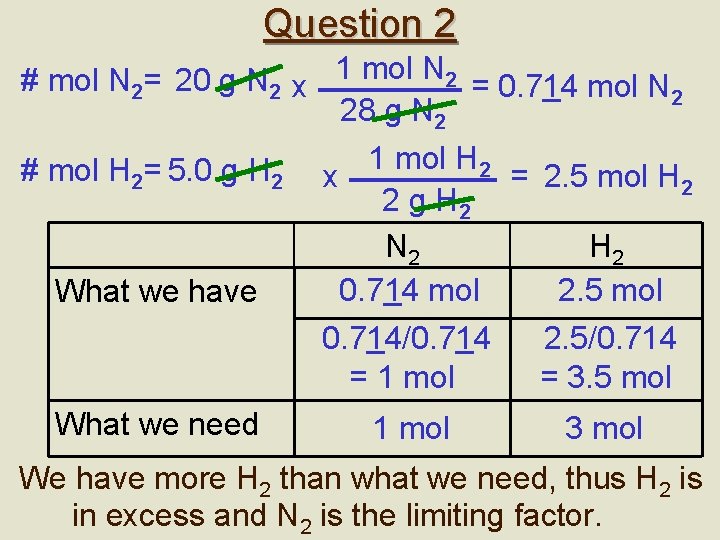
Question 2 # mol N 2= 20 g N 2 x 1 mol N 2 = 0. 714 mol N 2 28 g N 2 # mol H 2= 5. 0 g H 2 x 1 mol H 2 = 2. 5 mol H 2 2 g H 2 N 2 H 2 0. 714 mol 2. 5 mol What we have 0. 714/0. 714 2. 5/0. 714 = 1 mol = 3. 5 mol What we need 1 mol 3 mol We have more H 2 than what we need, thus H 2 is in excess and N 2 is the limiting factor.
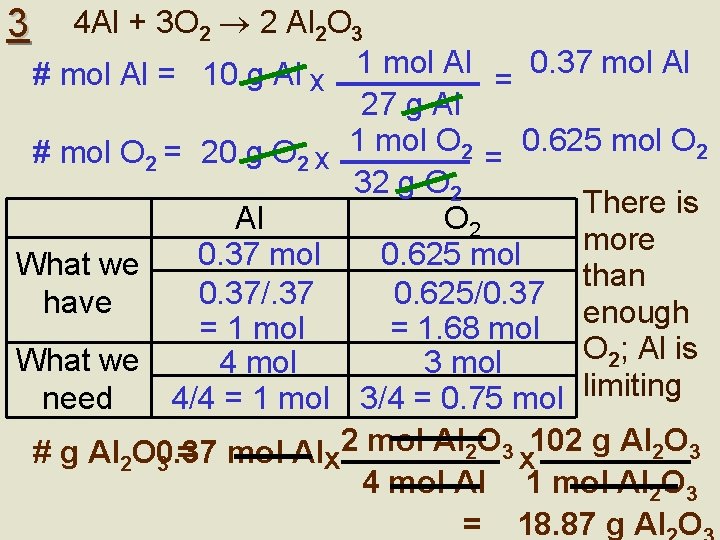
3 4 Al + 3 O 2 2 Al 2 O 3 # mol Al = 10 g Al x 1 mol Al = 0. 37 mol Al 27 g Al # mol O 2 = 20 g O 2 x 1 mol O 2 = 0. 625 mol O 2 32 g O 2 There is Al O 2 more 0. 37 mol 0. 625 mol What we than 0. 37/. 37 0. 625/0. 37 have enough = 1 mol = 1. 68 mol O ; Al is 2 What we 4 mol 3 mol limiting 4/4 = 1 mol 3/4 = 0. 75 mol need 2 mol Al 2 O 3 102 g Al 2 O 3 # g Al 2 O 0. 37 = mol Al x x 3 4 mol Al 1 mol Al 2 O 3 = 18. 87 g Al O
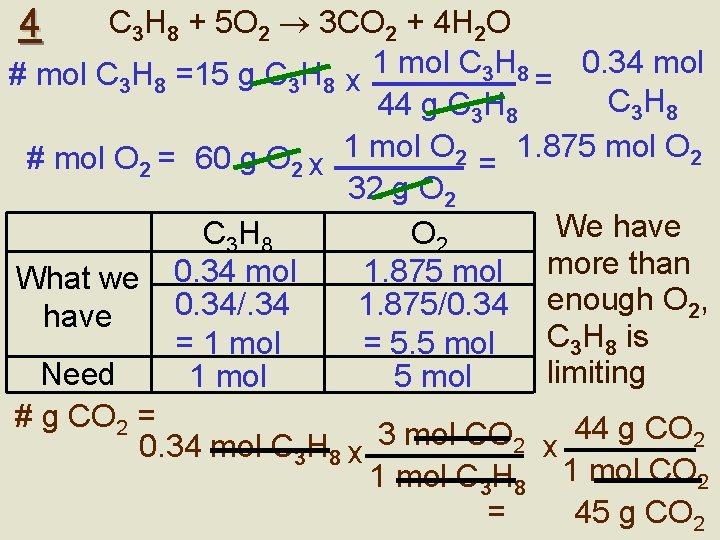
4 C 3 H 8 + 5 O 2 3 CO 2 + 4 H 2 O # mol C 3 H 8 =15 g C 3 H 8 x 1 mol C 3 H 8 = 0. 34 mol C 3 H 8 44 g C 3 H 8 # mol O 2 = 60 g O 2 x 1 mol O 2 = 1. 875 mol O 2 32 g O 2 We have C 3 H 8 O 2 more than 0. 34 mol 1. 875 mol What we enough O 2, 0. 34/. 34 1. 875/0. 34 have C 3 H 8 is = 1 mol = 5. 5 mol limiting Need 1 mol 5 mol # g CO 2 = 44 g CO 3 mol CO 2 2 x 0. 34 mol C 3 H 8 x 1 mol C 3 H 8 1 mol CO 2 = 45 g CO 2
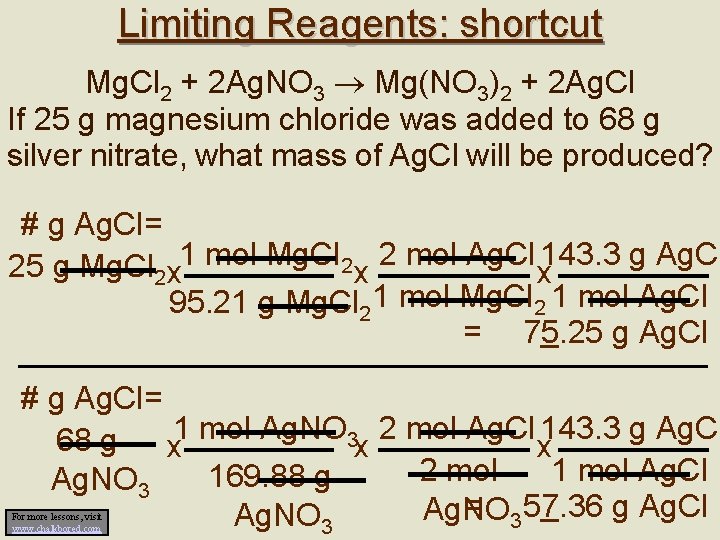
Limiting Reagents: shortcut Mg. Cl 2 + 2 Ag. NO 3 Mg(NO 3)2 + 2 Ag. Cl If 25 g magnesium chloride was added to 68 g silver nitrate, what mass of Ag. Cl will be produced? # g Ag. Cl= 25 g Mg. Cl 2 x 1 mol Mg. Cl 2 x 2 mol Ag. Cl x 143. 3 g Ag. Cl 95. 21 g Mg. Cl 21 mol Mg. Cl 2 1 mol Ag. Cl = 75. 25 g Ag. Cl # g Ag. Cl= 1 mol Ag. NO 3 2 mol Ag. Cl 143. 3 g Ag. Cl 68 g x x x 2 mol 1 mol Ag. Cl 169. 88 g Ag. NO 3 = 3 57. 36 g Ag. Cl Ag. NO 3 For more lessons, visit www. chalkbored. com