Sprain and Strain Prevention A quantitative approach to
- Slides: 58
Sprain and Strain Prevention A quantitative approach to functional movement improvement Central Pierce Fire and Rescue Wellness and Fitness Funding for this project has been provided by the State of Washington, Department of Labor & Industries, Safety & Health Investment Projects
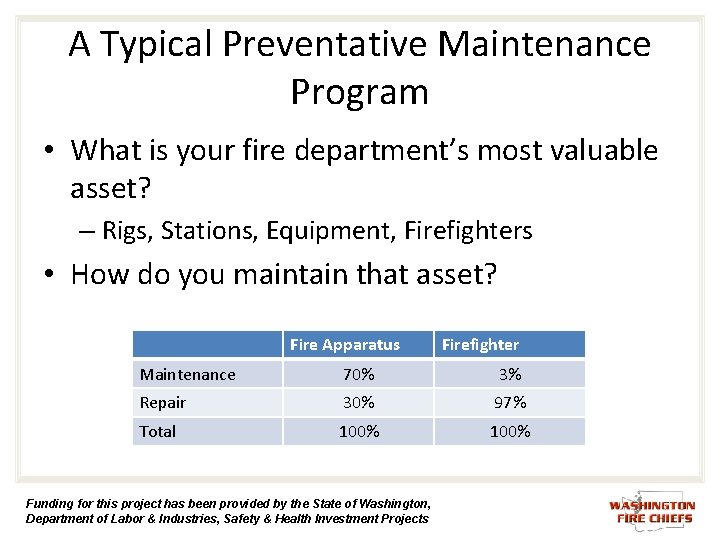
A Typical Preventative Maintenance Program • What is your fire department’s most valuable asset? – Rigs, Stations, Equipment, Firefighters • How do you maintain that asset? Fire Apparatus Firefighter Maintenance 70% 3% Repair 30% 97% Total 100% Funding for this project has been provided by the State of Washington, Department of Labor & Industries, Safety & Health Investment Projects
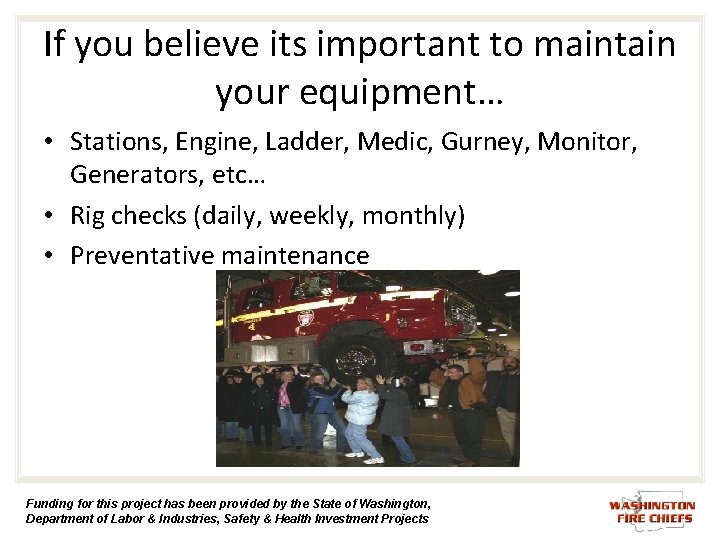
If you believe its important to maintain your equipment… • Stations, Engine, Ladder, Medic, Gurney, Monitor, Generators, etc… • Rig checks (daily, weekly, monthly) • Preventative maintenance Funding for this project has been provided by the State of Washington, Department of Labor & Industries, Safety & Health Investment Projects
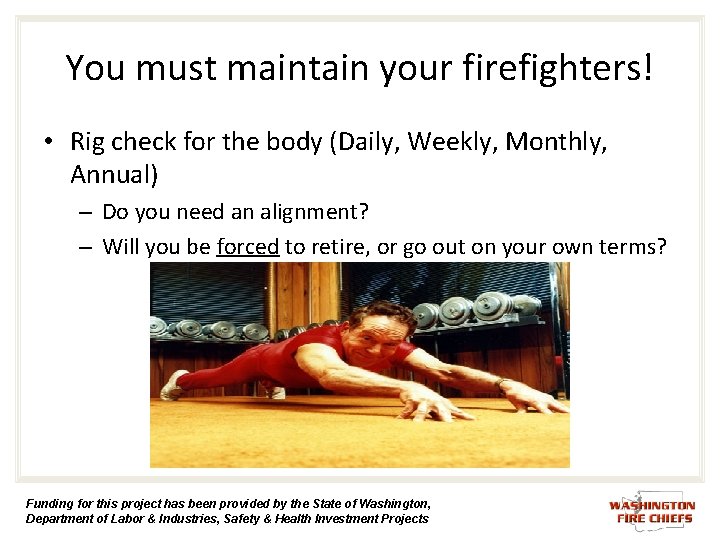
You must maintain your firefighters! • Rig check for the body (Daily, Weekly, Monthly, Annual) – Do you need an alignment? – Will you be forced to retire, or go out on your own terms? Funding for this project has been provided by the State of Washington, Department of Labor & Industries, Safety & Health Investment Projects
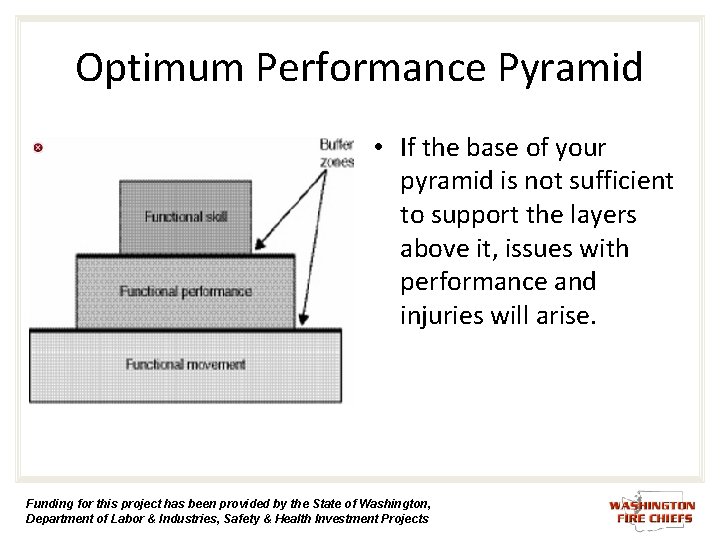
Optimum Performance Pyramid • If the base of your pyramid is not sufficient to support the layers above it, issues with performance and injuries will arise. Funding for this project has been provided by the State of Washington, Department of Labor & Industries, Safety & Health Investment Projects
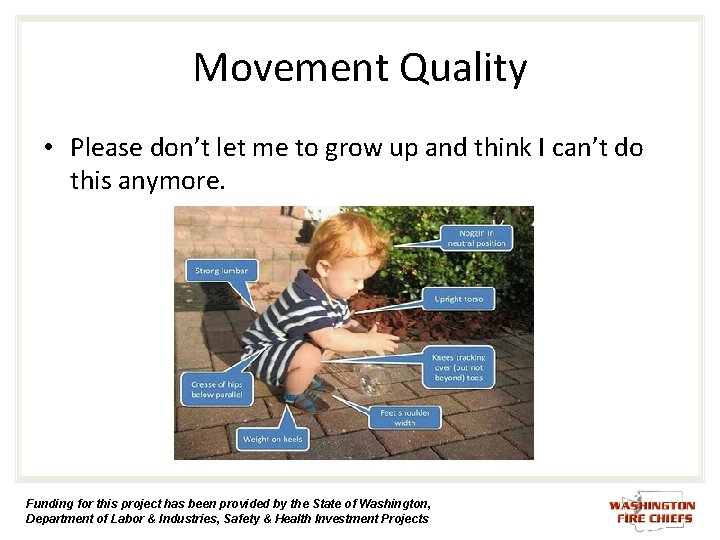
Movement Quality • Please don’t let me to grow up and think I can’t do this anymore. Funding for this project has been provided by the State of Washington, Department of Labor & Industries, Safety & Health Investment Projects
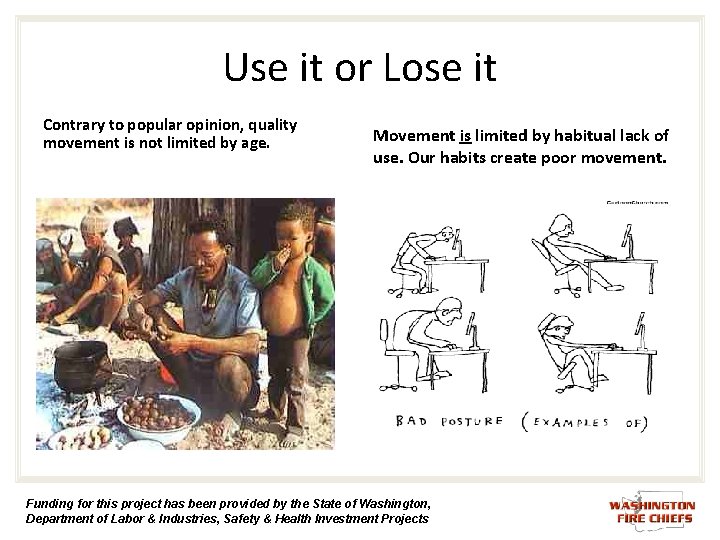
Use it or Lose it Contrary to popular opinion, quality movement is not limited by age. Movement is limited by habitual lack of use. Our habits create poor movement. Funding for this project has been provided by the State of Washington, Department of Labor & Industries, Safety & Health Investment Projects
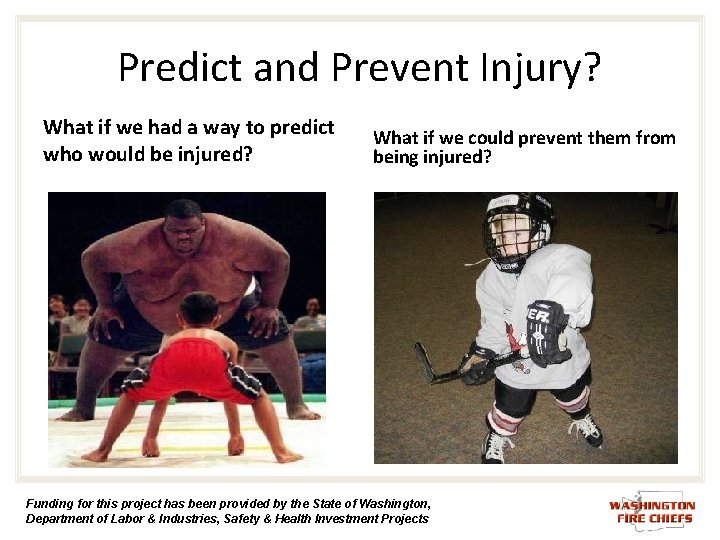
Predict and Prevent Injury? What if we had a way to predict who would be injured? What if we could prevent them from being injured? Funding for this project has been provided by the State of Washington, Department of Labor & Industries, Safety & Health Investment Projects
Injury Prediction and Prevention Model • The sports performance and fitness industry have been using an injury prediction and prevention model for several years called • THE FUNCTIONAL MOVEMENT SCREEN (FMS) Funding for this project has been provided by the State of Washington, Department of Labor & Industries, Safety & Health Investment Projects
What is the FMS? • The Functional Movement Screen (FMS) is the product of an exercise philosophy known as Functional Movement Systems. This exercise philosophy and corresponding set of resources is based on sound science, years of innovation, and current research. Funding for this project has been provided by the State of Washington, Department of Labor & Industries, Safety & Health Investment Projects
How does it work? • The FMS is a ranking and grading system that documents movement patterns that are key to normal function. The FMS identifies functional limitations and asymmetries. These issues can reduce the effects of physical conditioning and distort body awareness. • The FMS generates the Functional Movement Screen Score, which is used to target problems and track progress. • The scoring system will assist in identifying corrective exercises that will be most effective to restore proper movement and build strength in each individual. Funding for this project has been provided by the State of Washington, Department of Labor & Industries, Safety & Health Investment Projects
What does it do? • The FMS simplifies the concept of movement and its impact on the body. – Evaluation - Easily identifies movement asymmetries and limitations. – Standardization – Establishes a functional baseline to mark progress and provides a means to measure performance. – Safety - Identifies dangerous movement patterns so that they can be addressed, and identifies an individual’s readiness to perform exercise so that realistic goals can be set and achieved. – Corrective Strategies - Can be applied at any fitness level, simplifying corrective strategies for a wide array of movement issues. Funding for this project has been provided by the State of Washington, Department of Labor & Industries, Safety & Health Investment Projects
FMS Components • The FMS is designed to measure both MOBILITY and STABILITY. • The FMS is able to quantify a person’s ability to maintain control (STABILITY) within the presence of change (MOBILITY). • Proper stability and proper mobility combine to create proper movement patterns Funding for this project has been provided by the State of Washington, Department of Labor & Industries, Safety & Health Investment Projects
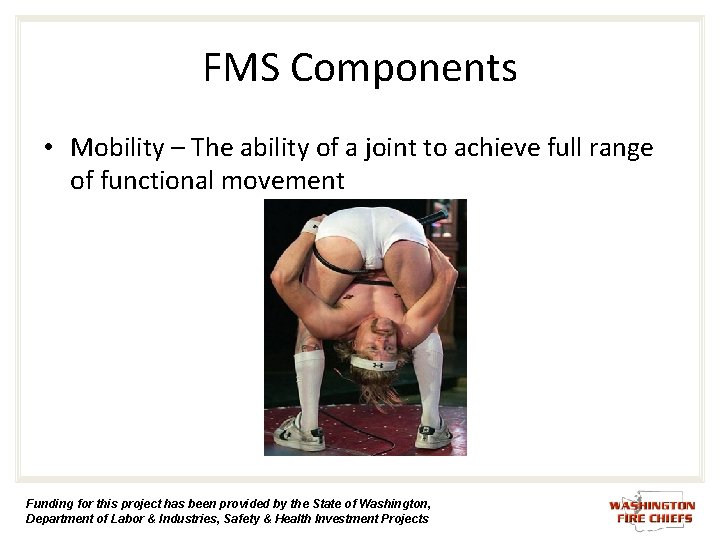
FMS Components • Mobility – The ability of a joint to achieve full range of functional movement Funding for this project has been provided by the State of Washington, Department of Labor & Industries, Safety & Health Investment Projects
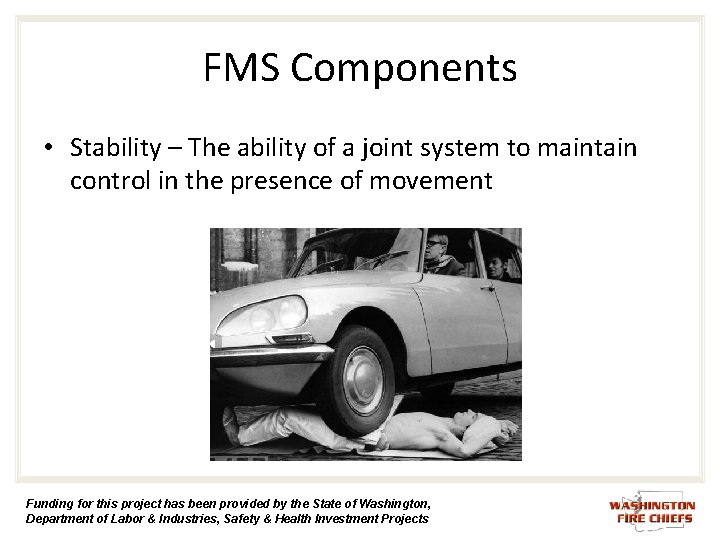
FMS Components • Stability – The ability of a joint system to maintain control in the presence of movement Funding for this project has been provided by the State of Washington, Department of Labor & Industries, Safety & Health Investment Projects
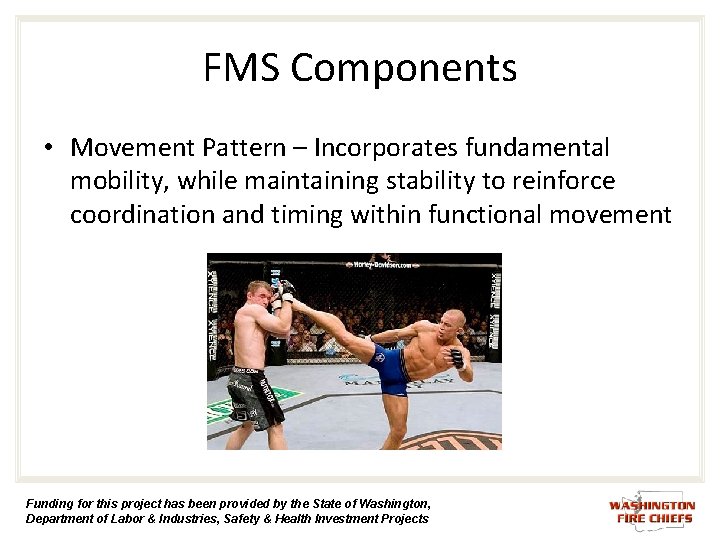
FMS Components • Movement Pattern – Incorporates fundamental mobility, while maintaining stability to reinforce coordination and timing within functional movement Funding for this project has been provided by the State of Washington, Department of Labor & Industries, Safety & Health Investment Projects
FMS Components • Consists of 7 movements – 1. Deep Squat – 2. Hurdle Step – 3. In-Line Lunge – 4. Shoulder Mobility – 5. Active Straight Leg Raise – 6. Trunk Stability Push Up – 7. Rotary Stability Funding for this project has been provided by the State of Washington, Department of Labor & Industries, Safety & Health Investment Projects
FMS Components • Each movement is scored based on how well it is performed – 3 = Able to complete the movement without compensation (Perfect) – 2 = Able to complete the movement with compensation (Adequate) – 1 = Unable to complete the movement even with compensation (Poor) – 0 = Pain is experienced while attempting to perform the movement pattern Funding for this project has been provided by the State of Washington, Department of Labor & Industries, Safety & Health Investment Projects
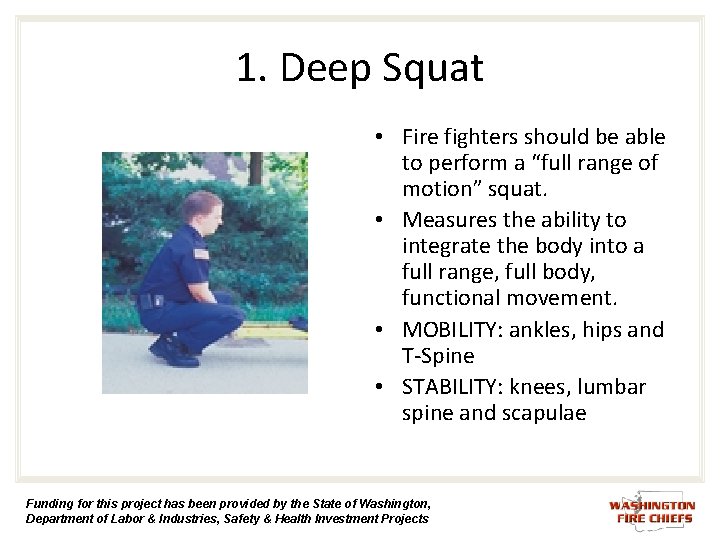
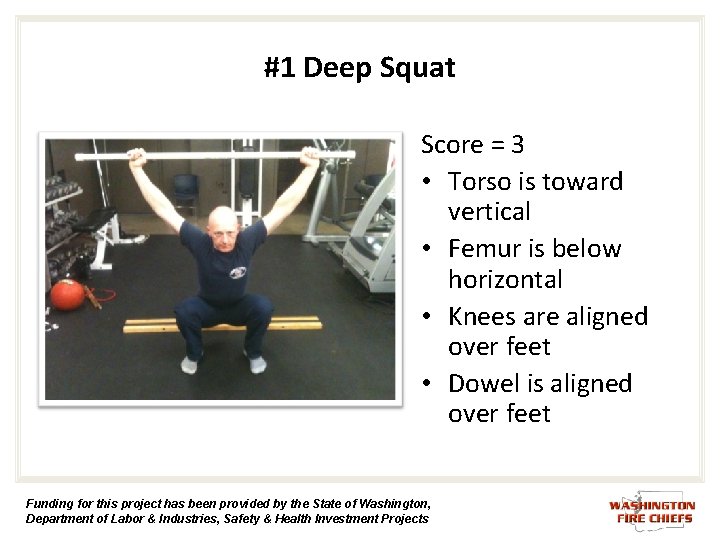
1. Deep Squat • Fire fighters should be able to perform a “full range of motion” squat. • Measures the ability to integrate the body into a full range, full body, functional movement. • MOBILITY: ankles, hips and T-Spine • STABILITY: knees, lumbar spine and scapulae Funding for this project has been provided by the State of Washington, Department of Labor & Industries, Safety & Health Investment Projects
#1 Deep Squat Score = 3 • Torso is toward vertical • Femur is below horizontal • Knees are aligned over feet • Dowel is aligned over feet Funding for this project has been provided by the State of Washington, Department of Labor & Industries, Safety & Health Investment Projects
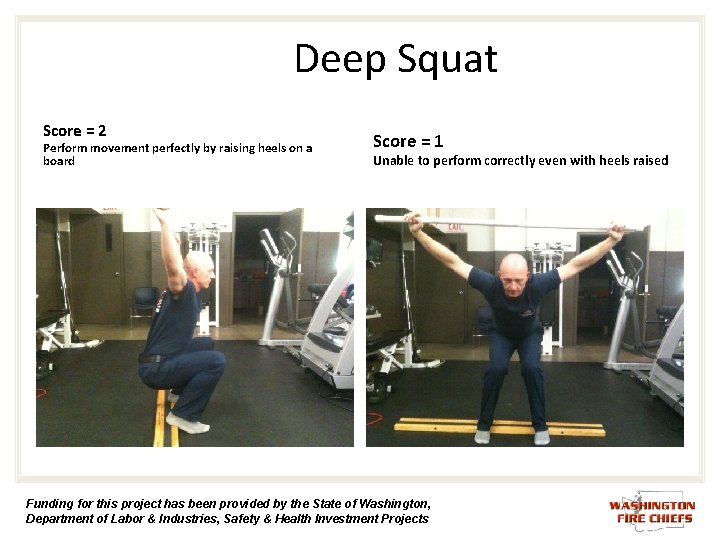
Deep Squat Score = 2 Perform movement perfectly by raising heels on a board Score = 1 Unable to perform correctly even with heels raised Funding for this project has been provided by the State of Washington, Department of Labor & Industries, Safety & Health Investment Projects
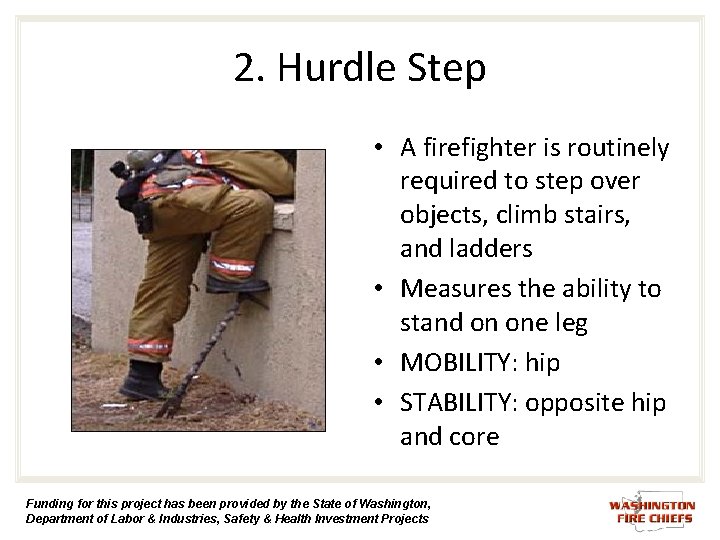
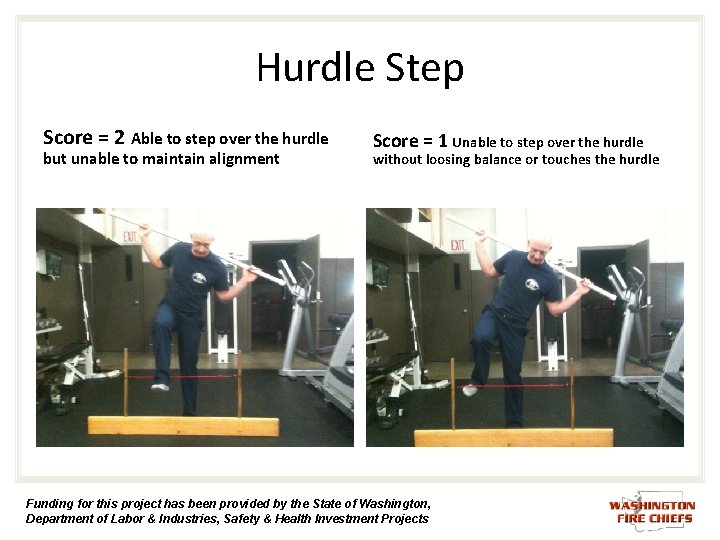
2. Hurdle Step • A firefighter is routinely required to step over objects, climb stairs, and ladders • Measures the ability to stand on one leg • MOBILITY: hip • STABILITY: opposite hip and core Funding for this project has been provided by the State of Washington, Department of Labor & Industries, Safety & Health Investment Projects
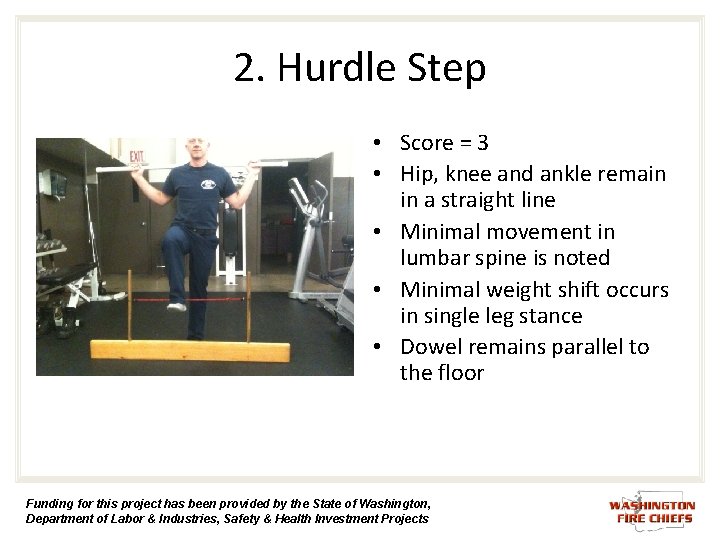
2. Hurdle Step • Score = 3 • Hip, knee and ankle remain in a straight line • Minimal movement in lumbar spine is noted • Minimal weight shift occurs in single leg stance • Dowel remains parallel to the floor Funding for this project has been provided by the State of Washington, Department of Labor & Industries, Safety & Health Investment Projects
Hurdle Step Score = 2 Able to step over the hurdle but unable to maintain alignment Score = 1 Unable to step over the hurdle without loosing balance or touches the hurdle Funding for this project has been provided by the State of Washington, Department of Labor & Industries, Safety & Health Investment Projects
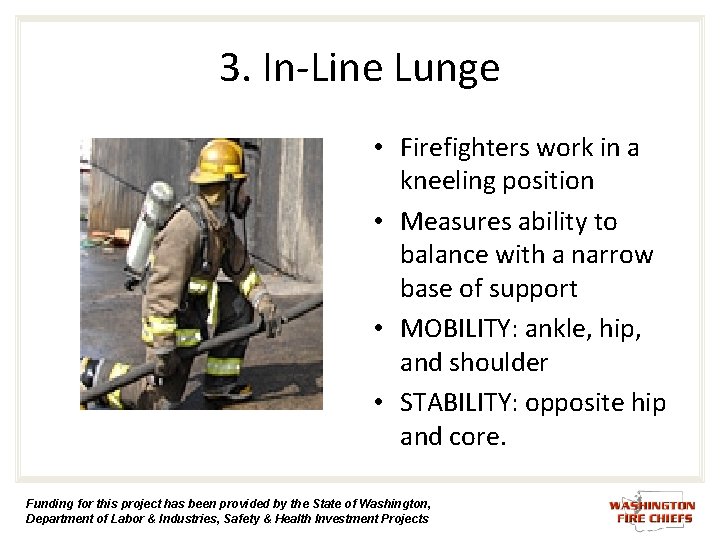
3. In-Line Lunge • Firefighters work in a kneeling position • Measures ability to balance with a narrow base of support • MOBILITY: ankle, hip, and shoulder • STABILITY: opposite hip and core. Funding for this project has been provided by the State of Washington, Department of Labor & Industries, Safety & Health Investment Projects
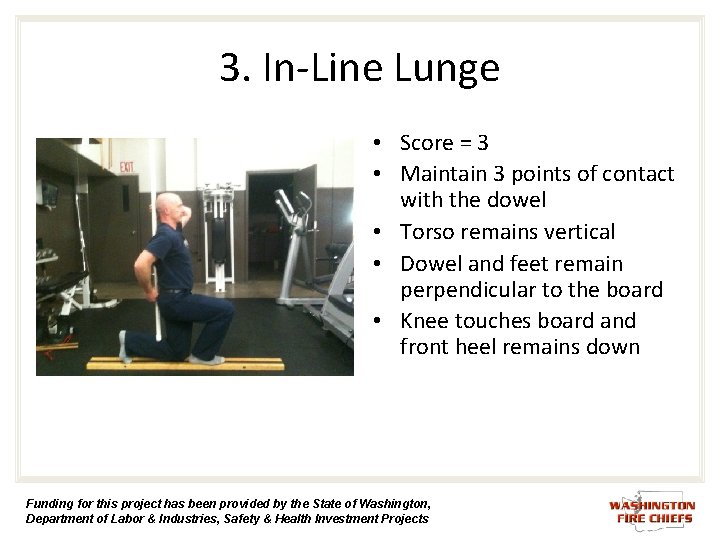
3. In-Line Lunge • Score = 3 • Maintain 3 points of contact with the dowel • Torso remains vertical • Dowel and feet remain perpendicular to the board • Knee touches board and front heel remains down Funding for this project has been provided by the State of Washington, Department of Labor & Industries, Safety & Health Investment Projects
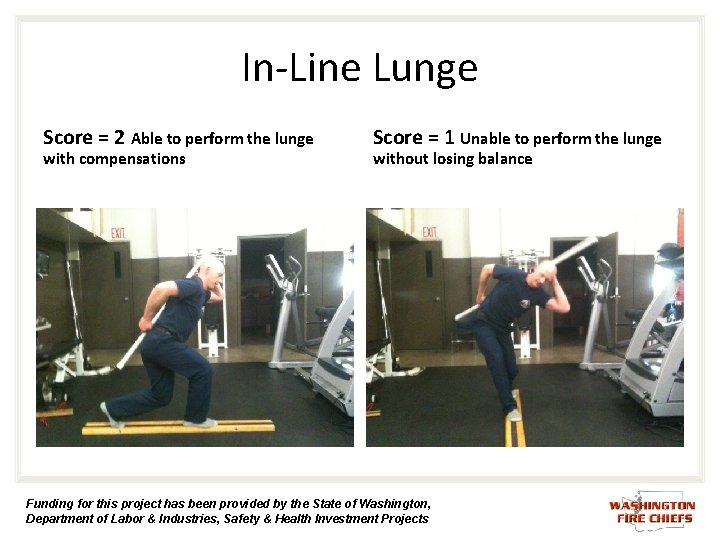
In-Line Lunge Score = 2 Able to perform the lunge with compensations Score = 1 Unable to perform the lunge without losing balance Funding for this project has been provided by the State of Washington, Department of Labor & Industries, Safety & Health Investment Projects
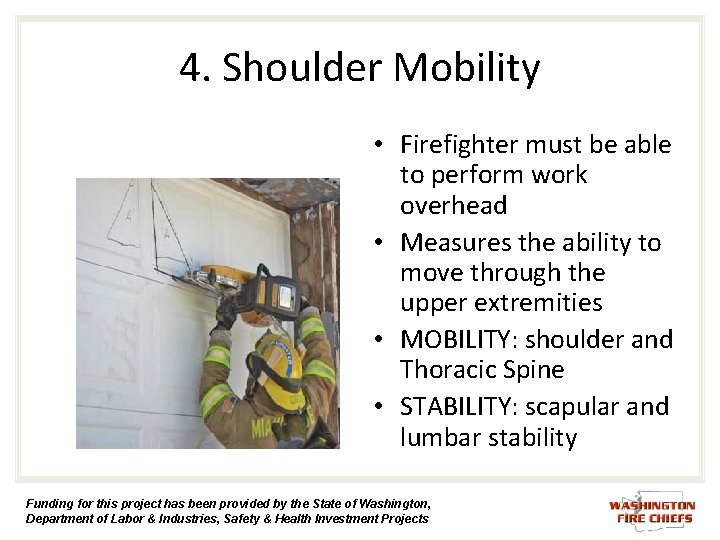
4. Shoulder Mobility • Firefighter must be able to perform work overhead • Measures the ability to move through the upper extremities • MOBILITY: shoulder and Thoracic Spine • STABILITY: scapular and lumbar stability Funding for this project has been provided by the State of Washington, Department of Labor & Industries, Safety & Health Investment Projects
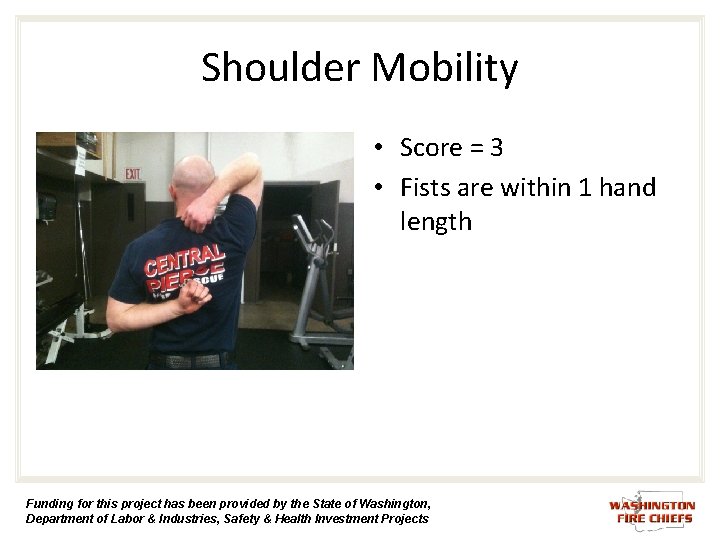
Shoulder Mobility • Score = 3 • Fists are within 1 hand length Funding for this project has been provided by the State of Washington, Department of Labor & Industries, Safety & Health Investment Projects
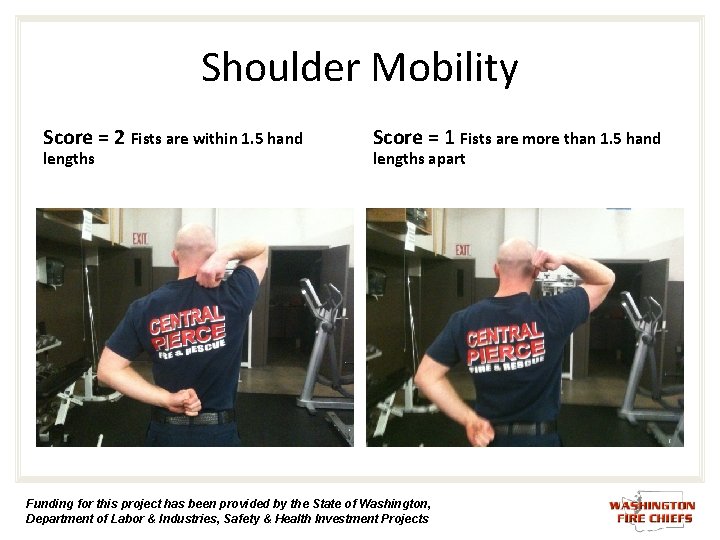
Shoulder Mobility Score = 2 Fists are within 1. 5 hand lengths Score = 1 Fists are more than 1. 5 hand lengths apart Funding for this project has been provided by the State of Washington, Department of Labor & Industries, Safety & Health Investment Projects
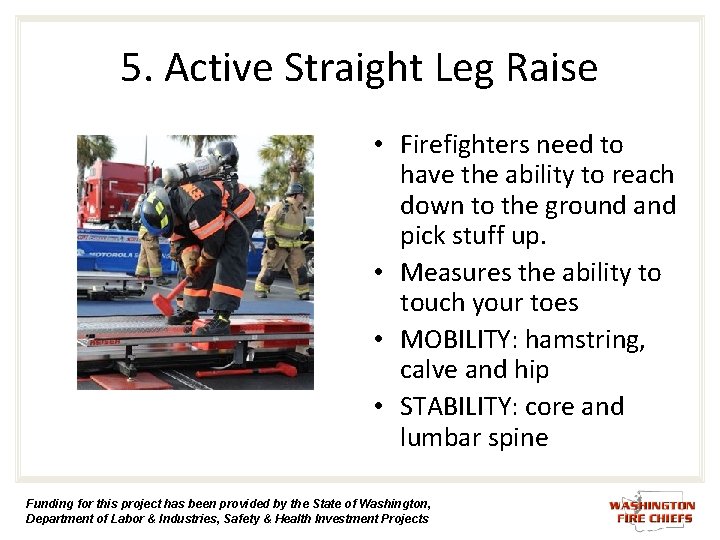
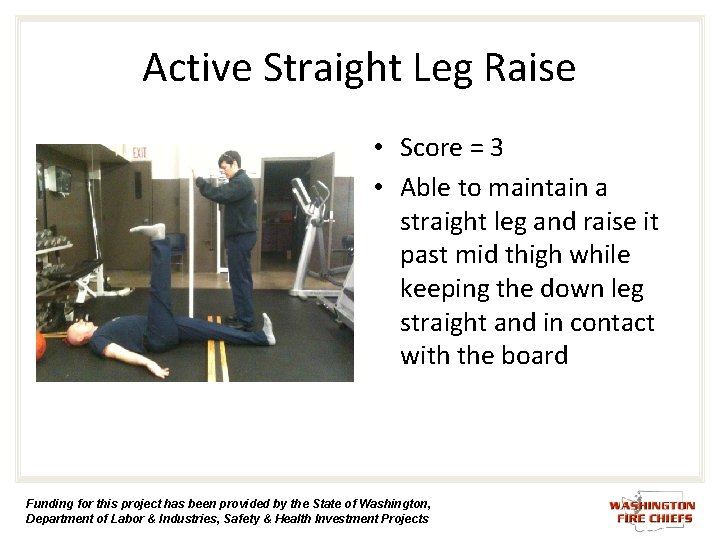
5. Active Straight Leg Raise • Firefighters need to have the ability to reach down to the ground and pick stuff up. • Measures the ability to touch your toes • MOBILITY: hamstring, calve and hip • STABILITY: core and lumbar spine Funding for this project has been provided by the State of Washington, Department of Labor & Industries, Safety & Health Investment Projects
Active Straight Leg Raise • Score = 3 • Able to maintain a straight leg and raise it past mid thigh while keeping the down leg straight and in contact with the board Funding for this project has been provided by the State of Washington, Department of Labor & Industries, Safety & Health Investment Projects
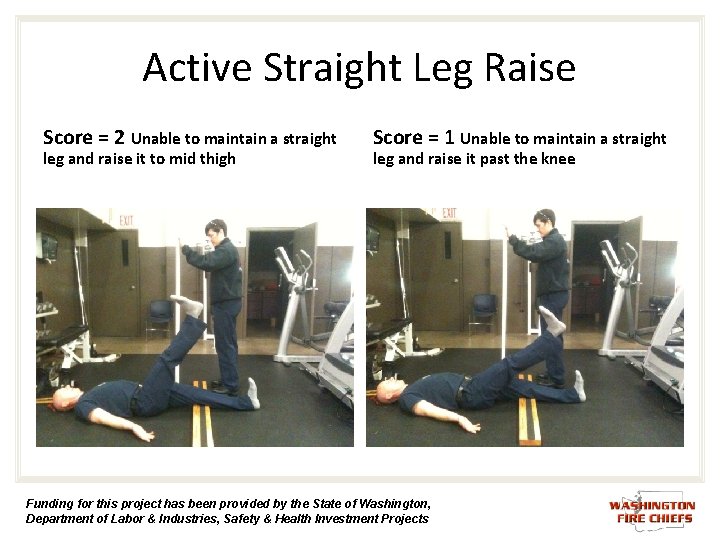
Active Straight Leg Raise Score = 2 Unable to maintain a straight leg and raise it to mid thigh Score = 1 Unable to maintain a straight leg and raise it past the knee Funding for this project has been provided by the State of Washington, Department of Labor & Industries, Safety & Health Investment Projects
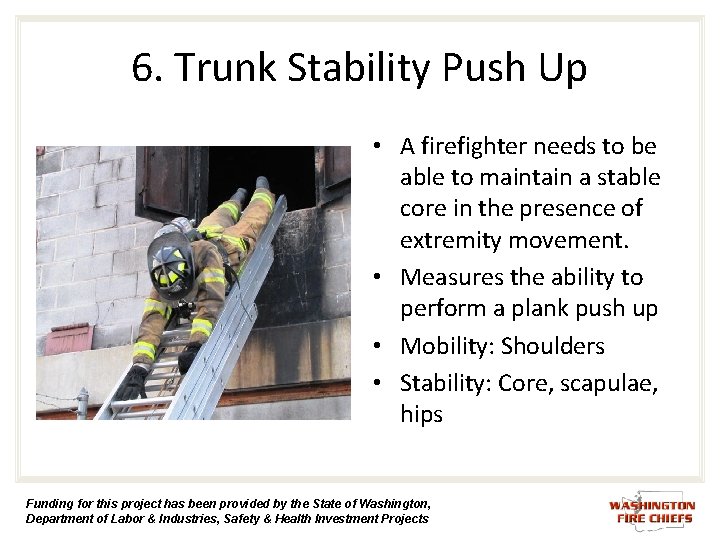
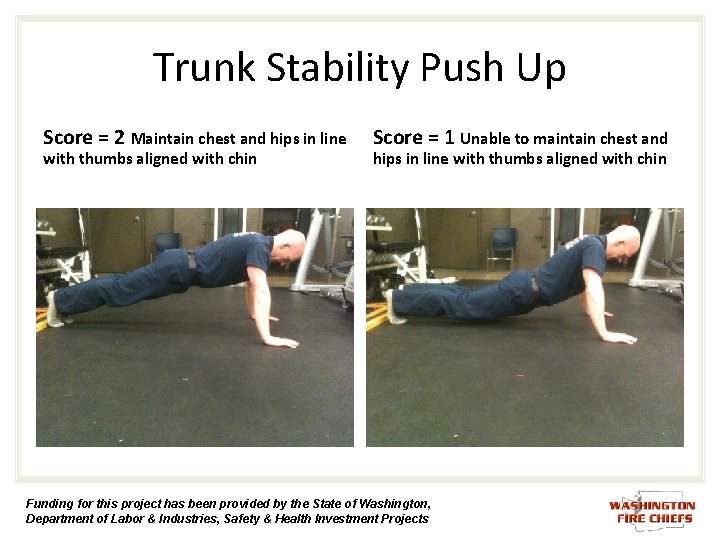
6. Trunk Stability Push Up • A firefighter needs to be able to maintain a stable core in the presence of extremity movement. • Measures the ability to perform a plank push up • Mobility: Shoulders • Stability: Core, scapulae, hips Funding for this project has been provided by the State of Washington, Department of Labor & Industries, Safety & Health Investment Projects
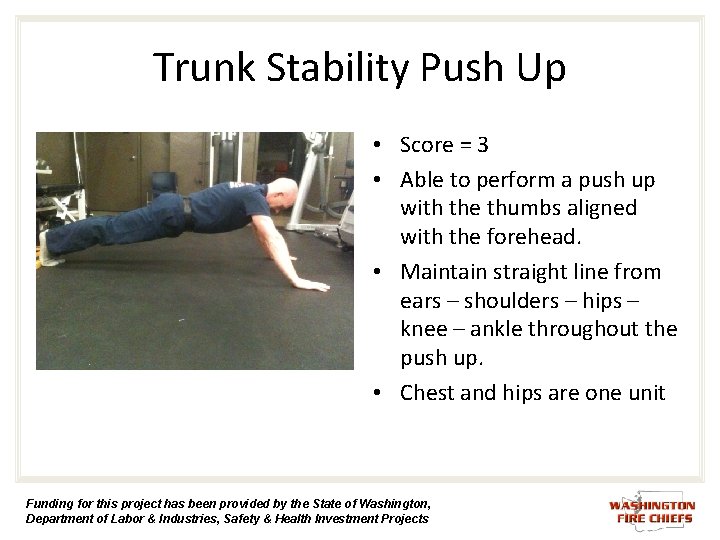
Trunk Stability Push Up • Score = 3 • Able to perform a push up with the thumbs aligned with the forehead. • Maintain straight line from ears – shoulders – hips – knee – ankle throughout the push up. • Chest and hips are one unit Funding for this project has been provided by the State of Washington, Department of Labor & Industries, Safety & Health Investment Projects
Trunk Stability Push Up Score = 2 Maintain chest and hips in line with thumbs aligned with chin Score = 1 Unable to maintain chest and hips in line with thumbs aligned with chin Funding for this project has been provided by the State of Washington, Department of Labor & Industries, Safety & Health Investment Projects
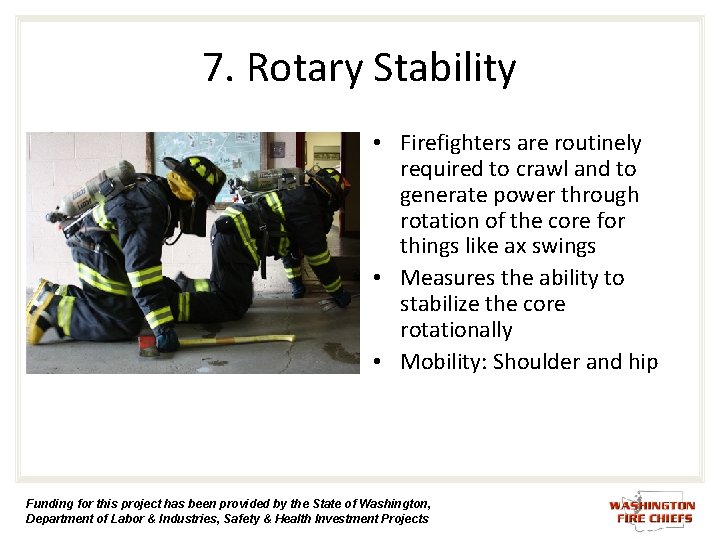
7. Rotary Stability • Firefighters are routinely required to crawl and to generate power through rotation of the core for things like ax swings • Measures the ability to stabilize the core rotationally • Mobility: Shoulder and hip Funding for this project has been provided by the State of Washington, Department of Labor & Industries, Safety & Health Investment Projects
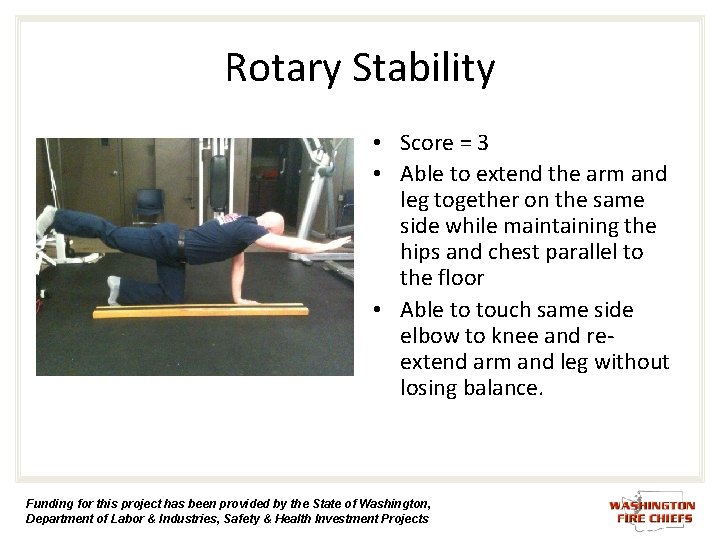
Rotary Stability • Score = 3 • Able to extend the arm and leg together on the same side while maintaining the hips and chest parallel to the floor • Able to touch same side elbow to knee and reextend arm and leg without losing balance. Funding for this project has been provided by the State of Washington, Department of Labor & Industries, Safety & Health Investment Projects
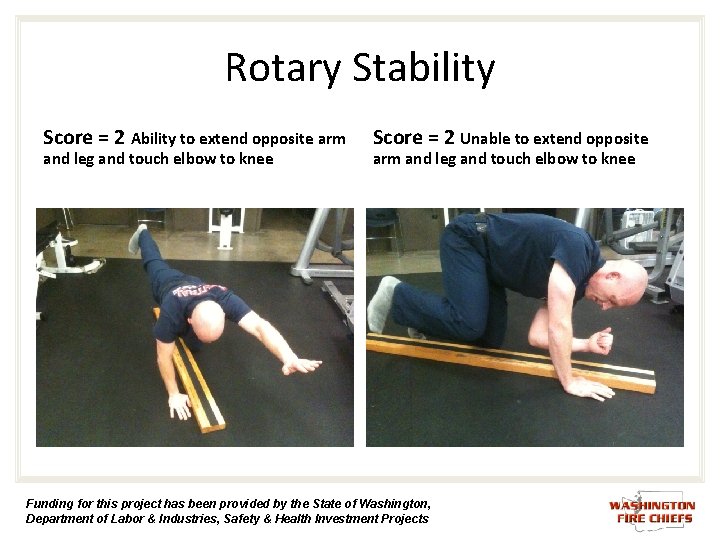
Rotary Stability Score = 2 Ability to extend opposite arm and leg and touch elbow to knee Score = 2 Unable to extend opposite arm and leg and touch elbow to knee Funding for this project has been provided by the State of Washington, Department of Labor & Industries, Safety & Health Investment Projects
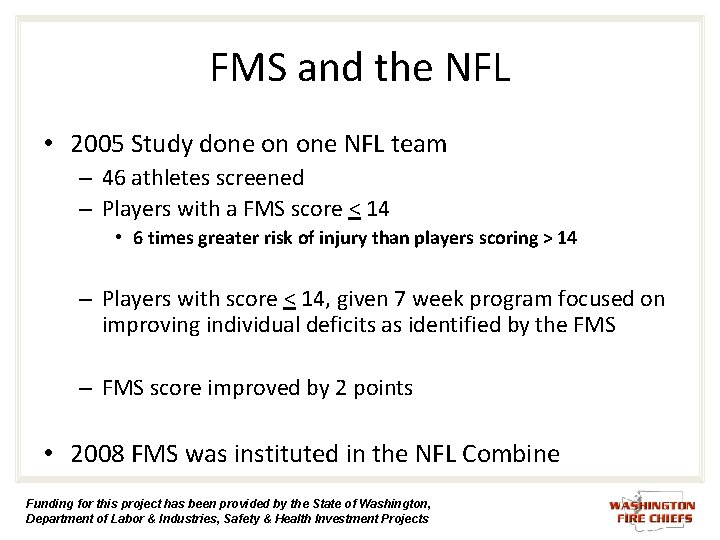
FMS and the NFL • 2005 Study done on one NFL team – 46 athletes screened – Players with a FMS score < 14 • 6 times greater risk of injury than players scoring > 14 – Players with score < 14, given 7 week program focused on improving individual deficits as identified by the FMS – FMS score improved by 2 points • 2008 FMS was instituted in the NFL Combine Funding for this project has been provided by the State of Washington, Department of Labor & Industries, Safety & Health Investment Projects
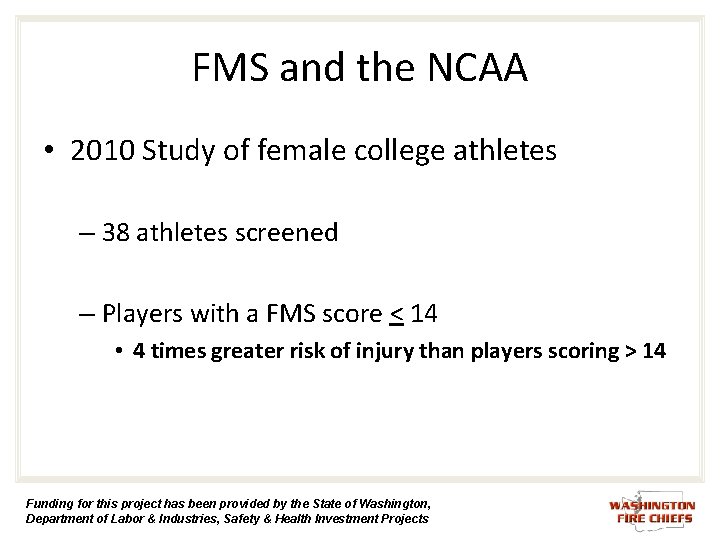
FMS and the NCAA • 2010 Study of female college athletes – 38 athletes screened – Players with a FMS score < 14 • 4 times greater risk of injury than players scoring > 14 Funding for this project has been provided by the State of Washington, Department of Labor & Industries, Safety & Health Investment Projects
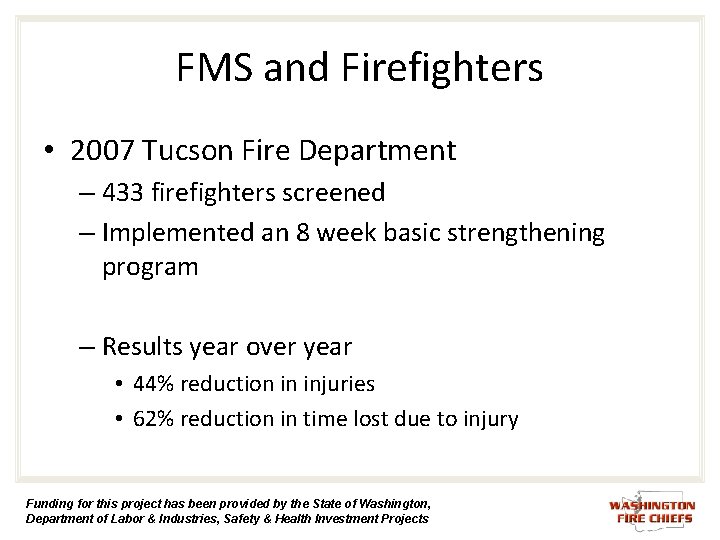
FMS and Firefighters • 2007 Tucson Fire Department – 433 firefighters screened – Implemented an 8 week basic strengthening program – Results year over year • 44% reduction in injuries • 62% reduction in time lost due to injury Funding for this project has been provided by the State of Washington, Department of Labor & Industries, Safety & Health Investment Projects
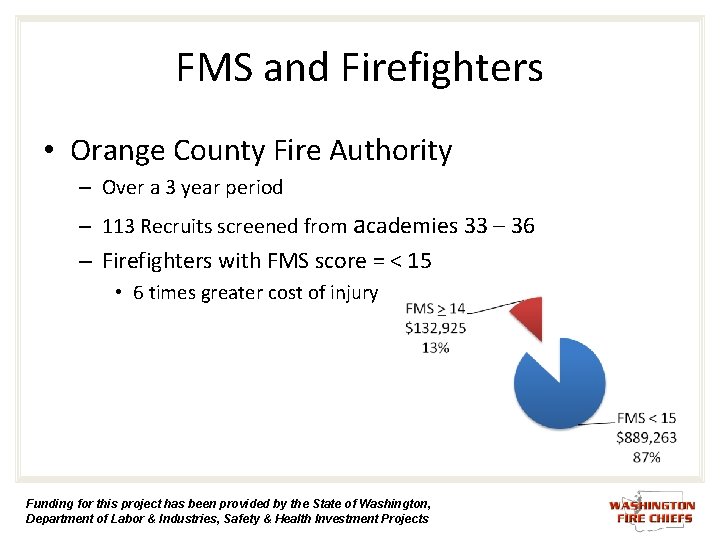
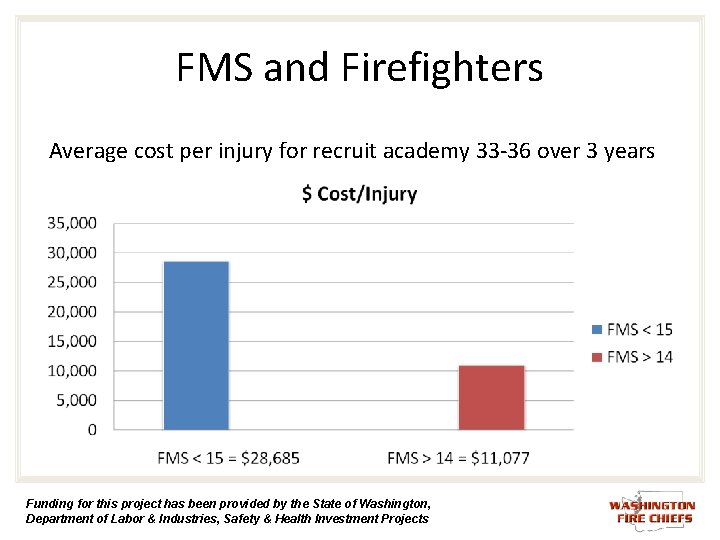
FMS and Firefighters • Orange County Fire Authority – Over a 3 year period – 113 Recruits screened from academies 33 – 36 – Firefighters with FMS score = < 15 • 6 times greater cost of injury Funding for this project has been provided by the State of Washington, Department of Labor & Industries, Safety & Health Investment Projects
FMS and Firefighters Average cost per injury for recruit academy 33 -36 over 3 years Funding for this project has been provided by the State of Washington, Department of Labor & Industries, Safety & Health Investment Projects
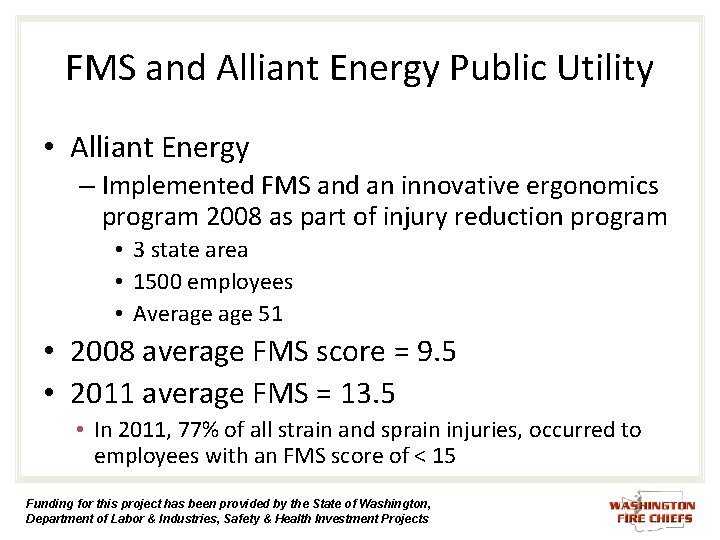
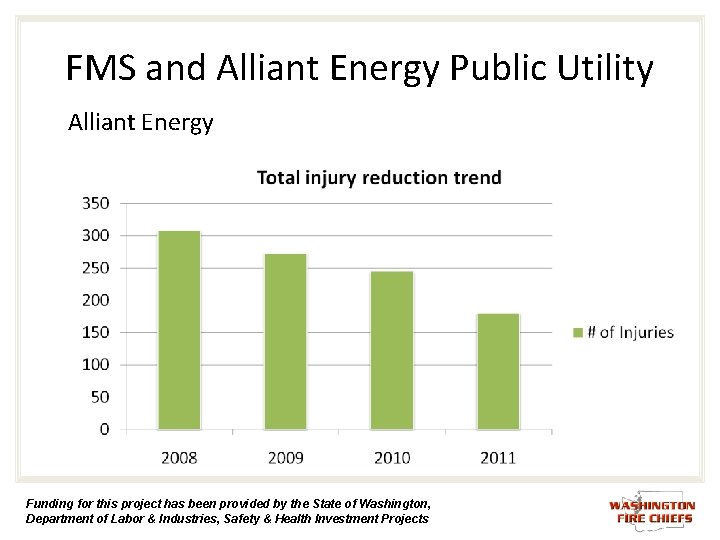
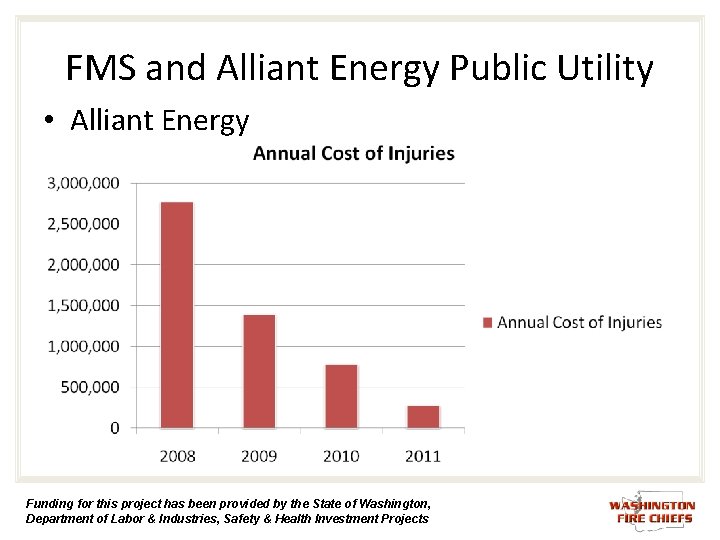
FMS and Alliant Energy Public Utility • Alliant Energy – Implemented FMS and an innovative ergonomics program 2008 as part of injury reduction program • 3 state area • 1500 employees • Average 51 • 2008 average FMS score = 9. 5 • 2011 average FMS = 13. 5 • In 2011, 77% of all strain and sprain injuries, occurred to employees with an FMS score of < 15 Funding for this project has been provided by the State of Washington, Department of Labor & Industries, Safety & Health Investment Projects
FMS and Alliant Energy Public Utility Alliant Energy Funding for this project has been provided by the State of Washington, Department of Labor & Industries, Safety & Health Investment Projects
FMS and Alliant Energy Public Utility • Alliant Energy Funding for this project has been provided by the State of Washington, Department of Labor & Industries, Safety & Health Investment Projects
CPFR and the FMS? • How did CPFR implement the FMS? – Trained ACE Peer Fitness Trainers (ACE PFT) in the FMS concepts by Deb Reed with Ergo. Fit Consulting – Each ACE PFT completed the FMS Home Study Course through Functional Movement Systems – ACE PFT screened A, B, and C shifts at a department wide battalion level drill Funding for this project has been provided by the State of Washington, Department of Labor & Industries, Safety & Health Investment Projects
CPFR and the FMS • Additional battalion level drill for A, B, and C shift where each firefighter received a personalized movement assessment by a physical therapist. – Done in cooperation with: • Physical therapy students from University of Puget Sound • 3 D Physical Therapy in Tacoma, WA Funding for this project has been provided by the State of Washington, Department of Labor & Industries, Safety & Health Investment Projects
CPFR and the FMS • Results of the FMS and physical therapist screening were recorded, analyzed and organized into a personalized corrective exercise program for each firefighter. • Personalized exercise programs were emailed to each participating firefighter. Funding for this project has been provided by the State of Washington, Department of Labor & Industries, Safety & Health Investment Projects
CPFR and the FMS • Each ACE PFT was assigned a group of firefighters to follow up with and answer questions about the exercise program and encourage program compliance. • Special attention is given to following up with all firefighters with a movement score < 14. Funding for this project has been provided by the State of Washington, Department of Labor & Industries, Safety & Health Investment Projects
CPFR and the FMS • ACE PFT’s will be performing a follow up FMS screen later in 2013 to track potential improvements. • Re-screen each firefighter annually over 3 year time frame to monitor improvements. • Compare historical “strain and sprain” injury numbers to 2013 -2015 “strain and sprain” injury numbers to track program effectiveness. Funding for this project has been provided by the State of Washington, Department of Labor & Industries, Safety & Health Investment Projects
How to create a personalized exercise program • ACE PFT’s digitally recorded dozens of exercises that were used to create the exercise program. • Each video provided a description of how TO and how NOT to perform each recommended exercise. • All videos were posted on You. Tube Funding for this project has been provided by the State of Washington, Department of Labor & Industries, Safety & Health Investment Projects
How to create a personalized exercise program • Each exercise was hyperlinked to the corresponding video that was posted on You. Tube. • Each program was created and then emailed to each individual. Funding for this project has been provided by the State of Washington, Department of Labor & Industries, Safety & Health Investment Projects
Sample Corrective Exercises • Level 1 (Mobility) – Supine OHDS • Level 2 (Stability) – Wall Sit with Shoulder Press Progression • Level 3 (Movement Pattern) – Goblet Squat with Press Funding for this project has been provided by the State of Washington, Department of Labor & Industries, Safety & Health Investment Projects
Sample Exercise Program The following is a link to a sample corrective exercise program and how to follow the program. http: //youtu. be/x 6 K 8 f. K 3 c 7 r. Q Funding for this project has been provided by the State of Washington, Department of Labor & Industries, Safety & Health Investment Projects
Questions? • If you have questions about this program or would like to discuss how it might work for your department contact • Cpt. Adam Jackson – adjackson@centralpiercefire. org • FF/EMT Jeff Krekling – jkrekling@centralpiercefire. org • 253 -538 -6400 Funding for this project has been provided by the State of Washington, Department of Labor & Industries, Safety & Health Investment Projects
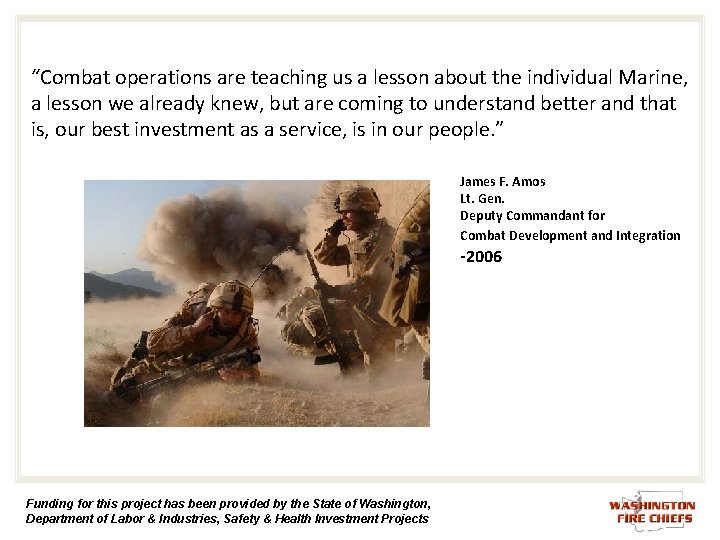
“Combat operations are teaching us a lesson about the individual Marine, a lesson we already knew, but are coming to understand better and that is, our best investment as a service, is in our people. ” James F. Amos Lt. Gen. Deputy Commandant for Combat Development and Integration -2006 Funding for this project has been provided by the State of Washington, Department of Labor & Industries, Safety & Health Investment Projects