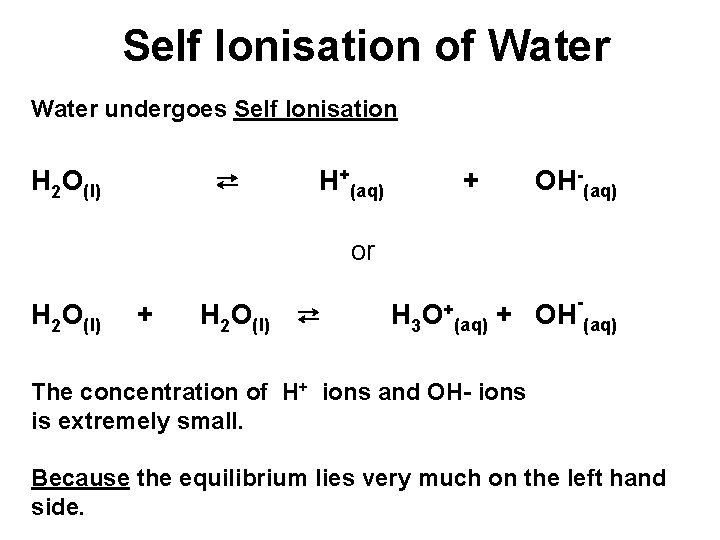
Self Ionisation of Water undergoes Self Ionisation H
- Slides: 39
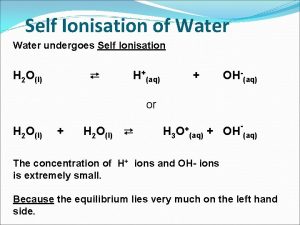
Self Ionisation of Water undergoes Self Ionisation ⇄ H 2 O(l) H+(aq) + OH-(aq) or H 2 O(l) + H 2 O(l) ⇄ H 3 O+ - (aq) + OH (aq) The concentration of H+ ions and OH- ions is extremely small. Because the equilibrium lies very much on the left hand side.
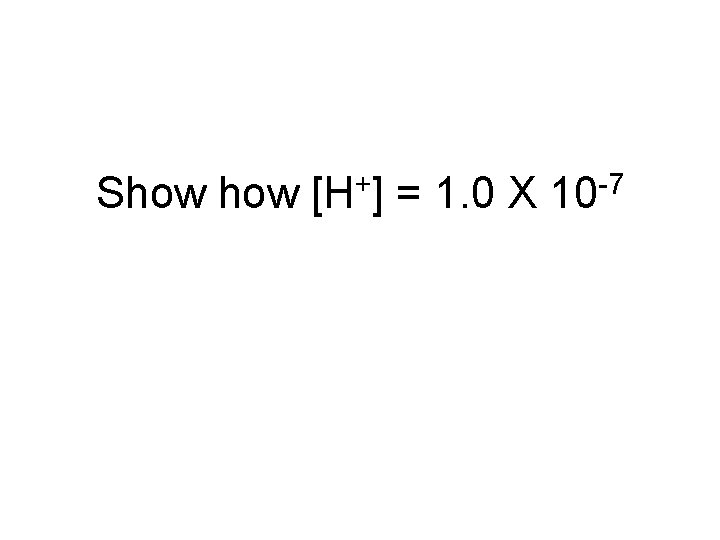
Show [H+] = 1. 0 X 10 -7
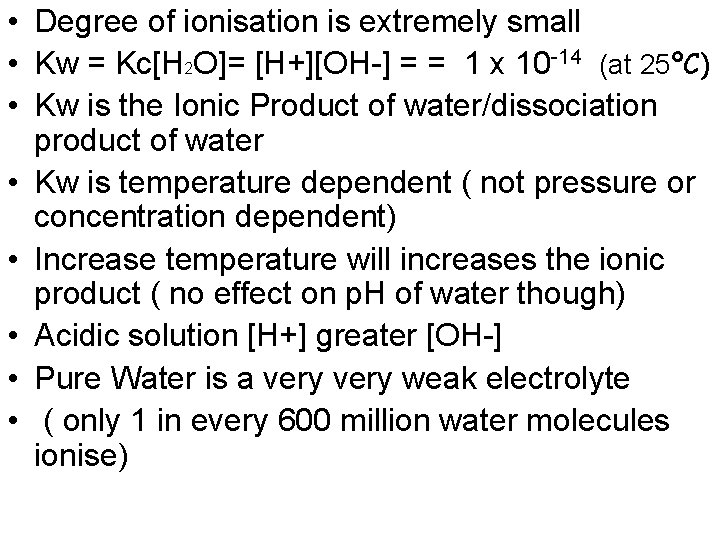
• Degree of ionisation is extremely small • Kw = Kc[H 2 O]= [H+][OH-] = = 1 x 10 -14 (at 25ºC) • Kw is the Ionic Product of water/dissociation product of water • Kw is temperature dependent ( not pressure or concentration dependent) • Increase temperature will increases the ionic product ( no effect on p. H of water though) • Acidic solution [H+] greater [OH-] • Pure Water is a very weak electrolyte • ( only 1 in every 600 million water molecules ionise)
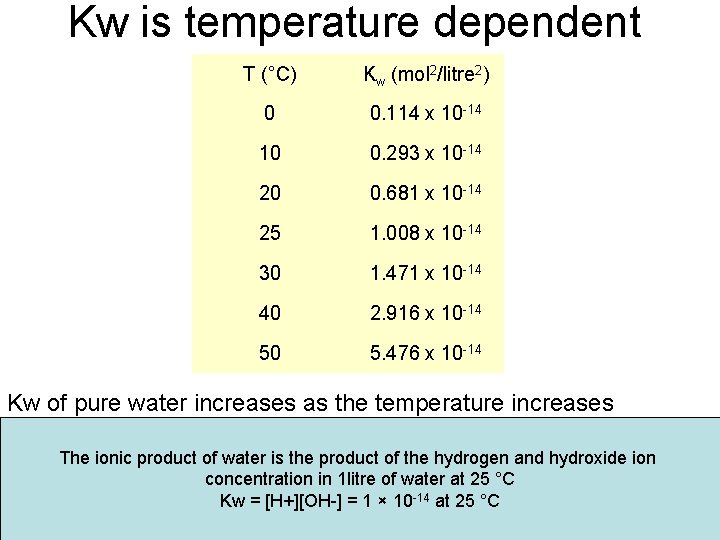
Kw is temperature dependent T (°C) Kw (mol 2/litre 2) 0 0. 114 x 10 -14 10 0. 293 x 10 -14 20 0. 681 x 10 -14 25 1. 008 x 10 -14 30 1. 471 x 10 -14 40 2. 916 x 10 -14 50 5. 476 x 10 -14 Kw of pure water increases as the temperature increases The ionic product of water is the product of the hydrogen and hydroxide ion concentration in 1 litre of water at 25 °C Kw = [H+][OH-] = 1 × 10 -14 at 25 °C
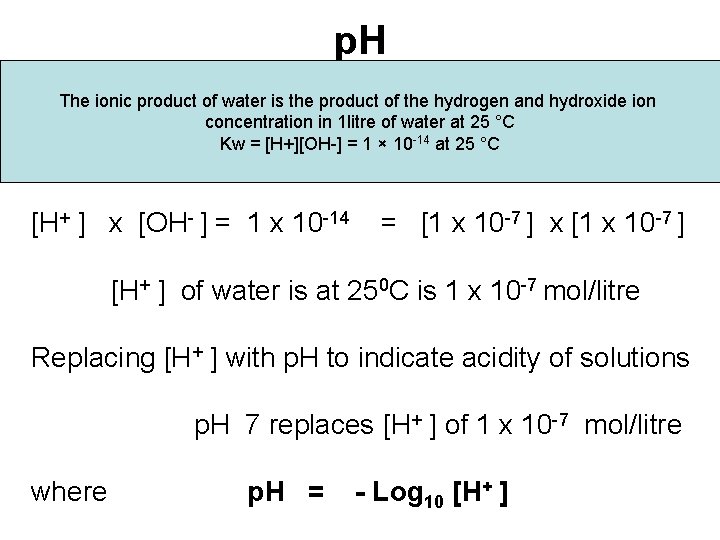
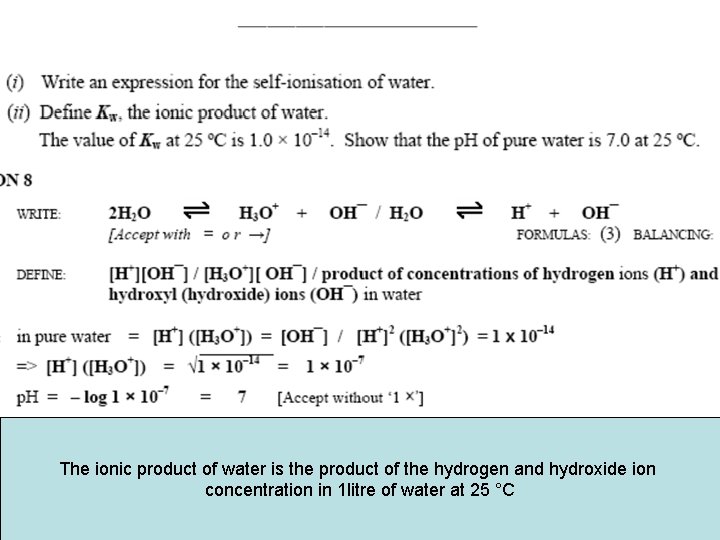
p. H The ionic product of water is the product of the hydrogen and hydroxide ion concentration in 1 litre of water at 25 °C Kw = [H+][OH-] = 1 × 10 -14 at 25 °C [H+ ] x [OH- ] = 1 x 10 -14 = [1 x 10 -7 ] x [1 x 10 -7 ] [H+ ] of water is at 250 C is 1 x 10 -7 mol/litre Replacing [H+ ] with p. H to indicate acidity of solutions p. H 7 replaces [H+ ] of 1 x 10 -7 mol/litre where p. H = - Log 10 [H+ ]
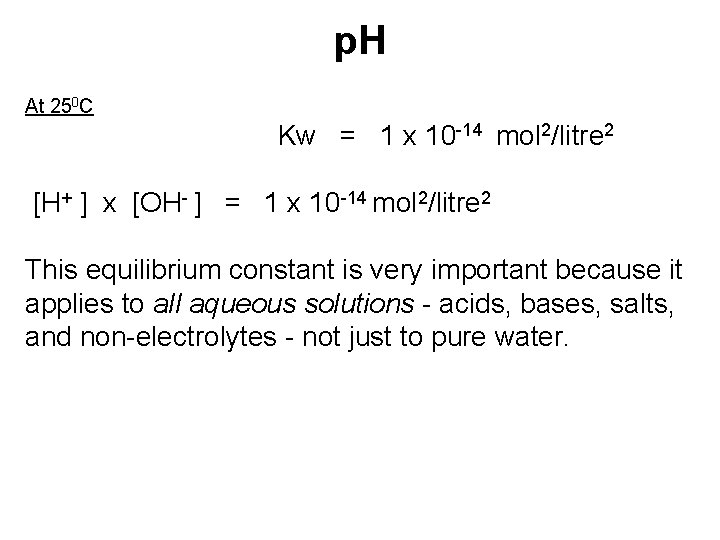
p. H At 250 C Kw = 1 x 10 -14 mol 2/litre 2 [H+ ] x [OH- ] = 1 x 10 -14 mol 2/litre 2 This equilibrium constant is very important because it applies to all aqueous solutions - acids, bases, salts, and non-electrolytes - not just to pure water.
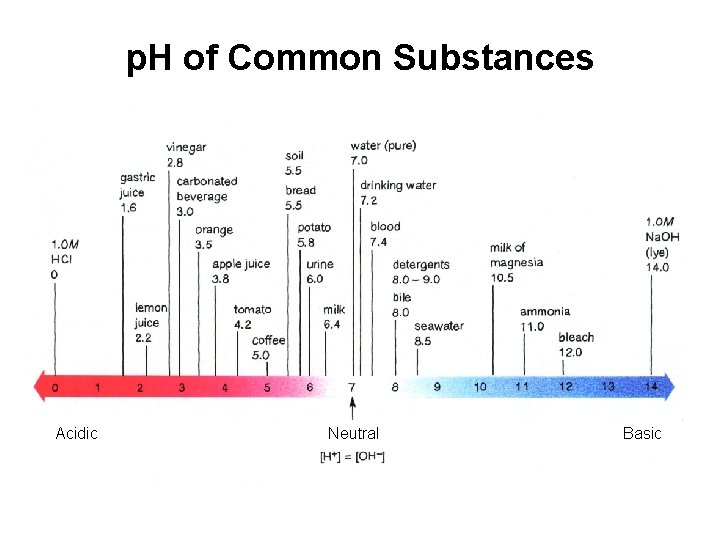
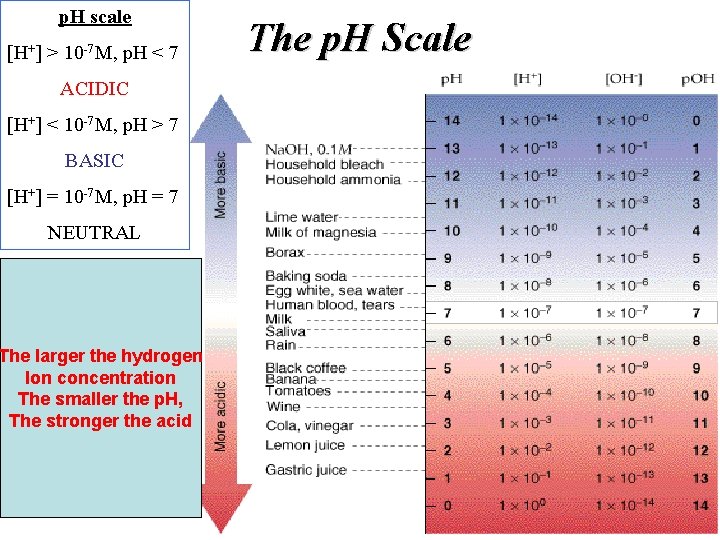
p. H of Common Substances Acidic Neutral Basic
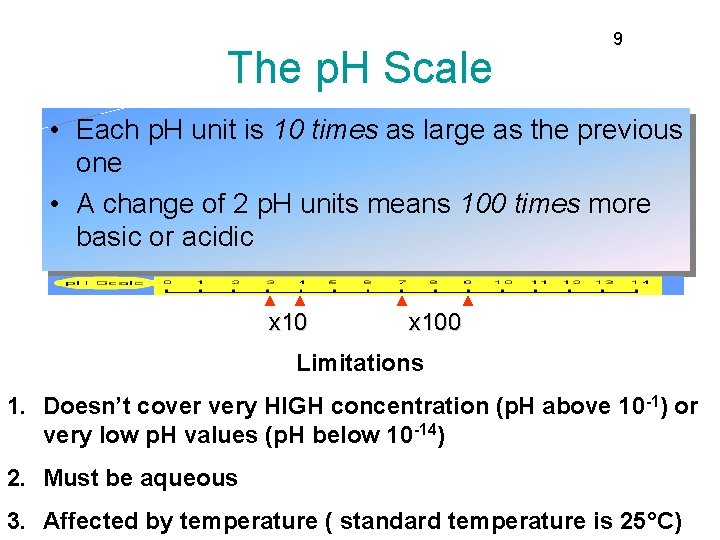
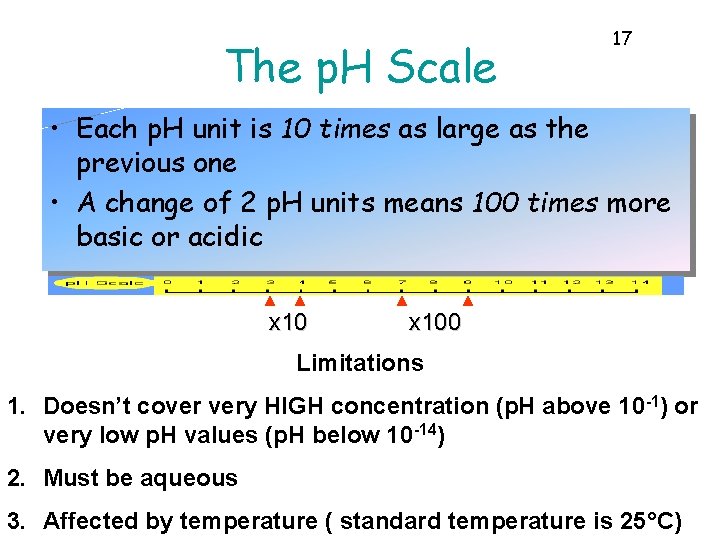
The p. H Scale 9 • Each p. H unit is 10 times as large as the previous one • A change of 2 p. H units means 100 times more basic or acidic x 100 Limitations 1. Doesn’t cover very HIGH concentration (p. H above 10 -1) or very low p. H values (p. H below 10 -14) 2. Must be aqueous 3. Affected by temperature ( standard temperature is 25°C)
The ionic product of water is the product of the hydrogen and hydroxide ion concentration in 1 litre of water at 25 °C
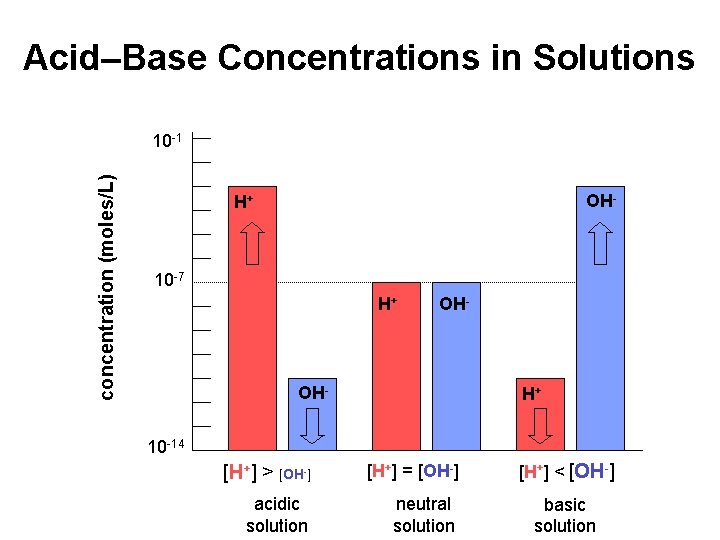
Acid–Base Concentrations in Solutions concentration (moles/L) 10 -1 OH- H+ 10 -7 H+ OH- H+ 10 -14 [H+] > [OH-] [H+] = [OH-] acidic solution neutral solution [H+] < [OH-] basic solution
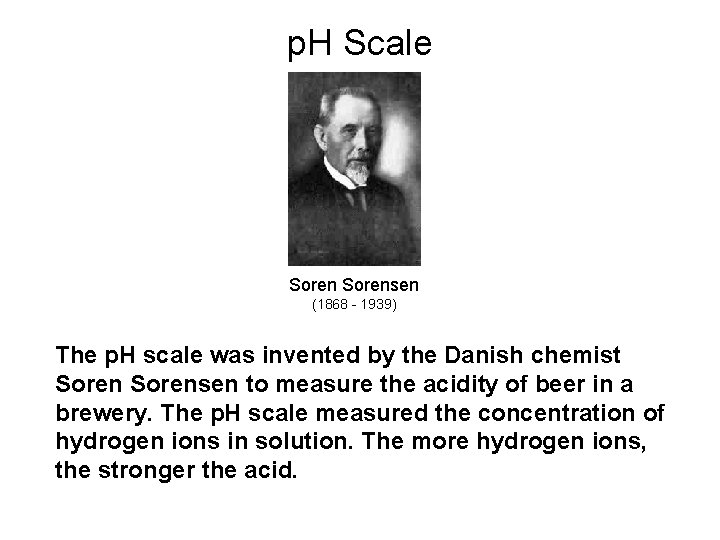
p. H Scale Sorensen (1868 - 1939) The p. H scale was invented by the Danish chemist Sorensen to measure the acidity of beer in a brewery. The p. H scale measured the concentration of hydrogen ions in solution. The more hydrogen ions, the stronger the acid.
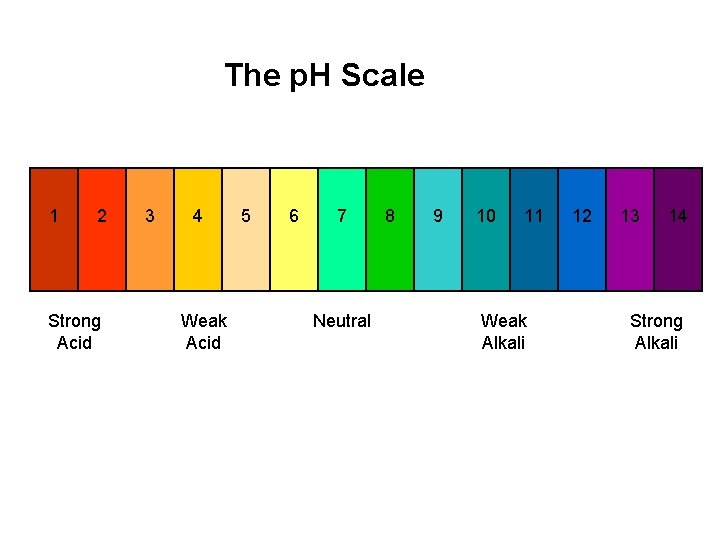
The p. H Scale 1 2 Strong Acid 3 4 Weak Acid 5 6 7 Neutral 8 9 10 11 Weak Alkali 12 13 14 Strong Alkali
p. H Scale The quantity of hydrogen ions in solution can affect the color of certain dyes found in nature. These dyes can be used as indicators to test for acids and alkalis. An indicator such as litmus (obtained from lichen) is red in acid. If base is slowly added, the litmus will turn blue when the acid has been neutralized, at about 6 -7 on the p. H scale. Other indicators will change color at different p. H’s. A combination of indicators is used to make a universal indicator.
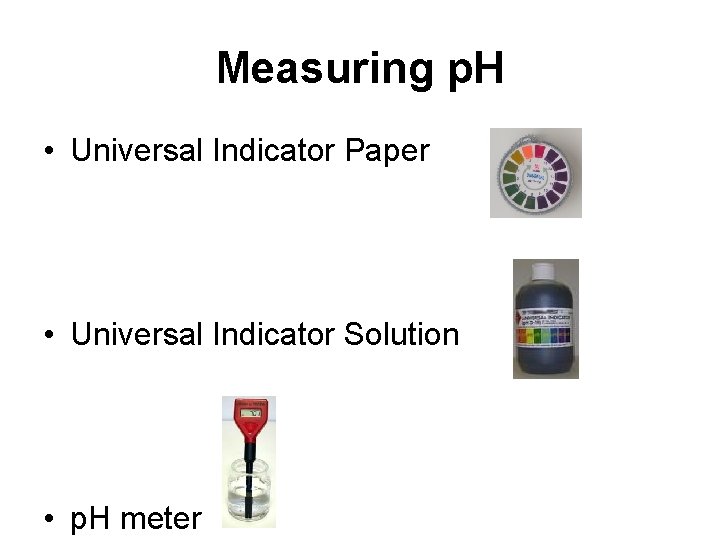
Measuring p. H • Universal Indicator Paper • Universal Indicator Solution • p. H meter
p. H scale [H+] > 10 -7 M, p. H < 7 ACIDIC [H+] < 10 -7 M, p. H > 7 BASIC [H+] = 10 -7 M, p. H = 7 NEUTRAL The larger the hydrogen Ion concentration The smaller the p. H, The stronger the acid The p. H Scale
The p. H Scale 17 • Each p. H unit is 10 times as large as the previous one • A change of 2 p. H units means 100 times more basic or acidic x 100 Limitations 1. Doesn’t cover very HIGH concentration (p. H above 10 -1) or very low p. H values (p. H below 10 -14) 2. Must be aqueous 3. Affected by temperature ( standard temperature is 25°C)
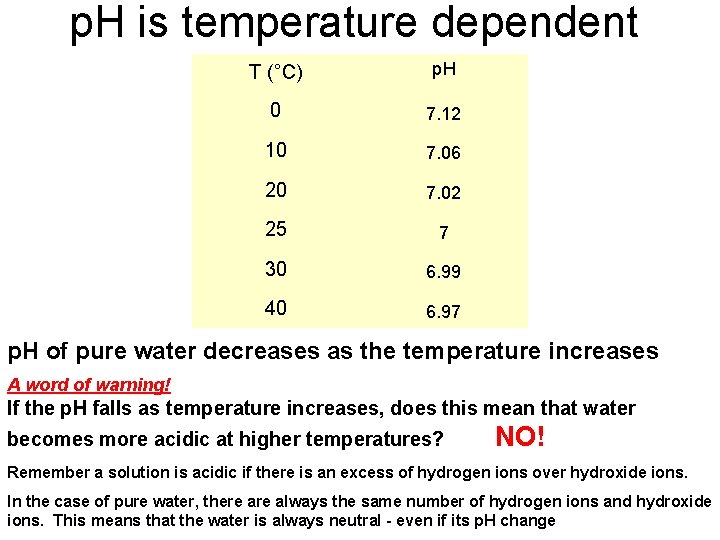
p. H is temperature dependent T (°C) p. H 0 7. 12 10 7. 06 20 7. 02 25 7 30 6. 99 40 6. 97 p. H of pure water decreases as the temperature increases A word of warning! If the p. H falls as temperature increases, does this mean that water becomes more acidic at higher temperatures? NO! Remember a solution is acidic if there is an excess of hydrogen ions over hydroxide ions. In the case of pure water, there always the same number of hydrogen ions and hydroxide ions. This means that the water is always neutral - even if its p. H change
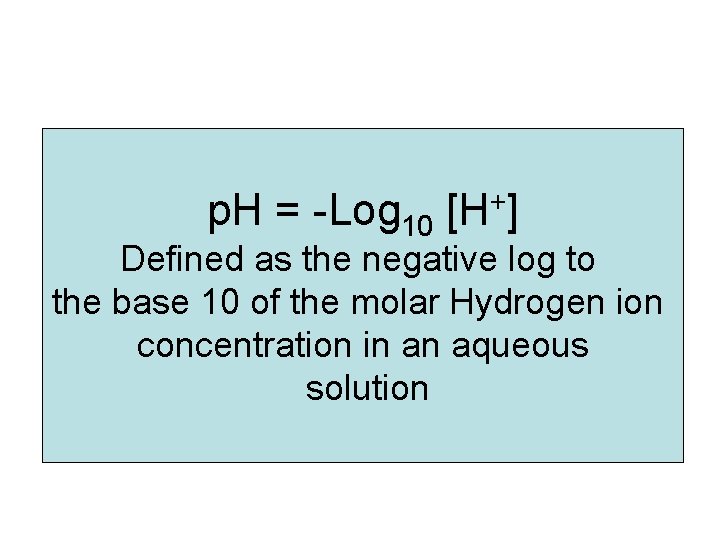
p. H= 7 at 25° C p. H = -Log 10 [H+] Defined as the negative log to the base 10 of the molar Hydrogen ion concentration in an aqueous solution
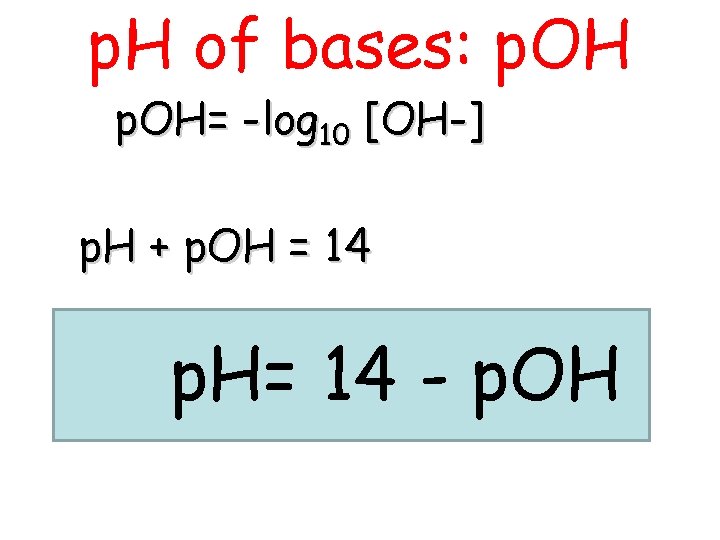
p. H of bases: p. OH= -log 10 [OH-] p. H + p. OH = 14 p. H= 14 - p. OH
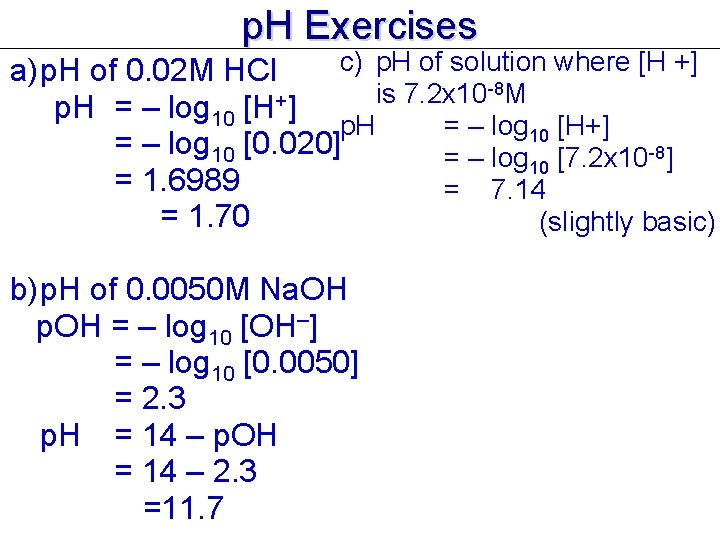
p. H Exercises c) p. H of solution where [H +] a)p. H of 0. 02 M HCl -8 M is 7. 2 x 10 p. H = – log 10 [H+] = – log 10 [0. 020] = – log 10 [7. 2 x 10 -8] = 1. 6989 = 7. 14 = 1. 70 (slightly basic) b)p. H of 0. 0050 M Na. OH p. OH = – log 10 [OH–] = – log 10 [0. 0050] = 2. 3 p. H = 14 – p. OH = 14 – 2. 3 =11. 7
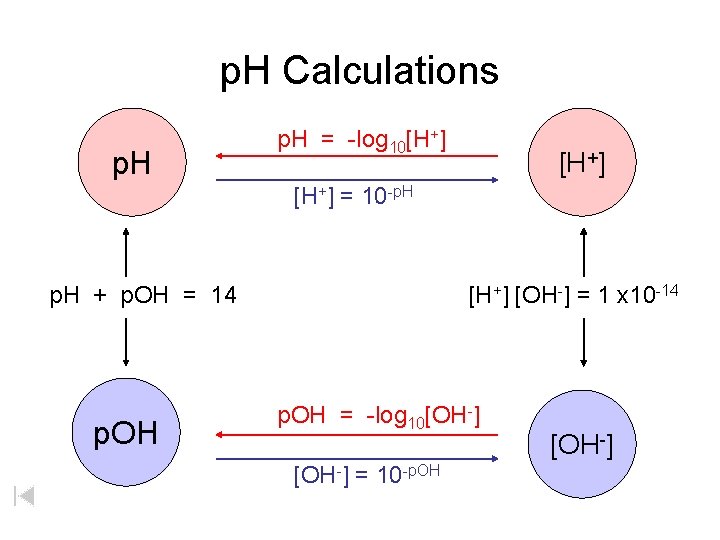
p. H Calculations p. H = -log 10[H+] = 10 -p. H + p. OH = 14 p. OH [H+] [OH-] = 1 x 10 -14 p. OH = -log 10[OH-] = 10 -p. OH [OH-]
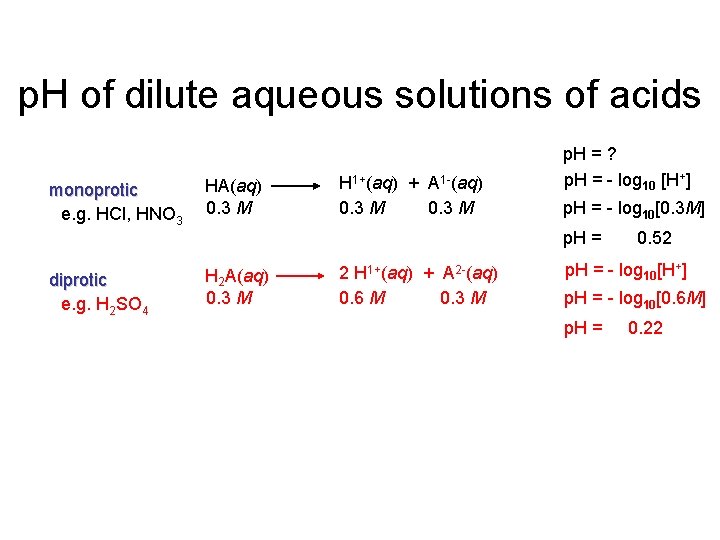
p. H of dilute aqueous solutions of acids monoprotic e. g. HCl, HNO 3 HA(aq) 0. 3 M H 1+(aq) + A 1 -(aq) 0. 3 M p. H = ? p. H = - log 10 [H+] p. H = - log 10[0. 3 M] p. H = diprotic e. g. H 2 SO 4 H 2 A(aq) 0. 3 M 2 H 1+(aq) + A 2 -(aq) 0. 6 M 0. 3 M 0. 52 p. H = - log 10[H+] p. H = - log 10[0. 6 M] p. H = 0. 22
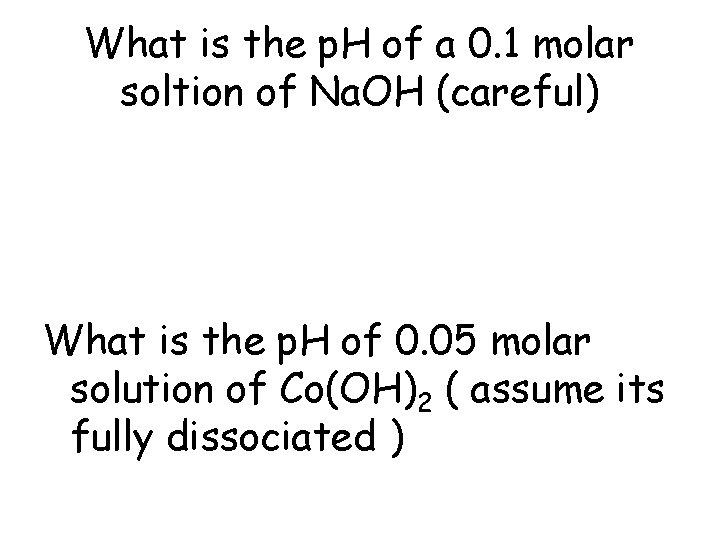
What is the p. H of a 0. 1 molar soltion of Na. OH (careful) What is the p. H of 0. 05 molar solution of Co(OH)2 ( assume its fully dissociated )
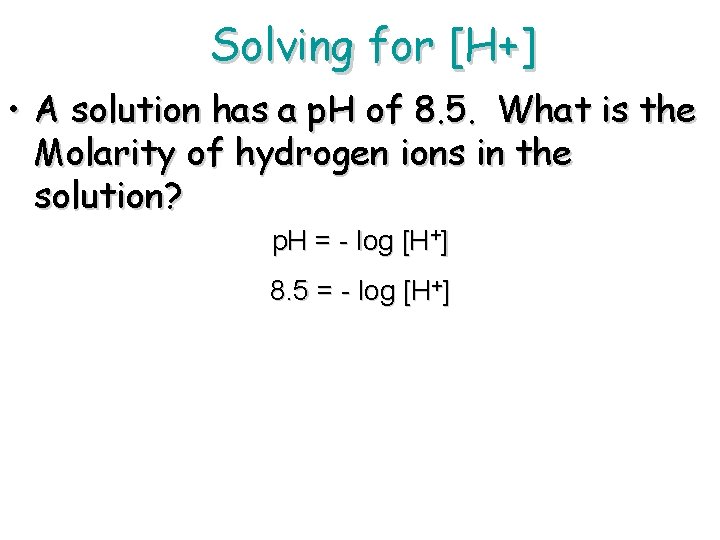
Solving for [H+] • A solution has a p. H of 8. 5. What is the Molarity of hydrogen ions in the solution? p. H = - log [H+] 8. 5 = - log [H+]
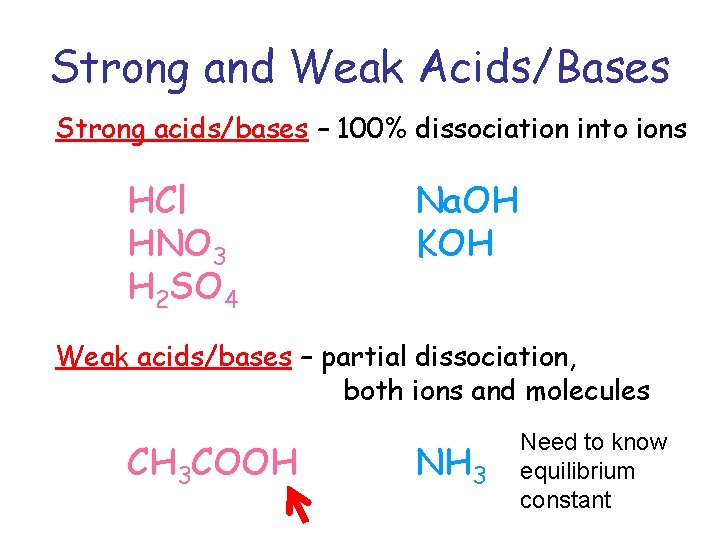
Strong and Weak Acids/Bases Strong acids/bases – 100% dissociation into ions HCl HNO 3 H 2 SO 4 Na. OH KOH Weak acids/bases – partial dissociation, both ions and molecules CH 3 COOH NH 3 Need to know equilibrium constant
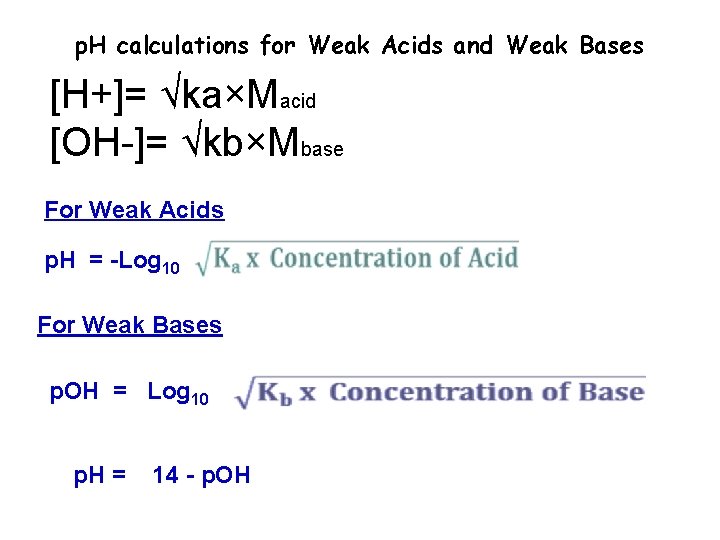
p. H calculations for Weak Acids and Weak Bases [H+]= √ka×Macid [OH-]= √kb×Mbase For Weak Acids p. H = -Log 10 For Weak Bases p. OH = Log 10 p. H = 14 - p. OH
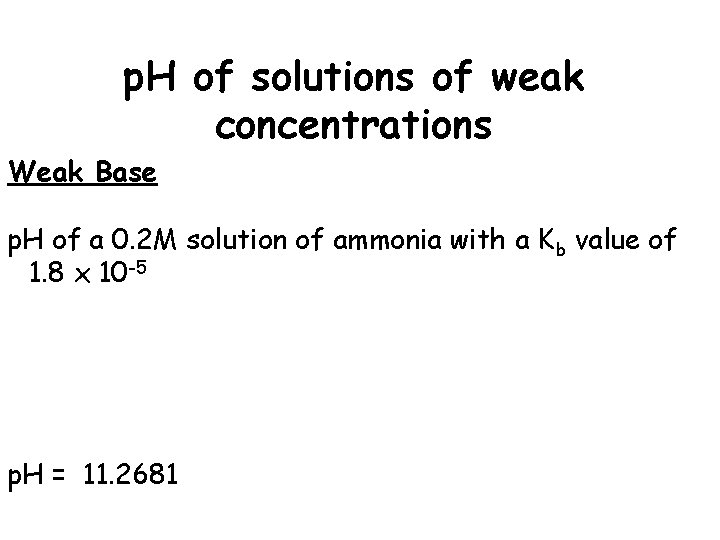
p. H of solutions of weak concentrations Weak Base p. H of a 0. 2 M solution of ammonia with a Kb value of 1. 8 x 10 -5 p. H = 11. 2681
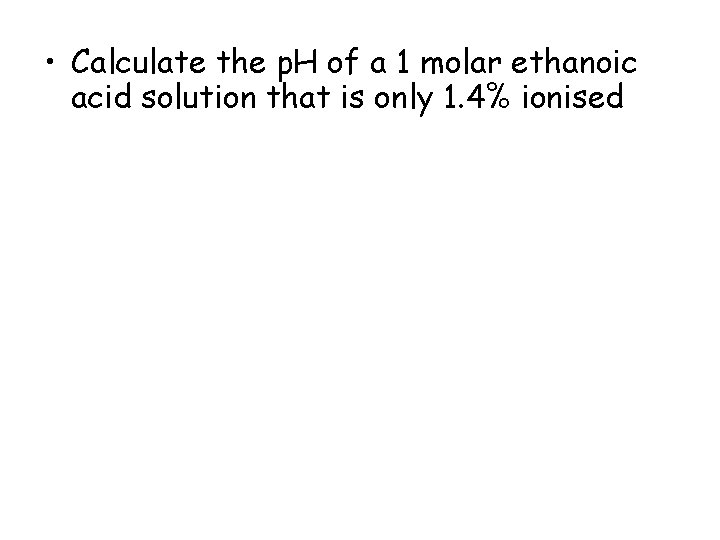
• Calculate the p. H of a 1 molar ethanoic acid solution that is only 1. 4% ionised
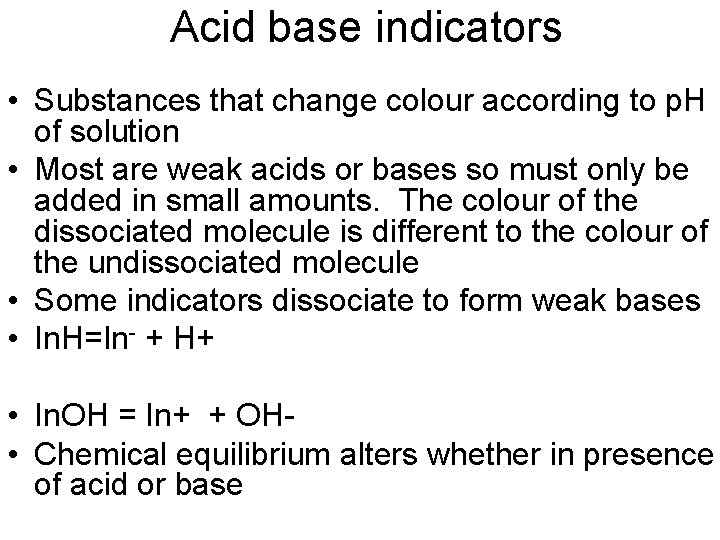
Acid base indicators • Substances that change colour according to p. H of solution • Most are weak acids or bases so must only be added in small amounts. The colour of the dissociated molecule is different to the colour of the undissociated molecule • Some indicators dissociate to form weak bases • In. H=In- + H+ • In. OH = In+ + OH • Chemical equilibrium alters whether in presence of acid or base
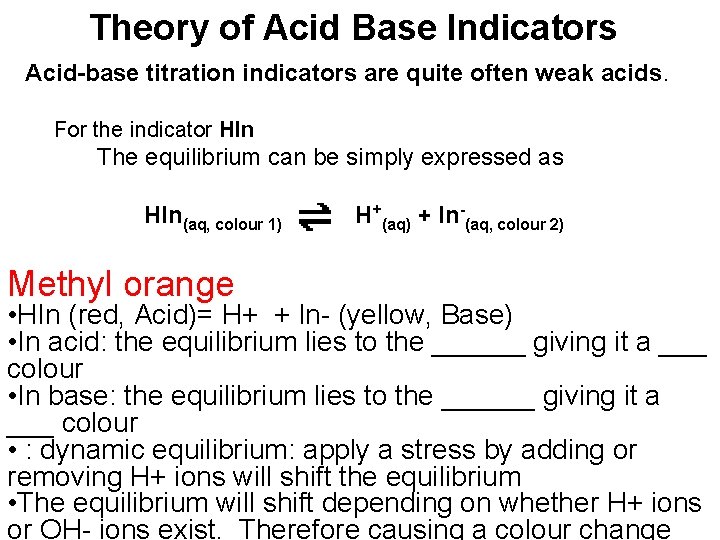
Theory of Acid Base Indicators Acid-base titration indicators are quite often weak acids. For the indicator HIn The equilibrium can be simply expressed as HIn(aq, colour 1) Methyl orange H+(aq) + In-(aq, colour 2) • HIn (red, Acid)= H+ + In- (yellow, Base) • In acid: the equilibrium lies to the ______ giving it a ___ colour • In base: the equilibrium lies to the ______ giving it a ___ colour • : dynamic equilibrium: apply a stress by adding or removing H+ ions will shift the equilibrium • The equilibrium will shift depending on whether H+ ions or OH- ions exist. Therefore causing a colour change
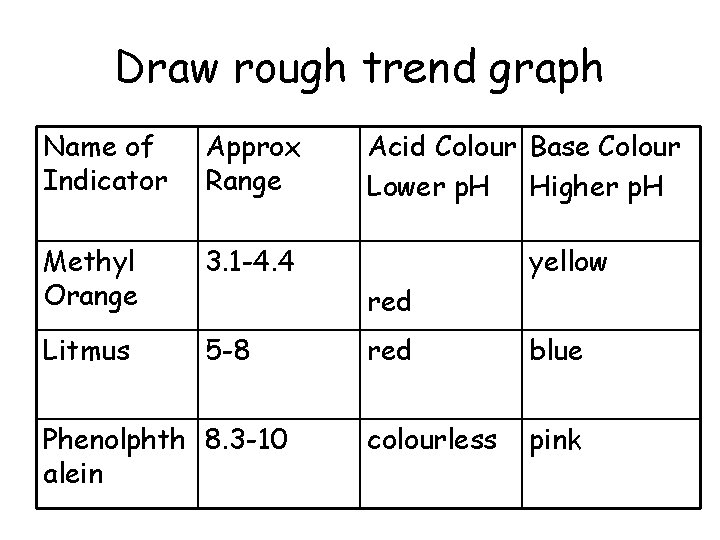
Draw rough trend graph Name of Indicator Approx Range Methyl Orange 3. 1 -4. 4 Litmus 5 -8 Acid Colour Base Colour Lower p. H Higher p. H yellow red Phenolphth 8. 3 -10 alein red blue colourless pink
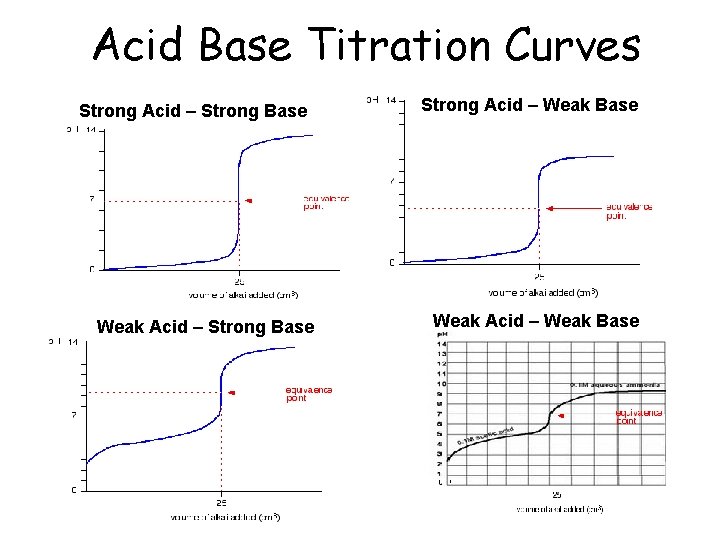
Acid Base Titration Curves Strong Acid – Strong Base Weak Acid – Strong Base Strong Acid – Weak Base Weak Acid – Weak Base
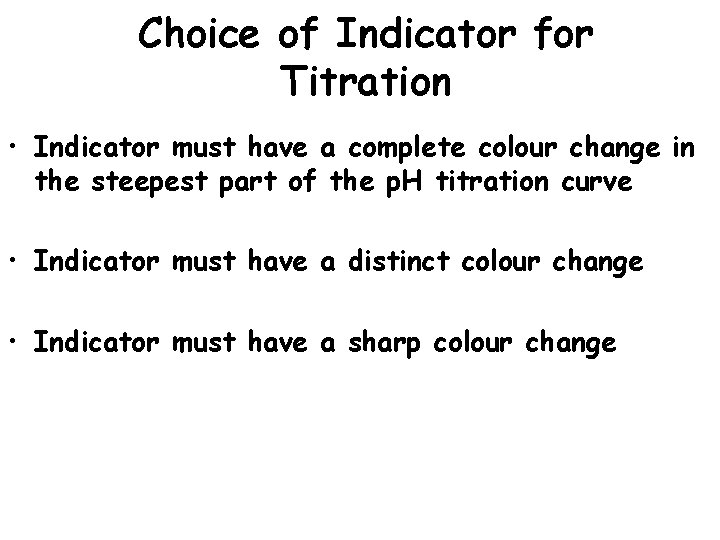
Choice of Indicator for Titration • Indicator must have a complete colour change in the steepest part of the p. H titration curve • Indicator must have a distinct colour change • Indicator must have a sharp colour change
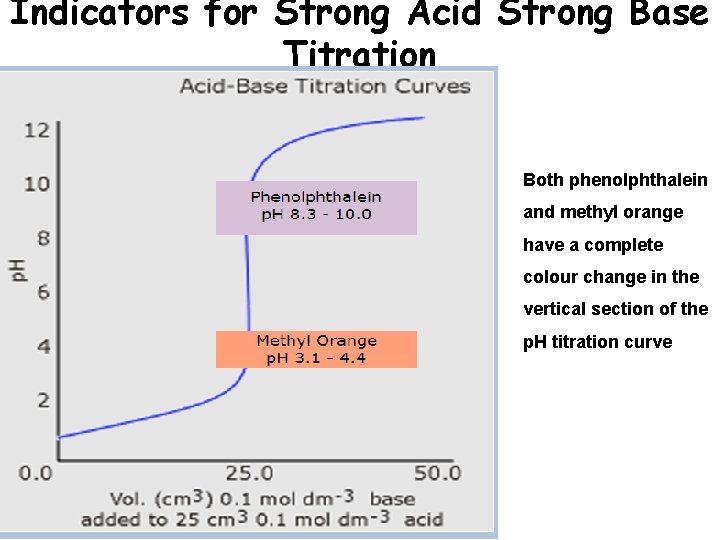
Indicators for Strong Acid Strong Base Titration Both phenolphthalein and methyl orange have a complete colour change in the vertical section of the p. H titration curve
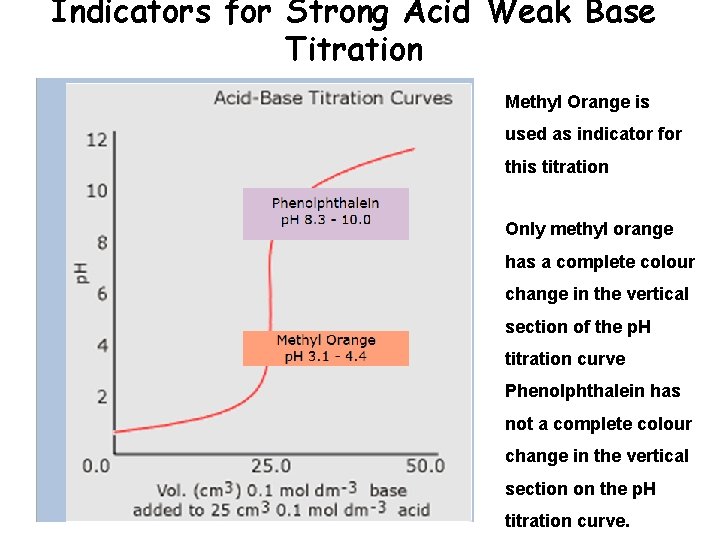
Indicators for Strong Acid Weak Base Titration Methyl Orange is used as indicator for this titration Only methyl orange has a complete colour change in the vertical section of the p. H titration curve Phenolphthalein has not a complete colour change in the vertical section on the p. H titration curve.
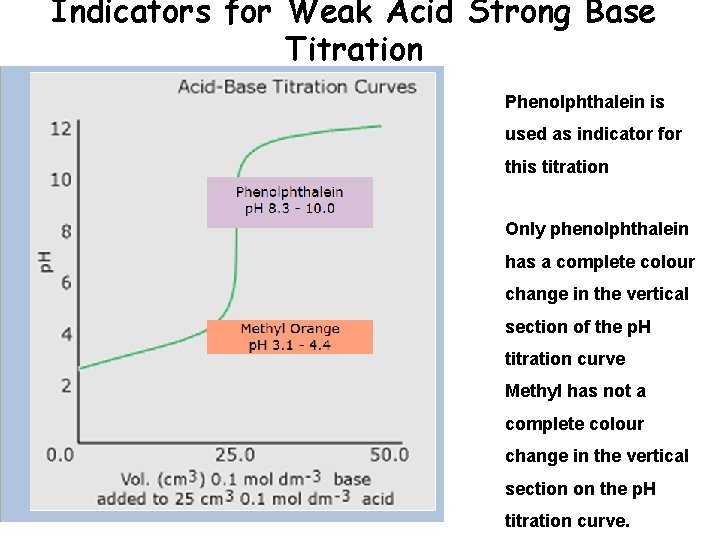
Indicators for Weak Acid Strong Base Titration Phenolphthalein is used as indicator for this titration Only phenolphthalein has a complete colour change in the vertical section of the p. H titration curve Methyl has not a complete colour change in the vertical section on the p. H titration curve.
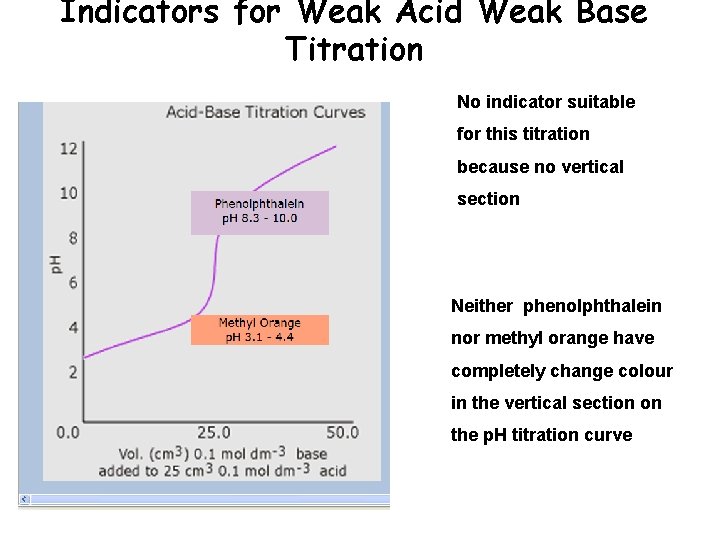
Indicators for Weak Acid Weak Base Titration No indicator suitable for this titration because no vertical section Neither phenolphthalein nor methyl orange have completely change colour in the vertical section on the p. H titration curve
Page 261, 262 Question NB to practise