
Acids and Bases Topics to be covered Definitions
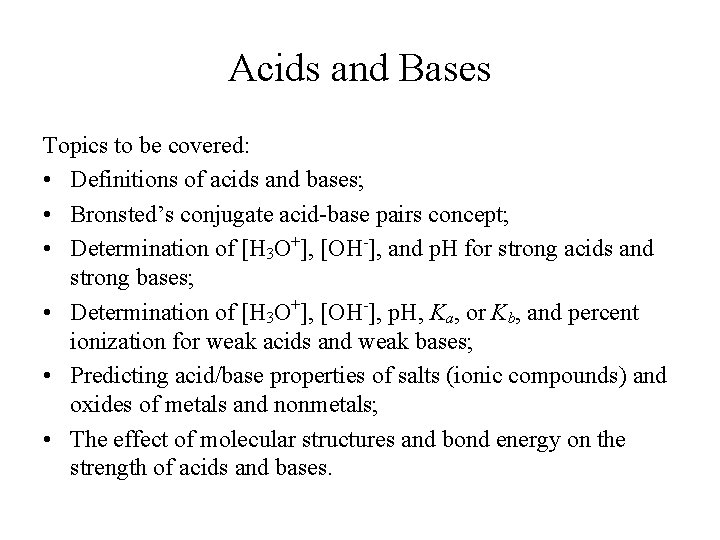
Acids and Bases Topics to be covered: • Definitions of acids and bases; • Bronsted’s conjugate acid-base pairs concept; • Determination of [H 3 O+], [OH-], and p. H for strong acids and strong bases; • Determination of [H 3 O+], [OH-], p. H, Ka, or Kb, and percent ionization for weak acids and weak bases; • Predicting acid/base properties of salts (ionic compounds) and oxides of metals and nonmetals; • The effect of molecular structures and bond energy on the strength of acids and bases.
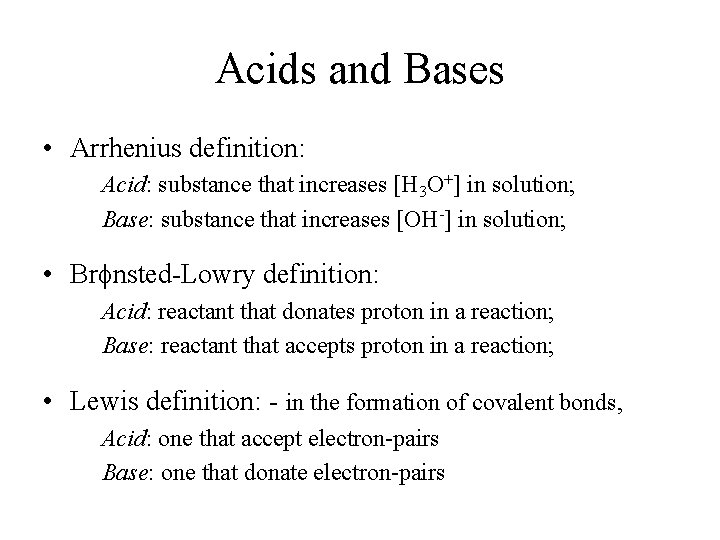
Acids and Bases • Arrhenius definition: Acid: substance that increases [H 3 O+] in solution; Base: substance that increases [OH-] in solution; • Br nsted-Lowry definition: Acid: reactant that donates proton in a reaction; Base: reactant that accepts proton in a reaction; • Lewis definition: - in the formation of covalent bonds, Acid: one that accept electron-pairs Base: one that donate electron-pairs
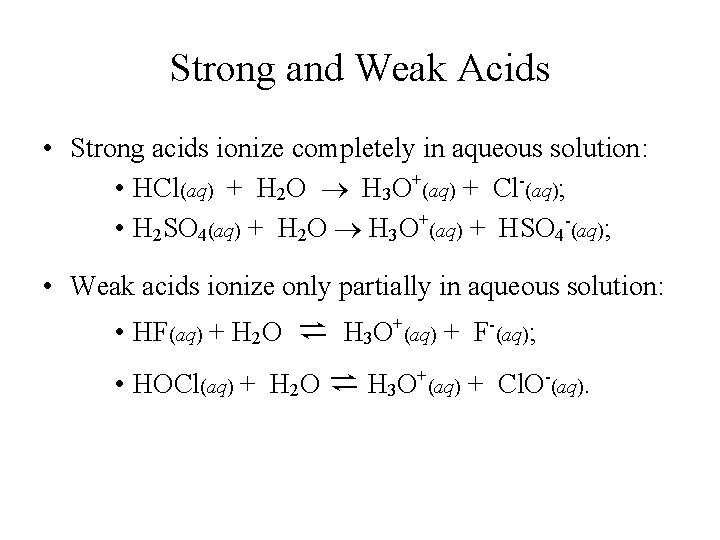
Strong and Weak Acids • Strong acids ionize completely in aqueous solution: • HCl(aq) + H 2 O H 3 O+(aq) + Cl-(aq); • H 2 SO 4(aq) + H 2 O H 3 O+(aq) + HSO 4 -(aq); • Weak acids ionize only partially in aqueous solution: ⇌ H 3 O+(aq) + F-(aq); H 2 O ⇌ H 3 O+(aq) + Cl. O-(aq). • HF(aq) + H 2 O • HOCl(aq) +
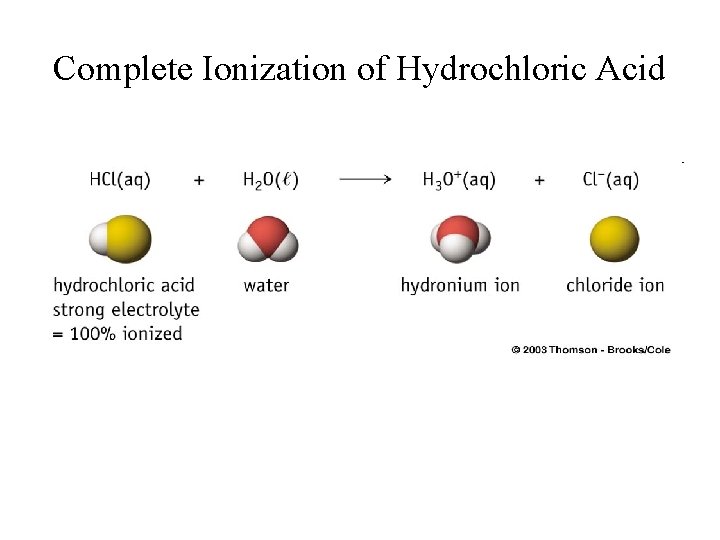
Complete Ionization of Hydrochloric Acid
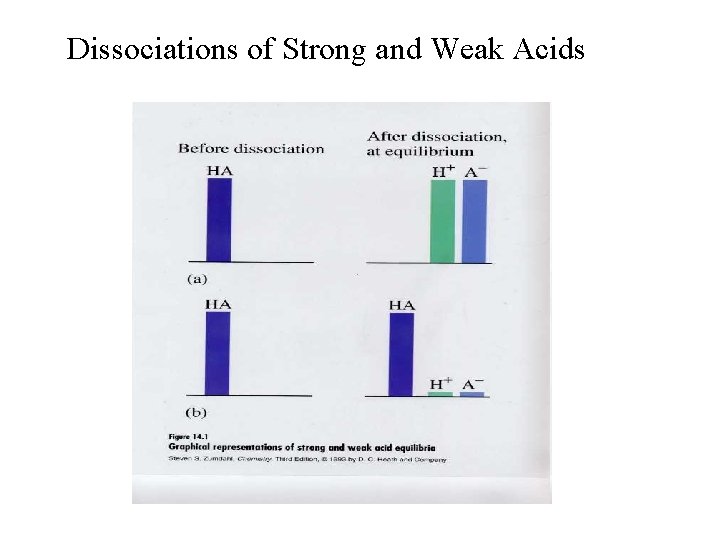
Dissociations of Strong and Weak Acids

Strong and Weak Bases • Strong bases ionize completely in aqueous solution: Na. OH(aq) Na+(aq) + OH-(aq); Ba(OH)2(aq) Ba 2+(aq) + 2 OH-(aq); • Weak bases ionize only partially in aqueous solution: NH 3(aq) + H 2 O NH 4+(aq) + OH-(aq); PO 43 -(aq) + H 2 O HPO 42 -(aq) + OH-(aq)
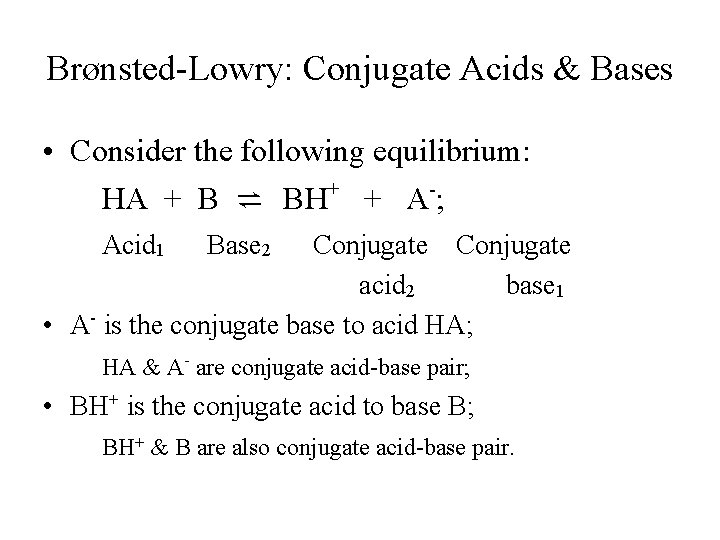
Brønsted-Lowry: Conjugate Acids & Bases • Consider the following equilibrium: HA + B ⇌ BH+ + A-; Acid 1 Base 2 Conjugate acid 2 base 1 • A- is the conjugate base to acid HA; HA & A- are conjugate acid-base pair; • BH+ is the conjugate acid to base B; BH+ & B are also conjugate acid-base pair.
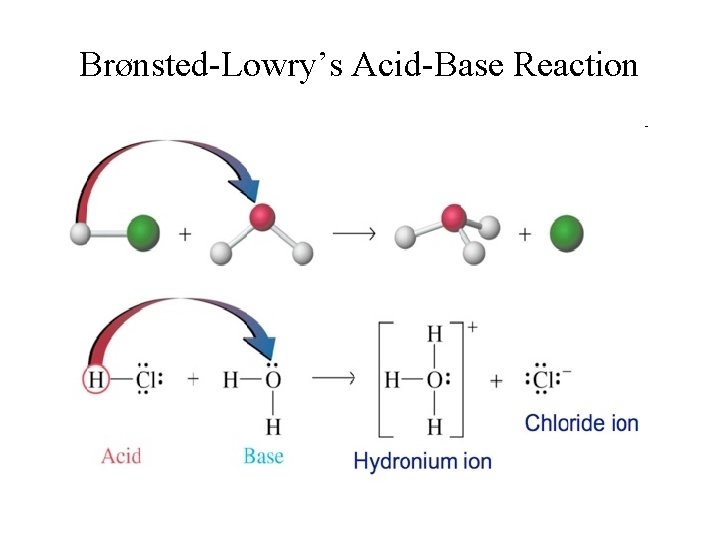
Brønsted-Lowry’s Acid-Base Reaction

Brønsted’s Conjugate Acid-Base Pairs
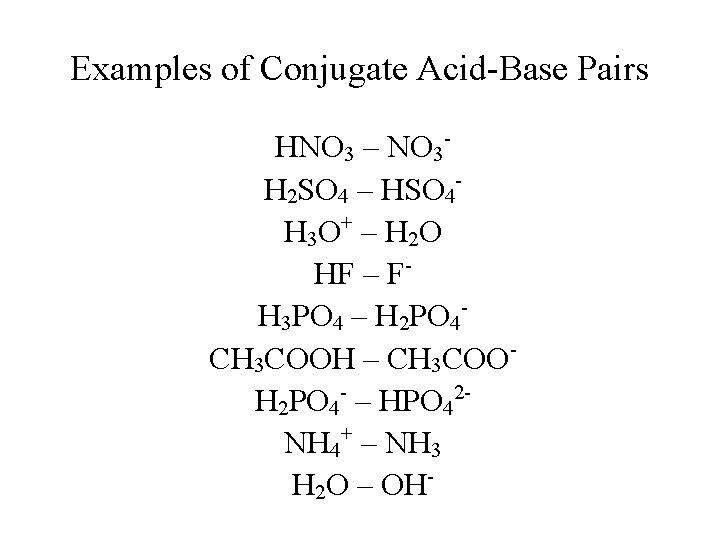
Examples of Conjugate Acid-Base Pairs HNO 3 – NO 3 H 2 SO 4 – HSO 4 H 3 O+ – H 2 O HF – F H 3 PO 4 – H 2 PO 4 CH 3 COOH – CH 3 COOH 2 PO 4 - – HPO 42 NH 4+ – NH 3 H 2 O – OH-
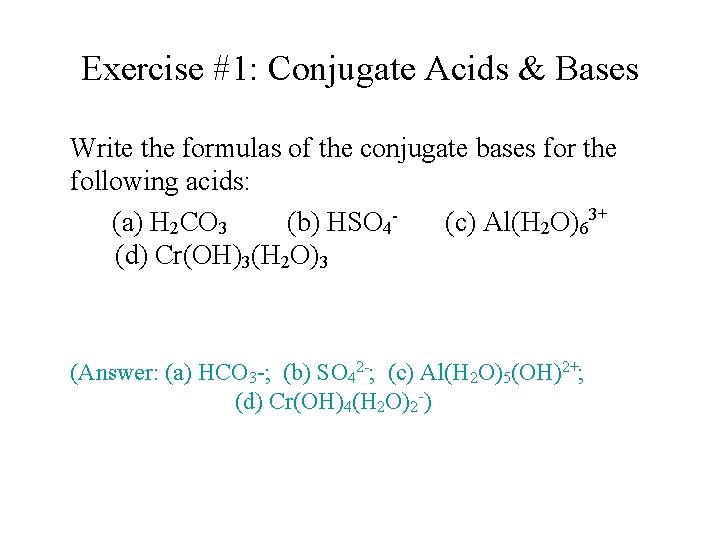
Exercise #1: Conjugate Acids & Bases Write the formulas of the conjugate bases for the following acids: (a) H 2 CO 3 (b) HSO 4(c) Al(H 2 O)63+ (d) Cr(OH)3(H 2 O)3 (Answer: (a) HCO 3 -; (b) SO 42 -; (c) Al(H 2 O)5(OH)2+; (d) Cr(OH)4(H 2 O)2 -)
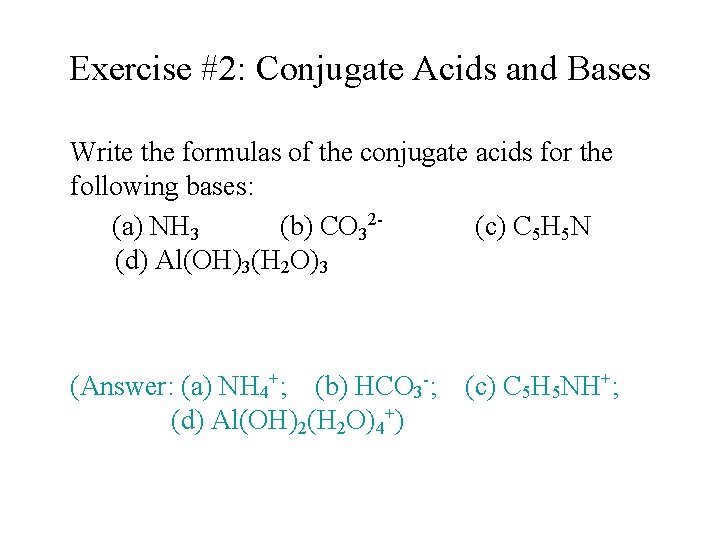
Exercise #2: Conjugate Acids and Bases Write the formulas of the conjugate acids for the following bases: (a) NH 3 (b) CO 32(c) C 5 H 5 N (d) Al(OH)3(H 2 O)3 (Answer: (a) NH 4+; (b) HCO 3 -; (c) C 5 H 5 NH+; (d) Al(OH)2(H 2 O)4+)
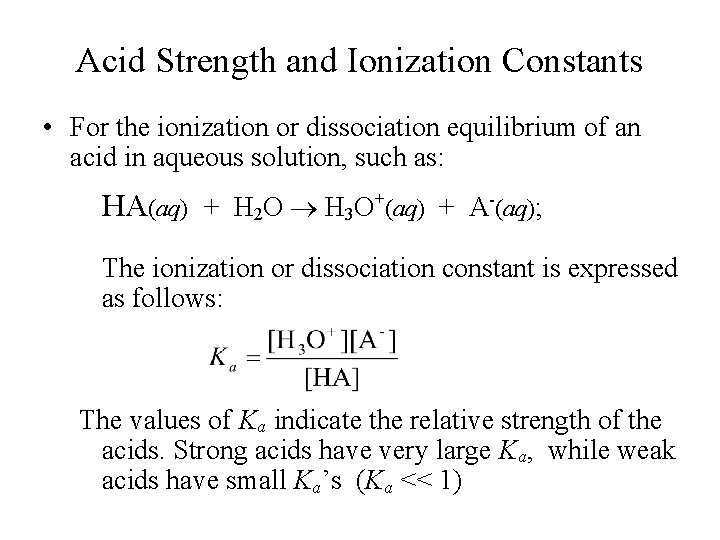
Acid Strength and Ionization Constants • For the ionization or dissociation equilibrium of an acid in aqueous solution, such as: HA(aq) + H 2 O H 3 O+(aq) + A-(aq); The ionization or dissociation constant is expressed as follows: The values of Ka indicate the relative strength of the acids. Strong acids have very large Ka, while weak acids have small Ka’s (Ka << 1)
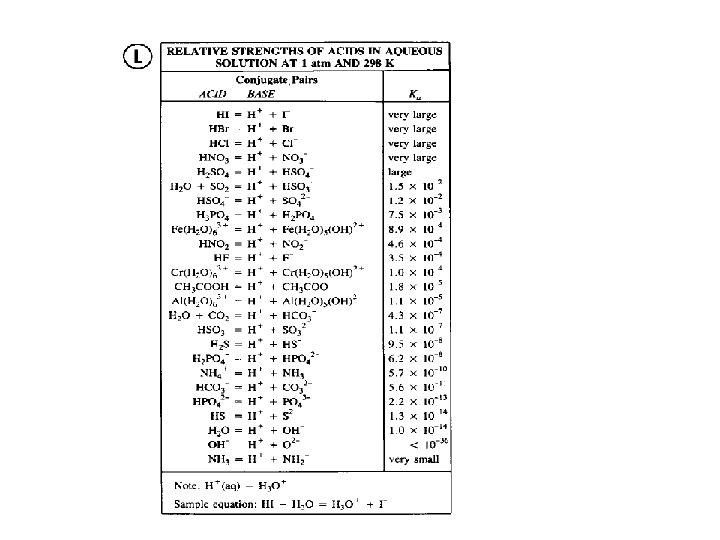
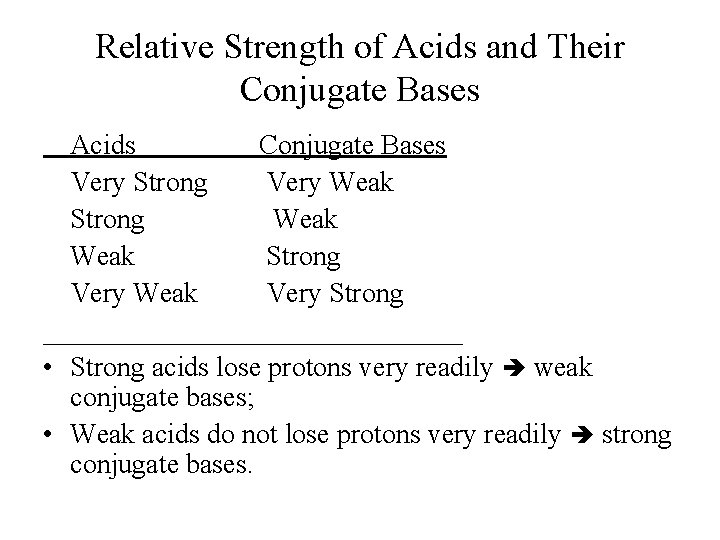
Relative Strength of Acids and Their Conjugate Bases Acids Conjugate Bases Very Strong Very Weak Strong Very Weak Very Strong _______________ • Strong acids lose protons very readily weak conjugate bases; • Weak acids do not lose protons very readily strong conjugate bases.
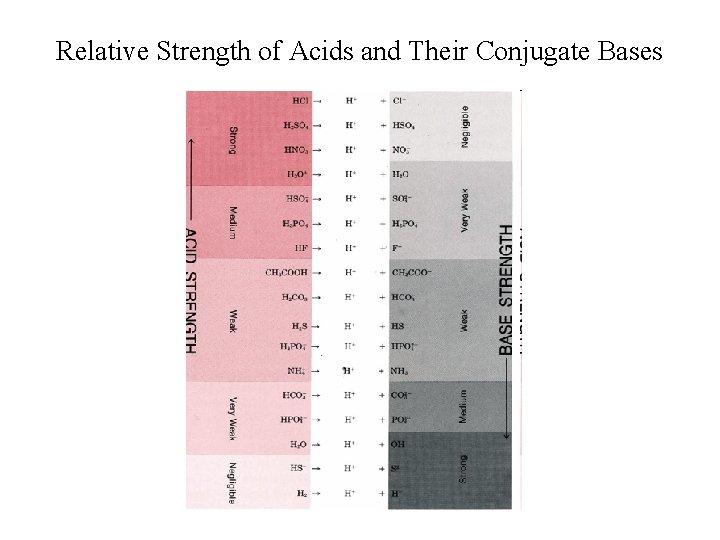
Relative Strength of Acids and Their Conjugate Bases
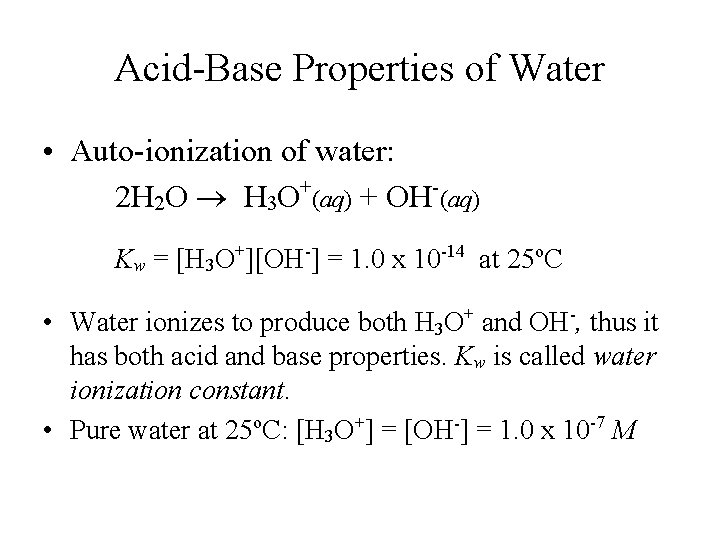
Acid-Base Properties of Water • Auto-ionization of water: 2 H 2 O H 3 O+(aq) + OH-(aq) Kw = [H 3 O+][OH-] = 1. 0 x 10 -14 at 25 o. C • Water ionizes to produce both H 3 O+ and OH-, thus it has both acid and base properties. Kw is called water ionization constant. • Pure water at 25 o. C: [H 3 O+] = [OH-] = 1. 0 x 10 -7 M
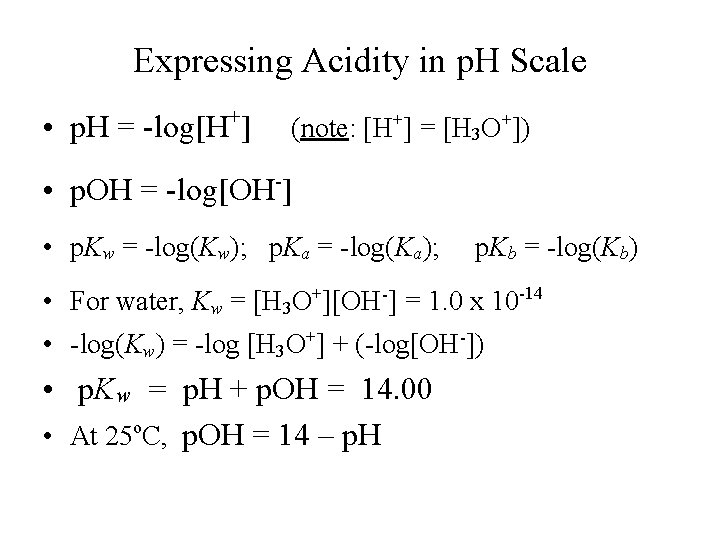
Expressing Acidity in p. H Scale • p. H = -log[H+] (note: [H+] = [H 3 O+]) • p. OH = -log[OH-] • p. Kw = -log(Kw); p. Ka = -log(Ka); p. Kb = -log(Kb) • For water, Kw = [H 3 O+][OH-] = 1. 0 x 10 -14 • -log(Kw) = -log [H 3 O+] + (-log[OH-]) • p. Kw = p. H + p. OH = 14. 00 • At 25 o. C, p. OH = 14 – p. H
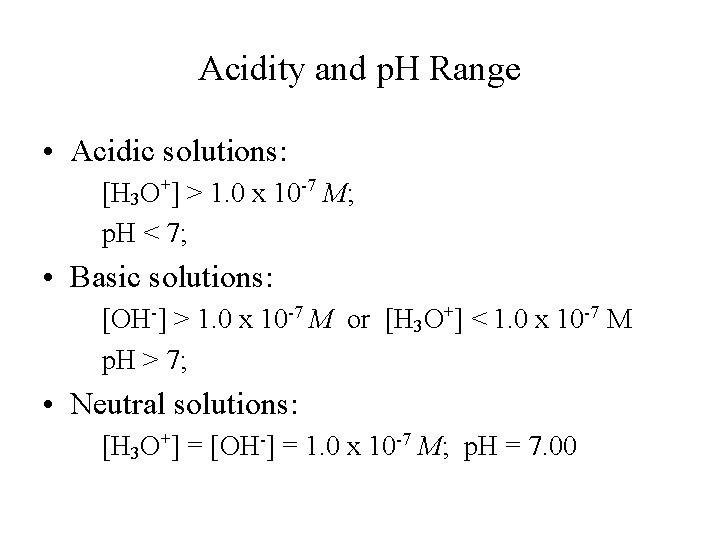
Acidity and p. H Range • Acidic solutions: [H 3 O+] > 1. 0 x 10 -7 M; p. H < 7; • Basic solutions: [OH-] > 1. 0 x 10 -7 M or [H 3 O+] < 1. 0 x 10 -7 M p. H > 7; • Neutral solutions: [H 3 O+] = [OH-] = 1. 0 x 10 -7 M; p. H = 7. 00
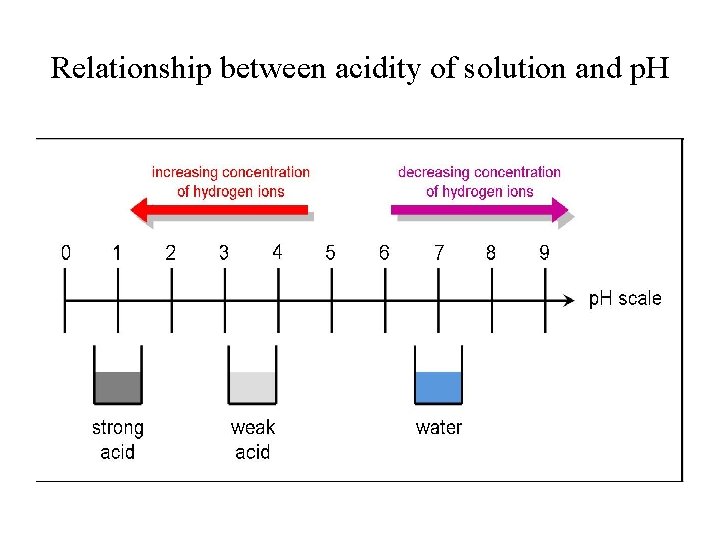
Relationship between acidity of solution and p. H
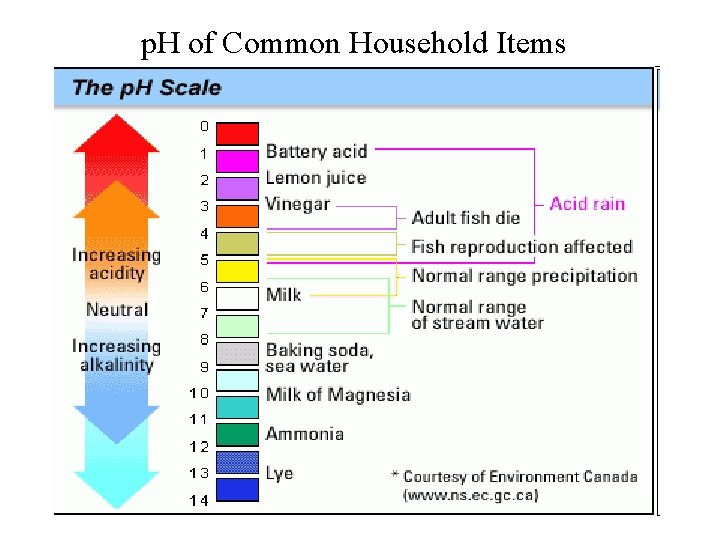
p. H of Common Household Items

Household Substances
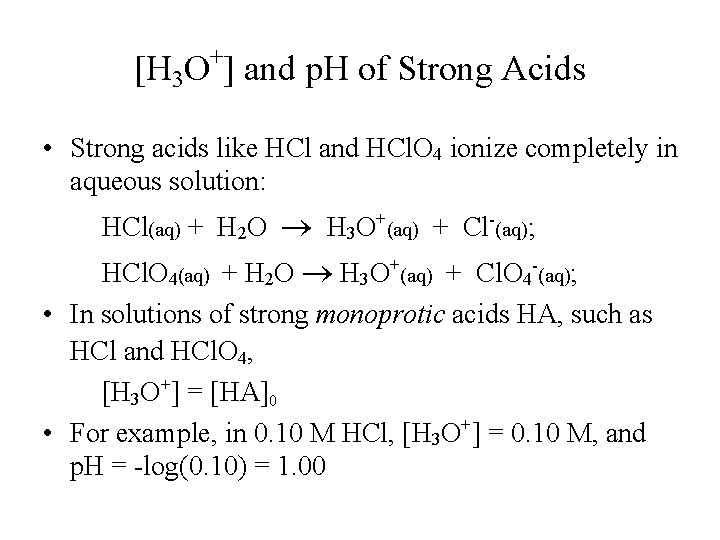
[H 3 O+] and p. H of Strong Acids • Strong acids like HCl and HCl. O 4 ionize completely in aqueous solution: HCl(aq) + H 2 O H 3 O+(aq) + Cl-(aq); HCl. O 4(aq) + H 2 O H 3 O+(aq) + Cl. O 4 -(aq); • In solutions of strong monoprotic acids HA, such as HCl and HCl. O 4, [H 3 O+] = [HA]0 • For example, in 0. 10 M HCl, [H 3 O+] = 0. 10 M, and p. H = -log(0. 10) = 1. 00
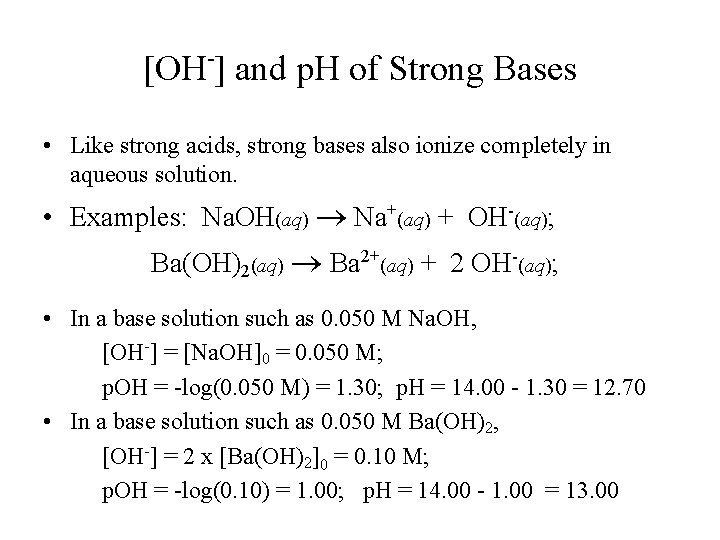
[OH-] and p. H of Strong Bases • Like strong acids, strong bases also ionize completely in aqueous solution. • Examples: Na. OH(aq) Na+(aq) + OH-(aq); Ba(OH)2(aq) Ba 2+(aq) + 2 OH-(aq); • In a base solution such as 0. 050 M Na. OH, [OH-] = [Na. OH]0 = 0. 050 M; p. OH = -log(0. 050 M) = 1. 30; p. H = 14. 00 - 1. 30 = 12. 70 • In a base solution such as 0. 050 M Ba(OH)2, [OH-] = 2 x [Ba(OH)2]0 = 0. 10 M; p. OH = -log(0. 10) = 1. 00; p. H = 14. 00 - 1. 00 = 13. 00
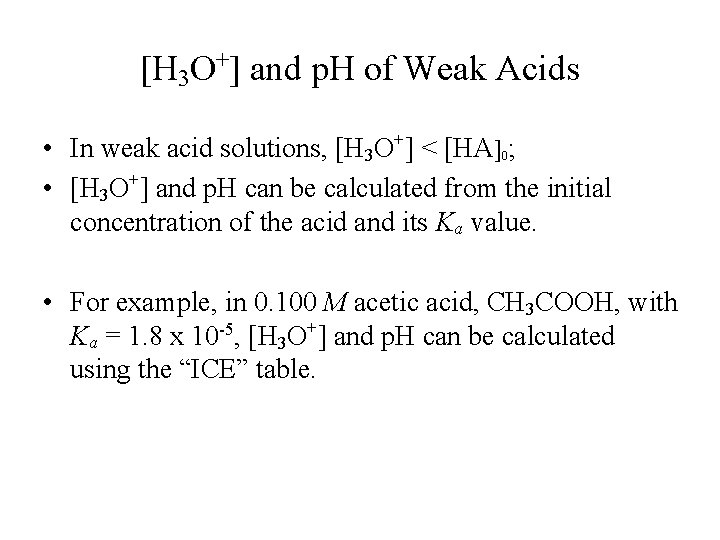
[H 3 O+] and p. H of Weak Acids • In weak acid solutions, [H 3 O+] < [HA]0; • [H 3 O+] and p. H can be calculated from the initial concentration of the acid and its Ka value. • For example, in 0. 100 M acetic acid, CH 3 COOH, with Ka = 1. 8 x 10 -5, [H 3 O+] and p. H can be calculated using the “ICE” table.
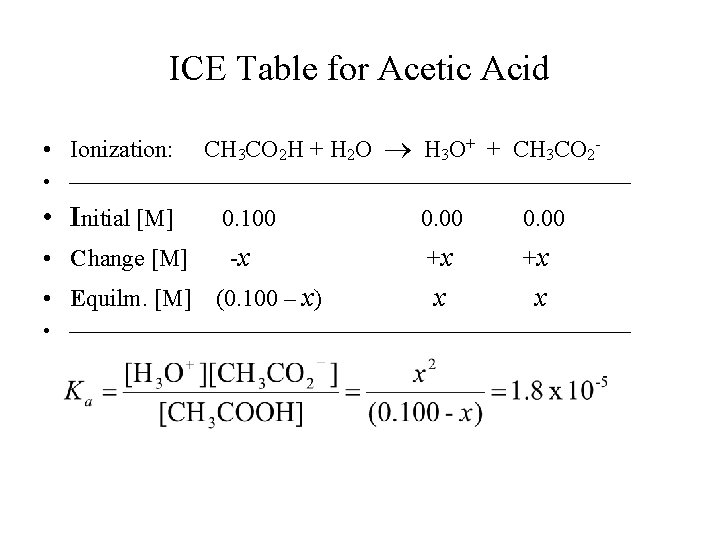
ICE Table for Acetic Acid • Ionization: CH 3 CO 2 H + H 2 O H 3 O+ + CH 3 CO 2 - • • Initial [M] • Change [M] 0. 100 -x • Equilm. [M] (0. 100 – x) 0. 00 +x +x x x •
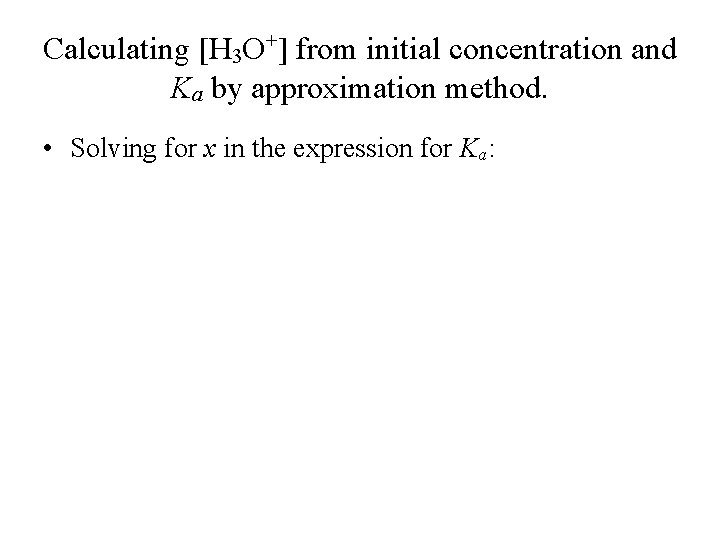
Calculating [H 3 O+] from initial concentration and Ka by approximation method. • Solving for x in the expression for Ka:
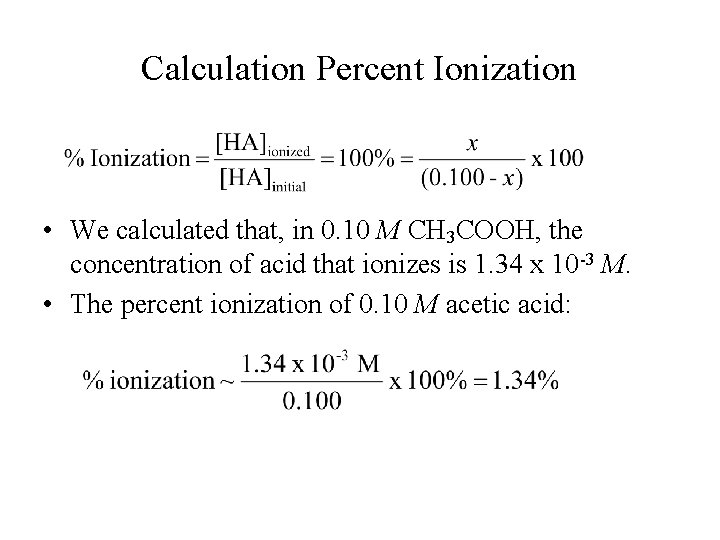
Calculation Percent Ionization • We calculated that, in 0. 10 M CH 3 COOH, the concentration of acid that ionizes is 1. 34 x 10 -3 M. • The percent ionization of 0. 10 M acetic acid:
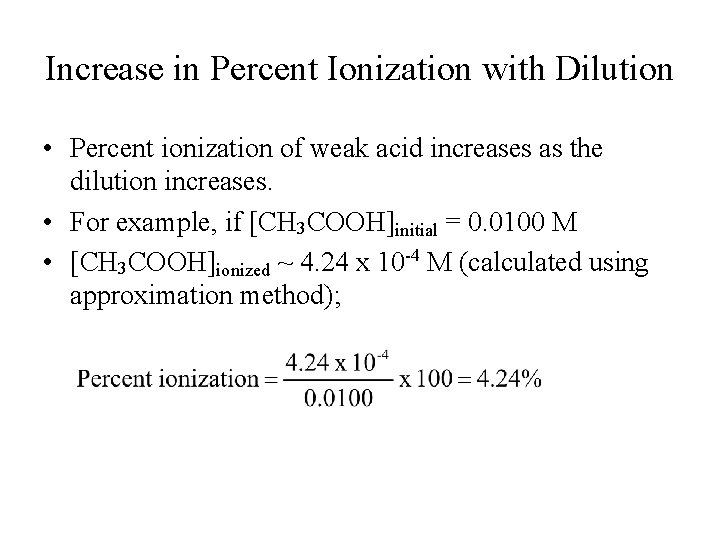
Increase in Percent Ionization with Dilution • Percent ionization of weak acid increases as the dilution increases. • For example, if [CH 3 COOH]initial = 0. 0100 M • [CH 3 COOH]ionized ~ 4. 24 x 10 -4 M (calculated using approximation method);
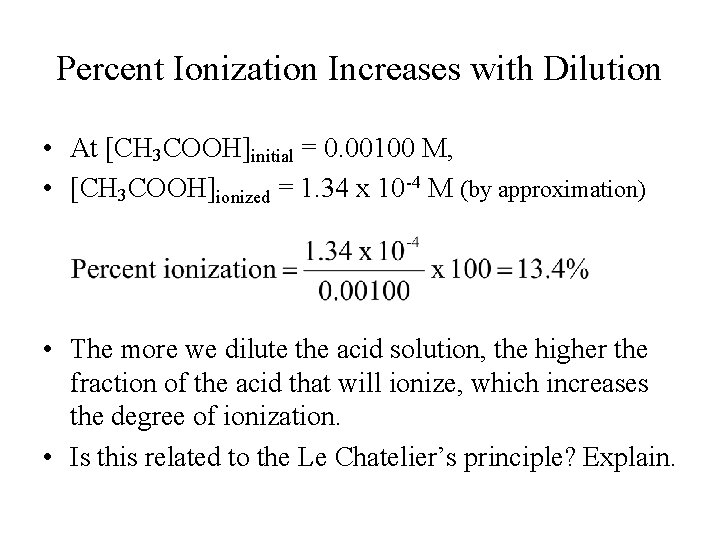
Percent Ionization Increases with Dilution • At [CH 3 COOH]initial = 0. 00100 M, • [CH 3 COOH]ionized = 1. 34 x 10 -4 M (by approximation) • The more we dilute the acid solution, the higher the fraction of the acid that will ionize, which increases the degree of ionization. • Is this related to the Le Chatelier’s principle? Explain.
Exercise #3: p. H and Percent Ionization 1) Nitrous acid, HNO 2, has Ka = 4. 0 x 10 -4 at 25 o. C. Calculate the p. H and percent ionization of HNO 2 in 0. 10 M solution of the acid. (Answer: p. H = 2. 20; % ionization = 6. 3%) 2) Chlorous acid, HOCl, has Ka = 3. 5 x 10 -8 at 25 o. C. Calculate the p. H and percent ionization of HOCl in 0. 10 M solution of the acid. (Answer: p. H = 4. 23; % ionization = 0. 059%)
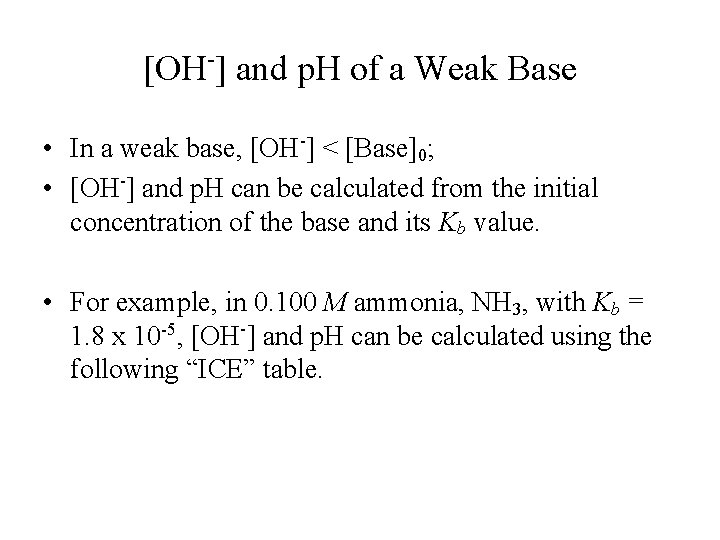
[OH-] and p. H of a Weak Base • In a weak base, [OH-] < [Base]0; • [OH-] and p. H can be calculated from the initial concentration of the base and its Kb value. • For example, in 0. 100 M ammonia, NH 3, with Kb = 1. 8 x 10 -5, [OH-] and p. H can be calculated using the following “ICE” table.
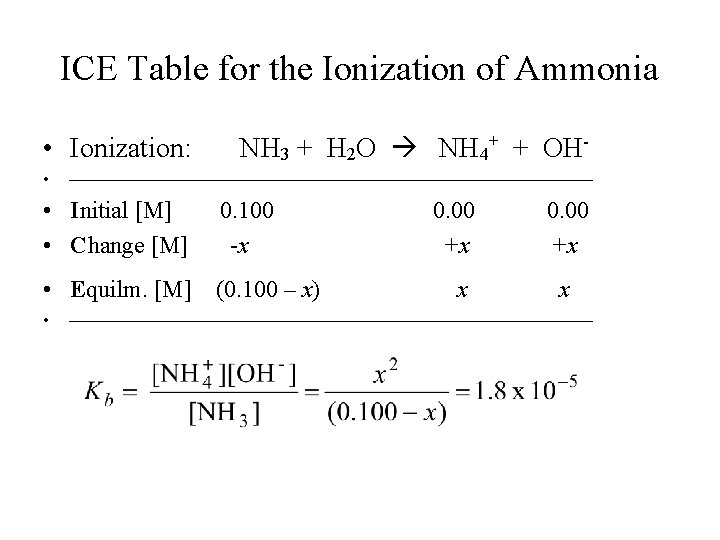
ICE Table for the Ionization of Ammonia • Ionization: • NH 3 + H 2 O NH 4+ + OH- • Initial [M] • Change [M] 0. 100 -x • Equilm. [M] (0. 100 – x) • 0. 00 +x x
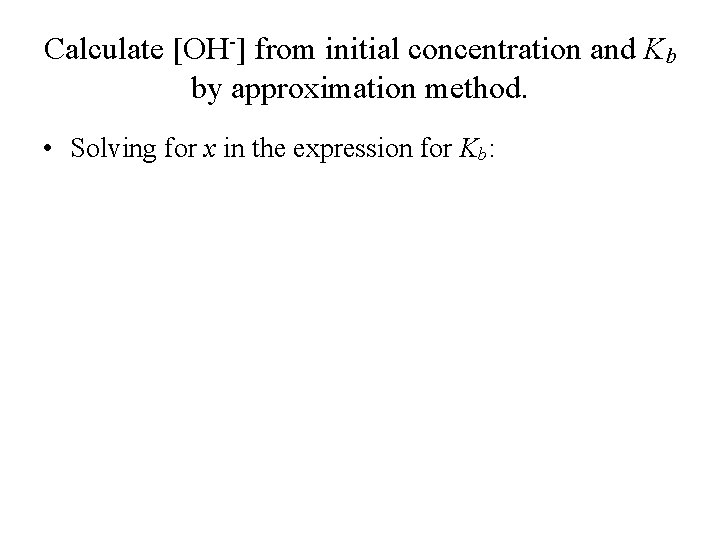
Calculate [OH-] from initial concentration and Kb by approximation method. • Solving for x in the expression for Kb:
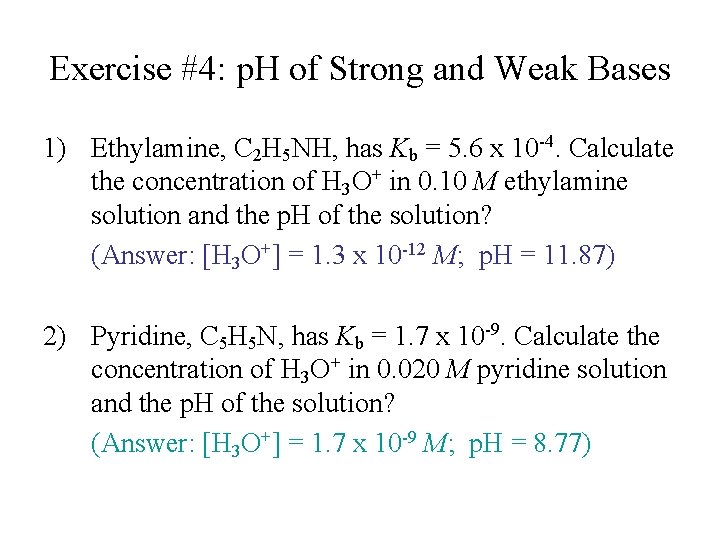
Exercise #4: p. H of Strong and Weak Bases 1) Ethylamine, C 2 H 5 NH, has Kb = 5. 6 x 10 -4. Calculate the concentration of H 3 O+ in 0. 10 M ethylamine solution and the p. H of the solution? (Answer: [H 3 O+] = 1. 3 x 10 -12 M; p. H = 11. 87) 2) Pyridine, C 5 H 5 N, has Kb = 1. 7 x 10 -9. Calculate the concentration of H 3 O+ in 0. 020 M pyridine solution and the p. H of the solution? (Answer: [H 3 O+] = 1. 7 x 10 -9 M; p. H = 8. 77)
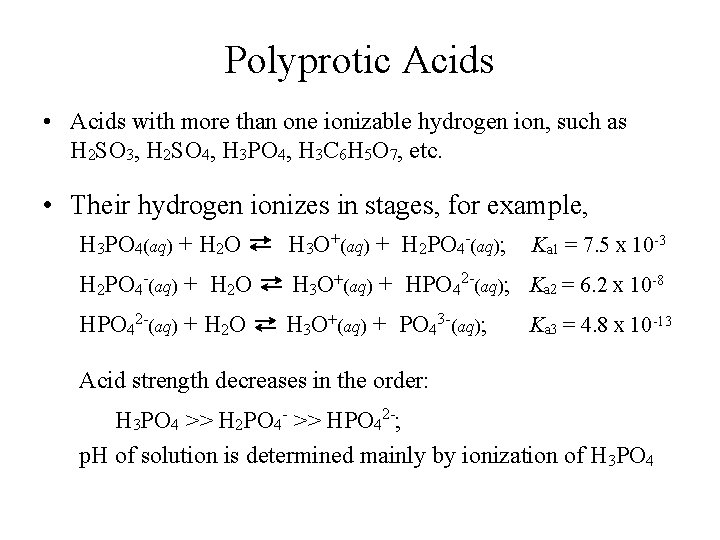
Polyprotic Acids • Acids with more than one ionizable hydrogen ion, such as H 2 SO 3, H 2 SO 4, H 3 PO 4, H 3 C 6 H 5 O 7, etc. • Their hydrogen ionizes in stages, for example, H 3 PO 4(aq) + H 2 O ⇄ H 3 O+(aq) + H 2 PO 4 -(aq); Ka 1 = 7. 5 x 10 -3 H 2 PO 4 -(aq) + H 2 O ⇄ H 3 O+(aq) + HPO 42 -(aq); Ka 2 = 6. 2 x 10 -8 HPO 42 -(aq) + H 2 O ⇄ H 3 O+(aq) + PO 43 -(aq); Ka 3 = 4. 8 x 10 -13 Acid strength decreases in the order: H 3 PO 4 >> H 2 PO 4 - >> HPO 42 -; p. H of solution is determined mainly by ionization of H 3 PO 4
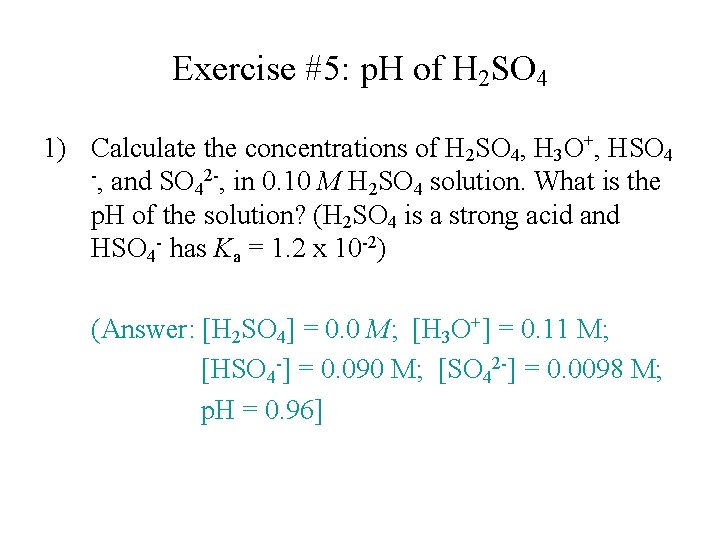
Exercise #5: p. H of H 2 SO 4 1) Calculate the concentrations of H 2 SO 4, H 3 O+, HSO 4 , and SO 42 -, in 0. 10 M H 2 SO 4 solution. What is the p. H of the solution? (H 2 SO 4 is a strong acid and HSO 4 - has Ka = 1. 2 x 10 -2) (Answer: [H 2 SO 4] = 0. 0 M; [H 3 O+] = 0. 11 M; [HSO 4 -] = 0. 090 M; [SO 42 -] = 0. 0098 M; p. H = 0. 96]

Salts and Their Corresponding Acids & Bases • Acids and bases from which each of the following salts are produced. Acids Bases • Na. Cl. O 4 • KNO 3 • (NH 4)2 SO 4 • Na. C 2 H 3 O 2 • Ba. Cl 2 • Na 3 PO 4
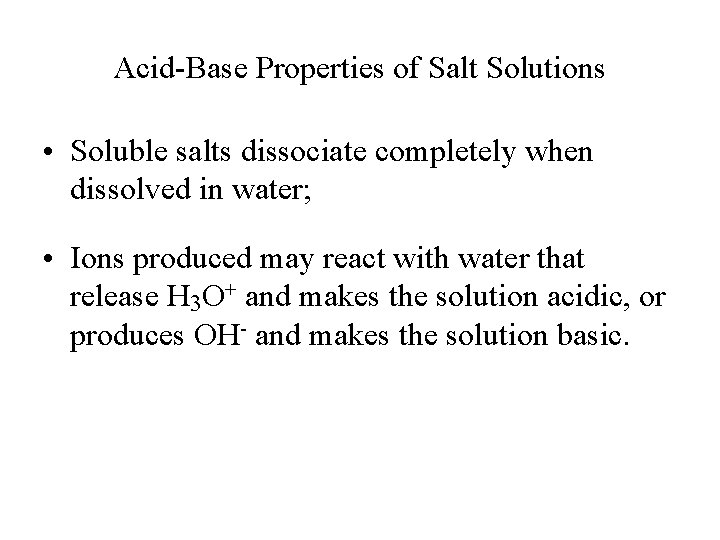
Acid-Base Properties of Salt Solutions • Soluble salts dissociate completely when dissolved in water; • Ions produced may react with water that release H 3 O+ and makes the solution acidic, or produces OH- and makes the solution basic.
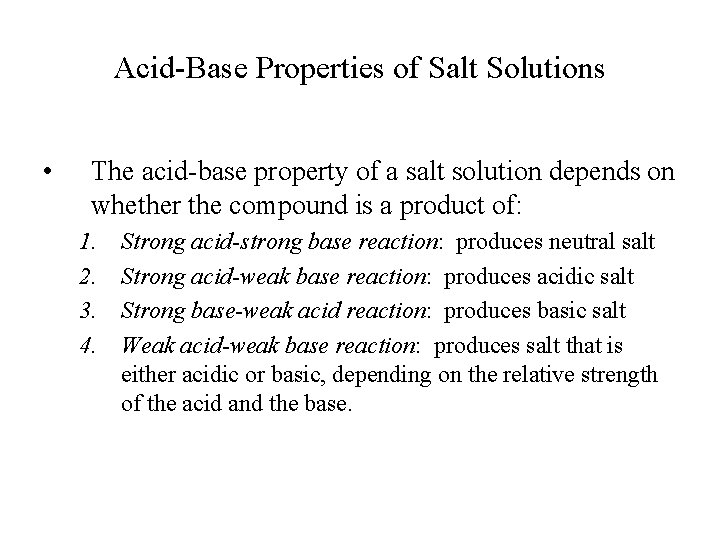
Acid-Base Properties of Salt Solutions • The acid-base property of a salt solution depends on whether the compound is a product of: 1. 2. 3. 4. Strong acid-strong base reaction: produces neutral salt Strong acid-weak base reaction: produces acidic salt Strong base-weak acid reaction: produces basic salt Weak acid-weak base reaction: produces salt that is either acidic or basic, depending on the relative strength of the acid and the base.
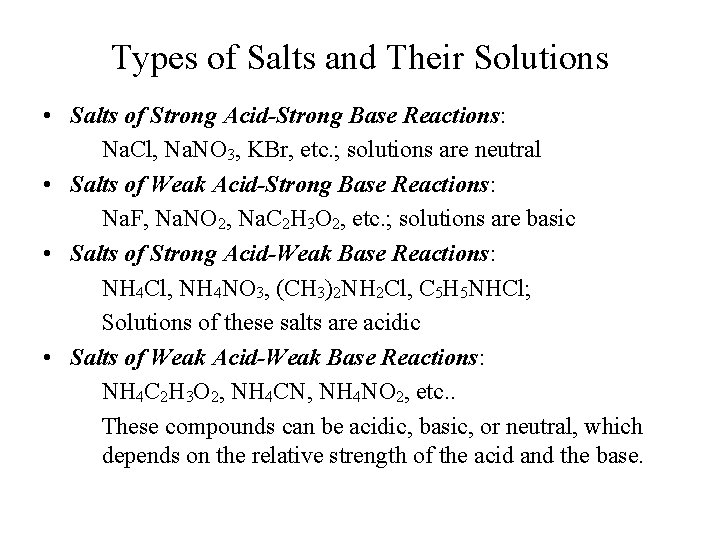
Types of Salts and Their Solutions • Salts of Strong Acid-Strong Base Reactions: Na. Cl, Na. NO 3, KBr, etc. ; solutions are neutral • Salts of Weak Acid-Strong Base Reactions: Na. F, Na. NO 2, Na. C 2 H 3 O 2, etc. ; solutions are basic • Salts of Strong Acid-Weak Base Reactions: NH 4 Cl, NH 4 NO 3, (CH 3)2 NH 2 Cl, C 5 H 5 NHCl; Solutions of these salts are acidic • Salts of Weak Acid-Weak Base Reactions: NH 4 C 2 H 3 O 2, NH 4 CN, NH 4 NO 2, etc. . These compounds can be acidic, basic, or neutral, which depends on the relative strength of the acid and the base.
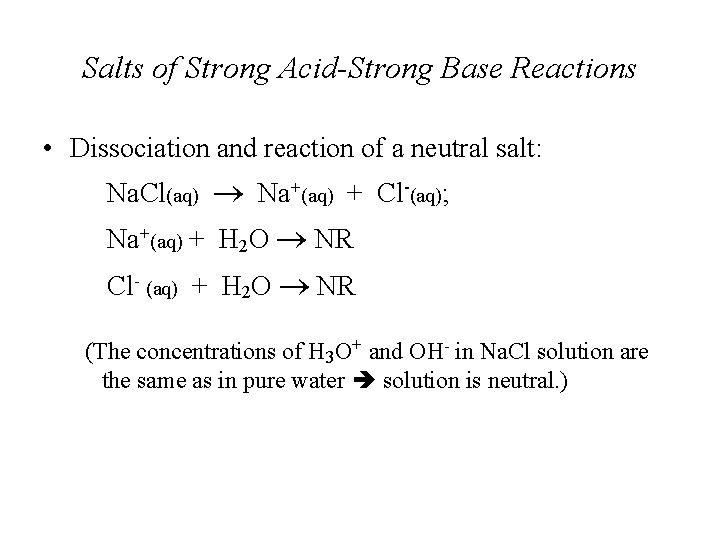
Salts of Strong Acid-Strong Base Reactions • Dissociation and reaction of a neutral salt: Na. Cl(aq) Na+(aq) + Cl-(aq); Na+(aq) + H 2 O NR Cl- (aq) + H 2 O NR (The concentrations of H 3 O+ and OH- in Na. Cl solution are the same as in pure water solution is neutral. )
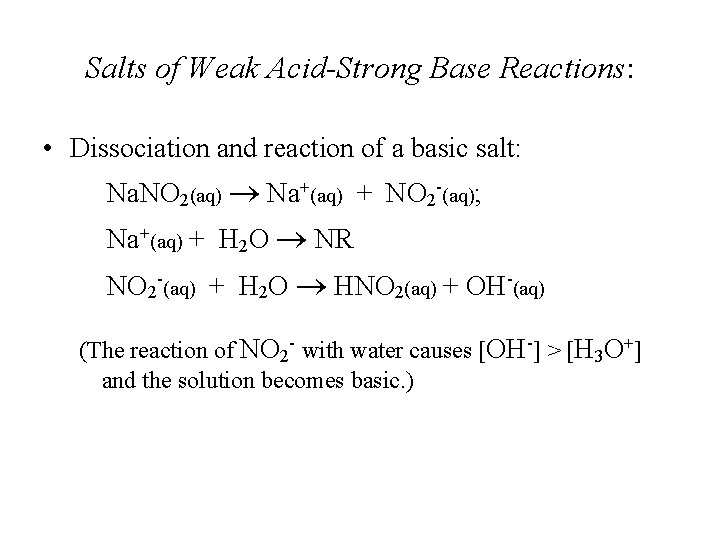
Salts of Weak Acid-Strong Base Reactions: • Dissociation and reaction of a basic salt: Na. NO 2(aq) Na+(aq) + NO 2 -(aq); Na+(aq) + H 2 O NR NO 2 -(aq) + H 2 O HNO 2(aq) + OH-(aq) (The reaction of NO 2 - with water causes [OH-] > [H 3 O+] and the solution becomes basic. )

Salts of Strong Acid-Weak Base Reactions • Dissociation and reaction of an acidic salt: NH 4 NO 3(aq) NH 4+(aq) + NO 3 -(aq); NH 4+(aq) + H 2 O NH 3(aq) + H 3 O+(aq); NO 3 -(aq) + H 2 O NR; • (The reaction of NH 4+ with water causes [H 3 O+] > [OH-], and the solution becomes acidic. )
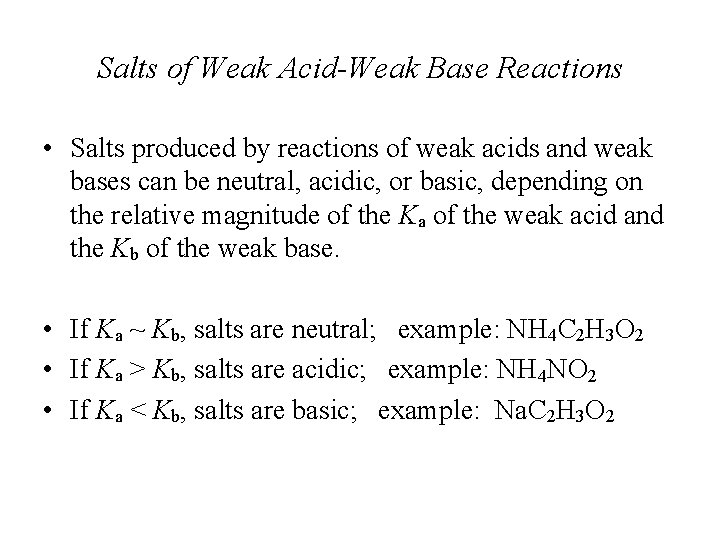
Salts of Weak Acid-Weak Base Reactions • Salts produced by reactions of weak acids and weak bases can be neutral, acidic, or basic, depending on the relative magnitude of the Ka of the weak acid and the Kb of the weak base. • If Ka ~ Kb, salts are neutral; example: NH 4 C 2 H 3 O 2 • If Ka > Kb, salts are acidic; example: NH 4 NO 2 • If Ka < Kb, salts are basic; example: Na. C 2 H 3 O 2
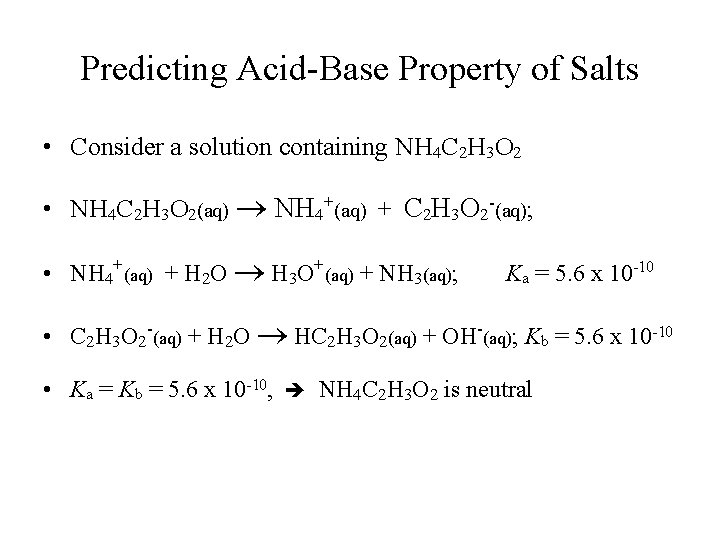
Predicting Acid-Base Property of Salts • Consider a solution containing NH 4 C 2 H 3 O 2 • NH 4 C 2 H 3 O 2(aq) NH 4+(aq) + C 2 H 3 O 2 -(aq); • NH 4+(aq) + H 2 O H 3 O+(aq) + NH 3(aq); Ka = 5. 6 x 10 -10 • C 2 H 3 O 2 -(aq) + H 2 O HC 2 H 3 O 2(aq) + OH-(aq); Kb = 5. 6 x 10 -10 • Ka = Kb = 5. 6 x 10 -10, NH 4 C 2 H 3 O 2 is neutral

Predicting Acid-Base Property of Salts • Consider a solution containing (NH 4)2 SO 4 • (NH 4)2 SO 4(aq) 2 NH 4+(aq) + SO 42 -(aq); • NH 4+(aq) + H 2 O H 3 O+(aq) + NH 3(aq); Ka = 5. 6 x 10 -10 • SO 42 -(aq) + H 2 O HSO 4 -(aq) + OH-(aq); Kb = 8. 3 x 10 -13 • Ka > Kb (NH 4)2 SO 4 is acidic;
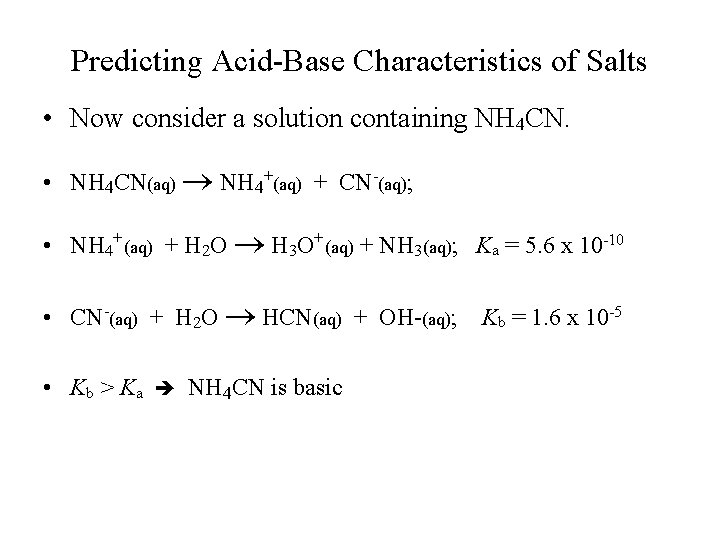
Predicting Acid-Base Characteristics of Salts • Now consider a solution containing NH 4 CN. • NH 4 CN(aq) NH 4+(aq) + CN-(aq); • NH 4+(aq) + H 2 O H 3 O+(aq) + NH 3(aq); Ka = 5. 6 x 10 -10 • CN-(aq) + H 2 O HCN(aq) + OH-(aq); Kb = 1. 6 x 10 -5 • Kb > Ka NH 4 CN is basic
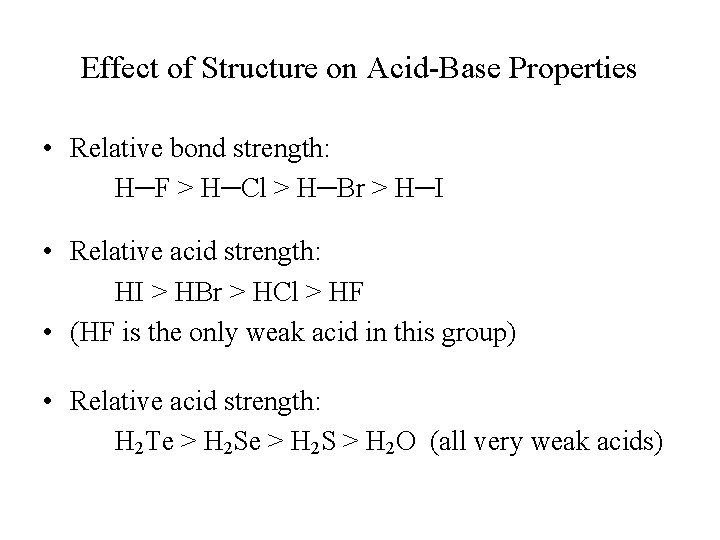
Effect of Structure on Acid-Base Properties • Relative bond strength: H─F > H─Cl > H─Br > H─I • Relative acid strength: HI > HBr > HCl > HF • (HF is the only weak acid in this group) • Relative acid strength: H 2 Te > H 2 S > H 2 O (all very weak acids)
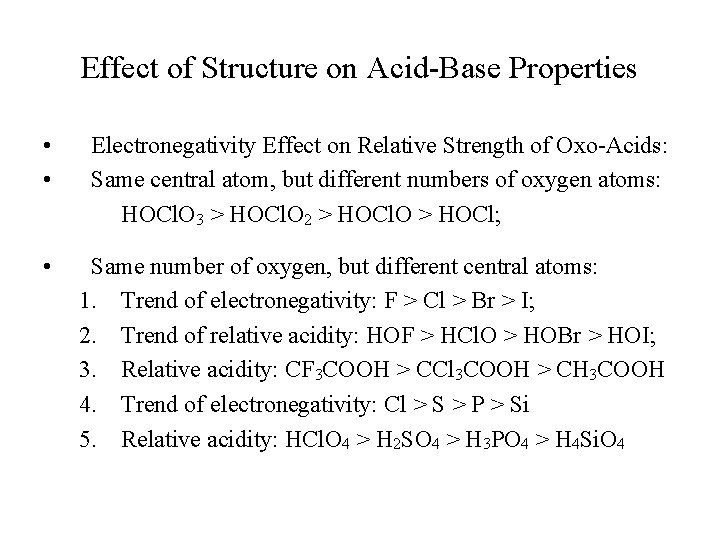
Effect of Structure on Acid-Base Properties • • Electronegativity Effect on Relative Strength of Oxo-Acids: Same central atom, but different numbers of oxygen atoms: HOCl. O 3 > HOCl. O 2 > HOCl. O > HOCl; • Same number of oxygen, but different central atoms: 1. Trend of electronegativity: F > Cl > Br > I; 2. Trend of relative acidity: HOF > HCl. O > HOBr > HOI; 3. Relative acidity: CF 3 COOH > CCl 3 COOH > CH 3 COOH 4. Trend of electronegativity: Cl > S > P > Si 5. Relative acidity: HCl. O 4 > H 2 SO 4 > H 3 PO 4 > H 4 Si. O 4
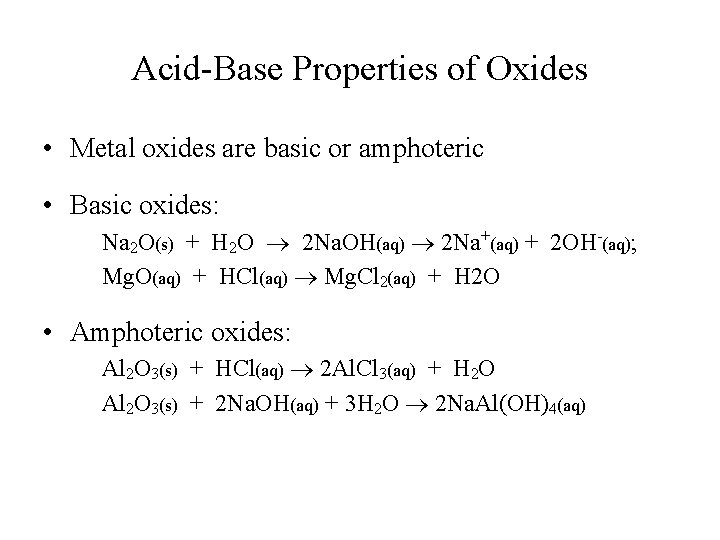
Acid-Base Properties of Oxides • Metal oxides are basic or amphoteric • Basic oxides: Na 2 O(s) + H 2 O 2 Na. OH(aq) 2 Na+(aq) + 2 OH-(aq); Mg. O(aq) + HCl(aq) Mg. Cl 2(aq) + H 2 O • Amphoteric oxides: Al 2 O 3(s) + HCl(aq) 2 Al. Cl 3(aq) + H 2 O Al 2 O 3(s) + 2 Na. OH(aq) + 3 H 2 O 2 Na. Al(OH)4(aq)
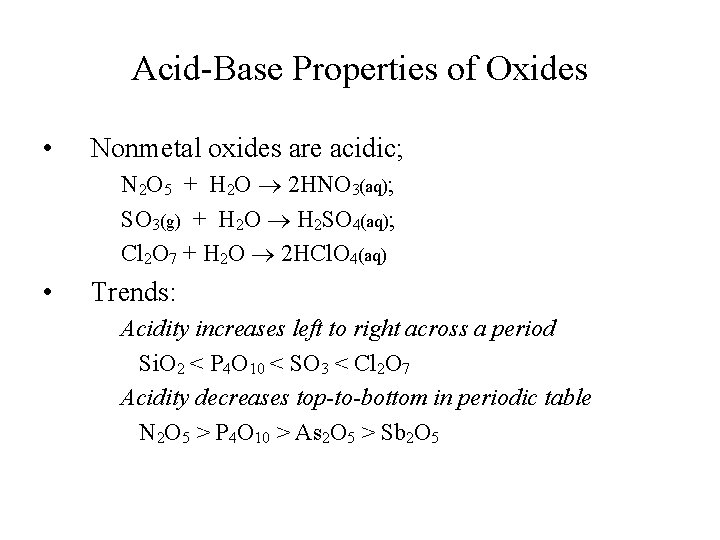
Acid-Base Properties of Oxides • Nonmetal oxides are acidic; N 2 O 5 + H 2 O 2 HNO 3(aq); SO 3(g) + H 2 O H 2 SO 4(aq); Cl 2 O 7 + H 2 O 2 HCl. O 4(aq) • Trends: Acidity increases left to right across a period Si. O 2 < P 4 O 10 < SO 3 < Cl 2 O 7 Acidity decreases top-to-bottom in periodic table N 2 O 5 > P 4 O 10 > As 2 O 5 > Sb 2 O 5
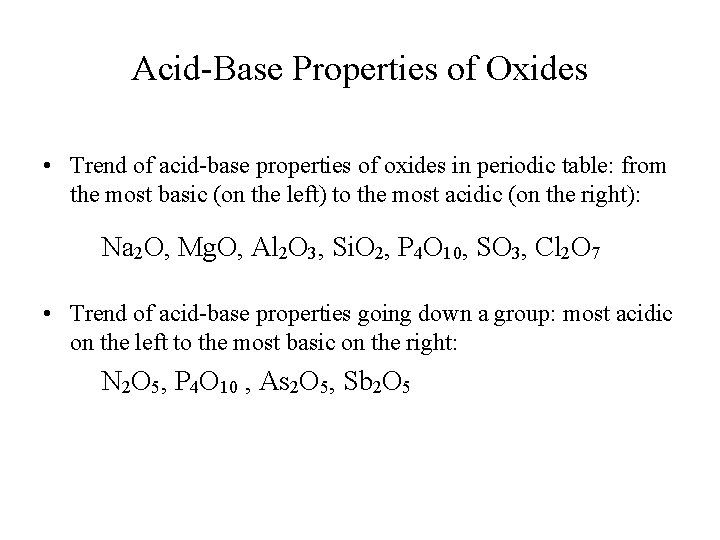
Acid-Base Properties of Oxides • Trend of acid-base properties of oxides in periodic table: from the most basic (on the left) to the most acidic (on the right): Na 2 O, Mg. O, Al 2 O 3, Si. O 2, P 4 O 10, SO 3, Cl 2 O 7 • Trend of acid-base properties going down a group: most acidic on the left to the most basic on the right: N 2 O 5, P 4 O 10 , As 2 O 5, Sb 2 O 5
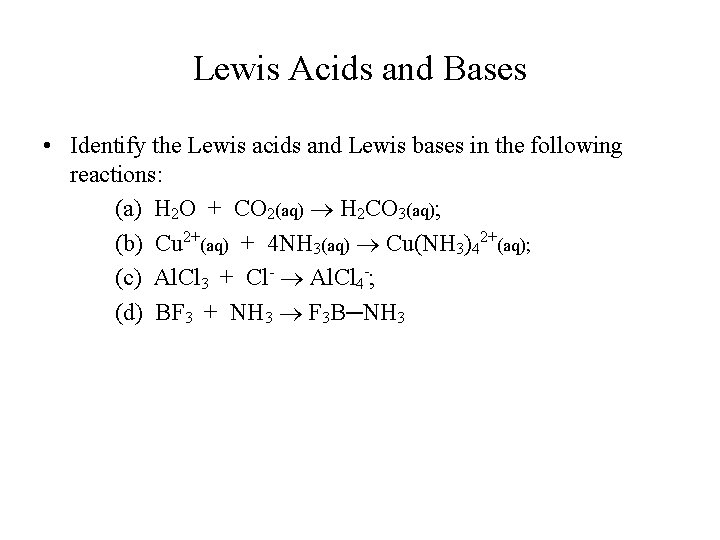
Lewis Acids and Bases • Identify the Lewis acids and Lewis bases in the following reactions: (a) H 2 O + CO 2(aq) H 2 CO 3(aq); (b) Cu 2+(aq) + 4 NH 3(aq) Cu(NH 3)42+(aq); (c) Al. Cl 3 + Cl- Al. Cl 4 -; (d) BF 3 + NH 3 F 3 B─NH 3
- Slides: 54