
Midterm results will be posted downstairs by the

• Midterm results will be posted downstairs (by the labs) this afternoon • No office hours today
What’s coming up? ? ? • • • Oct 25 Oct 27 Oct 29 The atmosphere, part 1 Midterm … No lecture The atmosphere, part 2 Ch. 8 • Nov 1 Light, blackbodies, Bohr Ch. 9 • • • Postulates of QM, p-in-a-box Hydrogen atom Multi-electron atoms Periodic properties Valence-bond; Lewis structures Hybrid orbitals; VSEPR MO theory Putting it all together Review for exam Ch. 9 Ch. 10 Ch. 11, 12 Ch. 12 Nov 3 Nov 5, 8 Nov 10, 12 Nov 15 Nov 17 Nov 19 Nov 22 Nov 24 Nov 26 Nov 29 Dec 1 Dec 2 Ch. 8

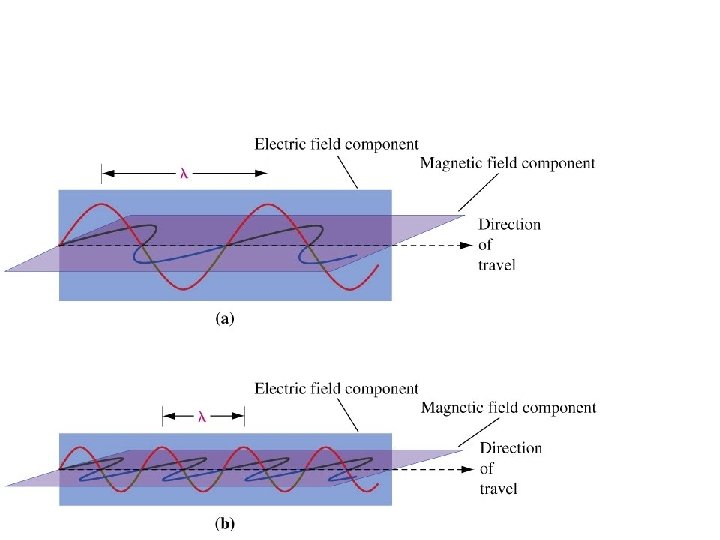
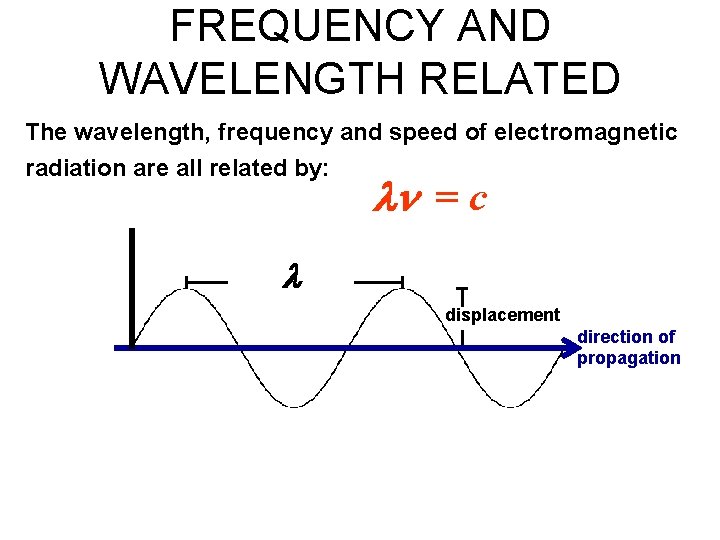
FREQUENCY AND WAVELENGTH RELATED The wavelength, frequency and speed of electromagnetic radiation are all related by: ln = c l displacement direction of propagation
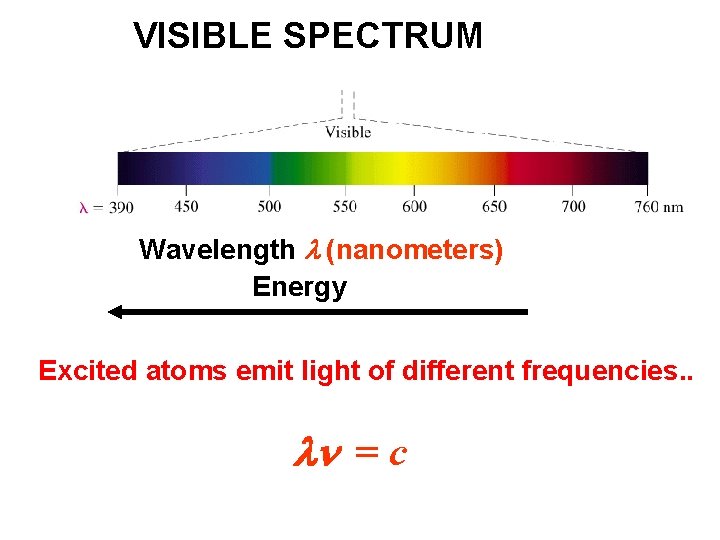
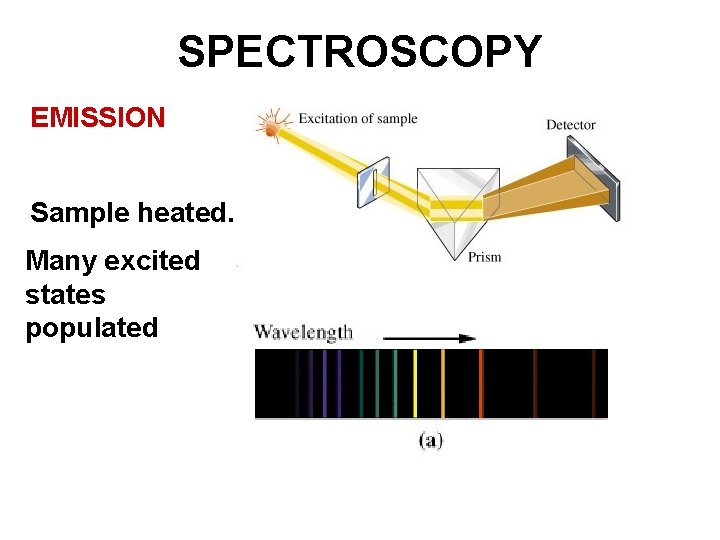
VISIBLE SPECTRUM Wavelength l (nanometers) Energy Excited atoms emit light of different frequencies. . ln = c
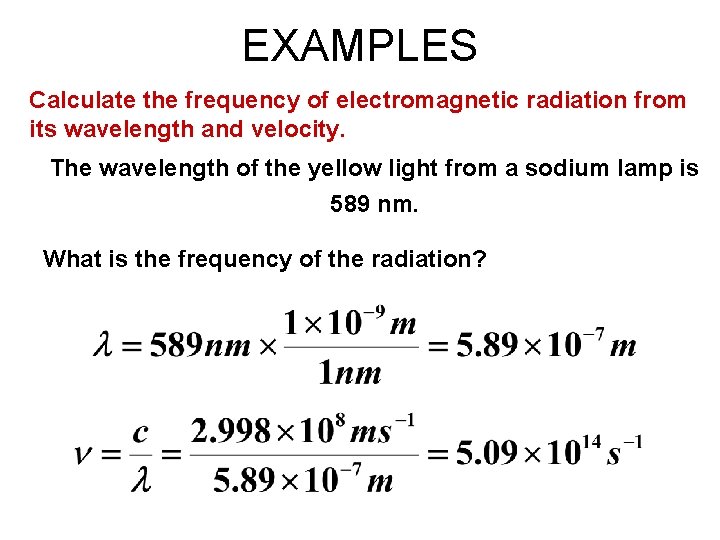
EXAMPLES Calculate the frequency of electromagnetic radiation from its wavelength and velocity. The wavelength of the yellow light from a sodium lamp is 589 nm. What is the frequency of the radiation?
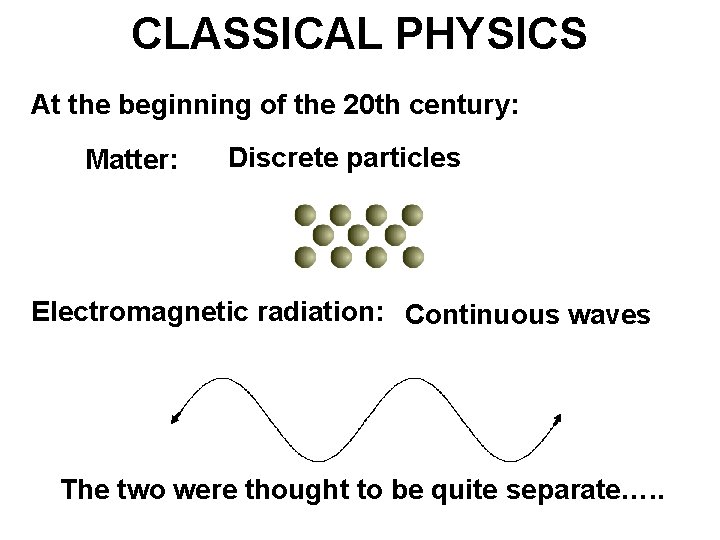
CLASSICAL PHYSICS At the beginning of the 20 th century: Matter: Discrete particles Electromagnetic radiation: Continuous waves The two were thought to be quite separate…. .
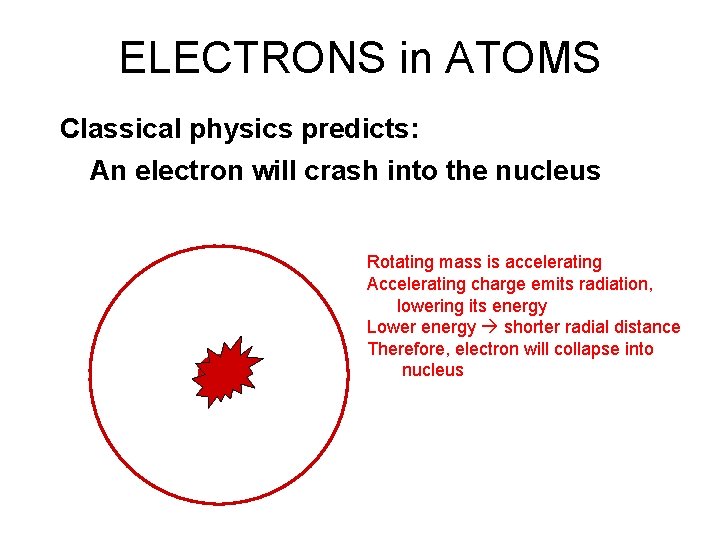
ELECTRONS in ATOMS Classical physics predicts: An electron will crash into the nucleus Rotating mass is accelerating Accelerating charge emits radiation, lowering its energy Lower energy shorter radial distance Therefore, electron will collapse into nucleus
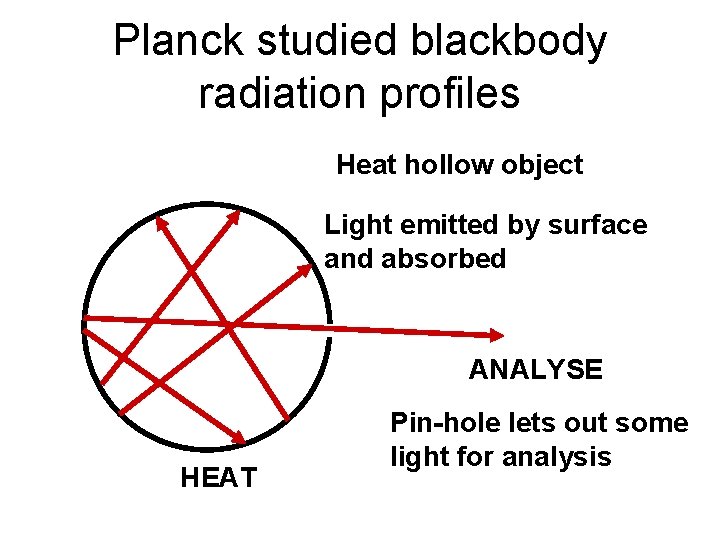
Planck studied blackbody radiation profiles Heat hollow object Light emitted by surface and absorbed ANALYSE HEAT Pin-hole lets out some light for analysis
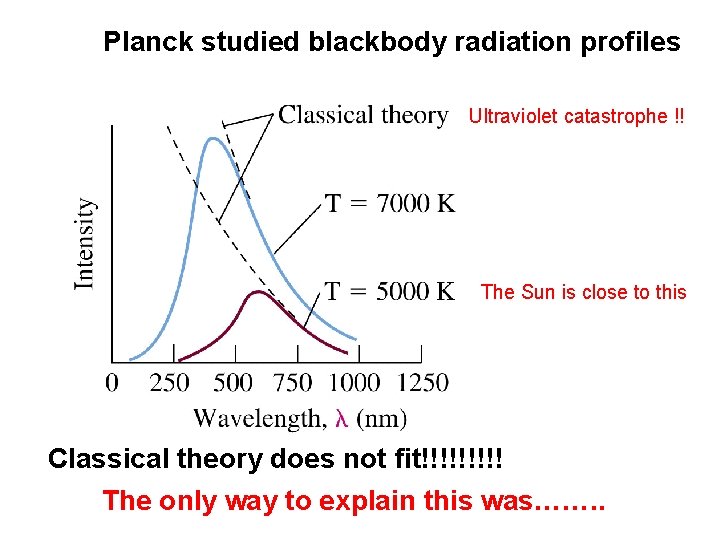
Planck studied blackbody radiation profiles Ultraviolet catastrophe !! The Sun is close to this Classical theory does not fit!!!!! The only way to explain this was……. .
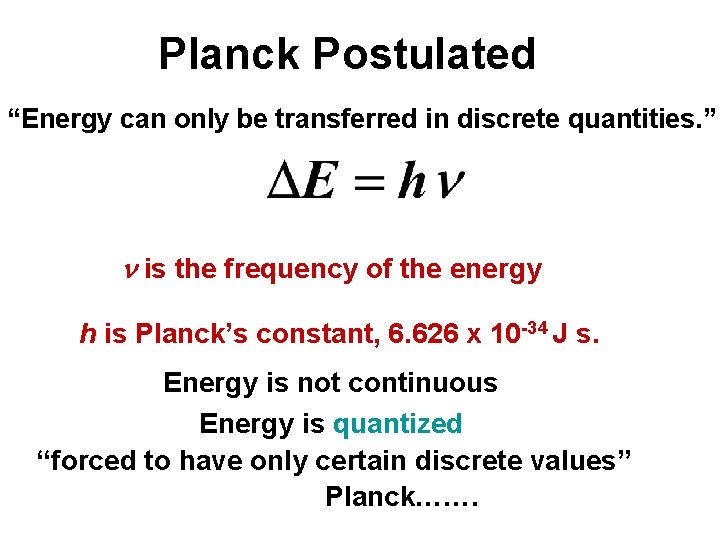
Planck Postulated “Energy can only be transferred in discrete quantities. ” n is the frequency of the energy h is Planck’s constant, 6. 626 x 10 -34 J s. Energy is not continuous Energy is quantized “forced to have only certain discrete values” Planck…….
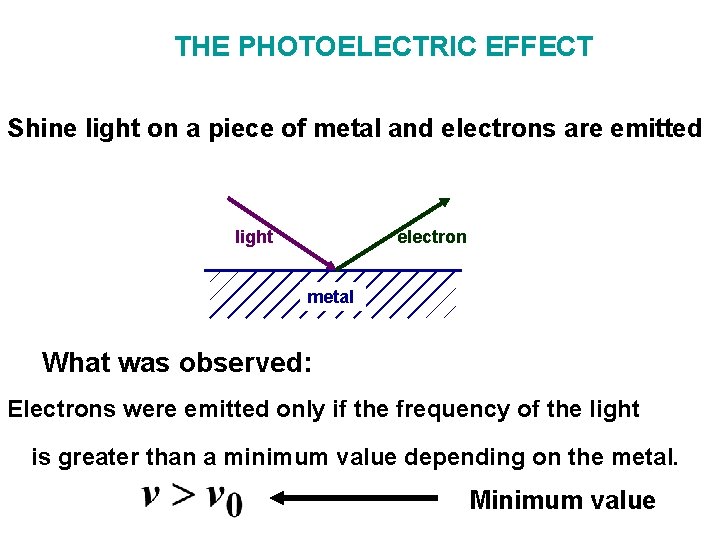
THE PHOTOELECTRIC EFFECT Shine light on a piece of metal and electrons are emitted light electron metal What was observed: Electrons were emitted only if the frequency of the light is greater than a minimum value depending on the metal. Minimum value
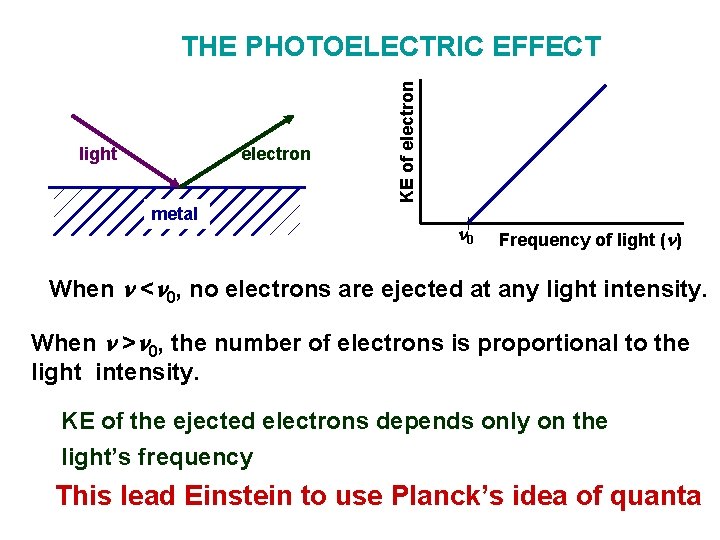
light electron metal KE of electron THE PHOTOELECTRIC EFFECT n 0 Frequency of light (n) When n <n 0, no electrons are ejected at any light intensity. When n >n 0, the number of electrons is proportional to the light intensity. KE of the ejected electrons depends only on the light’s frequency This lead Einstein to use Planck’s idea of quanta
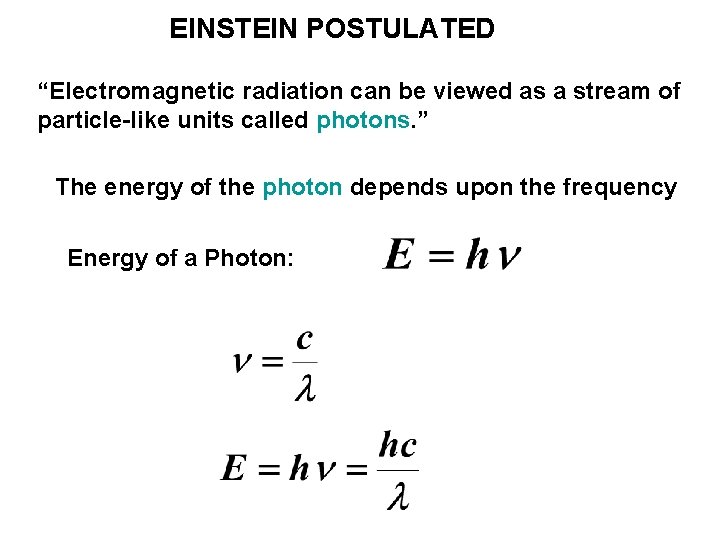
EINSTEIN POSTULATED “Electromagnetic radiation can be viewed as a stream of particle-like units called photons. ” The energy of the photon depends upon the frequency Energy of a Photon:
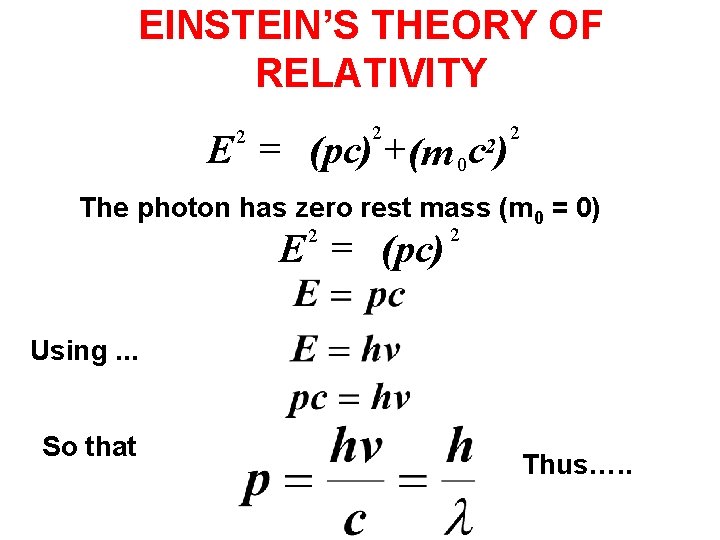
EINSTEIN’S THEORY OF RELATIVITY E = (pc) + (m 0 c 2) 2 2 2 The photon has zero rest mass (m 0 = 0) E = (pc) 2 2 Using. . . So that Thus…. .
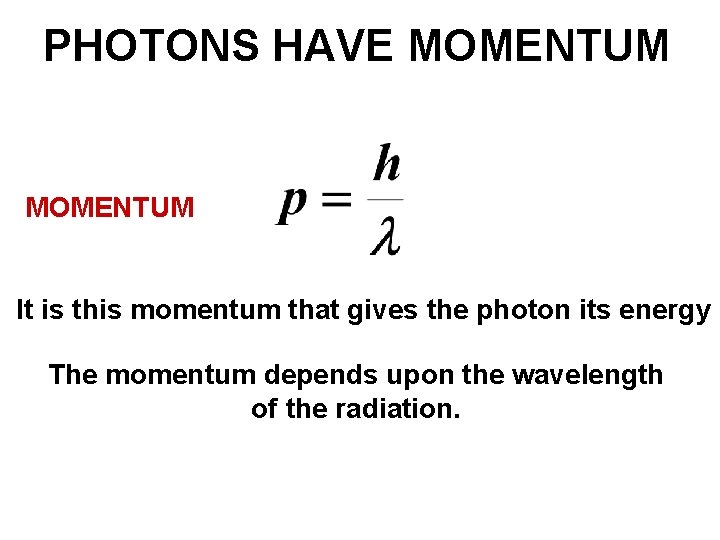
PHOTONS HAVE MOMENTUM It is this momentum that gives the photon its energy The momentum depends upon the wavelength of the radiation.
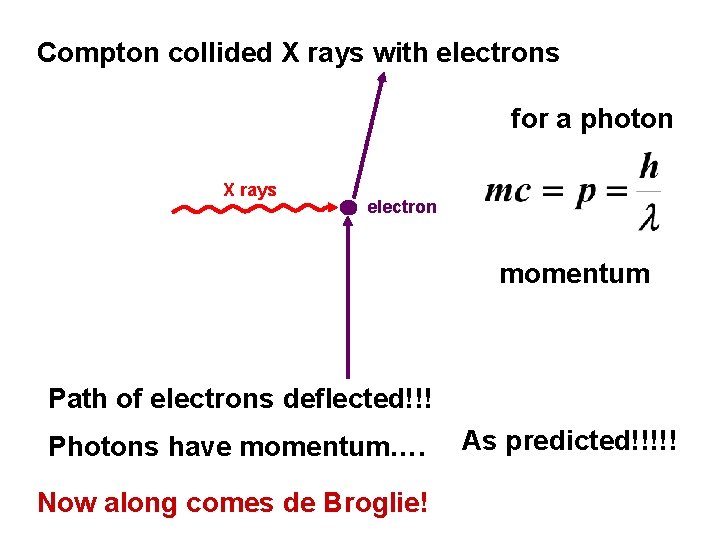
Compton collided X rays with electrons for a photon X rays electron momentum Path of electrons deflected!!! Photons have momentum…. Now along comes de Broglie! As predicted!!!!!
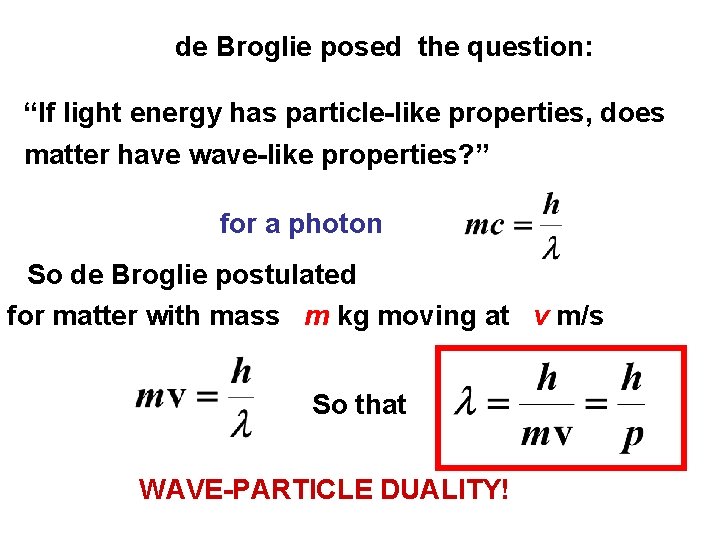
de Broglie posed the question: “If light energy has particle-like properties, does matter have wave-like properties? ” for a photon So de Broglie postulated for matter with mass m kg moving at v m/s So that WAVE-PARTICLE DUALITY!
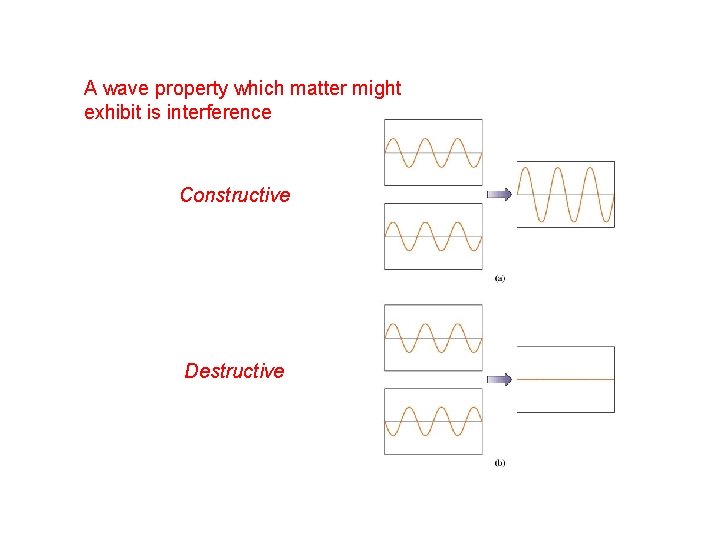
A wave property which matter might exhibit is interference Constructive Destructive
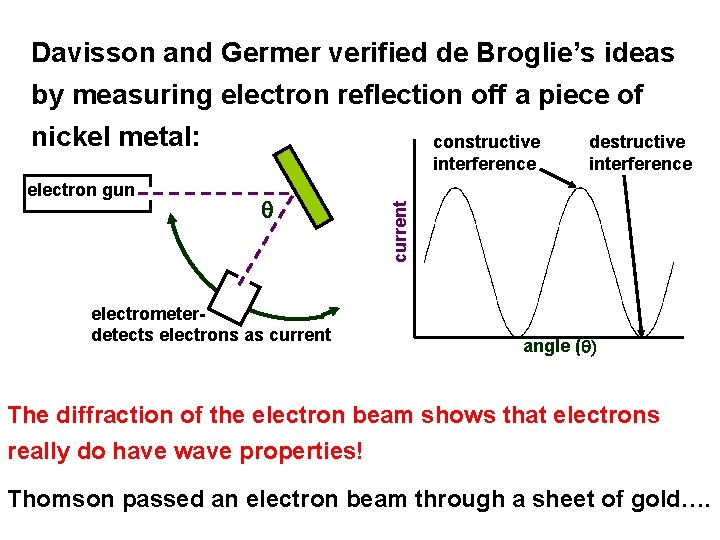
Davisson and Germer verified de Broglie’s ideas by measuring electron reflection off a piece of nickel metal: constructive destructive electron gun q electrometerdetects electrons as current interference angle (q) The diffraction of the electron beam shows that electrons really do have wave properties! Thomson passed an electron beam through a sheet of gold….
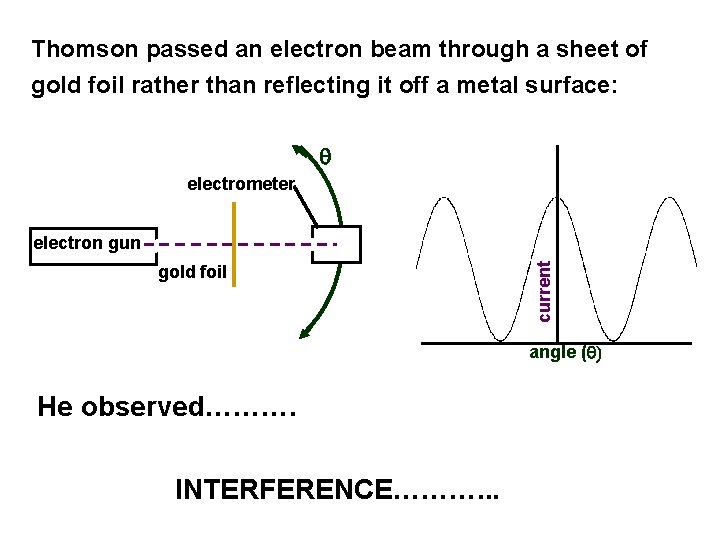
Thomson passed an electron beam through a sheet of gold foil rather than reflecting it off a metal surface: q electrometer gold foil current electron gun angle (q) He observed………. INTERFERENCE………. . .
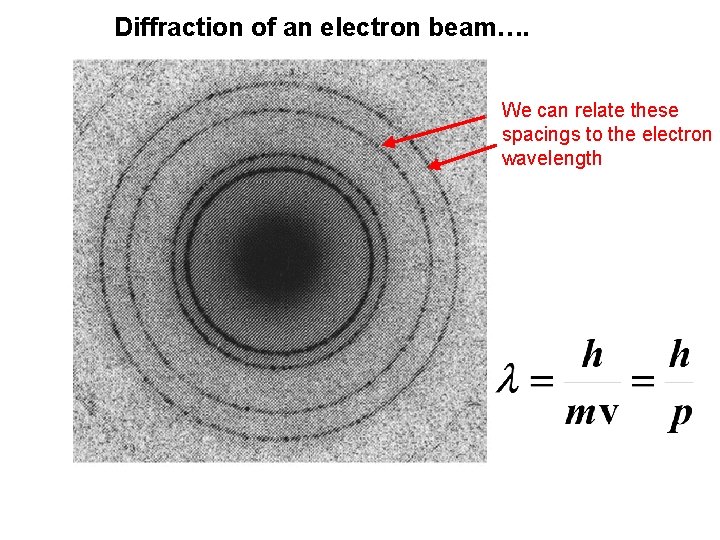
Diffraction of an electron beam…. We can relate these spacings to the electron wavelength
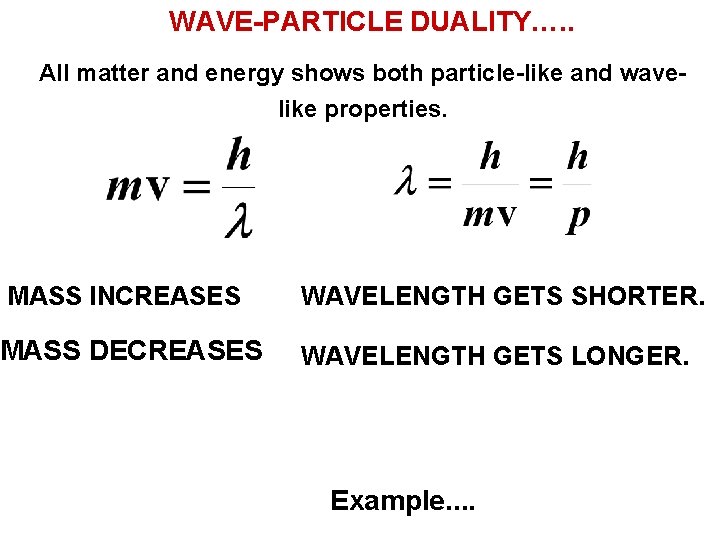
WAVE-PARTICLE DUALITY…. . All matter and energy shows both particle-like and wavelike properties. MASS INCREASES WAVELENGTH GETS SHORTER. MASS DECREASES WAVELENGTH GETS LONGER. Example. .
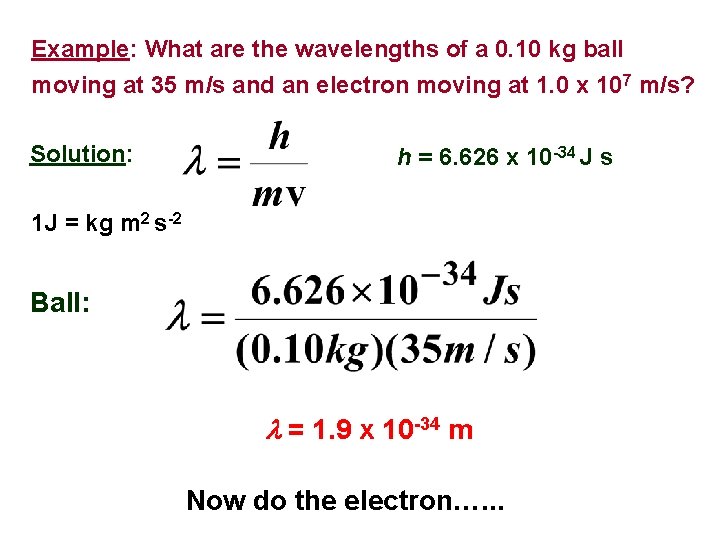
Example: What are the wavelengths of a 0. 10 kg ball moving at 35 m/s and an electron moving at 1. 0 x 107 m/s? Solution: h = 6. 626 x 10 -34 J s 1 J = kg m 2 s-2 Ball: l = 1. 9 x 10 -34 m Now do the electron…. . .
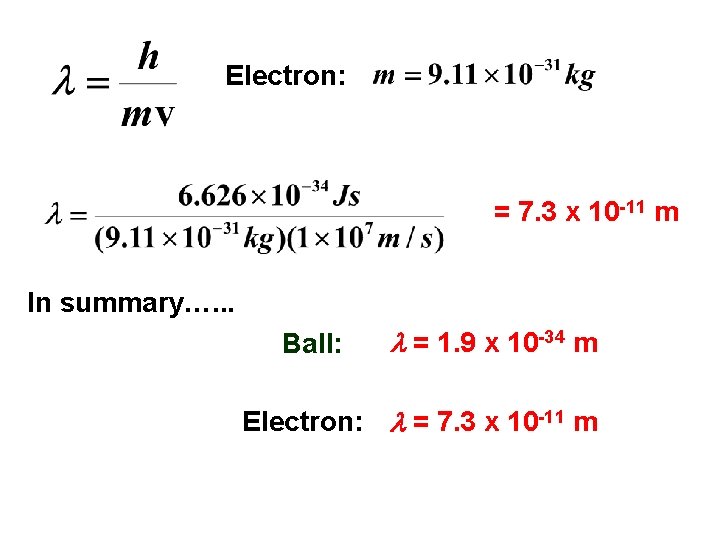
Electron: = 7. 3 x 10 -11 m In summary…. . . Ball: l = 1. 9 x 10 -34 m Electron: l = 7. 3 x 10 -11 m
WAVE-PARTICLE DUALITY…. . All matter and energy shows both particle-like and wave-like properties. Large pieces of matter are mainly particle-like, with very short wavelengths. Small pieces of matter are mainly wave-like with longer wavelengths.
ELECTRONS in ATOMS Electrons have both wavelike and particle like properties: their wavelike properties must be taken into account when describing the electronic structure of atoms. The first attempt was by Niels Bohr………. . .
WHY THE ELECTRON DOES NOT CRASH INTO THE NUCLEUS! Bohr postulated that the wavelength of the electron just fits the radius of the orbit. This why the electron does not crash into the nucleus!!!
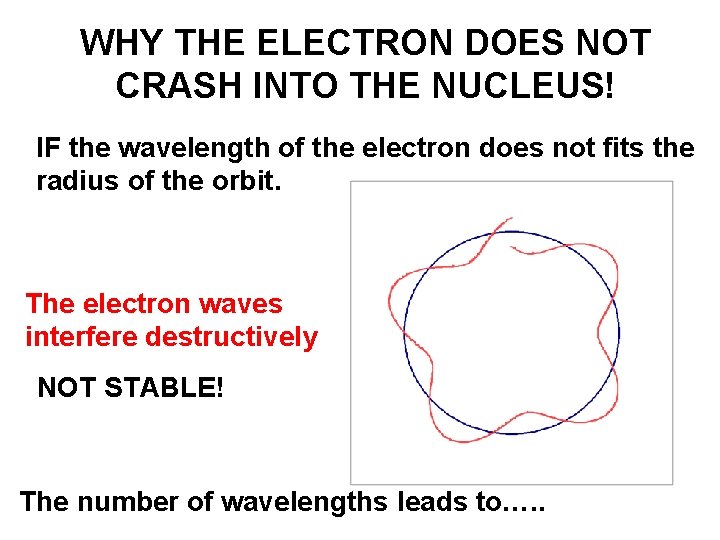
WHY THE ELECTRON DOES NOT CRASH INTO THE NUCLEUS! IF the wavelength of the electron does not fits the radius of the orbit. The electron waves interfere destructively NOT STABLE! The number of wavelengths leads to…. .
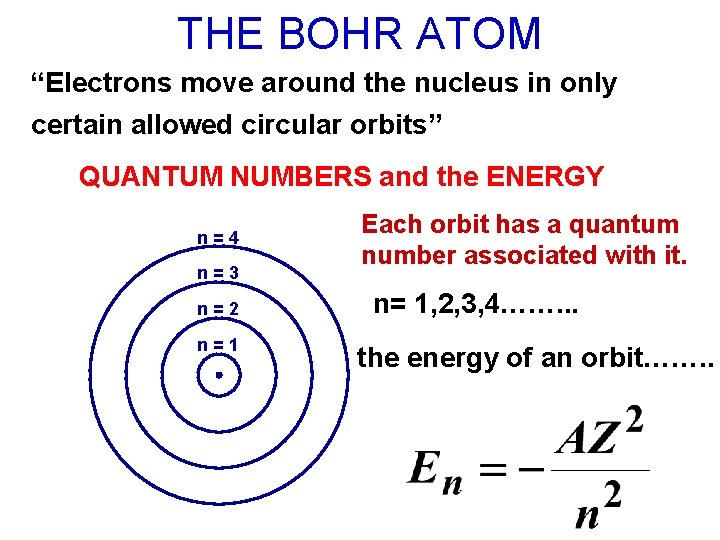
THE BOHR ATOM “Electrons move around the nucleus in only certain allowed circular orbits” QUANTUM NUMBERS and the ENERGY n=4 n=3 n=2 n=1 Each orbit has a quantum number associated with it. n= 1, 2, 3, 4……. . . the energy of an orbit……. .
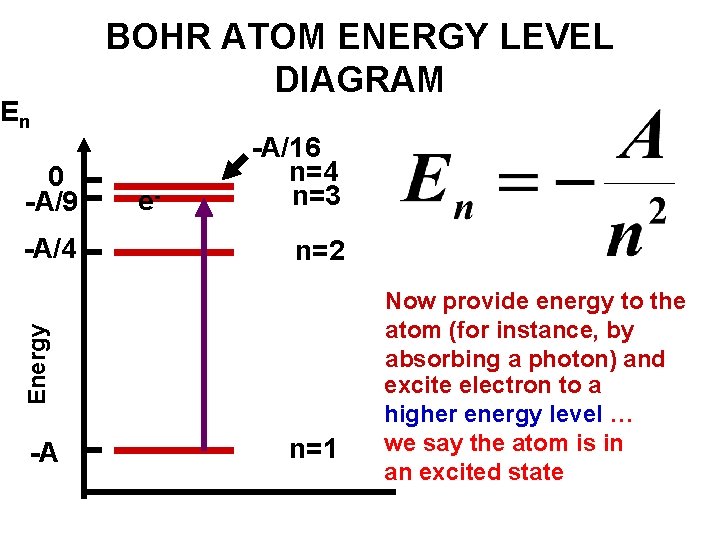
BOHR ATOM ENERGY LEVEL DIAGRAM En 0 -A/9 n=2 Energy -A/4 e- -A/16 n=4 n=3 -A n=1 Now provide energy to the atom (for instance, by absorbing a photon) and excite electron to a higher energy level … we say the atom is in an excited state
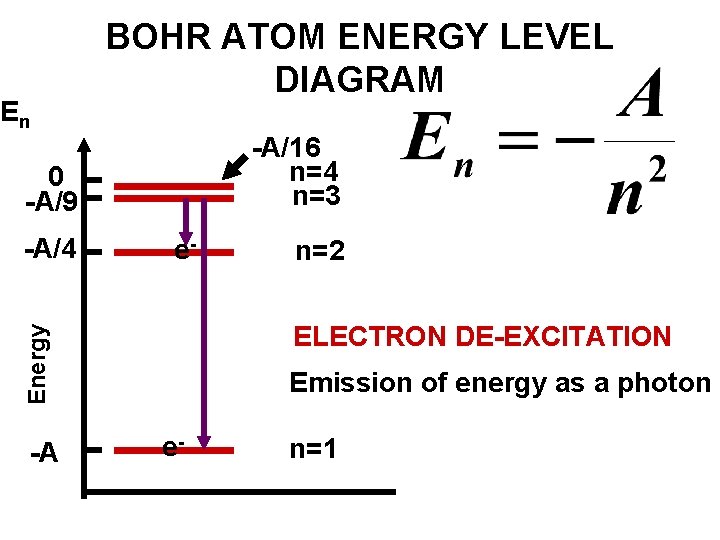
BOHR ATOM ENERGY LEVEL DIAGRAM En -A/16 n=4 n=3 0 -A/9 e- -A n=2 ELECTRON DE-EXCITATION Energy -A/4 Emission of energy as a photon e- n=1
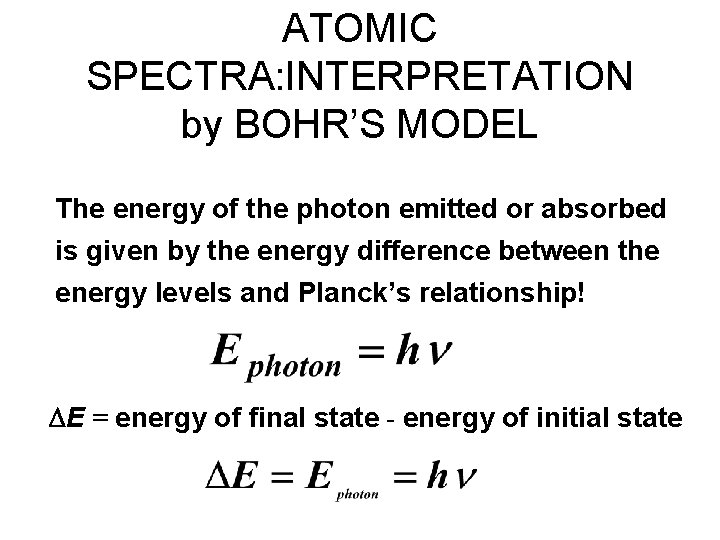
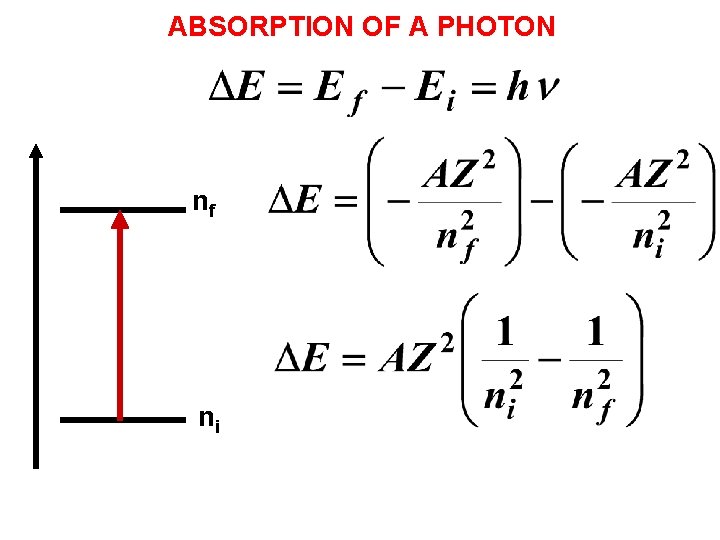
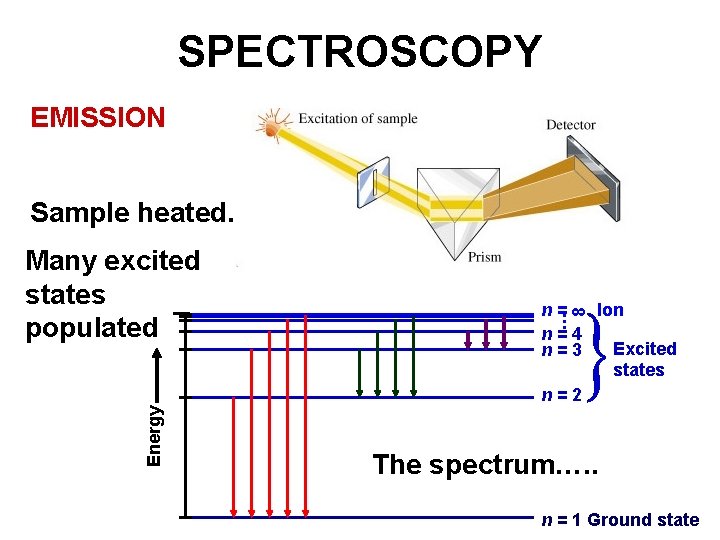
ATOMIC SPECTRA: INTERPRETATION by BOHR’S MODEL The energy of the photon emitted or absorbed is given by the energy difference between the energy levels and Planck’s relationship! DE = energy of final state - energy of initial state
ABSORPTION OF A PHOTON nf ni
SPECTROSCOPY EMISSION Sample heated. Energy 8 n= Ion n=4 Excited n=3 states n=2 . . . Many excited states populated The spectrum…. . n = 1 Ground state
SPECTROSCOPY EMISSION Sample heated. Many excited states populated
EXCITED GROUP 1 ELEMENTS Li Na K
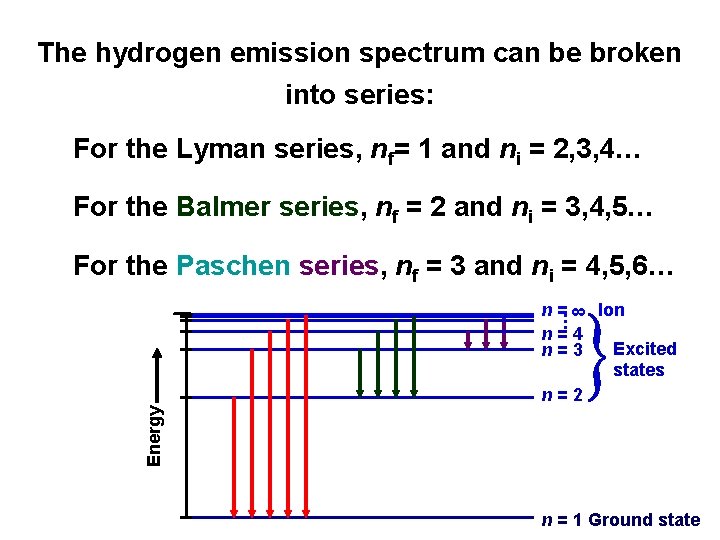
The hydrogen emission spectrum can be broken into series: For the Lyman series, nf= 1 and ni = 2, 3, 4… For the Balmer series, nf = 2 and ni = 3, 4, 5… For the Paschen series, nf = 3 and ni = 4, 5, 6… Energy . . . 8 n= Ion n=4 Excited n=3 states n=2 n = 1 Ground state
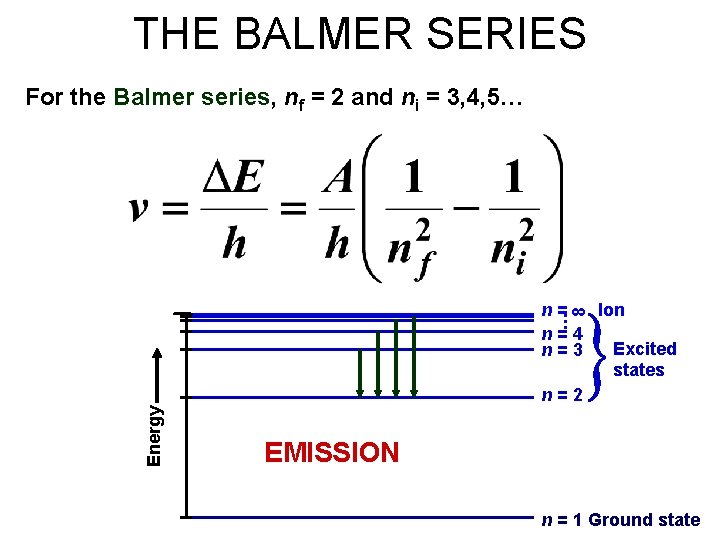
THE BALMER SERIES For the Balmer series, nf = 2 and ni = 3, 4, 5… Energy . . . 8 n= Ion n=4 Excited n=3 states n=2 EMISSION n = 1 Ground state

THE BALMER SERIES For the Balmer series, nf = 2 and ni = 3, 4, 5… Energy . . . 8 n= Ion n=4 Excited n=3 states n=2 EMISSION n = 1 Ground state
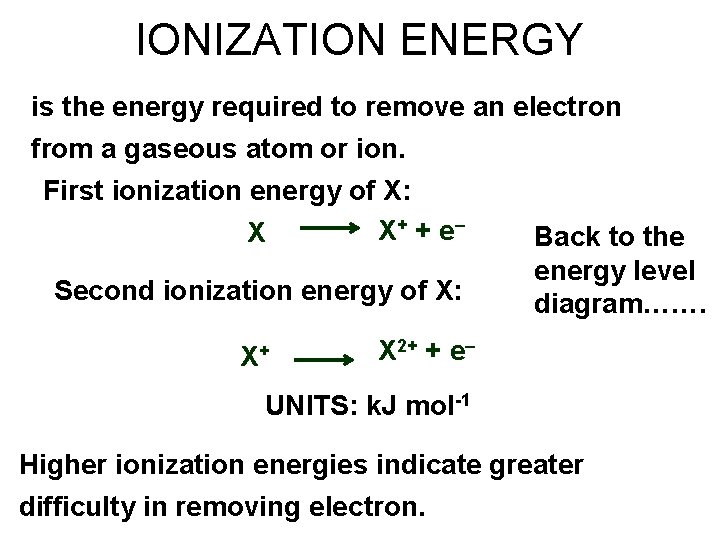
IONIZATION ENERGY is the energy required to remove an electron from a gaseous atom or ion. First ionization energy of X: X+ + e – X Second ionization energy of X: X+ Back to the energy level diagram……. X 2+ + e– UNITS: k. J mol-1 Higher ionization energies indicate greater difficulty in removing electron.
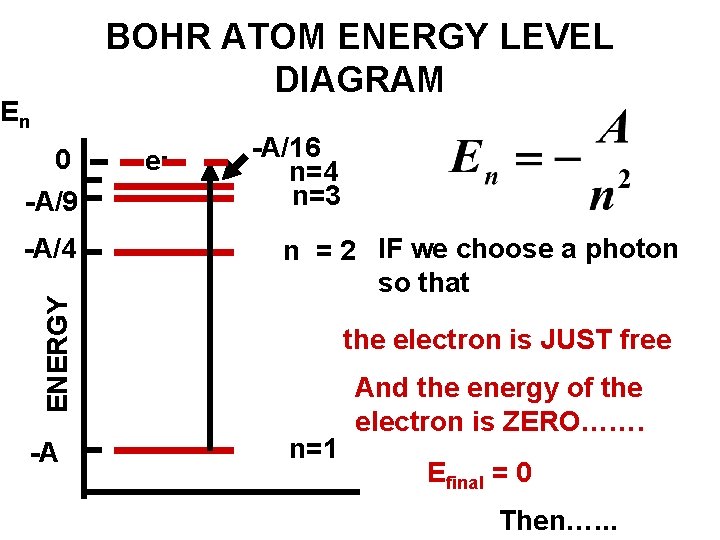
BOHR ATOM ENERGY LEVEL DIAGRAM En 0 -A/9 ENERGY -A/4 -A e- -A/16 n=4 n=3 n = 2 IF we choose a photon so that the electron is JUST free n=1 And the energy of the electron is ZERO……. Efinal = 0 Then…. . .
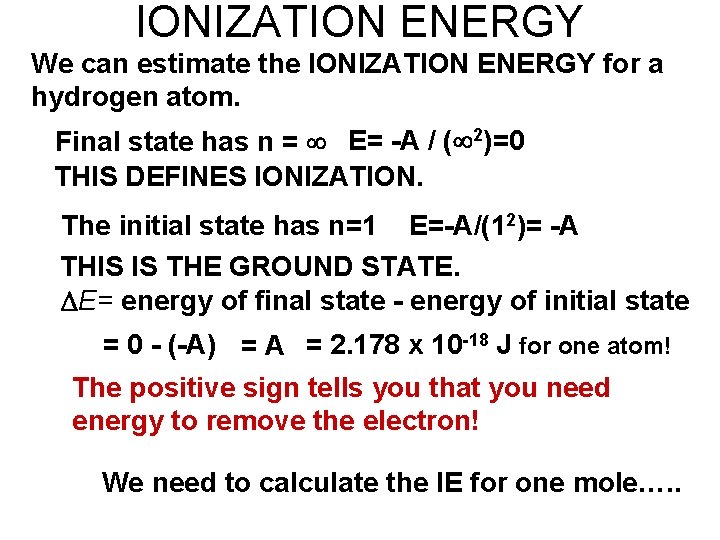
IONIZATION ENERGY We can estimate the IONIZATION ENERGY for a hydrogen atom. Final state has n = E= -A / ( 2)=0 THIS DEFINES IONIZATION. The initial state has n=1 E=-A/(12)= -A THIS IS THE GROUND STATE. DE= energy of final state - energy of initial state = 0 - (-A) = A = 2. 178 x 10 -18 J for one atom! The positive sign tells you that you need energy to remove the electron! We need to calculate the IE for one mole…. .
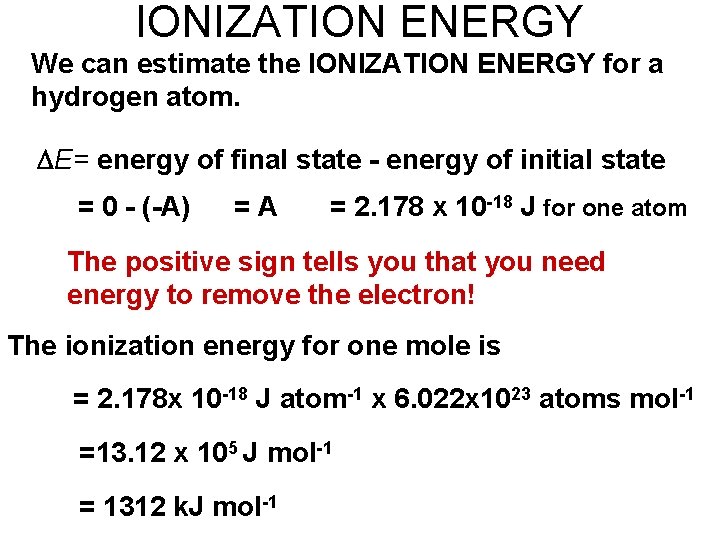
IONIZATION ENERGY We can estimate the IONIZATION ENERGY for a hydrogen atom. DE= energy of final state - energy of initial state = 0 - (-A) =A = 2. 178 x 10 -18 J for one atom The positive sign tells you that you need energy to remove the electron! The ionization energy for one mole is = 2. 178 x 10 -18 J atom-1 x 6. 022 x 1023 atoms mol-1 =13. 12 x 105 J mol-1 = 1312 k. J mol-1
- Slides: 45