RAP We know that the first civilizations formed






- Slides: 36
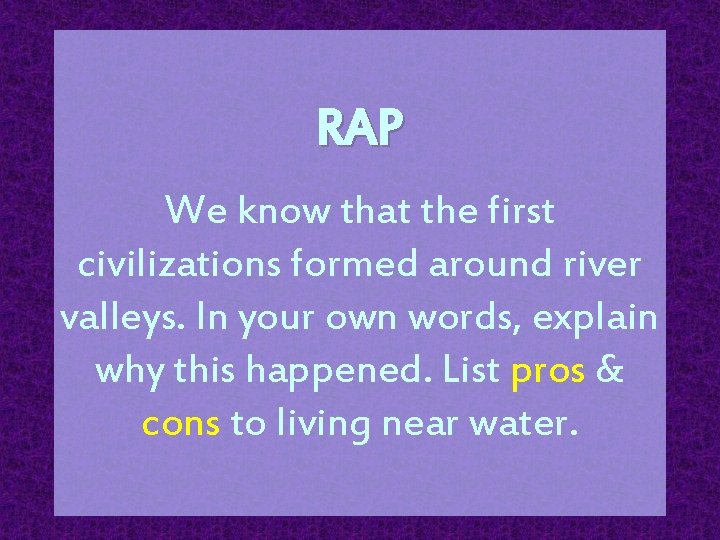
RAP We know that the first civilizations formed around river valleys. In your own words, explain why this happened. List pros & cons to living near water.
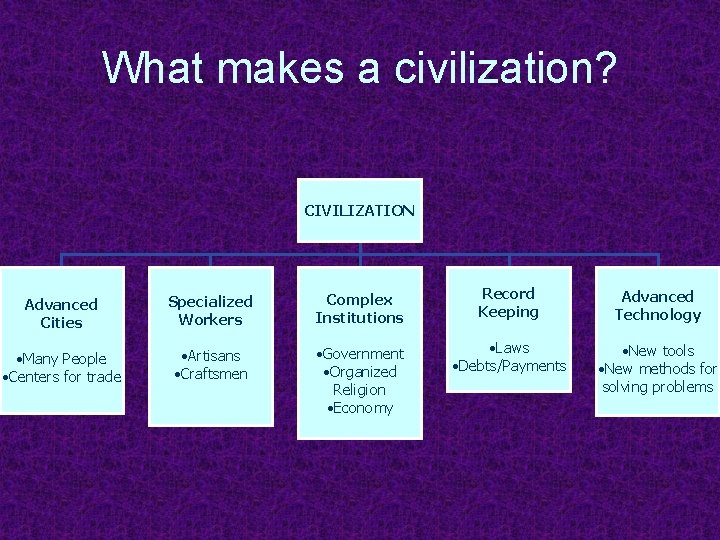
What makes a civilization? CIVILIZATION Advanced Cities Specialized Workers Complex Institutions Record Keeping Advanced Technology • Many People • Centers for trade • Artisans • Craftsmen • Government • Organized Religion • Economy • Laws • Debts/Payments • New tools • New methods for solving problems
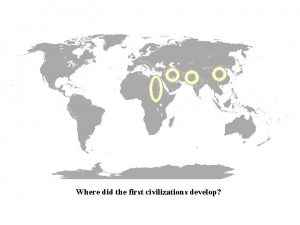
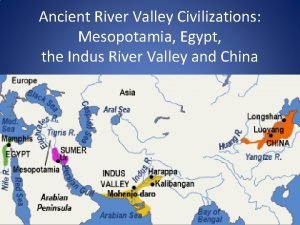
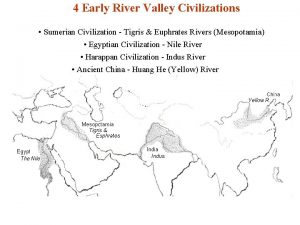
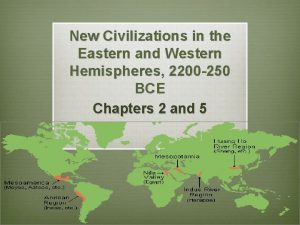
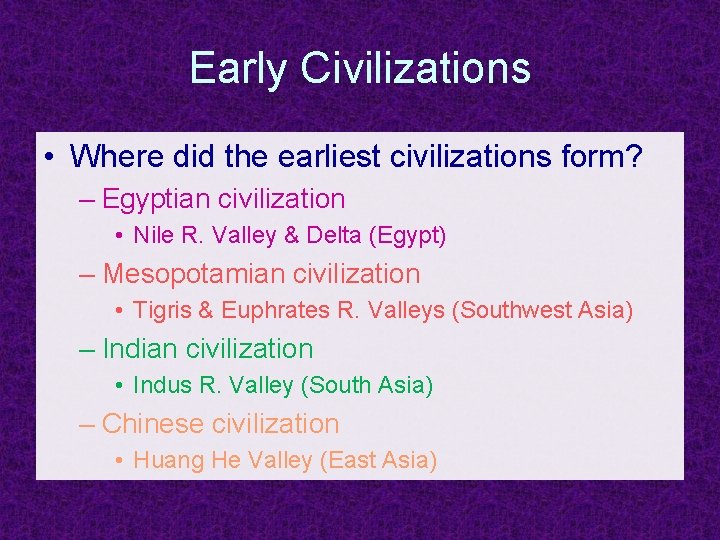
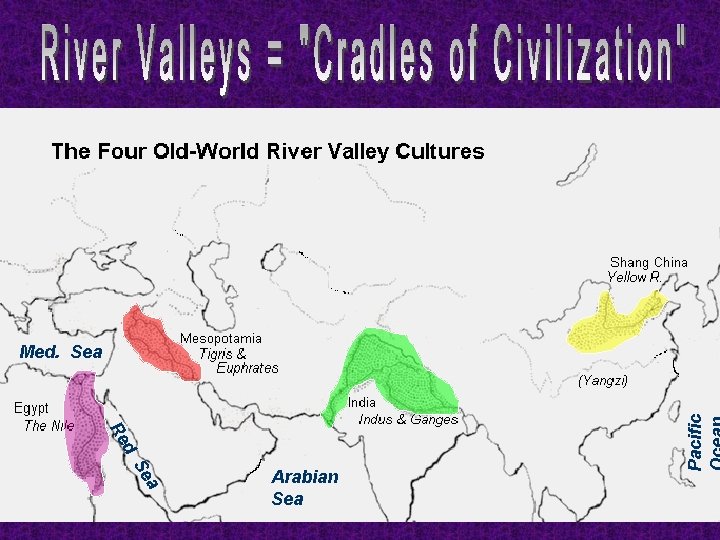
Early Civilizations • Where did the earliest civilizations form? – Egyptian civilization • Nile R. Valley & Delta (Egypt) – Mesopotamian civilization • Tigris & Euphrates R. Valleys (Southwest Asia) – Indian civilization • Indus R. Valley (South Asia) – Chinese civilization • Huang He Valley (East Asia)
Re d a Se Arabian Sea Pacific Med. Sea
• https: //www. youtube. com/watch? v=gze. O Wnn. SNjg
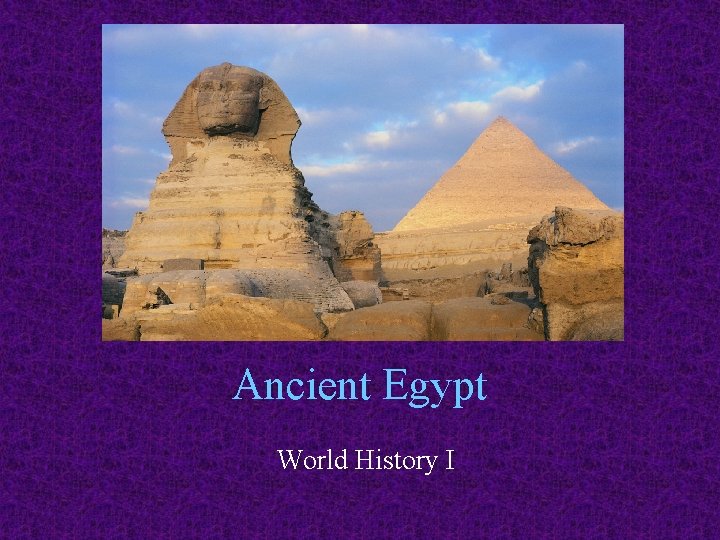
Ancient Egypt World History I
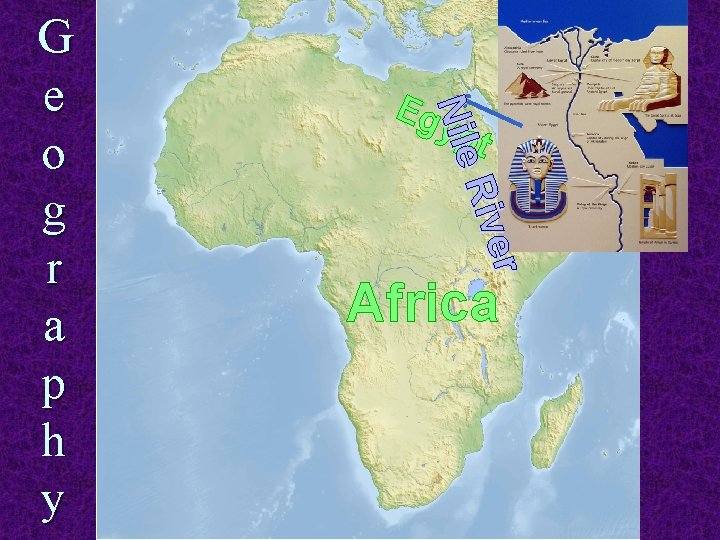
Eg er Riv Nile G e o g r a p h y ypt Africa
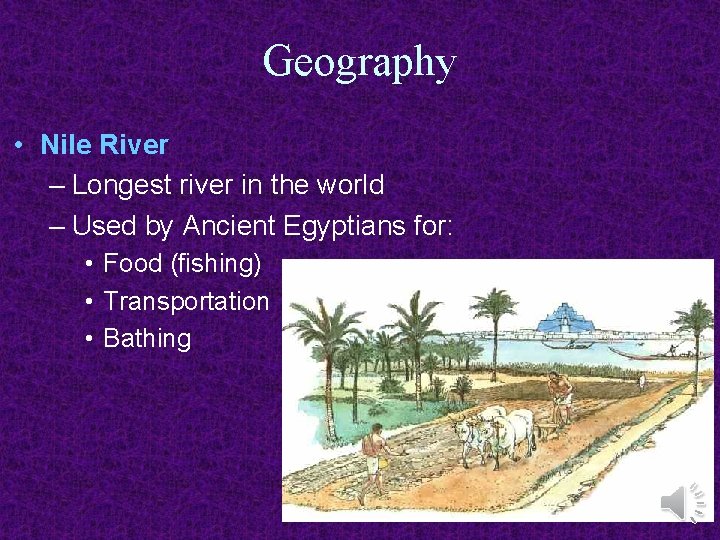
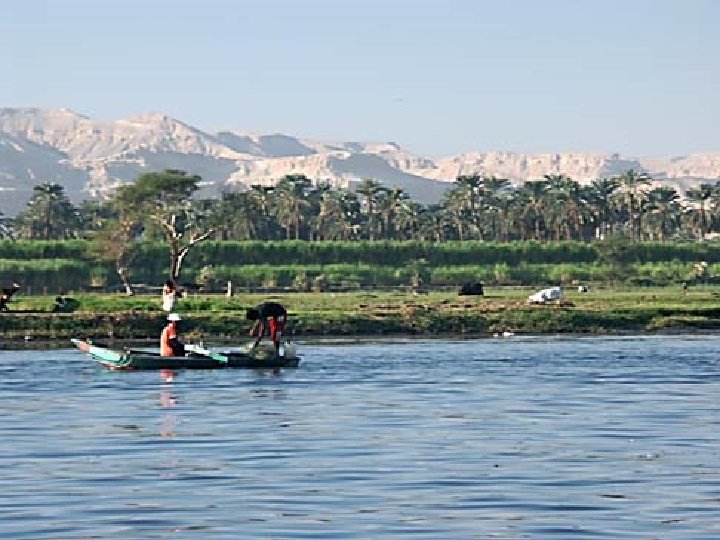
Geography • Nile River – Longest river in the world – Used by Ancient Egyptians for: • Food (fishing) • Transportation • Bathing
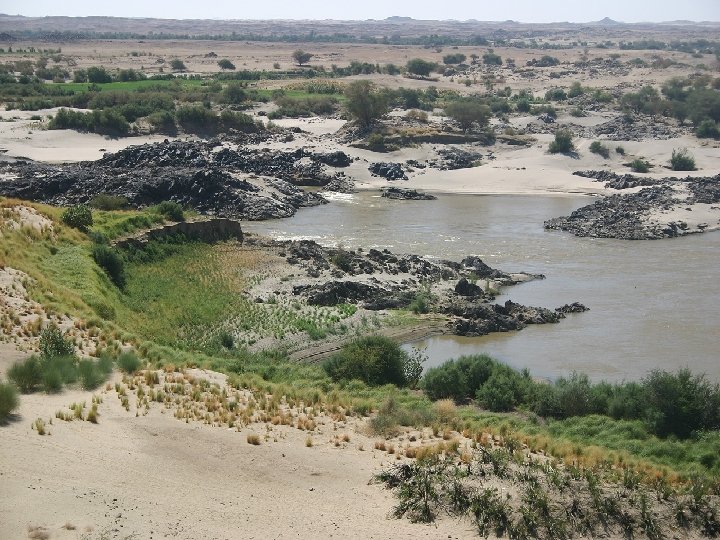
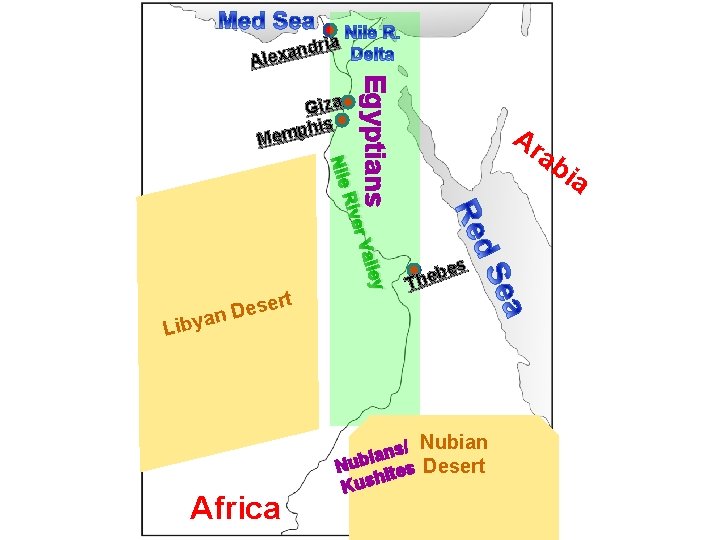
Geography • Flows NORTH from lakes in the Ethiopian Highlands to the Med. Sea (floods YEARLY) • Cataracts (shallow areas; some rocky ledges that cause waterfalls; often rough rapids) create impassable areas restricting travel • Empties into the Mediterranean Sea • Silt deposits at its mouth form Nile Delta • Desert provided protection from invaders to the west
n Alexa dria M Nile Egyptians Giza is emph Ar ab i rt lley r Va Rive ese D n ya es b The Lib Africa s/ Nubian n a i Nub ites Desert h Kus a
Egyptian Society • Polytheistic religion – Polytheism—belief / worship of many gods R A A N U B I S I S
mummification • Egyptians practiced mummification as a way of embalming their dead Canopic Jars
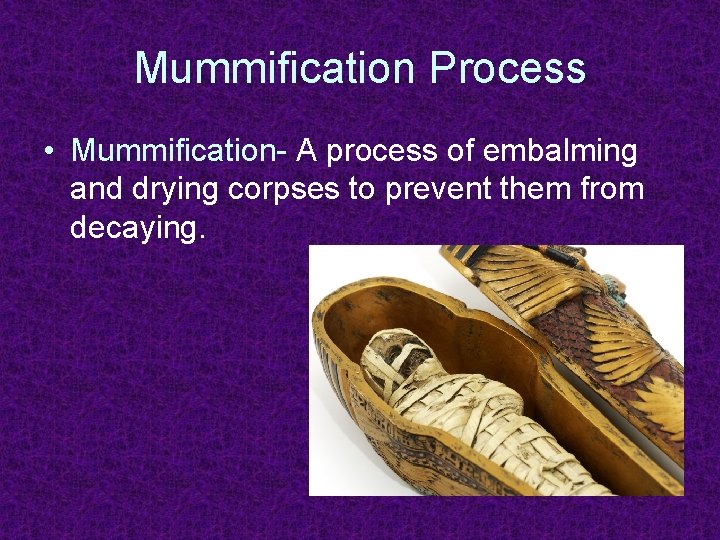
Mummification Process • Mummification- A process of embalming and drying corpses to prevent them from decaying.
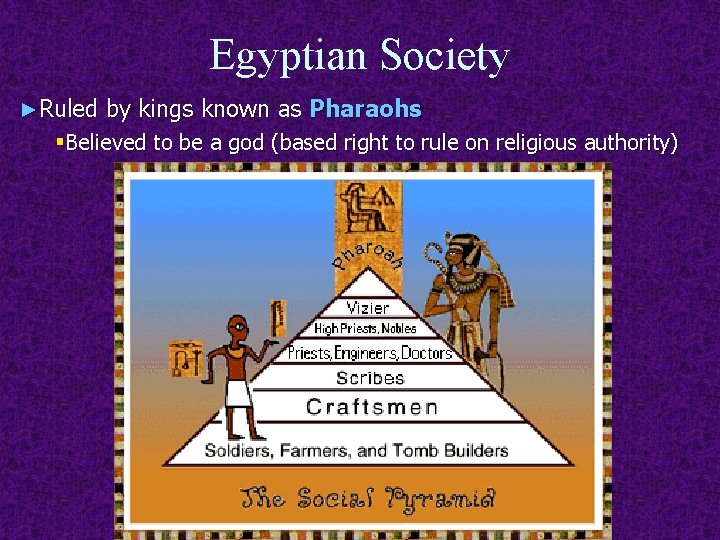
Egyptian Society ►Ruled by kings known as Pharaohs §Believed to be a god (based right to rule on religious authority)
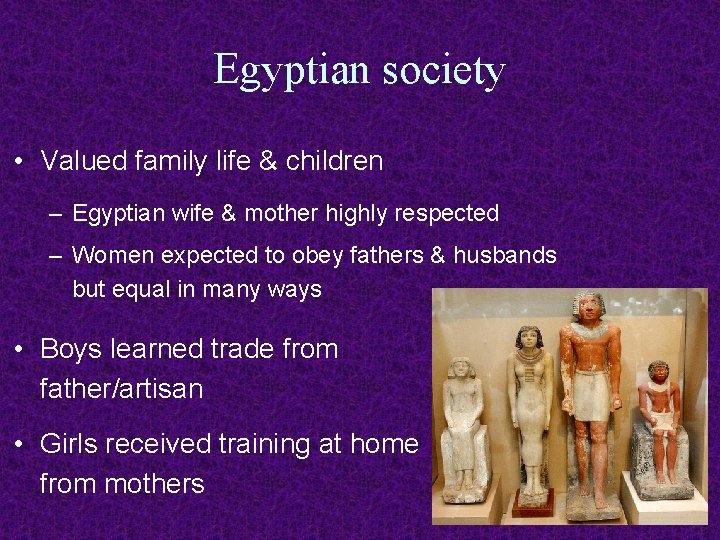
Egyptian society • Valued family life & children – Egyptian wife & mother highly respected – Women expected to obey fathers & husbands but equal in many ways • Boys learned trade from father/artisan • Girls received training at home from mothers
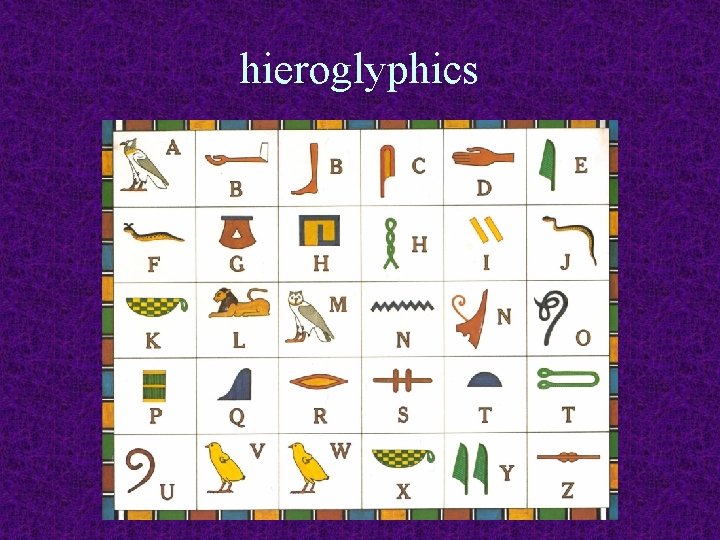
hieroglyphics
Papyrus
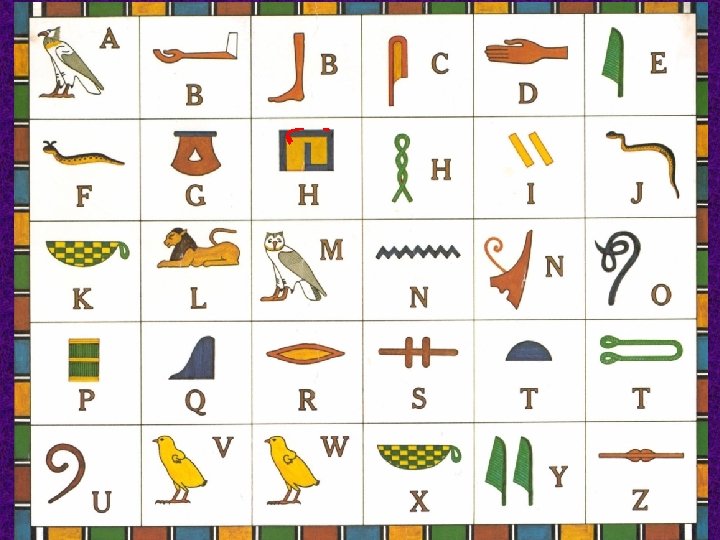
Hieroglyphics Bookmark Activity (Classwork) • Everyone needs a Hieroglyphics Sheet and a small strip of paper (bookmark size) • Hand draw (not trace) the hieroglyphics that spell your first name…if you can’t find a letter (such as x) be creative and use a symbol for another letter that has a similar sound • You must color your hieroglyphics as stated in the instructions on the hieroglyphics sheet • Hieroglyphics are read in the direction they are pointing so keep this in mind as you make your bookmark • Size your hieroglyphs to fill up the entire bookmark • To be collected on Monday.
RAP…Show What You Know 1 -True/False: Egypt was the first civilization to form. 2 -In which direction does the Nile River flow? 3 -Into what body of water does the Nile River empty? 4 -What are Egyptian rulers called? 5 -How could you describe Egyptian religion? 6 -Name one characteristic of ‘civilization. ’
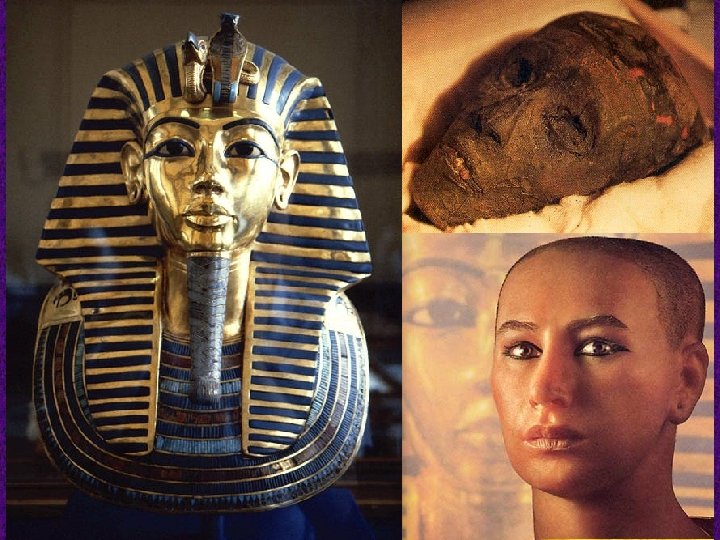
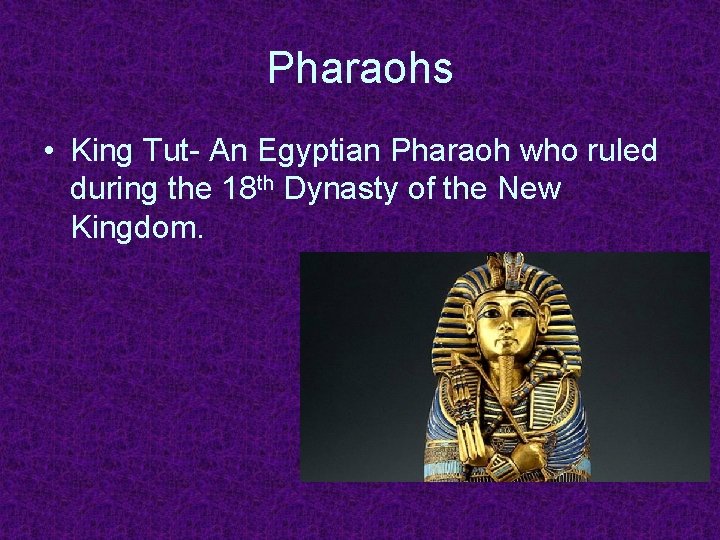
Pharaohs • King Tut- An Egyptian Pharaoh who ruled during the 18 th Dynasty of the New Kingdom.
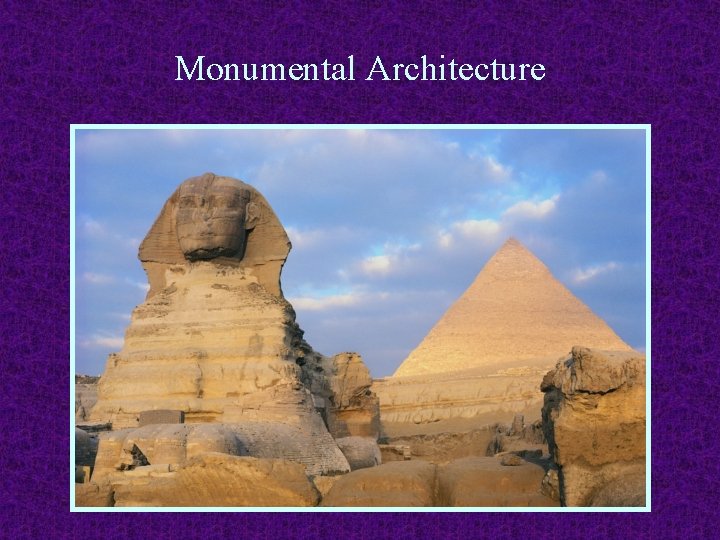
Monumental Architecture
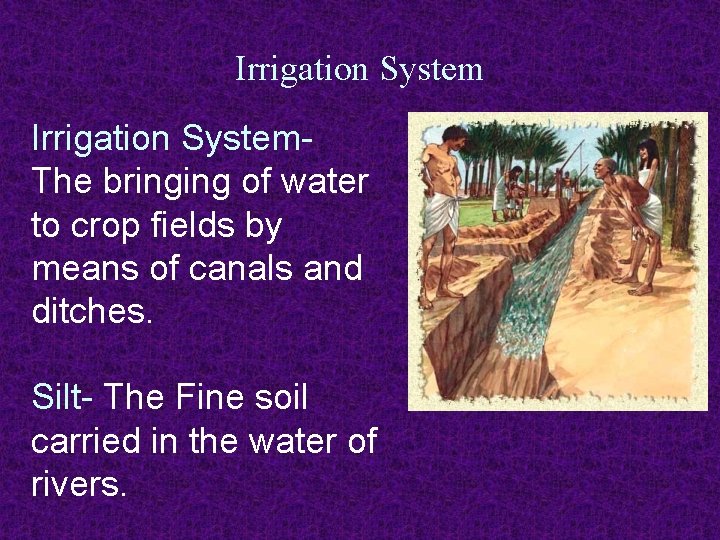
Irrigation System. The bringing of water to crop fields by means of canals and ditches. Silt- The Fine soil carried in the water of rivers.
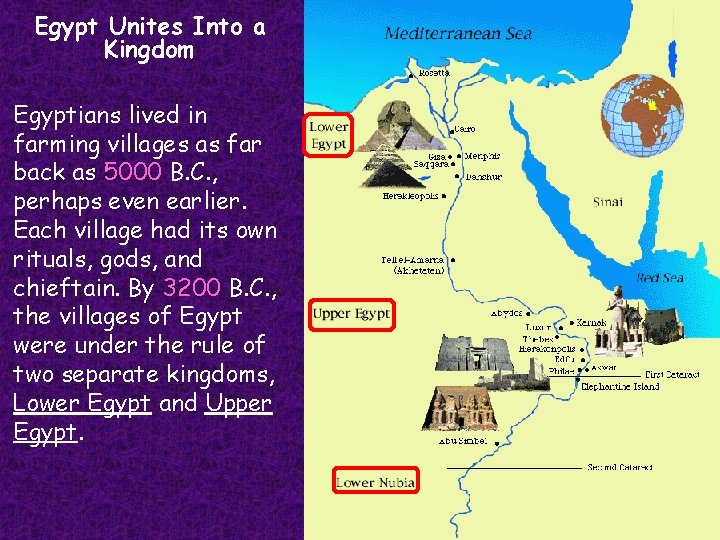
Egypt Unites Into a Kingdom Egyptians lived in farming villages as far back as 5000 B. C. , perhaps even earlier. Each village had its own rituals, gods, and chieftain. By 3200 B. C. , the villages of Egypt were under the rule of two separate kingdoms, Lower Egypt and Upper Egypt.
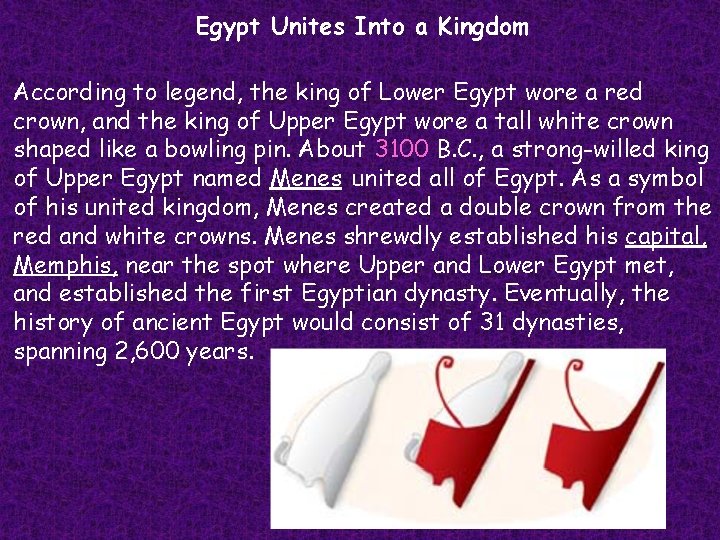
Egypt Unites Into a Kingdom According to legend, the king of Lower Egypt wore a red crown, and the king of Upper Egypt wore a tall white crown shaped like a bowling pin. About 3100 B. C. , a strong-willed king of Upper Egypt named Menes united all of Egypt. As a symbol of his united kingdom, Menes created a double crown from the red and white crowns. Menes shrewdly established his capital, Memphis, near the spot where Upper and Lower Egypt met, and established the first Egyptian dynasty. Eventually, the history of ancient Egypt would consist of 31 dynasties, spanning 2, 600 years.
Egypt Unites Into a Kingdom Little is known of Egypt’s first two dynasties, but records improve with the Third Dynasty. The Third Dynasty begins the period historians call the Old Kingdom, which lasted from 2660 to 2180 B. C. The Old Kingdom set the pattern for Egypt’s great civilization.
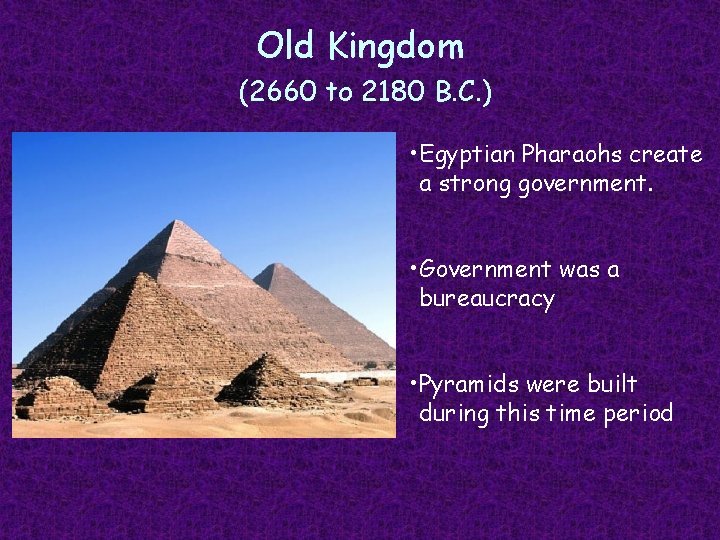
Old Kingdom (2660 to 2180 B. C. ) • Egyptian Pharaohs create a strong government. • Government was a bureaucracy • Pyramids were built during this time period
Middle Kingdom (about 2080– 1640 B. C. ) • Not a peaceful, calm period. • Major irrigation systems were created • Egyptian traders had greater contact with Middle Eastern civilizations. • Eventually, Egypt is conquered by a group called the Hyksos.
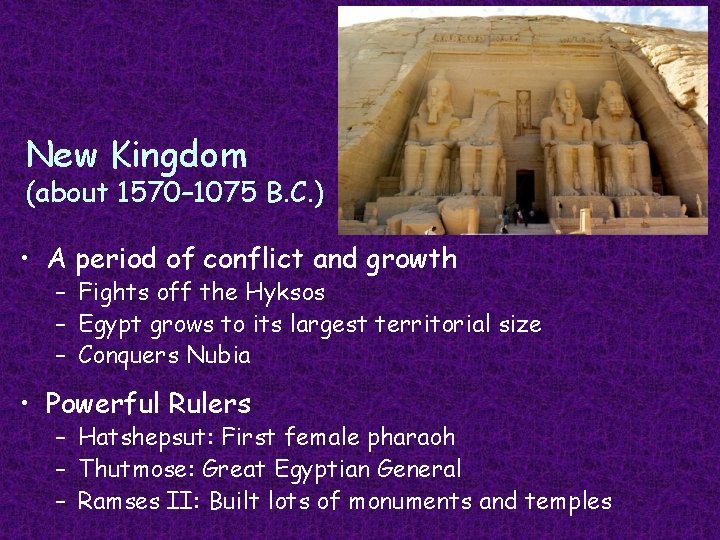
New Kingdom (about 1570– 1075 B. C. ) • A period of conflict and growth – Fights off the Hyksos – Egypt grows to its largest territorial size – Conquers Nubia • Powerful Rulers – Hatshepsut: First female pharaoh – Thutmose: Great Egyptian General – Ramses II: Built lots of monuments and temples
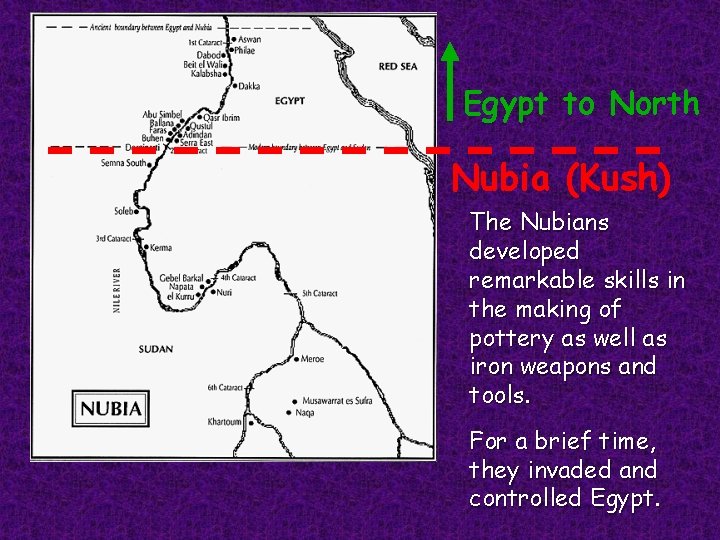
Egypt to North Nubia (Kush) The Nubians developed remarkable skills in the making of pottery as well as iron weapons and tools. For a brief time, they invaded and controlled Egypt.
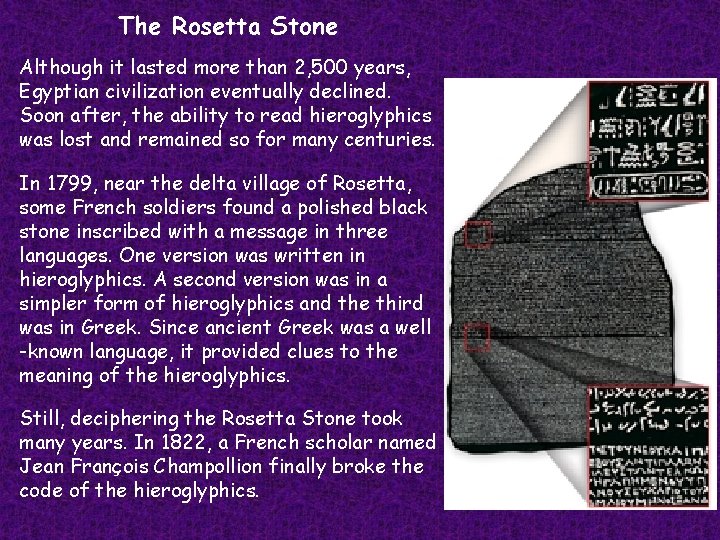
The Rosetta Stone Although it lasted more than 2, 500 years, Egyptian civilization eventually declined. Soon after, the ability to read hieroglyphics was lost and remained so for many centuries. In 1799, near the delta village of Rosetta, some French soldiers found a polished black stone inscribed with a message in three languages. One version was written in hieroglyphics. A second version was in a simpler form of hieroglyphics and the third was in Greek. Since ancient Greek was a well -known language, it provided clues to the meaning of the hieroglyphics. Still, deciphering the Rosetta Stone took many years. In 1822, a French scholar named Jean François Champollion finally broke the code of the hieroglyphics.
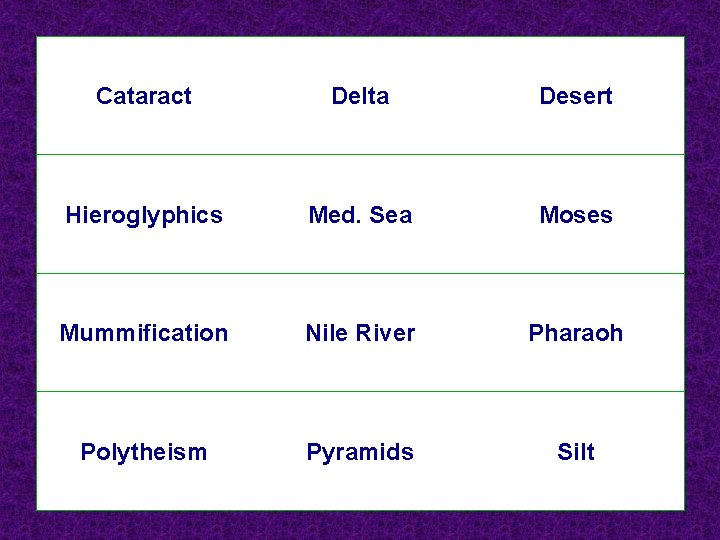
Cataract Delta Desert Hieroglyphics Med. Sea Moses Mummification Nile River Pharaoh Polytheism Pyramids Silt
Quiz Time • Heads up…you’ll have a quiz tomorrow • This is not multiple choice but you will have a word bank (which includes incorrect answers as well) • Complete the study guide for practice…this will help you review the essential terms for the quiz