Quantum ESPRESSO on HPC and GPU systems parallelisation



- Slides: 38
Quantum ESPRESSO on HPC and GPU systems: parallelisation and hybrid architecture Carlo Cavazzoni – c. cavazzoni@cineca. it Cineca & Ma. X
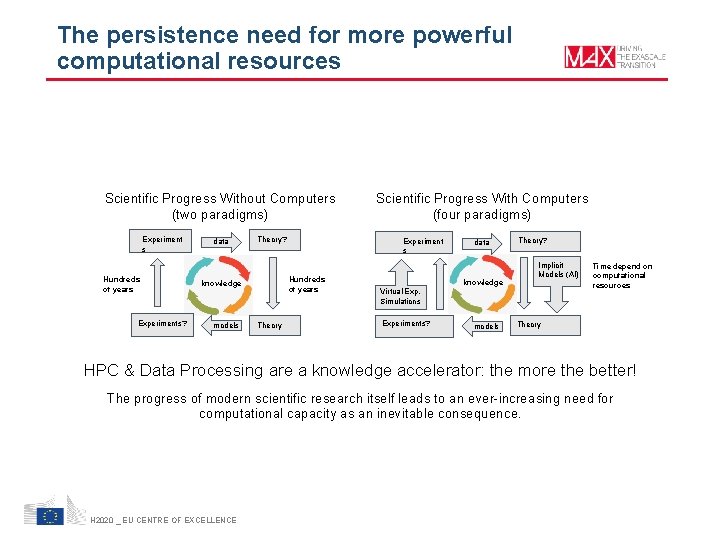
The persistence need for more powerful computational resources Scientific Progress Without Computers (two paradigms) Experiment s Hundreds of years Experiments? data Theory? models Experiment s Hundreds of years knowledge Theory Scientific Progress With Computers (four paradigms) data knowledge Theory? Implicit Models (AI) Virtual Exp. Simulations Experiments? models Time depend on computational resources Theory HPC & Data Processing are a knowledge accelerator: the more the better! The progress of modern scientific research itself leads to an ever-increasing need for computational capacity as an inevitable consequence. H 2020 _ EU CENTRE OF EXCELLENCE
The end of chip downsizing H 2020 _ EU CENTRE OF EXCELLENCE
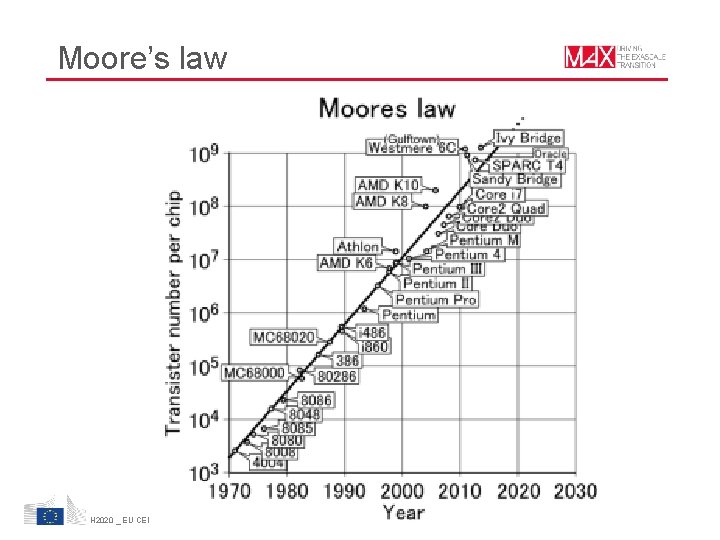
Moore’s law H 2020 _ EU CENTRE OF EXCELLENCE Moores Law
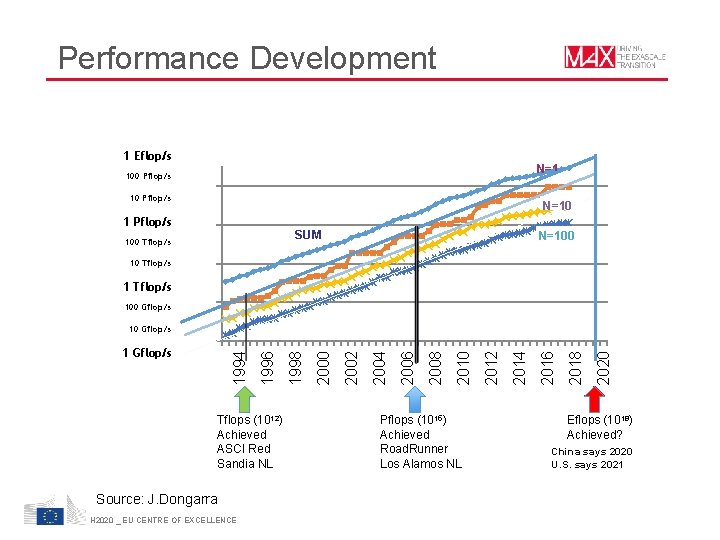
Performance Development 1 Eflop/s N=1 100 Pflop/s 10000 10 Pflop/s N=10 1 Pflop/s 1000000 SUM 100 Tflop/s N=100 10000 10 Tflop/s Tflops (1012) Achieved ASCI Red Sandia NL Source: J. Dongarra H 2020 _ EU CENTRE OF EXCELLENCE Pflops (1015) Achieved Road. Runner Los Alamos NL 2020 2018 2016 2014 2012 2010 2008 2006 2004 2002 1 2000 1 Gflop/s 1998 10 Gflop/s 100 1996 100 Gflop/s 1994 1 Tflop/s Eflops (1018) Achieved? China says 2020 U. S. says 2021
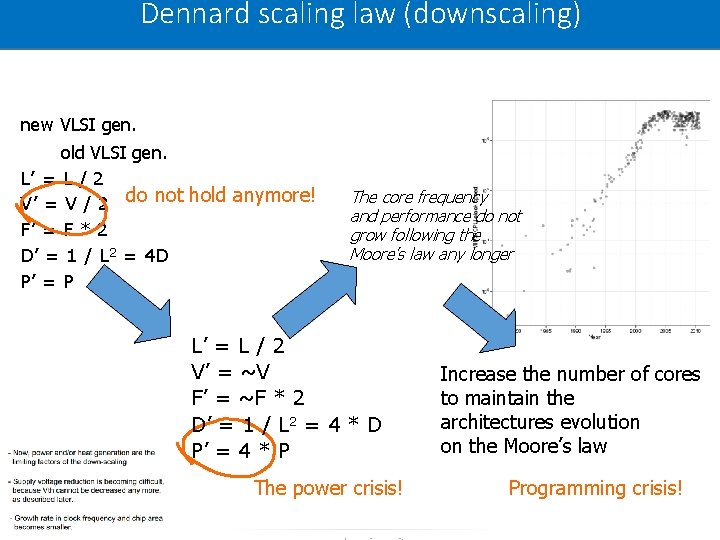
Dennard scaling law (downscaling) new VLSI gen. old VLSI gen. L’ = L / 2 V’ = V / 2 do not hold anymore! F’ = F * 2 D’ = 1 / L 2 = 4 D P’ = P The core frequency and performance do not grow following the Moore’s law any longer L’ = L / 2 V’ = ~V F’ = ~F * 2 D’ = 1 / L 2 = 4 * D P’ = 4 * P The power crisis! Increase the number of cores to maintain the architectures evolution on the Moore’s law Programming crisis!
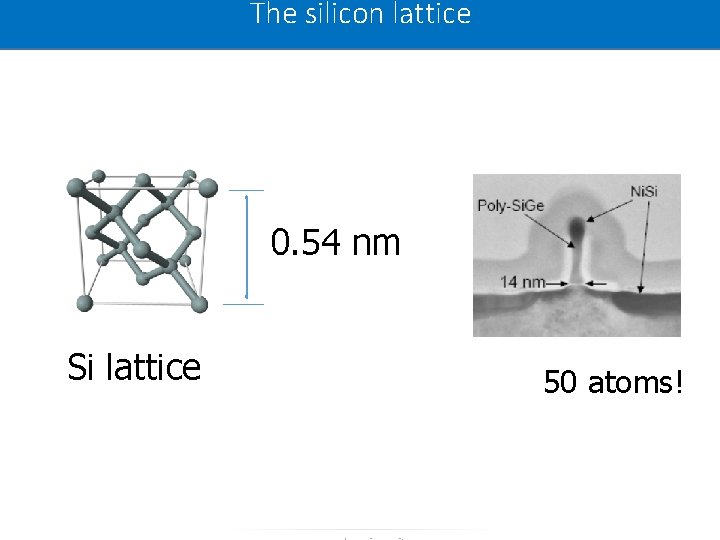
The silicon lattice 0. 54 nm Si lattice 50 atoms!
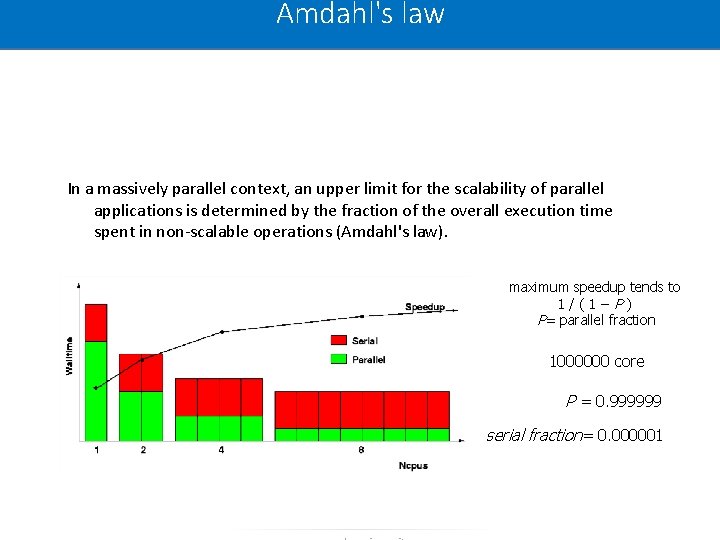
Amdahl's law In a massively parallel context, an upper limit for the scalability of parallel applications is determined by the fraction of the overall execution time spent in non-scalable operations (Amdahl's law). maximum speedup tends to 1 / ( 1 − P ) P= parallel fraction 1000000 core P = 0. 999999 serial fraction= 0. 000001
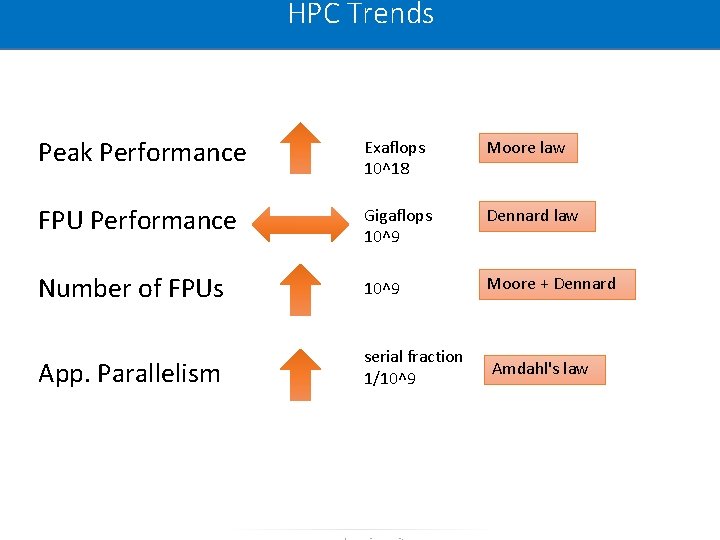
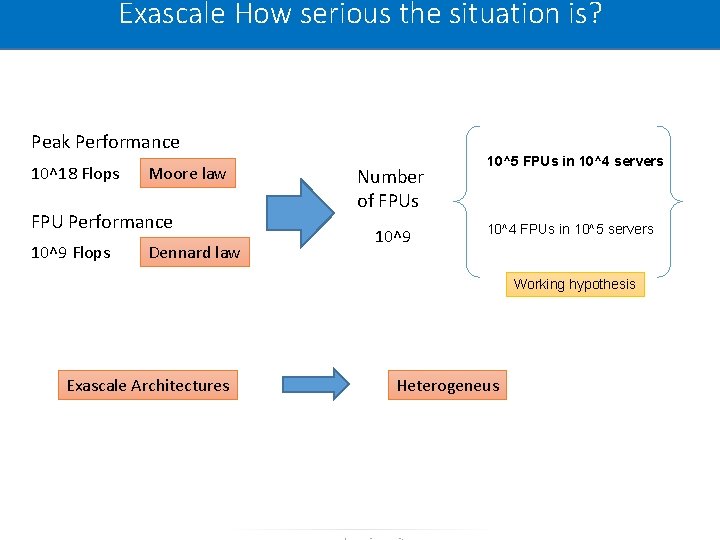
HPC Trends Peak Performance Exaflops 10^18 Moore law FPU Performance Gigaflops 10^9 Dennard law Number of FPUs 10^9 Moore + Dennard App. Parallelism serial fraction 1/10^9 Amdahl's law
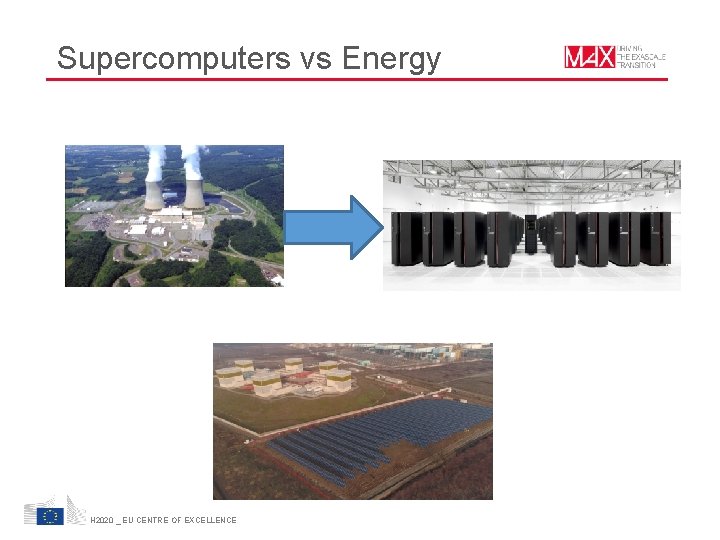
Supercomputers vs Energy H 2020 _ EU CENTRE OF EXCELLENCE
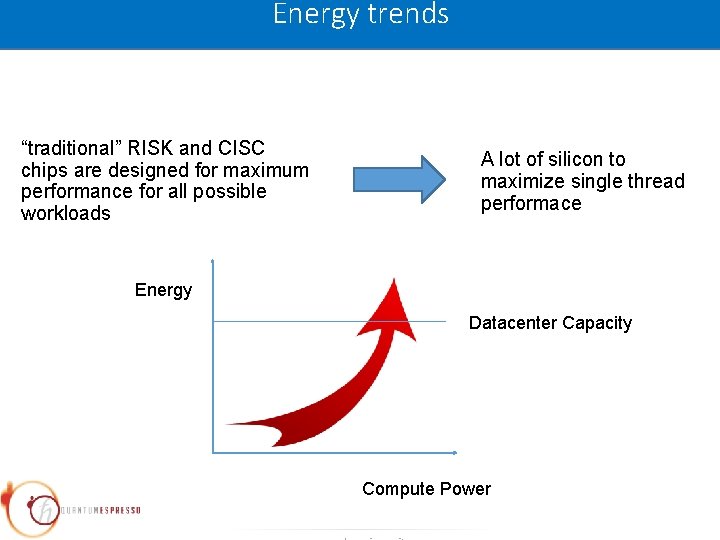
Energy trends “traditional” RISK and CISC chips are designed for maximum performance for all possible workloads A lot of silicon to maximize single thread performace Energy Datacenter Capacity Compute Power
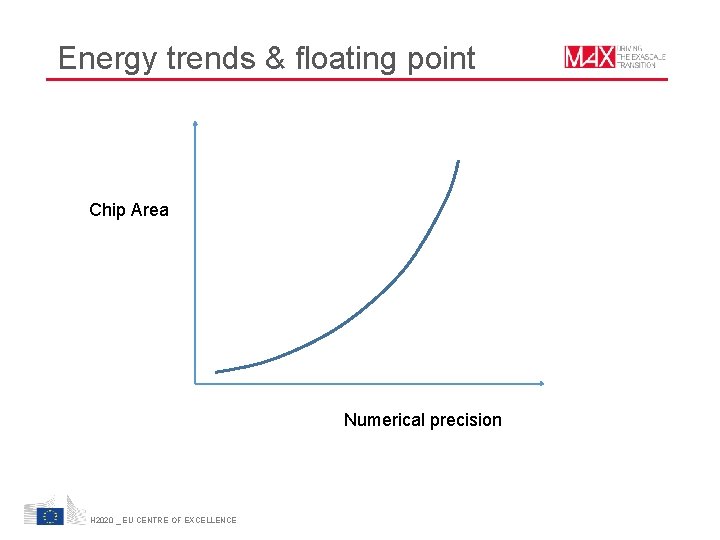
Energy trends & floating point Chip Area Numerical precision H 2020 _ EU CENTRE OF EXCELLENCE
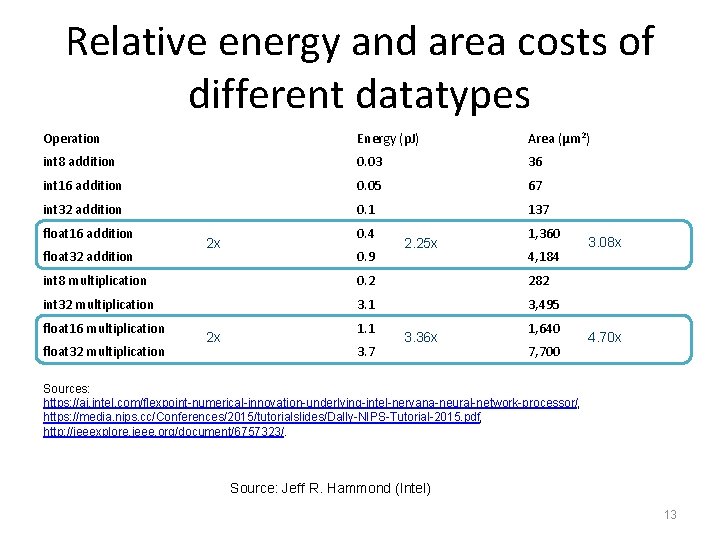
Relative energy and area costs of different datatypes Operation Energy (p. J) Area (μm 2) int 8 addition 0. 03 36 int 16 addition 0. 05 67 int 32 addition 0. 1 137 float 16 addition float 32 addition 2 x 0. 4 0. 9 2. 25 x 1, 360 4, 184 int 8 multiplication 0. 2 282 int 32 multiplication 3. 1 3, 495 float 16 multiplication float 32 multiplication 2 x 1. 1 3. 7 3. 36 x 1, 640 7, 700 3. 08 x 4. 70 x Sources: https: //ai. intel. com/flexpoint-numerical-innovation-underlying-intel-nervana-neural-network-processor/, https: //media. nips. cc/Conferences/2015/tutorialslides/Dally-NIPS-Tutorial-2015. pdf, http: //ieeexplore. ieee. org/document/6757323/. Source: Jeff R. Hammond (Intel) 13
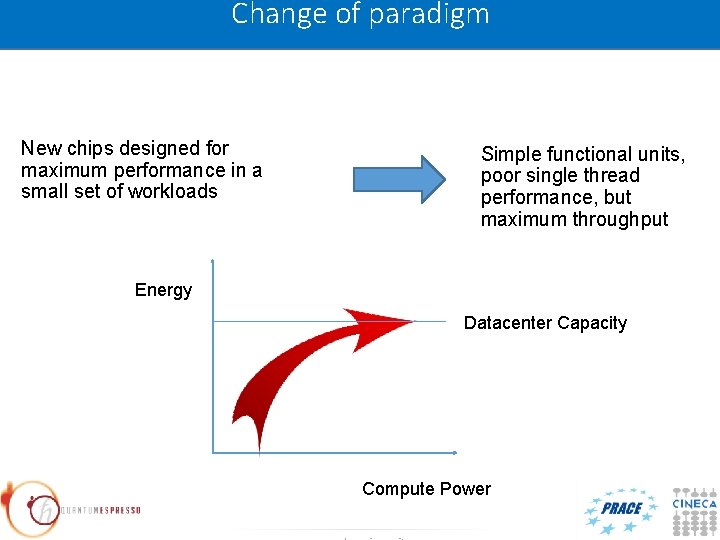
Change of paradigm New chips designed for maximum performance in a small set of workloads Simple functional units, poor single thread performance, but maximum throughput Energy Datacenter Capacity Compute Power
Specialized cores
Exascale How serious the situation is? Peak Performance 10^18 Flops Moore law FPU Performance 10^9 Flops Dennard law Number of FPUs 10^9 10^5 FPUs in 10^4 servers 10^4 FPUs in 10^5 servers Working hypothesis Exascale Architectures Heterogeneus
Exascale Race China (2021 -2022) Xiaomi, Shen. Wei, Hygon Frontier (Cray-AMD w GPU) U. S. (2021 -2023) Euro. HPC (2023) ARM by EST+GPU Japan (2022) Aurora 21 (Cray-Intel w GPU) Build a supercomputer capable of 10^18 Double Precision Floating Point Operation per Second Fugaku (Fujitsu w ARM)
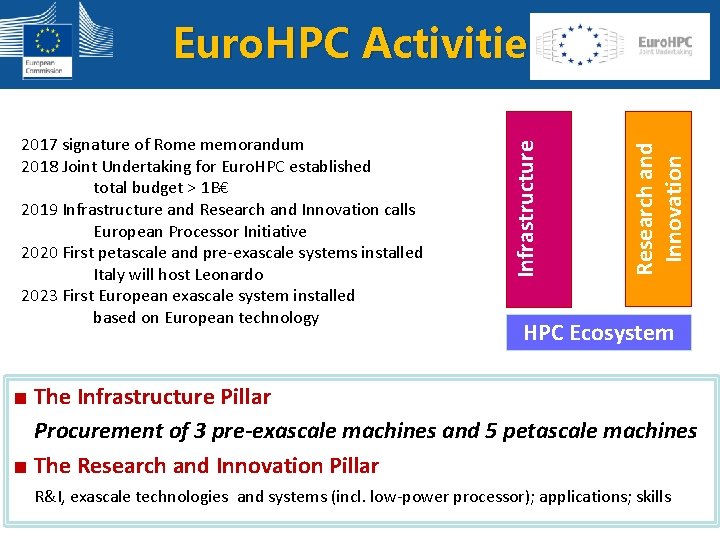
Research and Innovation 2017 signature of Rome memorandum 2018 Joint Undertaking for Euro. HPC established total budget > 1 B€ 2019 Infrastructure and Research and Innovation calls European Processor Initiative 2020 First petascale and pre-exascale systems installed Italy will host Leonardo 2023 First European exascale system installed based on European technology Infrastructure Euro. HPC Activities HPC Ecosystem ■ The Infrastructure Pillar Procurement of 3 pre-exascale machines and 5 petascale machines ■ The Research and Innovation Pillar R&I, exascale technologies and systems (incl. low-power processor); applications; skills
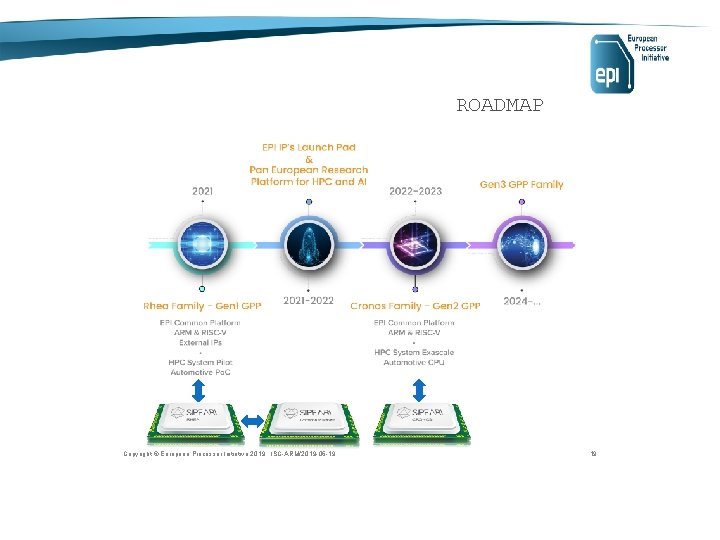
ROADMAP Copyright © European Processor Initiative 2019. ISC-ARM/2019 -06 -19 19
Leonardo Euro. HPC pre-exascale Partnership SISSA - ISAS + Consortium (Slovenia, Hungary, Slovakia, Austria)
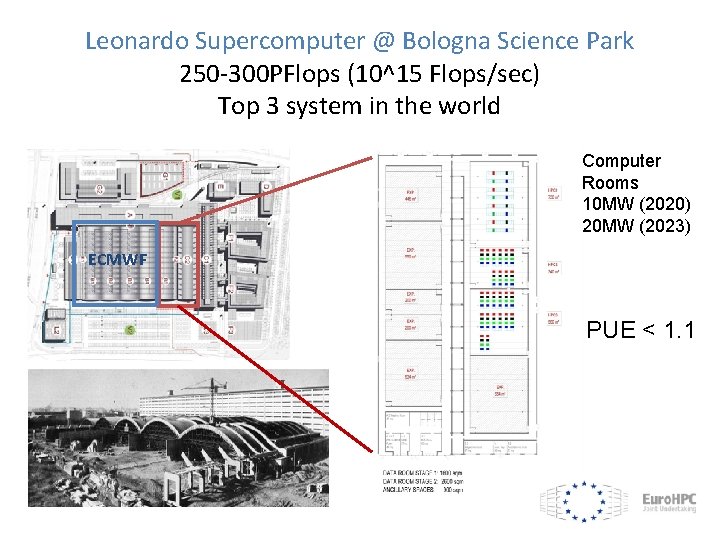
Leonardo Supercomputer @ Bologna Science Park 250 -300 PFlops (10^15 Flops/sec) Top 3 system in the world Computer Rooms 10 MW (2020) 20 MW (2023) ECMWF PUE < 1. 1
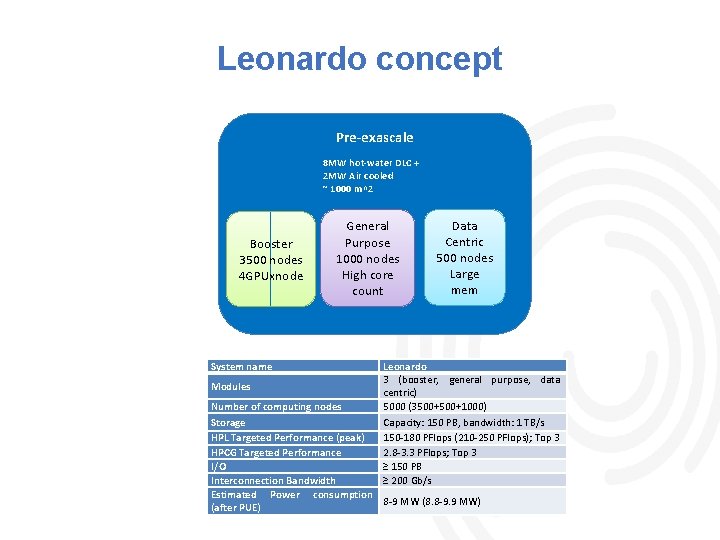
Leonardo concept Pre-exascale 8 MW hot-water DLC + 2 MW Air cooled ~ 1000 m^2 Booster 3500 nodes 4 GPUxnode System name Modules General Purpose 1000 nodes High core count Data Centric 500 nodes Large mem Leonardo 3 (booster, general purpose, data centric) 5000 (3500+1000) Capacity: 150 PB, bandwidth: 1 TB/s 150 -180 PFlops (210 -250 PFlops); Top 3 2. 8 -3. 3 PFlops; Top 3 ≥ 150 PB ≥ 200 Gb/s Number of computing nodes Storage HPL Targeted Performance (peak) HPCG Targeted Performance I/O Interconnection Bandwidth Estimated Power consumption 8 -9 MW (8. 8 -9. 9 MW) (after PUE)
What about applications The experience of Ma. X
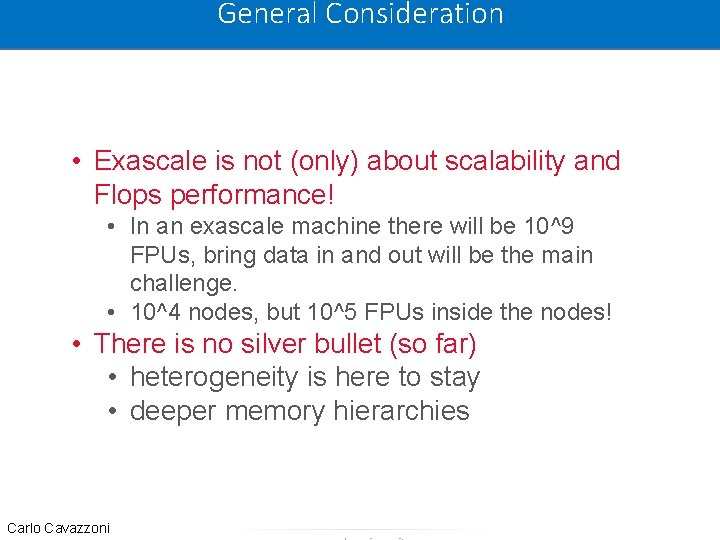
General Consideration • Exascale is not (only) about scalability and Flops performance! • In an exascale machine there will be 10^9 FPUs, bring data in and out will be the main challenge. • 10^4 nodes, but 10^5 FPUs inside the nodes! • There is no silver bullet (so far) • heterogeneity is here to stay • deeper memory hierarchies Carlo Cavazzoni
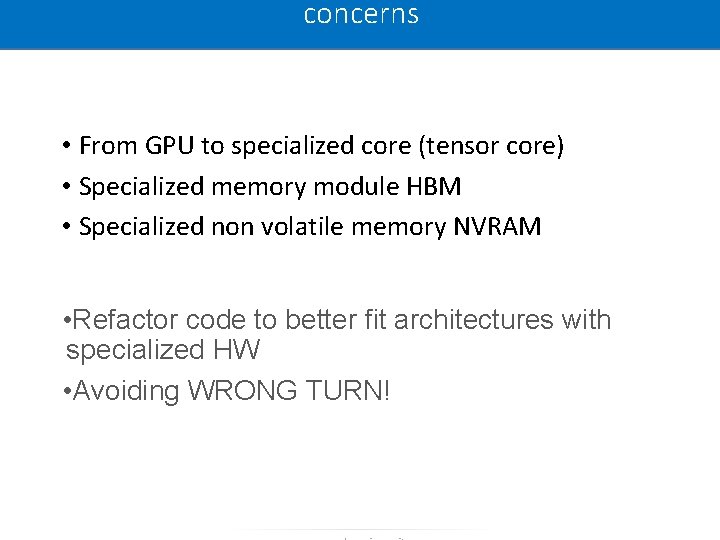
concerns • From GPU to specialized core (tensor core) • Specialized memory module HBM • Specialized non volatile memory NVRAM • Refactor code to better fit architectures with specialized HW • Avoiding WRONG TURN!
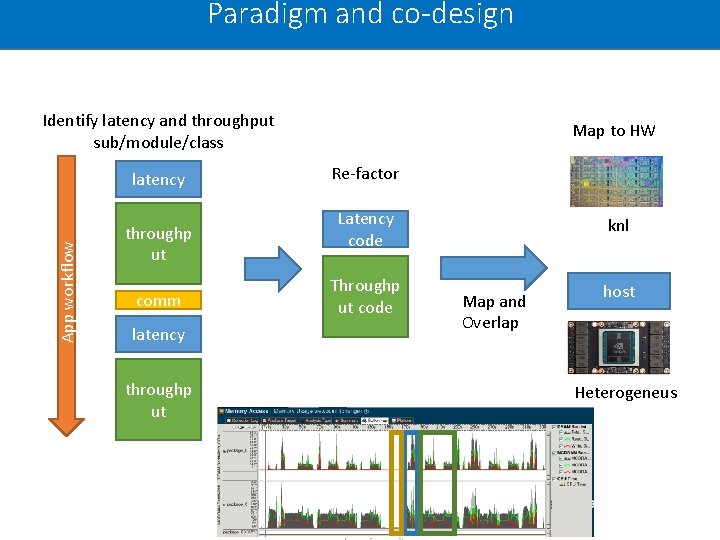
Paradigm and co-design Identify latency and throughput sub/module/class App workflow latency throughp ut comm latency throughp ut Map to HW Re-factor Latency code Throughp ut code knl Map and Overlap host Heterogeneus
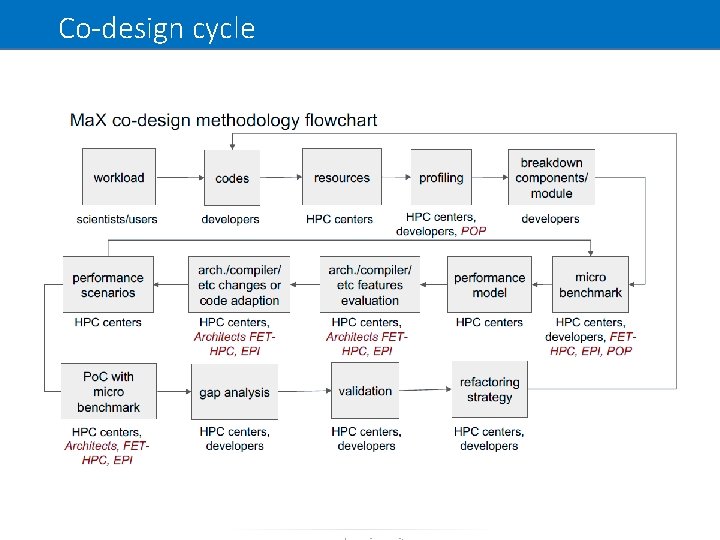
Co-design cycle
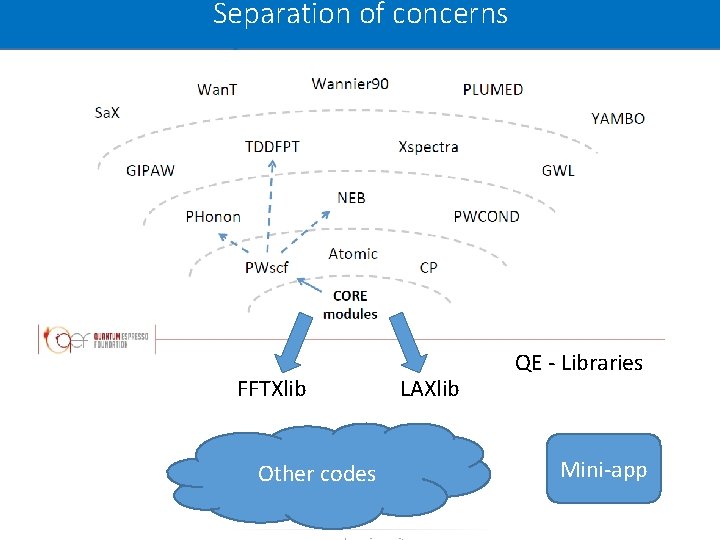
Separation of concerns Beyond Modularization FFTXlib Other codes LAXlib QE - Libraries Mini-app
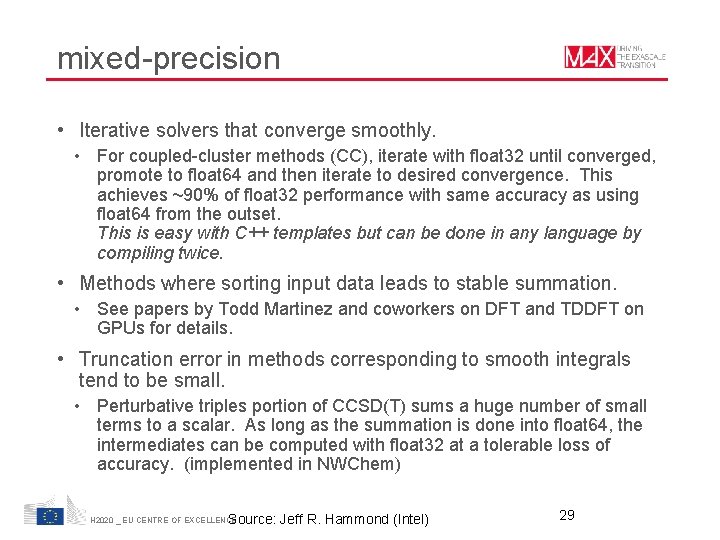
mixed-precision • Iterative solvers that converge smoothly. • For coupled-cluster methods (CC), iterate with float 32 until converged, promote to float 64 and then iterate to desired convergence. This achieves ~90% of float 32 performance with same accuracy as using float 64 from the outset. This is easy with C++ templates but can be done in any language by compiling twice. • Methods where sorting input data leads to stable summation. • See papers by Todd Martinez and coworkers on DFT and TDDFT on GPUs for details. • Truncation error in methods corresponding to smooth integrals tend to be small. • Perturbative triples portion of CCSD(T) sums a huge number of small terms to a scalar. As long as the summation is done into float 64, the intermediates can be computed with float 32 at a tolerable loss of accuracy. (implemented in NWChem) Source: Jeff R. Hammond (Intel) H 2020 _ EU CENTRE OF EXCELLENCE 29
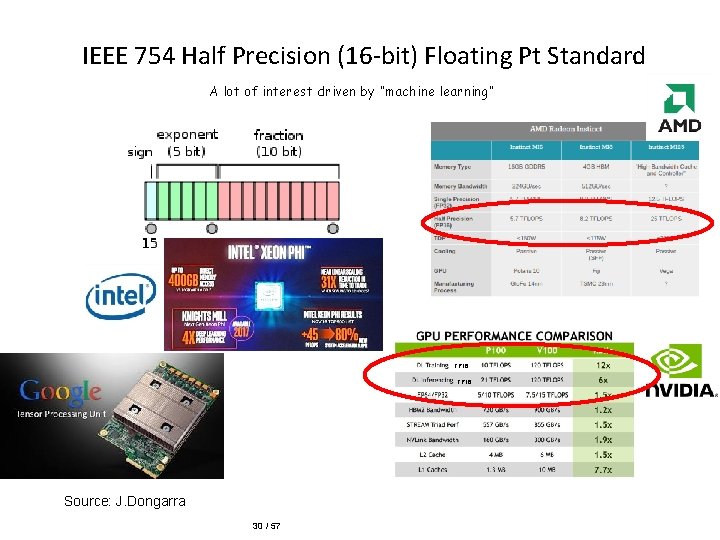
IEEE 754 Half Precision (16 -bit) Floating Pt Standard A lot of interest driven by “machine learning” FP 16 Source: J. Dongarra 30 / 57
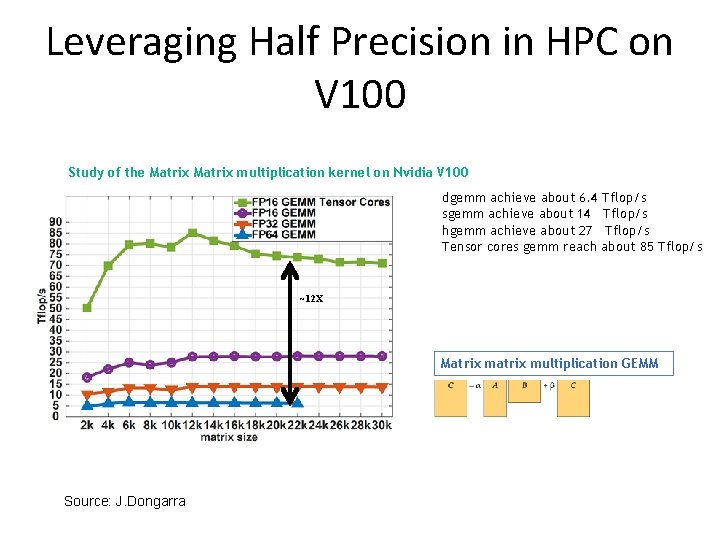
Leveraging Half Precision in HPC on V 100 Study of the Matrix multiplication kernel on Nvidia V 100 • • dgemm achieve about 6. 4 Tflop/s sgemm achieve about 14 Tflop/s hgemm achieve about 27 Tflop/s Tensor cores gemm reach about 85 Tflop/s ~12 X Matrix multiplication GEMM Source: J. Dongarra
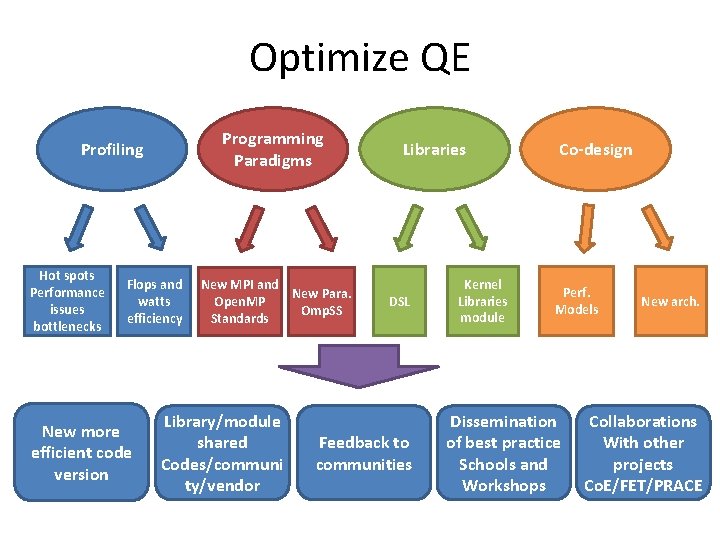
Optimize QE Programming Paradigms Profiling Hot spots Performance issues bottlenecks Flops and watts efficiency New more efficient code version New MPI and New Para. Open. MP Omp. SS Standards Library/module shared Codes/communi ty/vendor Libraries DSL Feedback to communities Kernel Libraries module Co-design Perf. Models Dissemination of best practice Schools and Workshops New arch. Collaborations With other projects Co. E/FET/PRACE
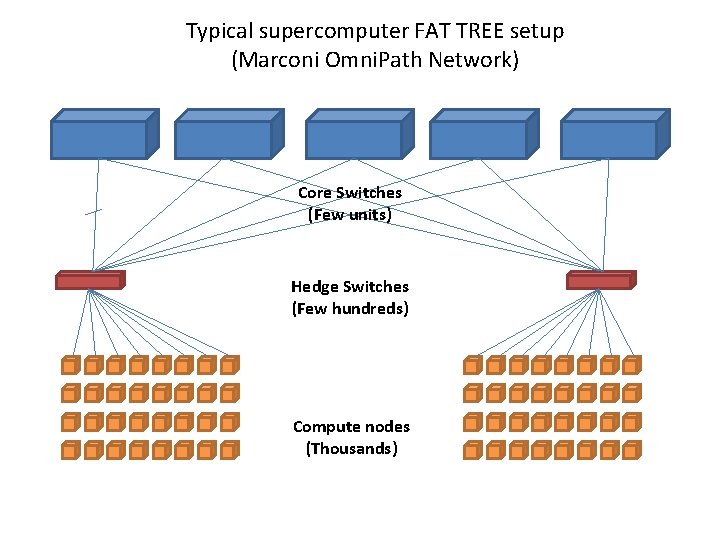
Typical supercomputer FAT TREE setup (Marconi Omni. Path Network) Core Switches (Few units) Hedge Switches (Few hundreds) Compute nodes (Thousands)
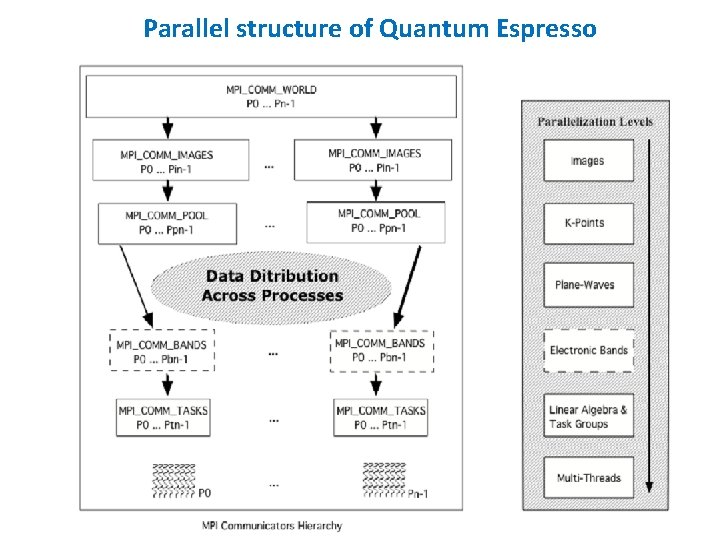
Parallel structure of Quantum Espresso
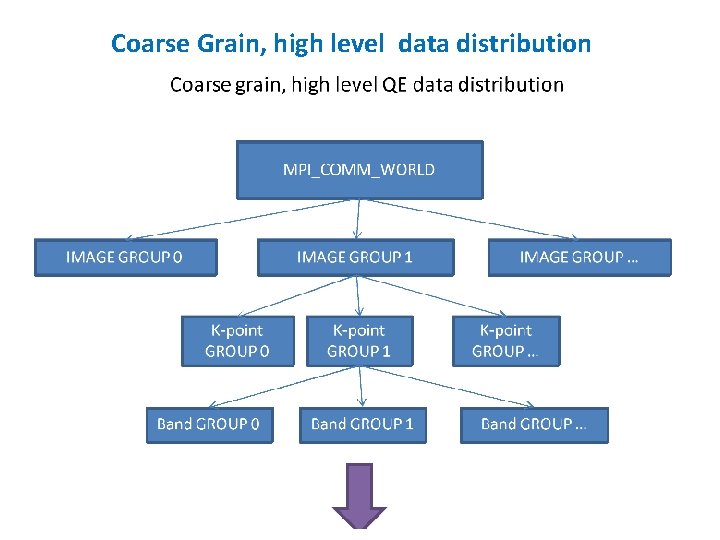
Coarse Grain, high level data distribution
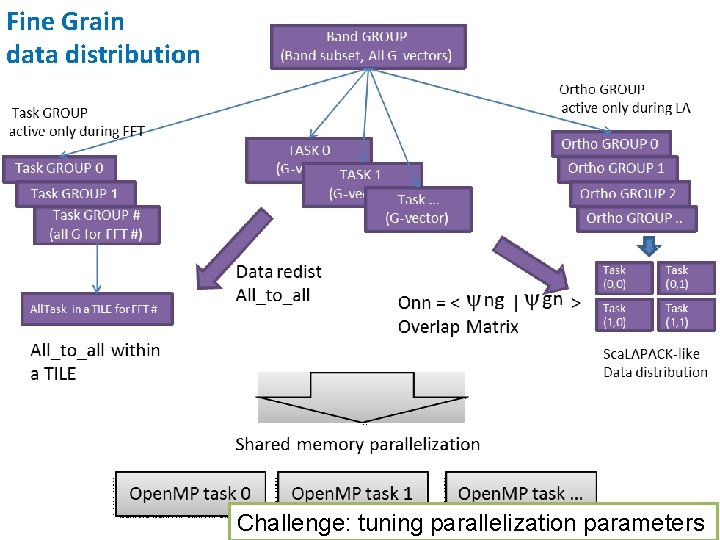
Fine Grain data distribution Challenge: tuning parallelization parameters
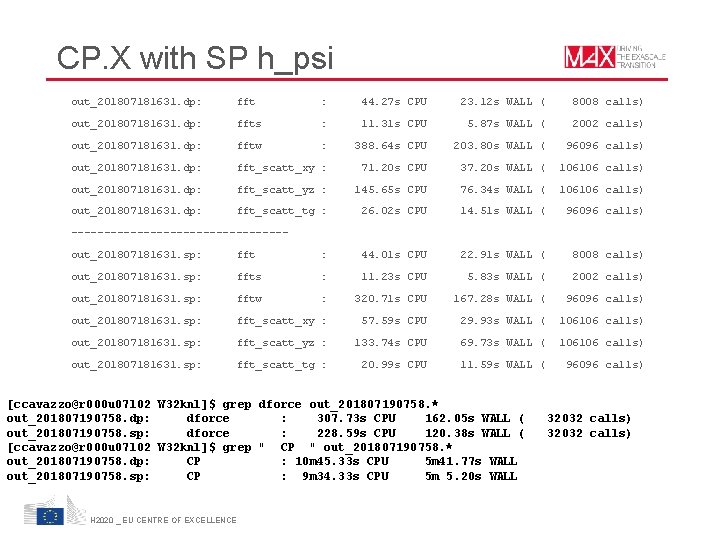
CP. X with SP h_psi out_201807181631. dp: fft : 44. 27 s CPU 23. 12 s WALL ( 8008 calls) out_201807181631. dp: ffts : 11. 31 s CPU 5. 87 s WALL ( 2002 calls) out_201807181631. dp: fftw : 388. 64 s CPU 203. 80 s WALL ( 96096 calls) out_201807181631. dp: fft_scatt_xy : 71. 20 s CPU 37. 20 s WALL ( 106106 calls) out_201807181631. dp: fft_scatt_yz : 145. 65 s CPU 76. 34 s WALL ( 106106 calls) out_201807181631. dp: fft_scatt_tg : 26. 02 s CPU 14. 51 s WALL ( 96096 calls) ----------------out_201807181631. sp: fft : 44. 01 s CPU 22. 91 s WALL ( 8008 calls) out_201807181631. sp: ffts : 11. 23 s CPU 5. 83 s WALL ( 2002 calls) out_201807181631. sp: fftw : 320. 71 s CPU 167. 28 s WALL ( 96096 calls) out_201807181631. sp: fft_scatt_xy : 57. 59 s CPU 29. 93 s WALL ( 106106 calls) out_201807181631. sp: fft_scatt_yz : 133. 74 s CPU 69. 73 s WALL ( 106106 calls) out_201807181631. sp: fft_scatt_tg : 20. 99 s CPU 11. 59 s WALL ( 96096 calls) [ccavazzo@r 000 u 07 l 02 W 32 knl]$ grep dforce out_201807190758. * out_201807190758. dp: dforce : 307. 73 s CPU 162. 05 s WALL ( out_201807190758. sp: dforce : 228. 59 s CPU 120. 38 s WALL ( [ccavazzo@r 000 u 07 l 02 W 32 knl]$ grep " CP " out_201807190758. * out_201807190758. dp: CP : 10 m 45. 33 s CPU 5 m 41. 77 s WALL out_201807190758. sp: CP : 9 m 34. 33 s CPU 5 m 5. 20 s WALL H 2020 _ EU CENTRE OF EXCELLENCE 32032 calls)
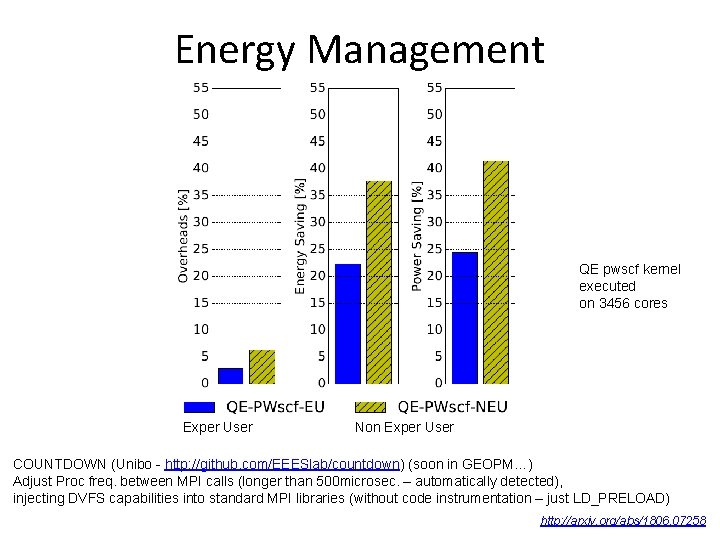
Energy Management QE pwscf kernel executed on 3456 cores Exper User Non Exper User COUNTDOWN (Unibo - http: //github. com/EEESlab/countdown) (soon in GEOPM…) Adjust Proc freq. between MPI calls (longer than 500 microsec. – automatically detected), injecting DVFS capabilities into standard MPI libraries (without code instrumentation – just LD_PRELOAD) http: //arxiv. org/abs/1806. 07258