PSY 369 Psycholinguistics Language Production Introduction and finishing



- Slides: 58
PSY 369: Psycholinguistics Language Production: Introduction (and finishing up comprehension)
Announcements n Homeworks 1 & 2 graded and entered n n Let me know if you did it but there is no grade Homework 3 – nearly done Homework 4 (due March 25) – collection of speech errors New homework options were posted yesterday. Both are journal summary types. n n 1. 1, 1. 2 – comprehension related 2. 1, 2. 2, 2. 3 – production related
Homework 4 (Due March 25) n Try to be vigilant for four or five days in noting speech errors made by yourself and others. Write each slip down (carry a small notebook and pencil with you). Then, when you have accumulated a reasonably size sample (aim for 20 to 30, but don't panic if you don't get that many), try to classify each slip in terms of n n the unit(s) involved the type of error n Remember that each error may be interpreted in different ways. For some of them, see if you can come up with more than one possibility.
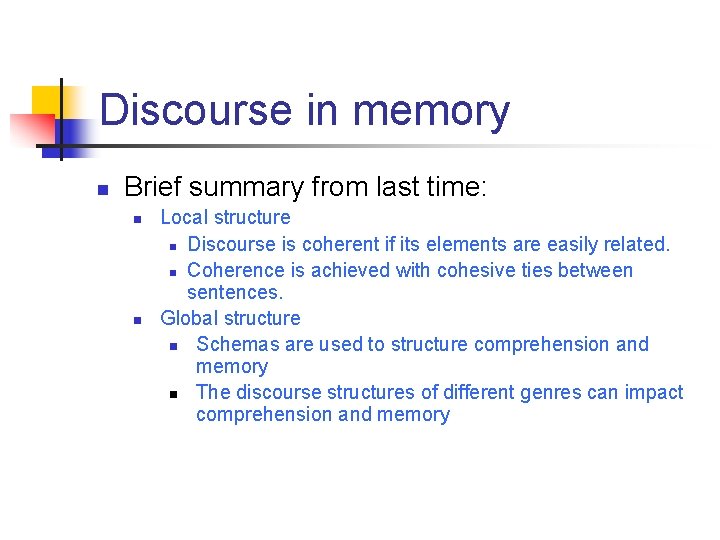
Discourse in memory n Brief summary from last time: n n Local structure n Discourse is coherent if its elements are easily related. n Coherence is achieved with cohesive ties between sentences. Global structure n Schemas are used to structure comprehension and memory n Effects of Genre, discourse structures
Effects of Genre n Not all kinds of discourse follow the same structure n Different effects, purposes, etc. n Expository discourse n n Narrative discourse n n n Convey info about a subject (e. g. , textbook, lecture) Tell a story: Introduce characters & settings, establish a goal, etc. APA style Newspaper articles
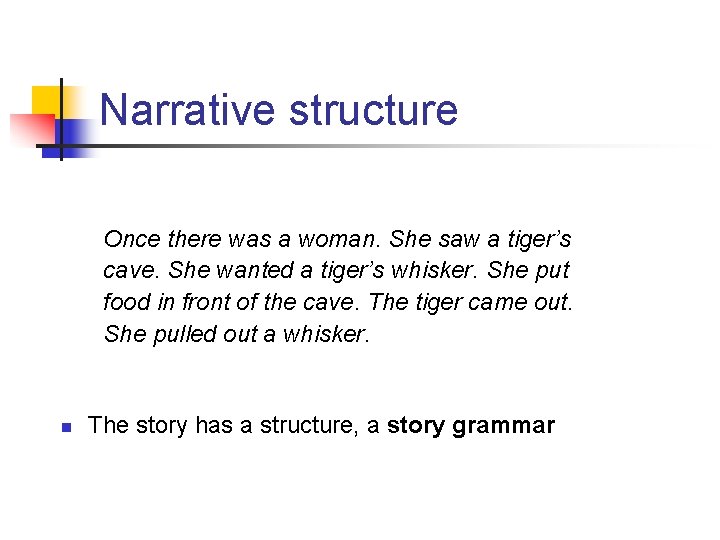
Narrative structure Once there was a woman. She saw a tiger’s cave. She wanted a tiger’s whisker. She put food in front of the cave. The tiger came out. She pulled out a whisker. n The story has a structure, a story grammar
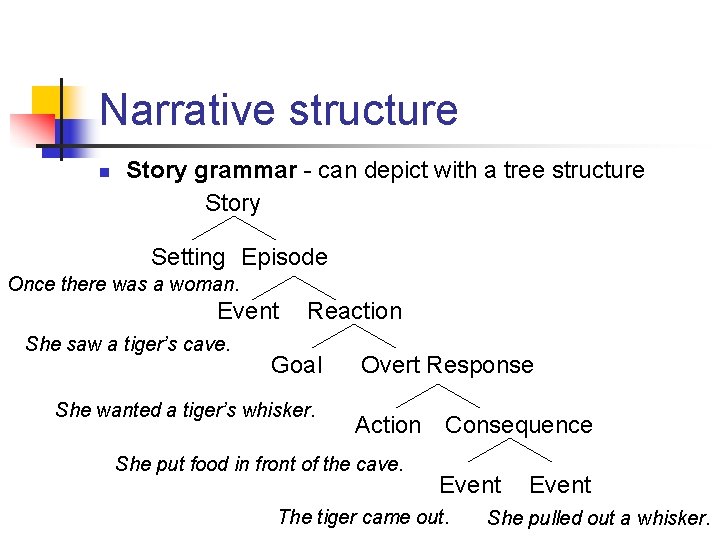
Narrative structure n Story grammar - can depict with a tree structure Story Setting Episode Once there was a woman. Event She saw a tiger’s cave. Reaction Goal She wanted a tiger’s whisker. Overt Response Action Consequence She put food in front of the cave. Event The tiger came out. Event She pulled out a whisker.
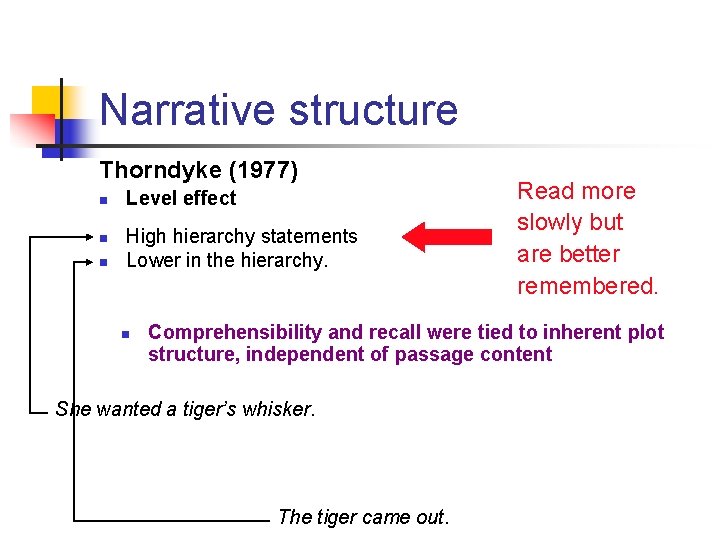
Narrative structure Thorndyke (1977) n n n Level effect High hierarchy statements Lower in the hierarchy. n Read more slowly but are better remembered. Comprehensibility and recall were tied to inherent plot structure, independent of passage content She wanted a tiger’s whisker. The tiger came out.
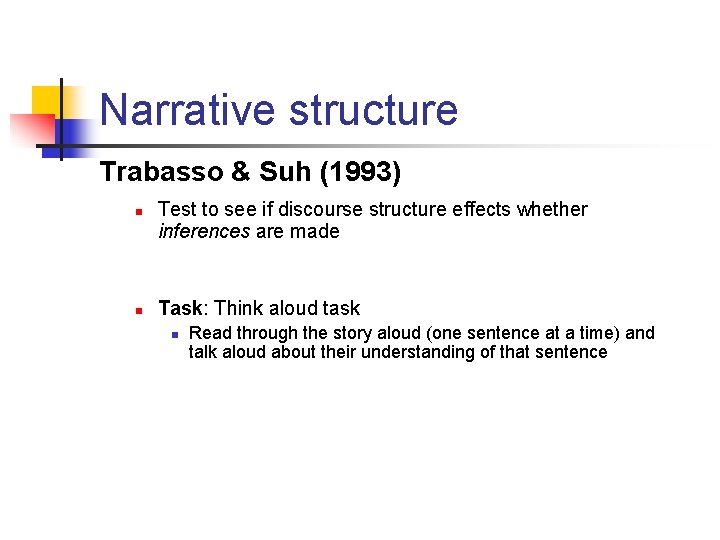
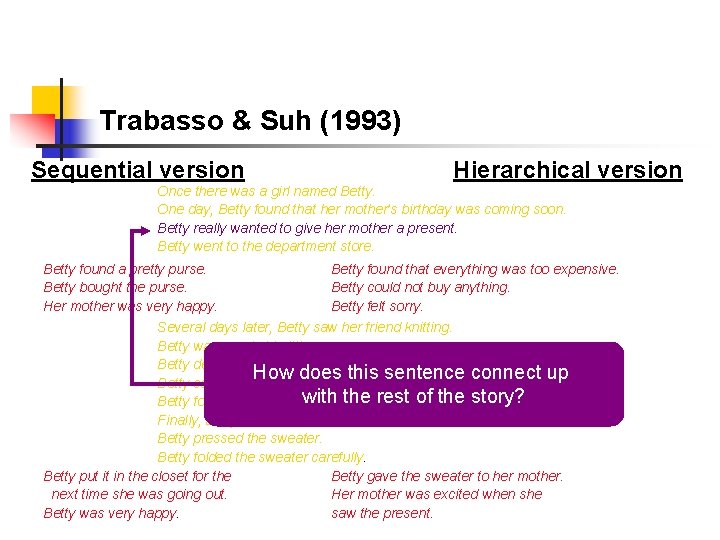
Narrative structure Trabasso & Suh (1993) n n Test to see if discourse structure effects whether inferences are made Task: Think aloud task n Read through the story aloud (one sentence at a time) and talk aloud about their understanding of that sentence
Trabasso & Suh (1993) Sequential version Hierarchical version Once there was a girl named Betty. One day, Betty found that her mother’s birthday was coming soon. Betty really wanted to give her mother a present. Betty went to the department store. Betty found a pretty purse. Betty bought the purse. Her mother was very happy. Betty found that everything was too expensive. Betty could not buy anything. Betty felt sorry. Several days later, Betty saw her friend knitting. Betty was good at knitting. Betty decided to knit a sweater. How does this sentence connect up Betty selected a pattern from a magazine. with the of the story? Betty followed the instructions in therest article. Finally, Betty finished a beautiful sweater. Betty pressed the sweater. Betty folded the sweater carefully. Betty put it in the closet for the Betty gave the sweater to her mother. next time she was going out. Her mother was excited when she Betty was very happy. saw the present.
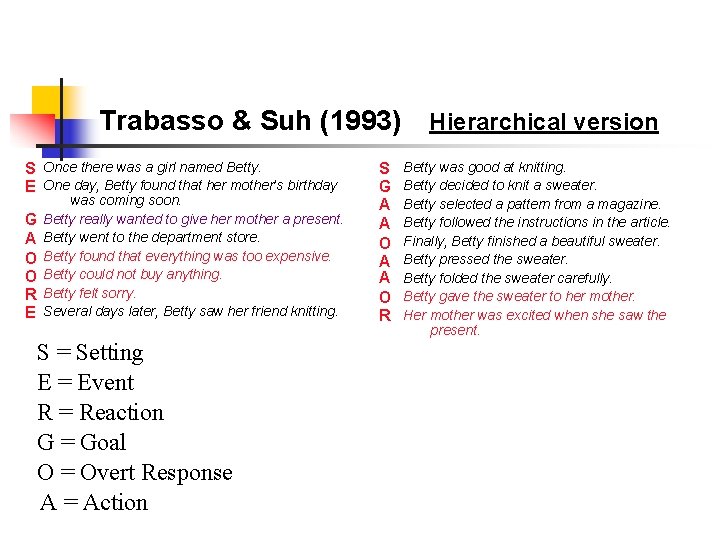
Trabasso & Suh (1993) S Once there was a girl named Betty. E One day, Betty found that her mother’s birthday G A O O R E was coming soon. Betty really wanted to give her mother a present. Betty went to the department store. Betty found that everything was too expensive. Betty could not buy anything. Betty felt sorry. Several days later, Betty saw her friend knitting. S = Setting E = Event R = Reaction G = Goal O = Overt Response A = Action S G A A O R Hierarchical version Betty was good at knitting. Betty decided to knit a sweater. Betty selected a pattern from a magazine. Betty followed the instructions in the article. Finally, Betty finished a beautiful sweater. Betty pressed the sweater. Betty folded the sweater carefully. Betty gave the sweater to her mother. Her mother was excited when she saw the present.
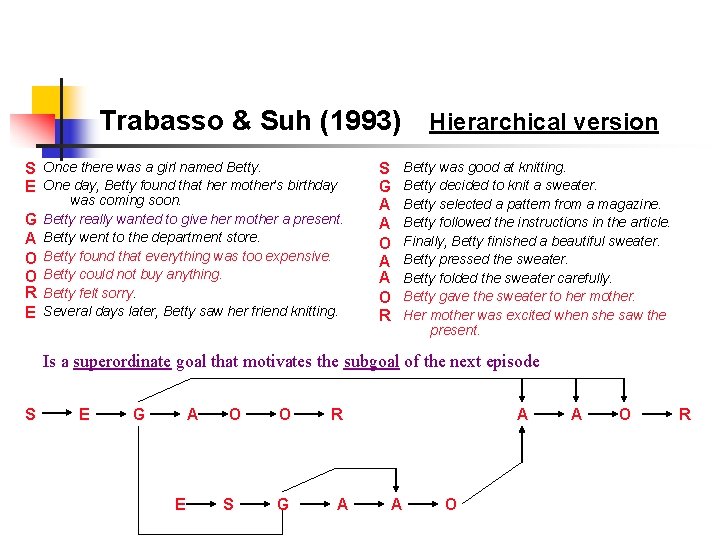
Trabasso & Suh (1993) S Once there was a girl named Betty. E One day, Betty found that her mother’s birthday G A O O R E was coming soon. Betty really wanted to give her mother a present. Betty went to the department store. Betty found that everything was too expensive. Betty could not buy anything. Betty felt sorry. Several days later, Betty saw her friend knitting. S G A A O R Hierarchical version Betty was good at knitting. Betty decided to knit a sweater. Betty selected a pattern from a magazine. Betty followed the instructions in the article. Finally, Betty finished a beautiful sweater. Betty pressed the sweater. Betty folded the sweater carefully. Betty gave the sweater to her mother. Her mother was excited when she saw the present. Is a superordinate goal that motivates the subgoal of the next episode S E G A E O S O G R A A A O R
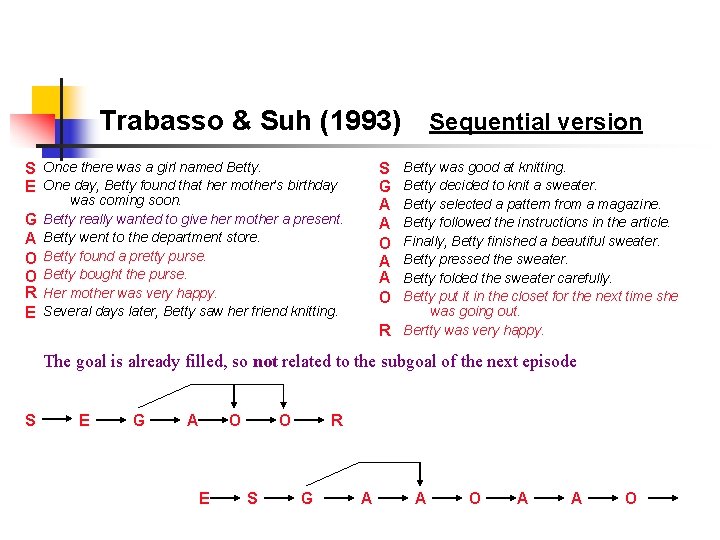
Trabasso & Suh (1993) S Once there was a girl named Betty. E One day, Betty found that her mother’s birthday G A O O R E Sequential version S G A A O Betty was good at knitting. Betty decided to knit a sweater. Betty selected a pattern from a magazine. Betty followed the instructions in the article. Finally, Betty finished a beautiful sweater. Betty pressed the sweater. Betty folded the sweater carefully. Betty put it in the closet for the next time she was going out. R Bertty was very happy. was coming soon. Betty really wanted to give her mother a present. Betty went to the department store. Betty found a pretty purse. Betty bought the purse. Her mother was very happy. Several days later, Betty saw her friend knitting. The goal is already filled, so not related to the subgoal of the next episode S E G A O E O S R G A A O
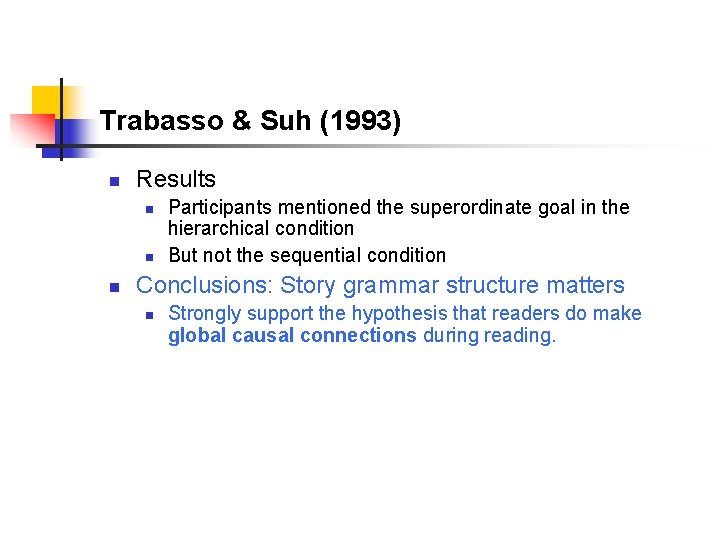
Trabasso & Suh (1993) n Results n n n Participants mentioned the superordinate goal in the hierarchical condition But not the sequential condition Conclusions: Story grammar structure matters n Strongly support the hypothesis that readers do make global causal connections during reading.
Discourse in memory n Brief summary from last time: n n Local structure n Discourse is coherent if its elements are easily related. n Coherence is achieved with cohesive ties between sentences. Global structure n Schemas are used to structure comprehension and memory n The discourse structures of different genres can impact comprehension and memory
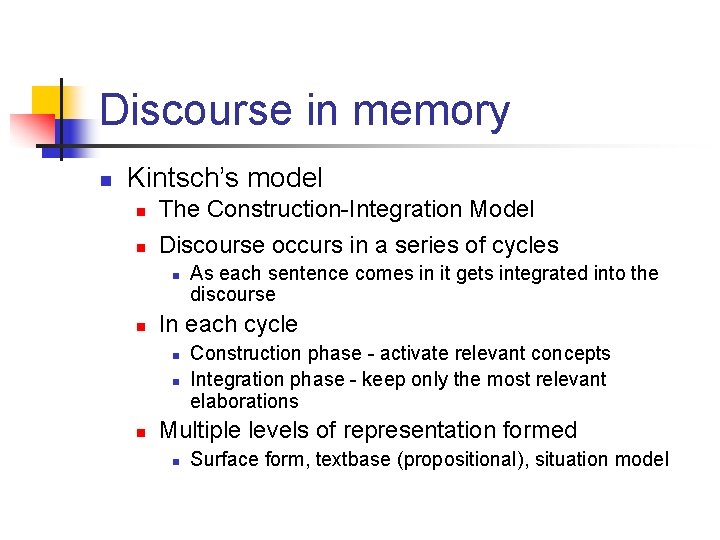
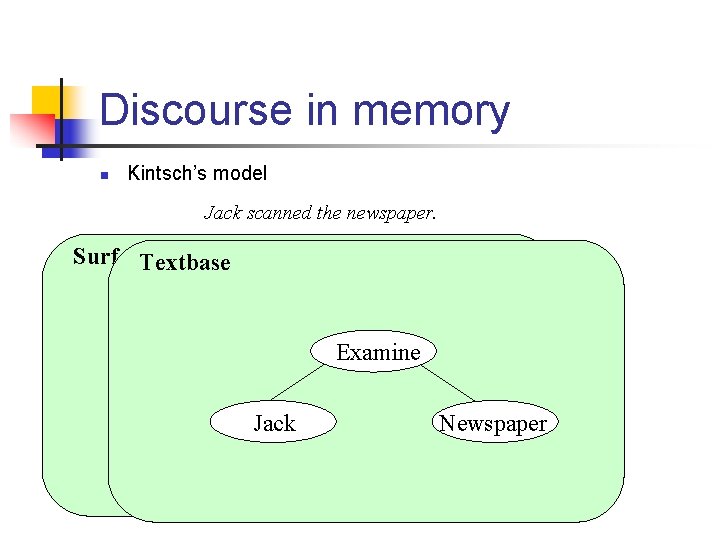
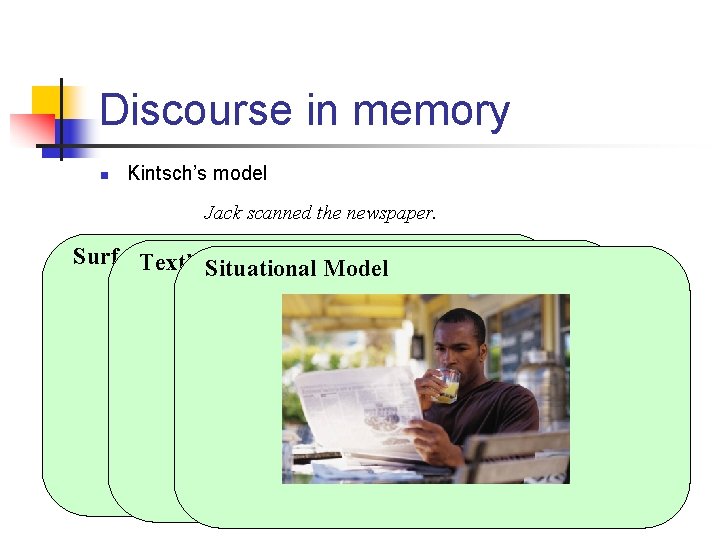
Discourse in memory n Kintsch’s model n n The Construction-Integration Model Discourse occurs in a series of cycles n n In each cycle n n n As each sentence comes in it gets integrated into the discourse Construction phase - activate relevant concepts Integration phase - keep only the most relevant elaborations Multiple levels of representation formed n Surface form, textbase (propositional), situation model
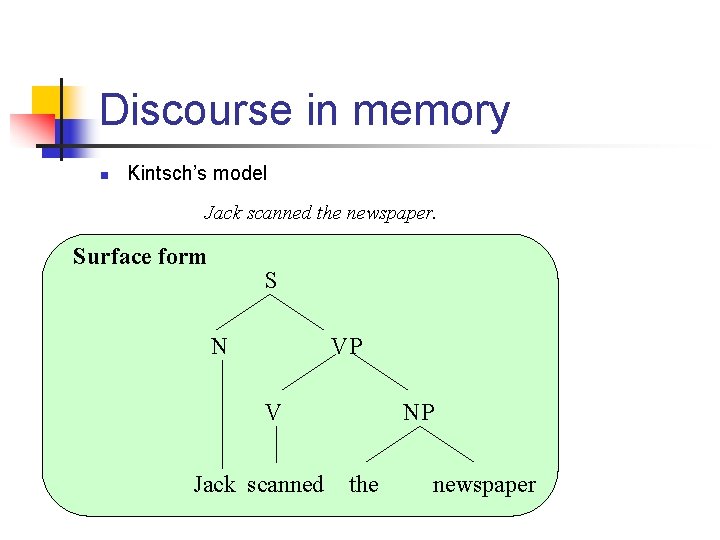
Discourse in memory n Kintsch’s model Jack scanned the newspaper. Surface form S N VP V Jack scanned NP the newspaper
Discourse in memory n Kintsch’s model Jack scanned the newspaper. Surface form Textbase S N VP Examine V Jack scanned NP Newspaper the newspaper
Discourse in memory n Kintsch’s model Jack scanned the newspaper. Surface form. Situational Model Textbase S N VP Examine V Jack scanned NP Newspaper the newspaper
Discourse in memory n Kintsch and colleagues (1990) It was Friday night and Jack and Melissa were bored, so they decided to catch a movie. Jack scanned the newspaper. He saw that they could just make the nine o’clock showing of the hot new romantic comedy. Off they went. n Did this sentence occur in the paragraph? Jack scanned the newspaper. Jack looked through the movie ads. Jack looked over some editorials.
Discourse in memory n Global structure summary: n n n Schemas are used to structure comprehension and memory Discourses have internal structures that impact comprehension and memory Evidence supports the psychological reality of a number of different representations n Propositions & propositional networks n Embodied representations n Inferences n Schemata and scripts n Situation models
Language comprehension n Multiple levels of representation involved n n n e. g. , sounds/letters, words, syntax, meaning, discourse Each level may have sets of rules for how the representations are connected Potential ambiguity at every level needs to be resolved n Related debates: Bottom-up vs. top-down, modular vs. interactive, serial vs. parallel
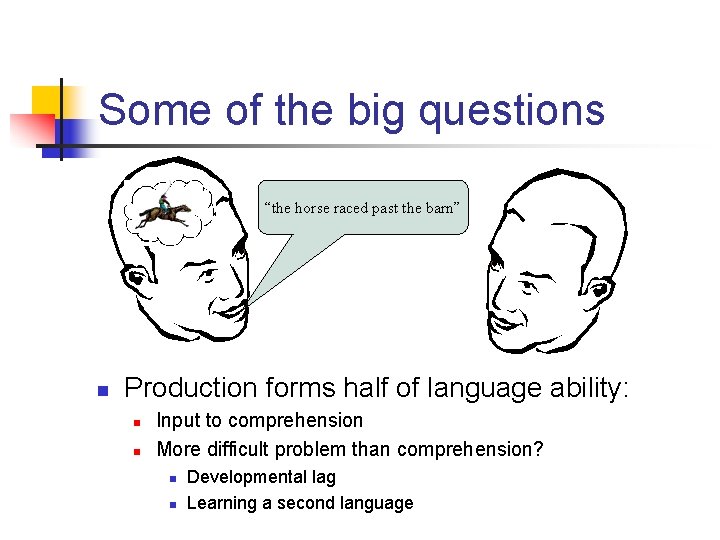
Some of the big questions “the horse raced past the barn” n Production forms half of language ability: n n Input to comprehension More difficult problem than comprehension? n n Developmental lag Learning a second language
What we don’t do Dr. C: How much money is there in my current account and in my deposit account? <SILENCE> Dr. C: Hello? <SILENCE> Computer: Colourless green ideas sleeeeeep furiously. Dr. C: How much money is there in my current account and in my deposit account? <SILENCE> Computer: Your current a-ccount encompasses two hundred dollars. I cannot access how. . <SILENCE>. . in your deposit account money much is there.
Undesirable features n n n Meaningless and irrelevant content. Long silences, strange pausing. Infelicities of vocabulary and structure: n n n ‘Your current account encompasses $200’ ‘I cannot access how in your deposit account money much is there. ’ Strange intonation and pronunciation: n n ‘Your current a-ccount’ ‘Sleeeeeep’
What we do do n Expressing non-ordered conceptual message via ordered array of sounds. n Start with a message (idea) and partition it, sequence it, and articulate it n Speakers must produce utterances with: n n Appropriate meaningful content, lexical items, syntax, & pronunciation, intonation, and phrasing. And they must do this fluently, in real time.
Getting the form right n Hearers: n n Details of form can sometimes (often? ) be ignored (e. g. missing words, not paying attention). Speakers: n Have to get every aspect of the form right, whether or not germane to message.
Getting the content wrong n Paradox: Adept at getting form right but content wrong: n Subject-verb agreement errors The report about the fires are very long n Less than 5% errors in experiment designed to elicit them (Bock & Miller 1991).
Getting the content wrong n Paradox: Adept at getting form right but content wrong: n Serious structural anomalies (unparseable) I cannot access how in your deposit account money much is there. n 0. 5% utterances (Deese 1984).
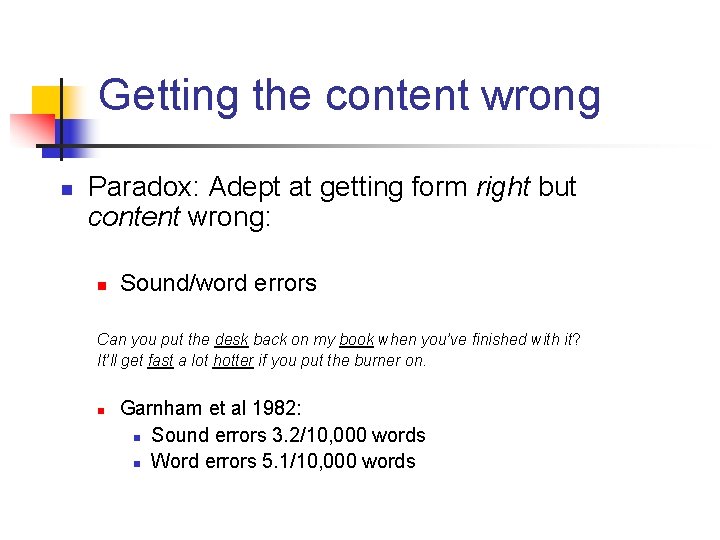
Getting the content wrong n Paradox: Adept at getting form right but content wrong: n Sound/word errors Can you put the desk back on my book when you’ve finished with it? It’ll get fast a lot hotter if you put the burner on. n Garnham et al 1982: n Sound errors 3. 2/10, 000 words n Word errors 5. 1/10, 000 words
Methodologies n Production is intrinsically more difficult subject to study than language comprehension n Not susceptible to experimental study? n n n Yes it is, but requires careful and clever methods Historically: observational methods Recently: experimental methods
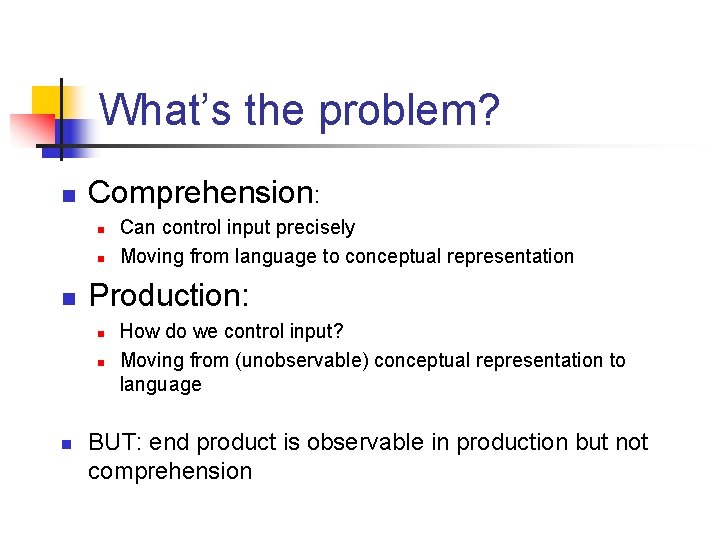
What’s the problem? n Comprehension: n n n Production: n n n Can control input precisely Moving from language to conceptual representation How do we control input? Moving from (unobservable) conceptual representation to language BUT: end product is observable in production but not comprehension
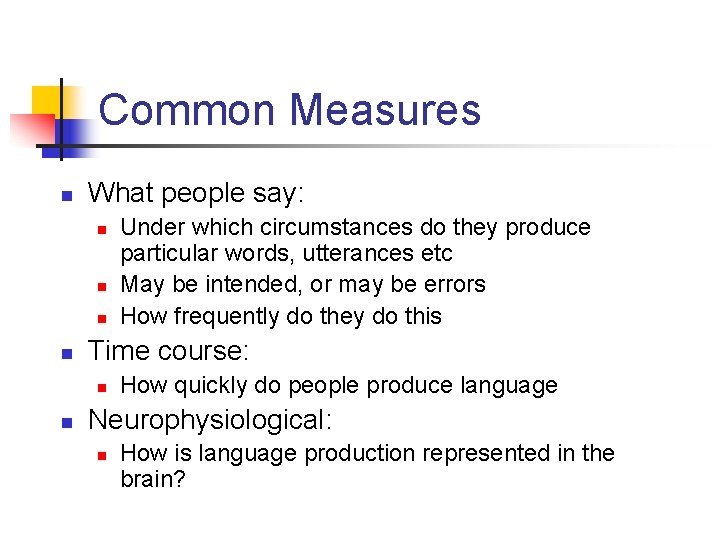
Common Measures n What people say: n n Time course: n n Under which circumstances do they produce particular words, utterances etc May be intended, or may be errors How frequently do they do this How quickly do people produce language Neurophysiological: n How is language production represented in the brain?
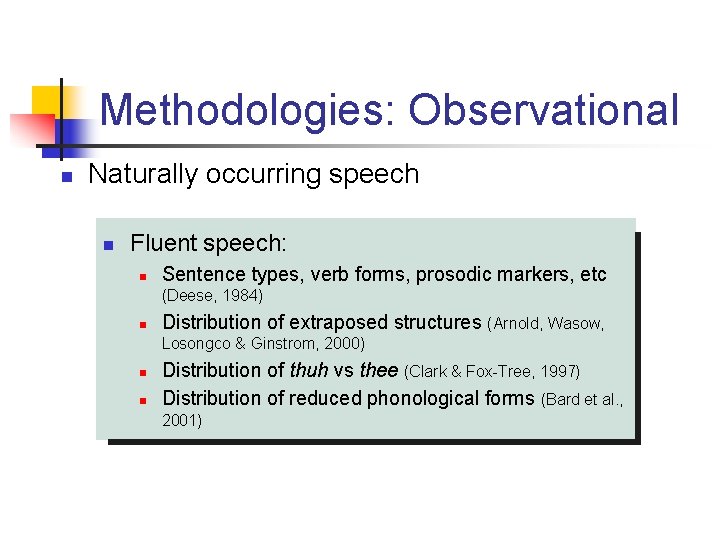
Methodologies: Observational n Naturally occurring speech n Fluent speech: n Sentence types, verb forms, prosodic markers, etc (Deese, 1984) n Distribution of extraposed structures (Arnold, Wasow, Losongco & Ginstrom, 2000) n n Distribution of thuh vs thee (Clark & Fox-Tree, 1997) Distribution of reduced phonological forms (Bard et al. , 2001)
Methodologies: Observational n Naturally occurring speech n Disfluent speech: n Scope of utterance planning (Ford & Holmes, 1978; Beattie, 1983) n Error detection and correction (Levelt, 1983)
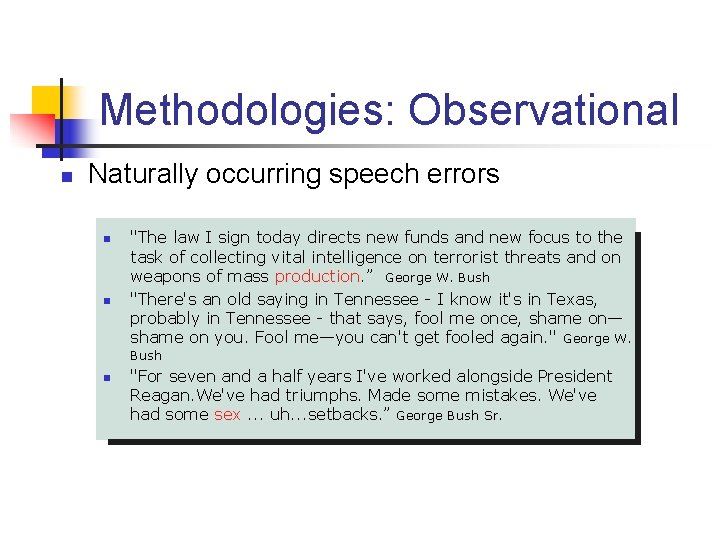
Methodologies: Observational n Naturally occurring speech errors n n "The law I sign today directs new funds and new focus to the task of collecting vital intelligence on terrorist threats and on weapons of mass production. ” George W. Bush "There's an old saying in Tennessee - I know it's in Texas, probably in Tennessee - that says, fool me once, shame on— shame on you. Fool me—you can't get fooled again. " George W. Bush n "For seven and a half years I've worked alongside President Reagan. We've had triumphs. Made some mistakes. We've had some sex. . . uh. . . setbacks. ” George Bush Sr.
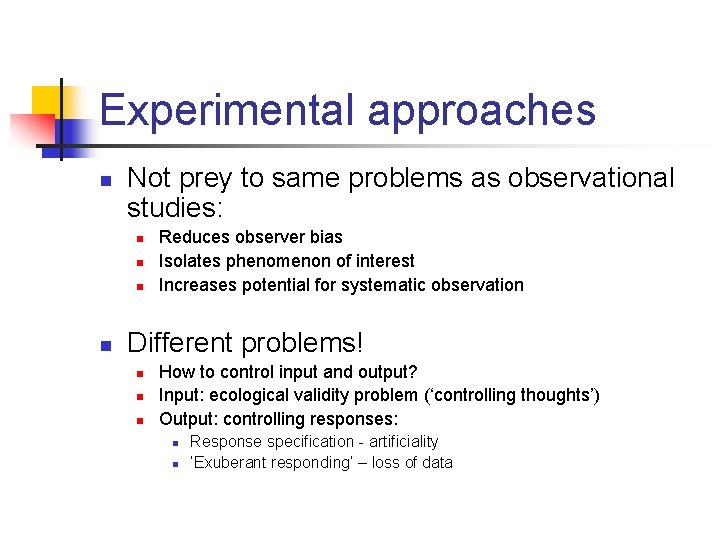
Experimental approaches n Not prey to same problems as observational studies: n n Reduces observer bias Isolates phenomenon of interest Increases potential for systematic observation Different problems! n n n How to control input and output? Input: ecological validity problem (‘controlling thoughts’) Output: controlling responses: n n Response specification - artificiality ‘Exuberant responding’ – loss of data
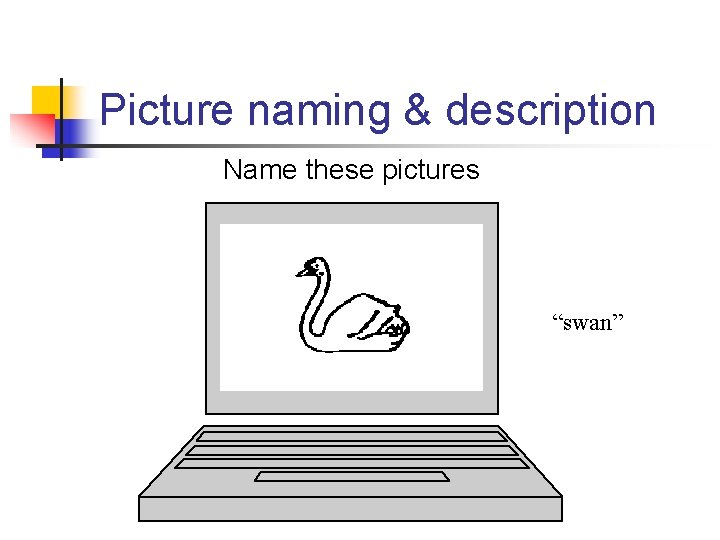
Picture naming & description Name these pictures “swan”
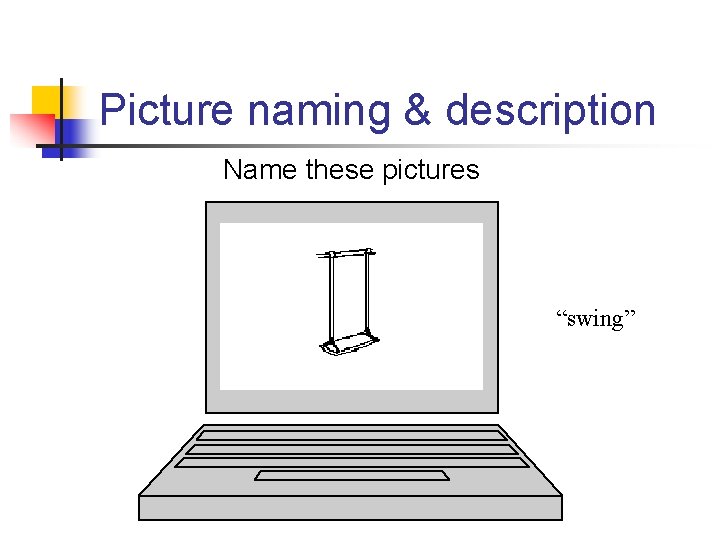
Picture naming & description Name these pictures “swing”
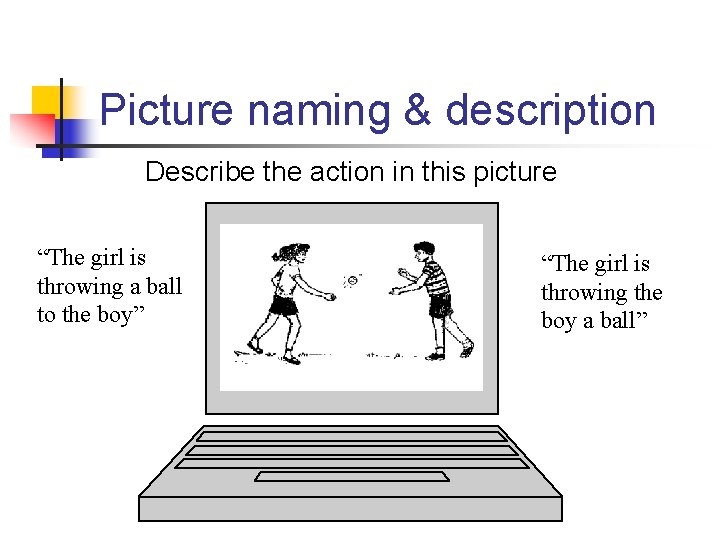
Picture naming & description Describe the action in this picture “The girl is throwing a ball to the boy” “The girl is throwing the boy a ball”
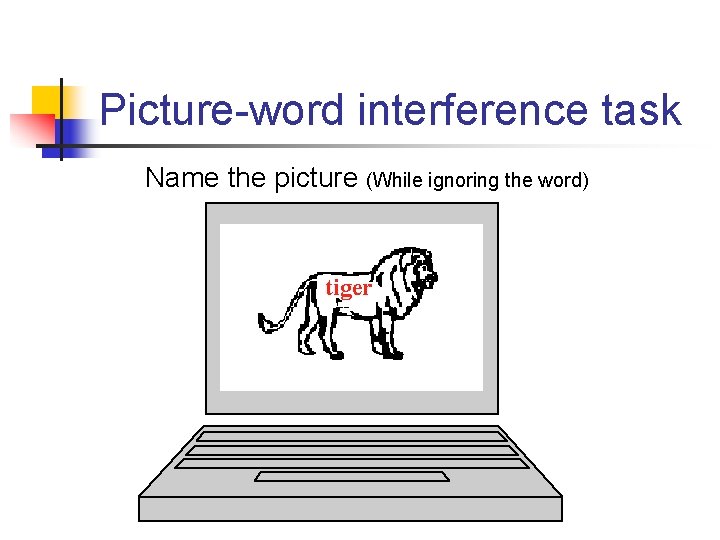
Picture-word interference task Name the picture (While ignoring the word) tiger
Neurophysiological Measures n Recent technological developments allow research on neurophysiological aspects of production. n n ERPs, f. MRI, PET, Which areas of the brain are involved? What is the time course of processing? Are different areas/processes/timecourses associated with different aspects of production?
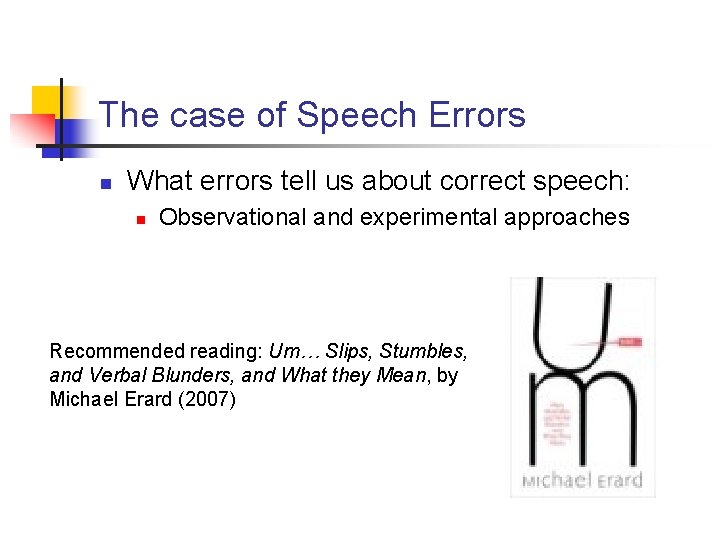
The case of Speech Errors n What errors tell us about correct speech: n Observational and experimental approaches Recommended reading: Um… Slips, Stumbles, and Verbal Blunders, and What they Mean, by Michael Erard (2007)
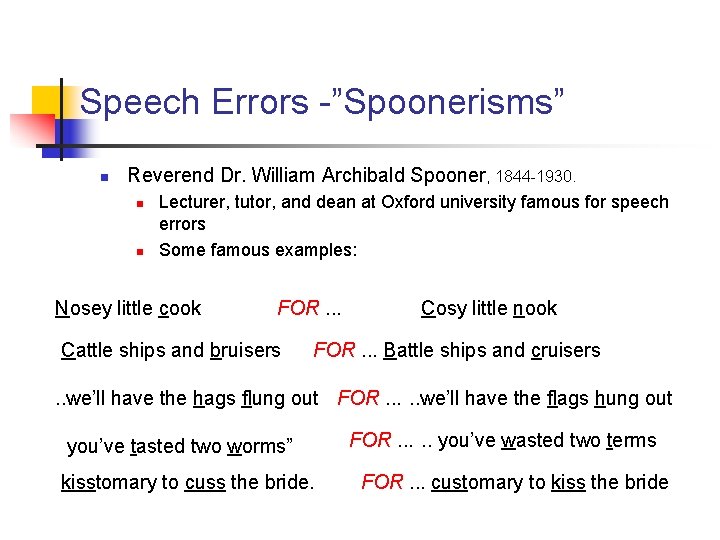
Speech Errors -”Spoonerisms” n Reverend Dr. William Archibald Spooner, 1844 -1930. n n Lecturer, tutor, and dean at Oxford university famous for speech errors Some famous examples: Nosey little cook FOR. . . Cattle ships and bruisers Cosy little nook FOR. . . Battle ships and cruisers . . we’ll have the hags flung out FOR. . . we’ll have the flags hung out you’ve tasted two worms” kisstomary to cuss the bride. FOR. . . you’ve wasted two terms FOR. . . customary to kiss the bride
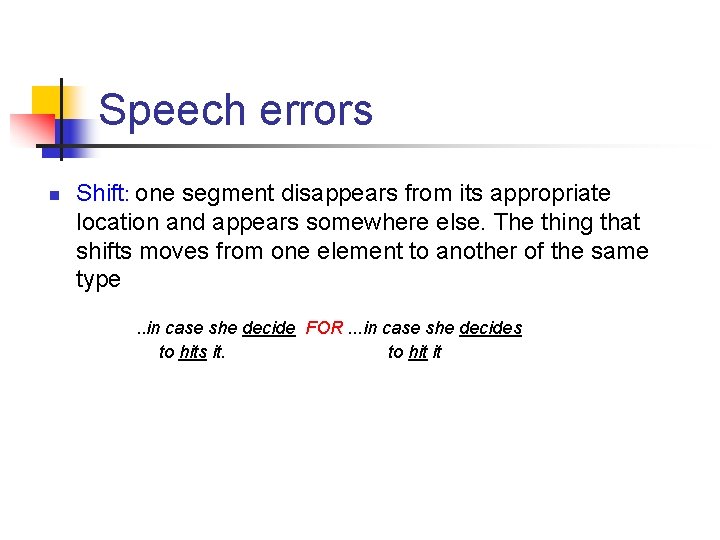
Speech errors n Shift: one segment disappears from its appropriate location and appears somewhere else. The thing that shifts moves from one element to another of the same type. . in case she decide FOR. . . in case she decides to hits it. to hit it
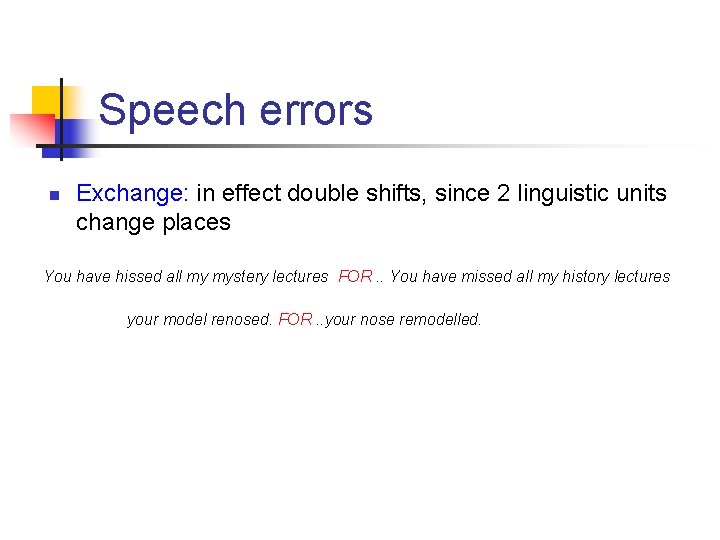
Speech errors n Exchange: in effect double shifts, since 2 linguistic units change places You have hissed all my mystery lectures FOR. . You have missed all my history lectures your model renosed. FOR. . your nose remodelled.
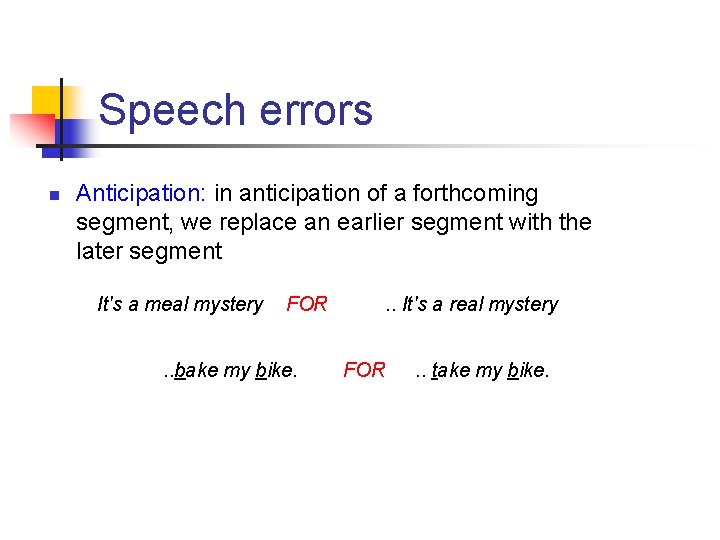
Speech errors n Anticipation: in anticipation of a forthcoming segment, we replace an earlier segment with the later segment It's a meal mystery FOR . . bake my bike. . . It's a real mystery FOR . . take my bike.
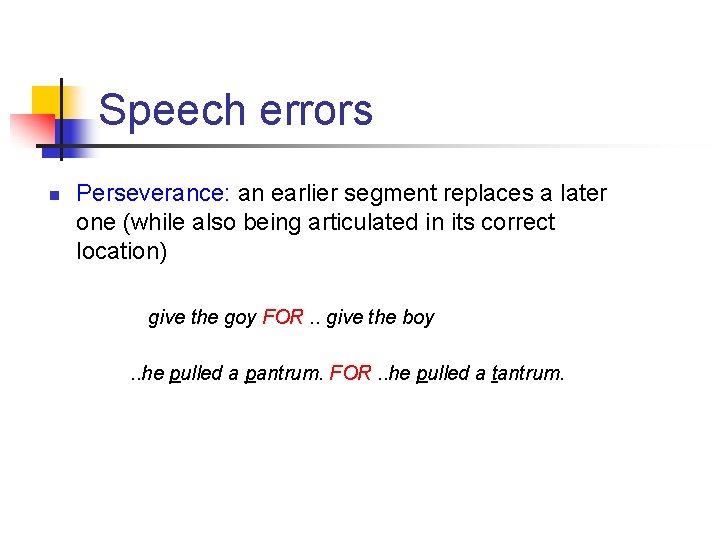
Speech errors n Perseverance: an earlier segment replaces a later one (while also being articulated in its correct location) give the goy FOR. . give the boy. . he pulled a pantrum. FOR. . he pulled a tantrum.
Speech errors n Addition: something is added to the target utterance I didn’t explain it clarefully enough FOR I didn’t explain it carefully enough.
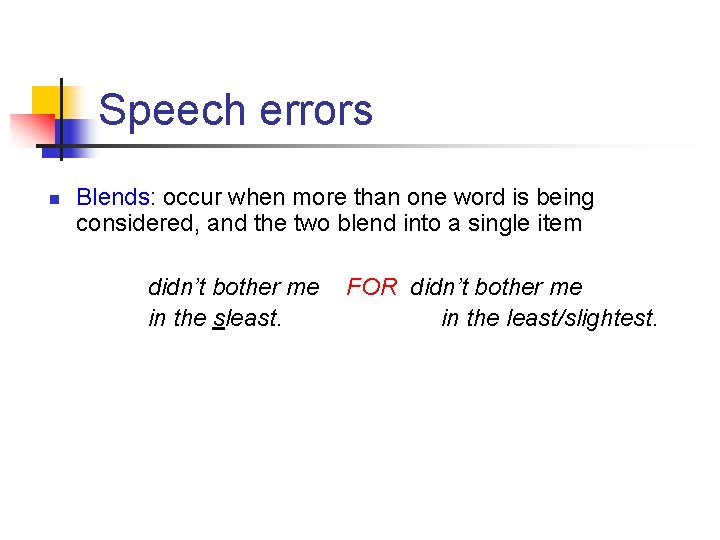
Speech errors n Blends: occur when more than one word is being considered, and the two blend into a single item didn’t bother me in the sleast. FOR didn’t bother me in the least/slightest.
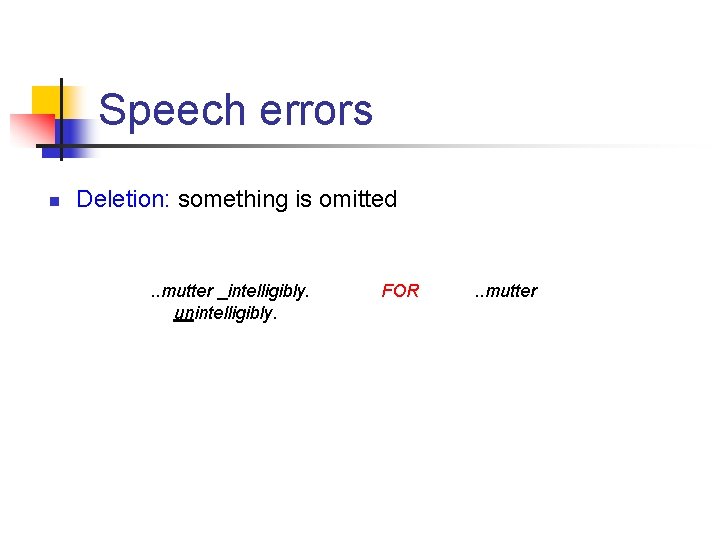
Speech errors n Deletion: something is omitted . . mutter intelligibly. unintelligibly. FOR . . mutter
Speech errors n Substitutions (malapropisms): when one segment is replaced by an intruder, but this differs from the other types of errors since the intruder may not occur at all in the intended sentence “Jack” is the president of the sentence. I’m stuttering psycholinguistics. FOR “Jack” is the subject of the sentence. FOR I’m studying psycholinguistics.
Speech error regularities n What can we learn from speech errors? n Look for regularities in the patterns of errors
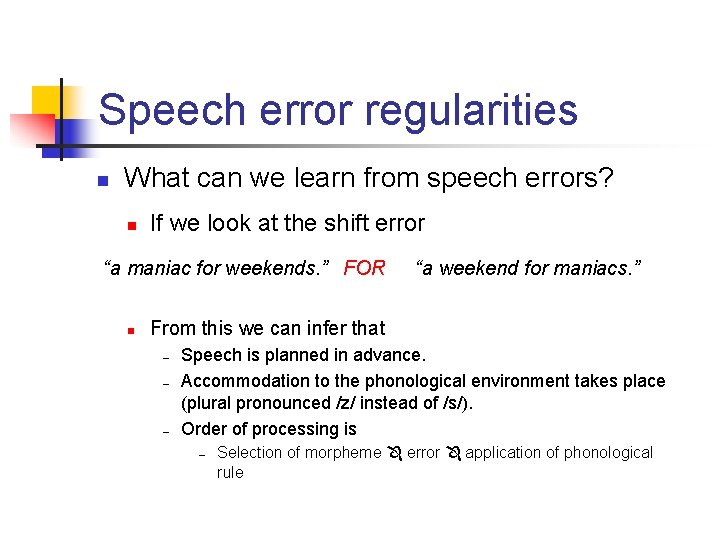
Speech error regularities n What can we learn from speech errors? n If we look at the shift error “a maniac for weekends. ” FOR n “a weekend for maniacs. ” From this we can infer that – – – Speech is planned in advance. Accommodation to the phonological environment takes place (plural pronounced /z/ instead of /s/). Order of processing is – Selection of morpheme error application of phonological rule
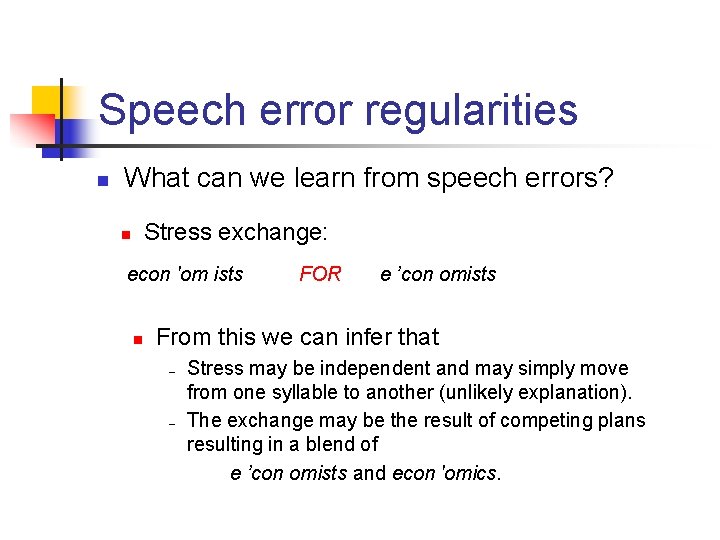
Speech error regularities n What can we learn from speech errors? Stress exchange: n econ 'om ists n FOR e ’con omists From this we can infer that – – Stress may be independent and may simply move from one syllable to another (unlikely explanation). The exchange may be the result of competing plans resulting in a blend of e ’con omists and econ 'omics.
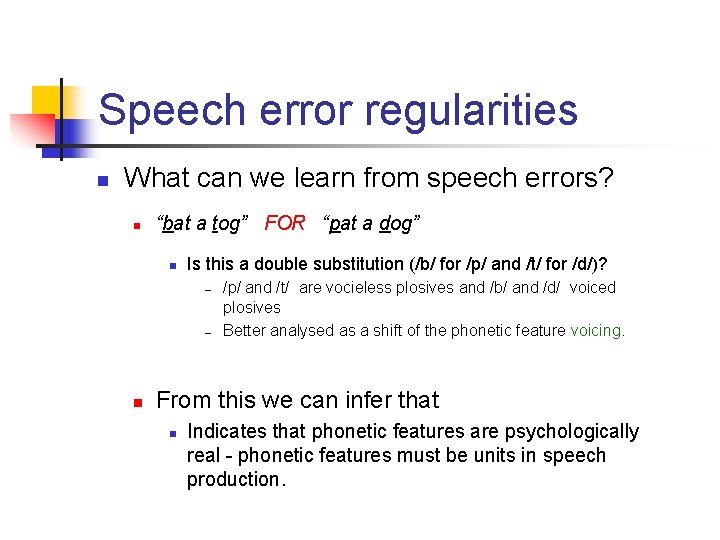
Speech error regularities n What can we learn from speech errors? n “bat a tog” FOR “pat a dog” n Is this a double substitution (/b/ for /p/ and /t/ for /d/)? – – n /p/ and /t/ are vocieless plosives and /b/ and /d/ voiced plosives Better analysed as a shift of the phonetic feature voicing. From this we can infer that n Indicates that phonetic features are psychologically real - phonetic features must be units in speech production.
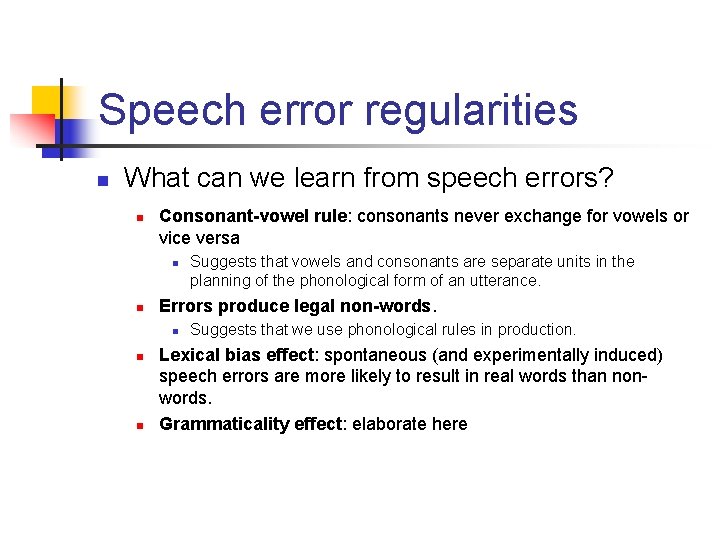
Speech error regularities n What can we learn from speech errors? n Consonant-vowel rule: consonants never exchange for vowels or vice versa n n Errors produce legal non-words. n n n Suggests that vowels and consonants are separate units in the planning of the phonological form of an utterance. Suggests that we use phonological rules in production. Lexical bias effect: spontaneous (and experimentally induced) speech errors are more likely to result in real words than nonwords. Grammaticality effect: elaborate here
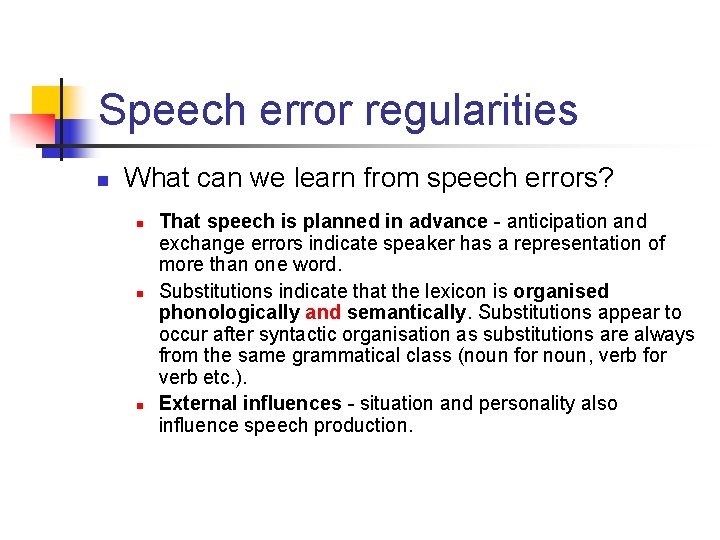
Speech error regularities n What can we learn from speech errors? n n n That speech is planned in advance - anticipation and exchange errors indicate speaker has a representation of more than one word. Substitutions indicate that the lexicon is organised phonologically and semantically. Substitutions appear to occur after syntactic organisation as substitutions are always from the same grammatical class (noun for noun, verb for verb etc. ). External influences - situation and personality also influence speech production.