Protection UQ Explain the protection mechanism of X

- Slides: 14
Protection UQ: Explain the protection mechanism of X 86 Intel family microprocessor(10 Marks)
Protection • The Intel 386 DX has four levels of protection which isolate and protect user programs from each other and the operating system. • The privilege levels control the use of – privileged instructions – I/O instructions – access to segments and segment descriptors.
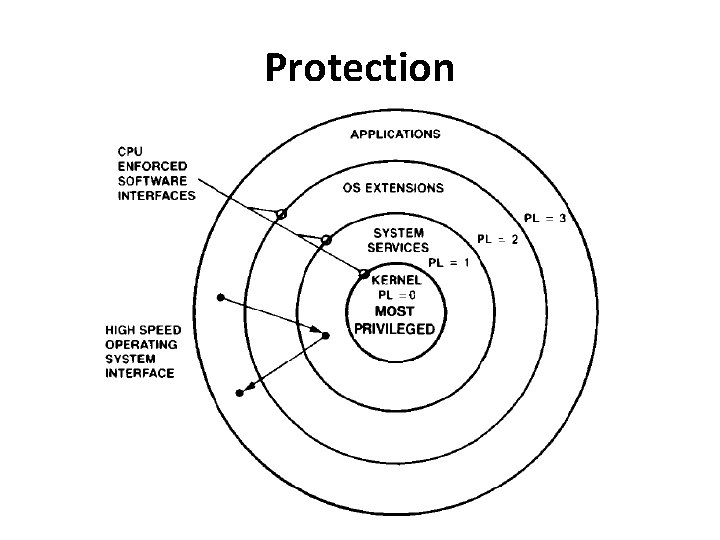
Protection • Intel 386 DX provides protection as part of its Memory Management Unit. • It offers an additional type of protection on a page basis, when paging is enabled(using U/S and R/W fields) • The four-level hierarchical privilege system is illustrated as follows:
Protection
Protection • The privilege levels (PL) are numbered 0 through 3. • Level 0 is the most privileged or trusted level.
Rules for Privileges • Intel 386 Dx controls access to both data and procedures according to the following rules: – Data stored in a segment with privilege level p can be accessed only by the code executing at a privilege level atleast as privileged as p – A code segment/procedure with a privilege level p can only be called by a task executing at the same or lesser privilege level than p
Privilege Levels
Current Privilege Level(CPL) • Also called Task Privilege Level • It specifies privilege level of currently executing task • A task’s CPL can only be changed by control transfers through gate descriptors to a code segment with a different privilege level. • E. g. an application program running at PL = 3 may call an OS routine at PL = 1 (via a gate) which would cause the task's CPL to be set to 1 until the OS routine is finished.
Current Privilege Level(CPL) • Normally, CPL = DPL of the segment that the processor is currently executing. • CPL changes as control is transferred to segments with differing DPLs.
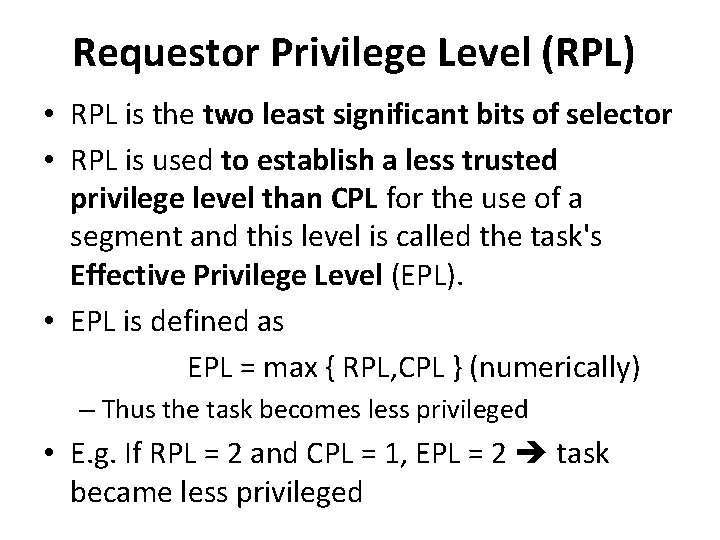
Requestor Privilege Level (RPL) • RPL is the two least significant bits of selector • RPL is used to establish a less trusted privilege level than CPL for the use of a segment and this level is called the task's Effective Privilege Level (EPL). • EPL is defined as EPL = max { RPL, CPL } (numerically) – Thus the task becomes less privileged • E. g. If RPL = 2 and CPL = 1, EPL = 2 task became less privileged
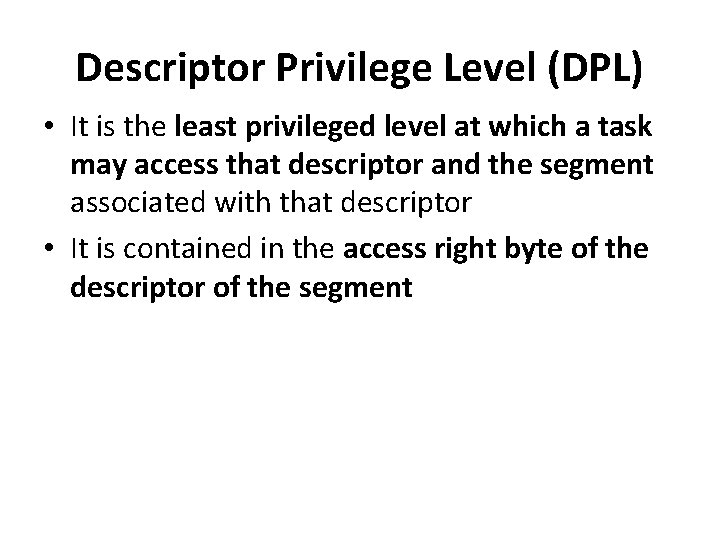
Descriptor Privilege Level (DPL) • It is the least privileged level at which a task may access that descriptor and the segment associated with that descriptor • It is contained in the access right byte of the descriptor of the segment
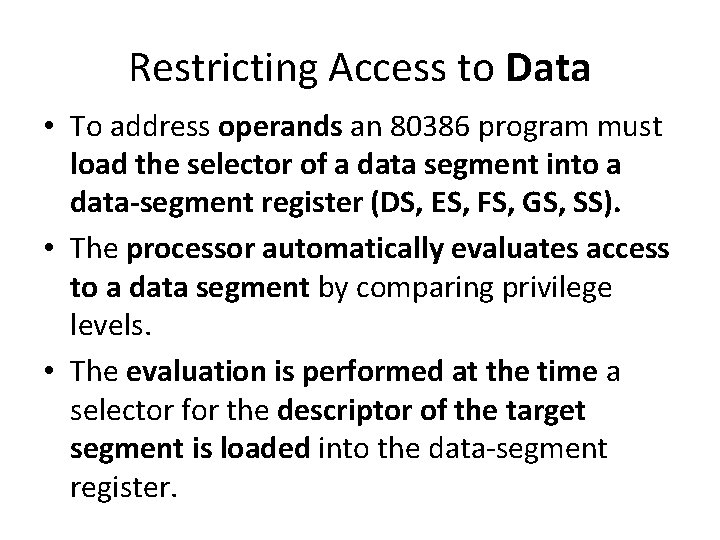
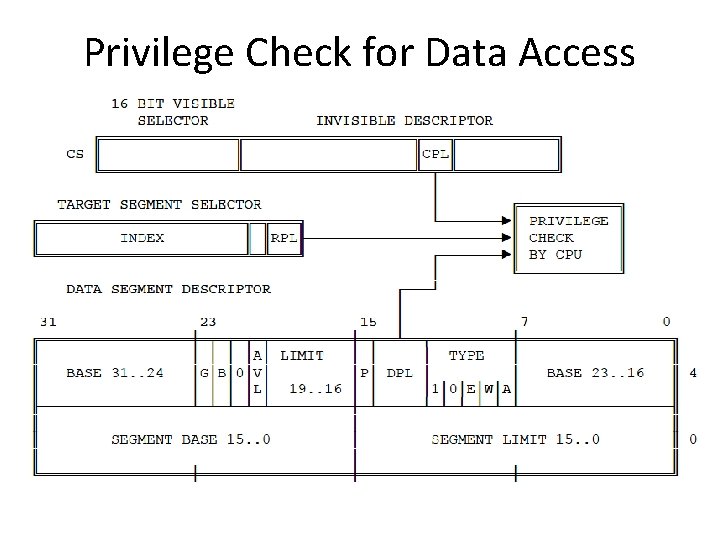
Restricting Access to Data • To address operands an 80386 program must load the selector of a data segment into a data-segment register (DS, ES, FS, GS, SS). • The processor automatically evaluates access to a data segment by comparing privilege levels. • The evaluation is performed at the time a selector for the descriptor of the target segment is loaded into the data-segment register.
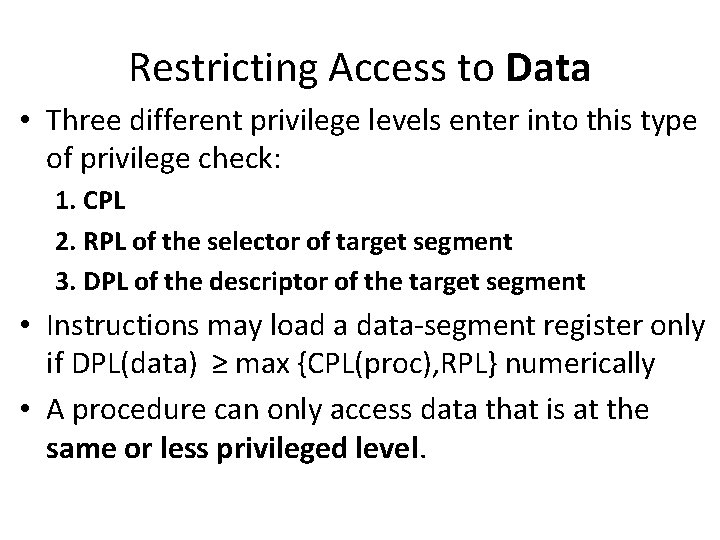
Restricting Access to Data • Three different privilege levels enter into this type of privilege check: 1. CPL 2. RPL of the selector of target segment 3. DPL of the descriptor of the target segment • Instructions may load a data-segment register only if DPL(data) ≥ max {CPL(proc), RPL} numerically • A procedure can only access data that is at the same or less privileged level.
Privilege Check for Data Access