Project Management CAPM Program Instructor L Drew Rosen



- Slides: 42
Project Management CAPM Program Instructor: L. Drew Rosen, Ph. D. , JONAH
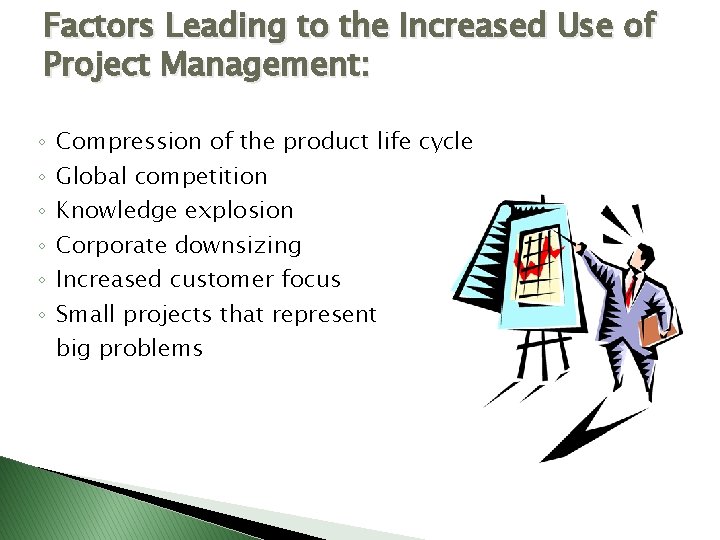
Factors Leading to the Increased Use of Project Management: ◦ ◦ ◦ Compression of the product life cycle Global competition Knowledge explosion Corporate downsizing Increased customer focus Small projects that represent big problems
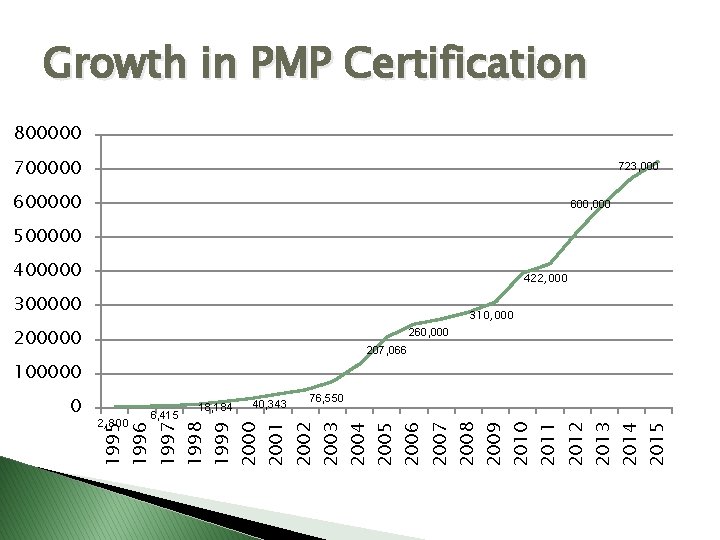
Growth in PMP Certification 800000 723, 000 600, 000 500000 422, 000 300000 310, 000 200000 260, 000 207, 066 100000 2015 2014 2013 2012 2011 2010 2009 2008 2007 2006 2005 2004 2003 2002 2001 2000 1998 1996 1999 6, 415 76, 550 40, 343 18, 184 1997 2, 800 1995 0
What is a project?
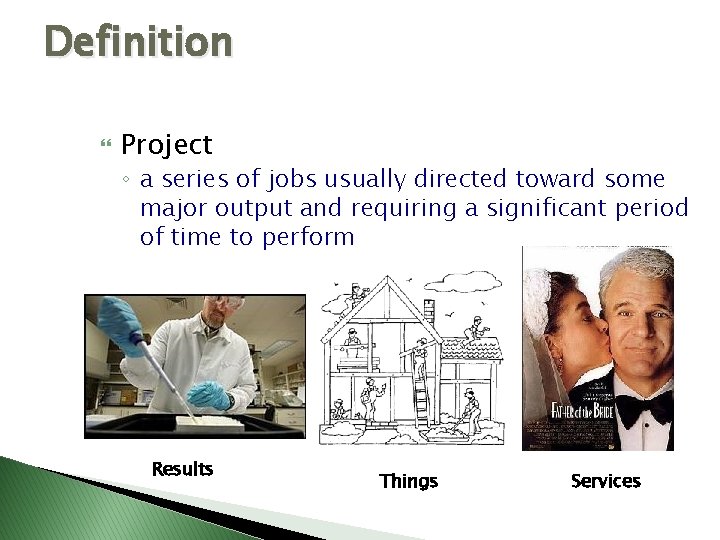
Definition Project ◦ a series of jobs usually directed toward some major output and requiring a significant period of time to perform Results Things Services
PMI Definition “A temporary endeavor undertaken to create a unique product or service” Project Management Institute, 2012
Why the emphasis on project management? Many tasks do not fit neatly into business-asusual. Need to assign responsibility and authority for achievement of organizational goals. Need to succeed and prosper!
Characteristics of Projects Unique Specific Deliverable Specific Due Date
Other Common Characteristics of Projects Multidisciplinary Conflict Complex Part of Programs
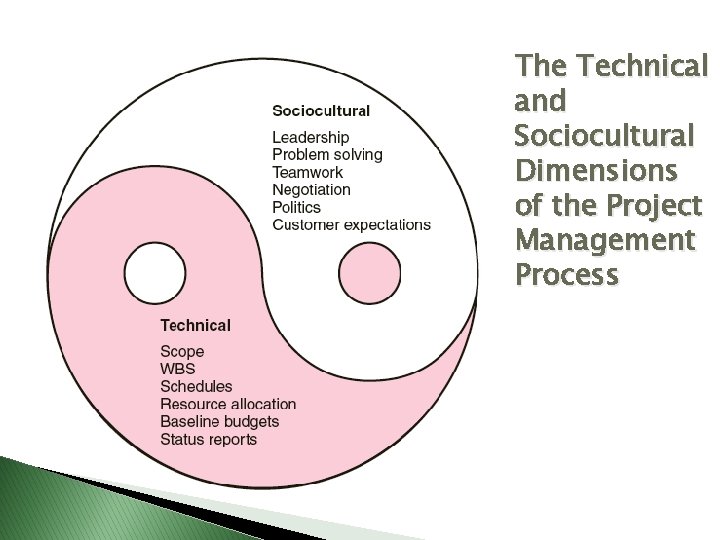
The Technical and Sociocultural Dimensions of the Project Management Process
PROGRAM MANAGEMENT VS PROJECT MANAGEMENT VS. OPERATIONS MANAGEMENT
Programs versus Projects Program Defined ◦ A series of coordinated, related, multiple projects that continue over an extended time and are intended to achieve a goal. ◦ A higher-level group of projects targeted at a common goal. ◦ Example: Project: completion of a required course in project management. Program: completion of all courses required for a business major.
Why Some Projects Fail……… Five Reasons for Failure 1. Lack of Project Manager Authority “I must be a mushroom. They keep me in the dark, feed me manure, and then they can me. ” 2. Lack of team participation “If workers were smart, they’d be managers. Why ask them anything? After all, I’m the boss. ” 3. Bad reporting “Reports are just useless paperwork and an irrelevant management requirement. I fill out the form and then forget the form. ”
Why Some Projects Fail……… Continued 4. Lack of people skills “I don’t thank people just for doing a good job. Doing a good job is what they get paid for. ” 5. Unrealistic goals and schedules “Your mission, should you decide to accept it…if caught or killed, the Secretary will disavow any knowledge…”
…. . and Others Succeed Three Reasons for Success 1. Committed teamwork “If anything goes bad, I did it. If anything goes semi-good, then we did it. If anything goes real good, then you did it. That’s all it takes to get people to win football games. ” – Paul “Bear” Bryant 2. SMART Goals With Real Consensus “Specific, Measurable, Agreed-Upon, Realistic, and Time-Specific. ” 3. Use of project management tools as a means, not an end. “We have 562 pages of charts and graphs and still don’t have a clue!”
Business Failures The construction industry is the largest single employer of the country’s work force, it makes a major contribution to the gross national product, and yet suffers one of the highest annual business failure rates in the country. Studies have shown that the number of failures in the construction industry is much higher than it should be. The reason for the high failure rate is not because owners of companies do not have the technical skills required for construction but because owners have not developed adequate business management skills or techniques. --- in particular; communication skills!
Most business failures occur within the first three years of operation with the major reason being a lack of planning. Some of the other reasons which lead to business failure are: • Insufficient working capital • Failure to qualify for loans • Loss of owner or key person • Excessive growth • Borrowing money from relatives and friends • Company officers taking a too large of a salary • Purchase or lease of expensive vehicles as status symbols • Not keeping adequate accounting records • Poor project estimating as a result of: a. not knowing the cost of material b. under estimating labor costs c. not understanding overhead or general conditions d. inadequate profit margins • Too many projects starting at the same time
WHAT IS MANAGED? THE THREE GOALS OF A PROJECT
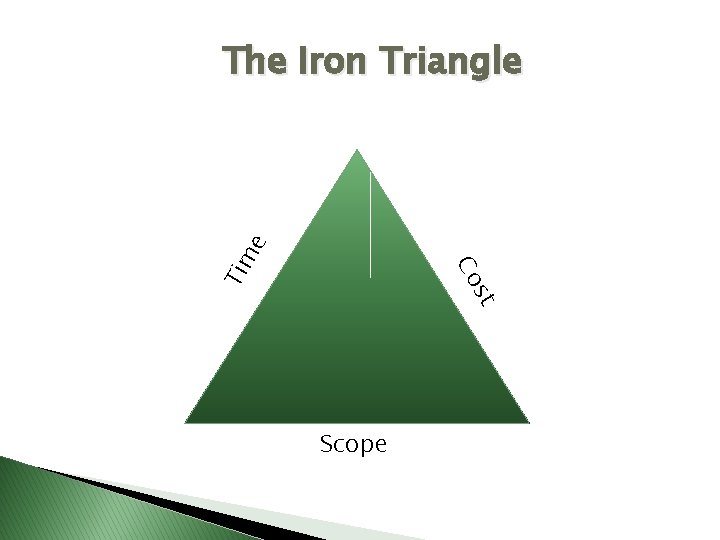
Co Tim e The Iron Triangle st Scope
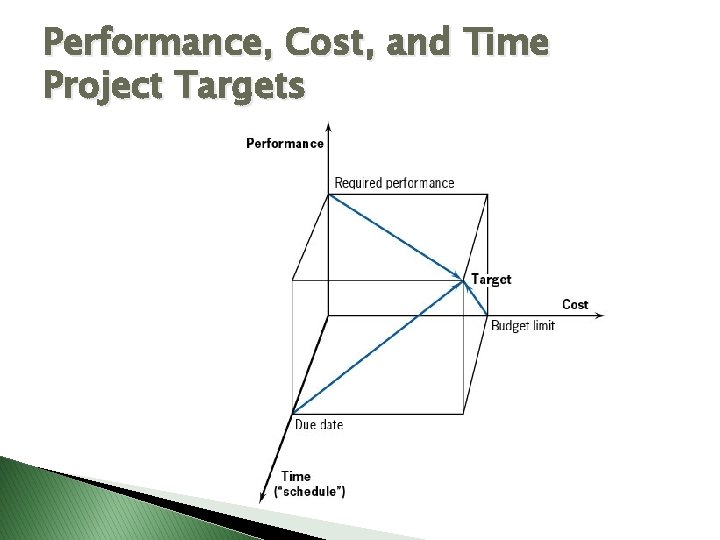
Performance, Cost, and Time Project Targets
Determinants of Project Success
The Quadruple Constraint
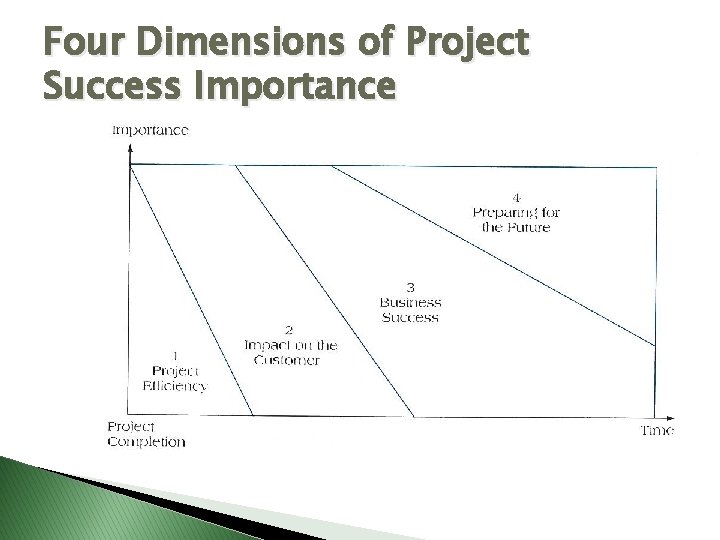
Four Dimensions of Project Success Importance
To Put A Man On The Moon The year 1962 “We commit this nation to put a man on the moon and return him safely to this earth by the end of this decade, and to do the other things, not because they are easy but because they are hard. ” The triple constraint project has begun.
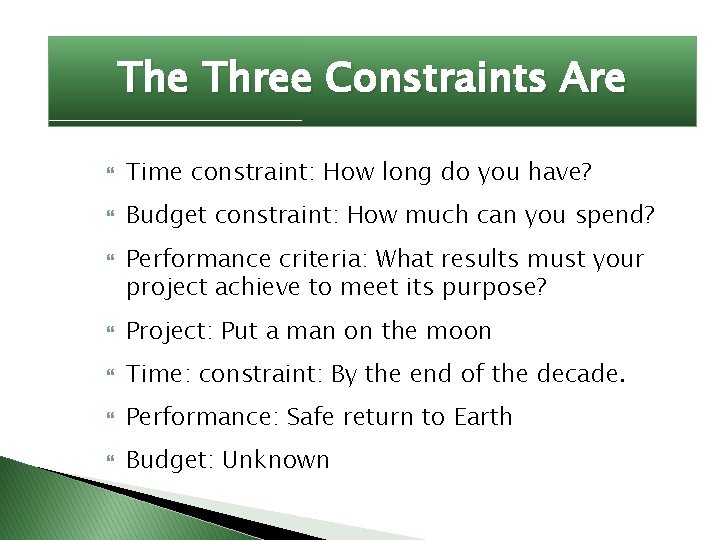
The Three Constraints Are Time constraint: How long do you have? Budget constraint: How much can you spend? Performance criteria: What results must your project achieve to meet its purpose? Project: Put a man on the moon Time: constraint: By the end of the decade. Performance: Safe return to Earth Budget: Unknown
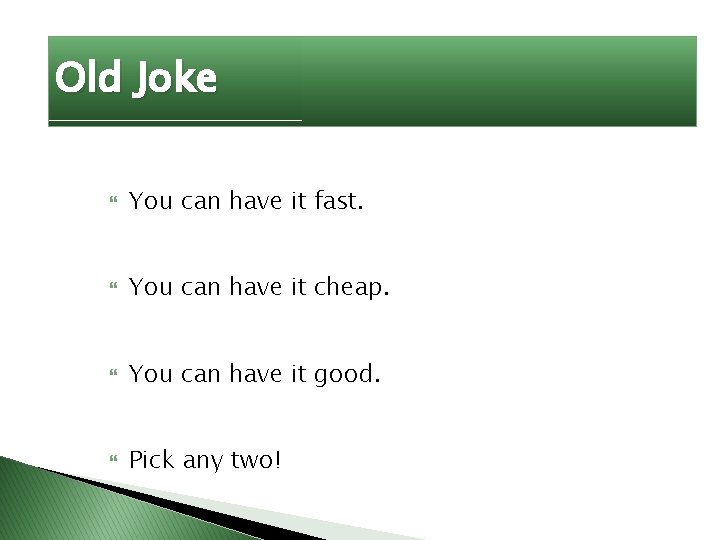
Old Joke You can have it fast. You can have it cheap. You can have it good. Pick any two!
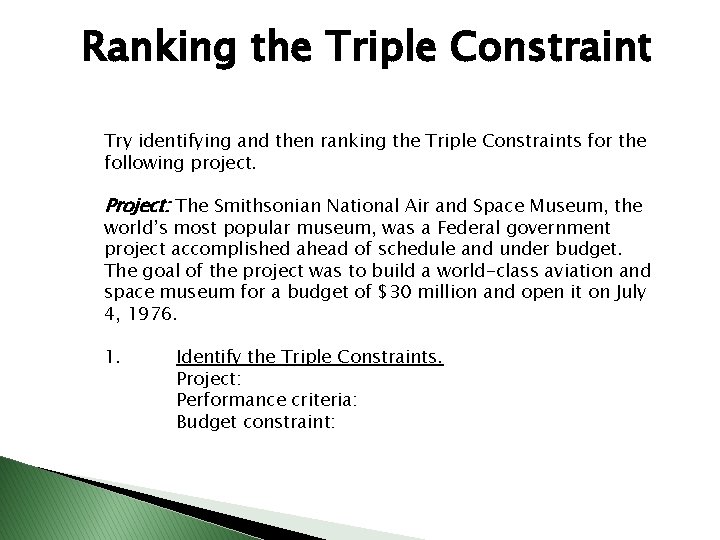
Ranking the Triple Constraint Try identifying and then ranking the Triple Constraints for the following project. Project: The Smithsonian National Air and Space Museum, the world’s most popular museum, was a Federal government project accomplished ahead of schedule and under budget. The goal of the project was to build a world-class aviation and space museum for a budget of $30 million and open it on July 4, 1976. 1. Identify the Triple Constraints. Project: Performance criteria: Budget constraint:
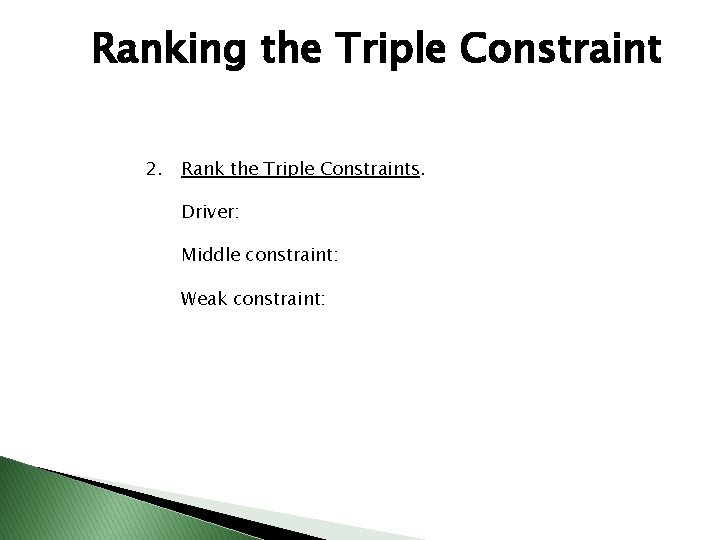
Ranking the Triple Constraint 2. Rank the Triple Constraints. Driver: Middle constraint: Weak constraint:
THE LIFE CYCLES OF PROJECTS
Important Life Cycle Questions � What work will be completed in each phase of the project? � What resources, people, equipment and facilities will be needed within each phase? � What are the expected deliverables of each phase? � What is the expected cost to complete a project phase? � Which phases contain the highest amount of risk?
The Project Life Cycle
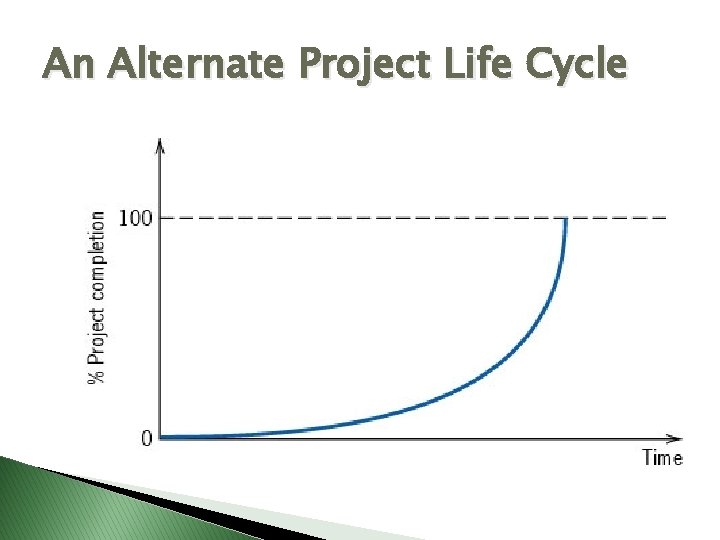
An Alternate Project Life Cycle
THE PM’S ROLES Communicator Facilitator Negotiator Scheduler Risk Manager Etc.
PM’s First Job Understand the expectations that the organization has for the project. Identify who among senior managers has a major interest in the project. Determine if anything about the project is atypical.
Stakeholders � Mystery ◦ ? � Key Stakeholders Project Stakeholders -Project Manager -Project Customer -Performing organization -Project Team -Project Management Team -Project Sponsor -Influencers -The Project Management Office
Stakeholders Influence on the Project Political capital leverage ◦ To change the project deliverable Change requests ◦ To alter the project deliverable Scope addendums ◦ To add to the project deliverable Sabotage
Skill Requirements for Effective Project Management � Conflict Resolution � Creativity � Ability � Good and Flexibility to Adjust to Change Planning � Negotiation ◦ win-win versus win-lose
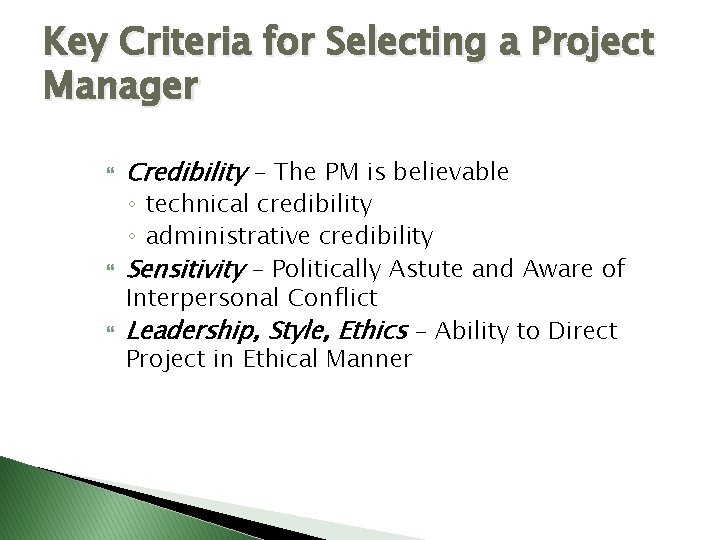
Key Criteria for Selecting a Project Manager Credibility - The PM is believable ◦ technical credibility ◦ administrative credibility Sensitivity - Politically Astute and Aware of Leadership, Style, Ethics - Ability to Direct Interpersonal Conflict Project in Ethical Manner
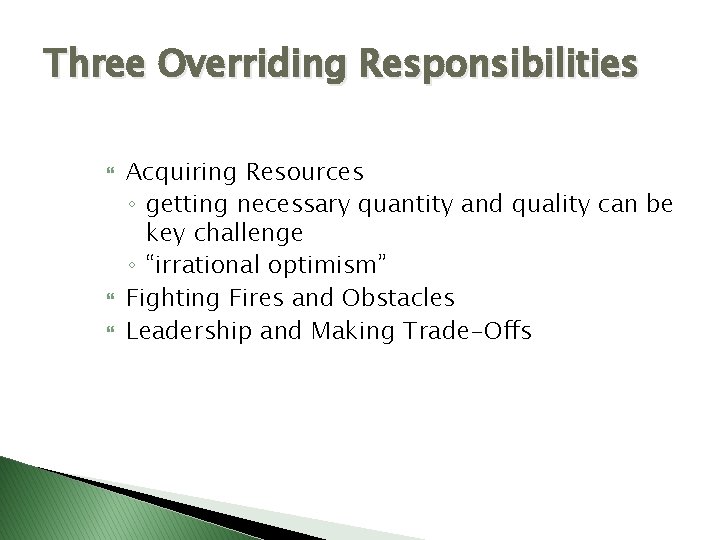
Three Overriding Responsibilities Acquiring Resources ◦ getting necessary quantity and quality can be key challenge ◦ “irrational optimism” Fighting Fires and Obstacles Leadership and Making Trade-Offs
Negotiation, Conflict Resolution, and Persuasion Necessary to meet three/four overriding responsibilities
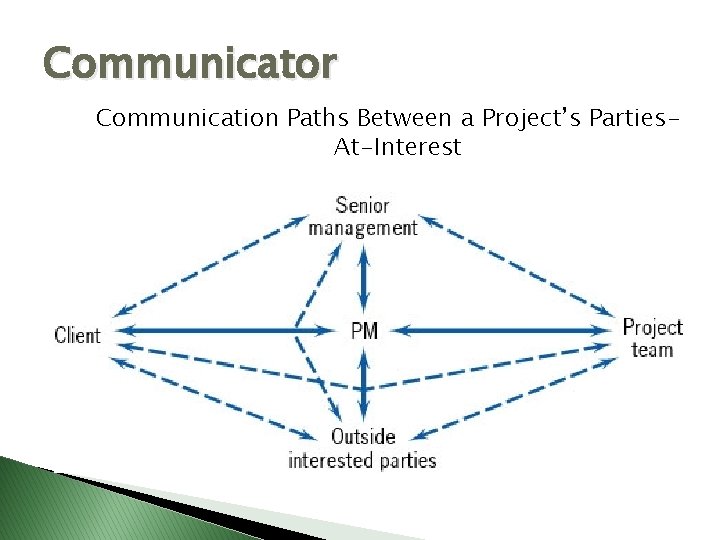
Communicator Communication Paths Between a Project’s Parties. At-Interest