
CAPITAL ASSET PRICING MODEL DR Manish Dadhich CAPM

- Slides: 12
CAPITAL ASSET PRICING MODEL DR. Manish Dadhich
CAPM A model that describes the relationship between risk and expected return and that is used in the pricing of risky securities. � The model was introduced by Jack Treynor, William Sharpe, John Lintner and Jan Mossin independently, building on the earlier work of Harry Markowitz on diversification and modern portfolio theory � The general idea behind CAPM is that investors need to be compensated in two ways: time value of money and risk �
ASSUMPTIONS Can lend and borrow unlimited amounts under the risk free rate of interest � Individuals seek to maximize the expected utility of their portfolios over a single period planning horizon. � Assume all information is available at the same time to all investors � � The market is perfect: there are no taxes; there are no transaction costs; securities are completely divisible; the market is competitive. The quantity of risky securities in the market is given.
IMPLICATIONS AND RELEVANCE OF CAPM � Investors will always combine a risk free asset with a market portfolio of risky assets. Investors will invest in risky assets in proportion to their market value. . � Investors can expect returns from their investment according to the risk. This implies a liner relationship between the asset’s expected return and its beta. � Investors will be compensated only for that risk which they cannot diversify. This is the market related (systematic) risk
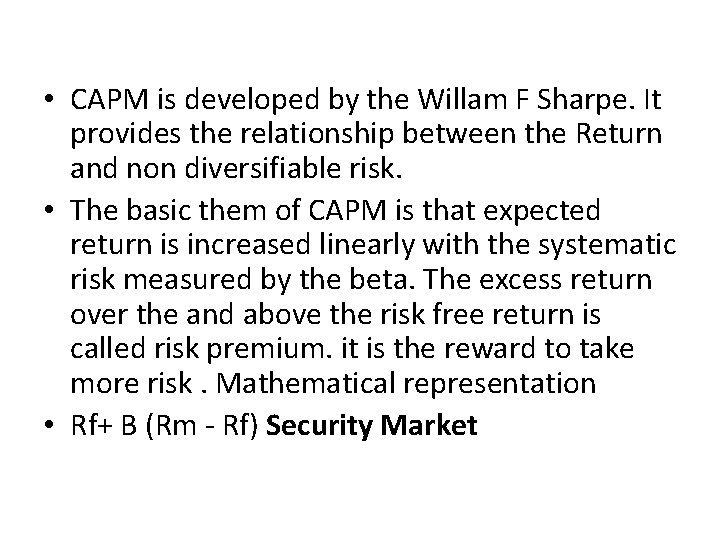
• CAPM is developed by the Willam F Sharpe. It provides the relationship between the Return and non diversifiable risk. • The basic them of CAPM is that expected return is increased linearly with the systematic risk measured by the beta. The excess return over the and above the risk free return is called risk premium. it is the reward to take more risk. Mathematical representation • Rf+ B (Rm - Rf) Security Market
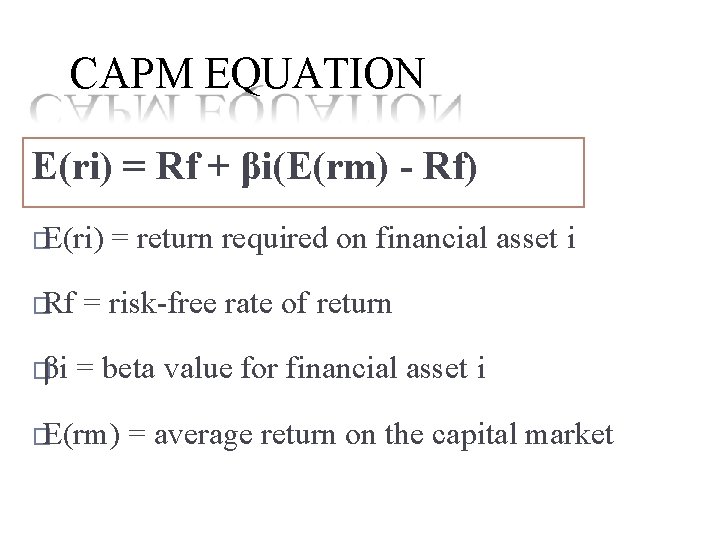
CAPM EQUATION E(ri) = Rf + βi(E(rm) - Rf) �E(ri) = return required on financial asset i �Rf = risk-free rate of return �βi = beta value for financial asset i �E(rm) = average return on the capital market
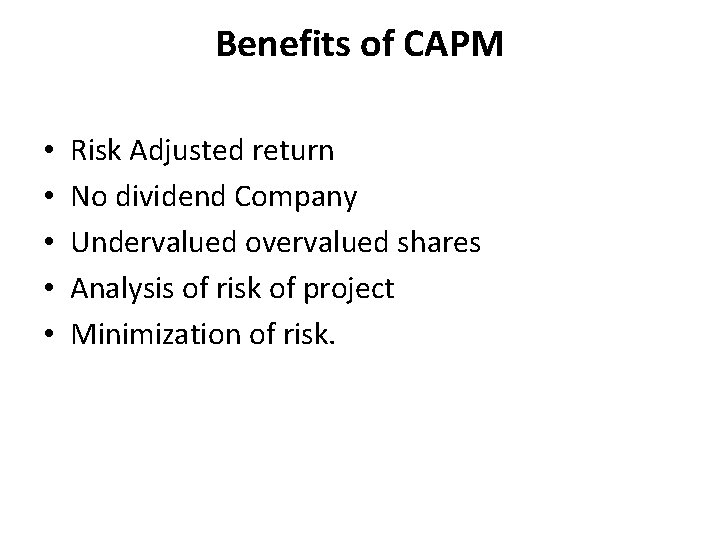
Benefits of CAPM • • • Risk Adjusted return No dividend Company Undervalued overvalued shares Analysis of risk of project Minimization of risk.
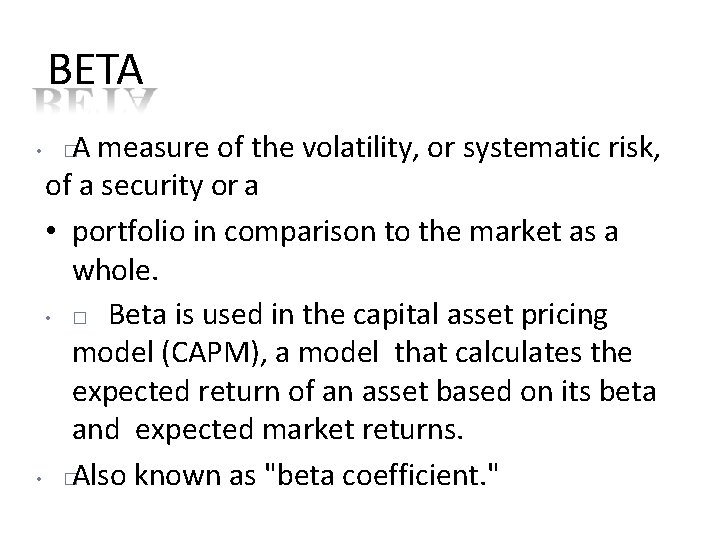
BETA A measure of the volatility, or systematic risk, of a security or a • portfolio in comparison to the market as a whole. • � Beta is used in the capital asset pricing model (CAPM), a model that calculates the expected return of an asset based on its beta and expected market returns. • �Also known as "beta coefficient. " • �
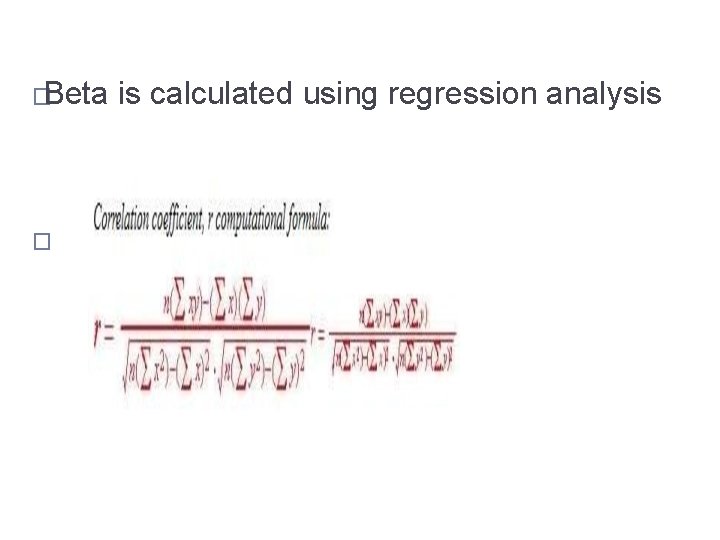
�Beta � is calculated using regression analysis
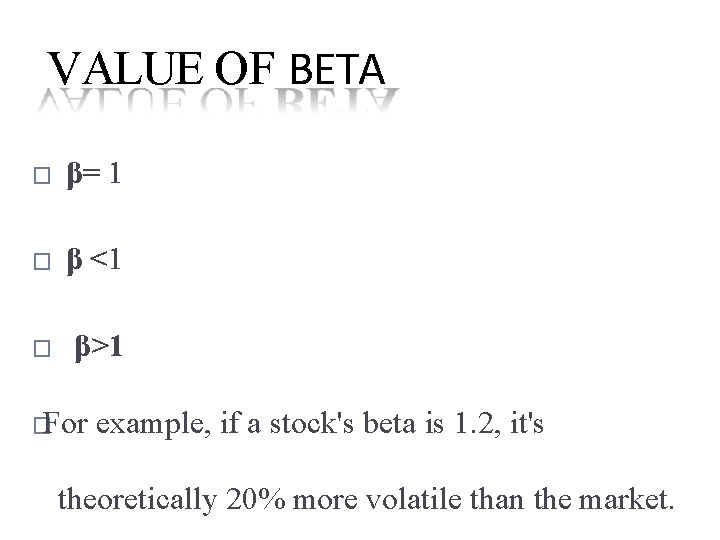
VALUE OF BETA � β= 1 � β <1 � β>1 �For example, if a stock's beta is 1. 2, it's theoretically 20% more volatile than the market.
Limitations CAPM has the following limitations: �It is based on unrealistic assumptions. �It is difficult to test the validity of CAPM. �Betas do not remain stable over time.
CONCLUSION Research has shown the CAPM to stand up well to criticism, although attacks against it have been increasing in recent years. Until something better presents itself, however, the CAPM remains a very useful item in the financial management tool